Worst-case Delay Analysis of Time-Triggered 802.15.4 for Wireless Industrial Environments
Hyun-Hee Kim1, Kyung-Chang Lee1*
<Abstract>
This paper focuses on worst-case delay analysis of the time-triggered IEEE 802.15.4 protocol to satisfy the industrial quality-of-service (QoS) performance. The IEEE 802.15.4 protocol is considered to be unsuitable for industrial networks because its medium access control method is contention-based CSMA/CA, which exhibits unstable performance with an unbounded delay distribution under heavy traffic. To avoid these limitations, this paper presents a time-triggered version of the nonbeacon-enabled network of IEEE 802.15.4 that relies on a time division multiplexing access (TDMA) method implemented in the application layer without any modification of specification.
The timing analysis of this time-triggered IEEE 802.15.4 was executed, and the worst-case transmission delay was calculated. Based on this analysis, the time-triggered IEEE 802.15.4 is a promising alternative for wireless industrial networking.
Keywords : IEEE 802.15.4, Worst-case Delay, Quality-of-Service, Time Division Multiplexing Access
1* Member, Corresponding Author, Department of Control and Instrumentation Engineering, Pukyong National University
(E-mail: [email protected])
1. Introduction
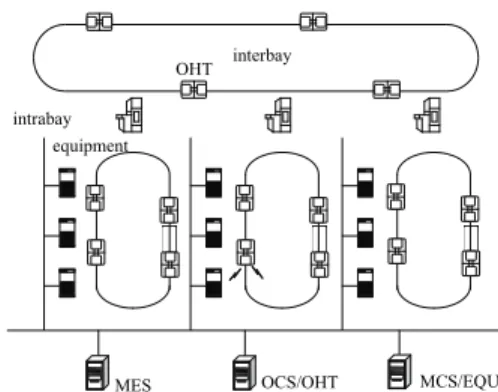
A growing need exists for mobile devices in automated material handling systems, including mobile robots, automated guided vehicles (AGVs), and overhead hoist transfers (OHTs). These mobile devices are essential components in moving materials or parts freely to improve the productivity of automated systems. One example of such a system is the 300-mm wafer system shown in Fig. 1 in which several OHTs are used to transport wafers to various locations in the system [1][2]. For the system to operate efficiently, many control functions are required, including functions for task allocation, collision avoidance, and motion control. These control functions require various types of information such as the locations of individual OHTs from the distributed sensor or bar code system along the rail, job order information calculated by material control systems (MCSs) and job-scheduling systems, and reports from OHTs and process equipment regarding the status of a task. Therefore, a need exists to exchange information among the various subsystems such as MCSs, OHTs, process equipment, and sensor systems. In general, various wire-based protocols such as DeviceNet or Ethernet are used for data exchange among stationary systems such as sensor systems and MCSs. Mobile systems like OHTs, however, are connected via wireless communication using radio-frequency modems.
OCS/OHT MCS/EQU
MES equipment
OHT interbay intrabay
Fig. 1 Example of an OHT system for 300-mm wafer production.
Although IEEE 802.15.4 is an alternative protocol for wireless industrial networking, its performance is unstable, and its delay is unbounded under heavy traffic because its medium access control (MAC) is based on the contention-based carrier sensing multiple access with collision avoidance (CSMA/CA) scheme. To overcome the limitations in the protocol, several researches about the beacon-enabled network of IEEE 802.15.4 for industrial environments have already been reported [3]-[7]. However, there are not many publications that can satisfy the industrial quality-of-service (QoS) performance due to inherent limitations of the beacon- enabled network. Here, the industrial QoS denotes that a frame is transmitted successfully within the allowable transmission time, that is, the pre-specified deadline, in a reliable fashion [8]. Recently, a new trial for obtaining the constant delay time using a time division multiplexing access (TDMA) scheme in the
nonbeacon-enabled network was announced, but its time delay was higher than the conventional IEEE 802.15.4 [9].
In order to guarantee the industrial QoS performance for cyclically generated messages that can be found in network-based control systems [10], this paper presents a time-triggered version of the nonbeacon- enabled network of IEEE 802.15.4 that uses a TDMA method implemented in the application layer without any modification of specification. Especially, to satisfy the industrial QoS performance in the time- triggered IEEE 802.15.4, frame retry and acknowledgement frame are eliminated. In general, the industrial network has a pair of frames such as cyclically transmitted request frame and response frame. For example, we can see that a remote plant node sends sensor data to a controller and wants to receive control data from the same controller node per a sampling time in the networked control system. Hence, it is better to transmit a response frame instead of an acknowledgement frame for reducing network traffic, and to send a new frame instead of trying to send old ones repeatedly when a frame is in error.
The remainder of this paper is organized as follows. Section 2 gives a brief overview of IEEE 802.15.4. And Section 3 presents a schematic architecture and the worst-case transmission delay of the time-triggered IEEE 802.15.4. Finally, a summary and conclusions are presented in Section 4.
2. Overview of IEEE 802.15.4
The IEEE 802.15.4 standard [11] defines the physical layer and the MAC sublayer for low-rate wireless personal area networks (LR-WPANs), and focuses on low-cost, low-speed, and low-power operation for a ubiquitous sensor network. The IEEE 802.15.4 defines two types of network configuration.
The star network requires at least one full-function device (FFD) that can serve as the coordinator of a personal area network (PAN). Networks are formed by groups of devices separated by suitable distances. Each device has a unique 64-bit identifier, but a short 16-bit identifier can be used within each PAN domain. The peer-to-peer network can form an arbitrary pattern of connections, and its extent is limited only by the distance between each pair of nodes. In addition to the one FFD, each PAN has other reduced-function devices (RFDs), which only communicate with the FFD and can never act as a coordinator. Since the standard does not define a network layer, an additional layer is necessary for routing [12][13].
The IEEE 802.15.4 protocol uses two types of channel access mechanisms depending on the network configuration. The nonbeacon- enabled network uses an unslotted CSMA-CA channel access mechanism. When a device wishes to transmit data frames, it waits for a random backoff time. If the channel is idle after that initial wait, the device can transmit its data frame. Otherwise, if the channel is
busy, the device waits for another random backoff time before trying to access the channel again. Acknowledgment frames are sent without using the CSMA-CA mechanism.
The beacon-enabled network uses an optional slotted CSMA-CA channel access mechanism. This permits the optional use of a superframe consisting of 16 equal-length time slots, which can be divided into the contention access period (CAP) and the contention free period (CFP). When a device wishes to transmit data frames during the CAP, it should locate the boundary of the next backoff slot and then wait for a random number of backoff slot times. If the channel is busy after this waiting period, the device should wait for another random number of backoff slot times. If the channel is idle, the device can begin transmitting on the next available backoff slot boundary.
However, two modes have several shortcomings for satisfying the industrial QoS performance due to their inherent problems.
The nonbeacon-enabled network has unbounded delay under heavy traffic because its MAC is based on the contention-based CSMA/CA scheme. The beacon-enabled network has more shortcomings. Firstly, the data exchange is not very efficient because the device has no pre-allocated time slot and competes for acquiring time slots using GTS request frame.
Second, the network utilization is very low when we use CFP because CFP can use only seven slots among twelve available slots. This implies that the network utilization is fewer
than 50%. Besides, if the traffic is high, most of time slots are used for CAP, not for CFP.
Hence, the nonbeacon-enabled network is more applicable than the beacon-enabled network when its several problems are eliminated [8].
3. Architecture of time-triggered IEEE 802.15.4
Since the MAC of IEEE 802.15.4 is contention-based CSMA/CA, the probability of a collision increases and the transmission time may grow rapidly as network traffic increases. In particular, since a node waits for a random initial backoff time in the IEEE 802.15.4 network, the transmission time is not constant even if a collision has not occurred under low traffic conditions.
Therefore, to apply the IEEE 802.15.4 to real-time industrial networking, we must avoid frame collisions and transmit without waiting the initial backoff time. To reduce this uncertainty in IEEE 802.15.4, we present a time-triggered architecture using a time division multiplexing access method that is implemented in the application layer.
Figure 2 shows the schematic diagram of the time-triggered architecture that eliminates frame collisions and reduces the uncertainty in the conventional IEEE 802.15.4. In this time-triggered IEEE 802.15.4, one FFD, which serves as the coordinator, and the other FFDs are connected to a PAN. The coordinator
controls the transmission sequence of the FFDs in a cycle with a scheduling list. The cycle consists of several time slots that are defined as sufficient time for the transmission of one message, and the scheduling list contains a group of short 16-bit identifiers that are scheduled according to the FFD transmission sequence. To control communications, the coordinator broadcasts a sync frame, which is implemented by writing control information into the first byte of the data payload of data frame; this control information contains the transmission sequence for each FFD.
When a FFD receives the sync frame, it waits until its allocated time slot and then begins transmitting a data frame on the time slot
boundary. If a station has no data to send, it skips its time slot. After finishing the communications of all FFDs, the coordinator waits for an inter-period space to prevent collisions between data frames and the next sync frame. Using this algorithm, all collisions among stations can be avoided, and each FFD can handle periodic real-time traffic.
In addition, two key functions are added to the time-triggered architecture to satisfy the industrial QoS of IEEE 802.15.4. First, macMinBE is set to 0 to guarantee a constant transmission time. In the conventional IEEE 802.15.4, macMinBE is used for initial collision avoidance. Because the initial backoff time of each FFD can be a different
sync
data 1 data 2 data n
coordinator
FFD
time slot
cycle
inter-period space (IPS)
…….
header control identifier 1
identifier
…. n trailer header control data payload trailer
sync message data message
Fig. 2 Schematic diagram of the time-triggered IEEE 802.15.4
Fig. 3 Theoretical worst-case transmission time of the time-triggered IEEE 802.15.4
random value with a default of 3, it is possible to avoid collisions among nodes with different values. However, because collisions are perfectly eliminated by the time division multiplexing access method in the time-triggered architecture, one can eliminate the transmission time fluctuation by setting macMinBE = 0.
Second, the acknowledgment frame is eliminated to minimize network traffic. In the conventional architecture, an acknowledgment frame is used for confirming successful transmission of data frame. If a transmitter does not receive an acknowledgment frame, it assumes that a collision has occurred and transmits the data frame again after waiting for a random backoff time. However, because collisions do not occur in the time division multiplexing access method, reducing any unnecessary transmission time is more important by removing the acknowledgment frame. Especially, it is allowed to eliminate acknowledgment frame because the industrial network has a pair of frames such as request frame and response frame.
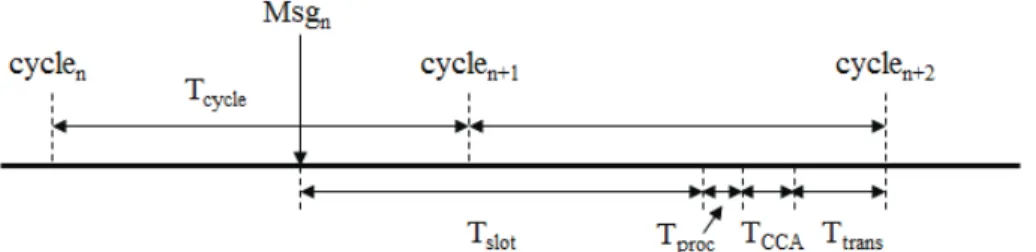
Figure 3 shows the theoretical worst-case transmission time (Tdelay) of the time- triggered IEEE 802.15.4 as follows:
f rame CCA proc sl ot
del ay T T T T
T (1)
where Tslot is the time when a node waits until its next time slot after message generation.
In the figure, if a message (Msgn) occurs as
soon as a current cycle (cyclen) starts, Tslot
has a maximum value and its value is equal to a cycle time (Tcycle). However, if additional message (Msgn+1) is generated in the current cycle (cyclen), the new message overrides the buffer and the older message (nth) is eliminated because the number of message buffer of each node is generally fixed to one in the TDMA method. In order to prevent buffer overriding, the cycle time is defined as the greatest common denominator (GCM) of generation time of all messages.
Hence, the worst-case transmission time can be calculated as
f rame cycl e
f rame cycl e
f rame CCA proc sl ot del ay
T T m
T T
T T T T T
s ec 132 . 0
16 8 4 1
(2)
Assuming that the maximum frame transmission time is 936 bit times (about 3.744 ms) and the message generation period is 10 ms, we can expect the worst-case transmission time of the time-triggered IEEE 802.15.4 to be less than 13.876 ms. In particular, by adjusting the message generation point appropriately, the transmission time can be driven to the very low value of 3.876 ms.
This indicates that the transmission time will be very low and constant, showing that the time-triggered IEEE 802.15.4 satisfies the industrial QoS and is a very promising alternative for wireless industrial networking.
4. Summary and conclusions
This paper presents the worst-case transmission delay of a time-triggered architecture to eliminate uncertainty of the transmission time and improve the real-time performance of IEEE 802.15.4 under condition with cyclically generated messages such as network-based control systems.
Due to the uncertainty of CSMA/CA, as the traffic begins to increase, collisions among messages occur frequently and the transmission time increases rapidly. Therefore, to use IEEE 802.15.4 in an industrial network, it is necessary to eliminate the uncertainty and prevent collisions.
The time-triggered IEEE 802.15.4 implemented in the application layer without any modification of specification eliminates collisions, which makes the transmission time almost constant. Moreover, the transmission time tends to remain within the allowable transmission time. Based on this analysis, the time-triggered architecture is better than the conventional IEEE 802.15.4 for a wireless industrial network.
Acknowledgements
This work was supported by the National Research Foundation of Korea(NRF) grant funded by the Ministry of Education (NRF-2017R1A2B4010448)
References
[1] T. Wakabayashi, S. Watanabe, Y. Kobayashi, T.
Okabe, and A. Koike, “High-speed AMHS and its operation method for 300-mm QTAT fab,”
IEEE Transactions on Semiconductor Manufacturing, Vol. 17, No. 3, pp. 317-323, March, 2004.
[2] J. H. Suh, J. W. Lee, Y. J. Lee, K. S. Lee,
“An automatic travel control of a container crane using neural network predictive PID control technique,” International Journal of Precision Engineering and Manufacturing, Vol.
7, No. 1, pp. 35-41, Jan., 2006.
[3] A. Koubaa, M. Alves, and E. Tovar, “i-GAME:
An implicit GTS allocation mechanism in IEEE 802.15.4 for time-sensitive wireless sensor networks,” Proc. 18th Euro micro Conference on Real-Time Systems, July, 2006.
[4] F. Barac, M. Fudlund, T. Zhang, “Scrutinizing Bit-and Symbol-Errors of IEEE 802.15.4 Communication in Industrial Environments,”
IEEE Transactions on Instrumentation and Measurement, Vol.63, No.7, pp.1783-1794, 2014.
[5] R. D. Gomes, D. V. Queirozc, A. C. Lima Filho d, I. E. Fonsecac, M. S. Alencar,
“Real-time link quality estimation for industrial wireless sensor networks using dedicated nodes,”
Ad Hoc Network, Vol.59, pp.116-133, May 2017.
[6] D. Kim, S. Park, K. Kang, and D. Lee.
“Time-triggered wireless sensor network for feedback control,” IEICE Electronics Express, Vol. 4, No. 21, pp.644-649, Nov., 2007.
[7] J. Francommen, G. Mercier, and T. Val,
“Beacon synchronization for GTS collision avoidance in an IEEE 802.15.4 meshed network,”
Proc. 7th IFAC International Conference on Fieldbuses and Networks in Industrial and Embedded Systems, pp. 1-8, Nov., 2007.
[8] J. Kim, J. Lim, C. Pelczar, and B. Jang, “IEEE International Symposium on Consumer Electronics,
pp. 1-4, April, 2008.
[9] Y. Tipsuwan and M.Y. Chow, “Gain scheduler middleware: a methodology to enable existing controllers for networked control and teleoperation - part I: networked control,” IEEE Transactions on Industrial Electronics, Vol. 51, No. 6, pp. 1218-1227, Dec., 2004.
[10] C. Lazar, “A remote-control engineering laboratory,” IEEE Transactions on Industrial Electronics, Vol. 55, No. 6, pp. 2368-2375, June, 2008.
[11] IEEE 802.15.4-2011, 2011.
[12] M. J. Lee, J. K. Zheng, Y. B. Ko, and D. M.
Shrestha, “Emerging standards for wireless mesh technology,” IEEE Wireless Communications, pp. 56-63, April, 2006.
[13] J. S. Lee, “Performance evaluation of IEEE 802.15.4 for low-rate wireless personal area networks,” IEEE Transactions on Consumer Electronics, Vol. 52, No. 3, pp. 742-749, Aug., 2006.
(Manuscript received May 8, 2017; revised May 26, 2017;
accepted June 7, 2017.)