161
Copyright © 2016 The Korean Society of Fisheries and Aquatic Science pISSN:0374-8111, eISSN:2287-8815
서 론
최근육상어류양식장에서발생하는배출수의 연안환경오염 에관한문제는전세계적으로심각한사회문제로대두되고있 다
(Nordvarg and Johansson, 2002; Kang et al., 2004).
육상 어류양식장에서배출된고형오물은주로어류의배설물과일 부잔여사료로 구성되어 있으며(Naylor, 2000; Brune et al., 2003),
이를처리하기위한방안으로유기질비료로사용(Shar- rer et al., 2007),
바이오가스로활용(Luo et al., 2013),
식물환 경복원(Ghaly et al., 2005)
등을시도하였지만,
실용화되지못 하고있다.
또한고염과고농도의유기물함량때문에도시폐수 처리장에서처리가곤란할뿐만아니라(Mirzoyan et al., 2008), 2016
년부터해양투기가금지되었기때문에이에대한대책이 절실하다.
해삼은저서퇴적물식자
(deposit feeder)
로서저서의퇴적물 을 이용하여성장하는바다의청소부로잘알려져있다(Kang et al., 2012).
해삼의이러한식성을활용하여다영양입체양식(Integrated Multi-Trophic Aquaculture, IMTA)
의여과생물로 서이용하고있을뿐만아니라(Kang et al., 2003; Zamora and Jeffs, 2011; Nelson et al., 2012; Hannah et al., 2013), IMTA
에서배출된저층배설물로상품크기까지성장시키고있다(Yo- koyama, 2013; Yu et al., 2014).
최근에는더욱진전하여육상 어류양식장의고형오물을처리하기위한시도에서희망적인결 과를얻고있다. Jeong et al. (2016)
의연구결과육상고형오물 의이화학적성질로서사료내잔류중금속과항생물질의안정 성을밝혔으며,
이를해삼에게급여했을때이들을효율적으로 소화시키는높은소화흡수율을밝히고있다. Jin et al. (2016)
은 고형오물을해삼사료자원으로활용하기위한실험으로육상양육상어류양식장의 고형오물을 발효시켜 만든 사료를 급여한 해삼(Apostichopus japonicus)의 성장
Feng Jin·최종국·정우철·Anisuzzaman Md·류충호
1·최병대·강석중*
경상대학교 해양식품생명의학과, 1경상대학교 식품공학과
Effects of Fermented Fecal Solid Diets on Growth of the Sea Cucumber Apostichopus japonicus
Feng Jin, Jong- Kuk Choi, U-Cheol Jeong, Anisuzzaman Md, Chung-Ho Ryu
1
, Byeong-Dae Choi and Seok-Joong Kang*Department of Seafood and Aquaculture Science, Gyeongsang National University, Tongyeong 53064, Korea
1
Department of Food Science and Techology, Gyeongsang National University Jinju 52828, Korea
The effects of fermented fecal solid diets on the growth of the sea cucumber Apostichopus japonicus was investigated in a recirculating aquaculture system (RAS) during a 90-day experiment at 16.5-17.5°C, 32±0.5 psu salinity, pH 7.9-8.2, and 5.2-7.1 mg/L dissolved oxygen. The aim was to determine the feasibility of RAS fecal solid waste as a renewable feed for A. japonicus . In this study, unfermented fecal solid (UF), fermented fecal solid (FF), and commer- cial feed (CF) diets were used. The results showed that the growth rate did not differ significantly ( P >0.05) between A. japonicus fed FF and CF; however, the growth rates of A. japonicus fed FF and CF were ~50% higher than that of those fed UF. Thus, utilization of fecal solid by A. japonicus may overcome the problem regarding accumulation of RAS waste. Use of a fermentation process would improve utilization of fecal solid as a renewable food source for A. japonicus .
Key words: Fecal solids, Sea cucumber, Apostichopus japonicus , Fatty acid, Amino acid
This is an Open Access article distributed under the terms of the Creative Commons Attribution Non-Commercial Licens (http://creativecommons.org/licenses/by-nc/3.0/) which permits unrestricted non-commercial use, distribution, and reproduction in any medium, provided the original work is properly cited.
http://dx.doi.org/10.5657/KFAS.2016.0161 Korean J Fish Aquat Sci 49(2) 161-167, April 2016
Received 22 March 2016; Revised 12 April 2016; Accepted 13 April 2016
*Corresponding author: Tel: +82. 55. 772. 9154 Fax: +82. 55. 648. 3089
E-mail address: [email protected]
식장에서배출된고형오물을해삼에게급여했을때해삼의에 너지수지차원에서이용가능성이높다고하였다
.
그러나성장 에서는고형오물을그대로급여했을때는상품사료의60%
수 준의성장효과를나타내었기때문에고형오물에대한이용률 개선의필요성을제기하였다.
사료의이용률을높이는방안으로발효과정을통하여소화흡 수율개선하고기능성물질을증가시키는방법은이미식품과 축산사료에서널리응용되고있다
(Kwak and Park, 2003; Song et al., 2011).
불소화또는난소화성원료에미생물을접종후발 효시켰을때고분자물질을저분자물질로변화시켜소화성이 개선되고또한미생물작용에의한악취제거에도뛰어난효과 를가지고있다(Anugwa et al., 1989; Wilfart et al., 2007).
따라서본연구는해삼의고형오물에대한이용성을개선하는 목적으로
4
단발효공정을거친고형오물을해삼에게공급하는 사육실험을통하여육상어류양식장에서배출되는고형오물의 이용성을높이고자연구를수행하였다.
재료 및 방법
실험사료
실험사료는 고형오물로제조한미발효고형오물사료
(Unfer- mented fecal solid, UF)
와이를발효시켜제조한발효고형오물 사료(Fermented fecal solid)
및시판중인상품사료(Commer- cial feed, CF)
를포함한3
종류를실험에사용하였다.
고형오물 사료는충청북도충주시금가면오석리에소재하고있는무지 개송어(Oncorhynchus mykiss)
양어장의배설물침전조에축적 된고형오물을채취하여실험실로운반후해삼사료로제조하 여사용하였으며 상품사료는중국에서 수입한 해삼배합사료(DL CO., LTD, China)
를사용하였다.
발효사료 제조
발효사료의제조공정은
4
단계로하였고,
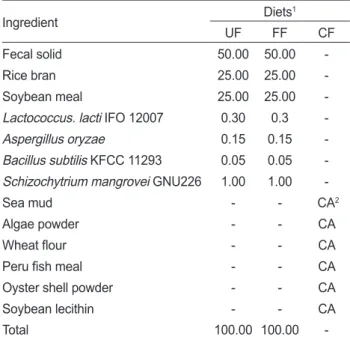
발효사료와미발효 사료의원료배합비율은Table 1
에나타낸바와같으며,
그원 료의일반성분은Table 2
에나타낸바와같다.
고형오물에악 취제거와수분조절을위하여미강을첨가하였고,
단백질함량 조절을위하여대두박을 첨가하였다.
고형오물,
미강및대두 박의비율은2:1:1
로 혼합하여 이를발효기질로 하였다.
제1
단발효는미생물증식에필요한영양원즉 기질을살균하기위한 목적으로 항균물질 생산능력이 있는 유산균
(Lactococ- cus lacti IFO 12007)
을이용하였고,
제2
단과제3
단발효과정 은고형오물중고분자물질과난분해성물질을분해하는단계 로서제2
단황국균(Aspergillus oryzae)
과제3
단고초균(Bacil- lus subtilis GSK3580)
을이용하였으며,
제4
단계는고도불포화 지방산함량을증가시키기위하여Schizochytrium mangrovei
GNU226
배양액을첨가하였다.
각단계별발효조건은제1
단계
L lactis IFO 12007
과2
단계A. oryzae
를각각10
6CFU/g
과10
6spores/g
을분무접종하여30℃
에서48
시간동안1
단과2
단발효를연속으로실시하였다.
다음으로3
단계는증류수를 첨가하여수분을90%
로조절하고B. subtilis GSK3580
을10
6CFU/g
접종해서43℃
에서24
시간동안발효를실시하였으며,
마지막4
단계로해양미세조류S. mangrovei GNU 226
발효 액을5%
첨가하여발효공정을마쳤다.
모든실험사료는볼밀(Seojin SJB-250A, Korea)
을이용하여45 µm
될때까지충분 히분쇄시켰다.
이분쇄된고형오물입자에Cr
2O
30.5%
와Cel-
Table 1. Formulation of experimental diets for Apostichopus ja- ponicus (dry basis %)
Ingredient Diets1
UF FF CF
Fecal solid 50.00 50.00 -
Rice bran 25.00 25.00 -
Soybean meal 25.00 25.00 -
Lactococcus. lacti IFO 12007 0.30 0.3 -
Aspergillus oryzae 0.15 0.15 -
Bacillus subtilis KFCC 11293 0.05 0.05 - Schizochytrium mangrovei GNU226 1.00 1.00 -
Sea mud - - CA2
Algae powder - - CA
Wheat flour - - CA
Peru fish meal - - CA
Oyster shell powder - - CA
Soybean lecithin - - CA
Total 100.00 100.00 -
1 UF, unfermented fecal solid diet; FF, fermented fecal solid diet;
CF, commercial feed. 2CA, certain amount.
Table 2. Proximate compositions of the experimental diets (%)
Diets1 Moisture (%) Composition
Crude protein Crude lipid Carbohydrate Ash
UF 5.50±0.23 21.55±1.23 4.75±0.04 24.84±0.26 48.86±0.50
FF 5.50±0.14 20.43±0.70 4.12±0.04 25.77±0.46 49.68±0.50
CF 5.40±0.17 21.81±0.93 1.73±0.03 26.52±0.37 49.94±0.85
1UF, unfermented fecal solid diet; FF, fermented fecal solid diet; CF, commercial feed diet.
lulose sodium alginate 0.5%
를완전하게섞어반죽한후,
펠렛 제조기(Dongwen EP-C220, Korea)
에서펠렛형태로압출성형 하였다.
성형된고형오물을65℃
에서건조시킨후,
다시분쇄시 켜입자크기가350 µm
인크럼블사료로가공하였고건조기에 건조시켜수분함량을5.4%
로조절하였으며4℃
에서냉장보관 하여실험에사용하였다.
발효고형오물 일반 성분 분석
실험사료의일반성분 분석은일반성분은
AOAC (1995)
방 법에따라조단백질은Kjeldahl
법으로분석하였으며,
조지방 은choloroform
과methanol
을2:1
비율로혼합한용액을용매 로한Bligh and Dyer
추출법(1959)
에준하였다.
수분은상압가 열건조법으로105℃
의건조기(Dongwon, dry oven, Korea)
에서6
시간동안건조후측정하였으며,
조회분은직접회화법 으로600℃
회화로에서4
시간동안태운후정량하였다.
탄수 화물함량은시료의수분,
단백질,
지질및회분의함량을뺀값 으로하였다.
발효고형오물 아미노산 분석
총아미노산은시료
100 mg
에6 N
염산2 mL
를첨가하여이 를heating block (HF21, Yamato Scientific Co., Japan)
에서110℃
로, 24
시간가수분해한후glass filter
로여과및감압건조 하였다.
건조물은sodium citrate buffer (pH 2.2)
로100 mL
정 용플라스크에정용한후아미노산자동분석기(Biochrom 30, Amershame Parmacia Biotech, England)
로분석및정량하 였다.
발효고형오물 지방산 분석
총지질추출은
Bligh and Dyer (1959)
방법에준수하여Chlo- roform
과methanol
을2:1
로혼합한용액을이용하여추출하였 다.
추출된총지질80 mg
을취하고, 0.5 N NaOH-methanol
용액을이용하여검화하였으며BF
3-methanol (Sigma, USA)
을 사용하여fatty acid methyl ester
로methylation
시킨 후capillary column (Omegawax
TM-320, 30 m×0.32 mm×0.25 μm, I.D., SUPELCO, USA)
이장착된Gas Chromatography (Glarus 600, Perkin Elmer, USA)
로 지방산을 분석하였다. Carrier gas
는헬륨을사용하였고injector
온도는250℃, detec- tor (FID)
온도는270℃
로각각설정하였다.
이때column
온도 는180℃
에서8
분간유지하고3℃/
분속도로230℃
까지증가 시킨후항온상태에서10
분간유지시켰다.
지방산의 동정은GC-MS
로동정된menhaden oil
을동일조건으로분석한결과 와ECL (equivalent chain length)
값을비교하여동정하였다. 발효고형오물을 이용한 해삼 사육실험
실험에사용한돌기해삼
(Apostichopus japonicus)
은경남통 영시산양면에위치하고있는해삼종묘생산업체에서분양받 아경상대학교어류양식및사료실험실의배양장으로운반하여
1,000 L
수조에수용하였다.
해삼사육실험은순환여과시 스템에서수행하였으며,
보충수는20%/
일로하였고순환률은1
회전/
일로하였다.
이때의실험환경은온도17±1℃,
염분32±1 psu,
용존산소5.0-7.2 mg/L
로서인공배합사료를공급 하면서5
주간예비사육을하였다.
예비사육을거친해삼을
24
시간절식시킨후평균체중11.50 g
인개체를180
마리선별하여9
개의사육수조인직사각형아 크릴수조(45×60×50 cm,
수량80 L)
에각각20
마리씩무작 위로분배하여3
개의실험구를설정하였다.
각실험구마다각 각다른실험사료를급여하여총3
개실험구를3
회반복으로 실험을수행하였다.
샘플 수집
해삼의초기체중은실험개시와동시에
20
마리를채집하여65℃
에서건조한후생체중량과건조중량을측정하여초기샘 플로하였다.
변과잔여사료의시료채취는사료를급여하기전 에사이펀을이용하여수조바닥에있는잔여사료와변을채집 하였으며,
이를증류수로탈염하여65℃
에서건조한후무게를 측정하였다.
해삼의최종체중은사육실험이종료되었을때,
실 험해삼을48
시간절식시킨후에초기샘플과동일한방법으로 체중을측정하였다.
성장 및 소화율
생존율
(survival rate),
일일 성장률(specific growth rate, SGR),
사료섭식률(ingestion rate, IR),
증체량(weight gain)
및 겉보기소화흡수율(apparent digestibility AD)
의계산식은다 음과같다.
Survival rate SR (%) = 100 × (N
2/ N
1)
위식에서
N
2는최종생존개체수, N
1은최초개체수이다. SGR (%/day) = 100 (lnW
2- lnW
1) / T
IR (mg/g/day) = C / [T × (W
2+ W
1) / 2]
위식에서
W
1과W
2는실험전과후각수조에있는해삼의건 조중량, T
는사육기간, C
는섭식한사료의건조중량이다.
Weight gain (WG): WG (g/tank) = W
F– W
I위식에서
W
I는수조당수용한해삼의최초총습중량, W
F는 최종총습중량이다.
AD (%) = 100-100×Cr
2O
3in diet /Cr
2O
3in feces
Cr
2O
3함량은Furukawa (1966)
방법에따랐으며,
광학식플 레이트에150 µL
씩넣어UV-Vis spectrometer
을이용하여350
nm
에서3
반복으로분석하였다.
분석후결과값과Y=0.2089
X+0.0032 (Y =
흡광도, X = Cr
2O
3mg/100 mL)
공식을이용해Cr
2O
3값을구하였다.
통계처리
모든 통계분석은
SPSS 16.0
프로그램을 사용하였고One- way ANOVA test
를 실시한후Duncan’s multiple rang test (Duncan, 1955)
로평균간의유의성(P<0.05)
을검정하였다.
결 과
발효고형오물의 일반성분
4
단발효과정을거친발효고형오물의일반성분은Table 2
에서나타낸바와같이조회분은발효전의
48.86%
에서발효후49.68%
로변화가없었으며조단백은21.55%
에서20.43%
로,
조지방은4.75%
에서4.12%
로낮아졌다.
발효고형오물의 아미노산 조성
고형오물사료발효전과후의아미노산분석결과는
Table 3
에 나타낸바와같이4
단발효과정을통해발효된고형오물사료의aspartic acid
함량은2.17%
에서1.76%
로낮아졌으며glycine
함량은0.68%
에서1.35%
로높아지는것으로나타났다. Thre- onine
함량은0.79%
에서0.55%
로낮아졌으며methionine
함량 은0.28%
에서0.82%
로높아지는것으로나타났다. Phenylala- nine
함량은0.63%
에서0.55%
로낮아졌으며lysine
은0.69%
에서
1.27%
로, arginine
은0.94%
에서1.16%
로높아지는것으 로나타났다.
발효고형오물의 지방산 조성
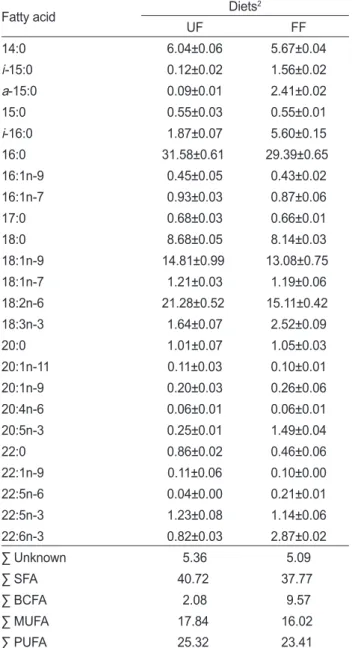
고형오물사료발효전과후의지방산조성은
Table 4
에나타낸 바와같이총24
종지방산이동정되었으며동정되지않은peak
의총합이각각5.36%
와5.09%
였다. 18:2n-6
함량은21.28%
에서
15.11%
로낮아졌으며20:5n-3 (EPA)
과22:6n-3 (DHA)
함량은각각0.25%
와0.82
에서1.49%
와2.87%
로높아지는것 으로나타났다.
포화지방산(SFA)
함량은40.72%
에서37.77%
로 낮아졌으며
iso-15, anteiso-15
및iso-16
을포함한분지지Table 3. Total amino acid composition of fecal solid diet in before and after fermentation (% of dry matter)
Amino acid Diets1
UF FF
Aspartic acid 2.17 1.76
Threonine 0.79 0.55
Serine 1.02 0.56
Glutamic acid 2.82 2.68
Proline 0.96 1.09
Glycine 0.68 1.35
Alanine 0.93 0.99
Valine 0.92 0.98
Methionine 0.28 0.82
Isoleucine 0.68 0.71
Leucine 1.44 1.42
Phenylalanine 0.63 0.55
Lysine 0.69 1.27
Histidine 0.49 0.51
Arginine 0.94 1.16
1UF, unfermented fecal solid diet; FF, fermented fecal solid diet.
Table 4. Total fatty acid composition of fecal solid diet in before and after fermentation (% of total lipid)1
Fatty acid Diets2
UF FF
14:0 6.04±0.06 5.67±0.04
i-15:0 0.12±0.02 1.56±0.02
a-15:0 0.09±0.01 2.41±0.02
15:0 0.55±0.03 0.55±0.01
i-16:0 1.87±0.07 5.60±0.15
16:0 31.58±0.61 29.39±0.65
16:1n-9 0.45±0.05 0.43±0.02
16:1n-7 0.93±0.03 0.87±0.06
17:0 0.68±0.03 0.66±0.01
18:0 8.68±0.05 8.14±0.03
18:1n-9 14.81±0.99 13.08±0.75
18:1n-7 1.21±0.03 1.19±0.06
18:2n-6 21.28±0.52 15.11±0.42
18:3n-3 1.64±0.07 2.52±0.09
20:0 1.01±0.07 1.05±0.03
20:1n-11 0.11±0.03 0.10±0.01
20:1n-9 0.20±0.03 0.26±0.06
20:4n-6 0.06±0.01 0.06±0.01
20:5n-3 0.25±0.01 1.49±0.04
22:0 0.86±0.02 0.46±0.06
22:1n-9 0.11±0.06 0.10±0.00
22:5n-6 0.04±0.00 0.21±0.01
22:5n-3 1.23±0.08 1.14±0.06
22:6n-3 0.82±0.03 2.87±0.02
∑ Unknown 5.36 5.09
∑ SFA 40.72 37.77
∑ BCFA 2.08 9.57
∑ MUFA 17.84 16.02
∑ PUFA 25.32 23.41
1Values are means of triplicate groups and values in the same row with different superscripts are significantly different (P<0.05). 2 UF, unfermented fecal solid diet; FF, fermented fecal solid diet.
방산
(Branched chain fatty acid, BCFA)
함량은2.08%
에서9.57%
로높아지는것으로나타났다.
발효고형오물을 이용한 기초사육실험
전 실험기간을통한 해삼의성장결과는
Table 5
에 나타낸 바와같다.
미발효고형오물사료구(UF)
구는초기11.50 g
에서25.32 g
으로 성장하였으며,
발효고형오물사료(FF)
구는 초기11.50 g
에서56.09 g
으로성장하였다.
이때상품사료(CF)
구는 초기11.50 g
에서55.42 g
으로성장하였다.
미발효고형오물사 료실험구는발효고형오물사료실험구와상품사료실험구에 비하여유의한차이로낮으며(P<0.05)
발효고형오물사료와상 품사료실험구에서는유의적차이가없었다(P<0.05).
증체량
(WG)
은Table 5
에 나타낸 바와 같이 미발효고형오물사료실험구
,
발효고형오물사료실험구및상품사료실험구 는각각276.41 g, 891.84 g
및878.32 g
였다.
발효고형오물사 료실험구는상품사료실험구에비하여유의적차이가없었으 나미발효고형오물사료실험구보다유의한차로높게나타났 다(P<0.05).
일일성장률(SGR)
에 있어 미발효고형오물사료 실험구,
발효고형오물사료 실험구 및 상품사료 실험구는 각 각0.88%/d, 1.76%/d
및1.75%/d
였다.
발효고형오물사료실 험구는 상품사료 실험구에 비하여 유의적 차이가 없었으나(P<0.05)
미발효고형오물실험구보다유의한차로높게나타났 다(P<0.05).
전실험기간에모든실험구에서는폐사한개체가 없어생존율100%
였다.
사료섭식률(IR)
과겉보기소화율(AD)
는Table 5
에나타낸바와같다.
사료섭식률에있어미발효고형 오물실험구,
발효고형오물실험구및상품사료실험구는각각8.23 g/g/d, 11.71 g/g/d
및12.23 g/g/d
였다.
미발효고형오물사 료실험구는발효고형오물실험구와상품사료실험구에비하 여유의한차이로낮게나타냈으며(P<0.05)
발효고형오물실험구와상품사료실험구에서는유의적차를나타내지않았다
(P<0.05).
겉보기소화율에있어미발효고형오물사료실험구,
발효고형오물사료실험구및상품사료실험구는각각15.26%, 26.73%
및27.48%
였다.
미발효고형오물사료실험구는발효고 형오물사료실험구와상품사료실험구에비하여유의한차이로 낮게나타냈으며(P<0.05)
발효고형오물사료실험구와상품사 료실험구에서는유의적차를나타내지않았다(P<0.05).
고 찰
전세계적으로육상순환양식시스템
(RAS)
에서배출되는고 형오물에의한환경오염문제는갈수록그정도가심각해지고있기때문에근본적인해결책이요구되고있다
. 2012
년국내어류양식생산량은
76,308
톤이고이를생산하기위하여소비된생사료는
443,382
톤이고,
배합사료는67,127
톤이다(KOSIS, 2013).
공급한사료의약36%
가고형오물로배출되었을때연 간약24,165
톤의고형오물이발생될것으로추정된다.
고형오 물은어류가소화하지못한잔여영양소와섭식하지못한잔여 사료로구성되어유기물함량이50-92%
차지한다(Piedrahita, 2003; Gebauer, 2004; Gebauer and Eikebrokk, 2006; Mirzoy- an et al., 2008).
본연구에서는육상어류양식장에서배출된고 형오물의이러한특성을이용하여농가부산물인미강과대두박 을보조원료로첨가하여미생물발효를통하여해삼사료로활 용하는시도를하였다.
성장결과를보았을때Talbe 5
에나타낸 바와같이발효고형오물사료실험구는미발효고형오물실험구 보다높은성장결과를나타났고상품사료와동일한해삼성장 을나타내었다.
미발효고형오물사료구에서성장이저조한것 은해삼이육상어류양식장에서배출된고형오물,
미강및대두 박에대한소화흡수능력이약한점이저조한성장결과에반영 Table 5. Initial and final wet weight and survival number of Apostichopus japonicus fed the three experimental diets (mean±SE)1Parameters UF FF CF
Initial
Total wt. (g) 230.01±3.71a 230.04±3.54a 230.07±.2.18a
Number 20 20 20
Individual wt. (g) 11.50±0.20a 11.50±0.16a 11.50±0.12a
Final
Total wt. (g) 506.42±63.73a 1,121.88±102.52a 1,108.39±113.72b
Number 20 20 20
Individual wt. (g) 25.32±6.2b 56.09±7.5a 55.42±5.7a
Culture period (day) 90 90 90
Survial rate (%) 100 100 100
Weight gain (g) 276.41±21.5a 891.84±45.2b 878.32±33.7b
Specific growth rate (%/d) 0.88±0.06a 1.76±0.04b 1.75±0.09b
Ingestion rate (g/g/d) 8.23±0.82a 11.71±0.89b 12.23±0.93b
Apparent digestibility (%) 15.26±0.57a 26.73±0.43b 27.48±0.71b
1Data values are means of triplicate groups and values in the same row with different superscripts are significantly different (P<0.05). 2UF, unfermented fecal solid diet; FF, fermented fecal solid diet; CF, commercial feed.
된것으로추정된다
(Table 5). Anugwa et al. (1989)
및Wilfart et al. (2007)
의연구에의하면불소화또는난소화성원료를발 효시키면고분자물질을저분자물질로변화시켜소화성이개 선된다고보고되어있다.
본연구에서발효과정을거친고형오 물사료는겉보기소화율이15.26%
에서26.73%
로높아지는점 이이와유사하였다.
선행연구에서해삼사료의아미노산조성 에서glutamic acid, methionine, lysine
및arginine
이해삼의성 장에중요한역할을한다고보고된바가있다(Li et al., 2012).
본연구에서발효과정을통한고형오물사료의아미노산조성에 있어
glutamic acid, methionine, lysine
및arginine
이각각2.0
배, 3.0
배, 1.8
배및1.2
배로증가되었다.
이러한특정아미노산 의증가로인해해삼의성장이개선된것으로생각된다.
해삼은
20:1n-9, 22:1n-9, 20:3n-3, 20:4n-6
및20:5n-3
를어느 정도로합성할가능성이제시되고있으나,
기타해양동물처럼 사료에20:5n-3 (EPA)
와22:6n-3 (DHA)
이결핍될때성장에 영향을미친다(Hasegawa et al., 2014; Yu et al., 2015; Wen et al., 2016 ).
본연구에서발효과정을거친고형오물사료는EPA
와DHA
함량이각각5.97
배와3.48
배로증가하였다.
이러한 고도불포화지방산의증가로인하여발효전과후의해삼사육효 과의차이를나타나게된원인이될수있을것으로생각된다.
발효전과후의지방산변화에있어또한BCFA
가4.6
배높아 진것을발견하였다.
대다수BCFA
는미생물에의하여합성되 는특이한지방산이다(Leo and Patrick, 1966).
해삼은BCFA
을합성할수없으나먹이로부터섭취하여체내에다량으로축 적하고있다(Kaneniwa et al., 1986; Hasegawa et al., 2014).
BCFA
의 해삼에대한생리 기능이아직밝혀지지 않았으나,
Hasegawa et al. (2014)
의연구에의하면사료의BCFA
함량이 증가함에따라해삼의빠른성장률을나타낸다고보고된바가 있다.
이러한복합적인요인의작용에의하여고형오물사료가 발효과정을통하여해삼사육효과가개선된것으로생각된다.
지충이(Sargassum thunbergii)
는해삼배합사료에널리사용 되고있는주요한원료로서(Seo et al., 2011; xia et al., 2012;
Yuan et al., 2006)
최근해삼양식규모가커짐에따라지충이의 가격이급격하게비싸지고있으며이로인한해조자원의고갈 이우려되고있다(Gao et al., 2011; Seo et al., 2011; Shi et al.,
2013).
이런문제를해결하기위하여육상식물로해삼사료원료인지충이를
20-40%
를대체하고있다(Seo et al., 2011; Yu et al., 2015 ).
본연구에서해조분말을사용하지않고육상어류양 식장에서배출된고형오물과가격이저렴한농가부산물미강과 대두박을첨가하여발효시킨후해삼에게급여하였을때상품 사료와동일수준인성장효과를얻었다.
이는육상어류양식장 에서배출된고형오물을처리하는동시에해삼사육에있어사 료비용절감과해조류의대량채집으로인한생태자원파괴를 개선하는데기여될수있을것으로판단된다.
이상의결과를종합해볼때지금까지육상어류양식장에서배 출되는고형오물을처리하는데마땅한대한이없는상황에서
육상고형오물의발효과정을거쳐서해삼사료자원화를시도했 다는점에서본연구의의의는크다고생각한다
.
사 사
이논문은
2015
년도해양수산부재원으로한국해양과학기술진흥원의지원을받아수행된연구임
(
수산실용화기술개발사 업의육상순환양식시스템에서배출된고형오물의해삼사료자 원화).
References
Anugwa FOI, Varel VH, Dickson JS, Pond WG and Krook LP, 1989. Effects of dietary fiber and protein concentration on growth, feed efficiency, visceral organ weights and large in- testine microbial populations of swine. J Nutr 119, 879-886.
AOAC (Association of Official Analytical Chemists). 1995. Of- ficial Methods of Analysis, vol. 4(16th ed.) Association of Official Analytical Chemists, Arlington, VA, U.S.A. (1984) 1-45.
Bligh EG and Dyer WJ. 1959. A rapid method of total lipid ex- traction and purification. Can J Biocami Physiolo 37, 911- 917.
Duncan DB. 1955. Multiple range and multiple F tests. Biomet- rics 11, 1-42.
Furukawa A. 1966. On the acid digestion method for the de- termination of chromic oxide as an index substance in the study of digestibility of fish feed. Nippon Suisan Gakkaishi 32, 502-506.
Gao QF, Wang Y, Dong S, Sun Z and Wang F. 2011. Absorp- tion of different food sources by sea cucumber Aposticho-
pus japonicus (Selenka)(Echinodermata: Holothuroidea):
evidence from carbon stable isotope. Aquaculture 319, 272- Gebauer R. 2004. Mesophilic anaerobic treatment of sludge 276.
from saline fish farm effluents with biogas production. Bio- resour Technol 93, 155-167.
Gebauer R. and Eikebrokk B. 2006. Mesophilic anaerobic treat- ment of sludge from salmon smolt hatching. Bioresour Technol 97, 2389-2401.
Ghaly A, Kamal M and Mahmoud N. 2005. Phytoremediation of aquaculture wastewater for water recycling and produc- tion of fish feed. Environ Int 31, 1-13.
Hannah L, Pearce CM and Cross SF. 2013. Growth and survival of California sea cucumbers (Parastichopus californicus) cultivated with sablefish (Anoplopoma fimbria) at an inte- grated multi-trophic aquaculture site. Aquaculture 406-407, 34-42. http://dx.doi.org/10.1016/j.aquaculture.2013.04.022.
Kaneniwa M, Itabashi Y, Endo S and Takagi T. 1986. Fatty ac- ids in Holothuroidea: occurrence of cis-14-tricosenoic acid.
Comp Biochem Phys B 84, 451-455.
Kang JC, Jee JH, Song SY, Moon SW, Kang JW, Lee YD and
Kim SJ. 2004. Effects of oral administration with fermented product from sewage in land-based seawater fish farm on haematological factors of olive flounder, Paralichthys oliva-
ceus. J Fish Pathol 17, 57-66.
Kang KH, Kwon JY and Kim YM. 2003. A beneficial coculture:
charm abalone Haliotis discus hannai and sea cucumber
Stichopus japonicus. Aquaculture 216, 87-93. http://dx.doi.
org/10.1016/S0044-8486(02)00203-X.
Kang SJ, Kang SW, Kang JH, Jung UC, Choi BD and Han JC.
2012. Sea cucumber aquaculture technology. Aqua info, Seoul, Korea, 32-36.
KOSIS (Korean Statistical Information Service). 2013. Survey on the Status of Fish Culture 2013. Statistics Korea, Dae- jeon, Korea.
Kwak W and Park J. 2003. Effects of molasses addition and (or) pelleting on nutritional characteristics of broiler litter pro- cessed by ensiling or deepstacking and palatability improve- ment by' Hanwoo'during the adjustment period. J Anim Sci Technol 45, 87-100.
Leo RF and Parker PL. 1966. Branched-chain Fatty acids in sediments. Science 152, 649-650.
Li SH, Ling MQ, SUN HL and YAN JP. 2012. Optimum dietary protein and amino acid levels for the growth of juvenile sea cucumber Apostichopus japonicus. Pr Fish Sci 33, 59-63.
Luo G, Li P, Tan H, Du J and Liang W. 2013. The start-up and saline adaptation of mesophilic anaerobic sequencing batch reactor treating sludge from recirculating aquaculture sys- tems. Aquacult Eng 54, 9-15. http://dx.doi.org/10.1016/j.
aquaeng.2012.10.004.
Mirzoyan N and Gross A. 2013. Use of UASB reactors for brackish aquaculture sludge digestion under different condi- tions. Water Res 47, 2843-2850. http://dx.doi.org/10.1016/j.
watres.2013.02.050.
Naylor RL, Goldburg RJ, Primavera JH, Kautsky N, Beveridge MC, Clay J, Folke C, Lubchenco J, Mooney H and Troell M. 2000. Effect of aquaculture on world fish supplies. Na- ture 405, 1017-1024.
Nelson EJ, MacDonald BA and Robinson SMC. 2012. The ab- sorption efficiency of the suspension-feeding sea cucumber,
Cucumaria frondosa , and its potential as an extractive in-
tegrated multi-trophic aquaculture (IMTA) species. Aqua- culture 370-371, 19-25. http://dx.doi.org/10.1016/j.aquacul- ture.2012.09.029.Nordvarg L and Johansson T. 2002. The effects of fish farm ef- fluents on the water quality in the Åland archipelago Baltic Sea. Aquacult Eng 25, 253-279.
Piedrahita RH. 2003. Reducing the potential environmental impact of tank aquaculture effluents through intensification and recirculation. Aquaculture 226, 35-44.
Seo J and Lee S. 2011. Optimum dietary protein and lipid levels for growth of juvenile sea cucumber Apostichopus japoni-
cus. Aquacult Nutr 17, 56-61.
Shi C, Dong S, Wang F, Gao Q, Tian X. 2013. Effects of four fresh microalgae in diet on growth and energy budget of juvenile sea cucumber Apostichopus japonicus (Selenka).
Aquaculture 416, 296-301. http://dx.doi.org/10.1016/j.aqua- culture.2013.09.050.
Song Y, Chu G, Ha J, Lee H, Kim S and Kim H. 2011. Effects of fermented diet using probiotics from pine needle microbes on growth performance, blood characteristics, carcass traits and economy of pigs. J Agri Life Sci 45, 93-101.
Wen B, Gao Q, Dong S, Hou Y, Yu H and Li W. 2016. Effects of dietary inclusion of benthic matter on feed utilization, diges- tive and immune enzyme activities of sea cucumber Apos-
tichopus japonicus (Selenka). Aquaculture 458, 1-7. http://
dx.doi.org/10.1016/j.aquaculture.2016.01.028.
Wen B, Gao Q, Dong S, Hou Y, Yu H and Li W. 2016. Effects of different feed ingredients on growth, fatty acid profiles, lipid peroxidation and aminotransferases activities of sea cucumber Apostichopus japonicus (Selenka). Aquaculture 454, 176-183.
Wilfart A, Montagne LP, Simmins HV, Milgen J and Noblet J.
2007. Sites of nutrient digestion in growing pigs: Effect of dietary fiber. J Anim Sci 85, 976-983.
Xia S, Yang H, Li Y, Liu S, Zhou Y and Zhang L. 2012. Effects of different seaweed diets on growth, digestibility, and am- monia-nitrogen production of the sea cucumber Aposticho-
pus japonicus (Selenka). Aquaculture 338, 304-308. http://
dx.doi.org/10.1016/j.aquaculture.2012.01.010.
Yokoyama H. 2013. Growth and food source of the sea cu- cumber Apostichopus japonicus cultured below fish cages
— Potential for integrated multi-trophic aquaculture. Aqua- culture 372, 372–375. Aquaculture 372, 28-38. http://dx.doi.
org/10.1016/j.aquaculture.2012.10.022.
Yu H, Gao Q, Dong S, Wen B, Hou Y and Ning L. 2015. Utiliza- tion of corn meal and extruded soybean meal by sea cucum- ber Apostichopus japonicus (Selenka): Insights from carbon stable isotope analysis. Aquaculture 435, 106-110.
Yu Z, Zhou Y, Yang H, Ma Y and Hu C. 2014. Survival, growth, food availability and assimilation efficiency of the sea cu- cumber Apostichopus japonicus bottom-cultured under a fish farm in southern China. Aquaculture 426, 426-427, http://dx.doi.org/10.1016/j.aquaculture.2014.02.013.
Yuan X, Yang H, Zhou Y, Mao Y, Zhang T and Liu Y. 2006.
The influence of diets containing dried bivalve feces and/or powdered algae on growth and energy distribution in sea cu- cumber Apostichopus japonicus (Selenka) (Echinodermata:
Holothuroidea). Aquaculture 256, 457-467. http://dx.doi.
org/10.1016/j.aquaculture.2006.01.029.
Zamora LN and Jeffs AG. 2011. Feeding, selection, digestion and absorption of the organic matter from mussel waste by juveniles of the deposit-feeding sea cucumber, Australos-
tichopus mollis. Aquaculture 317, 223-228. http://dx.doi.
org/10.1016/j.aquaculture.2011.04.011.