서 론
외래종은 세계적으로 토착종의 생물 다양성에 위협요 인으로 작용하며(Brown and Lomolino, 1998), 특히 한정 된 서식처인 담수 생태계에 외래어류의 도입은 토종 담 수어의 알과 소형어류를 비롯한 다양한 분류군의 담수생 물을 다량으로 포식하여 종 다양성의 감소를 초래하는 등 수중 생태계의 심각한 교란요인으로 작용하고 (McDowell, 1984), 외래어의 도입과 함께 서식지의 변화, 질병과 기생충의 유입, 잡종, 영양변화, 공간의 상호작용
과 같은 문제가 야기될 수 있다(Gozlan et al., 2005).
또한 외래어종이 새로운 서식지에 도입되면 생태적으 로 유사한 생태적 지위(ecological niche)를 가지는 종이 존재하지 않는 경우가 많고 토종 담수어류가 정착되지 않은 인위적으로 조성된 댐이나 보 등에서는 외래어종의 번식이 이루어지고 있으며 실제 이러한 서식처에서 다량 의 외래어종의 서식이 확인되며(Hong and Son, 2003), 종간 경쟁이 적절하게 이루어지지 않아 생태적 확산이 쉽게 일어나며 먹이가 되는 토종 담수어의 감소를 초래 한다(Azuma, 1992).
대표적인 예로 일본의 경우 배스의 도입 이후 sports
─
─ 395 ──
우리나라 주요 강과 호수에 분포하는 외래어종 배스 Micropterus salmoides 의 AFLP 분석에 의한 유전적 분화
이완옥∙이일로1∙송하윤1∙방인철1,*
(국립수산과학원 중부내수면연구소, 1순천향대학교 해양생명공학과)
Genetic Differentiation of the Largemouth Bass Micropterus salmoides from the Major Rivers and Reservoirs in Korea Assessed by AFLP. Lee, Wan-Ok, Il-Ro Lee1, Ha-Yoon Song1and In- Chul Bang1,*(Central Inland Fisheries Research Institute, NFRDI, Gapyong 477-815, Korea;
1Department of Marine Biotechnology, Soonchunhyang University, Asan 336-745, Korea)
Genetic diversity and differentiation within or among nine populations of introduc- ed fish, largemouth bass Micropterus salmoides were assessed by AFLP. The AFLP analysis using three primer combinations generated 299.2. AFLP bands and percen- tage of polymorphic bands were similar in those nine populations, ranging 14.1 to 21%. Heterozygosity and genetic diversity within or among populations were quite low for all of these populations with average values ranging from 0.054 to 0.067 and from 0.069 to 0.085, respectively. Analyses of pairwise distance and genetic similarity among nine populations of Micropterus salmoides also revealed the similar results with low genetic differentiation one another. Although pairwise Fst values were low, they were indicated a clear distinct genetic differentiation among the nine popu- lations. These results indicate that very small population of the largemouth bass was first introduced to Paldang reservoir and they are widely spread at most of aquatic habitats in Korea.
Key words : Introduced fish, largemouth bass, Micropterus salmoides, AFLP, genetic differentiation
* Corresponding author: Tel: 041) 530-1286, Fax: 041) 530-1638, E-mail: [email protected]
fishing 대상 종으로 많이 이용되고 있으나 대부분의 호 수에 분포하게 되어 토종 담수어류에 큰 영향을 미치고 있어(Terashima, 1980), 2005년 일본의 환경성에서는 배 스를 법적 규제 외래어종으로 지정하여 관리하고 있다 (Japanese Ministry of the Environment, 2005). 따라서 이해관계가 상충되는 사회 구성원들 간에 논쟁으로 외래 어종에 관한 많은 연구가 진행되고 있으며, 일본에 도입 된 배스에 관한 연구로는 북미에서 도입된 배스가 환경 과 종 다양성이 다른 일본에서의 적응에 관한 연구(Yodo and Kimura, 1998, 2002), 생태계 교란 및 토종어종의 감 소현상 연구(Maezono and Miyashita, 2002), Biwa 호에 출현하는 플로리다배스(M. floridauns)와 배스(M. sal- moides) 두 종간의 mtDNA control region 변이에 관한 연구(Aoki et al., 2006) 등의 생태학적, 생물학적인 여러 분야에 걸쳐 폭넓게 연구되고 있다.
국내의 경우 배스를 포함하는 외래어종의 현황에 관한 연구(Jang et al., 2002), 배스의 분포와 확산경로에 관한 연구(홍, 2002), 배스를 포함하는 군집의 종간 associa- tion에 관한 연구(Hong and Son, 2003), 배스의 먹이습성 과 고유종간의 상호작용에 관한 연구(Jang et al., 2006)와 같은 생태학적인 연구는 수행되었으나, 유전다양성 및 집 단구조에 관한 연구는 수행된 바 없다.
우리나라에 도입된 담수어류는 1929년 잉어(야마토잉 어)가 양식목적으로 일본에서 처음 도입된 이후 주로 양 식, 자원조성, 관상 및 실험 등 다양한 목적으로 도입되었 으며, 배스는 1973년 수산청이 미국 루이지애너에서 최 초로 도입하여 팔당호(조종천)와 토교지에 방류한 이후 (국립수산진흥원, 2001), 현재 우리나라 전국의 하천 및 호수에 널리 출현하는 것으로 알려져 있다(Jang, 2002;
홍, 2002). 따라서 환경부에서는 본 종을 1998년부터 생 태계교란 야생동식물로 지정하여 관리하고 있으나(환경 부, 2008), 효과적이고 체계적인 관리방안이 요구되고 있 다.
AFLP (amplified fragment length polymorphism) 기술 은 한 번에 많은 유전자 좌위(locus)를 검색할 수 있어 유전적 유사도가 가까운 종이나 품종 간에도 고도의 유 전적 변이와 다형성을 검출할 수 있으며(Mariette et al., 2001), microsatellite나 DNA 염기서열 분석처럼 primer 를 제작하기 위한 염기서열 정보 없이도 쉽게 적용이 가 능하여(Mueller and Wolfenbarger, 1999), 집단간 변이와 유전 다양성 분석에서 다양하게 이용되고 있는 실험방법 이다(Lee et al., 2008a).
따라서 본 연구에서는 우리나라의 수생태계를 교란시 키는 외래어종 배스의 효과적인 관리방안을 모색하기 위
한 기초자료로 활용하고자, AFLP에 의한 유전 다양성과 집단간 분화를 추정하였다.
재료 및 방법
1. 실험어 채집
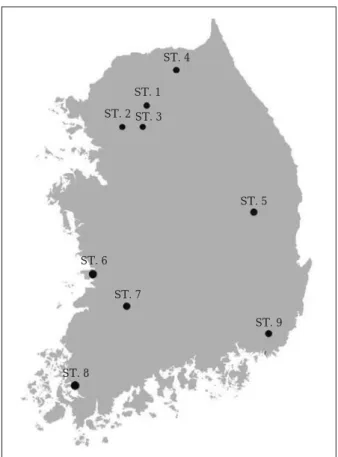
본 실험에 사용한 배스Micropterus salmoides는 2007 년3월부터9월까지 배스가 분포하는 전국의9개 수역에 서 전문 낚시인의 협조를 받아 루어낚시로 직접 채집하 였다. 채집된 조사지점은 Fig. 1과 같으며, 실험에 사용한 배스는 전장 93~521 mm (평균 321.3 mm), 체장 76~
438 mm (평균 269.0 mm), 체중7.4~2,150 g (평균577 g) 이었다.
ST. 1 : 경기도 가평군 청평면(국립수산과학원 중부내 수면연구소, NFRDI)
ST. 2 : 서울시 송파구 석촌동(석촌호) ST. 3 : 경기도 양평군 양서면(팔당호) ST. 4 : 강원도 화천군 화천읍(파로호)
Fig. 1. Map showing the collection sites of Micropterus salmoides from Korea.
ST. 4
ST. 1 ST. 3
ST. 5
ST. 9 ST. 7
ST. 6
ST. 8 ST. 2
ST. 6 : 전라북도 군산시 미룡면(은파저수지) ST. 7 : 전라북도 임실군 운암면(옥정호) ST. 8 : 전남 무안군 삼호읍(영산호) ST. 9 : 경남 양산시 물금읍(낙동강 하류)
2. Genomic DNA 추출
Genomic DNA는 집단 별 10개체씩의 꼬리지느러미 일부를 절단하여Asahida et al. (1996)의 방법에 따라 분 리하고 흡광광도계 측정과 0.7% agarose gel 전기영동을 통해서DNA의 양과 질을 확인한 후 실험에 이용하였다.
3. AFLP 지문 분석
AFLP 분석은 Vos et al. (1995)의 방법을 일부 변형하 여 사용하였다. Genomic DNA 2,000 ng을 EcoR I/Mse I (Promega, USA) 제한효소를 사용하여 반응시켰다. 절단 산물을 순수 분리한 후 EcoR I/Mse I adapter를 첨가하 여 ligation 반응을 실시하고1차PCR하였다. 반응액을1
× TE로 50배 희석하여EcoR I/Mse I selective primer를 이용하여 2차 PCR 을 수행하고 최종 PCR 반응액을 6%
denaturing polyacrylamide gel에서 전기영동하여 DNA 단편을 분리한 다음, silver staining kit (Promega, USA) 로 염색하여 관찰하였다.
4. 유전다양성, 유사도 및 통계 분석
Gel 상에서 각 위치에 확인된 DNA band의 유무에 따 라 0 또는 1로 표시하여 matrix code를 작성한 후, TFPGA (ver. 1.3; http://iubio.bio.indiana.edu.au/ tfpga/) 프로그램을 사용하여(Miller, 1997) 배스 집단 별 및 전 체의 평균 이형접합율(heterozygosity, He)과 평균 유전 다양성(genetic diversity) 수준을 구하고, 집단간의 den- drogram을 작성하였으며, 각집단별의 유전적 유사도는 Nei and Li (1979)의 공식을 적용하여 직접 계산하였다. 각 집단간의 유전적 거리를 구하고Hardy-Weinberg 평형 (HWE)을 검정하기 위하여 유전적 분화도(genetic diffe- rentiation, Fst)를 분석하였다(Wright, 1951). Fst 수치에 대한 유전적 검정(*P)은 무작위 대립유전자 치환(ran- dom allelic permutation) 과정을 10,000번 이상 반복하 여 수행하였다. 이러한 작업은 Arlequin 프로그램(ver.
2.000, Stefan et al., 2000)을 사용하였다. 또한NTSYS 프 로그램을 사용하여(Rohlf, 1992) 각 개체간의 유사도 matrix를 UPGMA (Unweighted Pair-Group Method us-
ing Arithmetic means)로 분석하여 각각을 군집화(clust- ering)하고 이를 토대로dendrogram을 작성하였다.
결과 및 고찰
1. 유전 다양성
3개 primer 조합에서 총 평균 299.2개의 유효 밴드가 출현하여 한 조합당 밴드수는 어름치(Lee et al., 2008b) 의 53개, 미호종개(Lee et al., 2008a)의 37개보다 많은 99.7개로 나타났으며, EcoR I/ Mse I 제한효소를 사용한
AFLP 분석이 효과적으로 수행된 것으로 판단되었다
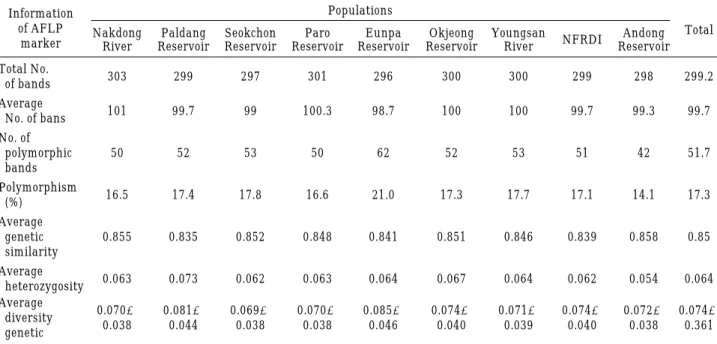
(Fig. 2). 그러나 배스 9집단의 다형성 밴드는 비교적 적 게 나타나 그 비율은 14.1~21%로 분석되었으며, 21.5~
24.5%로 보고된 멸종위기어류인 미호종개보다 오히려
낮은 값을 보였다(Table 1, Lee et al., 2008a).
배스 집단 내 유전적 유사도는 9집단 중 팔당호 집단 내 유사도가 0.835로 가장 낮았고, 안동호 집단이 0.858 로 가장 높게 나타났으나 집단간의 차이는 크지 않았으 며, 평균 0.847로서 분석되어 멸종위기어류인 미호종개의 0.942보다 낮은 것으로 분석되었다(Lee et al., 2008a).
배스 집단의 이형접합율은 평균 0.064로 분석되어 멸 종위기어류인 미호종개(Lee et al., 2008a)의 0.09보다 낮 았으며, 어름치(Lee et al., 2008b)의 0.04 보다는 높게 나 Fig. 2. AFLP fingerprint patterns from nine populations of Micropterus salmoides generated with a primer combination of E/AAT-M/CGT. 1~10, Nakdong River; 11~20, Paldang Reservoir; 21~30, Seok- chon Reservoir; 31~40, Paro Reservoir; 41~50, Eunpa Reservoir; 51~60, Okjeong Reservoir; 61~
70, Youngsan River; 71~80, NFRDI; 81~90, An- dong Reservoir.
타났으나 다른 어류와 비교시(칼납자루, 0.10~0.14; 긴몰 개, 0.1; 임실납자루, 0.04; 미발표자료) 우리나라의 멸종위 기 어류와 비슷한 수준으로 분석되었다. 이처럼 이형접합 율이 매우 낮은 결과는 아마 미국 루이지애너 주립 담수 시험장에서 생산한 양식집단의 비교적 적은 수가 도입된 것이 그 원인으로 추정된다. 또한 팔당호 집단 내 유사도
가 0.835로 가장 낮은 결과는 본 종이 최초로 팔당호에
방류되었고, 이들 집단으로부터 다른 수계에 확산되었기 때문인 것으로 사료된다. 한편 안동호 집단의 유사도가 제일 높게 나타나 이는 비교적 최근에 일부 개체들이 가 입되었음을 시사하였다.
2. 집단의 유전적 분화
상호 유전관계를 밝히기 위해 집단간 유전적 분화도 및 유전적 거리를 분석한 결과, 유전적 분화도는 낙동강 과 안동호 집단사이가 0.398로 가장 높았고, 은파저수지 와 옥정호 집단 사이가 0.125로 가장 낮게 나타났으며, 은파저수지 집단과 옥정호 집단간을 제외한 다른 집단 사이의 유전적 분화도 값이 0.150~0.398로 나타나 (Table 2), Wright (1978)가 제안한 0.05~0.15 범위의 보 통의 분화 정도보다 높은 값을 보여 은파저수지와 옥정 호 집단을 제외한 다른 집단들 간에는 분화가 빠르게 진 행 중인 것으로 나타났으며, 멸종위기어류인 미호종개의 Table 1. Summary on the profiles of AFLP analysis for nine populations of Micropterus salmoides.
Information Populations
of AFLP Nakdong Paldang Seokchon Paro Eunpa Okjeong Youngsan
NFRDI Andong Total marker River Reservoir Reservoir Reservoir Reservoir Reservoir River Reservoir Total No.
303 299 297 301 296 300 300 299 298 299.2
of bands Average
101 99.7 99 100.3 98.7 100 100 99.7 99.3 99.7
No. of bans No. of
polymorphic 50 52 53 50 62 52 53 51 42 51.7
bands Polymorphism
16.5 17.4 17.8 16.6 21.0 17.3 17.7 17.1 14.1 17.3
(%) Average
genetic 0.855 0.835 0.852 0.848 0.841 0.851 0.846 0.839 0.858 0.85
similarity Average
0.063 0.073 0.062 0.063 0.064 0.067 0.064 0.062 0.054 0.064
heterozygosity Average
0.070± 0.081± 0.069± 0.070± 0.085± 0.074± 0.071± 0.074± 0.072± 0.074± diversity
0.038 0.044 0.038 0.038 0.046 0.040 0.039 0.040 0.038 0.361
genetic
Table 2. Pairwise distance (above the diagonal) and pairwise genetic differentiation (below the diagonal) between the nine populations of Micropterus salmoides based on the AFLP analysis.
Populations
Nakdong Paldang Seokchon Paro Eunpa Okjeong Youngsan
NFRDI Andong River Reservoir Reservoir Reservoir Reservoir Reservoir River Reservoir
Nakdong River - 0.035 0.026 0.037 0.035 0.032 0.034 0.048 0.036
Paldang Reservoir 0.245 - 0.032 0.054 0.038 0.038 0.046 0.063 0.056
Seokchon Reservoir 0.197 0.226 - 0.030 0.030 0.022 0.039 0.041 0.035
Paro Reservoir 0.276 0.352 0.229 - 0.026 0.022 0.039 0.035 0.028
Eunpa Reservoir 0.226 0.241 0.208 0.169 - 0.020 0.038 0.036 0.030
Okjeong Reservoir 0.233 0.258 0.158 0.158 0.125 - 0.027 0.031 0.025
Youngsan River 0.256 0.311 0.291 0.290 0.255 0.192 - 0.029 0.028
NFRDI 0.339 0.388 0.301 0.261 0.241 0.223 0.212 - 0.021
Andong Reservoir 0.390 0.381 0.282 0.227 0.222 0.197 0.225 0.160 -
0.105~0.132보다 높은 값을 보였다(Lee et al., 2008a).
위와 같이 옥정호 집단과 은파저수지 집단 사이의 낮은 유전적 분화도는 옥정호에 서식하던 일부 개체가 은파저 수지로 확산된 결과로 판단된다. 또한 이 같은 결과는 미 국에서 도입된 배스가 국내에 정착하여 환경에 빠르게 적응한 결과로 Takamura (2007)의 보고와 같이 서식환
경이 전혀 다른 미국의 배스가 일본에서도 매우 잘 적응 하고 있다는 결과와 일치하였다.
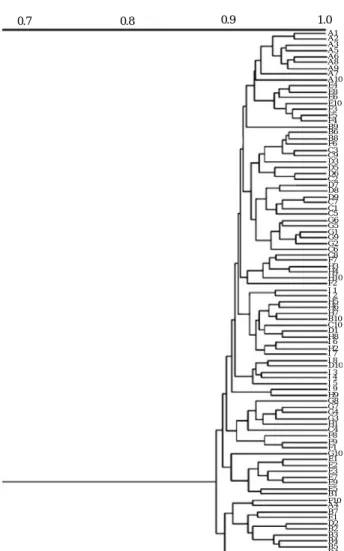
배스 집단간 유전적 거리는 팔당호 집단과 국립수산과 학원 중부내수면연구소 집단이 0.063으로 가장 높게 나 타나 처음 도입된 개체의 일부를 중부내수면 연구소에서 계대 사육한 결과로 보여지며, 은파저수지와 옥정호 집단 이0.020로 가장 낮게 나타났으며, 평균9집단 사이의 집 단 간 유전적 거리가0.020~0.063으로 분석되어 배스 9 집단은 매우 가까운 것으로 나타나 집단간에 큰 차이는 없었다. 유전거리를 기초로 유전적 근연관계를 추정하기 위해 9집단의 개체별UPGMA dendrogram을 분석한 결 과(Fig. 3) 일부 집단의 개체들이 유집되는 결과를 보였 으나, 대부분은 집단의 구분 없이 혼재되어 나타나는 양 상을 보였고, 집단간의 차이가 크지 않아 우리나라의 배 스 집단은 단일 집단으로 추정되었다. 이러한 결과와 상 기한 유전적 거리가 매우 낮음을 고려할 때 배스는 하나 의 작은 집단에서 확산된 중요한 증거가 되고 있다. 또한 집단간UPGMA dendrogram을 그린 결과(Fig. 4) 우리나 라에 최초로 도입된 배스가 팔당호에 방류된 사실과 일 치하였고, 이후에 다른 지역으로 확산되었음을 뒷받침하 였다. 또한 위와 같이 전국적으로 급격히 확산된 배스는 자연적인 영향 또는 사람들의 이용 목적에 의한 인위적 인 확산의 가능성 모두를 배제할 수 없을 것으로 판단되 었다. 한편 Aoki et al. (2006)은 일본에 분포하는 배스가 미국에 분포하는 배스 2종(플로리다배스, M. floridauns;
배스, M. salmoides)이 모두 분포하는 것으로 보고하여 현재 우리나라에 도입되어 분포하는 배스 또한 플로리다
A3 A5 A6A8 A9A7 A10E4 E8E6 E10F3 F5F4 B9B6 B8F6 C3C9 D3 D5 D6C2 D7 D8 D9C7 C1C5 G6 G5 G1 G9 G2 C6 C8F7 H3H4 H10 F2 I 1 I 2 H5H6 H7 B10 C10 D1 H8I 6 H2I 7 I 8D10 I 3I 4 I 5I 9 H9G8 G7 G4 G3H1 C4 F8 F9 F1 G10E1 E2 E3 E7E9 E5B1 F10A4 B7 E1 D2B2 B3B4 B5 D4
Fig. 3. A representative dendrogram showing the genetic relationships among nine Micropterus salmoides populations based on genetic distance data. Den- drogram was constructed by the UPGMA cluster- ing method. A1~10, Nakdong River population;
B1~10, Paldang Reservoir population; C1~10, Seokchon Reservoir population; D1~10, Paro Re- servoir population; E1~10, Eunpa Reservoir pop- ulation; F1~10, Okjeong Reservoir population;
G1~10, Youngsan River population; H1~10, NFRDI population; I1~10, Andong Reservoir pop- ulation. It is note that no clear genetic differentia- tion among the nine populations was observed.
Okjeong Reservoir Paro Reservoir
Seokchon Reservoir
Andong Reservoir Youngsan River Paldang Reservoir
NFRDI Nakdong River
0.050 0.040 0.030 0.020 0.010 0.000
Fig. 4. A representative dendrogram showing the genetic relationships among nine Micropterus salmoides populations based on genetic distance data. Den- drogram was constructed by the UPGMA cluster- ing method.
배스가 함께 도입되었을 가능성도 있어 염기서열 분석과 같은 정확한 종의 구분이 가능한 실험을 통한 플로리다 배스의 도입가능성에 대한 추가 연구도 필요할 것으로 사료된다.
본 연구에서는 전국적으로 확산되어 분포하는 배스 집 단 중9집단만을 분석하였으며, 팔당호와 비슷한 도입 초 기에 방류된 토교지 집단이 본 연구에 포함되어 있지 않 아 추후 토교지를 포함한 전국 집단에 대한 후속 연구가 뒷받침되어야 할 것이다.
사 사
본 연구는 국립수산과학원 중부내수면연구소 경상과제 인 “외래위해어종의 분포실태 및 관리방안 연구” 사업의 일환으로 수행되었으며, 간행물 등록번호는 RP-2008- FR009호 입니다.
적 요
한국에 도입된 외래어종 배스Micropterus salmoides 9 집단의 유전 다양성 및 집단구조를 AFLP 분석을 통해 조사하였다. 3쌍의primer 조합을 이용한 AFLP 분석에서
총 299.2개의 밴드가 생성되어 다형성 밴드의 비율은
14.1~21%로 유사하게 나타났으며, 이형접합률(0.054~
0.067) 및 유전적 다양성(0.069~0.085)은 낮은 값을 보 였다. 집단간 유전적 거리 및 상동성 분석 역시 유사한 결과를 나타내어 본 연구에 사용된 배스 9집단은 유전적 으로 매우 밀접한 근연관계를 나타내었다. 또한 집단간 분화도가 비교적 높게 나타나 9집단의 유전적 분화가 빠 르게 진행 중인 것으로 나타났다. 따라서 배스 집단의 낮 은 유전 다양성과 집단간 분화도 값은 매우 작은 집단이 팔당호에 처음 도입되어 우리나라 전 수계에 확산되었음 을 암시한다.
인 용 문 헌
국립수산진흥원. 2001. 국립수산진흥원 80년사. 동양칼라인쇄, 부산, 611p.
환경부. 2008. 야생동식물보호법. 환경부. http://www.me.go.kr /kor/statute/statute_04.jsp.
홍영표. 2002. 국내 외래어종의 분포와 확산경로 및 조절대책. 한국어류학회 심포지엄, p. 27-43.
Aoki D., Y. Nakayama, M. Hayashi and G. Iwasaki. 2006.
Genetic diversity and origin of Florida largemouth bass (Micropterus salmoides floridanus) introduced into Lake Biwa inferred from the mitochondrial DNA control re- gion. Jap. J. Conserv. Ecol. 11: 53-60.
Asahida, T., T. Kobayashi, K. Saitoh and I. Nakayama.
1996. Tissue preservation and total DNA extraction from fish stored at ambient temperature using buffers containing high concentration of urea. Fish. Sci. 62:
727-730.
Azuma, M. 1992. Ecological release in feeding behavior:
the case of Bluegills in Japan. Hydrobiol. 244: 269-276.
Brown, J.H. and M.V. Lomolino. 1998. Biogeography. Sun- derland, MA: Sinauer, 624p.
Gozlan, R.E., S. St-Hilaire, S.W. Feist, P. Martin and M.L.
Kent. 2005. Disease threat to European fish. Nature 435: 1046
Hong, Y.P. and Y.M. Son. 2003. Studies on the interspecific association of community including Micropterus sal- moides population, introduced fish in Korea. Korean J.
Ichthyol. 15: 61-68. (in Korean)
Jang, M.-H. 2002. Ecological study of freshwater fish in Korea : Fish fauna, prey-predator interaction and the responses of cyanobacteria to fish grazing. Ph. D. dis- sertation, Pusan National Univ. Busan, 224p.
Jang, M.-H., G.-J. Joo and M.C. Lucas. 2006. Diet of intro- duced largemouth bass in Korean rivers and potential interactions with native fishes. Ecol. Freshwater Fish 15(3): 315-320.
Jang, M.-H., J.-G. Kim, S.-B. Park, K.-S. Jeong, G.-I. Cho and G.-J. Joo. 2002. The current status of the distribu- tion of introduced fish in large river systems of South Korea. Internat. Rev. Hydrobiol. 87(2-3): 319-328.
Japanese Ministry of the Environment. 2005. The Invasive Alien Species Act. http://www.env.go.jp/nature/intro/
3shiryou.html.
Lee, I.-R., Y.-A. Lee, H. Shin, Y.K. Nam, W.-J. Kim and I.- C. Bang. 2008a. Genetic diversity of an endangered fish, Iksookimia choii (Cypriniformes), from Korea as assessed by amplified fragment length polymorphism.
Korean Journal of Limnology 41: 97-102. (in Korean) Lee, Y.-A., Y.-E. Yun, Y.K. Nam and I.-C. Bang. 2008b.
Genetic diversity of endangered fish Hemibarbus mylo- don (Cyprinidae) assessed by AFLP. J. Aquaculture 21(3): 196-200.
Maezono, Y. and T. Miyashita. 2002. Community-level im- pacts induced by introduced largemouth bass and blue- gill in farm ponds in Japan. Biol. Conserv. 109: 111-121.
Mariette, S., D. Chagne, C. Lezier, P. Pastuszka, A. Raffin,
thin and among Pinus pinaster populations: comparison between AFLP and microsatellite marker. J. Hered. 86:
469-479.
McDowall, R.M. 1984. Exotic fishes-the New Zealand ex- perience. In Courteny, W.R. and J.R. Stauffer (eds), Distribution, Biology and Management of Exotic Fishes.
John Hopkins University Press, Baltimore, p. 200-214.
Miller, M. 1997. Tools for population genetic analysis (TFPGA) 1.3: a windows program for the analysis of allozyme and molecular population genetic data. Com- puter software distributed by author. http://www.Mark sgenetic software.net /tfpga.htm.
Mueller, U.G. and L.L. Wolfenbarger. 1999. AFLP geno- typing and fingerprinting. Trends in Ecol. Evol. 14:
389-394.
Nei, M. and W.H. Li. 1979. Mathematical model for stud- ing genetical variation in terms of restriction endonu- cleases. Proc. Natl. Acad. Sci. USA 70: 3321-3323.
Rohlf, S.B. 1992. NTSYS-pc numerical taxonomy and mul- tivariate analysis system, version 1.7. Applied Biostati- stics Inc. New York, USA.
Stefan, S., D. Roessli and L. Excoffier. 2000. Arlequin ver.
2.000: A software for population genetics data analysis.
Genetics and Biometry Laboratory, Univ. of Geneva.
Takamura, K. 2007. Performance as a fish predator of lar- gemouth bass Micropterus salmoides (Lacepède) invad-
946.
Terashima, A. 1980. Bluegill: a vacant ecological niche in Lake Biwa. In: T. Kawai, H. Kawanabe and N. Mizuno, Editors, Freshwater Organisms in Japan: Their Ecolo- gy of Invasion and Disturbance, Tokai Univ. Press, To- kyo, p. 63-70.
Vos, P., R. Hodgers, M. Bleeker, M. Reijans, T. van de Lee, M. Hornes, A. Frijters, J. Pot, J. Peleman, M. Kuiper and M. Zabeau. 1995. AFLP, a new technique for DNA fingerprinting. Nucleic Acids Res. 23: 4407-4414.
Wright, S. 1951. The genetic structure of populations. Ann.
Eugen. 15: 323-354.
Wright, S. 1978. Evolution and the genetics of populations;
Vol 4: Variability within and among natural popula- tions. Univ. of Chicago Press, Chicago.
Yodo, T. and S. Kimura. 1998. Feeding habits of largemou- th bass Micropterus salmoides in lakes Shorenji and Nishinoko, Central Japan. Nippon Suisan Gakkaishi 64: 26-28. (in Japanese).
Yodo, T. and S. Kimura. 2002. Gonadal maturation of lar- gemouth bass Micropterus salmoides in lakes Shorenji and Nishinoko, Central Japan. Nippon Suisan Gakkai- shi 68: 151-156. (in Japanese).
(Manuscript received 10 May 2008, Revision accepted 19 August 2008)