Vol. 19, No. 3 pp. 325-336, 2018
간호사 경력개발에 관한 국내 연구 동향 분석
최현주1, 정귀임2*
1가야대학교 간호학과, 2고신대학교 간호대학
The analysis of trends in domestic research on career development of nurses
Hyun-Ju Choi
1, Kwuy-Im Jung
2*1Department of Nursing, Kaya University
2Kosin University College of Nursing
요 약 본 연구의 목적은 간호사를 대상으로 한 경력개발 관련 국내 연구의 최신 동향을 탐색하여 향후 간호‧보건 분야에서 경력관련 논문의 이론적 접근과 실천적 방향성을 제시하고자 시행하였다. 연구 대상은 2008년부터 2017년까지 10년간 국내 학술지에 실린 간호사 경력개발 관련 연구였다. 검색 데이터베이스 RISS 및 KISS등을 통해 검색어를 ‘간호’, ‘간호사’, ‘경 력’, ‘경력개발’, ‘경력개발 프로그램’, ‘경력관리’로 하여 검색된 논문 중 최종 29편의 논문을 분석대상으로 선정하였다. 분석 은 전체적인 동향분석을 위해 연도별, 출처별, 연구설계 및 대상자 별로 살펴보았고, 주제 별 경향성을 파악하기 위해서는 내용분석방법을 채택하였다. 내용분석 결과 상위 범주로 경력개발과 경력개발결과로 나뉘었고, 경력개발의 하위범주로 조직 경력관리, 개인경력관리 경력개발결과의 하위범주로 경력성과로 나뉘었다. 하위범주인 개인경력관리는 경력탐색, 경력계획, 경력정체, 경력단절로 구성되어 있었고, 조직경력관리는 CLS개발 및 적용, CLS 인식도 조사, 경력개발 모형구축으로 구성되 어 있었다. 경력성과는 경력몰입, 조직몰입, 이직의도, CLS 적용 후 변화, 경력만족, 경력변경의도 순으로 구성되어 있었다.
그리고 가장 많이 다룬 주제는 경력성과 중 경력몰입으로 나타났다. 따라서 앞으로 경력개발 관련 간호연구의 방향성은 개인 차원과 조직차원의 욕구를 부합시킨 통합적인 연구가 필요하며, 또한 대상자, 연구설계와 연구주제에 있어서의 다양성이 요 구된다.
Abstract This study was conducted to explore the latest trends in domestic research related to career development for nurses and present a theoretical approach and practical direction of career related papers in the field of nursing and health care. The subject of the study was articles regarding career development of nurses published in domestic journals from 2008 to 2017. The final 29 papers were found after searching the RISS and KISS databases for 'nursing', 'nurse', 'career', 'career development', 'career development program', and 'career management.' To analyze the overall trends, the analysis was reviewed by year, source, research design, and subjects, and content analysis was used to identify trends by topic. The results of content analysis were divided into career development and career development results as the upper categories. The subcategories of career development were divided into organizational career management, personal career management, and career performance. The subcategories of personal career management consisted of career exploration, career planning, career plateau, and career interruption. Organizational career management consisted of CLS development and application, CLS awareness survey, and career development model building. Career performance consisted of career commitment, organizational commitment, turnover intention, change after CLS application, career satisfaction, and career withdrawal intention. The most frequently discussed topics were career commitment among career performance. Therefore, the direction of nursing research related to career development requires integrated research that meets personal and organizational needs, and diversity in subject, research design and research theme is required.
Keywords : Career, Career Commitment, Career Development, Nurse, Research Trends
*Corresponding Author : Kwuy-Im Jung(Kosin Univ.) Tel: +82-51-990-3951 email: [email protected]
Received December 7, 2017 Revised (1st December 27, 2017, 2nd January 9, 2018) Accepted March 9, 2018 Published March 31, 2018
1. 서론
1.1 연구의 필요성
급변하는 노동시장 및 경쟁적인 의료 환경에 효율적 으로 대처하기 위해서 가장 핵심이 되고 있는 것은 인적 자원관리이다. 병원 조직의 인적 자원 중에서도 가장 많 은 수를 차지하며 환자 치료와 간호에 중추적인 역할을 담당하며, 병원 조직성과에 큰 영향을 미치는 간호 인력 에 대한 관리의 중요성은 갈수록 더해지고 있다[1]. 최근 들어 조직구성원들의 교육수준이 높아지고 전문 분야가 세분화, 다양화되면서 조직의 인적자원관리가 조직중심 적인 방식을 탈피하여 구성원들의 경력욕구를 이해하고 이를 효과적으로 관리할 필요성이 더욱 높아졌다[2]. 그 중에서도 병원의 간호사들은 엄격한 교육 방식을 통해 간호 지식을 체계적으로 습득한 전문가 집단으로 자기 자신의 직무와 경력에 대해 큰 관심을 갖고 있으며[1], 환자에 대한 대부분의 서비스가 간호사에 의해 제공되므 로, 질적으로 수준 높은 간호서비스는 의료의 질과 직결 된다고 하겠다[2]. 따라서 우수한 인력을 확보하고 유지 하는 것은 간호의 질을 유지하여 병원의 경쟁력을 높이 는 데 중요하다[2]. 간호사들은 과학적인 단계별 이론교 육과 장시간의 실습교육을 통해 체계적인 간호지식을 습 득한 전문가들로 자신의 경력에 대해 큰 관심을 가지고 있다[1]. 하지만 관료주의적 특성이 강한 병원 조직에서 간호사들은 개인의 경력욕구와 조직 내 현실 사이에서 갈등과 좌절을 경험한다[1]. 그 이유는 간호조직 내에서 경력개발이 주로 인력 수급에만 초점이 맞춰져 있고, 간 호사 개인과 직무특성에 따라 경력개발이 어떻게 이루어 지고 이 경력개발이 조직 목표와 조화를 이룰 것인지에 대한 인식과 노력이 부족하기 때문이다.
경력은 일생을 통한 개인의 일과 관련된 경험으로 자 신 또는 타인의 통제 하에 개인과 조직의 목표 달성을 위해 수행하는 활동을 의미하고[3], 경력개발은 개인이 경력목표와 전략, 전술을 수립하고 실천하는 활동 과정 과, 조직이 필요한 인력을 선발, 배치, 개발, 보상, 보유 하는 총체적인 인력관리체계를 말한다[3]. 경력개발을 통해 조직은 개인에게 미래지향적인 비전을 제시하고 실 현하도록 후원함으로써 개인의 자아실현을 지원하고 더 큰 성과를 기대할 수 있으며, 조직구성원의 사기, 동기부 여, 직무만족 등에 긍정적인 효과를 제공할 수 있는데 [4], 이러한 개인의 성장과 조직의 인적자본 육성을 위해
발전 및 정착시켜 나가야 할 바람직한 제도를 경력개발 제도라 한다[4].
초기에는 경력개발에 있어 조직의 활동을 경력관리 로, 조직구성원인 개인의 활동을 경력계획으로 구분하였 으나, 경력 패러다임의 변화로 과거처럼 조직에 의해 수 동적으로 경력을 관리하는 것이 아닌 개인이 주체가 되 어 경력을 개발하고자 하는 경향을 증가시켰다[5]. 이와 같이 최근에는 경력관리라는 용어를 개인적 차원과 조직 적 차원으로 구분하지 않고 양쪽 부분에 모두 사용되고 있다[6]. 경력관리란 개인차원에서는 경력목표를 설정하 고 이를 달성하기 위한 계획을 수립하고 실천하며 점검 하는 활동과정을 의미한다[7]. 조직 차원에서는 조직이 미래 필요성에 대비하여 구성원을 선발, 평가, 배치, 개 발하는 과정 및 조직의 요구와 개인의 요구가 일치할 수 있도록 개인의 경력 개발을 지원하고 관리하는 활동을 말한다[6]. 앞으로 병원의 간호조직은 조직중심적인 관 리방식을 통해서는 간호사들로부터 조직에 대한 관심이 나 애착, 간호서비스의 질 향상을 기대할 수 없으며, 간 호 업무의 전문성과 간호사 개인의 경력구도를 이해하고 조직이 이를 효과적으로 관리해야만 경력관리의 성과를 이끌어 낼 수 있다[2]. 이처럼 기존의 조직주도의 경력개 발 시대에서 개인주도 접근과 조직의 관리가 함께 중요 해 지는 경력패러다임의 변화에 따라 간호사 대상 경력 개발관련 연구의 최근 동향을 체계적으로 정리해보는 것 은 의미가 있다고 본다. 지난 10년간 간호사 경력관련 변인을 탐색하는 다양한 연구들이 있었지만 간호사 경력 관련 논문을 경력개발에 초점을 두고 체계적으로 분석한 연구는 없었다. 이는 경력에 대한 여러 접근과 대상의 범 위가 넓기 때문에 경력에 대한 여러 개념과 접근을 단일 한 하나의 체계로 포괄하기에는 한계점이 있기 때문이다 [8]. 경력개발에 관한 연구동향분석 선행 연구로는 기업 을 대상으로 하는 경력개발에 관한 연구동향분석 연구 [9]가 있었고, 국내외 경력개발 연구 및 프로그램 동향분 석을 한 연구[8]가 있었다. 하지만 이 연구들은 기업을 대상으로 하거나 청소년, 대학생, 기업 내 근로자나 여성 전체에 초점을 맞춘 것으로, 간호사만을 대상으로 내용 요소별로 경력개발의 범주를 구성하고 개인경력관리와 조직경력관리 모두를 통합하여 분석한 연구는 없었다.
이에 본 연구에서는 간호사를 대상으로 한 경력개발 관련 국내 연구의 동향을 탐색하기 위해 내용분석 방법 을 사용하여 지난 10년간 경력관련 연구들을 경력개발
의 범주 별로 체계적으로 구성하고 이 내용 요소 별로 분석하고자 하였다.
1.2 연구의 목적
본 연구의 목적은 간호사를 대상으로 한 경력개발 관 련 국내 연구의 최신 동향을 탐색하기 위해 내용분석 방 법을 사용하여 경력개발 연구의 구성요소들을 확인하고 자 하였다. 그에 따라 간호사 경력개발을 위한 이론적 접 근과 실천적 방향성을 제시하고 효율적인 간호인력 관리 의 기초자료를 제공하는데 목적이 있다. 또한 이 연구의 결과를 토대로 향후 간호 경력 연구를 위한 연구방향을 제시함에 의의가 있다.
2. 연구방법
2.1 연구설계
본 연구는 최근 10년간 간호사를 대상으로 한 경력개 발 관련 국내 연구논문을 내용분석법으로 분석한 문헌고 찰 연구이다.
2.2 연구문제 규정
간호사를 대상으로 한 경력개발에 관한 연구들의 동 향분석을 위해 본 연구에서 제기하는 2가지 문제는 다음 과 같다.
1) 국내에서 보고된 간호사를 대상으로 한 경력개발 연구의 일반적 연구동향은 어떠한가?
2) 국내에서 보고된 간호사를 대상으로 한 경력개발 연구의 내용요소별 연구동향은 어떠한가?
가. 간호사 경력개발의 범주별 연구동향은 어떠한 가?
나. 간호사 경력개발의 하위 범주별 연구동향은 어떠한가?
다. 간호사 경력개발의 주제별 동향은 어떠한가?
2.3 연구대상 2.3.1 선정기준
분석대상이 된 논문의 구체적인 선정기준은 다음과 같다.
1) 2008년 1월부터 2017년 9월까지 10년간 국내에서
발표된 간호사를 대상으로 한 논문
2) 심사위원의 심사를 거쳐 게재된 학술지 논문
2.3.2 제외기준
분석대상이 된 논문의 구체적인 제외기준은 다음과 같다.
1) 학술대회 발표논문 또는 출판되지 않은 학위논문 2) 학술지 논문과 학위논문의 중복 시 학술지 논문 3) 경력이라는 단어는 들어가나 경력개발이나 경력개
발결과와 무관한 내용의 논문 4) 연구대상자가 없는 이론 연구
2.4 자료수집
본 연구는 자료수집 전 대학소속기관에서 연구윤리위 원회의 연구승인을 받았다(IRB-0096-01호). 자료 수집 및 분석기간은 2017년 09월 20일부터 11월 30일까지였 으며 검색 데이터베이스는 한국교육학술정보원 (www.riss4u.co.kr), 한국학술정보(kiss.kstudy.com), 국 회도서관, 디비피아(www.dbpia.co.kr)를 이용하였다. 논 문 검색에 사용된 주요 핵심 단어는 ‘간호’, ‘간호사’,
‘경력’, ‘경력개발’, ‘경력개발 프로그램’, ‘경력관리’,
‘nurse’, ‘career’, ‘career development’, ‘career development system’, ‘career management’, ‘career management system’, ‘career development program’,
‘career management program’으로 조합하였으며 각 데 이터베이스 별로 자료를 받아 엑셀로 저장하였다. 검색 된 경력과 관련이 없는 논문, 경력이라는 검색어가 논문 제목에 포함되어 있으나 원문이 제공되지 않는 학술대회 초록집, 간호사와 경력이라는 단어가 각 논문의 제목에 낱말로 포함되어 의미가 달라지거나 모호해진 논문, 간 호사가 대상자가 아닌 경력관련 논문, 간호사가 대상자 이나 경력과 관련 없는 논문, 저자요청의 이유로 서지정 보만 제공되고 원문은 제공되지 않는 논문, 회색문헌(석
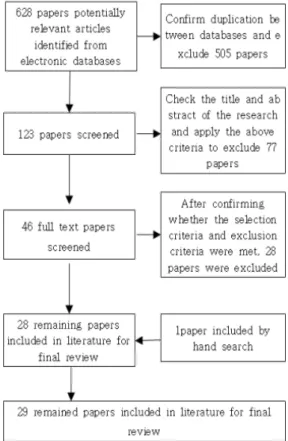
‧박사 학위논문, 연구보고서, 포스터 및 구연자료)등은 배재하였다. 일차적으로 논문검색 데이터베이스에서 검 색 된 논문은 총 628편이었으며 이 중 데이터베이스 간 중복여부를 확인하여 남은 논문은 123편이었다. 123편 중 연구제목과 초록을 확인하여 위의 기준을 적용하여 77편을 제외하자 검색조건을 충족시킨 논문은 모두 46 편이었다. 그 후 46편의 원본을 모두 확보하여 읽으면서
선정기준과 제외기준의 부합 여부를 재 확인하는 과정을 거쳤으며 그 결과 최종 28편의 논문이 선정되었으며 28 편 연구의 참고문헌 목록을 확인하는 과정에서 직접 수 기로 찾은 논문 1편을 추가로 포함하였다. 그리하여 최 종 분석에 사용된 논문은 총 29편이었다[Figure 1].
Fig. 1. Flowchart for article relevance assessment.
2.5 자료의 질 평가
본 연구는 한 가지 연구 설계가 아닌 간호사 경력개발 과 관련된 다양한 연구설계의 논문들을 통합적으로 내용 을 분석하는 작업이므로, 한 가지 논문의 질 평가도구를 사용하는 것은 적합하지 않을 수 있으며, 명확한 근거를 두고 연구의 선정기준과 제외기준을 적용하는 것이 중요 하다고 한 Whittemore와 Knafl[10]의 주장에 따라 통합 적 고찰에서 사용하는 엄격한 선정기준을 적용하였다.
우선적으로 심사위원의 심사를 거쳐 학술지에 게재되었 던 논문만을 대상으로 하였으며, 2인의 공동 연구자들이 통찰력과 심도 있는 논의를 통해 엄격한 선정기준과 제 외기준을 적용하였으며, 각 논문의 발표연도, 출처, 연구
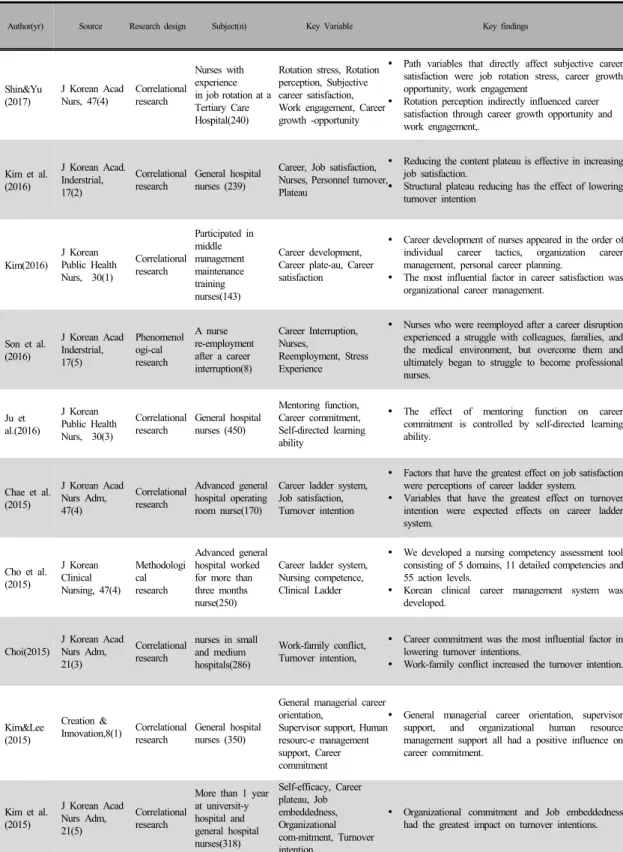
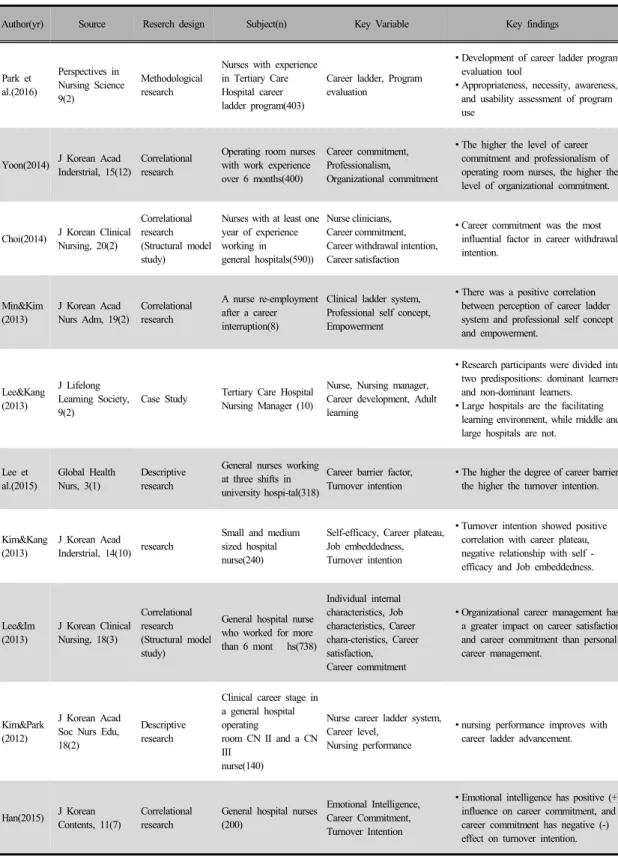
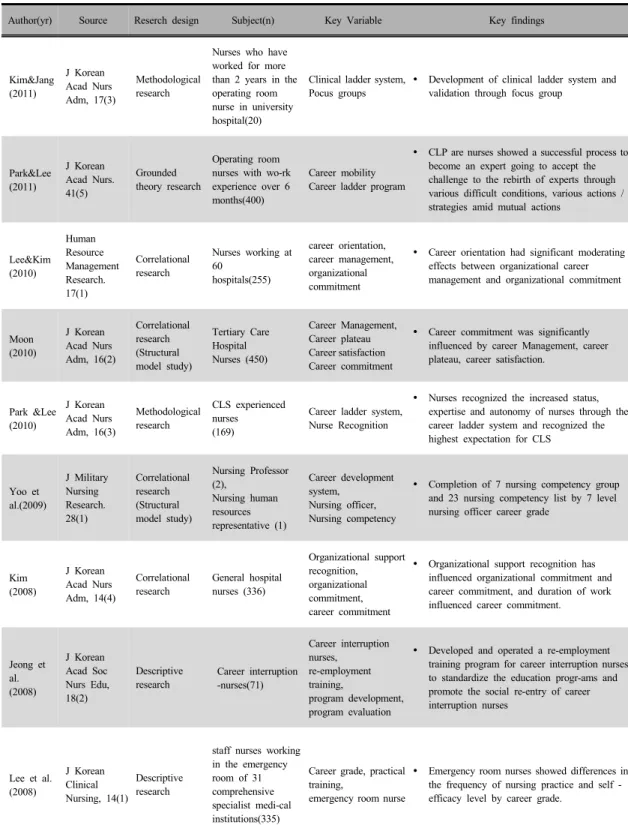
방법, 연구대상자, 주요변수 및 주요 연구결과 등으로 구 분하여 매트릭스를 작성하고 분석하면서 각각의 논문의 질을 평가하였다. 연구의 질 평가 결과 분석 대상이 된 논문 29편은 모두 적절하다고 판단하였고, 따라서 본 연 구의 최종 분석 대상 논문 수는 29편이었다[Table 1].
2.6 자료분석 2.6.1 분석방법
간호사 경력개발과 관련된 국내 연구의 분석을 위한 방법과 준거는 연구 동향을 다루고 있는 선행연구[8]를 참고하여 재구성하였다. 전체적인 동향분석을 위한 틀은 연도별, 출처별, 연구설계 및 대상자 별로 살펴보았다.
이는 준거별 연구의 특성 및 전체적인 경향성을 파악할 수 있도록 도와준다[8]. 연구설계는 먼저 양적과 질적으 로 구분한 후 연구목적에 따른 분류[11]를 사용하여 상 관성 연구, 서술연구, 방법론적 연구로 분류하였다. 탐색 적 서술연구, 서술적 상관관계연구, 비교서술연구는 서 술연구로, 인과관계 연구, 효과연구, 모형구축 연구는 상 관성 연구로 코딩하였다.
간호사 대상 국내 경력개발연구의 주제 별 경향성을 파악하기 위해서는 내용분석방법을 채택하였다. 내용분 석은 사회과학의 한 도구로서 크리픈도프(Krippendorf, 1980)[12]는 내용분석을 데이터로부터 데이터의 상황에 대한 반목 가능하고도 타당한 추론을 끌어내는 데 필요 한 하나의 연구기법으로 정의하였다. 내용분석에 대한 정의는 학자에 따라 조금씩 차이가 있으나 공통적인 인 식은 객관성, 체계성 및 일반성을 갖추어야 한다는 것이 다. 객관성이란 조사자의 개인적 특성이나 편견이 분석 결과에 개입되어서는 안 되며, 다른 연구자가 반복해도 동일한 분석결과가 나와야 함을 말한다. 체계성이란 명 백하고 일관성 있는 규칙에 따라 표본을 선정해야하며 각 항목은 분석에 포함될 수 있는 균등한 기회를 가져야 만 하는 것을 말한다. 그리고 일반성은 연구결과가 이론 적인 관계성을 가져야한다는 것을 말한다[8]. 따라서 본 연구에서는 간호사 경력개발 연구의 주제별 경향성을 살 펴보기 위한 분석방법으로 내용분석법을 사용하였다. 그 리하여 간호사 경력개발의 내용을 객관적이고 체계적으 로 분석하고 경력개발에 관한 통합적인 경향성을 탐색하 였다.
Table 1. Chronological Summary of the Reviewed Papers
Author(yr) Source Research design Subject(n) Key Variable Key findings
Shin&Yu (2017)
J Korean Acad Nurs, 47(4)
Correlational research
Nurses with experience in job rotation at a Tertiary Care Hospital(240)
Rotation stress, Rotation perception, Subjective career satisfaction, Work engagement, Career growth -opportunity
y Path variables that directly affect subjective career satisfaction were job rotation stress, career growth opportunity, work engagement
y Rotation perception indirectly influenced career satisfaction through career growth opportunity and work engagement,.
Kim et al.
(2016)
J Korean Acad.
Inderstrial, 17(2)
Correlational research
General hospital nurses (239)
Career, Job satisfaction, Nurses, Personnel turnover, Plateau
y Reducing the content plateau is effective in increasing job satisfaction.
y Structural plateau reducing has the effect of lowering turnover intention
Kim(2016)
J Korean Public Health Nurs, 30(1)
Correlational research
Participated in middle management maintenance training nurses(143)
Career development, Career plate-au, Career satisfaction
y Career development of nurses appeared in the order of individual career tactics, organization career management, personal career planning.
y The most influential factor in career satisfaction was organizational career management.
Son et al.
(2016)
J Korean Acad Inderstrial, 17(5)
Phenomenol ogi-cal research
A nurse re-employment after a career interruption(8)
Career Interruption, Nurses,
Reemployment, Stress Experience
y Nurses who were reemployed after a career disruption experienced a struggle with colleagues, families, and the medical environment, but overcome them and ultimately began to struggle to become professional nurses.
Ju et al.(2016)
J Korean Public Health Nurs, 30(3)
Correlational
research General hospital nurses (450)
Mentoring function, Career commitment, Self-directed learning ability
y The effect of mentoring function on career commitment is controlled by self-directed learning ability.
Chae et al.
(2015)
J Korean Acad Nurs Adm, 47(4)
Correlational research
Advanced general hospital operating room nurse(170)
Career ladder system, Job satisfaction, Turnover intention
y Factors that have the greatest effect on job satisfaction were perceptions of career ladder system.
y Variables that have the greatest effect on turnover intention were expected effects on career ladder system.
Cho et al.
(2015)
J Korean Clinical Nursing, 47(4)
Methodologi cal research
Advanced general hospital worked for more than three months nurse(250)
Career ladder system, Nursing competence, Clinical Ladder
y We developed a nursing competency assessment tool consisting of 5 domains, 11 detailed competencies and 55 action levels.
y Korean clinical career management system was developed.
Choi(2015)
J Korean Acad Nurs Adm, 21(3)
Correlational research
nurses in small and medium hospitals(286)
Work-family conflict, Turnover intention,
y Career commitment was the most influential factor in lowering turnover intentions.
y Work-family conflict increased the turnover intention.
Kim&Lee (2015)
Creation &
Innovation,8(1) Correlational research
General hospital nurses (350)
General managerial career orientation,
Supervisor support, Human resourc-e management support, Career commitment
y General managerial career orientation, supervisor support, and organizational human resource management support all had a positive influence on career commitment.
Kim et al.
(2015)
J Korean Acad Nurs Adm, 21(5)
Correlational research
More than 1 year at universit-y hospital and general hospital nurses(318)
Self-efficacy, Career plateau, Job embeddedness, Organizational com-mitment, Turnover intention
y Organizational commitment and Job embeddedness had the greatest impact on turnover intentions.
Table 1. (Continued from the previous pages.1) Chronological Summary of the Reviewed Papers
Author(yr) Source Reserch design Subject(n) Key Variable Key findings
Park et al.(2016)
Perspectives in Nursing Science 9(2)
Methodological research
Nurses with experience in Tertiary Care Hospital career ladder program(403)
Career ladder, Program evaluation
∙Development of career ladder program evaluation tool
∙Appropriateness, necessity, awareness, and usability assessment of program use
Yoon(2014) J Korean Acad Inderstrial, 15(12)
Correlational research
Operating room nurses with work experience over 6 months(400)
Career commitment, Professionalism, Organizational commitment
∙The higher the level of career commitment and professionalism of operating room nurses, the higher the level of organizational commitment.
Choi(2014) J Korean Clinical Nursing, 20(2)
Correlational research (Structural model study)
Nurses with at least one year of experience working in general hospitals(590))
Nurse clinicians, Career commitment, Career withdrawal intention, Career satisfaction
∙Career commitment was the most influential factor in career withdrawal intention.
Min&Kim (2013)
J Korean Acad Nurs Adm, 19(2)
Correlational research
A nurse re-employment after a career interruption(8)
Clinical ladder system, Professional self concept, Empowerment
∙There was a positive correlation between perception of career ladder system and professional self concept and empowerment.
Lee&Kang (2013)
J Lifelong Learning Society, 9(2)
Case Study Tertiary Care Hospital Nursing Manager (10)
Nurse, Nursing manager, Career development, Adult learning
∙Research participants were divided into two predispositions: dominant learners and non-dominant learners.
∙Large hospitals are the facilitating learning environment, while middle and large hospitals are not.
Lee et al.(2015)
Global Health Nurs, 3(1)
Descriptive research
General nurses working at three shifts in university hospi-tal(318)
Career barrier factor, Turnover intention
∙The higher the degree of career barrier, the higher the turnover intention.
Kim&Kang (2013)
J Korean Acad Inderstrial, 14(10) research
Small and medium sized hospital nurse(240)
Self-efficacy, Career plateau, Job embeddedness, Turnover intention
∙Turnover intention showed positive correlation with career plateau, negative relationship with self - efficacy and Job embeddedness.
Lee&Im (2013)
J Korean Clinical Nursing, 18(3)
Correlational research (Structural model study)
General hospital nurse who worked for more than 6 mont hs(738)
Individual internal characteristics, Job characteristics, Career chara-cteristics, Career satisfaction, Career commitment
∙Organizational career management has a greater impact on career satisfaction and career commitment than personal career management.
Kim&Park (2012)
J Korean Acad Soc Nurs Edu, 18(2)
Descriptive research
Clinical career stage in a general hospital operating
room CN II and a CN III
nurse(140)
Nurse career ladder system, Career level,
Nursing performance
∙nursing performance improves with career ladder advancement.
Han(2015) J Korean Contents, 11(7)
Correlational research
General hospital nurses (200)
Emotional Intelligence, Career Commitment, Turnover Intention
∙Emotional intelligence has positive (+) influence on career commitment, and career commitment has negative (-) effect on turnover intention.
Table 1. (Continued from the previous pages.2) Chronological Summary of the Reviewed Papers
Author(yr) Source Reserch design Subject(n) Key Variable Key findings
Kim&Jang (2011)
J Korean Acad Nurs Adm, 17(3)
Methodological research
Nurses who have worked for more than 2 years in the operating room nurse in university hospital(20)
Clinical ladder system, Pocus groups
y Development of clinical ladder system and validation through focus group
Park&Lee (2011)
J Korean Acad Nurs.
41(5)
Grounded theory research
Operating room nurses with wo-rk experience over 6 months(400)
Career mobility Career ladder program
y CLP are nurses showed a successful process to become an expert going to accept the challenge to the rebirth of experts through various difficult conditions, various actions / strategies amid mutual actions
Lee&Kim (2010)
Human Resource Management Research.
17(1)
Correlational research
Nurses working at 60
hospitals(255)
career orientation, career management, organizational commitment
y Career orientation had significant moderating effects between organizational career management and organizational commitment
Moon (2010)
J Korean Acad Nurs Adm, 16(2)
Correlational research (Structural model study)
Tertiary Care Hospital Nurses (450)
Career Management, Career plateau Career satisfaction Career commitment
y Career commitment was significantly influenced by career Management, career plateau, career satisfaction.
Park &Lee (2010)
J Korean Acad Nurs Adm, 16(3)
Methodological research
CLS experienced nurses (169)
Career ladder system, Nurse Recognition
y Nurses recognized the increased status, expertise and autonomy of nurses through the career ladder system and recognized the highest expectation for CLS
Yoo et al.(2009)
J Military Nursing Research.
28(1)
Correlational research (Structural model study)
Nursing Professor (2),
Nursing human resources representative (1)
Career development system,
Nursing officer, Nursing competency
y Completion of 7 nursing competency group and 23 nursing competency list by 7 level nursing officer career grade
Kim (2008)
J Korean Acad Nurs Adm, 14(4)
Correlational research
General hospital nurses (336)
Organizational support recognition, organizational commitment, career commitment
y Organizational support recognition has influenced organizational commitment and career commitment, and duration of work influenced career commitment.
Jeong et al.
(2008)
J Korean Acad Soc Nurs Edu, 18(2)
Descriptive research
Career interruption -nurses(71)
Career interruption nurses,
re-employment training,
program development, program evaluation
y Developed and operated a re-employment training program for career interruption nurses to standardize the education progr-ams and promote the social re-entry of career interruption nurses
Lee et al.
(2008)
J Korean Clinical Nursing, 14(1)
Descriptive research
staff nurses working in the emergency room of 31 comprehensive specialist medi-cal institutions(335)
Career grade, practical training,
emergency room nurse
y Emergency room nurses showed differences in the frequency of nursing practice and self - efficacy level by career grade.
2.6.2 내용분석 준거
간호사 경력개발연구의 동향을 분석하기 위한 내용분 석준거는 먼저 가장 상위 범주로 경력개발과 경력개발결 과로 나누었고, 경력개발의 하위범주로 개인경력관리, 조직경력관리를, 경력개발결과의 하위범주로 경력성과 로 구분하였다. 하위범주는 내용 별 분석을 좀 더 세분화 하여 내용 별 주제로 구분하였다[Figure 2].
Fig. 2. Content analysis criteria
3. 연구결과
3.1 연구의 일반적 특성
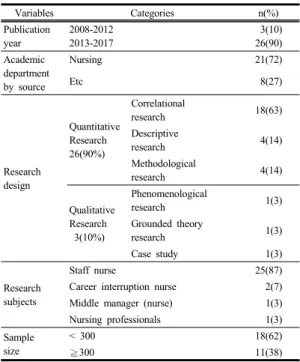
간호사 경력개발과 관련된 최근 10년간의 연구의 전 체적인 경향성을 파악하기 위한 일반적 특성은 다음과 같다. 발표 연도는 2013-2017년이 26편(90%)으로 최근 5년간 논문이 대다수를 차지했고, 출처는 간호학술지가 21편(72%)로 대부분이었다. 연구설계 별로는 양적연구 가 26편(90%)으로 대부분이었고 양적연구 내에서는 상 관성 연구(63%), 서술 연구(14%), 방법론적 연구(14%) 순이었다. 질적연구는 현상학적 연구(3%), 근거이론 (3%), 사례연구(3%)로 고른 분포를 보였다. 연구대상자
별로는 현재 병원에 근무 중인 일반 경력간호사가 대부 분이었고(87%), 경력단절간호사(7%), 중간관리자(3%), 간호인사전문가(3%)로 구성되어있었다. 표본 수는 300 개 미만이 18편(62%), 300개 이상이 11편(38%)으로 나 타났다[Table 2].
Table 2. General Analysis of the Review Papers (N=29)
Variables Categories n(%)
Publication year
2008-2012 2013-2017
3(10) 26(90) Academic
department by source
Nursing 21(72)
Etc 8(27)
Research design
Quantitative Research 26(90%)
Correlational
research 18(63)
Descriptive
research 4(14)
Methodological
research 4(14)
Qualitative Research 3(10%)
Phenomenological
research 1(3)
Grounded theory
research 1(3)
Case study 1(3)
Research subjects
Staff nurse 25(87)
Career interruption nurse 2(7)
Middle manager (nurse) 1(3)
Nursing professionals 1(3)
Sample size
< 300 18(62)
≧300 11(38)
3.2 연구의 주제별 내용분석 결과
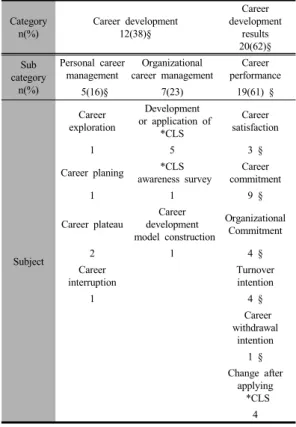
본 연구의 간호사 경력개발연구의 동향을 분석하기 위한 주제별 내용분석 결과는 다음과 같다[Table 3].
먼저 가장 상위 범주로 경력개발은 12편(38%), 경력 개발결과는 20편(62%)으로(경력개발, 경력개발결과 중 복 3편) 나뉘었고, 경력개발의 하위범주로 개인경력관리 5편(경력성과와 2편 중복), 조직경력관리 7편, 경력개발 결과의 하위범주로 경력성과 19편(개인경력관리와 2편 중복)으로 나왔다. 하위범주인 개인경력관리는 경력탐색 1편, 경력계획 1편, 경력정체 2편, 경력단절 1편 이었다.
조직경력관리는 CLS개발 및 적용 5편, CLS 인식도 조 사 1편, 경력개발 모형구축 1편으로 구성되어 있었다.
경력성과는 경력몰입 9편, 조직몰입 4편, 이직의도 4편, CLS 적용 후 변화 4편, 경력만족 3편, 경력변경의도 1편 순 이었다.
Table 3. Thematic content analysis of the Review Papers (N=29) Category
n(%)
Career development 12(38)§
Career development
results 20(62)§
Sub category
n(%)
Personal career
management Organizational
career management Career performance
5(16)§ 7(23) 19(61) §
Subject
Career exploration
Development or application of
*CLS
Career satisfaction
1 5 3 §
Career planing *CLS
awareness survey Career commitment
1 1 9 §
Career plateau
Career development model construction
Organizational Commitment
2 1 4 §
Career interruption
Turnover intention
1 4 §
Career withdrawal
intention 1 § Change after
applying *CLS
4
*CLS: Career Ladder System
§: reduplication
4. 논의
본 연구는 간호사를 대상으로 한 경력개발 관련 국내 연구의 최신 동향을 탐색하여 향후 간호‧보건 분야에서 경력관련 논문의 이론적 접근과 실천적 방향성을 제시하 고자 시도되었으며, 주요 결과들을 논의해보면 다음과 같다.
먼저 전체적인 동향분석의 결과에서 첫째, 발표된 논 문의 연도 별 분포는 최근 5년간에 편중되는 경향을 보 였는데, 이전에는 경력이나 경력개발에 대한 개념이 간 호영역에서는 낯선 개념이었고, 미국에서도 경력개발프 로그램이 본격적으로 조직에 확산되어 실시된 것은 1970년대 들어서라고 할 수 있으며, 80년대 들어와서야 경력개발에 대한 관심이 커져 다양한 연구가 이루어지기 시작했다고 하였다[9]. 우리나라의 경우 본격적으로 1990년 들어서 조직경력개발에 연구가 활성화 되었으
며, 간호영역에서는 2003년과 2004년부터 공식적으로 2개 상급종합병원에서 간호사 경력개발제도(CLS)를 도 입, 적용[13]하면서부터 간호사들의 경력개발과 조직적 인 관리에 대한 관심이 증폭되기 시작했다. 따라서 우리 나라의 간호사 경력관련 연구는 역사가 짧은 편이므로 앞으로 개척해야할 부분이 많은 분야라 생각된다.
연구설계 별로 살펴보면 양적연구가 대부분(90%)이 었고 질적연구는 비중이 적었는데(10%), 국내외 전체 분야의 경력개발 연구 및 프로그램 동향분석을 한 Choi[8]의 연구에서도 사례나 질적연구가 14%만 차지 하고 양적연구가 대부분인 것으로 나와 유사한 경향성을 보이고 있었다. 양적연구 내에서는 상관성 연구(63%), 서술 연구(14%), 방법론적 연구(14%) 순이었는데, 간호 파트에서 경력관련 연구가 관련 변수들 간의 상관관계, 인과관계를 확인하는 서술적 조사연구에 편중되어 있는 현 실정을 보여주는 결과이다. 경력이 간호학에서 나온 개념은 아니지만 최근 간호사 인적자원관리가 병원 조직 성과에 큰 영향을 미치는 중요한 요소로 대두[1]된 만큼 간호학에서도 경력개발과 관리에 대한 다양한 연구 주제 와 연구방법이 확산되었으면 하는 바람이다.
연구대상자별로는 병원근무 경력 최소 1년 이상, 종 합병원 이상(종합병원~상급종합병원), 일반 간호사를 대 상으로 한 연구가 가장 많았는데, 이는 현재 우리나라의 일부 병원에서 시행중인 CLS가 상급 종합병원을 중심 으로 개발되었으며, 5개 등급 중에서 초보자인 1년 미만 은 신규간호사로서 적응기에 해당하고 자동승급 되는 것 으로 되어있어[14]경력관련 연구 대상자로는 적응기가 끝난 1년 이상의 경력간호사가 적절한 것으로 사료된다.
그리고 연구대상자들이 현재 병원에 근무 중인 staff 간 호사에게만 치중되어 있어 경력단절 간호사, 간호관리 자, 병원조직 외에 다양한 분야에서 근무 중인 간호사 등 대상자를 넓혀서 다양한 연구를 해 볼 필요가 있다. 그리 고 국내외 전체 경력개발 연구에 대한 동향분석을 한 Choi[8]의 연구에서는 대상자 분포가 직장인뿐만 아니 라 초등학생에서부터 대학생에 이르기까지 학년별로 다 양한 접근이 시도된 것을 볼 수 있는데, 간호경력에서도 간호사뿐만 아니라 미래의 간호사로서 본인의 career를 단계별로 쌓아가고 있는 간호대학생을 대상으로 하는 경 력 연구도 필요할 것으로 생각된다.
간호사 대상 국내 경력개발 연구의 주제 별 경향성을 파악하기 위한 내용분석 결과에서 ‘경력개발’보다는 ‘경
력개발결과’에 대한 연구가 더 많았는데, 이는 앞서 연구 설계의 동향 결과에서 나왔듯이 간호파트의 경력관련 연 구가 변수들 간의 인과관계를 확인하는 상관성 연구에 편중되어 있어, 선행 요인들로 인한 결과변수로서 ‘경력 개발결과’에 치중한 것으로 보인다. ‘경력개발결과’의 하 위 범주인 ‘경력성과’에서 가장 많이 다룬 주제는 ‘경력 몰입’으로 나왔다. 이는 경력관련 연구의 발원지인 미국 에서 1980년대 들어오면서 간호직과 같은 전문직을 대 상으로 경력몰입에 대한 연구가 활발하게 연구가 이루어 졌으며[15-16], 국내에서도 이 선행연구들의 영향을 받 아 호텔종사원, 경찰공무원, 소방공무원 등과 같은 직종 을 대상으로 이루어진 연구에서 경력몰입이 가장 큰 경 력성과로 나왔으며[17-18], 이에 간호사를 대상으로 경 력몰입을 경력성과로 한 연구가 가장 많이 이루어진 것 으로 보인다.
경력개발의 하위범주에서는 개인경력개발보다 조직 경력개발의 수가 더 많았는데 이는 우리나라의 간호경 력개발 연구의 본격적인 시초는 미국에서 1980년대부터 높은 역량을 갖춘 간호사를 보유하기 위한 전략으로 임 상등급 또는 경력사다리 개념을 사용한 평가 및 보상체 계가 적용되기 시작하였고, 이에 우리나라도 2003년부 터 CLS를 일부 도입[13]한 이후부터 병원조직과 간호조 직의 경력관리를 중심으로 연구가 집중되었는데, 초기 시행된 CLS는 개인보다는 조직의 목표가 우선시 되는 조직차원의 제도였기 때문에 본 연구에서 나타난 연구동 향에서도 개인보다 조직경력개발에 대한 연구가 많았던 것으로 보인다. 국외는 국내와 달리 개인의 목표를 우선 시 하여 개인의 생애주기 발달 단계 접근 차원의 연구가 많으므로[8], 앞으로는 간호사 대상 연구에서도 조직이 나 개인에 치우치지 않고, 간호사 개인의 특성을 고려하 여 조직의 체계적인 시스템과 지지체계가 따를 수 있는 통합적인 경력관련 연구가 필요하다고 본다.
조직경력관리에서는 CLS의 개발, CLS의 개발 및 적 용이 가장 많았고, CLS 시행 후 인식도를 측정하는 도구 를 개발하여 인식정도를 알아보는 연구와 경력관리모형 을 구축하는 연구 등이 있었다. 이 또한 앞서 언급했듯이 2003년 CLS시행이후 이 시스템을 개발하고 검증하는 연구가 집중된 것으로 본다. 외국의 경우 CLS를 간호업 무의 향상 뿐 아니라 평가 및 보상 측면 등에서 다양하 게 운영함으로써 유능한 간호사의 이직을 예방하고 채용 비용을 절감하여 비용 효과적이면서도 질적으로 우수한
간호서비스를 생산해내고 있다[19]. 하지만 우리나라의 경우 이 제도에 대한 전반적인 실행에 대한 공감과 이해 부족, 구체적인 적용방법과 지식의 부족, 행정적 지원의 부족, 보상체계에 대한 병원 측의 재정적인 지원부담등 으로[20], CLS는 일부 상급종합병원의 일부 부서를 중 심으로 시행되고 있다. 따라서 간호조직의 유효성을 극 대화하고 간호사의 전문적 성장을 통한 직무만족도를 향 상시키는 목적으로 CLS를 널리 보급하기 위해서는 한국 의 간호실정에 맞게 재 해석하여 토착화시키는 작업이 필수적이다[20]. 그리고 현재 CLS등 경력개발에 관련해 서 소외되는 중소병원 간호사의 경력개발에 관한 연구는 더욱 보기 드문 실정이다. 중소병원 간호사는 대형병원 에 비해 상대적으로 열악한 근무환경과 간호인력 부족으 로, 이직뿐만 아니라 중소병원에서 대형병원으로의 간호 사 이동 현상이 심각한 수준에 이르고 있으므로 경력이 동과 경력단절의 경우가 많으며, 조직의 경력개발관리에 대한 지원도 부족한 실정이다[21]. 따라서 앞으로는 대 형 병원뿐만 아니라 중소형 병원의 간호사를 대상으로도 경력개발에 대한 연구가 활발히 진행되어야 할 것이다.
개인경력관리에서는 경력정체, 경력탐색, 경력계획, 경력단절 등이 고른 분포를 보였는데, 개인경력관리의 주요 초점 중의 하나로 손꼽히는 경력전략실행과 경력전 술[5]에 대한 연구는 없었다. 따라서 추후에는 개인의 경 력관리행동의 단계에서 다루고 있는 주요 초점 등을 단 계별, 통합적으로 연구해 볼 필요성이 있다.
5. 결론 및 제언
본 연구는 간호사를 대상으로 한 경력개발 관련 국내 연구의 최신 동향을 탐색하여 향후 간호‧ 보건 분야에서 경력관련 논문의 실천적 방향성을 제시하는 기초자료를 제공고자 시도되었으며, 주요 결과들을 논의해보면 다음 과 같다. 상위 범주로 경력개발과 경력개발결과로 나뉘 었고, 경력개발의 하위범주로 조직경력관리, 개인경력관 리, 경력개발결과의 하위범주로 경력성과로 나뉘었다.
하위범주인 개인경력관리는 경력탐색, 경력계획, 경력정 체, 경력단절로 구성되어 있었고, 조직경력관리는 CLS 개발 및 적용, CLS 인식도 조사, 경력개발 모형구축 등 이 있었다. 경력성과는 경력몰입, 조직몰입 , 이직의도, CLS 적용 후 변화, 경력만족, 경력변경의도 순으로 구성
되어 있었다. 결론적으로 간호사를 대상으로 한 최근 10 년간의 경력개발 연구에서 가장 많이 다룬 주제는 경력 성과 중 경력몰입으로 나타났다. 본 연구결과를 토대로 다음과 같은 제언을 하고자 한다.
첫째, 지금까지 경력개발관련 간호연구는 조직 차원 의 연구에 치중되어 있는 편이므로 조직 차원의 접근뿐 만 아니라 개인차원과 조직차원의 욕구를 부합시킨 통합 적인 경력관련 연구가 필요하다.
둘째, 지금까지 연구대상이 대형병원 중심의 일반간 호사에만 치중되어 있는 편이므로 중‧소형병원 간호사 와 병원 외 간호사, 간호대학생들에 대한 경력개발 연구 도 필요하다.
셋째, 연구설계는 양적연구 중 상관성 연구에, 범주는
‘경력성과’에, 주제는 ‘경력몰입’에 편중되어 있으므로 다양한 연구설계와 연구주제로의 확대가 필요하다.
References
[1] I. O. Moon, “The structural model about impact of nurse‘s career management, career plateau, career satisfaction on career commitment”, The Journal of Korean Academy of Nursing Administration, vol. 16, no.
2, pp. 180-189, 2010.
DOI: https://doi.org/10.11111/jkana.2010.16.2.180 [2] Y. M. Lee, W.Y. Jang, Y. H. Kim “Correlations between
Carrier Barrier Factors and Nurses' Turnover Intention”, The Journal of Global Health Nurs, vol. 3, no. 1, pp.
34-44, 2013.
DOI: https://doi.org/10.1186/1744-8603-9-34
[3] K. S. Suh, T. J. Park, T. H. Kim, B. H. Kim, “The Effects of individual and organizational career management on career satisfaction, prospect, and commitment”, Korean Academic Society of Business Administration, vol. 32, no. 6, pp. 1715-1739, 2003.
[4] H. S. Hong, “A study on the influence of career development and career barrier factors on job satisfaction : focusing on job stress as a mediator”, Master’s Thesis of Sungkyunkwan University, 2011.
[5] Y. A. Cho, C. Y. Jyung, “ The development and validation of the career management behavior scale”, Journal of Career Education Reserch, vol. 28, no. 4, pp.
157-178, 2015.
[6] J. S. Moon, S. B. Choi, “The Effect of Career Management Behavior, Organizational Support for Career Development and Career Outcomes on Organizational Committment”, Journal of Management Education Research, vol. 27, no. 5, pp. 431-457, 2012.
[7] Greenhaus. J. H, Callanan. G. A, Godshalk. V. M,(J. K.
Tak Translation) “Career Development and Division”, (Third Edition), pp. 20, Seoul, Sigma Press, 2002.
[8] M. S. Choi, “The analysis of trends in career
development research and programs at domestic and abroad”, Master’s Thesis of Dankook University, 2014.
[9] J. K. Tak, “A recent research trend on career development in organizations”, Journal of Kwangwoon University of Humanities and Social Sciences, vol. 25, no. 1, pp. 213-229, 1996.
[10] Whittemore. R, Knafl. K, “The integrative review:
Updated methodology”, Journal of Advanced Nursing, vol. 52, no. 5, pp. 546-551, 2005.
DOI: http://doi.org/10.1111/j.1365-2648.2005.03621.x [11] H. K. Lee, Y. H. Yang, M. Y. Kim, E. Y, “Introduction
to nursing research”, (5th Edition), pp. 128-136, Seoul, Hyunmoonsa 2014.
[12] Krippendorf. K, “Content Analysis: An introduction to its methodology”, pp. 128-136, Newburry Park, CA:
Sage Publication. 1980.
[13] S. N. Chae, I. S. Go, I. S. Kim, K. S. Yoon, “The structural model about impact of nurse‘s career management, career plateau, career satisfaction on career commitment”, The Journal of Korean Academiy of Nursing Administration, vol. 21, no. 3, pp. 233-242, 2015.
DOI: http://doi.org/10.11111/jkana.2015.21.3.233 [14] M. S. Cho, Y. A. Cho, K. H Kim, I. G. Kwon, J. L. Lee
“Development of Clinical Ladder System Model for Nurses: For Tertiary Care Hospitals”, The Journal of Korean Clinical Nursing Research, vol. 21, no. 3, pp.
277-292, 2015.
[15] Greenhaus J. H, Parasuraman S, Wormley W. M,
“Effects of race on organizational experience, job performance evaluations, and career outcome”, Academy of Management Journal, vol. 33, no. 1, pp. 64-86, 1990.
DOI: http://doi.org/10.2307/256352
[16] Blau G. J. “Further exploring meaning and measurement of career commitment”, Journal of Vocational Behavior.
32, 284-297, 1988.
DOI: http://doi.org/10.1016/0001-8791(88)90020-6 [17] K. O. Hong, I. W. Im, “ Investigation of relationships of
hotel employees’ career characteristics with their organizational commitment, career commitment and job satisfaction”, Journal of Northeast Asia Tourism Research, vol. 10, no. 1, pp. 203-230, 2014.
[18] H. S. Lee, “A Study on the determinants var iables of career commitment to the police officer s and fire officer s ”, The Journal of Police Research, vol. 6, no. 2, pp.
37-62, 2011.
[19] Nelson, J. M, Cook, P. F, “Evaluation of a career ladder program in an ambulatory care environment”, The Journal of Nursing Economic, vol. 26, pp. 353-360, 2008.
[20] G. O. Park, M. S. Lee, “Nurses’ experience of career ladder programs in a general hospital”, The Journal of Korean Acad Nurs vol. 41, no. 5, pp. 581-592, 2011.
DOI: http://doi.org/10.4040/jkan.2011.41.5.581
[21] H. J. Choi, “Moderating effects of work-family conflict between job · organizational · career characteristics and turnover intention among nurses in small and medium-sized hospitals”, The Journal of Korean Academiy of Nursing Administration, vol. 21, no. 3, pp.
297-307, 2015.
DOI: http://doi.org/10.11111/jkana.2015.21.3.297
최 현 주(Hyun-Ju Choi) [정회원]
•1995년 4월 ~ 2014년 8월 : 인제 대학교 부산백병원, 해운대백병원 선임간호사
•2014년 8월 : 인제대학교 일반대학 원 보건학과(보건학 박사)
•2014년 9월 ~ 현재 : 가야대학교 간호학과 조교수
<관심분야>
간호교육, 인사조직관리, 간호사 경력관리, 리더십
정 귀 임(Kwuy- Im Jung) [정회원]
•2003년 2월 : 계명대학교 대학원 간호학과(간호학 박사)
•2014년 3월 ~ 현재 : 고신대학교 간호대학 부교수
<관심분야>
간호관리, 간호교육, 간호윤리, 간호정보