Copyright © 2018, The Korean Society of Veterinary Service. All Rights Reserved. 287 한국가축위생학회지 제41권 제4호 (2018)
Korean J Vet Serv, 2018, 41(4), 287-289 ISSN 1225-6552, eISSN 2287-7630 https://doi.org/10.7853/kjvs.2018.41.4.287
< Short Communication>
Korean Journal of
Veterinary Service
Available online at http://kjves.org
*Corresponding author: Kun-Ho Song, Tel. +82-42-821-6789, Fax. +82-42-821-6703, E-mail. [email protected]
PCR-based detection of feline vector-borne pathogens in Daejeon
Tae-Hyung Kim, Kyoung-Won Seo, Kun-Ho Song*
College of Veterinary Medicine, Chungnam National University, Daejeon 34134, Korea (Received 17 August 2018; revised 19 November 2018; accepted 1 December 2018)
Abstract
This study was conducted to investigate the detection of various vector-borne pathogens in such cats.
A total of 48 stray cats collected in Daejeon were included in this study. The total positive rate of he- motropic mycoplasmas and Babesia spp. was 25% and 4%, respectively. It is recommended that spe- cies-level classification of hemotropic mycoplasmas and Babesia spp. is needed and that a large-scale prevalence study of infectious agents in all the regions of South Korea be conducted.
Key words : Vector-borne disease, Hematopic mycoplasmas, Babesia spp., PCR, Stray cat
INTRODUCTION
Many vector-borne pathogens in cats are clinically important, including diseases such as Anaplasma, Babesia, Bartonella, Elrhichia, and Mycoplasma (Wardrop et al, 1996).
Feline hemotropic mycoplasmas are small epicellular parasites that adhere to the erythrocytes of infected ani- mals and cause feline infectious anemia (Rosenqvist et al, 2016). In clinical fields, hemotropic mycoplasmas are identified by cytological examination or serologic tests;
however, these methods have been found to have low sensitivity and specificity, resulting in frequent false negative results (Rosenqvist et al, 2016). Conversely, polymerase chain reaction (PCR) method has a high sensitivity for detection of vector-borne pathogen in- fection (Alho et al, 2017).
Feline babesiosis is a tick-borne protozoan disease that affects domestic and wild animals and humans worldwide. While the disease has been found in dogs around the world, it is rarely found in cats. Babesiosis is treated with antiprotozoal drugs, while tick control is the best way to prevent infection (Hartmann et al, 2013).
Epidemiologically, pathogens of such importance in stray cats have never been isolated by PCR in Daejeon, therefore, this study was to conduct to detect the hemo- tropic mycoplasmas and Babesia spp. in stray cats.
MATERIALS AND METHODS
Asymptomatic 48 stray cats (25 females and 23 males; median body weight : 3.3 kg; age : unknown) in Daejeon were included in this study. Blood was col- lected via the jugular vein and all samples were stored at −80°C until analysis. Nucleic acid was subsequently extracted from the blood samples and analyzed for the presence of vector-borne pathogens. Total Nucleic Acid Purification Kit (POBGENTM, KogeneBiotech, Seoul, South Korea) was used to extract both DNA and RNA.
Briefly, 140 L liquid sample was transferred into nu- clease-free microcentrifuge tubes, after which 10 L proteinase K solution (20 mg/mL) and 300 L Buffer LB1 was added. Sampled were then incubated at 56°C for 20 min for digestion, after which 250 L absolute ethanol was added and the samples were vortexed well.
Next, approximately 700 L of the sample was applied to a spin column placed in a 2 mL collection tube
288 Tae-Hyung Kim, Kyoung-Won Seo, Kun-Ho Song
Korean J Vet Serv, 2018, Vol. 41, No. 4
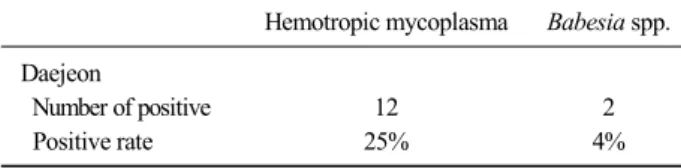
Table 1. Number of positive rate of vector-borne pathogens in stray cat in Daejeon
Hemotropic mycoplasma Babesia spp.
Daejeon
Number of positive 12 2
Positive rate 25% 4%
(supplied), after which the samples were centrifuged for 15 s at 8,000 × g. The flow-through was subsequently discarded after which and add 600 L buffer WB1 was added to the spin column, and centrifuged for 15 s at 8,000 × g to wash the column. The flow-through was again discarded, after which, 500 L buffer WB2 was added to the spin column and the samples was centri- fuged for 15 s at 8,000 × g to wash the column, and flow-through was discarded. After this step was repeated twice, the spin column was placed in a 2 mL collection tube (supplied) and centrifuged at full speed for 1 min.
The flow through and the collection tube were then dis- carded, after which, the column was placed in a new 1.5 mL collection tube and add 50 L nuclease free was added directly to the spin column membrane. After being allowed to stand for 5 min, the samples were cen- trifuged for 1 min at 8,000 × g to elute the nucleic acids.
Real time PCR was conducted to detect pathogens us- ing the nucleic acid extracted from the blood as a template. Briefly, the nucleic acid extracted from blood was added into master mix for real time PCR with a 20
L reaction volume, including pathogen specific primers and a probe, after which, one step RT-PCR was per- formed by subjecting the samples to 50°C for 10 min to perform reverse transcription and genetic amplification followed by fluorescent detection by 45 cycles of 95°C for 10 sec and 60°C for 30 sec. qPCRs specific for he- motropic mycoplsama and feline babesiosis were de- signed using 16S rRNA gene sequence data. The assays detected at the level of approximately 10 to 100 copies of a sequence-specific plasmid with target genetic region per reaction. For the determination of the qPCR results, we considered as positive above Ct value 40 after ge- netic analysis.
RESULTS AND DISCUSSION
We investigated the prevalence of vector-borne patho- gens in 48 stray cats found in Daejeon using PCR. All sampled were negative for Rickettia, Batenella, Anaplasma, Leptospira, FeLV, FIV, feline corona virus, and Erlichia. However, 12 samples (25%) were positive for hemotropic mycoplasmas and 2 samples (4%) were pos- itive for Babesia spp.
Feline hemotropic mycoplasmas are Gram-negative bacteria that cause infected cats to be anemia (Rosenqvist et al, 2016). There are three species, Mycoplasma hae- mofelis, Candidatus Mycoplasma haemominutum and Candidatus Mycoplasma turicensis (Neimark et al, 2001). Mycoplasma haemofelis often induce hemolytic anemia during acute or chronic infection in cats (Cho et al, 2016). Microscopic examination of Wright-Giemsa stained peripheral blood smears is used for diagnosis of hemotropic mycoplasma infection (Crado-Fornelio et al, 2003; Cho et al, 2016). However, this method has low sensitivity; therefore, PCR is now recommended for di- agnosis of hemotropic mycoplasmas infection in cats (Cho et al, 2016).
Among 369 domestic cats in southern Brazil, a total of 79 samples (21.4%) were positive (Santos et al, 2014) which is similar to the positive rate observed in the present study. Moreover, the positive rate of hemo- tropic mycoplasma infection in our study was similar to that observed in Jeonju, South Korea (26%, Cho et al, 2016).
Outdoor access is a well-known risk factor for hemo- tropic mycoplasma infection, and some prevalence stud- ies in the United States and Ireland showed that feral cats had a higher prevalence rate of hemoplasmas than client-owned cats (Jensen et al, 2001; Juvet et al, 2010).
Feline babesiosis is a tick-borne protozoan disease commonly found in dogs around the world, but rarely found in cats. In our study, the positive rate by PCR was 4% in stray cats. In a study of stray cats in Bangkok, Thailand, the positive rate by PCR was only 1.4% (Simking et al, 2010). These two studies suggest that there is a low low prevalence of Babesia infection in stray cats. Babesia spp. which have a low prevalence in feral cats, should be considered in anemic patients
Feline vector-borne pathogens in stray cats 289
Korean J Vet Serv, 2018, Vol. 41, No. 4 with doubtful history, and confirmed by PCR. Moreover,
follow-up studies of the epidemiology or the route of infection of these diseases are needed, especially those investigating the relationship between groups of cli- ent-owned cats and stray cats because the pathogens are so prevalent in the latter group. It should be noted that this study was limited in that species-level classification of hematopic mycoplasma and Babesia spp. was not been performed. Therefore, species-level classification should be conducted in future studies.
CONCLUSION
In this study, we investigated the prevalence of vari- ous vector-borne pathogens. Of these infectious agents, the positive rate of hemotropic mycoplasmas was high, but the positive rate of Babesia spp. was relatively low.
It is recommended that a large-scale prevalence study of infectious agents in all the regions of South Korea be conducted.
REFERENCES
Alho AM, Lima C, Latrofa MS, Colella V, Ravagnan S, Capelli G, Madeira de Carvalho L, Cardoso L, Otranto D. 2017.
Molecular detection of vector-borne pathogens in dogs and cats from Qatar. Parasit Vectors 10: 298.
Cho EK, Yu DH, Choi US. 2016. Prevalence of feline hemotropic mycoplasmas among feral cats in Korea by use of a PCR assay. J Vet Clin 33: 145-150.
Crado-Fornelio A, Martinez-Marcos A, Buling-Sarana A, Barba-Carretero JC. 2003. Presence of Mycoplasma hae-
mofelis, Mycoplasma haemominutum and piroplasmids in cats from southern Europe: a molecular study. Vet Microbiol 93: 307-317.
Hartmann K, Addie D, Belák S, Boucraut-Baralon C, Egberink H, Frymus T, Gruffydd-Jones T, Hosie MJ, Lloret A, Lutz H, Marsilio F, Möstl K, Pennisi MG, Radford AD, Thiry E, Truyen U, Horzinek MC. 2013. Babesiosis in cats:
ABCD guidelines on prevention and management. J Feline Med Surg 15: 643-646.
Jensen WA, Lappin MR, Kamkar S, Reagan WJ. 2001. Use of a polymerase chain reaction assay to detect and differ- entiate two strains of Haemobartonella felis in naturally infected cats. Am J Vet Res 62: 604-608.
Juvet F, Lappin MR, Brennan S, Mooney CT. 2010. Prevalence of selected infectious agents in cats in Ireland. J Feline Med Surg 12: 476-482.
Neimark H, Johansson KE, Rikihisa Y, Tully JG. 2001. Proposal to transfer some members of the genera Haemobaarto- nella and Eperythrozoon to the genus Mycoplasma with descriptions of ‘Candidatus Mycoplasma haemofelis’,
‘candidatus Mycoplasma haemomuris’, ‘Candidatus Mycoplasma haemosuis’ and ‘Candidatus Mycoplasma wendyonii’. Int J Syst Evol Microbiol 51: 891-899.
Rosenqvist MB, Meilstrup AKH Jesper Larsen J, Olsen JEH, Jensen AL, a Line Elnif Thomsen LE. 2016. Prevalence of feline haemoplasma in cats in Denmark. Acta Vet Scand 58: 78.
Santos AP, Conrado Fde O, Messick JB, Biondo AW, Oliveira ST, Guimaraes AM, Nascimento NC, Pedralli V, Lasta CS, González FH. 2014. Hemoplasma prevalence and hematological abnormalities associated with infection in three different cat populations from Southern Brazil. Rev Bras Parasitol Vet 23: 428-434.
Simking P, Wongnakphet S, Stich RW, Jittapalapong S. 2010.
Detection of Babesia vogeli in stray cats of metropolitan Bangkok, Thailand. Vet Parasitol 173: 70-75.
Wardrop KJ, Birkenheuer A, Blais MC, Callan MB, Kohn B, Lappin MR, Sykes J. 1996. Update on canine and feline blood donor screening for blood-borne pathogens. J Vet Intern Med 30: 15-35.