747 KOR. J. HORT. SCI. TECHNOL. 17(6), DECEMBER 1999 원예과학기술지 17(6):747-749. 1999
종자처리가 수박대목용 박 종자의 발아성에 미치는 영향
문보식*․정연옥1․조정래
경상대학교 농과대학 원예학과, 1진주교육대학교 실과교육과
Seed Treatment to Improve Germinability of Gourd (Lagenaria siceraria Standl.)
Moon, Bo Shik*․Jeong, Yeon Ok1․Cho, Jeoung Lai Dept. of Horticulture, Gyeongsang Nat'l. Univ., Chinju 660-701, Korea
1Dept. of Practical Arts Education, Chinju Nat'l. Univ. of Education, Chinju 660-756, Korea
*corresponding author
ABSTRACT Various methods for seed treatments have been devised to improve the rate and uniformity of seed germination of gourd (Lagenaria siceraria Standl.). Hydropriming and priming, the imbibition of seeds in distilled water and osmotic solutions respectively, are useful techniques for early establishment of uniform seedlings. In this study, the optimum conditions for hydropriming and priming were determined in gourd (Lagenaria siceraria Standl.) seeds. Effect of hydropriming was compared with those of osmotic priming. Seeds, hydroprimed or primed with 50 mM solution of KH2PO4 and KNO3 at 30℃ for 2 days, showed shorter T50 (number of days to 50% of the final germination percentage) and MDG (mean number of days to germination) than those unprimed. The relative effectiveness of hydropriming and priming in improving the germinability of gourd seeds was more evident when germinated at 20℃ than at 25℃ and 35℃.
Additional key words: germinability, seed treatment
Seed treatmentz Germination (%)
T50
(day)
MDG (day) Chemical Concn
KNO3
KH2PO4
K3PO4
NaOH
Ca(NO3)2
PEG 8000
50 mM 100 mM 200 mM 50 mM 100 mM 200 mM 50 mM 100 mM 200 mM 50 mM 100 mM 200 mM 50 mM 100 mM 200 mM -0.50 MPa -0.75 MPa -1.00 MPa -1.25 MPa
97.5 ay 95.0 a 91.7 a 95.0 a 95.8 a 95.0 a 99.2 a 85.8 a 50.8 b 99.2 a 95.0 a 51.7 b 95.0 a 95.0 a 91.7 a 94.2 a 96.7 a 98.3 a 90.0 a
1.97 f 2.25 ef 2.89 de 1.91 f 2.32 ef 2.79 e 2.28 ef 3.58 cd 6.50 a 2.23 ef 4.29 bc 6.21 a 2.42 ef 2.81 de 4.38 b 2.44 ef 2.37 ef 2.57 ef 2.89 de
2.38 ij 2.64 hij 3.91 cd 2.34 ij 2.73 hij 3.41 def 2.79 hij 4.10 c 6.61 a 2.73 hij 4.66 b 6.06 a 2.81 ghi 3.44 de 5.05 b 2.86 f-i 2.95 e-h 3.12 e-h 3.35 efg Hydropriming 97.5 a 1.81 f 2.24 j Untreated 94.2 a 2.37 ef 2.81 ghi
zSeeds were treated in the dark with various chemicals at 30℃ for 2 days and dark- germinated at 25℃ for up to 7 days. Seeds were imbibed in distilled water for hydro- priming. Untreated seeds were directly taken from the seed package.
yMeans within columns were separated by DMRT (Duncan's multiple range test) at P
= 0.05.
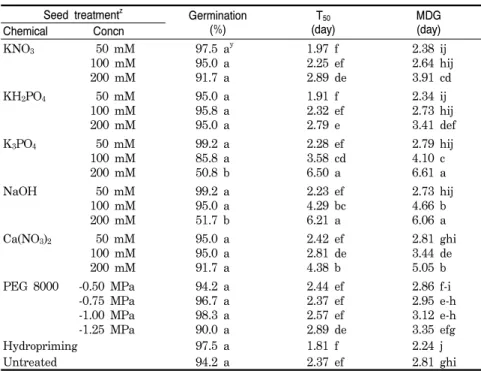
Table 1. Effects of priming chemicals and their concentrations on percent germination, number of days to 50% of the final germination percentage (T50) and mean number of days to germination (MDG) of gourd seeds.
서 언
박은 수박재배시 만할병 방제를 위한 대목으 로 많이 이용되고 있으나, 종자 발아율이 낮고 균일하지 않아 균일한 대목묘 생산과 접목시기 조절에 문제점이 제기되고 있다. 종자 priming 은 종자를 수분포텐셜이 낮은 삼투용액에 침지 하여 수분흡수 유도기간을 연장시키는 처리로 발아율을 높이고 발아소요일수를 단축시킬 수 있는 장점이 있다(Khan, 1992). 그러나 작물에 따라 사용되는 화학물질의 종류와 농도가 다르 고, PEG와 같은 화학물질은 사용후 세척과정 에서 수질을 오염시킬 수 있으며, 사용상 불편 한 점이 따른다(Khan, 1992). 최근에는 prim- ing이 지니는 문제점을 해결하기 위한 방법으 로 일부 작물에서 hydropriming이 제기되고 있는데(Fugikura 등, 1993), 이는 종자를 물에 단기간 침지시키는 것으로서 처리가 간단하고, 비용이 저렴하여 osmotic priming 처리효과와 차이가 없다면 유용한 종자처리 방법이 될 수 있다. 따라서 본 연구는 수박대목용 박종자의 발아율 향상 및 발아소요일수 단축과 균일한 발 아를 유도하기 위해 종자전처리 기술중 prim- ing과 hydropriming 방법을 비교 검토하였다.
재료 및 방법
본 실험에 사용한 재료는 서울종묘(주)의 ‘FR- Top' 박(Lagenaria siceraria Standl.) 종자였 으며, priming 화학물질로는 KNO3, KH2PO4, K3PO4, NaOH, Ca(NO3)2, PEG 8000을 사용
하였다. 염 농도는 0(증류수, hydropriming), 50, 100, 200mM, PEG 8000은 Michel(1983) 의 방법에 따라 수분포텐셜을 -0.50, -0.75,
-1.00, -1.25MPa로 조절한 후 30℃에서 2일간 처리하였다.
Hydropriming 및 priming시 최적 처리기간 의 구명을 위해 증류수(hydropriming), 50mM KNO3와 50mM KH2PO4를 사용하여 30℃에 서 0, 6, 12, 24, 48, 96시간 처리하였다. 또한 처리온도 구명을 위해서는 15, 20, 25, 30, 35, 40℃에서 12시간 처리하였다. 그리고 20℃에서 12시간 처리한 후 20, 25 및 30℃의 항온기에 서 발아온도에 따른 효과를 조사하였다.
Hydropriming 및 priming 처리는 플라스틱 원통용기[80(높이)mm×100(직경)mm]에 종자 50립씩을 넣고 증류수 100mL을 주입한 후 완 전히 밀봉하여 일정기간 암상태에 두었으며, 처 리후 즉시 종자를 꺼내어 수돗물에 2분간 세척 한 후 사용하였다.
발아실험은 petridish(9.0×1.5cm)에 Toyo No. 2 여과지 1매를 깔고 5mL의 증류수로 적 신 후 종자를 40립씩 치상하여 암상태의 항온기 내에서 완전임의배치 3반복으로 실시하였으며, 치상후 12시간 간격으로 7일간 조사하였는데, 유근이 2mm 이상 나온 것을 발아한 것으로 판 정하였다. 실험성적은 최종발아율, T50(Cool- bear 등, 1984; 최종발아율에 대한 50% 발아소 요일수) 및 MDG(Hartmann과 Kester, 1983;
평균발아소요일수)로 나타내었으며 Duncan의 다중검정(DMRT)과 요인분석을 하였다.
결과 및 고찰
Priming시 화학물질의 종류와 농도에 따른 발아율은 200mM의 K3PO4와 NaOH를 제외
KOR. J. HORT. SCI. TECHNOL. 17(6), DECEMBER 1999 748
Seed treatment
duration (hrs) Seed treatmentz Germination (%)
T50
(day)
MDG (day)
6
12
24
48
96
Hydropriming KNO3 50 mM KH2PO3 50 mM Control Hydropriming KNO3 50 mM KH2PO3 50 mM Control Hydropriming KNO3 50 mM KH2PO3 50 mM Control Hydropriming KNO3 50 mM KH2PO3 50 mM Control Hydropriming KNO3 50 mM KH2PO3 50 mM Control
90.8 cdey 94.2 a-d 87.5 e 87.5 e 98.3 a 96.7 abc 97.5 ab 94.2 a-d 98.3 a 98.3 a 94.2 a-d 98.3 a 95.8 a-d 97.5 ab 96.7 abc 95.8 a-d 90.0 de 91.7 b-e 91.7 b-e 92.5 a-e
2.04 ef 2.47 bc 2.35 cd 2.74 a 1.83 f 2.28 cd 2.21 de 2.74 a 1.84 f 2.30 cd 2.02 ef 2.74 a 1.83 f 2.23 de 2.01 ef 2.61 ab 1.96 f 2.64 ab 2.36 cd 2.77 a
2.36 ghi 2.75 cde 2.67 def 3.06 ab 2.10 j 2.52 fgh 2.49 fgh 3.11 a 2.17 ij 2.56 efg 2.30 hij 3.04 ab 2.19 ij 2.55 efg 2.34 g-j 2.91 abc 2.37 ghi 2.85 bcd 2.66 def 3.10 a Significance
Seed treatment duration (A) Seed treatment (B)
A × B
※※
NS NS
※※
※※
NS
※※
※※
NS
zSeeds were treated in the dark at 30℃ and dark-germinated at 25℃ for up to 7 days.
Control seeds were directly taken from the seed package and germinated for the durations indicated.
yMeans within columns were separated by DMRT at P = 0.05.
NS, ※※
Nonsignificant or significant at P = 0.01, respectively
Table 2. Effects of hydropriming and priming durations and methods on percent germination, T50, and MDG of gourd seeds.
Seed treatment
temp. (℃) Seed treatmentz Germination (%)
T50
(day)
MDG (day) 15
20
25
30
35
40
Hydropriming KNO3 50 mM KH2PO3 50 mM Control Hydropriming KNO3 50 mM KH2PO3 50 mM Control Hydropriming KNO3 50 mM KH2PO3 50 mM Control Hydropriming KNO3 50 mM KH2PO3 50 mM Control Hydropriming KNO3 50 mM KH2PO3 50 mM Control Hydropriming KNO3 50 mM KH2PO3 50 mM Control
96.7 abcy 98.3 a 94.2 abc 95.0 abc 98.3 a 98.3 a 96.7 abc 96.7 abc 96.7 abc 97.5 ab 95.8 abc 91.7 c 98.3 a 96.7 abc 97.5 ab 94.2 abc 95.0 abc 96.7 abc 95.0 abc 94.2 abc 95.0 abc 97.5 ab 96.7 abc 92.5 bc
1.93 ijk 2.11 ghi 2.11 ghi 2.80 ab 1.77 k 2.30 efg 1.98 h-k 2.62 bcd 2.09 g-j 2.51 cde 2.18 ghi 2.71 abc 1.83 jk 2.28 efg 2.21 fgh 2.74 abc 1.80 k 2.31 efg 2.20 fgh 2.89 a 1.99 h-k 2.44 def 2.23 fgh 2.87 ab
2.30 fgh 2.47 d-g 2.48 def 3.24 a 2.04 h 2.63 def 2.33 e-h 2.98 abc 2.48 def 2.77 bcd 2.61 def 3.10 ab 2.10 h 2.52 def 2.49 def 3.11 ab 2.14 gh 2.74 cd 2.66 cde 3.26 a 2.31 fgh 2.71 cd 2.49 def 3.15 a Significance
Seed treatment temp. (A) Seed treatment (B) A × B
NS
※ NS
※
※※
NS
NS
※※
NS
zSeeds were treated in the dark for 12 hours and germinated at 25℃ in darkness.
Control seeds were directly taken from the seed package and germinated at the temperatures indicated.
yMeans within columns were separated by DMRT at P = 0.05.
NS, ※, ※※Nonsignificant or significant at P = 0.05 and 0.01, respectively
Table 3. Effects of hydropriming and priming temperatures and chemicals on percent germination, T50, and MDG of gourd seeds.
한 모든 화학물질에서 대부분 90% 이상으로 처 리간 차이가 없었으나, 그 중 50mM KH2PO4
와 50mM NaOH 처리가 99.2%로 가장 높았 으며, 화학물질의 농도가 높아질수록 발아율이 떨어지는 경향이었다. 증류수로 Hydropriming 한 종자의 발아율은 97.5%로 높았으나 prim- ing한 종자와 무처리 종자에 비해 유의차는 없 었다(Table 1).
T50은 화학물질의 종류와 농도에 따라 현저한 차이를 보였으며 농도가 높아질수록 지연되었 다. 50mM의 KNO3 및 50mM KH2PO4 처리시 T50이 각각 1.91일 및 1.97일로 PEG 등 다른 화학물질에 비해 0.3~0.5일 단축되는 경향을 보였다. 특히 hydropriming 처리는 1.81일로 priming에 비해 T50 단축에 다소 효과적이었고, 무처리의 2.37일에 비해 0.6일 정도 단축되는 경향을 보였다. 평균발아소요일수(MDG)도 T50
과 유사한 결과를 보여 hydropriming이나 priming 처리가 발아의 균일도 향상에 어느 정 도 효과적이었으나 무처리와 통계적인 유의차는 없었다.
따라서 처리된 화학물질의 종류보다는 농도 가 발아에 더 큰 영향을 미쳤으며 200mM보다 는 50mM에서, 특히 hydropriming이 priming 이나 무처리에 비해 T50 단축과 균일한 발아 유 도에 효과적이었지만 유의차는 없었다.
고추와 토마토 등에서는 무처리에 비해 priming이 발아력 향상에 효과적인 것으로 알 려져 있으나(Jeong 등, 1994; Kang 등, 1997;
Kang과 Cho, 1996), 본 실험에서는 처리가 간 단하고, 비용이 저렴한 hydropriming이 T50과 평균발아소요일수 단축에 priming 처리와 비슷 하게 나타나 priming 처리를 대체할 수 있을 것으로 사료되었다.
박 종자에 적합한 종자처리시 처리기간과 온 도의 구명을 위해 발아율 향상과 발아촉진에 가 장 우수하다고 판단된 조건(hydropriming, 50 mM KNO3, 50mM KH2PO4)에서 처리기간과 온도를 달리하여 발아율, T50 및 평균발아소요일 수를 비교 조사하였다.
Hydropriming이나 priming 처리기간에 따 른 발아율은 모든 처리구에서 대부분 90% 이상 으로 유의차는 없었으나, 전반적으로 12시간 처 리가 높은 경향을 나타내었다(Table 2). T50은 처리기간의 경과와 더불어 단축되었으나, 96시 간 처리에서는 다소 지연되는 현상을 보였는데, 이는 처리기간이 길어짐에 따라 종자내 이온이 과다하게 축적되거나(Smith와 Cobb, 1991) 지 나친 침지로 발아에 불리하게 작용한 것으로 생 각된다.
Hydropriming 12시간 처리종자의 T50은 1.83일로 priming이나 무처리 종자에 비해 각 각 0.4일, 0.9일 단축되어 가장 효과적인 것으 로 나타났다. 평균발아소요일수도 T50과 유사한 경향을 보였는데, hydropriming 12시간 처리 가 2.10일로 priming이나 무처리에 비해 발아 의 균일도 향상에 효과적이었다. 박종자는 1~
3% KNO3에서 3일간 처리하는 것이 효과적이
749 KOR. J. HORT. SCI. TECHNOL. 17(6), DECEMBER 1999 Germination temp.
(℃) Seed treatmentz Germination (%)
T50
(day)
MDG (day) 20
25
30
Hydropriming Priming Control Hydropriming Priming Control Hydropriming Priming Control
85.8 by 90.0 ab 47.5 c 95.0 a 95.0 a 93.3 ab 90.8 ab 87.5 ab 86.7 ab
2.61 bcd 2.88 bc 3.71 a 1.68 e 1.79 e 2.48 cd 2.27 d 2.26 d 3.07 b
2.89 cd 3.19 bc 4.14 a 2.02 e 2.14 e 2.82 cd 2.65 d 2.66 d 3.59 b Significance
Germination temp. (A) Seed treatment (B) A × B
※※
※※
※※
※※
※※
NS
※※
※※
NS
zSeeds were primed in the dark with 50mM KH2PO4 and hydroprimed at 20℃ for 12 hours and germinated at 25℃ in darkness. Control seeds were directly taken fresh from the seed package and germinated at the temperatures indicated.
vMeans in columns were separated by DMRT at P = 0.05.
NS, ※※Nonsignificant or significant at P = 0.01, respectively
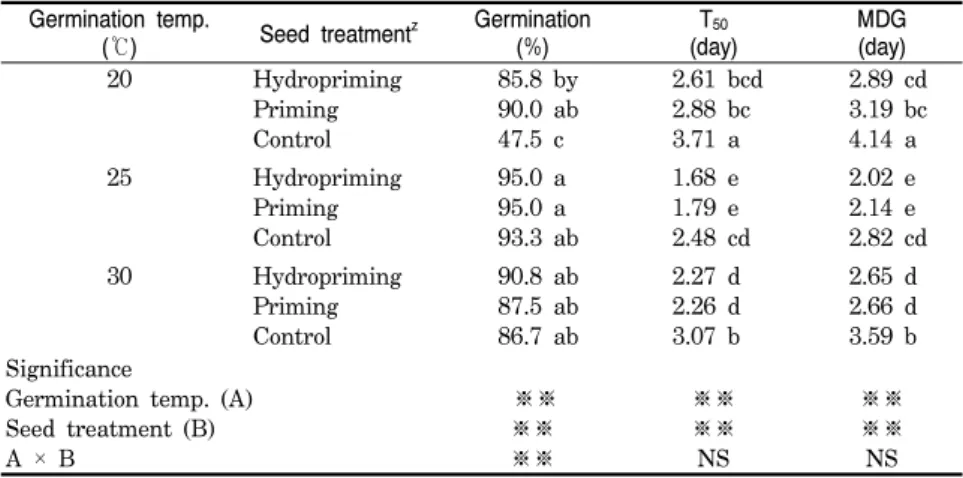
Table 4. Effects of germination temperatures after hydropriming and priming on percent germination, T50, and MDG of gourd seeds.
라 하였으나(Yoo 등, 1996), 본 실험에서는 priming에 비해 hydropriming 12시간 처리가 가장 효과적인 것으로 나타났다.
박종자의 발아촉진에 효과적인 12시간 hy- dropriming 및 priming시 처리온도를 달리하 여 발아율, T50과 평균발아소요일수를 조사하 였다(Table 3). 발아율은 hydropriming이나 priming 모두 94% 이상으로 처리온도에 따른 차이는 없었으나 20℃에서 98.3%로 가장 높게 나타났다. T50과 평균발아소요일수도 온도에 따른 차이는 없었으나 20℃ 처리시 가장 짧았 으며, 25℃ 처리에서는 그 효과가 감소되었다.
Priming의 적정온도는 15~25℃라는 보고 가 많은데(Bradford, 1986; Khan, 1992), 본 실험의 박종자에서도 hydropriming이나 prim- ing 처리시 20℃가 양호한 것으로 확인되었다.
특히 hydropriming 처리는 priming이나 무처 리에 비해 조기 및 균일한 발아 유도에 효과적 인 것으로 나타나 종자 처리비용을 절감할 수 있을 것으로 기대되었다.
발아에 적합한 온도에 파종된 종자들은 정상 적인 발아 및 유묘출현이 이루어지나, 저온이나 고온 등 불량환경 조건에서는 유묘출현의 지연 과 함께 종자부패와 각종 병원균의 침입을 받게 된다 (Bradford, 1986; Khan, 1992). 따라서 종자처리로 불량한 환경조건에서도 발아율 향 상, T50 단축과 균일한 발아를 유도하는 것은 큰 의미를 가질 수 있으며, 여러 채소 작물에 대한 종자처리시 재배적온보다는 저온에서의 발아율 향상에 더 효과적이다(Bradford, 1986;
Khan, 1992).
Hydropriming 및 priming후 발아온도를 달 리하여 발아율, T50 및 평균발아소요일수를 조
사하였다(Table 4). 발아온도가 적온보다 낮은 20℃에서는 무처리 종자의 발아율이 47.5%로 매우 낮았으나, priming과 hydropriming 종자 는 각각 90%와 85.8%로 현저히 증가되었고, T50 및 평균발아소요일수 단축 효과도 있었다.
적온인 25℃에서는 90% 이상의 높은 발아율을 보였으며, hydropriming 종자의 T50과 평균발 아소요일수는 1.68일과 2.02일로 무처리 종자 에 비해 각각 0.80일 단축되어 조기에 균일한 발아를 유도함을 알 수 있다. 이러한 경향은 30℃에서도 유사하게 나타났다. 이와같은 결과 로 볼 때 hydropriming이나 priming 처리는 25℃와 30℃보다는 발아에 불리한 20℃의 저 온에서 발아촉진 및 균일한 발아 유도에 더 효 과적이었다. 따라서 이러한 종자처리는 불량한 환경조건에서도 초기 입모율 향상에 효과적으 로 이용되어 질 수 있을 것으로 생각된다.
초 록
박종자의 발아율 향상과 발아촉진을 위한 종 자처리시 hydropriming과 priming 처리와 종 자의 발아성을 비교 검토하고, 종자처리 기술의 실용화를 위해 처리 화학물질 및 농도, 처리기 간 및 처리온도, 발아온도에 따른 효과를 비교 검토하였다. 증류수(hydropriming)나 50mM KH2PO4와 50mM KNO3로 20℃에서 12시간 처리시 T50 및 평균발아소요일수 단축에 효과적 이었다. 무처리종자에 비하여 hydropriming이 나 priming에 의한 발아촉진 효과는 발아온도 25℃나 35℃보다 20℃에서 현저하게 나타났다.
추가 주요어:발아, 종자처리
인용문헌
Bradford, K. J. 1986. Manipulation of seed water relations via osmotic priming to improve germination under stress condi- tions. HortScience 26:1105-1112.
Coolbear, P., A. Francis, and D. Grierson.
1984. The effect of low temperature presowing treatment on the germination performance and membrane integrity of artificially aged tomato seeds. J. Exp.
Bot. 35:1609-1617.
Fugikura, Y., H. L. Kraak, A. S. Basra, and C. M. Karssen. 1993. Hydropriming, a simple and inexpensive priming method.
J, Seed Sci. & Technol. 21:639-642.
Hartmann, H. T. and D. E. Kester. 1983.
Plant Propagation. Principles and Prac- tices. 4th edition, Pentice-Hall, Inc. New Jersey. p. 127.
Jeong, Y. O., J. L. Cho, and S. M. Kang.
1994. Priming effect of pepper (Capsi- cum annuum L.) seeds as affected by aging and growth regulators treatments.
J. Kor. Soc. Hort. Sci. 35:407-414.
Kang, N. J., Y. O. Jeong, J. L. Cho, and S.
M. Kang. 1997. Changes of seed proteins related to low temperature germinability of primed seeds of pepper (Capsicum annuum L.). J. Kor. Soc. Hort. Sci. 38:
342-346.
Kang, J. S. and J. L. Cho. 1996. Effect of optimal priming conditions on seed ger- mination and seedling growth of tomato.
J. Kor. Soc. Hort. Sci. 37:645-651.
Khan, A. A. 1992. Preplant physiological seed conditioning. Hort. Rev. 13:131-181.
Michel, B. E. 1983. Evaluation of the water potential of solutions of polyethy- lene glycol 8000 both in the absence and presence of other solutes. Plant Physiol.
72:66-70.
Smith, P. T. and B. G. Cobb. 1991. Ac- celerated germination of pepper seed by priming with salt solutions and water.
HortScience 26:417-419.
Yoo, K. C., J. H. Kim, Y. R. Yeoung, and S. H. Lee. 1996. Effects of priming treatment on improving germination of gourd seeds. J. Kor. Soc. Hort. Sci.
37:42-46.