• 검색 결과가 없습니다.

Enhancement of Seed Germination and Uniformity in Triploid Watermelon (Citrullus lanatus (Thunb.) Matsum. and Nakai)

N/A
N/A
Protected

Academic year: 2021

Share "Enhancement of Seed Germination and Uniformity in Triploid Watermelon (Citrullus lanatus (Thunb.) Matsum. and Nakai)"

Copied!
9
0
0

로드 중.... (전체 텍스트 보기)

전체 글

(1)

Research Report

Enhancement of Seed Germination and Uniformity in Triploid Watermelon (Citrullus lanatus (Thunb.) Matsum. and Nakai)

Phanna Phat 1 , Sameena Sheikh 1† , Jeong Hyeon Lim 1 , Tae Bok Kim 1 , Mun Ho Seong 1 , Hyong Gwon Chon 1 , Yong Kyu Shin 2 , Young Ju Song 3 , and Jaejong Noh 3*

1

Watermelon Experiment Station, Jeollabuk-do A.R.E.S., Gochang 585-863, Korea,

2

Fruit Vegetables Research Institute, Jeonbuk A.R.E.S., Gunsan 573-913, Korea

3

Jeollabuk-do Agricultural Research and Extension Services, Iksan 570-140, Korea

Abstract: One of the main factors restricting production of triploid seedless watermelon is poor germination due to weak embryos, thick seed coats, and larger air spaces. This study was carried out to investigate the priming effects of different concentrations of chemicals, including hydrogen peroxide (H

2

O

2

), fusicoccin, and gibberellic acid (GA) on germination and seedling uniformity of triploid watermelon (Citrullus lanatus). Three commercial triploid cultivars, Seedless Plus, Sinus, and Sizero, were pretreated with water and different levels of H

2

O

2

(2 and 4%), fusicoccin (FC: 1, 5, and 10 µM), and GA (1, 5, and 10 µM). The present findings helped to find optimal priming conditions for improving germination of triploid watermelon. Treatment with 5 µM GA and hydropriming helped to break seed dormancy, enhancing the final germination percentages in all triploid cultivars and increasing the germination index in Sizero. These seed-priming treatments could be used on large scale for industrial applications.

Moreover, hydropriming provides a simple, effective, and costless method to improve seed germination and seedling vigor of Sinus and Sizero varieties.

Additional key words: germination index, germination rate, priming, triploid, uniformity

*Corresponding author: [email protected]

These authors contributed equally to this work.

※ Received 26 November 2014; Revised 3 September 2015; Accepted 24 September 2015. This work was supported by a grant from JBARES, IPET, and RDA. We gratefully acknowledge the help of technical staff members at Watermelon Experiment Station to successfully conduct this experiment.

Ⓒ 2015 Korean Society for Horticultural Science

Introduction

Seed germination is a crucial factor for commercial agri- culture and substantial work has examined the conditions required for optimal germination. In the early 1950s, optimal soil temperatures for diploid seed germination were established in the range of 21-35°C (Harrington and Minges, 1954). Since then, new hybrid cultivars have replaced open-pollinated cultivars and new cultivars were found to respond to different temperature ranges. For proper seed germination, growth, and development, diploid watermelon requires warmer than 26°C (Whitaker and Davis, 1962), but triploid seeds originating from tetraploid ovaries require 24-38°C for 24-72 h. Triploid seedless watermelon was

first developed in Japan in the early 1950s (Kihara, 1951).

Triploid seedless watermelon has been becoming popular over the last two decades due to its crisp and sweet taste without the hard seeds of standard watermelon (Egel, 1999;

Marr and Gast, 1991). Triploids result from breeding between a tetraploid watermelon, as the female parent, and a diploid watermelon, as the male parent. Triploid watermelon does not produce sufficient pollen for fertilization; thus the production of triploid seedless fruits requires a diploid plant for pollen (Maynard and Elmstrom, 1992; Zhang, 2004).

Watermelon growers face various problems in obtaining

good seed germination, as triploid seeds have low germination

due to the thicker seed coat, underdeveloped embryos,

(2)

and larger air space cavities compared with diploids (Duval and NeSmith, 2000; Grange et al., 2000, 2003). Triploid seed germination is generally low, at 60-80% compared to up to 95 % in diploid (Liu et al., 2010; Nerson et al., 1985). Heavy seeds germinate better because of higher seed coat tissue compared to light-weight seeds in triploids (Yang and Sung, 1994). Methods such as nicking, scarification and lateral splitting of seed coat enhance the germination rate in triploid, but also can injure the embryo (Duval and Nesmith, 1998; Grange et al., 2000). Hence, there is a need to explore more efficient and reliable methods to enhance seed germination rate and seedling establishment, as normal germination methods no longer produce good results, especially in tetraploids and triploids.

Seed priming has been reported to enhance seed germi- nation performance of various field crops (Eskandari, 2013;

Shehzad et al., 2012). Various seed priming methods can improve germination; these methods include hydropriming (Huang et al., 2002; Moghanibashi et al., 2012), which improves germination by partially hydrating seeds, although radicle emergence does not occur. Other priming methods include halopriming (Siadat et al., 2011), osmopriming (Chen et al., 2010; Esmaelli and Heidarzade, 2012; Farooq et al., 2005, 2007; Rezaei and Ramezani, 2012; Rouhi et al., 2011), thermopriming (Yari et al., 2012), solid matrix priming (Mereddy et al., 2000), and biopriming (Moenzadeh et al., 2010). The growth regulator gibberellic acid (GA) can improve seed germination rates and reduce germination time in endive and chicory (Ghodrat and Rousta, 2012;

Tzortzakis, 2009). The application of hydrogen peroxide (H 2 O 2 ) enhanced germination efficiency with no effect on seed coat (Duval and NeSmith, 2000). Hydrogen peroxide has been suggested to mediate imbibition and hydrolytic activities required for germination and alleviate salt and temperature stresses (Çavusoglu andKabar, 2010). Fusicoccin (FC), from Fusicoccum amygdali is a novel 5-8-5 membrane tricyclic diterpene glucoside. It is a potent promoter of germination and dormancy-breaking agent. The mode of action of FC on plant 14-3-3 proteins and H + -ATPase are currently attracting substantial attention (Tajima et al., 2004). FC induced cell wall loosening and thus loss of turgor and cell enlargement by stimulating H + extrusion and K + uptake similarly to, but much more strongly than auxin (Marre, 1979).

The information on seed germination, emergence and uniform growth in polyploid watermelon remains inadequate, despite the different priming and seed treatment methods studied so far. Hence, this study was carried out to investi- gate the priming effects of different concentrations of

chemicals, including H 2 O 2 , FC, and GA, on germination and seedling uniformity of triploid and diploid watermelon.

Materials and Methods Seed and Chemical Materials

The experimental materials included seeds of three triploid cultivars, Seedless Plus (Nong Woo Bio Co., Suwon, Korea), Sinus (L & S Seed Company, Cheongju, Korea), and Sizero (Syngenta, Bangkok, Thailand). Sambokggul, diploid cultivar, was used as a control. These were subjected to hydropriming testing at the Watermelon Experiment Station, Daesan, Gochang during the year 2013. Hydrogen peroxide (H 2 O 2 ), fusicoccin (FC), and giberrelic acid (GA) were tested as germination-enhancing agents. Different concentrations of H 2 O 2 (2, 4%), FC (1, 5 , 10 µM) and GA (1, 5, and 10 µM), water (H 2 O), and a control condition were used to analyze the effect on germination rate of seeds.

Experimental Design

The experiment was conducted as a three-factor compact family block design (CRBD) randomized with three replica- tions and ten types of treatments: one water, two concent- rations of H 2 O 2 , three of FC, three of GA, and one control.

However, the 4% H 2 O 2 treatment was omitted for cultivar Seedless Plus due to insufficient seeds. Each replication contained twenty-five seeds of each cultivar.

Hydration and Incubation

Twenty-five seeds per replication for each treatment were weighed. The seeds were gathered together on 22

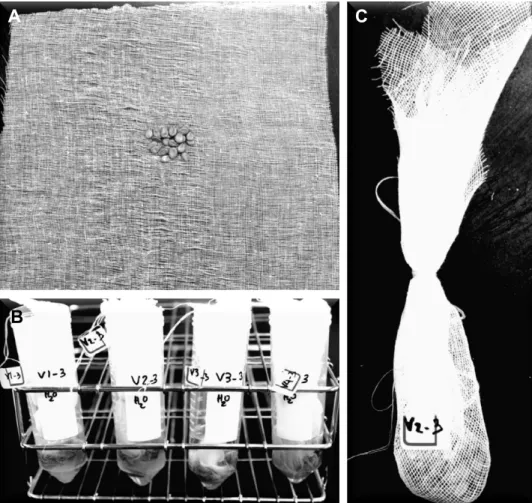
× 22 cm squares of muslin gauze cloth, then wrapped and tied using thread attached to a unique number for each treatment (Seedless Plus V1, Sinus V2, Sizero V3, and Sambokggul V4). The gauze-wrapped seeds were soaked in centrifuge tubes containing 15 ml of each respective concentration of solution for 12 hours and kept at room temperature (Fig. 1). Imbibed seeds were rinsed with distilled water prior to incubation at 31 ± 2°C with 35% relative humidity until seeds were dried to their original seed weight (around 48 hours).

Evaluation of Germination

Primed seeds were sown in plastic trays containing

commercial soil mixture and raised in a plastic house. The

temperature and humidity were recorded every hour using a

data log. The average temperature and humidity at day/night

were 32 ± 8°C and 62 ± 21%/24 ± 2°C and 93 ± 8%,

(3)

A

B

C

Fig. 1. The process of hydration and incubation during seed priming treatment. A, seeds on the muslin gauze cloth; B, seeds soaked in each solution at room temperature after being wrapped and tied up using thread attached to a label with a unique number; C, and washed seeds allowed to dry to their original seed weight prior to incubation.

respectively. Seeds were considered germinated upon the protrusion of the cotyledon above the soil. After the third day, the number of germinated seeds was recorded daily for two weeks. The time to 50% germination (T 50 ) was calculated according to the modified formula reported by Farooq et al. (2005) in Equation 1, and the final germi- nation percentage (FGP) was estimated using Equation 2.

The germination index was calculated based on the formula described by the Association of Official Seed Analysts (AOSA, 1983) and used by Farooq et al. (2005) in Equation 3.

Shoot length (cm) and seed weight (g) were recorded on the last day of observation and 20% of maximal and minimal height seedlings were dropped out.

Equation 1

                

N = the final number of germinated seeds; n j , n i : cumulative number of seeds germinated by adjacent counts at times t j and t i when n i < N/2 < n j .

Equation 2

FGP = Total No. of germinated seeds × 100 Total No. of seed evaluated

Equation 3

GI = No. of germinated seeds

+ ---- + No. of germinated seeds Days of first count Days of final count Statistical Analysis

The data were analyzed using the statistiXL program

for general statistical analysis. For each of the measured

(4)

Table 1. The effects of different priming treatments on seedling vigor of triploid and diploid cultivars on the basis of FGP, T 50 , and GI.

Treatments FGP z (%) T 50 y GI x

Seedless Plus Sinus Sizero Sambokggul Seedless Plus Sinus Sizero Sambokggul Seedless Plus Sinus Sizero Sambokggul

Control 53.3 58.7 73.3 97.3 6.2 4.1 4.9 4.2 2.3 3.3 3.5 5.4

H 2 O 54.7 81.3 86.7 98.7 5.6 3.7 4.5 4.6 2.3 5.0 4.6 .9

H 2 O 2 (2%) 40.0 45.3 60.0 76.0 5.0 3.8 4.9 6.6 1.9 2.7 2.9 3.0

H 2 O 2 (4%) - 44.0 49.3 86.7 4.2 5.4 7.2 - 2.5 2.1 2.9

FC (1 μM) 42.7 69.3 80.0 93.3 5.0 4.2 4.4 4.7 2.1 4.3 4.1 4.6

FC (5 μM) 41.3 74.7 60.0 92.0 5.0 4.2 4.3 4.4 2.1 4.2 3.2 4.9

FC (10 μM) 41.3 58.7 74.7 94.7 4.4 4.2 4.6 5.1 2.1 3.4 3.8 4.5

GA (1 μM) 45.3 68.0 78.7 90.7 4.8 4.0 5.1 4.9 2.2 4.1 3.7 4.3

GA (5 μM) 68.0 68.0 86.7 94.7 5.0 4.2 5.0 4.6 3.2 3.8 4.1 4.8

GA (10 μM) 50.7 58.7 74.7 86.7 5.0 3.9 4.9 5.0 2.4 3.5 3.6 3.8

LSD v 14.5 20.3 12.6 - - - - - - - 1.3 -

Values are means from three replicates.

z Final germination percentage.

y Time to 50% germination.

x Germination index.

v LSD values at p ≤ 0.05.

variables, comparison of means or medians was conducted through a one-way analysis of variance (ANOVA) to determine whether differences are statistically significant (p ≤ 0.05).

Means of treatments were separated by Fisher’s LSD test at p ≤ 0.05.

Results

Effect of Priming on Seedling Vigor

The different priming and non-priming treatments showed significant effects on the seedling vigor of triploids (Table 1). FGP was significantly different and higher in primed seeds compared to control in the triploids but not in the diploid.

Seedless Plus had a higher FGP with 5 μM GA (68%), Sinus with hydroprimed (81.3%), Sizero with both hydroprimed (86.7%) and GA 5 μM (86.7%), and Sambokggul with hydro- primed (98.7%) all showed higher FGP compared with the control treatment. However, time to 50% germination did not show a statistically significant difference among triploid and diploid cultivars. A significant difference in GI was found only in Sizero with hydroprimed treatment (4.6) compared with the control treatment (3.5).

Days to Percentage Germination vs Germination Rate Germination rate (Table 2) was highest in Sizero (control,

73%; hydroprimed, 87%) followed by Sinus (control, 59%;

hydroprimed, 81%) and Seedless Plus (control, 53%, FC 5 μM, 68%). In addition, seeds of Seedless plus treated with 1 μM FC started germinating within three days (1.3%), but seeds treated with 5 μM GA started germinating by the fourth day (21.3%). The maximum germination percentage 22.7% was attained within 3 days and reached to 81%

FGP within 8 days in hydroprimed seed of Sinus; in other treatments FGP ranged from 44% to 71%. Seeds of hydro- primed Sizero began to germinate within 3 days, then the germination rate continuously increased, reaching 87%

(FGP) on the 7 th day of the first week. However, seeds primed with other treatments started germinating within 4 days with maximal germination rate at the 7 th day, from 2% to 77% FGP.

Effect of Priming on Shoot Height and Fresh Weight

The shoot height and fresh weight of triploids and diploid

cultivars also showed the effect of different priming treat-

ments (Table 3). Seed priming consistently had no positive

effect on shoot height among triploid cultivars. Control

treatment had higher shoot height with 8.1, 9.0, 9.0 cm

in Seedless Plus, Sinus, and Sizero, respectively, compared

to the primed treatments. Although FC likely had positive

effect on the growth of shoot height in Sambokggul with

(5)

Ta bl e 2. T he ef fect of d iffer en t pr im ing trea tm ent s on p er ce ntage ger m in ati on over ti m e of d ip loi d and tr ip loi d seed s.

Cu ltivar Tr eat m en t Per cen tag e of seed s ger m in at ed b y th is day (% ) 3

rd

4

th

5

th

6

th

7

th

8

th

9

th

10

th

11

th

12

th

13

th

14

th

Seed les s Pl us Co ntr ol 0.0±0 .0

z

9. 3 ± 5. 3 26. 7± 11. 9 38. 7± 15. 4 38. 7± 15. 4 41. 3 ± 14. 7 44. 0 ± 12. 0 48. 0 ± 8. 0 48. 0 ± 8. 0 48. 0 ± 8. 0 53. 3 ± 2. 7 53. 3 ± 2. 7 H

2

O 0. 0 ± 0. 0 9. 3 ± 9. 3 20. 0 ± 12. 0 32. 0 ± 10. 6 40. 0 ± 8. 3 49. 3 ± 8. 7 52. 0 ± 10. 1 53. 3 ± 10. 753. 3 ± 10. 753. 3 ± 10. 7 54. 7 ± 9. 3 54. 7 ± 9. 3 2% H

2

O

2

0. 0 ± 0. 0 6. 7± 1. 3 22. 7± 3. 5 36. 0 ± 4. 6 37 .3 ± 3. 5 40. 0 ± 2. 3 40. 0 ± 2. 3 40. 0 ± 2. 3 40. 0 ± 2. 3 40. 0 ± 2. 3 40. 0 ± 2. 3 40. 0 ± 2. 3 1 µ M FC 1. 3 ± 1. 3 13. 3 ± 7.1 28. 0 ± 12. 2 32. 0 ± 14. 0 40. 0 ± 10. 1 41. 3 ± 8. 7 41. 3 ± 8. 741. 3 ± 8. 741. 3 ± 8. 741. 3 ± 8. 7 42. 7 ± 7.4 42. 7 ± 7.4 5 µ M FC 0. 0 ± 0. 0 18. 7± 3. 5 26. 7± 7.4 34. 7± 11. 4 36. 0 ± 10. 1 40. 0 ± 6. 1 41. 3 ± 4. 8 41. 3 ± 4. 8 41. 3 ± 4. 8 41. 3 ± 4. 8 41. 3 ± 4. 8 41. 3 ± 4. 8 10 µM F C 0. 0 ± 0. 0 13. 3 ± 1. 3 32. 0 ± 4. 0 37 .3 ± 1. 3 40. 0 ± 2. 3 40. 0 ± 2. 3 41. 3 ± 2. 741. 3 ± 2. 741. 3 ± 2. 741. 3 ± 2. 7 41. 3 ± 2. 7 41. 3 ± 2. 7 1 µ M G A 0. 0 ± 0. 0 17. 3 ± 1. 3 28. 0 ± 6. 1 36. 0 ± 6. 1 40. 0 ± 4. 0 41. 3 ± 2. 7 44. 0 ± 2. 3 44. 0 ± 2. 3 45. 3 ± 1. 3 45. 3 ± 1. 3 45. 3 ± 1. 3 45. 3 ± 1. 3 5 µ M G A 0. 0 ± 0. 0 21. 3 ± 8. 7 33. 3 ± 12. 7 53. 3 ± 10. 9 60. 0 ± 6. 1 61. 3 ± 4. 8 64. 0 ± 2. 3 68. 0 ± 2. 3 68. 0 ± 2. 3 68. 0 ± 2. 3 68. 0 ± 2. 3 68. 0 ± 2. 3 10 µM GA 0. 0 ± 0. 0 10. 7± 1. 3 29. 3 ± 4. 8 40. 0 ± 9. 2 48. 0 ± 4. 6 49. 3 ± 3. 5 49. 3 ± 3. 5 50. 7± 4. 8 50. 7± 4. 8 50. 7± 4. 8 50. 7± 4. 8 50. 7 ± 4. 8 Si nu s Co nt ro l 4. 0 ± 2. 3 38. 7± 19. 6 45. 3 ± 13. 1 50. 7± 8. 1 53. 3 ± 8. 7 53. 3 ± 8. 7 58. 7 ± 3. 5 58. 7± 3. 5 58. 7± 3. 5 58. 7± 3. 5 58. 7± 3. 5 58. 7 ± 3. 5 H

2

O 22. 7 ± 11. 4 49. 3 ± 12. 7 65. 3 ± 9. 3 77. 3 ± 1. 3 80. 0 ± 2. 3 81. 3 ± 3. 5 81. 3 ± 3. 5 81. 3 ± 3. 5 81. 3 ± 3. 5 81. 3 ± 3. 5 81. 3 ± 3. 5 81. 3 ± 3. 5 2% H

2

O

2

8. 0 ± 6. 1 28. 0 ± 6. 9 40. 0 ± 6. 1 45. 3 ± 3. 5 45. 3 ± 3. 5 45. 3 ± 3. 5 45. 3 ± 3. 5 45. 3 ± 3. 5 45. 3 ± 3. 5 45. 3 ± 3. 5 45. 3 ± 3. 5 45. 3 ± 3. 5 4% H

2

O

2

1. 3 ± 1. 3 20. 0 ± 2. 3 41. 3 ± 1. 3 44. 0 ± 2. 3 44. 0 ± 2. 3 44. 0 ± 2. 3 44. 0 ± 2. 3 44. 0 ± 2. 3 44. 0 ± 2. 3 44. 0 ± 2. 3 44. 0 ± 2. 3 44. 0 ± 2. 3 1 µ M FC 13. 3 ± 4. 8 53. 3 ± 14. 8 57 .3 ± 14. 7 64. 0 ± 12. 2 69. 3 ± 8. 769. 3 ± 8. 769. 3 ± 8. 7 69. 3 ± 8. 7 69. 3 ± 8. 7 69. 3 ± 8. 769. 3 ± 8. 769. 3 ± 8. 7 5 µ M FC 13. 3 ± 7. 1 40. 0 ± 14. 0 52. 0 ± 12. 2 62. 7 ± 13. 3 68. 0 ± 12. 0 70. 7 ± 9. 3 73. 3 ± 8. 7 74. 7 ± 9. 6 74. 7 ± 9. 6 74. 7 ± 9. 6 74. 7 ± 9. 6 74. 7 ± 9. 6 10 µM F C 5. 3 ± 2. 7 37 .3 ± 17 .0 49. 3 ± 18. 8 57 .3 ± 12. 7 58. 7± 11. 4 58. 7 ± 11. 4 58. 7 ± 11. 4 58. 7± 11. 4 58. 7± 11. 4 58. 7± 11. 4 58. 7± 11. 4 58. 7 ± 11. 4 1 µ M G A 9. 3 ± 1. 3 50. 7± 19. 4 58. 7± 17 .5 66. 7± 11. 4 68. 0 ± 10. 1 68. 0 ± 10. 1 68. 0 ± 10. 1 68. 0 ± 10. 1 68. 0 ± 10. 1 68. 0 ± 10. 1 68. 0 ± 10. 1 68. 0 ± 10. 1 5 µ M G A 6. 7± 3. 5 38. 7± 14. 8 50. 7± 8. 7 64. 0 ± 2. 3 65. 3 ± 1. 3 65. 3 ± 1. 3 65. 3 ± 1. 3 66. 7± 1. 3 66. 7± 1. 3 68. 0 ± 0. 0 68. 0 ± 0. 0 68. 0 ± 0. 0 10 µM GA 9. 3 ± 5. 3 37. 3 ± 10. 4 53. 3 ± 2. 7 56. 0 ± 4. 6 56. 0 ± 4. 6 57. 3 ± 5. 8 57. 3 ± 5. 8 57. 3 ± 5. 8 57. 3 ± 5. 8 57. 3 ± 5. 8 58. 7 ± 5. 8 58. 7 ± 5. 8

Si zero Co nt ro l 0. 0 ± 0. 0 13. 3 ± 1. 3 42. 7 ± 8. 1 65. 3 ± 4. 8 70. 7 ± 5. 3 73. 3 ± 2. 7 73. 3 ± 2. 7 73. 3 ± 2. 7 73. 3 ± 2. 7 73. 3 ± 2. 7 73. 3 ± 2. 7 73. 3 ± 2. 7 H

2

O 4. 0 ± 4. 0 30. 7± 13. 5 64. 0 ± 18. 3 84. 0 ± 6. 1 86. 7± 3. 5 86. 7 ± 3. 5 86. 7 ± 3. 5 86. 7± 3. 5 86. 7± 3. 5 86. 7± 3. 5 86. 7± 3. 5 86. 7 ± 3. 5 2% H

2

O

2

0. 0 ± 0. 0 14. 7± 3. 5 40. 0 ± 10. 6 53. 3 ± 10. 7 54. 7± 9. 3 57 .3 ± 6. 7 60. 0 ± 4. 0 60. 0 ± 4. 0 60. 0 ± 4. 0 60. 0 ± 4. 0 60. 0 ± 4. 0 60. 0 ± 4. 0 4% H

2

O

2

0. 0 ± 0. 0 1. 3 ± 1. 3 14. 7± 1. 3 40. 0 ± 2. 3 42. 7± 2. 7 46. 7 ± 4. 8 49. 3 ± 4. 8 49. 3 ± 4. 8 49. 3 ± 4. 8 49. 3 ± 4. 8 49. 3 ± 4. 8 49. 3 ± 4. 8 1 µ M FC 0. 0 ± 0. 0 25. 3 ± 9. 3 58. 7 ± 9. 6 73. 3 ± 7. 4 77. 3 ± 5. 3 78. 7 ± 4. 8 80. 0 ± 4. 6 80. 0 ± 4. 6 80. 0 ± 4. 6 80. 0 ± 4. 6 80. 0 ± 4. 6 80. 0 ± 4. 6 5 µ M FC 0. 0 ± 0. 0 32. 0 ± 8. 0 46. 7 ± 13. 5 56. 0 ± 8. 3 57. 3 ± 7. 1 58. 7 ± 7. 4 58. 7 ± 7. 4 58. 7 ± 7. 4 58. 7 ± 7. 4 58. 7 ± 7. 4 60. 0 ± 6. 1 60. 0 ± 6. 1 10 µM F C 0. 0 ± 0. 0 28. 0 ± 8. 3 50. 7 ± 11. 4 65. 3 ± 9. 3 70. 7 ± 5. 8 73. 3 ± 4. 8 73. 3 ± 4. 8 74. 7 ± 5. 3 74. 7 ± 5. 3 74. 7 ± 5. 3 74. 7 ± 5. 3 74. 7 ± 5. 3 1 µ M G A 0. 0 ± 0. 0 18. 7 ± 9. 3 46. 7 ± 7. 4 60. 0 ± 12. 0 70. 7 ± 9. 3 74. 7 ± 5. 3 77. 3 ± 2. 7 78. 7 ± 3. 5 78. 7 ± 3. 5 78. 7 ± 3. 5 78. 7 ± 3. 5 78. 7 ± 3. 5 5 µ M G A 0. 0 ± 0. 0 26. 7± 13. 5 49. 3 ± 22. 8 58. 7± 22. 4 73. 3 ± 10. 4 82. 7 ± 7.4 86. 7 ± 3. 5 86. 7± 3. 5 86. 7± 3. 5 86. 7± 3. 5 86. 7± 3. 5 86. 7 ± 3. 5 10 µM GA 0. 0 ± 0. 0 22. 7 ± 8. 1 50. 7 ± 9. 6 57. 3 ± 13. 9 62. 7 ± 9. 3 69. 3 ± 8. 7 69. 3 ± 8. 7 73. 3 ± 4. 8 73. 3 ± 4. 8 73. 3 ± 4. 8 74. 7 ± 3. 5 74. 7 ± 3. 5

Sa m bok gg ul Co nt ro l 9. 3 ± 7. 4 56. 0 ± 28. 1 70. 7 ± 27. 4 85. 3 ± 12. 7 92. 0 ± 6. 1 94. 7 ± 3. 5 97. 3 ± 1. 3 97. 3 ± 1. 3 97. 3 ± 1. 3 97. 3 ± 1. 3 97. 3 ± 1. 3 97. 3 ± 1. 3 H

2

O 1. 3 ± 1. 3 34. 7± 15. 4 64. 0 ± 22. 3 66. 7± 21. 8 89. 3 ± 4. 8 94. 7 ± 1. 3 96. 0 ± 2. 3 98. 7± 1. 3 98. 7± 1. 3 98. 7± 1. 3 98. 7± 1. 3 98. 7 ± 1. 3 2% H

2

O

2

0. 0 ± 0. 0 2. 7 ± 2. 7 20. 0 ± 2. 3 40. 0 ± 10. 6 57. 3 ± 18. 8 61. 3 ± 16. 7 69. 3 ± 12. 7 74. 7 ± 7. 4 74. 7 ± 7. 4 74. 7 ± 7. 4 76. 0 ± 8. 0 76. 0 ± 8. 0 4% H

2

O

2

0. 0 ± 0. 0 0. 0 ± 0. 0 4. 0 ± 4. 0 21. 3 ± 10. 7 48. 0 ± 12. 9 60. 0 ± 12. 9 68. 0 ± 14. 4 76. 0 ± 14. 0 76. 0 ± 14. 0 77. 3 ± 14. 7 86. 7 ± 7. 4 86. 7 ± 7. 4 1 µ M FC 2. 7± 2. 7 30. 7± 15. 7 57 .3 ± 25. 3 73. 3 ± 15. 4 86. 7± 7.1 92. 0 ± 6. 1 92. 0 ± 6. 1 93. 3 ± 4. 8 93. 3 ± 4. 8 93. 3 ± 4. 8 93. 3 ± 4. 8 93. 3 ± 4. 8 5 µ M FC 8. 0 ± 4. 6 36. 0 ± 16. 0 62. 7± 16. 4 82. 7± 13. 3 89. 3 ± 6. 7 89. 3 ± 6. 7 89. 3 ± 6. 7 92. 0 ± 4. 0 92. 0 ± 4. 0 92. 0 ± 4. 0 92. 0 ± 4. 0 92. 0 ± 4. 0 10 µM F C 0. 0 ± 0. 0 18. 7± 10. 4 58. 7± 27 .6 73. 3 ± 24. 7 88. 0 ± 10. 1 88. 0 ± 10. 1 94. 7 ± 3. 5 94. 7± 3. 5 94. 7± 3. 5 94. 7± 3. 5 94. 7± 3. 5 94. 7 ± 3. 5 1 µ M G A 0. 0 ± 0. 0 20. 0 ± 11. 5 54. 7± 21 70. 7± 15. 4 86. 7± 7.4 89. 3 ± 4. 8 89. 3 ± 4. 8 90. 7± 3. 5 90. 7± 3. 5 90. 7± 3. 5 90. 7± 3. 5 90. 7 ± 3. 5 5 µ M G A 0. 0 ± 0. 0 32. 0 ± 18. 5 62. 7± 23. 4 82. 7± 15. 4 90. 7± 9. 3 93. 3 ± 6. 7 93. 3 ± 6. 7 94. 7± 5. 3 94. 7± 5. 3 94. 7± 5. 3 94. 7± 5. 3 94. 7 ± 5. 3 10 µM GA 0. 0 ± 0. 0 20. 0 ± 6. 9 60. 0 ± 16. 2 70. 7± 17 .3 82. 7± 7.4 84. 0 ± 6. 1 85. 3 ± 4. 8 86. 7± 5. 3 86. 7± 5. 3 86. 7± 5. 3 86. 7± 5. 3 86. 7 ± 5. 3

z

Val ues ar e m ean ± SE fr om th ree rep licat es.

(6)

Table 3. The effect of different priming treatments on shoot height (cm) and fresh weight (g) of seedlings of triploid and diploid cultivars

Treatments Cont. H

2

O H

2

O

2

FC GA P

value

2% 4% 1 µM 5 µM 10 µM 1 µM 5 µM 10 µM

Seedless Plus

Number of

seedlings 24 25 16 20 18 18 19 30 21

Shoot height

Means 8.1 ± 0.5

z

7.2 ± 0.4 6 ± 0.3 7.7 ± 0.4 6.7 ± 0.4 7.3 ± 0.3 7.9 ± 0.3 7 ± 0.3 7.7 ± 0.3 0.01

Variance 7.0 3.4 1.5 2.8 3.4 1.4 1.2 2.0 1.5

Fresh weight

Means 0.51 ± 0.04 0.49 ± 0.03 0.38 ± 0.03 0.54 ± 0.04 0.48 ± 0.03 0.47 ± 0.03 0.55 ± 0.03 0.5 ± 0.03 0.57 ± 0.04 0.04

Variance 0.04 0.03 0.01 0.04 0.02 0.01 0.02 0.02 0.04

Sinus

Number of

seedlings 27 36 19 10 32 35 29 29 28 25

Shoot height

Means 9 ± 0.4 8.7 ± 0.3 6.3 ± 0.4 4.3 ± 0.3 8.8 ± 0.3 7.6 ± 0.3 7.1 ± 0.4 8.3 ± 0.3 8.8 ± 0.3 9 ± 0.3 1.27

Variance 4.44 3.49 2.78 0.97 3.17 3.33 3.84 3.07 2.92 2.17

Fresh weight

Means 0.7 ± 0.06 0.72 ± 0.06 0.45 ± 0.03 0.27 ± 0.03 0.6 ± 0.03 0.56 ± 0.03 0.48 ± 0.03 0.61 ± 0.04 0.63 ± 0.04 0.69 ± 0.04 1.87

Variance 0.10 0.12 0.02 0.01 0.04 0.02 0.02 0.04 0.05 0.04

Sizero

Number of

seedlings 35 40 27 21 36 25 37 36 39 33

Shoot height

Means 9 ± 0.2 8.8 ± 0.2 5.8 ± 0.3 4.7 ± 0.2 8.4 ± 0.2 7.8 ± 0.3 7.1 ± 0.3 7.2 ± 0.5 7.2 ± 0.3 7.4 ± 0.3 3.19

Variance 1.89 2.01 1.88 0.81 1.29 2.40 2.59 7.22 4.35 3.05

Fresh weight

Means 0.61 ± 0.03 0.77 ± 0.03 0.47 ± 0.03 0.44 ± 0.03 0.8 ± 0.06 0.63 ± 0.04 0.62 ± 0.03 0.57 ± 0.04 0.6 ± 0.04 0.61 ± 0.05 8.24

Variance 0.03 0.03 0.02 0.02 0.13 0.03 0.03 0.06 0.06 0.07

Sambok- ggul

Number of

seedlings 43 47 36 41 42 43 45 41 43 39

Shoot height

Means 9.4 ± 0.4 9.8 ± 0.4 5.3 ± 0.3 4.1 ± 0.2 10.1 ± 0.3 10.1 ± 0.3 10.3 ± 0.3 9.5 ± 0.3 9.9 ± 0.3 9.8 ± 0.3 9.18

Variance 5.65 6.57 3.15 1.87 3.99 3.26 3.91 4.22 3.35 3.64

Fresh weight

Means 0.97

weigh 0.94

30.03h 0.56

0.033h 0.41

0.02h 1.06

0.022h 1.07

0.032h 1.04

0.032h 0.92

0.03h 0.93

0.03h 0.86

0.023h 1.28

Variance 0.17 0.13 0.04 0.03 0.11 0.12 0.08 0.09 0.07 0.07

a height of 10.1 cm (1 µM FC), 10.1 cm (5 µM FC), and 10.3 cm (10 µM FC) over the control treatment (9.4 cm), a significant effect was not found. Fresh weight of shoots showed a marginal difference in primed treatment with 2% H 2 O 2 over the control, FC, and GA treatments among triploids and diploid cultivars with the exception Seedless Plus. Fresh weight was 0.38 g in seedlings from seeds treated with 2% H 2 O 2 , compared to 0.51 g in control, 0.54 g in 1 µM FC, 0.55 g in 1 µM GA, 0.5 g in 5 µM GA, and 0.57 g in 10 µM GA in Seedless Plus. Inconsistent differences were observed in treatments with FC and GA over the control treatment among all triploids and diploid cultivars.

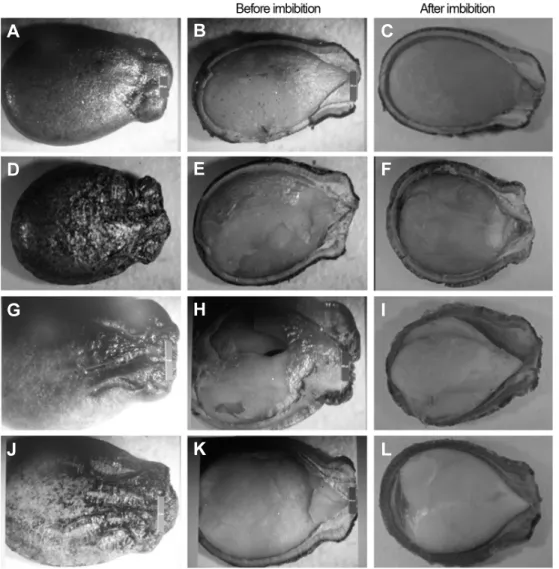
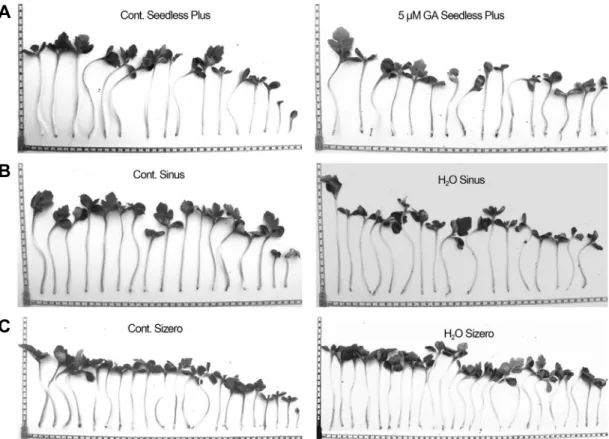
All these differences in seedling vigor were suggested to be due to differences in shape and sizes of seeds, seed coat thickness, and air space cavity. Larger air spaces in seeds were observed in Sinus, followed by Seedless Plus, Sizero, and Sambokggul (Fig. 2). Seedlings of control vs primed seeds with 5 µM GA, w hich w as the most effective in Seedless Plus, hydroprimed Sinus, and hydroprimed

Sizero are shown in the Fig. 3.

Discussion

The present experimental findings showed that seed priming has a positive effect on the germination rate in all triploid cultivars and germination index (GI) in Sizero, whereas time to 50% germination (T 50 ) showed no effect.

In our study, seeds of triploids and diploids had some differences in seed shape and sizes, thickness of seed coat, and air space cavity and these factors led to variation in response to priming treatments, resulting in differences in germination ability. FGP increased in all triploid cultivars and GI increased in Sizero, but T 50 showed no differences.

The results revealed that Seedless plus showed better

performance with 5 µM GA (FGP, 68%; GI, 3.2), Sinus with

hydropriming (FGP, 81.3%; GI, 5.0), and Sizero w ith hydro-

priming (FGP, 86.7%; GI, 4.6) treatments. Sambokggul

showed the highest FGP 98.7% with hydropriming treatment

(7)

A B C

D E F

G H I

J K L

Fig. 2. Differences in shape of triploid seeds showing larger airspace in comparison to diploid cultivar before and after imbibition.

A-C, Diploid, Sambokggul; D-F, Triploid, Seedless Plus; G-I, Triploid, Sinus; J-L, Triploid, Sizero.

whereas GI and T 50 showed no effect of any primed treat- ment over the control. Germination rate w as 68% after 13 days in Seedless plus with 5 µM GA, 81% within 8 days in Sinus with hydropriming, and 87% with 8 days in Sizero with hydropriming. Seed priming consistently had no effect on shoot height among triploid cultivars and fresh weight of shoots had a marginal difference of regression in seeds treated with 2% of H 2 O 2 over the control among triploids and diploid cultivars, with the exception of Seedless Plus. In particular, it was noted that as the concentration of different treatments increased, there was corresponding negative impact on the seedling vigor of the triploids and diploid cultivars. Hence, concentration played key factor in controlling the germination behavior in triploids. It has been reported that priming techniques were applied successfully to improve germination rate, uniformity of germination,

final germination, or shorten T 50 (Eskandari and Kazemi, 2011; Moghamibashi et al., 2012); however, germination efficiency was found to vary with species and priming method (Selvarani and Umarani, 2011). This result was in agreement with the results of Huang et al. (2002), which showed that hydropriming was effective in triploid water- melon cultivar Guangxi. FC was found to accelerate metabolic processes (Lutsenko et al., 2005), transmembrane electric potential, and germination (Ajmal Khan et al., 2009; Ballarin- Denti and Cucucci, 1979; Gul and Weber, 1998; Simonovic et al., 2000).

The amount of seed material and its composition within

the seed is presumably utilized to support seed coat splitting

and seedling emergence. In triploids particularly, due to

the weak embryo, the energy required to overcome the

resistance of the thick seed coat and the overlying growth

(8)

A

B

C

Fig. 3. Comparison of seedlings of control vs primed seeds; A, GA 5 µM in Seedless Plus; B, control vs hydroprimed Sinus;

and C, and control vs hydroprimed Sizero.

media would be limited to some extent, resulting in low emergence rate. Hence prior seed priming treatment, i.e.

before the seed began growing in the nursery, helped to provide this energy to enhance germination performance.

The present findings helped to find the optimal priming conditions for achieving improved germination of triploid watermelon. GA and hydropriming helped to break down seed dormancy and thus led to the enhancement of FGP and GI . It w as concluded that hydropriming and 5 µM GA seed treatments could efficiently enhance germination in triploids. These seed priming treatments could be used on a large scale for industrial applications. Hydropriming is a simple, effective, and costless method for improving seed germination and seedling vigor of Sinus and Sizero.

Literature Cited

Ajmal Khan, M., B. Gul, and D.J. Weber. 2009. Effect of germination regulating chemicals on seed germination of Halogeton glomeratus for alleviation of salinity stress. Pak. J. Bot. 41:1205-1212.

Ballarin-Dent, A. And M. Cucucci. 1979. Effect of abscisic acid, gibberellic acid and fusicoccin o the treatment potential during early phase of germination in radish (Raphnus sativus L.) seeds.

Planta 1476:19-23.

Çavusoglu, K. and K. Kabar. 2010. Effects of hydrogen peroxide on the germination and early seedling growth of barley under NaCl and high termperature stresses. Eur. Asia J. Biosci. 4:70-79.

Chen, K., R. Arora, and U. Arora. 2010. Osmopriming of spinach (Spinacia oleracea L. cv. Bloomsdale) seeds and germination performance under temperature and water stress. Seed Sci.

Technol. 38:45-57.

Duval, J.R. and D.S. NeSmit. 1998. Germination response of

‘Genesis’ triploid watermelon [Citrullus lanatus (Thunb.) Matsum.

& Nakai] to hydrogen peroxide and seed coat alteration.

HortScience 33:545-546.

Duval, J.R. and D.S. NeSmit. 2000. Treatment with hydrogen peroxide and seedcoat removal or clipping improve germination of ‘Genesis’ triploid watermelon. HortScience.35:85-86.

Egel, D.S.1999. Seed germination and health for triploid (Seedless) watermelons. BP ‐62.

Eskandari, H. and K. Kazemi. 2011. Effect of seed priming on germination properties and seedling establishment of cowpea (Vigna sinensis). Not. Sci. Biol. 3:113-116.

Eskandari, H. 2013. Effects of priming technique on seed germination properties, emergence and field performance of crops. A review.

Intl. J. Agron. Plant Prod. 4:454-458.

Esmaelli, M.A. and A. Heidarzade. 2012. Investigation of different

(9)

osmopriming techniques on seed and seedling properties of rice (Oryza sativa) genotypes. IRJABS 3: 242-246.

Farooq, M., S.M.A. Basra, H. Rehman, N. Ahmad, and B.A.

Saleem. 2007. Osmopriming improves the germination and early seedling growth of melons (cucumis meloL.). Pak. J. Agric.

Sci. 44:529-536.

Farooq, M., S.M.A. Basra, B.A. Saleem, M. Nafees, and S.A.

Chishti. 2005. Enhancement of tomato seed germination and seedling vigor by osmopriming. Pak. J. A. Sci. 42:36-41.

Ghodrat, V. and M.J. Rousta. 2012. Effect of priming with gibberellic acid (GA

3

) on germination and growth of corn (Zea mays L.) under saline conditions. IJACS 4:882-885.

Grange, S.L., D.I. Leskovar, L.M. Pike, and B.G. Cobb. 2000.

Excess moisture and seedcoat nicking influence germination of triploid watermelon. HortScience 35:1355-1356.

Grange, S.L., D.I. Leskovar, L.M. Pike, and B.G. Cobb. 2003.

Seedcoat structure and oxygen enhanced environments affect germination of triploid watermelon. J. Am. Soc. Hortic. Sci.

128:253-259.

Gul, B. and D.J. Weber. 1998. Effect of dormancy relieving compounds on the seed germination of non-dormant Allenrolfea occidentalis under salinity stress. Ann. Bot. 82:555-560.

Harrington, J.F. and P.A. Minges. 1954. Vegetable seed germination.

Univ. Calif. Agric. Ext. Serv. (Mimeo).

Huang, R., S. Sukprakarn, T. Thongket, and S. Juntakool. 2002.

Effect of hydropriming and redrying on the germination of triploid watermelon seeds. Kasetsart J. (Nat. Sci.) 36:219-224.

Kihara, H. 1951. Triploid watermelons. Proc. Am. Soc. Hortic.

Sci. 58:217-230.

Liu, P., W. Liu, S. Zhao, Z. Yan, N. He, and X. LU. 2010.

Comparison of seed coat structure between different ploidy watermelons. J. Changjiang Vegetables. DOI CNKL:SON:

CJSC.0.2010-08-009.

Lutsenko, E.K., E.A. Marushko, N.V. Kononenko, and T.G. Leonova.

2005. Effect of fusicoccin on the early stages of sorghum growth at high NaCl concentration. Ann. Rev. Plant Physiol. 30:273-288.

Marr, C.V. and K.L.B. Gast. 1991. Reactions by consumers in a ‘farmers’market to prices for seedless watermelon and ratings of eating quality. HortTechnology 1:105-106.

Marre, E. 1979. Fusicoccin: a tool in plant physiology. Ann. Rev.

Plant Physiol. 30:273-288.

Maynard, D.N. and G.W. Elmstrom. 1992. Triploid watermelon production practices and varieties. Acta Hortic. 318:169-173.

Mereddy, R., L. Wu, S.W. Hallgren, Y. Wu, and K.E. Conway.

2000. Solid matrix priming improves seedling vigor of Okra seeds. Proc. Okla. Acad. Sci. 80:33-37.

Moeinzadeh, A., F. Sharif-Zadeh, M. Ahmadzadeh, and F.H.

Tajabadi. 2010. Biopriming of sunflower (Helianthus annuus L.) seed with Pseudomonas fluorescens for improvement of seed invigoration and seedling growth. AJCS 4:564-570.

Moghanibashi, M., H. Karimmojeni, P. Nikneshan, and D. Behrozi.

2012. Effect of hydropriming on seed germination indices of sunflower (Helianthus annuus L.) under salt and draught conditions. PKJ 1:10-15.

Nerson, H., H.S. Paris, Z. Karchi, and M. Sachs. 1985. Seed treatments for improved germination of tetraploid watermelon.

HortScience 15: 253-254.

Rezaei, R. and M. Ramezani. 2012. The physiological effects on some traits of osmopriming germination of maize (Zea mays L.), rice (Oryza sativa L.) and cucumber (Cucumis sativus L.).

IJB 4:132-148.

Rouhi, H.R., M.A. Aboutalebian, and F. Sharif-Zadeh. 2011. Effects of hydro and osmopriming on drought stress tolerance during germination in four grass species. Int. J. AgriScience 1:107-114.

Selvarani, K. and K. Umarani. 2011. Evaluation of seed priming methods to improve seed vigour of onion (Allium cepacv.

aggregatum) and carrot (Daucus carota). J. Agric. Technol.

7: 857-867.

Shehzad, M., M. Ayub, A.U.H. Ahmad, and M. Yaseen. 2012.

Influence of priming techniques on emergence and seedling growth of forage sorghum (Sorghum bicolor L.). J. Anim. Plant Sci. 22:154-158.

Siadat, S.A., S.A. Moosavi, M.S. Zadeh, F. Fotouhi, and M.

Zirezadeh. 2011. Effects of halo and phytohormone seed priming on germination and seedling growth of maize under different duration of accelerated ageing treatment. Afr. J. Agric. Res.

6:6453-6462.

Simonovic, A., D. Grubisic, Z. Giba, And R. Konjevic. 2000.

Interaction of gibberellics and fusicoccin in growth retardant and far red light inhibited germination in lettuce seeds. Plant Growth Regul. 32:91-97.

Tajima, N., M. Nukina, N. Kato, and T. Sasso. 2004. Novel fusicoccin R and S and the fusicoccin S Aglycon (phomosiol) from Phomopsis amygdali Niigata 2-A, and their seed germination stimulating activity in the presence of absisic acid. Biosci.

Biotechnol. Biochem. 68:1125-1130.

Tzortzakis, N.G. 2009. Effect of pre-sowing treatment on seed germination and seedling vigour in endive and chicory. HortScience 36:117-125.

Whitaker, T.W. and G.N. Davis. 1962. Cucurbits. Interscience publisher. Inc., New York.

Yang, M.L. and F.J.M. Sung. 1994. The effect of suboptional temperature on germination of triploid watermelon seeds of different weights. Seed Sci. Technol. 22:485-493.

Yari, L., A. Zareyan, S. Sheidaie, and F. Khazaei. 2012. Influence of high and low temperature treatments on seed germination and seedling vigor of rice (Oryza sativa L.). WASJ 16:1015-1018.

Zhang, X. 2004. Inbred tetraploid watermelon line 90-4194.United

States Patent Application Number 2004/0172690 A1.

수치

Fig.  1.  The  process  of  hydration  and  incubation  during  seed  priming  treatment
Table  1.  The  effects  of  different  priming  treatments  on  seedling  vigor  of  triploid  and  diploid  cultivars  on  the  basis  of  FGP,  T 50 ,  and  GI.
Table  3.  The  effect  of  different  priming  treatments  on  shoot  height  (cm)  and  fresh  weight  (g)  of  seedlings  of  triploid  and  diploid  cultivars Treatments Cont
Fig.  2.  Differences  in  shape  of  triploid  seeds  showing  larger  airspace  in  comparison  to  diploid  cultivar  before  and  after  imbibition
+2

참조

관련 문서