채취 시기와 발아 온도에 따른 진달래의 종자 및 발아 특성
최규성1⋅송기선2⋅구다은3⋅이하나4⋅성환인4⋅김종진 4*
1국립백두대간수목원 식물양묘실, 2한국임업진흥원 임업지식서비스단,
3국립산림품종관리센터 종묘관리과, 4건국대학교 산림조경학과
Characteristics of Seed and Germination of Rhododendron mucronulatum by Collection Dates and Germination Temperatures
Kyu Seong Choi1, Ki Seon Song2, Da Eun Koo3, Ha Na Lee4, Hwan In Sung4 and Jong Jin Kim 4*
1Plant Propagation and Reproduction Division, Baekdudaegan National Arboretum, Bonghwa 36209, Korea
2Forestry Knowledge Service Division, Korea Forestry Promotion Institute, Seoul 07570, Korea
3Department of Seed and Seedling Management, National Forest Seed and Variety Center, Choongju 27495, Korea
4Department of Forestry and Landscape Architecture, Konkuk University, Seoul 05029, Korea
1)
요 약: 본 연구는 우리나라 자생수종인 진달래(Rhododendron mucronulatum Turcz.)의 열매 및 종자의 특성을 조사하여 종자를 통한 대량번식 기술의 기초자료를 확보하고자 실시하였다. 진달래 열매는 강화군 고려산(435 m)에서 2013년 8월 26일, 9월 5일, 9월 12일, 10월 4일에 각각 채취하였다. 채취된 종자의 발아 온도 실험은 5, 10, 15, 20, 25, 30℃에서 실 시하였다. 열매의 함수율은 2013년 9월 5일 채취 열매에서 54.5%로 가장 높았으며, 채취일자에 관계없이 열매의 종자개 수는 91.3∼116.3개였다. 종자의 길이는 10월 4일 채취 종자에서 1947.4 ㎛, 폭은 9월 12일에서 727.3 ㎛로 가장 컸다.
발아율은 종자의 채취시기에 관계없이 25℃에서 높았으며, 9월 12일 채취한 종자에서 27.3%로 가장 높았다. 한편, 채취 시기와 관계없이 5, 10 및 30℃에서는 전혀 발아가 되지 않았다. T50과 평균발아일수는 온도가 높아질수록 짧아지는 경향 을 보였으며, 발아균일도는 채취시기가 늦을수록 낮아지는 경향을 보였다. 발아속도는 25℃에서 가장 빠른 것으로 조사되 었다. 본 실험의 결과를 종합해 볼 때 진달래 종자의 적정 채취시기는 9월 12일~10월 4일 경이며, 적정 발아 온도는 25℃
인 것으로 판단된다.
Abstract: This study was carried out in order to secure basic data of seedling mass propagation technique of Rhododendron mucronulatum which is the native tree species of Korea by surveying the characteristics of its fruit and seed. The fruits were collected at Mt. Goryeo in Ganghwa-gun on different dates in 2013; August 26th, September 5th, September 12th, October 4th. The seed germination test was carried out at 5, 10, 15, 20, 25 and 30℃. Moisture content of the fruit was highest (54.5%) in the fruit collected on September 5th. Number of the seeds in a fruit was 91.3 to 116.3, regardless of the collection date. Seed length was highest (1947.4 ㎛) in the seeds collected on October 4th and seed width was highest (727.3 ㎛) in the seeds collected on September 12th. Germination rate of the seeds was highest at 25℃ regardless of the seed collection date, which showed the highest value(27.3%) in the seeds collected September 12th. Meanwhile, the seeds were not germinated not at all at 5, 10 and 30℃. T50 and mean germination time of the seeds got shorter at the higher temperature. Germination uniformity got lower when the collection date got later. Germination speed of the seeds was fastest at 25℃. According to the results of this study, it seems that the appropriate time to collect fruit and seed is between September 12th and October 4th, and the appropriate temperature for the seed germination is 25℃.
Key words: germination rate, germination temperature, Rhododendron mucronulatum, seed collection date, water content of fruit
* Corresponding author E-mail: [email protected] ORCID
Jong Jin Kim https://orcid.org/0000-0001-8863-1349
ISSN 2586-6613(Print), ISSN 2586-6621(Online) http://e-journal.kfs21.or.kr
237
서 론
진달래속 식물은 전 세계적으로 1,200여 종이 포함된 매우 큰 분류군으로서 아프리카와 남미지역을 제외한 전 대륙에 널리 분포하며, 그 중 700여종 이상이 주로 동아 시아에 분포한다고 보고되었다(Baily and Baily, 1978).
진달래속 식물인 진달래(Rhododendron mucronulatum Turcz.)는 우리나라 전 지역의 양지바른 산지에서 자라는 낙엽관목으로 일본, 중국에도 분포하며, 높이 2∼3 m에 달한다. 잎은 호생하며, 잎의 표면에 인편이 약간 있다.
꽃은 잎이 나오기 전인 4월에 피며 화관은 깔때기 모양 이고 자홍색 또는 연한 홍색이며 겉에 잔털이 있다. 열매 는 삭과로서 원통형이며 10월에 익는다(Lee, 1982). 국내 재배품종은 약 100여종이 있으며, 이 중에서 진달래는 원예 및 조경용 수종으로의 개발가치가 높아 우량형질을 활용하여 신품종을 많이 육종하고 있다(Shin, 2008).
진달래속 식물의 번식은 종자를 이용한 실생번식과 삽 목, 분주, 조직배양 등 무성번식에 의해서 가능하나 삽목 에 의한 번식이 주를 이룬다. 하지만 진달래는 삽목이 잘 되지 않는 수종으로 알려져 있다(Shin, 2008; Chu, 2013).
종자의 원활한 발아를 위해서는 종자의 채취시기가 중 요한데, 조기 채취된 종자는 배 또는 배유의 미성숙으로 종자 활력이 떨어질 수 있으며, 너무 늦은 시기에 채취된 종자는 종자 내 수분 감소 등의 원인으로 활력이 소실될 수도 있다. 종자 활력의 소실은 불가역적 생리 현상으로 일단 종자가 활력을 소실하면 되돌릴 수 없다. 이렇게 종 자의 채취시기는 종자의 성숙 및 활력과 밀접한 관련이 있다. 그러므로 종자를 채취하고자 할 때는 적정 시기를 판단하는 것이 무엇보다 중요하다(FRI, 1994; Han et al., 2004; Tak et al., 2006). 지금까지 산림수종을 대상으로 종자를 시기별로 채취하여 관찰한 연구는 비교적 많은 데, 느릅나무(Tak et al., 2006), 종가시나무(Choi, 2012), 고로쇠나무(Song, 2016) 등이 있다. 하지만 원예, 조경 및 생태복원용 등 다양한 분야에서 이용되고 있는 진달래에 관한 연구는 주로 발아와 삽목(Hwang et al., 1998; Park et al., 2005; Shin, 2008; Kim et al., 2013), 생리 반응(Kim et al., 2010; Lee et al., 2010; Kim et al., 2012) 등이 보고 되었으며, 채취시기에 따른 종자의 특성 구명에 대한 연 구는 미미한 실정이다.
따라서 본 연구에서는 우리나라 자생수종인 진달래를 대 상으로 채취시기에 따른 열매와 종자의 형태적 특성을 조사 하고 시기별로 채취된 종자를 이용해 온도별 발아실험을 실시하였다. 이를 통해 진달래 종자의 적정 채취시기와 최적 발아온도를 구명하고, 발아율이 저조한 진달래 종자를 이용 한 증식 기술 개발의 기초자료로 활용하고자 하였다.
재료 및 방법
1. 열매 및 종자 채취
본 실험에 사용된 진달래(R. mucronulatum Turcz.) 열 매와 종자는 인천광역시 강화군 강화읍 고려산(435 m)의 북사면에 위치한 진달래 군락지(37°44′41″N, 125°26′04″
E)에서 채취하였다. 열매는 2013년 8월 26일, 9월 5일, 9 월 12일, 10월 4일에 채취하였다. 채취한 열매는 음지건 조 후 종자를 체눈의 크기가 2.360 ㎜인 체(Model Sie 200-008, Saehan Co., Seoul, Korea)로 종자를 가려낸 후, 체눈의 크기가 1.000 ㎜인 체(Model Sie 200-018, Saehan Co., Seoul, Korea)로 작은 불순물을 가려내는 정선작업 을 진행하였다. 정선된 종자는 건국대학교 산림복원학연 구실 5℃의 저온저장고에 저장하였다.
2. 열매와 종자의 형질 조사
채취한 진달래 열매 및 종자의 형질분석을 위해 채취 시기별로 육안으로 균일한 열매 100개를 선정하여 채취 당일에 열매와 종자의 크기를 측정하였다. 진달래 열매 의 크기는 디지털 캘리퍼스(CD-20CPX, Mitutoyo Corp., Kawasaki, Japan)를 이용하여 측정하였으며, 종자의 크기 는 비디오현미경(AST-ICS305B, Alphasystec, Anyang-si, Korea)을 이용하여 측정하였다. 또 생중량의 경우 채취당 일에 측정하고 모든 열매는 실험실 상온(room temperature) 에서 자연건조 처리를 하였는데, 이 자연건조 기간 동안 2일 간격으로 더 이상 열매의 무게변화가 나타나지 않는 날까지 열매의 무게를 측정하였으며 이를 통해 진달래 열매의 건중량 및 함수율을 구하였다. 열매의 종자개수 는 채취시기별로 종자 정선 완료 후에 조사하였다.
3. 발아실험
진달래 종자의 발아실험은 항온기(BI-5160, New power eng. co., Hwaseong-si, Korea)를 이용하여 실시하였다. 채 취된 종자의 발아실험은 2014년 2월 7일부터 3월 18일까 지(40일) 5, 10, 15, 20, 25, 30℃ 각각의 항온기에서 채취 시기별로 실시하였다. 발아실험은 여과지(Whatman No.
1, GE Healthcare, Buckinghamshire, UK)를 2장씩 깐 petri dish에 멸균수를 흐르지 않을 정도로 넣은 후 종자를 50 립씩 3반복으로 항온기에 배치하였으며, 암조건으로 실 시하였다.
4. 발아특성 조사
유근이 2 mm 이상 출현된 종자를 기준으로 하여 매일 발아된 종자의 개수를 조사하였다. 채취시기에 따른 온도 별 발아실험 후 각 처리별 발아 조사 결과를 이용하여 발
아율(Germination rate), T50 (Days to 50% of germination of final germination rates), 평균발아일수(Mean germination time), 발아균일도(Germination uniformity), 발아속도 (Germination speed)를 구하였다(Ranal and Santana, 2006;
Kulkarni et al., 2007).
◦ Germination rate(%) = (N/S) × 100
◦ T50(days) = Ti + (Tj - Ti) × (N/2 - Ni)/(Nj - Ni)
◦ Mean germination time(days) = ∑(TxㆍNx)/N
◦ Germination uniformity = ∑[(MGT - Tx)2ㆍNx]/N - 1
◦ Germination speed = ∑(Nx/Tx)
(N: 총 발아수, S: 총 공시 종자수, Ni: N에 대한 50% 발아 직전까지의 총 발아수, Nj: N에 대한 50% 발아 직후까지 의 총 발아수 Ti: Ni 시점까지 소요된 발아기간, Tj: Nj 시 점까지 소요된 발아기간, Nx: 조사 당일의 발아수, Tx: 치 상 후 조사일수)
공시수종의 열매 및 종자의 형질조사 결과와 발아율, T50, 평균발아일수, 발아균일도, 발아속도 등의 결과 값에 대한 분석은 SPSS 프로그램(version 20.0, Statistical Package for Social Science, Inc., Chicago, IL, USA)을 이용하여 분산분석(ANOVA)을 실시하였다. 통계적으로 차이가 유 의한 경우 Duncan's multiple range test를 실시하여 각 항 목 평균값을 비교하였다.
결과 및 고찰
1. 열매의 특성
진달래 열매의 채취시기별 형질 조사결과, 2013년에 채취한 열매 중 길이는 10월 4일 열매가 15.5 ㎜, 폭은 9 월 5일 열매가 4.4 ㎜로 가장 컸다(Table 1). 열매의 길이 와 폭은 채취시기별로 유의적 차이를 보였는데 이는 채 취 현지 진달래 군락의 개체 간 차이로 판단된다. 열매지 수(L/W)는 전체적으로 3.0∼3.8로 조사되었으며 2013년 8월 26일과 10월 4일에 가장 큰 값으로 조사되었다. 이것 은 길이(p<0.05)가 길고, 폭(p<0.05)이 작았기 때문으로 사료된다. 한편 Park et al.(2005)은 발아실험에 사용된 진 달래 열매의 길이가 약 17.0 ㎜인 것으로 보고하여 고려 산에서 채취된 본 실험의 진달래 열매와는 차이를 보였 는데, 이는 다양한 환경조건과 생장조건에 의한 결과로 보인다(Leishman, M.R. et al., 2000).
Yim(2016)은 같은 진달래속 식물인 철쭉의 열매를 서 울 아차산에서 시기별로 채취한 결과, 길이는 2013년 10 월 1일 열매에서 가장 길고 폭은 9월 5일 열매에서 가장 큰 것으로 보고하여 본 실험과 유사한 경향을 보였다.
진달래 열매의 생중량과 건중량은 2013년 10월 4일 열 매가 가장 높은 값으로 조사되었다. 함수율은 2013년 9 월 5일에 54.5%로 가장 높았고, 이후에는 열매의 채취시 기가 늦어질수록 함수율이 유의적으로 낮아져 생중량, 건중량과는 반대의 경향을 보였다. 한편, 아차산 철쭉의 경우 채취시기가 늦어질수록 함수율이 감소하는 경향이 보고되었다(Yim, 2016).
Collection date Length (㎜) Width (㎜) Fruit index (L/W)
2013. 08. 26 15.3±1.7za 4.0±0.4b 3.8±0.3a
2013. 09. 05 13.3±1.8c 4.4±0.5a 3.0±0.2c
2013. 09. 12 14.4±2.6b 4.0±0.7b 3.6±0.4b
2013. 10. 04 15.5±1.9a 4.1±0.5b 3.8±0.4a
zMean±SD(n=100). Different letters in each column indicate significant difference by Duncan’s multiple range test; p<0.05.
Table 1. Fruit size of R. mucronulatum by collection date.
Collection date Fresh weight (g) Dry weight (g) Water content (%)
2013. 08. 26 2.14±0.19za 1.06±0.09a 50.6±0.8b
2013. 09. 05 1.64±0.14b 0.75±0.07b 54.5±0.9a
2013. 09. 12 2.08±0.60a 1.04±0.28a 50.1±1.2b
2013. 10. 04 2.14±0.13a 1.11±0.10a 48.1±1.9c
zMean±SD (n=100). Different letters in each column indicate significant difference by Duncan’s multiple range test; p<0.05.
Table 2. Fresh weight, dry weight and water content of R. mucronulatum fruits by collection date.
Figure 1. Changes in water content of fruits of R.
mucronulatum. Bars indicate SD.
진달래 열매를 자연건조 처리 후 수분함량을 2일 간격 으로 조사한 결과, 진달래 열매는 2일 동안 87∼90%의 수분이 급격하게 감소하였으며, 4일부터는 수분함량이 완만하게 감소하는 것으로 조사되었다. 자연건조 처리 후 12일에는 모든 수분이 증발하여 변화가 없었다(Figure 1). 한편 진달래와 같은 속의 식물인 산철쭉 열매의 경우 도 채취 후 수분함량 감소 유형이 진달래와 유사한 것으 로 조사되었다(personal communication).
2. 종자의 특성
일반적으로 종자의 크기와 무게는 종자 발아율, 발아속 도 및 유묘의 생존에 영향을 미치는 중요한 인자로 알려 져 있다(Khan et al., 1999; Navarro and Guitian, 2003). 본 연구에서 진달래 열매 채취시기별 종자에 대한 형질 조 사 결과, 진달래 종자의 길이는 2013년 10월 4일 종자가 1947.4 ㎛, 8월 26일 종자는 1908.8 ㎛, 9월 12일 종자는 1844.5 ㎛ 순으로 길었고, 9월 5일 종자는 1652.9 ㎛로 다
른 채취시기의 종자의 길이 보다 유의적으로 짧은 것으 로 조사되었다(Table 3). 종자의 폭은 9월 12일 종자가 727.3 ㎛로 가장 길었으나 채취시기에 따른 유의성은 없 었다(Table 3). 종자지수는 전체가 2.6∼3.0으로 조사되었 으며 유의성은 없으나 2013년 8월 26일과 9월 5일에 가 장 높게 나타났다. 진달래 종자의 길이와 폭은 채취시기 별로 차이를 보였으나 일정한 경향이 나타나지 않았는 데, 이는 본 실험이 수행된 고려산 진달래의 경우 종자 길이와 폭과 같은 형태적 성숙은 8월 말 정도이면 성숙 이 완료되는 것으로 사료된다.
진달래 열매 내 종자 개수는 91.3∼116.3개로 조사되었 다. 2013년 8월 26일 열매에서 종자가 116.3개로 가장 많 았고 그 다음으로 10월 4일 열매가 107.7개로 많았으며, 9월 5일 열매에서는 91.3개로 가장 적은 개수의 종자가 나왔다. 이러한 결과는 열매의 길이(크기)가 긴 열매에서 상대적으로 많은 종자가 생산된 것으로 분석되었다 (p<0.01)(Table 4).
3. 발아 특성
진달래 종자의 채취시기와 발아처리 온도는 종자발아 특성 요소 중 발아율, T50, 평균발아일수, 발아속도에 있 어서는 유의하게 상호작용하는 것으로 조사되었으나, 발아균일도에서는 유의하게 상호작용하지 않은 것으로 조사되었다(Table 5). 종자 채취시기는 종자발아 특성 모든 요소에 유의한 영향을 미쳤고, 발아처리 온도는 발 아균일도를 제외한 4가지 요소에 영향을 미친 것으로 조사되었다.
Collection date Length (㎛) Width (㎛) Seed index (L/W)
2013. 08. 26 1908.8±157.4zab 646.6± 82.5a 3.0±0.6a
2013. 09. 05 1652.9±152.0b 704.3±148.8a 3.0±0.6a
2013. 09. 12 1844.5±314.0ab 727.3±101.1a 2.6±0.5a
2013. 10. 04 1947.4± 72.0a 687.9± 93.5a 2.9±0.3a
zMean±SD(n=100). Different letters in each column indicate significant difference by Duncan’s multiple range test; p<0.05.
Table 3. Seed size of R. mucronulatum by collection date.
Collection date Fruit length (㎜) No. of seed
2013. 08. 26 15.3±1.7za 116.3± 7.6za
2013. 09. 05 13.3±1.8c 91.3±11.0b
2013. 09. 12 14.4±2.6b 93.7±10.5b
2013. 10. 04 15.5±1.9a 107.7± 9.3ab
zMean±SD(n=100). Different letters in each column indicate significant difference by Duncan’s multiple range test; p<0.05.
Table 4. Seed numbers of R. mucronulatum fruit by collection date and fruit length.
Source
F-value
Germination rate T50 Mean
germination time Germination
uniformity Germination speed
Collection date(A) 6.091*** 22.679*** 68.005*** 6.141*** 11.386***
Germination temperature(B) 23.352*** 11.322*** 22.792*** - 25.975***
A × B 2.747** 7.444*** 18.077*** - 4.084***
p**<0.05, p***<0.01
Table 5. Results of two-way ANOVA for effects of collection date and germination temperature on germination characteristics of R. mucronulatum.
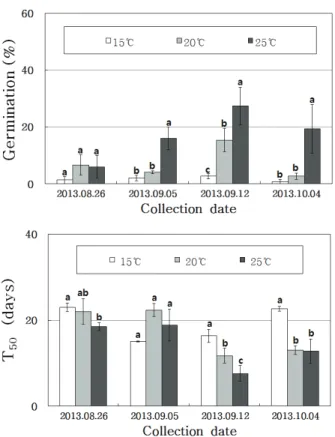
한편 발아율은 9월 12일에 채취한 종자가 25℃에서 27.3%로 가장 높았다. 처리 온도 중 가장 높은 발아율을 보인 25℃를 채취시기별로 살펴보면 9월 12일, 10월 4일, 9월 5일, 8월 26일 순으로 발아율이 높게 나타났다 (Figure 2). 한편 채취시기와 관계없이 5℃, 10℃, 30℃에 서는 전혀 발아가 되지 않았는데 이것은 진달래 종자의 발아가 온도에 매우 민감하게 반응하기 때문에 나타난 결과로 사료된다. 일반적으로 종자 채취시기는 종자의 성숙 및 활력과 밀접한 관련이 있다(Choi et al., 2003).
발아율이 높은 25℃ 중 8월 26일 진달래 종자의 발아율 이 상대적으로 저조한 것은 외부 형태적인 크기는 이미 성숙하였으나 열매의 조기 채취로 배 또는 배유가 미성 숙하여 종자 활력이 제대로 갖추어지지 않았기 때문으로 판단된다(Han et al., 2004). Choi et al.(2012)은 종가시나 무 종자의 경우 2011년 11월 11일∼21일에 채취한 종자 의 발아율이 91%, 2012년 2월 15일∼20일에 채취한 종 자의 발아율은 43%로 보고하여 채취시기에 따라 발아율 이 큰 차이를 보이는 것으로 보고하였다. 그리고 적수크 령(Pennisetum alopecuroides for. erythrochaetum) 종자의 채취시기별 비교에서는 미성숙단계로 판단되는 10월 2 일과 퇴화가 진행된 것으로 예상되는 11월 25일에 채취 된 종자가 다른 시기에 채종한 종자들보다 낮은 발아율 을 보인 것으로 보고되었다(Lim et al., 2010). 이처럼 수 종에 따라 종자의 채취시기 및 성숙단계에 따른 발아율 차이가 있음을 알 수 있다.
Shin(2008)과 Chu(2013)의 보고에 따르면, 진달래 종자 는 25℃에서 발아율이 가장 높고, 5℃와 35℃에서는 발 아가 되지 않아 본 실험의 결과와 동일한 경향을 보였다.
또 녹비작물인 헤어리벳치의 온도별(10℃, 15℃, 20℃, 25℃) 발아 실험에서도 온도가 높아질수록 발아율이 증 가되어 25℃에서 95.3%로 가장 높게 보고되어 본 실험과 동일한 결과를 보였다(Kim et al., 2003).
총 발아율의 50%가 발아된 일수를 나타내는 T50은 전체 적으로 7.0∼23.0일로 조사되었으며, T50이 가장 긴 처리구 는 2013년 8월 26일의 15℃로 조사되었다(Figure 2). 또한,
Figure 2. Germination rate and T50 of R. mucronulatum by collection date and temperature. Different letters above column indicate significant difference by Duncan’s multiple range test;
p<0.05. Bars indicate SD.
진달래 종자는 온도가 높아질수록 T50이 짧아졌는데 이는 온도가 증가할수록 발아가 빨리 이루어졌기 때문으로 판 단된다. 한편, Lee and Nam(2009)은 초본인 주걱쑥부쟁이 의 경우 온도에 따른 T50이 20℃, 25℃, 30℃에서 각각 3.3 일, 3.5일, 3.9일로 높은 온도에서 길어진 것으로 보고하였 는데, 이는 원예종의 종자발아적온이 18∼21℃이기 때문 으로 판단된다(Hartmann et al., 1997; Ball, 1998).
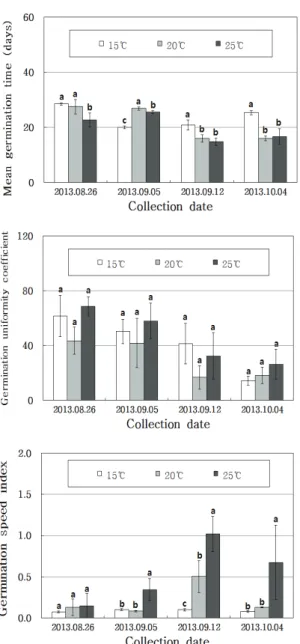
진달래의 평균발아일수는 온도가 높아질수록 짧아지 는 경향을 보였다(Figure 3). 이와 같은 이유는 온도가 높 아질수록 발아가 촉진되어 짧아지며, 이는 온도가 높아 질수록 짧아진 T50의 결과와도 같은 이유로 설명될 수 있다.
Figure 3. Mean germination time, germination uniformity and germination speed of R. mucronulatum by collection date and temperature. Different letters above column indicate significant difference by Duncan’s multiple range test; p<0.05. Bars indicate SD.
갈매보리수나무(Choi, 2012)와 녹비작물인 헤어리벳치 (Kim et al., 2003)의 종자발아실험에서도 온도가 높아질 수록 평균발아일수가 짧아져 본 실험과 동일한 결과를 보였다.
발아균일도는 높은 발아율을 보인 25℃에서 채취시기 가 늦어질수록 발아균일도의 값이 낮아지는 것으로 나타 났다(Figure 3). 한편, 곰취 종자(Jeon et al., 2013)는 온도 가 높아질수록 평균발아일수와 발아균일도가 높아지고, 병풍쌈(Song et al., 2013)의 온도별 발아시험 또한 평균 발아일수와 발아균일도가 20℃에서 가장 낮은 것으로 보 고하여 본 실험과는 다른 경향을 보였다.
발아속도는 2013년 9월 12일 25℃에서 1.02일로 가장 빨랐으며, 2013년 8월 26일 15℃에서는 0.07일로 가장 느 린 것으로 조사되었다(Figure 3). 8월 26일 채취 종자는 처리 온도별 발아속도 차이가 없었으나, 나머지 3번의 채 취 종자에서는 25℃에서 빠른 발아속도를 보였다. 한편, 갈매보리수나무 종자의 발아속도는 10℃와 30℃에서 가 장 느리고, 25℃에서 가장 빠른 것으로 보고되어 본 실험 과 동일한 경향을 보였다(Choi, 2012). 한편, 병풍쌈 종자 (Song et al., 2013)와 곰취 종자(Jeon et al., 2013)의 발아 는 10℃, 15℃, 20℃, 25℃에서 온도가 낮을수록 빠른 발 아속도를 보여 본 실험과는 다른 경향을 보였는데 이것 은 곰취와 병풍쌈이 본 실험의 진달래와 산철쭉과는 다 르게 음지식물이기 때문에 나타난 결과로 판단된다.
종자의 발아에 있어서 온도와 채취시기는 종자의 발아 에 중요한 영향을 미치는 요소이다. 따라서 진달래의 발 아율을 높여 묘목을 대량생산하기 위해서는 적합한 발아 적온 및 채취시기를 확립할 필요가 있다. 본 연구의 결과 를 종합해 볼 때, 진달래 종자의 길이와 폭과 같은 형태 적 성숙은 8월말 정도이면 이루어지는 것으로 사료되나 종자발아 특성을 고려하면 9월 12일∼10월 4일경에 열매 를 채취하는 것이 좋을 것으로 판단된다. 하지만 앞으로 이러한 진달래 종자의 발아에 영향을 끼치는 종자의 내 부 생리적 성숙 과정에 관한 연구가 함께 수행되어야 보 다 적절한 채취시기가 결정될 수 있을 것으로 판단된다.
한편 진달래 종자의 높은 발아율을 위해서는 25℃를 유 지하는 것이 좋을 것으로 판단된다. 앞으로 진달래 종자 를 이용한 증식 기술 개발에 본 연구결과가 활용되기를 기대하는 바이다.
감사의 글
이 논문은 2017학년도 건국대학교의 연구년 교원 지원에 의하여 연구되었음.
References
Baily, L.H. and Baily, E.Z. 1978. Hortus third: A Concise Dictionary of Plants Cultivated in the United States and Canada. 1st Ed. Macmillan Publishing Company. New York, U.S.A. pp. 949-965.
Ball, V. 1998. Ball Redbook. 16th Ed. Ball Publishing, Illinois, U.S.A. pp. 413-414.
Choi, B.H. et al. 2003. Seed Science. Hyangmoon-sa, Seoul.
p. 379.
Choi, C.H. 2012. Effect of temperature and various pre- treatments on germination of Hippophae rhamnoides seeds.
Korean Journal of Plant Research 25(1): 132-141.
Choi, S.M., Shin, H.C. and Park, N.C. 2012. The seed germination and seedling growth of Quercus glauca Thunb.
by seed collection time and size of seeds. Proceedings of 2017 Summer Meeting of the Korean Forest Society. pp.
162-163.
Chu, S.S. 2013. Development of production technique for seedlings of Rhododendron species by container nursery system. (Dissertation). Seoul. Graduate School of Agriculture and Animal Science, Konkuk University.
Forest Research Institute (FRI). 1994. Forest tree seeds and nursery practice. Forest Research Institute, Seoul. pp. 1-51.
Han, S.H, Kim, C.S, Jang, S.S, Lee, H.J. and Tak, W.S. 2004.
Changes in the seed characters and germination properties of three tree species at different storage time. Korean Journal of Agricultural and Forest Meteorology 6(3):
183-189.
Hartmann, H.T., Kester, D.E., Davies, F.T. and Geneve, R.L.
1997. Plant propagation: Principles and practices. 6th Ed.
Upper Saddle River, NJ, U.S.A. pp. 1-728.
Hwang, S.K., Hwang, H.J. and Kim, K.S. 1998. Effect of cutting dates and rooting promoters on rooting of Rhododendron mucronulatum Turcz. Korean Journal of Horticultural Science and Technology 16(1): 33-36.
Jeon, K.S., Song, K.S., Kim, C.H., Yoon, JH. and Kim, J.J.
2013. Effects of seed pre-treatment and germination environments on germination characteristics of Ligularia fischeri seeds. Protected Horticulture and Plant Factory 22(3): 262-269.
Khan, M.L., Bhuyan, P., Shankar, U. and Todaria, N.P. 1999.
Seed germination and seedling fitness in Mesua ferrea L.
in relation to fruit size and seed number per fruit. Acta Oecologia 20: 599-606.
Kim, C.G., Seo, J.H., Cho, H.S. and Lee, J.M. 2003.
Germination of hairy-vetch under different temperature and environmental conditions. Korean Journal of Breeding Science 35(1): 356-356.
Kim, N.Y., Lee, K.C., Han, S.S. and Park, W.G. 2010. Water relations parameters of Rhododendron micranthum Turcz.
from P-V curves. Korean Journal of Plant Research 23(4):
374-378.
Kim, N.Y., Lee, K.C., Han, S.S., Lee, H.B. and Park, W.G.
2012. Photosynthetic characteristics and chlorophyll content of Rhododendron micranthum by the natural habitat. Protected Horticulture and Plant Factory 21(2):
147-152.
Kim, N.Y., Bae, K.H., Kim, .YS., Lee, H.B. and Park, W.G.
2013. Habitat environment and cutting, seed propagation of rare plant Rhododendron micranthum Turcz. Journal of
Forest Science 29(2): 165-172.
Kulkarni, M.G., Street, R.A. and Staden, J.V. 2007.
Germination and seedling growth requirements for propagation of Dioscorea dregeana(Kunth) Dur. and Schinz: A tuberous medicinal plant. South African Journal of Botany 73: 131-137.
Lee, C.B. 1982. Illustrated flora of Korea. Hyangmunsa, Seoul, Korea. pp. 1-601.
Lee, C.H. and Nam, G.U. 2009. Characteristics of seed germination in Heteropappus arenarius Kitam. native to Korea as influenced by temperature. Korean Journal of Plant Research 22(2): 116-122.
Lee, K.J, Song, K.S, Chung, Y.S., Yoon, T.S., Hong, S.K., Kim, J.H., Lee, S.W. and Kim, J.J. 2010. Physiological responses of Rhododendron mucronulatum and R. indicum with shading treatment in autumn season. Korean Journal of Horticultural Science and Technology 28(3): 403-408.
Leishman, M.R., Wright, I.J., Moles, A.T. and Westoby, M.
2000. The evolution ecology of seed size. pp. 31-57. In:
Fenner, M. (Ed.). Seeds, The Ecology of Regeneration in Plant Communities. CABI Publishing. Oxon, UK.
Lim, C.S., Oh, J.Y., Seck, Y.C. and Kim, D.H. 2010. Effects of harvest time and GA3 treatment on the germination rate of Pennisetum alopecuroides for. erythrochaetum. Journal of Agriculture and Life Sciences 44(6): 1-7.
Navarro, L. and Guitian, J. 2003. Seed germination and seedling survival of two threatened endemic species of the northwest Iberian peninsula. Biological Conservation 109: 313-320.
Park, I.S., Kang, S.Y., Kim, D.S., Song, H.S. 2005. Seed germination and seedling growth of Rhododendron species by gamma rays irradiation. Flower Research Journal 13(2):
116-120.
Ranal, M.A. and Santana, D.G. 2006. How and why to measure the germination process? Brazilian Journal of Botany 29:
1-11.
Shin, K.H. 2008. Studies on propagation of Rhododendron mucronulatum and R. yedoense var. poukhanense in container. (Dissertation). Graduate School of Agriculture and Animal Science, Konkuk University.
Song, K.S., Jeon, K.S., Yoon, J.H., Kim, C.H. and Kim, J.J.
2013. Effects of temperatures on seed germination of Parasenecio firmus. Korean Journal of Medicinal Crop Science Symposium. pp. 39-40.
Song, K.S., Yoon, J.H., Jeon, K.S., Kim, .CH., Park, Y.B. and Kim, J.J. 2016. Germination characteristics and early growth of Acer pictum subsp. mono (Maxim.) H. Ohashi by harvesting dates. Korean Journal of Medicinal Crop Science 24(1): 21-26.
Tak, W.S., Choi, C.H. and Kim, T.S. 2006. Change in the
seed characteristics and germination properties of Ulmus davidiana var. Japonica according to seed collection time.
Journal of Korean Forest Society 95(3): 316-322.
Yim, J.Y. 2016. Characteristics of fruits and seed of
Rhododendron schlippenbachii on Mt. Acha. (Dissertation).
Graduate School of Agriculture and Animal Science, Konkuk University.
Manuscript Received : May 8, 2018 First Revision : June 13, 2018 Second Revision : July 10, 2018 Third Revision : July 13, 2018 Accepted : July 14, 2018