Several factors affecting on seed germination of Dracocephalum argunense Fischer ex Link
Young Deug Chang, Cheol Hee Lee, Jeong Seob Song1 and Ju Kwang Hwang*
Dept. of Horticultural Science, Chungbuk National Univ., Cheongju, 361-763, Korea
1Floriculture Research Division, National Institute of Horticultural and Herbal Science, Suwon 441-440, Korea
Abstract - Dracocephalum argunense Fischer ex Link (Labiatae) is a perennial herbaceous plant used as valuable materials for ornamentals, honey production, and pharmaceutics. Since seed germination of this species was quite difficult, present studies were conducted to improve the germination rate by subjecting the seeds to various environmental conditions (tem- perature and light) and treatments (scarification, priming and seed coating). Optimum temperature for adequate germination was 20℃ though it ranged from 15℃ to 25℃, and low temperature treatment improved germination rate. Light was required for higher germination rate in this species. The scarification of seeds resulted in much higher germination, especially by the physical treatment with sandpaper or chemical treatment with sulfuric acid for 30 seconds. Various primers with different concentrations were treated on the seeds and it was demonstrated that low temperature enhanced germination rate, regardless of kinds and concentrations of the primers. Three treatment combinations of the primers, 0.5 mM GA3 treated for 48 hours, 0.5 mM IAA for 24 hours, and 1.0 mM IAA for 24 hours, increased the seed germination rate profoundly. Soaking treatment of inorganic salts, KNO3 and KH2PO4, promoted germination when seeds were subjected to low temperature. Water soluble primers such as sucrose at 0.5 and 3% concentration and solid primer talc powder were effective in enhancing germination rate.
Key words - Labiatae, GA, scarification, priming, seed coating
*
Corresponding author. E-mail : [email protected]Introduction
Dracocephalum argunense Fischer ex Link, a member of family Labiatae, is a herbaceous perennial plant growing around the rim of mountain areas of Korea, and is used as plants for ornamentals, honey production and pharmaceutics (Kim, 1996).
It is 15~40 cm tall with white hair, and has square stems and opposite, aromatic and exstipulate leaves of size 2~5 cm. Purple flowers bloom during May to July and fruits ripen during September to October. According to folk medicine, leaves or whole plants are known to have beneficial effects on pers- piration, urination, dropsy, pulmonary and intestinal tuberculosis, inflammation and headaches (Lee, 2003).
Generally this species is propagated by seeds in nature, but germination rate is very low. The germination of many temperate zone plants is enhanced by dormancy breaking treat- ments such as low temperature (Lee et al., 2002; Park and
Chung, 1993; Kang et al., 2001), and fluctuating temperature (Chiang and Park, 1994). It is also improved by treatment of growth regulators such as GA3, and by priming treatment.
Germination of seeds with hard seed coat is greatly shortened by physico-chemical treatment (Yeom et al., 1985). Present experiments were undertaken to examine the effects of environ- mental conditions (temperature and light) and various treat- ments such as priming, scarification, and seed coating on the germination improvement in D. argunense.
Materials and Methods
Seeds were harvested 40 days after flower bloom and the weight per 100 seeds were 420 mg (Fig. 1). They were dried under well ventilated shade, cleaned, and kept in refrigerators.
Seeds that were harvested during the previous year and kept under 4℃ for 1 year, and those harvested during present year without temperature treatments were used in this experiments.
To study the effects of temperature and light on seed ger-
Fig. 1. Flowering and seed development of Dracocephalum argunense.
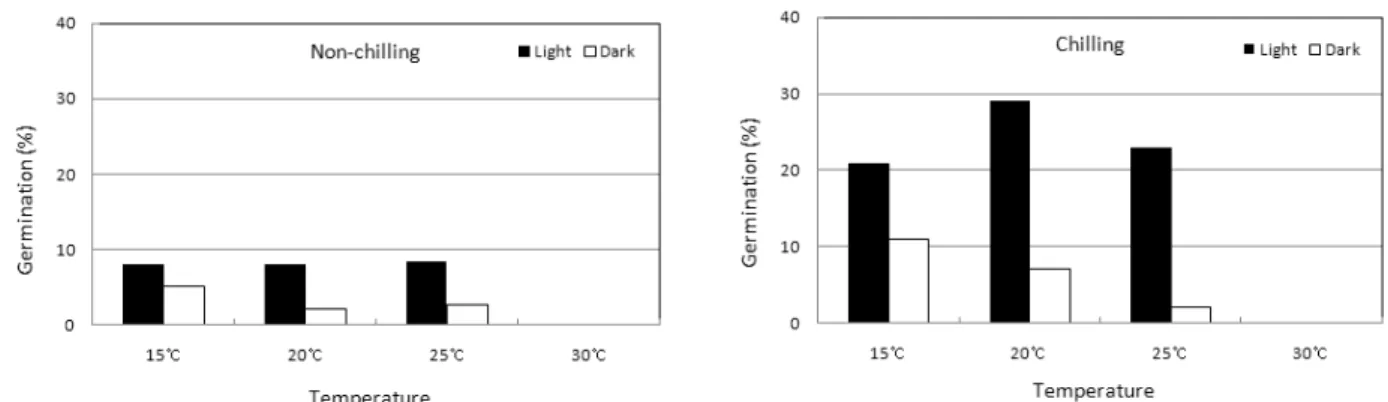
Fig. 2. Effect of seed chilling and germination temperature on seed germination of Dracocephalum argunense.
mination, seeds were maintained under 15, 20, 25, and 30℃
with or without light. Also physico-chemical treatments using sandpaper and concentrated sulfuric acids were conducted on the seeds those harvested during present year. Seeds were rubbed 50 times with pieces of sandpaper. For scarification test, seeds were immersed in sulfuric acid for 5, 10, 30, 60, and 180 seconds, and then washed with running water for more than 3 minutes. Priming treatments with GA3 and IAA at 3 levels (0, 1, and 2 mM) and with KNO3 and KH2PO4 at 3 levels (5, 10, and 20 mM) were performed by immersing seeds for 12, 24, and 48 hours. Seed coating was done with solution of carboxymethyl cellulose, polyvinyl alcohol, and sucrose at 4 levels (0.5, 1, 2, and 4%). The treatments of calcium carbonate and talc powder were performed on the seeds to improve germination rate. All seeds were sterilized with DiazicarenTM 1% solution for 1 hour before placed on germination plates, and placed under light and temperature of 25℃ with 4 repli- cations of 100 seeds. Germination start and rate, among others, were investigated.
Results and Discussions
In this species, chilling treatment was effective in increasing germination rate (Fig. 2), especially under light condition.
Germination rate was less than 10% with unchilled seeds, while that was 21~29% with chilled seeds placed under light.
The seeds required light for germination, indicated by higher germination rate under light. Optimum temperature for ger- mination proved to be 20℃, which was about same result reported by Park et al. (1998) who conducted germination studies on many native promising Korean mountain vegetables.
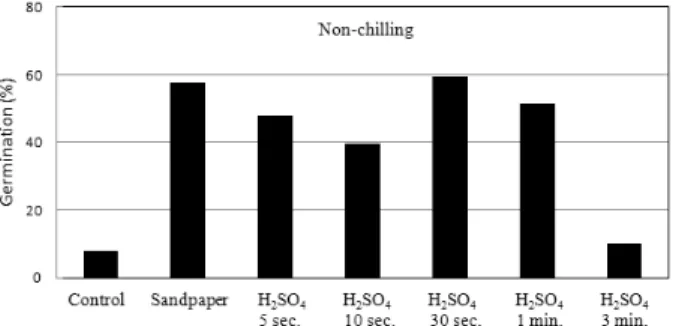
The germination rate that freshly harvested seeds treated physicochemical scarification was shown in Fig. 3. The physicochemically treated seeds promoted germination than non-treated seeds. Especially rubbing seeds 50 times with sandpaper reached 57.5% compared 7.4 times high with control.
And the chemical treatment with sulfuric acid was also im- proved germination, the seeds that treated sulfuric acid for 30 seconds was effective reaching high of 59.3%. Treatment for
Fig. 3. Effect of physicochemical scarification on seed germi- nation on the 14th day after sowing of Dracocephalum argunense.
Fig. 4. Seed surface change after physicochemical scarification of Dracocephalum argunense. From left control, to right mechanical abrasion by sandpaper, H2SO4 5 seconds and H2SO4 1 minute treatment.
Fig. 5. Effect of GA3 and IAA soaking on seed germination on the 14th day after sowing of Dracocephalum argunense maintained the light at 25℃.
zConcentration (mM) of each treatments.
ySoaking times (hours) of each treatments.
longer than 3 minutes resulted in very low germination rate, which can be accounted by the damage to the embryos and endosperms of seeds. Like in Tylosema esculentum in which
sandpaper treatment was reported to be the most desirable method for breaking dormancy (Travlos et al., 2007), sandpaper treatment is highly recommended in D. argunense.
Microscopic observations of physicochemically treated seeds revealed minute cracks by sandpaper, but rather big pieces of broken seed coat by sulfuric acid treatment for 1 minute (Fig.
4). The presence of chemical inhibitory substances of dormancy is ruled out by the lettuce seed germination test of seed coat extracts collected during this experiment. More than 90% of lettuce seeds germinated (data not shown).
The results of experiments using growth regulators to im- prove germination rate of unchilled present year seeds and chilled previous year seeds are presented in Fig. 5. Treatment
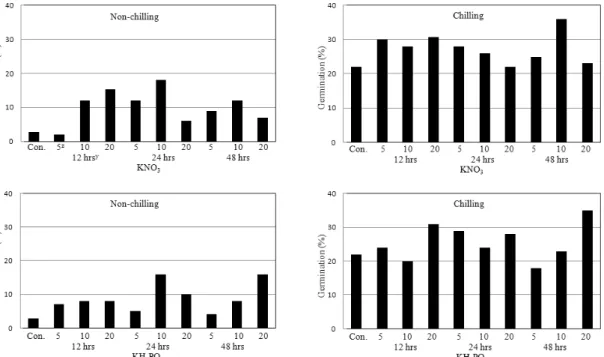
Fig. 6. Effect of KNO3 and KH2PO4 on seed germination on the 14th day after sowing of Dracocephalum argunense maintained the light at 25℃.
zConcentration (mM) of each treatments.
ySoaking times (hours) of each treatments.
of GA3 on chilled seeds increased up to only 10%, while that on chilled increased up to 32% in case of 10 mM soaked for 48 hours. Generally soaking for 48 hours was better than 24 hours, indicating hard seed coat dormancy in this species. The improvement of seed germination by GA3 has been known for long time (Song and Lee, 2002; Ku and Yoon, 1999), but in this species beneficiary effects ate not so great as expected.
The scarification of seed coat which increase the permeability of cells might increase the germination rate greatly, by allowing water to the inside of seeds. The positive effects of IAA on seed germination have been also reported in many plant species such as Polygonatum odoratum (Chang and Lee, 2007), and Ex- ochorda serratifolia (Lee et al., 2006), but in this species the effects were not manifest. The best improvement of 31% was obtained with treatment of 1 mM IAA on chilled seeds soaked for 24 hours, compared with 21% of the control.
The improvement of germination rate by soaking seeds in KNO3 and KH2PO4 was shown in Fig. 6. Unchilled seeds responded less favorably than chilled seeds, with best ger- mination of 18% by 10 mM KNO3 for 24 hour soaking, and 16% by 10 mM KH2PO4 for 24 hour. The germination rate of
chilled seeds ranged from 23 to 36% by KNO3 treatment, and 18 to 35% by KH2PO4. The positive effects of inorganic salts were reported in many plant species such as P. odoratum (Chang and Lee, 2007), Typha orientalis (Lee et al., 2002), Crotalaria sessiflora (Kang et al., 2001), and Lycoris aurea (Park and Chung, 1993). In this experiment, comparison with control demonstrated about 60% germination improvement by 10 mM KNO3 for 48 hour soaking and 20 mM KH2PO4 for 48 hours.
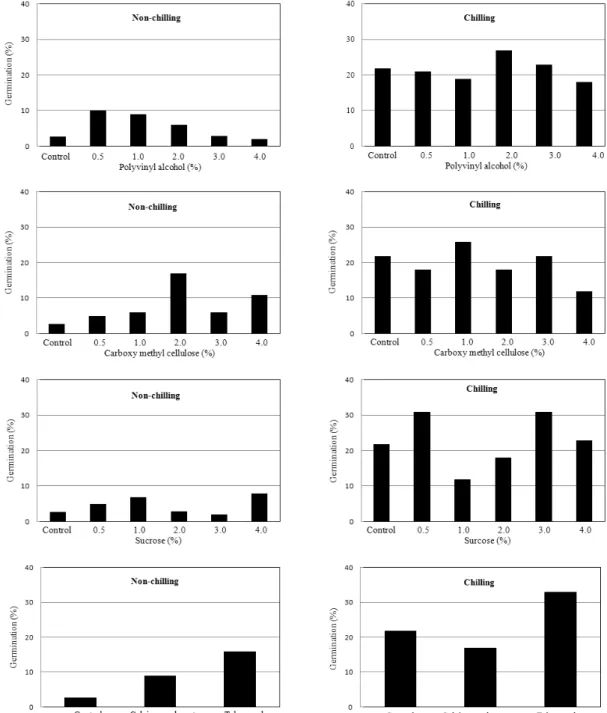
The priming treatments on seeds by water soluble and solid primers were performed and the results are shown on Fig. 7.
With unchilled seeds best responses were obtained by 2%
carboxymethyl cellulose (17% germination) and by talc powder (16%). In other treatments, no positive results were demonstrated.
With chilled seeds, the best result was obtained by 2% polyvinyl alcohol (27%), by 1% carboxymethyl cellulose (26%), by 0.5 and 1% sucrose (31%, respectively) and by talc powder (33%). Some adverse effects such as delay of germination initiation were observed with some primers, rendering priming treatments somewhat unrecommendable for germination im- provement in this species.
In conclusion, D. argunense seeds mature within 40 days
Fig. 7. Effect of calcium carbonate and talc powder on seed germination on the 14th day after sowing of Dracocephalum argunense maintained the light at 25℃.
after flowering and are able to germinate immediately after seed harvesting. The environmental conditions for optimum germination is 20℃ under light. The germination of dormant seeds induced by long storage period can be improved by scarification with sandpaper or concentrated sulfuric acid.
Also chilling treatments on seeds, priming by inorganic salts for 48 hours, and seed coating by talc powder are observed to
increase germination rate of this species to some degree.
Acknowledgements
This work was supported by the research grant of the Chung- buk National University in 2007.
Literature Cited
Chang, Y.D. and C.H. Lee. 2007. Effect of storage duration, temperature and priming treatment on seed germination of Polygonatum odoratum var. pluriflorum. Kor. J. Plant Res.
20: 481-489. (in Korean)
Chiang, M.H. and K.W. Park. 1994. Effects of temperature, light and mechanical treatment on the seed germination of Chrysan- themum coronarium L. J. Kor. Soc. Hort. Sci. 35:534-539. (in Korean)
Kang, J.H., Y.J. Kim, and B.S. Jeon. 2001. Effect of presown cold stratification, GA3, KNO3 and acetone treatment on ger- mination of Crotalaria sessiflora L. Kor. J. Med. Crop Sci.
9: 124-129. (in Korean)
Kim, T.J. 1996. Korean Resources Plants IV. Seoul Natinal University Press. Seoul. (in Korean)
Ku, J.H. and B.H. Yoon. 1999. Presoaking with GA3 improves germination of Zoysiagrass (Zoysia japonica Steud.) seed on poor germination conditions. Kor. Turfgrass Sci. 13: 21-28.
(in Korean)
Lee, H.D., H.H. Kim, S.D. Kim, J.H. Kim, J.W. Lee, T. Yun and C.H. Lee. 2002. Effect of temperature, light and priming treatment on seed germination of Typha orientalis Presl.
Kor. J. Plant Res. 15: 279-284. (in Korean)
Lee, H.D., S.D. Kim, H.H. Kim, J.W. Lee, J.H. Kim, C.H. Lee, and C.H. Lee. 2006. Effects of storage method, growth regu- lator, and inorganic salt on the seed germination of Exochorda serratifolia S. Moore. Kor. J. Hort. Sci. Technol. 24: 90-94.
(in Korean)
Lee, T.B. 2003. Coloured Flora of Korea. Hyangmunsa. Seoul.
(in Korean)
Park, K.W., G.P. Lee, K.W. Park, and J.C. Jeong. 1998. Seed morphology of thirty Korean wild green species and effect of seed stratificaion on germination. J. Kor. Soc. Hort. Sci. 39:
129-134. (in Korean)
Park, Y.J. and Y.O. Chung. 1993. Effects of chemicals, decoating and low temperature treatments on seed germination in Lycoris aurea. Kor. J. Med. Crop Sci. 4: 172-177. (in Korean) Song, J.S. and J.S Lee. 2002. Dormancy and germination charac-
teristics of seed and plant of Primula sieboldii. J. Kor. Soc.
Hort. Sci. 43:91-94. (in Korean)
Travlos, I.S., G. Economou, and A.I. Karamanos. 2007. Germi- nation and emergence of the hard seed coated Tylosema escul- entum (Burch) A. Schreib in response to different pre-sowing seed treatments. J. Arid Environ. 68:501-507.
Yeam, D.Y., J.J. Murray, H.L. Portz, and Y.K. Joo. 1985.
Optimum seed coat scarification and light treatment for the germination of zoysiagrass (Zoysia japonica Steud.) Seed. J.
Kor. Soc. Hort. Sci. 26:179-185.
(Received 6 May 2009 ; Accepted 22 June 2009)