한국과 홍콩의 공동주택 친환경 인증제도의 비교분석 연구
A Comparison Study of the Green Building Certification Systems for Multifamily Housing between South Korea and Hong Kong
김성화* 이재훈** 김민영***
Kim, Sung-Hwa Lee, Jae-Hoon Kim, Min-Young
Abstract
In line with the recent public concern on the environmental issues in building industry, there has been a rise in demand for a healthy, sustainable housing environment in South Korea. In order to achieve a healthy environment in residential buildings, considerable efforts have been made in a wide range of sectors. Among others, the development of the certification schemes to promote environment-friendly planning and building construction is remarkable. In urban South Korea, recently built houses tend to be significantly high-rise, high-density buildings. Global warming has brought about drastic climate change and continued to increase the average annual temperature year by year. These changes should be well reflected on the government’s implementation of the building environmental assessment system. For guidance, therefore, this study looks to the case of Hong Kong which is well known for high-density housing development and subtropical climate conditions. It compares the features of the green building certification schemes for newly developed multifamily housing in two regions, namely HK?BEAM in Hong Kong and G-SEED in South Korea. Based on the findings, it argues that the G-SEED implementor should have expanded roles in providing training programs and follow-up services in collaboration with the certification authorities. It is also argued that G-SEED professionals should be involved in the early stages of design processes, and training programs and licence systems to produce green building professionals should be developed. Finally, it points out that the assessment indicators should be more detailed and diversified.
Keywords : Green Building Certification System, Multifamily Housing, South Korea, Hong Kong 주 요 어 : 친환경인증제도, 공동주택, 한국, 홍콩
I. 서 론
1. 연구의 배경 및 목적
인류에 의한 지구환경의 파괴가 보고되고 그에 따라 자 연환경에 관한 관심이 증대되었다. 이와 함께 에너지소비 량, CO2배출량 등이 높은 건축행위가 자연환경에 미치는 악영향도 함께 인식되면서 각 국가들은 건축행위에서 비 롯되는 문제점들을 해결하기위해 많은 노력을 하고 있다.
환경 친화적이고 지속가능한 건축을 유도하기위해 각 국가들은 친환경 건축물에 대한 많은 연구를 진행하였고
환경성능의 평가기준이 마련되어 다양한 건축물 평가 제 도를 개발하기에 이르렀다. 건축물 평가 제도들은 각 나 라의 특성에 따라 내용과 수준이 다르게 나타나는데, 선 진화된 나라들의 경우 에너지와 환경부하 뿐만 아니라 거 주자의 안전성과 쾌적성 등 신체적 건강 요소에 관련된 항목들까지 그 범위를 넓혀가고 있다.
현재 우리나라는 지구온난화의 영향으로 기후특성이 점 차 아열대성기후로 변화하고 있으며 주상복합 등으로 인 해 도시의 주거건축물이 고층·고밀화 되는 경향을 보이 고 있다. 물론 홍콩과 한국은 공동주택 관련 법적 기준 및 주거 내부 공간구성에 차이가 있지만 고온 다습한 기 후로 냉방에너지 부하량이 많고, 고층·고밀도의 주거환 경을 일찍이 경험한 홍콩이 주거환경에서 친환경적 요소 를 어떻게 도입하고 반영하는지를 살펴보는 것은 의미가 있다고 사료된다.
홍콩은 고층·고밀화의 주거환경 속에서 설비적인 요 소와 더불어 주광과 자연환기를 주거계획의 매우 중요한 요소로 고려하여 채광 및 통풍, 저에너지를 위한 방향으 로 주거개발을 진행해오고 있다1). 이런 기후특성 및 개발 적 특성에 따른 요소들을 홍콩의 친환경인증기준에 반영
***정회원(주저자), 경북대학교 건축토목공학부 겸임교수, 공학박사
***정회원(교신저자), 단국대학교 건축학과 교수, 공학박사
***정회원, 경북대학교 건축공학과 석사
Corresponding Author: Jae-Hoon Lee, Dankook University College of Architecture, 152, Jukjeon-ro, Suji-gu, Yongin-si Gyeonggi-do, 448-701, Korea E-mail: [email protected] 이 논문은 2013년도 국토교통부 및 국토과학기술진흥원의 연구비 지원에 의해 연구되었음(과제번호: 13CHUD-C061955-02).
이 논문은 2013년 한국주거학회 추계학술발표대회에 발표한 논문을 수정, 보완한 연구임.
하여 시행하고 있다2). 그리고 평가기준을 수용하기 위한 세부적인 방법들은 법적 기준과 더불어 각종 가이드라인 (Hong Kong Urban Design Guideline, Council for Sustainable Development) 등으로 다양하게 제안되고 있다3). 이에 본 연구는 홍콩의 친환경 인증제도와 한국의 녹색건축 인증 제도를 비교하여 그 특성을 분석하고 우리나라의 친환경 인증기준에 관해 개선방향을 모색해 보고자 한다.
2. 연구내용 및 범위
홍콩의 친환경 인증제도는 홍콩정부가 운영 관리하는 CEPAS (Comprehensive Environmental Performance Assessment Scheme for Buildings)와 비영리기관인 BEAM Society에 서 운영하고 있는 BEAM (Building Environmental Assessment Method) 두 가지가 있다. BEAM은 CEPAS보다 10년 정 도 앞서 시작되었고, 정부정책도 BEAM에 유리하게 설정 되어 BEAM이 좀 더 활용되고 있는 상황이다. 따라서 본 연구에서는 현재 활성화되어 있는 BEAM과 한국의 G- SEED를 비교하여 살펴본다.
본 연구는 이론적 고찰을 통해 연구의 타당성을 살펴 본 후 3장에서 홍콩과 한국의 친환경건축물 관련 인증제 도의 평가항목별 득점비율과 항목별 세부사항의 내용을 비교 분석한다. 또한 등급평가기준과 인증 및 운영기관도 함께 살펴봄으로서 친환경인증제도의 평가항목별 내용뿐 만 아니라 운영 및 관리에 대한 부분도 다루고자 한다.
친환경관련 인증제도는 신축건물 혹은 기존건물, 용도별 로 차이가 있어 본 연구에서는 신축건물을 기준으로 하 였고, 용도는 공동주택으로 범위를 한정시켰다.
4장에서는 홍콩과 한국의 친환경 관련 인증제도의 특징 을 비교·분석하고 사례를 살펴보았다. 홍콩의 사례는 2010년 인증을 받은 2개 단지4)를 대상으로 하고, 한국의 사례는 친환경 인증제에서 녹색건축 인증제로 개정되어 인증기준을 고시한 2013년 6월 이후 인증을 받은 6개 단 지를 다루고 있다. 사례 수는 작지만, 홍콩과 한국의 친 환경 관련 인증제도의 특성들이 어떻게 반영되었는지 살 펴보기 위해 사례연구를 포함하였다. 5장에서는 앞에서의 연구내용을 바탕으로 홍콩의 친환경 관련 인증제도의 특 성을 나타내는 배경이나 원인을 살펴보고, 한국의 녹색건 축 인증제도의 개선방향에 대해 제안하는 것으로 연구를 구성하였다.
II. 선행연구 고찰
인증제도와 관련된 선행연구는 해외 친환경 인증제도들 간의 비교분석5), 해외 친환경인증제도와 국내 친환경인증 제도의 비교분석6), 인증 제도를 적용한 사례분석7) 등이 있다.
국내 연구에 소개된 해외의 친환경인증제도로는 미국 LEED (Leadership in Energy and Environmental Design), 영국 BREEAM (Building Research Establishment and Environmental Assessment Method), 캐나다 GBTool (Greenbuilding Assessment Tool), 일본 CASBEE (Comprehensive Assessment System for Building Environmental Efficiency) 등이 있으며 LEED에 관한 연 구가 가장 많았다.
한국의 G-SEED는 주택성능등급표시제도와 친환경 건 축물 인증제도를 통합하여 2013년 2월 시행된 제도이다.
Lee et al.(2013)8)은 G-SEED와 영국의 BREEAM, 미국의 LEED를 대상으로 평가항목별 상관성을 통하여 배점구조 를 분석하였고, Yun and Ryu(2013)9)은 2002년에서 2012 년까지 국내 학술지에 발표된 녹색건축물 인증에 관한 논 문 및 기사를 선행연구의 범위로 설정하여 공동주택 부 문을 중심으로 분석하였으며, An(2014)10)은 녹색건축인증
5) Lee, H. W., Choi, C. H., & Cho, M. G. (2007). A Study on Comparing and Analyzing Items of Foreign Green Building Certification Criteria. Journal of Korea Institute of Architectural Sustainable Environment and Building System, 1(2), 41-49.
6) Ka, C. H., Park, S. D., Jeon, Y. H., & Tae, C. S. (2012).
Development of Regional Priority Credits in the Korea Green Building Certification Criteria. Journal of Architectural Institute of Korea, 27(10), 269-276.
Kim, H. K., Kim, J. M., Lee, Y. K., & Lee, J. H. (2012). A Suggestion for an Improved Operational Scheme through a Comparison Study on the National Green Building Certification Criteria. Journal of Architectural Institute of Korea, 28(6), 255-264.
Oh, R. J., Jung, H. Y., & Kim, K. S. (2009). A Study on the Comparative Analysis and Improvement of Indoor Environment Factors in the Green Building Rating System. Journal of Korea Institute of Architectural Sustainable Environment and Building System, 3(2), 47-54.
7) Kim, S. H., Cho, T. G., & Yee, J. H. (2012). A Study on the Comparative Analysis and Improvement of the Domestic and Japanese Green Building Certification Criteria by Actual Evaluation in an Apartment Complex. Journal of Architectural
Institute of Korea, 14(10), 155-165.
Tae, S. H., Shin, S. W., & Lim, S. C. (2007). A Study on Indoor Environmental Ratings by Comparing Green Building Certification Systems Through Case Studies. Journal of Architectural Institute of Korea, 23(8), 229-236.
8) Lee, S. O., Cho, D. W., Park, C. Y., & Lee, S. H. (2013). A Study on Score Calculation Method for Certification Grade of G- SEED(Korea)&World Green Building Rating Systems. Journal of Architectural Institute of Korea, 29(11), 283-290.
9) Yun, Y. S., & Ryu, S. H. (2013). A Study on the Improvement of G-SEED through Analysis of the Previous Studies-Based on Apartment Houses. Journal of the Korea Institute of Ecological Architecture and Environment, 13(5), 31-42.
1) Kim, S. H., & Lee, J. H. (2005). A Study on the Characteristics of the Super High-Rise Housing Complex in Hong Kong. Journal of the Korean Housing Association, 16(4), 37-44.
2) Kim, E. J., Kim, S. H., & Lee, J. H.(2013), A Comparison Study of the Green Building Certification Systems for Multifamily Housing between South Korea and Hong Kong. Proceeding of Autumn Annual Conference of KHA, 25(2), 175-180.
3) Seo, B. K., Kim, S. H., & Lee, J. H. (2014). Regulating Natural Lighting and Ventilation of Residential Buildings in Hong Kong, Architectural Research of AIK, 16(3), 83-84.
4) 홍콩은 인증 받은 점수를 관계자 외에는 공개하지 않아 자료를 구 할 수 있는 2개 단지만을 대상으로 하였다.
제(G-SEED)에서 공동주택을 대상으로 생태관련분야를 중 심으로 분석하였다. Yeom(2014)11)는 공동주택부문을 중심 으로 지속가능성 제고를 위한 개선모델의 제시를 목적으 로 영국의 BREEAM, 미국의 LEED, 호주의 Green Star, 일본의 CASBEE, 독일의 DGNB와 함께 국내의 녹색건 축 인증제도를 분석하였으며, Jeong(2014)12)은 녹색건축인 증제의 업무용 건축물을 대상으로 7개 전문분야 중 에너 지 및 환경오염부분에 초점을 맞추어 연구를 진행하였다.
선행연구를 분석한 결과, 해외 인증제도의 분석은 미국, 영국, 일본, 캐나다, 독일 등을 대상으로 이루어졌으며, 홍 콩의 친환경 인증제에 대한 연구는 거의 이루어지지 않 은 것으로 나타났다. 또한 우리나라의 녹색건축인증제는 공동주택을 대상으로 한 연구가 많았다. 이에 본 연구는 홍콩과 한국의 친환경관련 인증제도의 특성을 비교 분석 하여 향후 국내의 녹색건축 인증제도의 개정에 있어 개 선방향을 제시하고자 한다.
III. 한국과 홍콩의 친환경 인증제도의 특징
1. 홍콩의 BEAM
BEAM은 1996년 신축 건물용과 기존 오피스 건물용을 위한 두 가지 버전으로 시작하여 1999년 오피스 건물용 에 대한 평가방법이 업데이트되면서 고층주거건물을 위한 새로운 평가방법이 도입되었다.
BEAM은 대지부문(Sa), 자원부문(Ma), 에너지활용(Eu), 수자원활용(Wu), 실내 환경(Ieq), 혁신 및 부가사항(Ia) 6 개의 전문분야로 구성되어 있다.
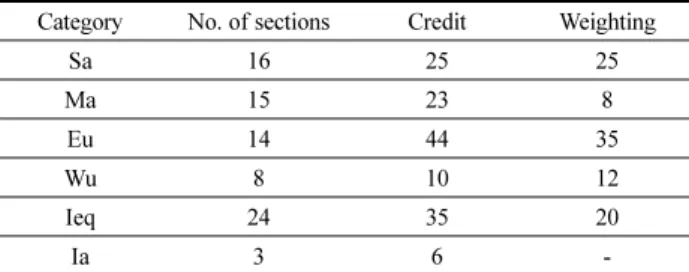
총 항목 수는 80개로 필수항목 9개, 평가항목 71개로 총143점 만점이며 필수항목은 인증을 받기 위한 선결조 건으로 점수를 부여하지 않고 있다. 10개의 항목에서는 특정조건을 만족시킬 경우 추가적으로 보너스 점수 1점을, 혁신 및 부가사항은 2개의 항목에서 최대 5점까지 보너 스를 획득할 수 있도록 구성되어 있다.
혁신 및 부가사항을 제외한 각 항목별 배점 합계에 대 한 획득한 항목의 배점합계의 비율과 전문분야별 가중치 를 곱한 값을 합하여 최종점수를 결정하여 등급인증을 하 고 있다.
배점구성을 살펴보면 에너지 활용 부문이 44점으로 가 장 높고, 그 다음으로 실내 환경(35점), 대지부문(25점) 순 으로 분포되어 있다. 항목 당 배점은 대부분 1~2점으로
이루어져 있고, 9개 항목은 3점 배점으로 구성되어 있다.
세부 항목 수는 실내 환경 부문이 24개로 가장 많고, 대 지 부문(16개), 자원 부문(15개), 에너지 활용(14개)은 비 슷한 분포를 보이고 있다. 가중치는 점수분포가 가장 높 았던 에너지 활용이 35%로 가장 높고, 대지부문 25%, 실 내 환경 20%순으로 이루어져 있다<Table 1>.
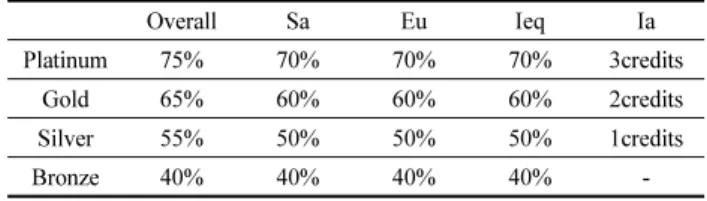
BEAM은 Platinum, Gold, Silver, Bronze로 총 4개의 등 급으로 구성되어 있으며, 평가항목이 용도별로 구분되어 있지 않고 각 항목 안에 용도에 따른 규제사항 이나 예 외사항을 두고 있다. 그리고 대지부문과 에너지 활용, 실 내 환경, 혁신 및 부가사항은 각 등급별로 최소한의 득점 점수를 설정하고 있다. 이것은 가중치가 높은 세 가지 전 문분야에 대해 일정 점수 이상을 획득하도록 하고 있다
<Table 3>.
전문 분야별 세부 항목의 내용을 살펴보면<Table 2>, 대지분야에서는 건물주변 미기후를 고려(Microclimate around buildings)하여 주동배치 및 저층부와 고층부의 건물 형태 를 디자인하도록 규정하고 있으며, 4점의 높은 점수를 부 여하고 있다.
자원부문에서는 철거 폐기물과 신축 폐기물로 구분하여 폐기물의 재활용 비율에 따라 각각 점수를 부여하고 있 다. 그리고 건물 공사 시 재활용 자재가 전체 사용 자재 의 몇 %에 해당되는가에 따라 그리고 어느 부분에 사용 했는지(구조적 요소, 입면, 내부 요소)에 따라 점수를 주 고 있다. 그리고 건물재사용, 규격화표준화 디자인, 프리 패브공법이용 등을 통해 자원의 효율적 이용을 촉진시키 는 항목들이 있다.
에너지 활용 분야에서는 CO2나 연간 에너지 소비량의 감 축 정도에 따라 최대 15점을 부여하고 있다13). 그리고 최 대 전력 수요를 감소시킬 경우 감소비율에 따라 점수를 부 여하고 있으며, 테스트와 시운전(Testing & commissioning), 운영 및 관리(Operation & maintenance), 측정 및 모니터 링(Metering & monitoring), 피크 시 수요 감소(Peak electricity demand reduction) 등의 세부 항목을 통해 에 너지 사용에 대한 효율적인 관리를 도모하고 있는 것으 로 나타났다14). 또한 건물의 향이나 형태를 고려하고 자 연환기를 증가시키거나 자연광을 효율적으로 차단시키는 10) An, J. H. (2014). A Study of the Improving Direction of the
Green Standard for Energy and Environmental Design-Focused on the Ecology-related Items. Master's thesis, University of Hanyang, Seoul.
11) Yeom, D. W. (2014). A Study on the Sustainability Improvement Model for G-SEED. Doctoral dissertation, University of Ajou, Suwon.
12) Jeong, Y. W. (2014). A Study of the Green Building Cerrification to Improve the Sustainability. Master’s thesis, University of Ajou, Suwon.
Table 1. HK-BEAM: Category Weighting
Category No. of sections Credit Weighting
Sa 16 25 25
Ma 15 23 8
Eu 14 44 35
Wu 8 10 12
Ieq 24 35 20
Ia 3 6 -
13) 용도별로 감축비율에 따라 점수가 조금 다르지만, 시뮬레이션을 통해 소요되는 에너지 소비량을 분석하고 있다.
건물계획 기법15)(Energy efficient building layout) 등을 통 해 에너지 사용을 감소하도록 유도하고 있다.
수자원 분야는 연간 물 사용량, 모니터링 및 제어(누수 를 감지하기 위한 장치설치)등과 같은 유지관리에 대한 내용을 포함하고 있다.
세부항목 수와 가중치가 가장 높은 실내 환경 분야는 방범 및 범죄로부터의 안전성16)을 규정하고 있다. 실내공 기 오염물질에 대해서는 라돈에 대해 규제하고 있으며, 적정기준을 수용할 경우 1점을 부여하고 있다. 환기항목 에서는 주호 내 공간뿐만 아니라 공용공간 및 주차장 영 역에 대해 환기 성능을 평가하고 있으며, 공용공간에 대 한 환기(Ventilation in common areas)는 자연환기를 선택 하는 경우 보너스 점수를 부여하고 있다. 쾌적성 항목에 서는 냉난방장치 가동 시 열 쾌적성, 자연환기 시 열 쾌 적성을 평가하여 각각의 환기성능과 그로 인한 거주자의 열 쾌적성까지 평가하고 있다.
혁신 및 부가사항은 가중치를 두고 있는 전문분야는 아 니지만 최대 6점을 획득할 수 있다. 새로운 기술을 도입 하여 친환경 성능을 향상시킬 경우 보너스 점수 5점을 부 여하고 있으며, 친환경 전문가가 인증에 참여할 경우 추 14) 홍콩은 신축건물과 기존건물 모두에 대해 에너지 유지관리에 대
한 항목이 있지만 우리나라는 기존건축물에 대해서만 에너지 유지 관리에 대한 평가가 이루어지고 있다.
15) 외부 입면에 광선반이나 수평 및 수직루버 등을 설치 시 점수를 부여하고 있다.
Table 2. HK-BEAM: Performance Categories and Credits
Section Credits Section Credits Section Credits
Site aspects (Sa) 22+3B Ozone depleting substances 2 Indoor environmental quality (Ieq) 32+3B Minimum landscape area Required Regionally manufactured materials 2 Minimum ventilation performance Required
Contaminated land 1B Demolition waste reduction 2 Security 1
Local transport 3 Construction waste reduction 2 Plumbing and drainage 1
Neighbourhood amenities 3 Energy use (Eu) 42+2B Biological contamination 1
Site design appraisal 1,1B Minimum energy performance Required Waste disposal facilities 1
Ecological impact 1B Reduction of CO2 emissions 15 Construction IAQ management 2
Cultural heritage 1 Peak electricity demand reduction 3 Outdoor sources of air pollution 2
Landscaping and planters 3 Embodied energy in building structural elements 1,1B Indoor sources of air pollution 3
Microclimate around buildings 4 Ventilation systems in car parks 2 IAQ in car parks 1
Neighbourhood daylight access 1 Lighting system in car parks 2 Increased ventilation 1
Environmental management plan 1 Renewable energy systems 5 Background ventilation 1
Air pollution during construction 1 Air-conditioning units 1 Localised ventilation 2
Noise during construction 1 Clothes drying facilities 1 Ventilation in common areas 1,1B
Water pollution during construction 1 Energy efficient appliances 2 Thermal comfort in air-conditioned premises 2 Noise from building equipment 1 Testing and commissioning 4,1B Thermal comfort in naturally ventilated premises 2
Light pollution 1 Operation and maintenance 3 Natural Lighting 2
Material aspects (Ma) 22+1B Metering and monitoring 1 Interior lighting in normally occupied areas 1,1B Timber used for temporary works Required Energy efficient building layout 2 Interior lighting in areas not normally occupied 1
Use of non-cfc based refrigerants Required Water use (Wu) 9+1B Room acoustics 1
Construction demolition waste
management plan Required Water quality survey Required Noise isolation 1,1B
Waste recycle facilities Required Minimum water saving performance Required Background noise 1
Building reuse 2,1B Annual water use 3 Indoor vibration 1
Modular and standardized design 1 Monitoring and control 1 Access for persons with disability 1
Prefabrication 2 Water efficient irrigation 1 Amenity features 2
Adaptability and deconstruction 3 Water recycling 2,1B Innovations & additions (Ia) 1+5B Rapidly renewable materials 2 Water efficient appliances 1 Innovation Techniques
Sustainable Forest Products 1 5B
Effluent discharge to foul sewers 1 Performance Enhancements
Recycled materials 3 BEAM Professional 1
16) 안전성에 대한 평가는 계획적 기법과 설비적 방법으로 이루어져 있으며, 19개 세부항목 중 최소 75%를 준수하면 1점을 부여한다.
Table 3. HK-BEAM: Minimum Percentage of Credits to Qualify for the Overall Grade
Overall Sa Eu Ieq Ia
Platinum 75% 70% 70% 70% 3credits
Gold 65% 60% 60% 60% 2credits
Silver 55% 50% 50% 50% 1credits
Bronze 40% 40% 40% 40% -
가적으로 1점을 획득할 수 있다. 이런 혁신적인 내용을 평가할 수 있는 항목이 있기 때문에 새로운 기술이나 기 법 등을 보다 적극적으로 도입할 수 있으며, 전문가의 참 여로 인해 인증을 효율적으로 진행하도록 유도하고 있음 을 엿볼 수 있다.
2. 한국의 녹색건축인증제도(G-SEED)
한국의 녹색건축인증제도17)는 국토교통부와 환경부에서
공동령으로 시행하고 있으며, 운영기관18)으로는 한국건설 기술원, 인증기관으로는 한국토지주택공사, 한국에너지기 술연구원, (주)크레비즈큐엠, 한국교육환경연구원등 모두 11개 기관이 있다19). 정부에서 운영한다는 점은 홍콩의 CEPAS와 같지만 운영·인증기관이 통합되지 않는다는 점 에서 차이가 있다.
17) 우리나라의 녹색건축 인증제도는 용도별로 평가항목, 배점, 가중 치가 다르다. 용도는 공동주택, 복합건축물(주거)업무용건축물, 학교 시설, 판매시설, 숙박시설, 소형주택, 기존공동주택, 기존업무용건축 물, 그 밖의 시설로 구분되어 있다.
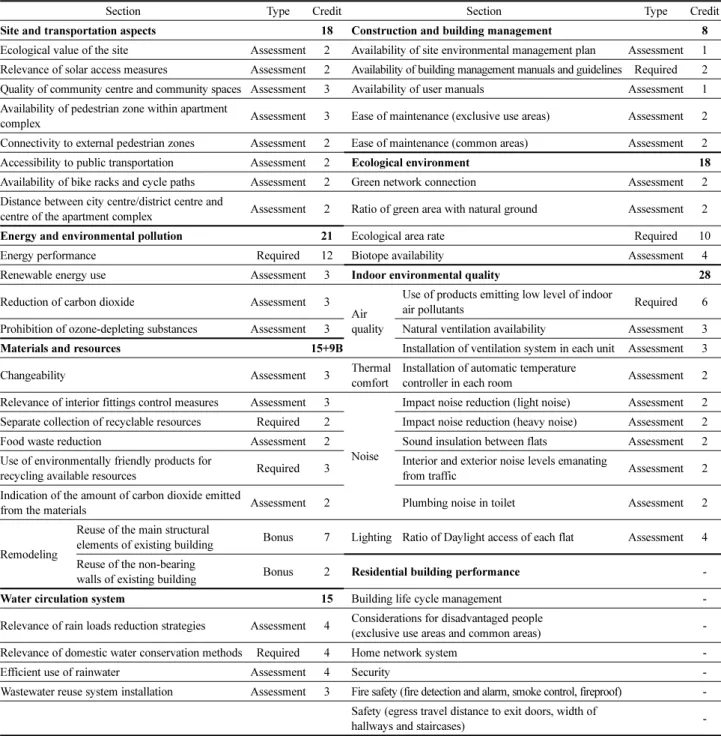
Table 4. G-SEED: Categories and Credits
Section Type Credit Section Type Credit
Site and transportation aspects 18 Construction and building management 8
Ecological value of the site Assessment 2 Availability of site environmental management plan Assessment 1 Relevance of solar access measures Assessment 2 Availability of building management manuals and guidelines Required 2 Quality of community centre and community spaces Assessment 3 Availability of user manuals Assessment 1 Availability of pedestrian zone within apartment
complex Assessment 3 Ease of maintenance (exclusive use areas) Assessment 2
Connectivity to external pedestrian zones Assessment 2 Ease of maintenance (common areas) Assessment 2
Accessibility to public transportation Assessment 2 Ecological environment 18
Availability of bike racks and cycle paths Assessment 2 Green network connection Assessment 2 Distance between city centre/district centre and
centre of the apartment complex Assessment 2 Ratio of green area with natural ground Assessment 2
Energy and environmental pollution 21 Ecological area rate Required 10
Energy performance Required 12 Biotope availability Assessment 4
Renewable energy use Assessment 3 Indoor environmental quality 28
Reduction of carbon dioxide Assessment 3
Air quality
Use of products emitting low level of indoor
air pollutants Required 6
Prohibition of ozone-depleting substances Assessment 3 Natural ventilation availability Assessment 3
Materials and resources 15+9B Installation of ventilation system in each unit Assessment 3
Changeability Assessment 3 Thermal
comfort
Installation of automatic temperature
controller in each room Assessment 2
Relevance of interior fittings control measures Assessment 3
Noise
Impact noise reduction (light noise) Assessment 2 Separate collection of recyclable resources Required 2 Impact noise reduction (heavy noise) Assessment 2
Food waste reduction Assessment 2 Sound insulation between flats Assessment 2
Use of environmentally friendly products for
recycling available resources Required 3 Interior and exterior noise levels emanating
from traffic Assessment 2
Indication of the amount of carbon dioxide emitted
from the materials Assessment 2 Plumbing noise in toilet Assessment 2
Remodeling
Reuse of the main structural
elements of existing building Bonus 7 Lighting Ratio of Daylight access of each flat Assessment 4 Reuse of the non-bearing
walls of existing building Bonus 2 Residential building performance -
Water circulation system 15 Building life cycle management -
Relevance of rain loads reduction strategies Assessment 4 Considerations for disadvantaged people
(exclusive use areas and common areas) -
Relevance of domestic water conservation methods Required 4 Home network system -
Efficient use of rainwater Assessment 4 Security -
Wastewater reuse system installation Assessment 3 Fire safety (fire detection and alarm, smoke control, fireproof) - Safety (egress travel distance to exit doors, width of
hallways and staircases) -
18) 녹색건축인증에 관한규칙 제3조에 의해 운영기관 및 업무를 지 정하고 있다.
19) 인증기관: 한국토지주택공사, 한국에너지기술연구원, (주)크레비 즈큐엠, 한국교육환경연구원, 한국환경공단, 한국환경건축연구원, 한 국생산성본부인증원, 한국그린빌딩협의회, 한국시설안전공단, 한국 감정원, 한국환경산업기술원
녹색건축 인증제도의 공동주택 부문은 토지이용 및 교 통, 에너지 및 환경오염, 재료 및 자원, 물 순환 관리, 유 지관리, 생태환경, 실내 환경, 주택성능분야로 총8개 부문 으로 구성되어 있다. 총 항목 수는 54개이며, 필수항목 7 개 39점, 평가항목 34개로 84점으로 총123점 만점으로 구 성되어 있다. 리 모델링 시 가산항목 2개에 9점이 추가 되고, 주택성능분야 11개 항목은 별도의 배점 없이 평가 에 의한 등급만 부여하고 있다. G-SEED는 필수항목이 인 증을 받기 위한 선결조건이지만 홍콩과 달리 점수를 부 여하고 있다<Table 4>.
필수항목 중 생활용 상수 절감대책, 유지관리 문서제공, 실내공기오염물질 저 방출 제품사용의 항목에서는 최소배 점기준이 가장 낮은 4급이 아니라 3급 혹은 2급으로 되 어 있어 4급은 실제적으로 의미가 없다. 따라서 필수항목 의 경우 법적으로 규정된 기준이 최소배점 기준으로 제 시될 필요가 있다고 판단된다.
등급인증을 위한 배점산출방법은 총 7개의 전문 분야로 별로 할당된 배점합계에 대한 획득한 배점합계비율을 구 한 후 각 전문분야별로 규정되어 있는 가중치와 곱한 값 을 모두 합하여 구하도록 되어 있어 홍콩의 BEAM과 같 은 방식으로 배점이 산출된다.
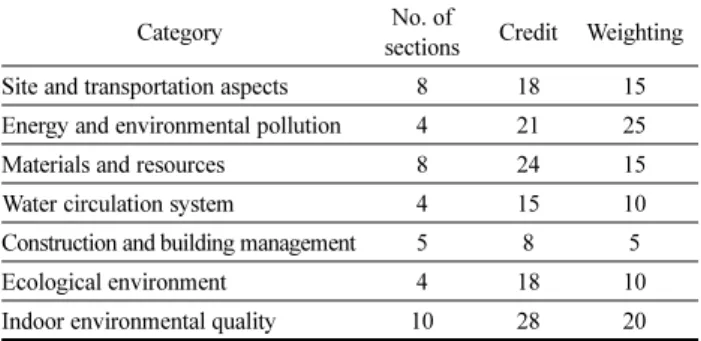
실내 환경 부문이 28점으로 가장 배점이 높고, 그 다 음으로 재료 및 자원 부문(24점), 에너지 및 환경오염(21 점) 순으로 나타났다. 가중치는 항목별 배점의 총합이 세 번째로 많았던 에너지 및 환경오염이 25%로 가장 높았 고, 그 다음으로 실내 환경(20%), 토지이용 및 교통(15%), 재료 및 자원(15%)순으로 나타났다. 세부 항목 수는 실 내 환경 부문이 10개로 가장 많고, 토지이용 및 교통과 재료 및 자원 부문이 각각 8개로 구성되어 있다<Table 5>.
우리나라의 녹색건축 인증제도가 총 54개 세부항목(주 택성능분야11개 항목포함)으로 구성되어 있는 반면 홍콩 의 BEAM은 80개로 이루어져 있어 친환경 건축물을 위 한 선택의 폭이 좀 더 다양함을 알 수 있다.
녹색건축 인증제도는 최우수(그린1등급), 우수(그린2 등급), 우량(그린3등급), 일반(그린4등급)으로 모두 4개 의 등급으로 구성되어 있다<Table 6>.
전문 분야별 세부 항목의 내용을 살펴보면, 토지이용 및 교통과 생태환경 분야에서는 인접대지와의 관계를 고려한 일조권간섭방지에 대한 항목이 있고, 교통부하량을 절감 하기 위한 대중교통의 근접성 및 자전거 이용을 활성화 시키는 평가 기준들이 있다. 우리나라는 일조권은 매우 중 요하게 다루고 있지만 지역적 차원에서의 바람길 확보20)를 통한 미기후에 대한 계획은 반영되어 있지 않다.
에너지 및 환경오염 분야에 대한 평가는 주로 에너지 성능지표검토서21)를 바탕으로 이루어지고 있으며, 에너지 유지관리에 대한 내용은 포함되어 있지 않다. 2013년 개 정을 통해 기존 공동주택의 용도의 평가에 에너지 사용 량 모니터링 및 거주자 만족도 조사항목이 신설되었으나 인증을 갱신해야만 의미가 있는 내용이다.22)
재료 및 자원 분야는 가변성(단위세대내의 내력벽 및 기둥의 길이비율평가), 생활용 가구재 사용억제 대책(실 면적 대비 수납공간의 비율) 등을 평가하고 있으며, 필수 항목으로 재활용 가능자원의 분리수거, 유효자원 재활용 을 위한 친환경인증제품 사용여부가 포함되어 있다. 그리 고 리 모델링시 기존건축물에 대하여 주요 구조부 재사 용 및 비내력벽 재사용시 가산점을 부여하고 있다.
물 순환 관리는 우수이용, 중수도 설치, 상수절감대책 등을 통해 물 사용량을 얼마나 줄이고 있는지에 대해 평 가하고 있다. 그러나 보다 효율적인 물 순환 관리를 위해 서는 연간 물 사용량 파악 및 모니터링을 통한 유지관리 계획이 필요하다.
홍콩의 경우 각 전문분야 내에 유지관리 항목이 포함 되어 있는 반면 한국은 독립적인 전문 분야로 유지관리 분야를 두고 있다. 환경관리계획, 사용방법에 관한 매뉴얼
20) 상계동 지역은 재개발 후 오염문제가 심각해졌다. 이러한 문제 해결을 위해 도시 기후도를 작성하여 풍동실험을 실시하였다. 실험 결과 건물의 높이 및 배치형태로 인해 산에서 내려오는 신선한 공기 가 도시 내부로 원활히 흘러 들어가지 못해 오염이 심각하다는 사실 을 밝혀냈다(KBS 1TV 환경스페셜 “바람, 도시에서 길을 잃다”, 2001.07.11.)
21) 건축물의 에너지절약 설계기준(국토교통부 고시)의 에너지성능 지표 검토서에서 취득한 점수 또는 건축물 에너지 효율 인증등급을 근거로 평가한다.
22) Yeom, D. W. (2014). A Study on the Sustainability Improvement Model for G-SEED. Doctoral dissertation, University of Ajou , South Korea. P155에 의하면 ‘2013년 현재 인증이 갱신된 사례는 없는 것으로 나타나 앞으로 갱신의 유도를 활성화하기 위한 방안이 필요한 것으로 판단된다’라고 언급하였다
Table 5. G-SEED: Category Credits and Weighting
Category No. of
sections Credit Weighting
Site and transportation aspects 8 18 15
Energy and environmental pollution 4 21 25
Materials and resources 8 24 15
Water circulation system 4 15 10
Construction and building management 5 8 5
Ecological environment 4 18 10
Indoor environmental quality 10 28 20
Table 6. G-SEED: Minimum Credit to Qualify for Each Grade
Grade Minimum credit Full credit
Best (1st class green grade) 74 Excellent (2nd class green grade) 66 100 Good (3rd class green grade) 58 Average (4th class green grade) 50
을 제공여부와 수리용이성에 따라 점수를 부여하고 있다.
실내 환경 분야를 살펴보면, 실내공기오염물질 저 방출 제품의 적용 항목에 포름알데히드 및 휘발성 유기화합물 에 대해 규정하고 있다. 근래 언론에서도 심각성을 보도 했던 라돈23)은 다중이용시설에서 권고사항으로 규정하고 있지만, 공동주택의 경우 이에 대한 규제가 없어 라돈에 대한 평가가 필요하다. 환기항목에서는 자연통풍확보여부 에서 개폐가능한 창면적의 비율에 의한 평가와 환기성능 확보에 필요한 적정 환기설비의 설치에 따른 평가가 이 루어지고 있다. 또한 음환경의 평가항목은 경량충격음, 중 량충격음, 세대간 경계벽의 차음, 교통소음에 대한 실내·
외 소음도, 화장실 급배수 소음 등 매우 구체적으로 설정 되어 있다. 이는 공동주택의 층간소음으로 인한 사회적인 문제를 반영하고 있는 것으로 보여진다.
IV. 한국과 홍콩의 친환경관련 인증제도의 특징비교 및 사례분석
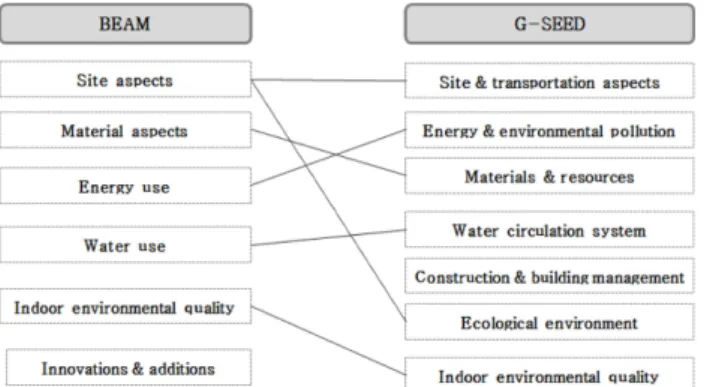
홍콩과 한국의 친환경 관련 인증제도의 특징을 비교분 석하고자 한다. BEAM과 G-SEED는 전문분야에 약간 차 이가 있어 본 연구에서는 G-SEED의 토지이용 및 교통 분야와 생태환경 분야를 통합해서 BEAM의 대지분야와 비교하였다<Figure 1>24).
운영과 인증은 홍콩과 한국의 상황에 따라 일원화될 수 도 분리될 수도 있지만 한국의 G-SEED는 운영기관을 중 심으로 인증기관과 협력하여 교육 및 사후관리의 기능을 포함하는 통합적인 운영이 요구된다.
등급평가에서는 배점을 산출하는 방식은 한국과 홍콩이 동일하지만, 세부적인 내용에서 다소 차이가 있다. 홍콩의 BEAM처럼 가중치가 높은 전문분야(대지, 에너지, 실내 환경) 등에 대해서는 최소한의 득점기준을 둠으로써 저비
용성이나 점수취득의 용이성에 의해 어느 한 분야에 치 우쳐 등급을 받지 않도록 배점 산출의 기준을 재조정할 필요가 있다.
가중치는 전문분야에 따라 약간의 차이는 있지만 BEAM 과 G-SEED 모두 대지, 에너지, 실내 환경 분야의 가중 치가 높게 책정되어 있었다.
전문분야별 특징을 비교하면 G-SEED는 대지이용 부문 에서 거주환경 내의 커뮤니티센터 및 시설공간의 조성, 단지내부 보행자 전용도로 조성 등을 평가항목으로 설정 하여 전반적으로 거주자의 거주환경 측면에서 생활편의에 높은 가치를 두고 있다. 반면 홍콩은 단지 주변의 미기후 를 고려하여 주동을 배치하고 풍향을 고려한 보행자 공 간계획 등을 통해 대지 분야에서는 보다 거시적인 측면 에서 대지환경을 평가하고 있음을 알 수 있다. 홍콩의 도 시디자인 가이드라인은 지역 및 지구(District) 차원과 부 지(site) 차원에서 바람 길을 확보하는 방향으로 건물을 배 치하도록 세부가이드라인을 제시하고 있다. 또한 디자인 에 따라 건물저층부와 고층부의 디자인이 주변 환경에 어 떤 영향을 주는지 살펴보는 SVR (Site Air Ventilation)과 LVR (Local Air Ventilation Assessment)을 시행하여 환기 및 공기흐름에 문제점이 파악되면 디자인을 변경하도록 하고 있다25). 즉, 우리나라는 개별 주호에 대한 친환경성 을 좀 더 중요하게 다루고 있지만, 홍콩은 단지 및 지역 차원에서의 미기후를 고려하여 에너지 절약 및 지속가능 한 개발을 유도하고 있다.
자원분야의 경우 홍콩은 폐기물 발생량을 줄이기 위해 재활용범위와 비율을 구체적으로 제시하여 점수를 획득하 도록 하고, 발생된 폐기물을 부지 내에서 재이용하도록 적극적으로 장려하고 있다. 한국의 G-SEED는 음식쓰레기 및 생활폐기물에 대한 관리 항목은 인증기준에 포함되어 있지만 건축행위로 인해 발생하는 폐기물의 재활용 및 재 활용 자재 사용은 반영되어 있지 않다.
에너지 분야를 보면 홍콩은 건물의 에너지 시뮬레이션 을 통해 소비량을 분석하고 평가한다. 한국은 에너지 성 능지표 산정 시 열관류율을 기준으로 평가하고 있지만 열 관류율만으로는 에너지 사용량이 어느 정도인지 판단하기 어렵다. 따라서 에너지성능지표에 의한 평가가 아닌 에너 지 사용량에 의한 평가방법이 검토되어야 한다.
실내 환경 분야는 홍콩의 경우 자연환기, 국부환기, 공 용 공간 환기 등 환기에 관한 평가기준들이 다양하게 구 성되어 있다. 이는 홍콩의 아열대성 기후와 고층·고밀화 된 주거환경으로 인해 환기의 중요성이 반영된 것으로 생 각된다. 또한 쾌적성과 안전성에 대한 평가기준을 반영함 으로써 신체적 건강요소에 관련된 내용으로 그 범위를 넓
25) 홍콩계획기준 및 가이드라인(Hong Kong Planning Standard Guidelines)은 12장으로 구성되어 있으며, 11장이 Urban Design Guidelines(http://www.pland.gov.hk/pland_en/tech_doc/hkpsg/full/
ch11/ch11_text.htm)이다.
23) KBS 추적60분 “라돈의 공포”, 2013.12.28, 2014.03.22, 2014.03.29 3회 방영.
24) BEAM은 유지관리 분야가 독립적으로 구성되어 있지 않고 각 전문분야 내에 유지관리 내용이 포함되어 있다.
Figure 1. Comparison of the Performance Categories in South Korea and Hong Kong
혀 가고 있다. 한국의 실내환경 분야는 소음에 대한 평가 기준이 홍콩보다 세부적으로 제시되어 있는데 이것은 층 간소음으로 인한 이웃 간의 분쟁 증가에 따른 것으로 보 여진다.
BEAM은 유지관리 분야가 독립적으로 구성되어 있지 않 고 각 전문분야 내에 유지관리 내용들이 포함되어 있다
<Table 7>. 반면 한국은 유지관리 분야가 별도의 전문분야
로 구성되어 있다. 유지관리 분야가 독립적으로 구성되어 있어 전반적인 관리는 가능하지만 전문분야별로 구체적이 고 세부적인 유지관리의 내용은 미흡하다고 볼 수 있다.
2010년 인증을 받은 홍콩의 2개 단지와 2013년 6월 이 후 인증을 받은 한국의 6개 단지에 대해 각 분야별 점수 분포를 살펴보았다<Figure 2>.
홍콩의 공동주거는 배점비율이 에너지부문(36%)>대지부 문(23%)>실내 환경(22%)순으로, 한국은 에너지부문(25%)
>대지부문·실내 환경(23%)순으로 나타났다.
에너지, 대지, 실내 환경 3가지 주요 분야에 대해 약간 의 차이는 있지만 가중치와 사례의 점수비율이 비슷하게 나타났다. 결론적으로 점수비율이 가중치의 영향을 받고 있음을 알 수 있다.
주요 득점 분야는 에너지, 대지, 실내 환경 분야로 한 국과 홍콩이 유사하지만, 에너지 부분의 득점 비율은 한 국의 25%인 반면 홍콩은 36%로 높게 나타났다.
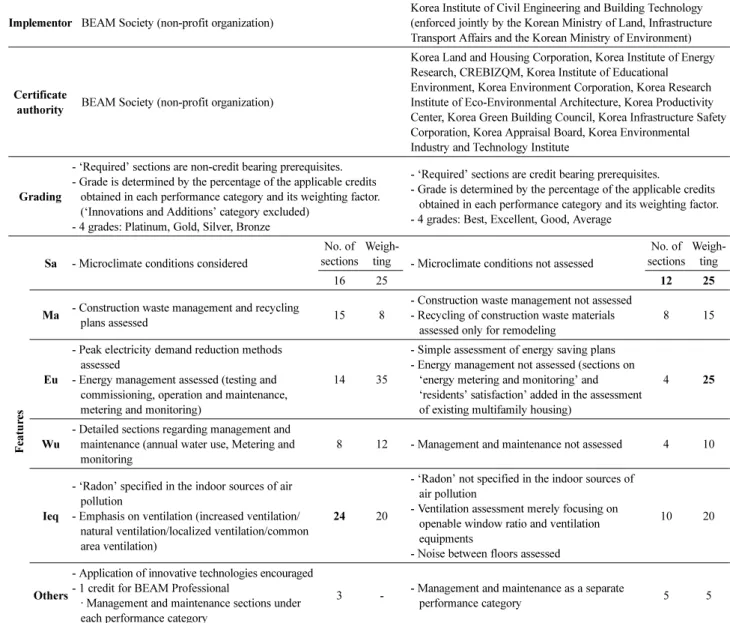
Table 8. Comparison of HK-BEAM and G-SEED
HK-BEAM (Hong Kong) G-SEED (South Korea)
Implementor BEAM Society (non-profit organization)
Korea Institute of Civil Engineering and Building Technology (enforced jointly by the Korean Ministry of Land, Infrastructure Transport Affairs and the Korean Ministry of Environment)
Certificate
authority BEAM Society (non-profit organization)
Korea Land and Housing Corporation, Korea Institute of Energy Research, CREBIZQM, Korea Institute of Educational Environment, Korea Environment Corporation, Korea Research Institute of Eco-Environmental Architecture, Korea Productivity Center, Korea Green Building Council, Korea Infrastructure Safety Corporation, Korea Appraisal Board, Korea Environmental Industry and Technology Institute
Grading
- ‘Required’ sections are non-credit bearing prerequisites.
- Grade is determined by the percentage of the applicable credits obtained in each performance category and its weighting factor.
(‘Innovations and Additions’ category excluded) - 4 grades: Platinum, Gold, Silver, Bronze
- ‘Required’ sections are credit bearing prerequisites.
- Grade is determined by the percentage of the applicable credits obtained in each performance category and its weighting factor.
- 4 grades: Best, Excellent, Good, Average
Features
Sa - Microclimate conditions considered
No. of sections
Weigh-
ting - Microclimate conditions not assessed
No. of sections
Weigh- ting
16 25 12 25
Ma - Construction waste management and recycling
plans assessed 15 8
- Construction waste management not assessed - Recycling of construction waste materials
assessed only for remodeling
8 15
Eu
- Peak electricity demand reduction methods assessed
- Energy management assessed (testing and commissioning, operation and maintenance, metering and monitoring)
14 35
- Simple assessment of energy saving plans - Energy management not assessed (sections on
‘energy metering and monitoring’ and
‘residents’ satisfaction’ added in the assessment of existing multifamily housing)
4 25
Wu
- Detailed sections regarding management and maintenance (annual water use, Metering and monitoring
8 12 - Management and maintenance not assessed 4 10
Ieq
- ‘Radon’ specified in the indoor sources of air pollution
- Emphasis on ventilation (increased ventilation/
natural ventilation/localized ventilation/common area ventilation)
24 20
- ‘Radon’ not specified in the indoor sources of air pollution
- Ventilation assessment merely focusing on openable window ratio and ventilation equipments
- Noise between floors assessed
10 20
Others
- Application of innovative technologies encouraged - 1 credit for BEAM Professional
· Management and maintenance sections under each performance category
3 - - Management and maintenance as a separate
performance category 5 5
Table 7. Sections regarding Maintenance and Management in Hong Kong
Category Section
Sa - Environmental management plan Ma - Demolition waste reduction
- Construction waste reduction Eu - Operation and maintenance
- Metering and monitoring Wu - monitoring and control Ieq - Construction IAQ management
그러나 자원분야는 한국이 홍콩에 비하여 높은 배점비 율을 보이고 있다. 이는 가변형 벽체, 수납공간, 분리수거, 음식물쓰레기시설, 친환경표시인증제품사용 등 현재 공동 주택에서 많이 채택하고 있어 점수 획득이 용이한 것으 로 판단된다.
V. 결 론
본 연구는 한국과 홍콩의 친환경 관련 인증제도의 비 교 분석을 통해 녹색건축 인증제도의 개선방향 및 홍콩 인증제도에서의 시사점 모색을 목적으로 하고 있다.
친환경 인증 시 건물 계획초기 단계부터 인증 전문가 를 참여시켜 경제적이고 효율적인 계획이 이루어질 수 있 도록 하고 이에 더불어 전문가 양성과 보급을 위해 교육 프로그램 개발 및 연구가 체계적으로 이루어져야 한다.
인증제도의 평가항목 수와 제안기법을 보면 홍콩의 BEAM은 평가항목의 내용이 구체적이고 항목 수도 한국 의 인증기준보다 다양해서 설계자와 시공자들이 건축물에 쉽게 적용할 수 있도록 구성되어 있다. 그리고 기계설비 적인 요소이외에도 주동배치 및 자연환기, 자연채광을 위 한 계획적 요소들을 인증기준에 반영하고 있다. 홍콩은 아열대 기후와 고밀도 개발의 도시화에 의해 발생되는 열 부하량을 감소시키는 것이 매우 중요한 문제가 되고 있 다. 이런 상황으로 인해 홍콩의 친환경 인증기준은 설비 적 방법과 더불어 디자인적 기법을 반영하고 있다. 이것 은 친환경이 곧 비용발생이라는 선입관을 줄여 친환경 계 획이 보다 확산될 수 있는 계기가 될 수 있다. 한국의 녹 색건축 인증제도도 구체적인 평가기준을 마련하고, 평가 항목의 수를 늘여 선택의 폭을 넓힐 수 있도록 해야 한 다. 그리고 평가기준의 항목에서도 건축 계획적 기법을 확충해 나가야 할 것이다.
인증기준의 내용에 대한 부분은 대지분야의 경우 개별 주호보다는 지역적이고 도시적인 측면에서 친환경 건축을 평가하는 부분이 보완되어야 하고, 자원 분야에서는 폐기 물 관리 및 자원 재활용 계획 수립 시 철거와 신축 시 그리고 재활용 자재의 적용 범위 및 재활용 비율 등에 대 해 구체적인 기준을 설정할 필요가 있다.
에너지 분야에서 에너지 사용에 대해 운영 전, 운영 그 리고 유지 단계별로 관리계획이 수립되어야 하고, 에너지 모니터링 특히 피크 시 에너지 사용량에 대한 모니터링 이 요구된다. 수자원은 모니터링 및 제어를 통한 유지관 리 계획의 수립이 이루어져야 한다.
실내 환경 분야에서는 라돈에 대한 규제와 주호내부뿐 만 아니라 공용공간에 대한 환기도 포함해야 된다. 안전 성에 대한 평가는 G-SEED 경우 점수는 부여하지 않고 주택성능 등급으로만 표시하고 있다. 그러나 건축물에서 발생하는 범죄가 증가하면서 범죄예방을 위한 건축설계의 중요성이 대두되었다26). 따라서 범죄로부터의 안전성에 대 한 평가기준이 논의될 필요가 있다.
홍콩의 BEAM은 클라이언트가 평가를 받기 전에 직접 예비평가를 해 볼 수 있도록 웹을 기반으로 하는 툴 구 축을 계획 중이라고 한다. 이런 계획은 인증 제도를 좀 더 활성화시키고 많은 참여를 유도할 수 있는 방안으로 한국에서도 검토할 필요성이 있다고 사료된다.
본 연구는 한국과 홍콩의 신축 공동주택에 대한 친환 경인증 제도의 특성을 분석한 것으로 향후 녹색건축 인 증제의 개선방향에 참고자료로 활용될 수 있을 것이다.
앞으로의 연구에서는 기존건축물과 공동주택 이외의 용도 에 추가분석이 요구된다.
REFERENCES
1. Ka, C. H., Park, S. D., Jeon, Y. H., & Tae, C. S. (2012).
Development of Regional Priority Credits in the Korea Green Building Certification Criteria. Journal of Architectural Institute of Korea, 27(10), 269-276.
2. Kim, M. S., Kim, J. H., & Kim, J. J. (2011) Improving Korea’s Green Architecture Certification System. Proceeding of Autumn Annual Conference of Architectural Institute of Korea, 31(2), 95-96.
3. Kim, S. U. (2013). A Study on the Establishment of Quality Assurance System for Korea Green Building Certification System. Journal of Architectural Institute of Korea, 29(3), 309-316.
4. Kim, S. H., Cho, T. G., & Yee, J. H. (2012). A Study on the Comparative Analysis and Improvement of the Domestic and Japanese Green Building Certification Criteria by Actual Evaluation in an Apartment Complex. Journal of Architectural Institute of Korea, 14(10), 155-165.
5. Kim, S. H., & Lee, J. H. (2005). A Study on the Characteristics of the Super High-Rise Housing Complex in Hong Kong. Journal of the Korean Housing Association, 16(4), 37-44.
6. Kim, E. J., Kim, S. H., & Lee, J. H. (2013). A Comparison Study of the Green Building Certification Systems for Multifamily Housing between South Korea and Hong Kong. Proceeding of Autumn Annual Conference of KHA,
26) 국토교통부는 개정건축법(’14. 11.29)에 맞춰 현재 권고사항으로 운영 중인 “건축물 범죄예방 설계 가이드라인”을 보완하여 범죄예 방 기준으로 고시할 예정이다.
Figure 2. Credit Ratios obtained by Performance Category (Residential Buildings)
25(2), 175-180.
7. Kim, H. K., Kim, J. M., Lee, Y. K., & Lee, J. H. (2012). A Suggestion for an Improved Operational Scheme through a Comparison Study on the National Green Building Certification Criteria. Journal of Architectural Institute of Korea, 28(6), 255-264.
8. Seo, B. K., Kim, S. H., & Lee, J. H. (2014), Regulating Natural Lighting and Ventilation of Residential Buildings in Hong Kong. Architectural Research of AIK, 16(3), 83-84.
9. An, J. H. (2014). A Study of the Improving Direction of the Green Standard for Energy and Environmental Design- Focused on the Ecology-related Items. Master's thesis, University of Hanyang, Seoul.
10. Yeom, D. W. (2014). A Study on the Sustainability Improvement Model for G-SEED. Doctoral dissertation, University of Ajou, Suwon.
11. Oh, R. J., Jung, H. Y., & Kim, K. S. (2009). A Study on the Comparative Analysis and Improvement of Indoor Environment Factors in the Green Building Ratin System.
Journal of Korea Institute of Architectural Sustainable Environment and Building System, 3(2), 47-54.
12. Yun, Y. S., & Ryu, S. H. (2013). A Study on the Improvement of G-SEED through Analysis of the Previous Studies-Based on Apartment Houses. Journal of the Korea Institute of Ecological Architecture and Environment, 13(5), 31-42.
13. Lee, S. O., Cho, D. W., Park, C. Y., & Lee, S. H. (2013). A Study on Score Calculation Method for Certification Grade of G-SEED (Korea) & World Green Building Rating Systems. Journal of Architectural Institute of Korea, 29(11), 283-290.
14. Lee, H. W., Choi, C. H., & Cho, M. G. (2007). A Study on Comparing and Analyzing Items of Foreign Green Building Certification Criteria. Journal of Korea Institute of Architectural Sustainable Environment and Building System, 1(2), 41-49.
15. Jeong, Y. W. (2014). A Study of the Green Building Certification to Improve the Sustainability. Master’s thesis, University of Ajou, Suwon.
16. Tae, S. H., Shin, S. W., & Lim, S. C. (2007). A Study on Indoor Environmental Ratings by Comparing Green Building Certification Systems Through Case Studies.
Journal of Architectural Institute of Korea, 23(8), 229-236.
17. Ministry of Land, Infrastructure and Transport. & Ministry of Environment. (2013. 06. 28). Green Certification standards, South Korea.
18. BEAM Society. (2010). BEAM Plus New Buildings, Hong Kong.
Received: June 27, 2014 Revised: November 10, 2014 Accepted: December 24, 2014