A Study for Life Cycle Assessment(LCA) of Hybrid TTX carbody with Composites
하이브리드 복합재 차체 틸팅차량에 대한 전주기 평가 (LCA) 연구
이상진 *+ 정종철 * 조세현 * 김정석 ** 서승일 **
Sang-Jin Lee Jong-Cheol Jeong Se-Hyun Cho Jung-Suk Kim Soung-il Seo
ABSTRACT
본 연구는 한국형 틸팅 차량의 복합재 적용 차체에 대한 비용 모델링과 전주기 평가 (LCA) 를 수행하
였다 원자재 생산에서 차체 제작 수명이 끝나는 시점까지의 사용에 대한 모든 단계에서의 비용을 분 . ,
석했다 . 5 년 동안 년간 90 대의 생산량에 대한 금속 차체 , 2 종의 복합재 차체에 대해 비교하였다 . 2 종
의 복합재 차체는 하이브리드 스틸 복합재 구조와 전체 복합재 차체를 나타낸다 또한 이 두 경우 모 - . ,
두에 대해 오토클레이브 진공 성형 레진 인퓨젼 공법의 성형에 대해 분석하였다 제작시의 모든 성형 , , .
공법에 대해 하이브리드 차체는 전체 복합재 차체 보다 4~6 % 비용이 낮았다 . 전체 복합재 차체의
경우 레진 인퓨젼의 경우가 오토클레이브에 대해서는 , 11% 낮은 가장 낮은 제작 비용이 소요되었다 .
비용 - 전주기 분석을 통해 전체 복합재 차체는 가장 높은 제작비용이 소요되고 사회 경제학적 측면에
서 전체 전주기 비용과 환경영향은 단순 차량 구입 비용보다 더 중요한 변수이며 전체 복합재 차체가 분명한 최적의 해답 임을 확인하였다.
1. INTRODUCTION
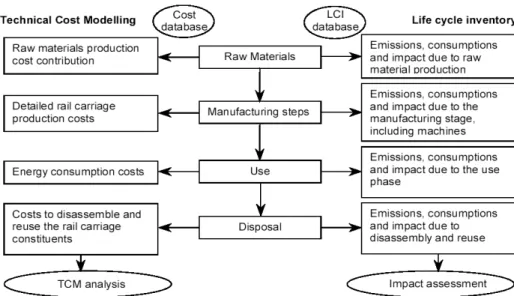
As a contribution to the development of the Korean Tilting train at Hankuk Fiber Glass Co., Ltd [1], the manufacturing costs and related environmental impact have been assessed, based upon a comparison between a composite car-body (with various alternatives) and metallic steel and aluminium car-bodies. Both approaches rely on a common detailed analysis of the involved processes in all life cycle stages, with focus on the manufacturing stage. Three candidate composite manufacturing processes have been considered: autoclave and oven curing of prepregs, and resin infusion [2,3]. For each process, material and energy consumption, required labour, and other auxiliary inputs were determined dependent on train body characteristics. These case specific inputs were then combined to a cost database in order to perform TCM work. In parallel, a life cycle inventory database was combined with these specific inputs to yield the total life cycle emissions and extractions as a basis for the calculation of life cycle impacts, as shown in Fig. 1.
주 한국화이바 철도차량사업부 교신저자
* ( ) , + ([email protected]) 한국철도기술연구원 기존철도고속화사업단
**
Fig. 1 Combined Technical Cost Modelling(TCM) and Life Cycle Assessment(LCA)
2. CAR-BODY DESCRIPTION - SCENARIO DEFINITION
The object of this present study is a rail car-body for the Korean Tilting Train eXpress(TTX), with an expected life time of 30 years and 9,000,000 km. Four scenarios were envisaged, as described in Table 1. The manufacturing stage was modelled for the first two scenarios, and compared to existing data for steel and aluminium carriages. For the composite scenarios (1 & 2), the rail carriage is made by joining a stainless steel under-frame to the body composite structure. In the hybrid scenario, a steel inner-frame is embedded, as can be seen in Fig. 2. A total of 440 cars will assume to be produced, starting 2009 for a duration of 5 years, therefore giving an annual production volume of 90 cars.
Scenario 1:
Composite
7.6 tones
Scenario 2:
Hybrid
8.8 tones
Scenario 3:
Aluminum
9.0 tones
Scenario 4:
Steel
11.5 tones Under-frame Stainless steel
5.3 tones Stainless steel
5.3 tones Aluminum
9.0 tones Stainless steel 11.5 tones
Body Frame Composite
2.3 tones Composite
2.0 tones
Inner frame None Mild steel
1.5 tones None None
Table 1 Car body Scenarios
Fig.2 Schematic View of the Hybrid
carbody
3. MANUFACTURING COST STUDY
3.1 Manufacturing scenarios
Three candidate composite manufacturing processes have been studied. The first two are based on prepreg preforming, cured either in an autoclave or an oven. The third process consists of resin infusion of carbon non-crimp fabrics. Fig. 3 shows a schematic plant diagram for the autoclave curing process. Three lay-up cells are used in order to meet the annual target volume. In order to limit the complexity of the model, it is assumed that the composite structure is built in one step, combining prepreg, core material and adhesive film; as well as the inner-frame for the hybrid scenario. Therefore, lay-up times for the first and second skins have been added to reflect the real cycle time. As a result there is only one step on the autoclave, where the curing cycle time has been doubled. After curing, the part goes to the assembly cell, where it is then taken out of the mould and trimmed. Finally, the car-body is assembled to the steel under-frame by means of rivets. The rail carriage is then finished. The over-head crane is used to demould the part and assemble it to the under-frame, as well as to carry the inner-frame for the hybrid car-body scenario. For oven curing, the process is the same except that the autoclave is replaced by an oven. For the resin infusion process, different material stocks are used, and no curing equipment is needed, as it is performed in the mould, at limited temperature (70 ).
Fig. 3 Manufacturing Plant Diagram of the Autoclave Process (Hybrid carbody)
Two approaches to manufacturing plant utilization have been compared when calculating the manufacturing costs: i) Dedicated scenario, where the full plant cost will be amortized across the number of parts produced.
This gives the upper limit of the manufacturing costs, and ii) Utilization-based scenario, where it is assumed that
machines and workers can be amortized between different processes, where costs allocated to car body
manufacturing will be proportional to the time used in the plant.
3.2 Results
Cost versus volume curves are shown in Fig. 4 for the three processes, for both dedicated and utilization-based scenarios. Dedicated scenario curves are split in three parts, corresponding to the number of shifts needed to achieve a given volume. The cost step between each shift is due to the necessity of hiring an additional shift.
For the utilization-based scenarios, the cost difference is small between the two prepreg processes, with the increase for autoclave processing due to the higher equipment cost. Further cost reduction is observed for the resin infusion process, which is due to lower material costs and significantly lower equipment cost. The material costs are lower because impregnation of the composite structure is performed in the mould, rather than buying a semi-finished pre-impregnated product.
Fig. 4 Cost-volume curves for the hybrid car-body scenario (AC = autoclave cure, oven = oven cure, RI = resin infusion,
ded = dedicated plant, util = utilization-based plant).
As can be seen in Fig. 5, the most important contributions to the final part cost, for the target volume of 90 parts/year, can be ranked in the following way:
- Materials: the sandwich structure (prepreg and honeycomb) accounts for 35% of the final part cost.
- Direct labour: since 3 sets of 20 workers are needed to build the sandwich structure and reach the target volume, it is the second largest contribution (~25%).
- Sub-contracted parts: under-frame cost (and inner-frame for the hybrid carbody) account for 15% of the final part cost. If combined with the material cost, 50% of the final part cost comes from the materials used to build the part.
- The remaining 25% of the cost is split between tooling (which also includes all the vacuum consumables),
energy (mainly for the curing cycles), equipment (autoclave cost) and overheads (these include indirect labour
cost and plant area cost).
Fig. 5 Manufacturing cost breakdown at target volume (hybrid car-body).
4. COUPLED COST AND LIFE CYCLE MODELLING
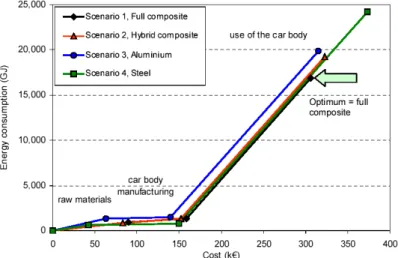
The objective here was to determine the influence of each part of the life cycle on cost and environmental impact. This has been summarized in one graph, presented in Fig. 6, to show cost versus energy consumption (as one major indicator of the environmental impacts) for the stages of: a) raw material production, b) manufacturing stage, and c) use phase.
Fig. 6 Energy/cost curves showing the benefits of composite car-bodies versus metallic constructions.
The coupled results show that the raw material and manufacturing phase costs are approximately half of the total
life cycle costs, whilst the environmental impact is relatively insignificant (3~8%). The use phase of the car body
is the most important in terms of environmental impact, for all scenarios. In terms of cost, it represents
approximately half of the whole life cycle. With steel rail carriages being of greater weight, the use phase cost is
correspondingly higher to give both the greatest environmental impact and the highest life cycle cost. Compared to the steel scenario, the hybrid composite variant has a lower life cycle cost and a lower environmental impact.
However, the life cycle cost is greater for the hybrid composite solution than for the aluminium rail carriage variant. Hence the hybrid composite solution can only be justified versus aluminium for the lower environmental impact. However, the full composite variant has both lower total life cycle costs and lower environmental impact than all of the alternatives, and is hence the optimum solution.
5. CONCLUSION
For the autoclave curing process, the hybrid car-body variant showed a 4% to 6% cost reduction compared to the composite car-body. However, the latter allows a 1,200 kg weight saving over the hybrid variant. Compared to steel and aluminium benchmarks, the full composite car-body variant reduces the mass by 34% and 15.5%
respectively. Of the three candidate composite manufacturing processes, the resin infusion variant is the most cost-efficient with a saving of 11% over the autoclave process. However, further evaluation of the process would be required, including evaluation of structural properties, feasibility tests, and mould fill simulations. Materials and direct labour costs dominate the part cost, accounting for up to 85% of the final part cost. This has been confirmed by sensitivity studies, where parameters governing labour (number of workers and lay-up times) and raw material (mainly prepreg price) costs had the largest influence on the final part cost. The use phase clearly had the biggest impact on the environment with near negligible contributions from the other phases. The full composite car-body was the most costly to manufacture, but the reduction in rail carriage weight enabled large energy savings to be made in the use phase and hence an overall life cycle cost reduction.
6. ACKNOWLEDGEMENT
This research is funded by Ministry of Construction and Transportation. The authors thank the support.
REFERENCES