—80—
INTRODUCTION
Family Elopidae under the order Elopiformes are dis- tributed globally in tropical and subtropical areas, and seven species belonging to one genus (Elops) are recog- nized in the world (Eschmeyer and Fong, 2010). Of which two species, Elops machnata (Forsskål, 1775) and E. hawaiensis Regan, 1909 have been recognized in the Indo-Pacific (Whitehead, 1962), and only one species, E. hawaiensis has been recorded in Korea and Japan (Aizawa, 2002; Kim et al., 2005). However, taxonomic study of the family Elopidae is poorly-known except for a brief description (Nelson, 2006). Mori (1928) reported E. machnata in the Korean waters for the first time with- out any morphological description. Subsequently, many Korean ichthyologists regarded the species as E. saurus (Chyung, 1954), E. machnata (Chyung, 1977; Kim, 1983) and E. hawaiensis (Youn, 2002; Kim et al., 2005b). None of the previous authors provided any descriptions based on specimens, except the description of leptocephalus of E. hawaiensis by Kim et al. (2005a). Therefore, we re- described the morphological characteristics of E. hawai- ensis adult collected from Korean waters, and also com- pared mitochondrial DNA cytochrome b sequences with
those of Elopidae spp.
MATERIALS AND METHODS
The four specimens of E. hawaiensis were collected from Busan and Gwangyang, South Sea of Korea bet- ween 2008 and 2010, and were deposited at the Ichthyo- logy laboratory, Pukyong National University (PKU).
Counts and measurements were made according to Hubbs and Lagler (2004), with digital vernier caliper to the nearest 0.1 mm. The vertebrae were counted from radiograph (SOFTEX HA-100, Japan), following McBride and Horodysky (2004).
Genomic DNA was extracted from muscle tissue using 10% Chelex 100 Resin (Bio-rad, Hercules). The poly- merase chain reaction (PCR) was used to amplify the mitochondrial DNA cytochrome b gene, following McBride and Horodysky (2004). Nucleotide sequence data reported here have been submitted to the DDBJ/
EMBL/GenBank nucleotide sequence databases (acces- sion number HQ157200~HQ157201, HQ616666~
HQ616667). Mitochondrial DNA cytochrome b sequ- ences were aligned using BioEdit version 7 (Hall, 1999), and for the molecular comparisons, we obtained the mitochondrial DNA cytochrome b sequences of three Elops species (E. hawaiensis, E. saurus and E. smithi)
Redescription of the Hawaiian Ladyfish Elops hawaiensis from Korea
By Hyuck Joon Kwun, Chung Bae Kang1and Jin Koo Kim*
Department of Marine Biology, Pukyong National University, Busan 608-737, Korea
1Korea Ocean and Fisheries Institute, Busan 608-807, Korea
ABSTRACT Redescription of the Hawaiian ladyfish Elops hawaiensis was carried out based on four specimens collected from Busan and Gwangyang between 2008 and 2010. This species has a gular plate between the symphysis and isthmus, and the entire premaxillary tooth band is exposed when the mouth is closed. Our Korean specimens of E. hawaiensis are characterized by having 65~~67 vertebrae, 14 anal fin rays and 95~~101 lateral line scales, which values differed slightly from those given in previ- ous studies. Molecular analysis using 480 base pairs of mitochondrial DNA cytochrome b sequences showed that our four specimens corresponded well with E. hawaiensis (99.8~~100.0%). Therefore, our results suggest that there may exist regional differences in vertebrae and anal fin ray counts for E.
hawaiensis.
Key words : Redescription, Hawaiian ladyfishes, Elops hawaiensis, Korea
*Corresponding author: Jin Koo Kim Tel: 82-51-629-5927, Fax: 82-51-629-5931, E-mail: [email protected]
http://www.fishkorea.or.kr
and two outgroups (Megalops atlanticus and M. cyprinoi- des) from the NCBI (National Center for Biotechnology Information): Elops hawaiensis (AB051070), Elops sau- rus (GQ183881, GQ183882), Elops smithi (GQ183883, GQ183894), Megalops cyprinoides (AB051110), Mega- lops atlanticus (NC005804). The genetic distances were calculated according to the Kimura-2-parameter model (Kimura, 1980) using pairwise distance of MEGA 4 (Tamura et al., 2007).
Elops hawaiensis Regan, 1909 (Korean name: dang-myeol-chi)
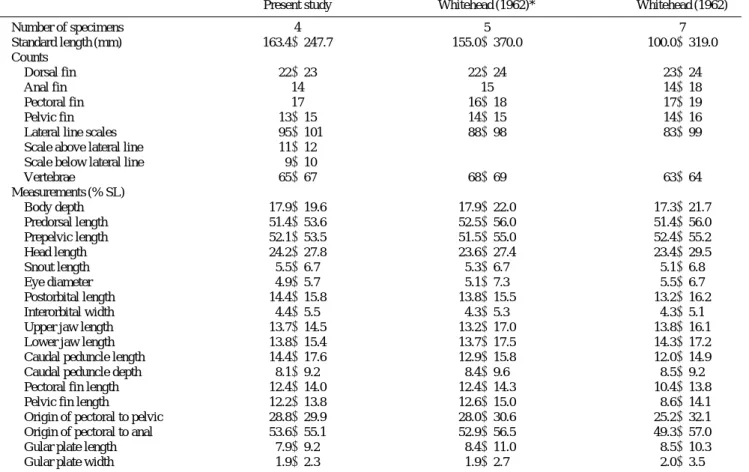
(Fig. 1, Table 1)
Elops hawaiensis Regan, 1909: 39 (type locality: Ha- waii); Whitehead, 1962: 328; Sato and Yasuda, 1980:
315; Kim et al., 2005a: 217, fig. 1; Kim et al., 2005b:
80; Aizawa, 2002: 188, 1450; Youn, 2002: 137, 488;
McBride et al., 2010: 32.
Elops saurus (not Linnaeus): Mori, 1952: 28; Chyung, 1954: 36.
Elops machnata (not Forsskål): Mori, 1928: 3; Chyung, 1977: 104, plate 21; Kim, 1983: 164.
Material examined. PKU 428, one specimen, Busan, 21 Jun. 2008; PKU 3268, one specimen, Gwangyang, 27 Nov. 2009; PKU 4224, one specimen, Busan, 9 Sep.
2010; PKU 4666. One specimen, Busan, 20 Oct. 2010.
Description. Counts and proportional measurements are shown in Table 1. Body elongated, compressed.
Snout short, slightly pointed and mouth terminal. Maxilla covered side of lower jaw; posterior tip of maxilla beyond posterior margin of eye. Both jaw, vomer and palatine with small conical teeth. Whole premaxillary tooth band exposed when mouth closed. Gular plate present between symphysis and isthmus. Developed adipose tissue cov- ered eye except pupil. Interorbital region concaved. All fins comprise of only soft rays. Axillary scales present at pectoral and pelvic fins. Pectoral fin located at ven- tral region of body and pelvic fin abdominal, located below origin of dorsal fin. Caudal fin deeply forked, length of both lobes equal. Lateral line extended to cau- dal fin base in a straight line. Body covered with small cycloid scales, but head exposed.
Coloration. When fresh, head and body lustrous sil- very white and bluish dorsally. Pupil black, adipose tissue around eyes transparent. Tip of dorsal and caudal fins blackish, a lot of small melanophores present. Pectoral, pelvic and anal fins transparent, yellowish partially. After fixation, head and body lose luster; ventral body, upper jaw, anal fin and base of caudal fin dark yellowish. Adi- pose tissue semitransparent yellowish. Pectoral, pelvic and anal fins darkish.
Distribution. E. hawaiensis occurs in Busan (Mori, 1928, 1952; present study), Gwangyang (present study) and Jeju (Kim et al., 2005a) from Korea. It occurs in the Indo-Pacific (Whitehead, 1962), Hawaii (Regan, 1909) and Japan (Aizawa, 2002).
Remarks. Two Elops species (E. hawaiensis and E.
Fig. 1. Elops hawaiensis (A) fresh specimen, PKU 428, 247.7 mm SL; (B) preserved specimen, PKU 3268, 236.4 mm SL.
A
B
machnata) are distributed in the Indo-Pacific region.
They are distinguished by the number of vertebrae (68~
70 in E. hawaiensis vs. 63~64 in E. machnata) and expo- sure of the premaxillary tooth (whole tooth exposed vs.
anterior tooth covered by lower jaw) (Whitehead, 1962).
In this study, morphological characteristics of observed specimens correspond well with those of E. hawaiensis, especially in whole premaxillary tooth exposed. The num- ber of vertebrae of observed specimens (65~67) slightly
differs from those of the original description (68: Regan, 1909) and taxonomic review (68~70: Whitehead, 1962).
However, Kim et al. (2005a) reported that E. hawaiensis leptocephalus from Jeju Island has 66 total myomeres, and Uyeno (1984) and Sato and Yasuda (1980) reported that it has 66~70 and 66~68 total vertebrae, being corresponded to those of observed specimens (see Table 1). To clarify the taxonomic status of our four speci- mens, we analyzed 470 base pairs of mitochondrial DNA
Table 1. Comparison of counts and measurements of Elops hawaiensis species
Elops hawaiensis Elops machnata
Present study Whitehead (1962)* Whitehead (1962)
Number of specimens 4 5 7
Standard length (mm) 163.4~247.7 155.0~370.0 100.0~319.0
Counts
Dorsal fin 22~23 22~24 23~24
Anal fin 14 15 14~18
Pectoral fin 17 16~18 17~19
Pelvic fin 13~15 14~15 14~16
Lateral line scales 95~101 88~98 83~99
Scale above lateral line 11~12 - -
Scale below lateral line 9~10 - -
Vertebrae 65~67 68~69 63~64
Measurements (% SL)
Body depth 17.9~19.6 17.9~22.0 17.3~21.7
Predorsal length 51.4~53.6 52.5~56.0 51.4~56.0
Prepelvic length 52.1~53.5 51.5~55.0 52.4~55.2
Head length 24.2~27.8 23.6~27.4 23.4~29.5
Snout length 5.5~6.7 5.3~6.7 5.1~6.8
Eye diameter 4.9~5.7 5.1~7.3 5.5~6.7
Postorbital length 14.4~15.8 13.8~15.5 13.2~16.2
Interorbital width 4.4~5.5 4.3~5.3 4.3~5.1
Upper jaw length 13.7~14.5 13.2~17.0 13.8~16.1
Lower jaw length 13.8~15.4 13.7~17.5 14.3~17.2
Caudal peduncle length 14.4~17.6 12.9~15.8 12.0~14.9
Caudal peduncle depth 8.1~9.2 8.4~9.6 8.5~9.2
Pectoral fin length 12.4~14.0 12.4~14.3 10.4~13.8
Pelvic fin length 12.2~13.8 12.6~15.0 8.6~14.1
Origin of pectoral to pelvic 28.8~29.9 28.0~30.6 25.2~32.1
Origin of pectoral to anal 53.6~55.1 52.9~56.5 49.3~57.0
Gular plate length 7.9~9.2 8.4~11.0 8.5~10.3
Gular plate width 1.9~2.3 1.9~2.7 2.0~3.5
*Including Elops hawaiensis and Elops australis with holotype
Table 2. Genetic divergence among three Elops species with outgroups
Species 1 2 3 4 5 6 7 8 9 10 11
1 Elops hawaiensis (PKU 428)
2 Elops hawaiensis (PKU 3268) 0.002 3 Elops hawaiensis (PKU 4224) 0.000 0.002 4 Elops hawaiensis (PKU 4666) 0.000 0.002 0.000 5 Elops hawaiensis (AB051070) 0.000 0.002 0.000 0.000 6 Elops saurus (GQ183881) 0.017 0.019 0.017 0.017 0.017
7 Elops saurus (GQ183882) 0.019 0.022 0.019 0.019 0.019 0.002
8 Elops smithi (GQ183883) 0.009 0.011 0.009 0.009 0.009 0.013 0.011
9 Elops smithi (GQ183894) 0.011 0.013 0.011 0.011 0.011 0.019 0.022 0.011 10 Megalops cyprinoides (AB051110) 0.162 0.162 0.162 0.162 0.162 0.156 0.159 0.159 0.156 11 Megalops atlanticus (NC005804) 0.164 0.164 0.164 0.164 0.164 0.156 0.156 0.162 0.161 0.111
cytochrome b sequences, and compared them with those of three Elops species. The results showed that DNA of observed specimens corresponds to DNA of E. hawaien- sis (99.8~100.0%), but slightly differed to E. saurus (97.8~98.3%) and E. smithi (98.7~99.1%) from the western North Atlantic. Our molecular results suggest that there may exist regional differences in vertebrae and anal fin counts between Korean E. hawaiensis and those by Whitehead (1962) (Table 2). Although E. hawai- ensis and E. smithi are well distinguished by the number of vertebrae (68~70 in E. hawaiensis vs. 73~80 in E.
smithi) and distribution (Indo-Pacific vs. Western Atlan- tic) (McBride et al., 2010), genetic distance between them was considerably small. It has a considerable attrac- tion for their evolutionary history of the genus Elops.
REFERENCES
Aizawa, M. 2002. Elopidae. In: Nakabo, T. (ed.), Fishes of Japan with Pictorial Keys to the Species. English ed.
Tokai Univ. Press, Tokyo, p. 188.
Chyung, M.K. 1954. Korean fishes. Ministry of Trade, Seoul, 517pp. (in Korean)
Chyung, M.K. 1977. The fishes of Korea. Il-ji Publishing, Seoul, 727pp. (in Korean)
Eschmeyer, W.N. and J.D. Fong. 2010. Species of fishes by family/subfamily. On-line version dated 05 Aug 2010.
http://research.calacademy.org/research/ichthyology/
catalog/SpeciesByFamily.asp.
Forsskål, P. 1775. Descriptiones animalium avium, amphi- biorum, piscium, insectorum, vermium; quae in iti- nere orientali observavit Petrus Forskål. Post mortem auctoris edidit Carsten Niebuhr. Adjuncta est materia medica kahirina atque tabula maris rubri geographica.
Hauniæ, xxxiv, 164pp.
Hall, T.A. 1999. BioEdit: a user-friendly biological sequence alignment editor and analysis program for Windows 95/98/NT. Nucl. Acids Symp. Ser., 41: 95-98.
Hubbs, C.L. and K.F. Lagler. 2004. Fishes of the great lakes region. Revised ed. Michigan Univ. Press, Ann Arbor., 332pp.
Kim, B.J., Y.B. Go and K. Nakaya. 2005a. A leptocephalus larva of Elops hawaiensis (Elopiformes: Elopidae) from Jeju island, Korea. Korean J. Ichthyol., 17: 217- 220.
Kim, I.S., Y. Choi, C.L. Lee, Y.J. Lee, B.J. Kim and J.H.
Kim. 2005b. Illustrated book of Korean fishes. Kyo- Hak Publishing Co., Seoul, 615pp. (in Korean)
Kim, Y.U. 1983. Fish larvae of Changson channel in Nam- hae, Korea. Bull. Korean Fish. Soc., 16: 163-180.
Kimura, M. 1980. A simple method for estimating evolution- ary rates of base substitutions through comparative studies of nucleotide sequences. J. Mol. Evol., 16:
111-120.
McBride, R.S. and A.Z. Horodysky. 2004. Mechanisms main- taining sympatric distributions of two ladyfish (Elo- pidae: Elops) morph in the Gulf of Mexico and west- ern North Atlantic Ocean. Limnol. Oceanogr., 49:
1173-1181.
McBride, R.S., C.R. Rocha, R. Ruiz-Carus and B.W. Bowen.
2010. A new species of ladyfish, of the genus Elops (Elopiformes: Elopidae), from the western Atlantic Ocean. Zootaxa, 2346: 29-41.
Mori, T. 1928. A catalogue of the fishes of Korea. J. Pan- Pac. Res. Inst., 3: 3-8.
Mori, T. 1952. Check list of the fishes of Korea. Mem. Hyogo Univ. Agric., 1: 1-228.
Nelson, J.S. 2006. Fishes of the world. 4thed. John Wiley and Sons, Inc., Hoboken, New Jersey, 601pp.
Regan, C.T. 1909. A revision of the fishes of the genus Elops.
Ann. Mag. Nat. Hist. Ser. 8, 3: 37-40.
Sato, M. and F. Yasuda. 1980. Metamorphosis of the lepto- cephali of the ten-pounder, Elops hawaiensis, from Ishigaki island, Japan. Jpn. J. Ichthyol., 26: 315-324.
Shen, S.C. 2001. Order Elopiformes. In: Shen, S.C. (ed.), Fishes of Taiwan. Revised ed. Nat. Taiwan Univ.
Press, Taipei, pp. 95-96.
Smith, D.G. 1999. Elopidae. In: Carpenter, K.E. and V.H.
Niem (eds.), FAO species identification guide for fishery purposes. The living marine resources of the Western Central Pacific. Volume 3. Batoid fishes, chimaeras and bony fishes part 1 (Elopidae to Lino- phrynidae). Food and Agriculture Organization of the United Nations, Rome, pp. 1619-1620.
Tamura, K., J. Dudley, M. Nei and S. Kumar. 2007. MEGA4:
Molecular evolutionary genetics analysis (MEGA) software version 4.0. Mol. Evol., 24: 1596-1599.
Uyeno, T. 1984. Order Elopiformes. In: Masuda, H., K.
Amaoka, C. Araga, T. Uyeno and T. Yoshino (eds.), The Fishes of the Japanese Archipelago. Tokai Univ.
Press, Tokyo, pp. 21.
Whitehead, P.J.P. 1962. The species of Elops (Pisces: Elopi- dae). Ann. Mag. Nat. Hist. Ser. 13, 5: 321-329.
Youn, C.H. 2002. Fishes of Korea with pictorial key and systematic list. Academy Publishing Co., Seoul, 747pp. (in Korean)
한국산 당멸치, Elops hawaiensis의 재기재
권혁준∙강충배1∙김진구
부경대학교 자원생물학과, 1한국해양수산연구원
요 약 :2008~2010년 사이에 우리나라 부산 및 광양에서 채집된 당멸치, Elops hawaiensis 4개체의 형태특징
을 상세히 재기재하였다. 본 종은 아래턱의 봉합부와 협부 사이에 후판을 가지며, 입을 닫았을 때 전상악골의 치 대 전체가 노출된다. 한국산 당멸치는 척추골수이 65~67개, 뒷지느러미 연조수가 14개, 측선비늘이 95~101개 를 가지는 것이 특징적이었으며 이전 연구결과와 약간 달랐다. 미토콘드리아 DNA cytochrome b 480 bp의 염기 서열을 분석한 결과, 우리의 4개체는 E. hawaiensis와 99.8~100% 일치하였다. 따라서, 우리 결과는 당멸치가 척 추골 및 뒷지느러미 계수에서 지역적 변이가 존재할 것이라는 사실을 제시한다.
찾아보기 낱말 :재기재, 당멸치, Elops hawaiensis, 한국