http://crossmark.crossref.org/dialog/?doi=10.14474/ptrs.2019.8.4.194&domain=pdf&date_stamp=2019-12-25
Received: 28 November, 2019 Revised: 10 December, 2019 Accepted: 12 December, 2019
Corresponding author: Wan-Hee Lee (ORCID https://orcid.org/0000-0001-8030-4853)
Department of Physical Therapy, College of Health Science, Sahmyook University, 815 Hwarang-ro, Nowon-gu, Seoul 01795, Republic of Korea
Tel: 82-2-3399-1633 Fax: 82-2-3399-1639 E-mail: [email protected]
This is an Open-Access article distributed under the terms of the Creative Commons Attribution Non-Commercial License (http://creativecommons.org/licenses/
by-nc/4.0) which permits unrestricted non-commercial use, distribution, and reproduction in any medium, provided the original work is properly cited.
Copyright © 2019 Korean Academy of Physical Therapy Rehabilitation Science
https://doi.org/10.14474/ptrs.2019.8.4.194
pISSN 2287-7576 eISSN 2287-7584
Phys Ther Rehabil Sci 2019, 8 (4), 194-201 www.jptrs.org
Reliability and validity of rehabilitative ultrasound images obtained using a hands-free fixed probe in measuring the muscle structures of the tibialis anterior and the
gastrocnemius
Mun-Sang Choi
a, Jang-Hoon Shin
b, Hye-Kang Park
b, Wan-Hee Lee
c
a
Team of Physical Therapy, National Traffic Rehabilitation Hospital, Yangpyeong, Republic of Korea
b
Department of Physical Therapy, The Graduate School, Sahmyook University, Seoul, Republic of Korea
c
Department of Physical Therapy, College of Health Science and Social Welfare, Sahmyook University, Seoul, Republic of Korea
Objective: This study aimed to investigate the reliability and validity of muscle thickness (MT) and pennation angle (PA) meas- urements of the ankle muscle, including the tibialis anterior (TA) and the medial gastrocnemius (MGCM), using a hands-free fixed probe and to compare it with the conventional linear probe.
Design: Observational inter-rater reliability study.
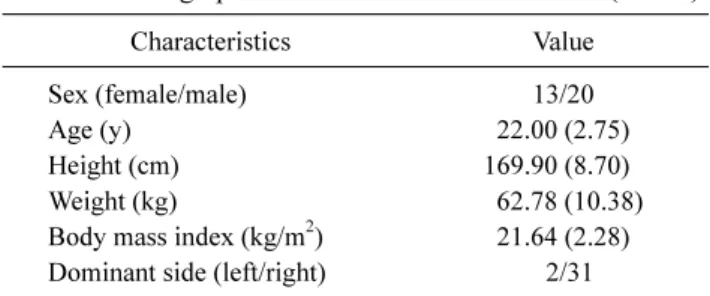
Methods: Thirty-three healthy subjects (20 male, 13 female) were included. In all subjects, ultrasound images were acquired from the TA and MGCM using a hands-free fixed probe and a conventional linear probe in random sequence by two examiners at two time-points within a 7-day interval. MT and PA were calculated on the taken images. Intra-class correlation coefficients (ICC), 95% confidence intervals, standard error of measurement and the Pearson’s correlation coefficient were used to estimate reliability and validity. And also, Bland-Altman plots were generated for a visual representation of MT and PA at the TA and MGCM.
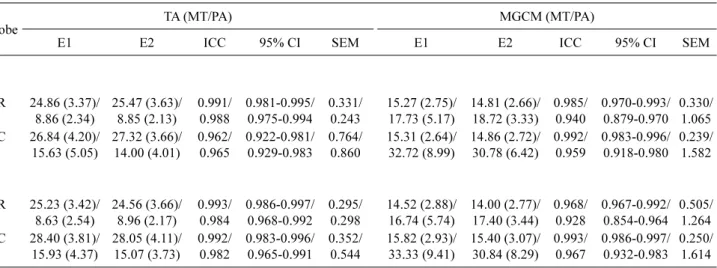
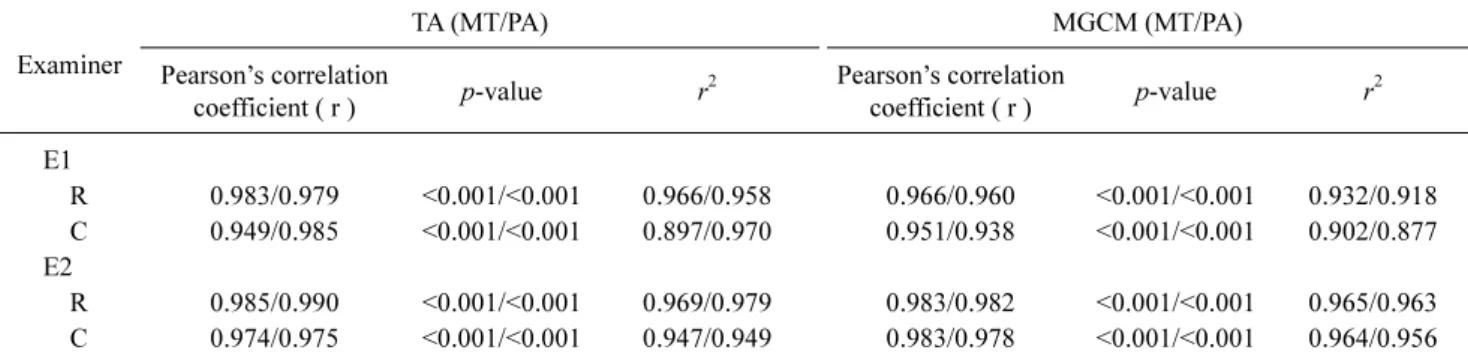
Results: The ICC for all intra-rater reliability was 0.943 to 0.995 and that for all inter-rater reliability was 0.928 to 0.993, indicat- ing excellent reliability. A significantly high correlation was observed between MT and PA at the TA and MGCM with use of the hands-free fixed probe and the conventional linear probe (r>0.938; p<0.001).
Conclusions: The hands-free fixed probe provided excellent images for measurement of the MT and PA of the TA and MGCM and is a useful device for making clinical measurements of muscle structure without grasping of the probe.
Key Words: Ankle, Muscle structure, Reliability, Ultrasonography, Ultrasound probe
Introduction
Excessive muscle co-contraction between the tibialis an- terior (TA) and the gastrocnemius (GCM) causes stiffness in the ankle joint and limits postural control [1]. The TA pro- vides a peripheral feedback mechanism modulating agonists such as the GCM in maintaining human upright posture and activates reciprocal inhibition that is more likely to be effec- tive for ankle strategy [2]. Young age and healthy status of individuals increases the frequency of using the ankle strat-
egy to maintain posture stability [3,4]. This means they use more reciprocal inhibition by the TA on the GCM, which produces less muscle co-contraction in the ankle joint.
Ankle movement is the primary maneuver after perturbation
in which muscle contraction at the ankle produces a torque
that rotates the body toward the support surface [5]. The lo-
cation of the center of pressure under each foot provides
neutral control of the ankle muscles, including the dorsi-
flexors and plantarflexors that regulate the body’s center of
gravity, which controls inverted pendulum during static