1. Introduction
Leaf area index (LAI) was first introduced by Watson (1947) and defined as the ratio of leaf area to a given unit of land area, a ratio that is functionally linked to spectral reflectance. LAI is important in explaining the ability of the crop to intercept solar energy for biomass production and in understanding the impact of crop management practices. LAI
estimates in space and time from remotely sensed vegetation indices (VI) contribute to improve yield forecast.
VIs are dimensionless, radiometric measures that function as indicators of relative abundance and activity of green vegetation. A vegetation index should maximize sensitivity to plant biophysical parameters, normalize or model external effects such as sun angle, viewing angle, and the atmosphere, and
Comparing LAI Estimates of Corn and Soybean from Vegetation Indices of Multi-resolution Satellite Images
Sun-Hwa Kim*, Suk Young Hong*
†, Kenneth A. Sudduth**, Yihyun Kim* and Kyungdo Lee*
*National Academy of Agricultural Science, Rural Development Administration (RDA), Republic of Korea
**Cropping Systems and Water Quality Research Unit, USDA-ARS, USA
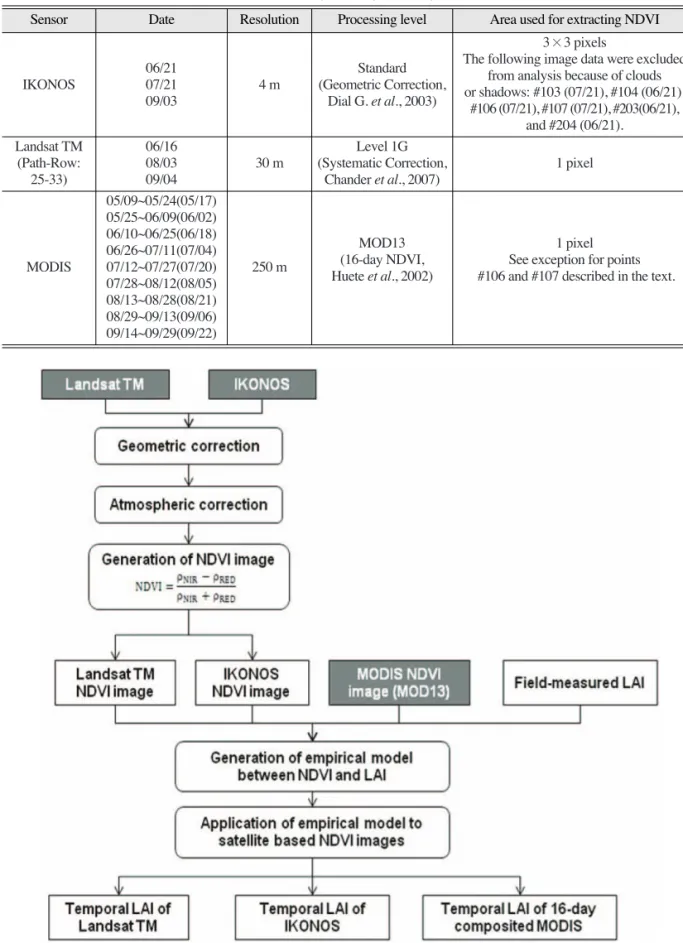
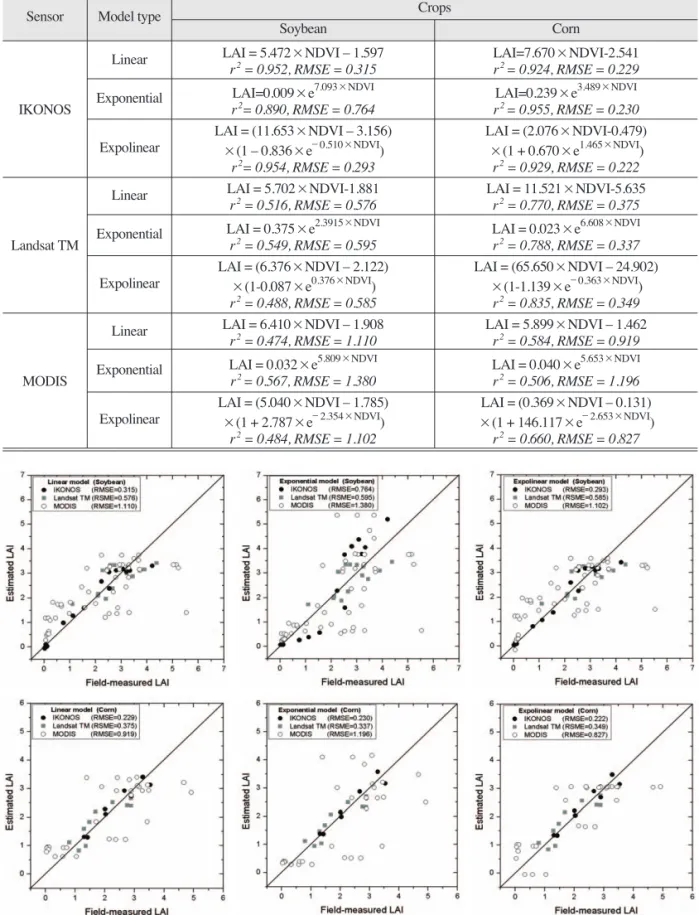
Abstract : Leaf area index (LAI) is important in explaining the ability of the crop to intercept solar energy for biomass production and in understanding the impact of crop management practices. This paper describes a procedure for estimating LAI as a function of image-derived vegetation indices from temporal series of IKONOS, Landsat TM, and MODIS satellite images using empirical models and demonstrates its use with data collected at Missouri field sites. LAI data were obtained several times during the 2002 growing season at monitoring sites established in two central Missouri experimental fields, one planted to soybean (Glycine max L.) and the other planted to corn (Zea mays L.). Satellite images at varying spatial and spectral resolutions were acquired and the data were extracted to calculate normalized difference vegetation index (NDVI) after geometric and atmospheric correction.
Linear, exponential, and expolinear models were developed to relate temporal NDVI to measured LAI data. Models using IKONOS NDVI estimated LAI of both soybean and corn better than those using Landsat TM or MODIS NDVI.
Expolinear models provided more accurate results than linear or exponential models.
Key Words : leaf area index, NDVI, IKONOS, Landsat TM, MODIS, Missouri
Received October 18, 2012; Revised November 5, 2012; Accepted November 7, 2012.
†