This is an Open Access article distributed under the terms of the Creative Commons Attribution Non-Commercial License (http: //creativecommons.org/licenses/by- nc/4.0/) which permits unrestricted non-commercial use, distribution, and reproduction in any medium, provided the original work is properly cited.
© 2020 THE KOREAN SOCIETY OF MYCOLOGY.
Accepted: March 20, 2020 Revised: March 20, 2020 Received: February 27, 2020 https://doi.org/10.4489/KJM.20200005 Kor. J. Mycol. 2020 March, 48(1): 47-53
OPEN ACCESS pISSN : 0253-651X eISSN : 2383-5249
RESEARCH ARTICLE
Westerdykella reniformis: A New Record from Field Soils in Korea
Mahesh Adhikari
1, Sang Woo Kim
1, Byeong Heon Gwon
1, Han Jun Ju
1, Hyang Burm Lee
2, and Youn Su Lee
1,*1
Division of Biological Resource Sciences, Kangwon National University, Chuncheon 24341, Korea
2
Division of Food Technology, Biotechnology & Agrochemistry, College of Agriculture and Life Sciences, Chonnam National University, Gwangju 61186, Korea
*
Corresponding author: [email protected]
ABSTRACT
During a survey of fungal diversity in different provinces of South Korea in 2017, a new fungal isolate was discovered. This fungal isolate was identified as Westerdykella reniformis, based on its morphological characteristics and phylogenetic analysis, using internal transcribed spacer (ITS) and 28S ribosomal DNA (28S rDNA) sequence data. To our knowledge, W.
reniformis has not previously been reported in South Korea. Thus, in this study, we report a new record of a species from the Dothideomycetes class in Korea, and provide a detailed description with morphological illustrations.
Keywords: Diversity, ITS, Westerdykella reniformis, 28S rDNA
INTRODUCTION
The class Dothideomycetes comprises the most diverse class within the Ascomycota, which is the largest known fungal phylum. They occur almost everywhere on earth and are found mainly as plant pathogens that cause serious crop losses [1]. Torula thermophila has been reclassified as Scytalidium thermophilum.
S. thermophilum is characterized by intercalary and terminal conidial chains [2]. Westerdykella species are widespread saprobic fungi that have been isolated on a variety of substrates, such as: soil, mud, algal debris, dung, and plant material [3]. This genus is well-known by its cleistothecioid ascomata with small asci containing one-celled ascospores devoid of germ slits [4]. Knowledge of the taxonomy of some fungal genera like Torula, Scytalidium and Westerdykella in Korea is limited. Only one species of Torula, namely, Torula caligans, and one species of Westerdykella, namely, Westerdykella dispersa have been recorded in South Korea since 2006 [5].
A survey of Korean indigenous fungal diversity was conducted in Jeju and Ulsan, South Korea, in
2017. Fungal isolates showing different morphologies were isolated in soil samples from paddy fields
and orchards. As a result, the previously unrecorded Dothideomycetes, Westerdykella reniformis, was
discovered. This fungal species had not yet been reported in Korea. In this report, we present macro-
morphological and micro-morphological characteristics of this new reported fungal isolate.
MATERIALS AND METHODS
Isolation of fungal isolates
Soil samples were collected in 2017 in different paddy fields located in Ulsan (35 °31'45.36'' N, 129°
06'23.12'' E) and Orchards located in Jeju (33°.27'13.77'' N, 126°.19'51.23'' E), South Korea. Soil samples were collected at a depth of 10-15 cm by removing crop debris. The soil samples were air dried and stored in sterile polythene bags at 4℃ before use. Morphologically different fungal isolates were isolated on potato dextrose agar (PDA; Difco Laboratories, Detroit, Michigan, USA) supplemented with 100 μg L
-1chloramphenicol using a conventional soil dilution technique [6]. The diluted soil suspensions were streaked on petri plates and incubated at 25 ℃ for 5 days. Then, the morphologically different colonies that developed were aseptically transferred to fresh PDA plates to get pure cultures. The pure fungal isolates were finally kept on PDA slants at 4 ℃ for further use.
Morphological examination
The macro-morphological characteristics of the fungal isolate KNU17-72 was determined on five different agar media, namely Malt extract agar (MEA), Potato dextrose agar (PDA), Yeast extract sucrose agar (YES), Czapek yeast extract agar (CYA) and Oatmeal agar (OA). Mycelial plugs of the fungal isolates were inoculated on petri plates of each medium and incubated at 25 ℃ in the dark for 7 days. Colony characteristics were documented and a light microscope (Olympus BX50F-3 microscope, Olympus Optical Co., Ltd., Tokyo, Japan) was used to examine microscopic fungal structures. For micro-morphological examination, mounts of all the isolates that had grown on MEA were prepared and photomicrographs were taken using an Olympus BX50F-3 microscope (Olympus Optical Co., Ltd., Tokyo, Japan) equipped with a CMOS digital camera (KOPTIC Korea Optics, Seoul, Korea). Furthermore, the microscopic structures were characterized using scanning electron microscope (SEM) (LEO 1450VP Variable Pressure Scanning Electron Microscope, Carl Zeiss, Oberkochen, Germany).
Genomic DNA extraction, PCR, sequencing, and phylogenetic analysis
Genomic fungal DNA was isolated from mycelia of fungal isolates with the DNeasy Plant Mini Kit (Qiagen, Hilden, Germany). The internal transcribed spacer (ITS) region of each sample was PCR amplified using primers ITS1 (5'-TCCGTAGGTGAACCTGCG-3') and ITS4 (5'-TCCTCCGCTTATTGATATGC-3') [7]. In addition, the large subunit of 28S rDNA was amplified with universal primers LR0R (ACCCGCTGAACTTAAGC) [8] and LR7 (TCCTGAGGGAAACTTCG) [9]. The PCR products were sequenced at Macrogen (Seoul, Korea) using an ABI PRISM 3730XL Analyzer (Life Technologies, Gaithersburg, MD, USA). The DNA sequences were subjected to BLAST analysis using GenBank database (Table 1). The phylogenetic tree was constructed by the neighbor-joining method using the Kimura�s 2-parameter model [10] implemented in the program MEGA version 6 [11] with 1,000 bootstrap replicates.
The presently studied fungal isolate, KNU17-72, has been deposited in the culture collection site of the
National Institute of Biological Resources (NIBR, Incheon, Korea), under NIBRFG000500006. The nucleotide sequence of the ITS gene of the study isolate, KNU17-72, is deposited in the GenBank data base under accession number MH231762.
RESULTS
Morphological characterization
In this study, the morphologically different fungal isolate KNU17-72 was found in paddy field located in Jeju. Five different agar media, namely MEA, PDA, YES, CYA and OA were used to examine the macro-morphological characteristics of the isolate. Furthermore, the isolate were characterized according to their microscopic structures using compound and scanning electron microscopes. The macro and micro- morphological characteristics of the isolate are described below.
Morphological characteristics of the KNU17-72 isolate
Colony characteristics: The colony features of the KNU17-72 isolate on different agar media are presented in Fig. 1. Colonies on MEA reached a diameter of 25 mm after 7 days of incubation at 25℃.
Colonies were faint brown with a velvety texture and reverse faint brown in color. Colonies on PDA reached approximately 25-27 mm in diameter, forming isabelline colonies with a velvety texture and reverse isabelline color. Colonies on YES attained a diameter of 27 mm after 7 days of incubation at 25 ℃.
Colonies were khaki with a velvety texture, and reverse khaki color. Colonies on CYA attained a diameter of approximately 25-27 mm after 7 days of incubation at 25 ℃. Colonies were khaki in color, presented moderately velvety texture, and were reverse khaki. Colonies on OA grew slowly compared to other agar Table 1. The ITS and 28S rDNA gene sequences of Westerdykella reniformis used in this study, along with reference strains and their GenBank accession numbers.
No. Species Isolate No. GenBank accession No.
ITS 28S rDNA
1. Preussia isomera CBS 388.78 GQ203763.1 GQ203723.1
2. Preussia lignicola CBS 363.69 GQ203783.1 DQ384098.1
3. Preussia australis S: Lundqvist 20884-a GQ203773.1 GQ203732.1
4. Preussia terricola CBS 317.65 NR 156524.1 GQ203725.1
5. Preussia funiculata F: Huhndorf 2577 GQ203762.1 GQ203722.1
6. Westerdykella centenaria BS 142400 NR 156002.1 NG_058468.1
7. Westerdykella nigra CBS 416.72 GQ203800.1 GQ203800.1
8. Westerdykella angulata CBS 610.74 NR 155956.1 NR_155956.1
9. Westerdykella ornata CBS 379.55 NR 103587.1 NR_103587.1
10. Westerdykella reniformis RKGE-35 JX235700.1 JX235704.1
11. Westerdykella multispora CBS 383.69 GQ203799.1 GQ203799.1 12. Westerdykella rapa-nuiensis ined. GE-2013 CBS-604.97 JX235699.1 JX235703.1 13. Westerdykella dispersa CBS 297.56 (T) NR 111187.1 NR_111187.1
14. Westerdykella aurantiaca FNBR-03 JN118571.1 JN118571.1
ITS: Internal transcribed spacer.
media used, attaining a diameter of 17 mm after 7 days of incubation at 25 ℃. Colonies were isabelline with white boundaries, and a velvety texture, and were reverse dark grey in color.
Micromorphology: brownish black cleistothecia after three weeks; globose to sub-globose asci (12-15×
16-18 μm); each ascus producing 32 ascospores. Ascospores had a distinct central grove; without pycnidial state.
Phylogenetic analysis
Molecular analysis was carried out by comparing the ITS sequences from KNU17-72 with other strains available in the GenBank database using the BLAST program. The ITS and 28S rDNA gene sequences of Westerdykella reniformis used in this study, along with reference strains and their GenBank accession numbers .The combined analysis of the internal transcribed spacer and 28S large subunit ribosomal RNA gene sequences revealed that the study isolate, KNU17-72, was W. reniformis, (Fig. 2). In addition, the combined ITS and 28S gene sequence analysis also revealed that the KNU17-72 isolate was phylogenetically most closely related to W. reniformis strain RKGE-35, existing along with W. reniformis RKGE-35 as a monophyletic clade (97% phenotypic similarity) in the phylogenetic tree. (Fig. 2).
Fig. 1. Westerdykella reniformis KNU17-72 grown on different media at 25℃ for 7 days. (A-E)
Colonies grown on malt extract agar (MEA), potato dextrose agar (PDA), yeast extract sucrose (YES),
Czapek yeast extract (CYA), and oatmeal agar (OA) (top=obverse, bottom=reverse). (F) asci. (G) and
(H) ascospores (scale bars: F=20 μm; G-H=10 μm).
Fig. 2. Neighbor-joining phylogenetic analysis using combined analysis of internal transcribed rDNA sequences and 28S large subunit ribosomal RNA gene sequences of W. reniformis KNU17-72. The species examined in this study are in bold. Bootstrap scores of ≥50% are indicated at the nodes. The scale bar represents the number of substitutions per site. Sequences of type specimens are indicated by a symbol (T).
DISCUSSION
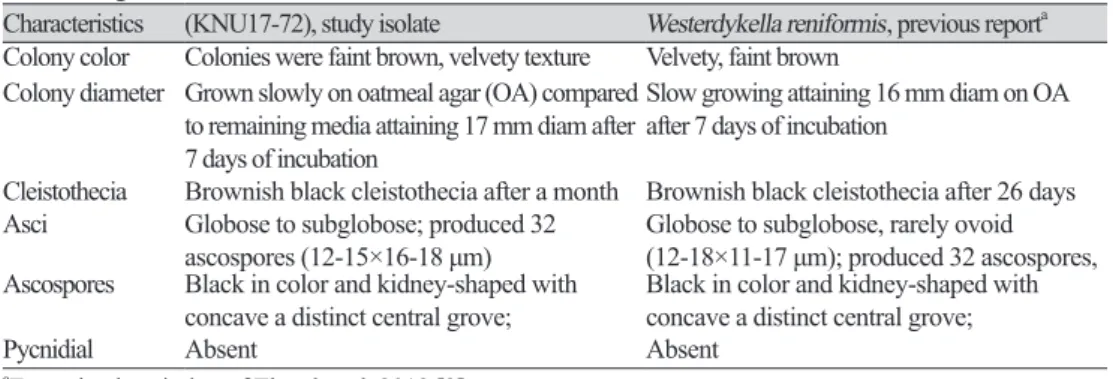
In this study, the fungal isolate KNU17-72, showing different morphologies, was isolated in 2017, from soil samples collected from different locations in Jeju, South Korea. The macro-morphology of the Korean isolate, W. reniformis KNU17-72, was very similar (Table 2) to the description given in a previous report by Ebead et al. [3]. Briefly, the colonies of our KNU17-72 isolate were velvety and faint brown to khaki in color. Notably, KNU17-72 grew slowly on OA agar medium compared to the other agar media used, reaching only 17 mm after 7 days of incubation. This result agrees with a previous report [3], which states that W. reniformis grows slowly on OA agar medium. In addition, KNU17-72 produced ascospores having central groves (Fig. 1H), which appears to be distinctive of W. reniformis, as has been reported
Table 2. Morphological characteristics of KNU17-72 and the reference species W. reniformis on different agar media at 25℃.
Characteristics (KNU17-72), study isolate Westerdykella reniformis, previous report
aColony color Colonies were faint brown, velvety texture Velvety, faint brown
Colony diameter Grown slowly on oatmeal agar (OA) compared to remaining media attaining 17 mm diam after 7 days of incubation
Slow growing attaining 16 mm diam on OA after 7 days of incubation
Cleistothecia Brownish black cleistothecia after a month Brownish black cleistothecia after 26 days Asci Globose to subglobose; produced 32
ascospores (12-15×16-18 μm) Globose to subglobose, rarely ovoid (12-18×11-17 μm); produced 32 ascospores, Ascospores Black in color and kidney-shaped with
concave a distinct central grove; Black in color and kidney-shaped with concave a distinct central grove;
Pycnidial Absent Absent
a