약학회지 제 45권 제 2 호 140〜 146(2001) Yakhak Hoeji Vol. 45,No. 2
트리아졸환 함유
6-엑소메칠렌 펜남 유도체의 합성
임 채 욱 # • 오정석 • 임 철 부 중 앙 대 학 교 약학대학 의약화학 교실 (Received March 3,2001; Revised March 23,2001)
Synthesis of 6-Exomethylene Penam Derivatives with Triazole Ring
Chaeuk Im #, Jung Suk Oh and Chul Bu Yim
Division of Medicinal Chemistry, College of Pharmacy, Chung-ang University, Seoul 156-756’ Korea
Abstract -The synthesis of new 6-exomethylene penams with triazole ring for (3-lactamase inhibitor was described. The 6,6-dibromopenam 6 was treated with CH3MgBr and carbaldehyde 5 to afford the 6-bromo- 6-(l-hydroxy-l-methyl)penicillanate 7,which was reacted with acetic anhydride to give acetoxy compound 8. The deacetoxybromination of 8 with zinc and acetic acid gave 6-exomethylenepenams, Z-isomer 9 and E-isomer 10,which were oxidized to sulfones 11 and 12 by m-CPBA. The /Mnethoxybenzyl compounds 9—12 were deprotected by A1C13 and neutralized to give the sodium salts 13 〜 16.
Keywords □ Triazole, 6-exomethylenepenam, p-lactamase inhibitor
임상에서 널리 시용되고 있는 (3-lactam 항생제에 대한 내성균의 출현으로 기존 항생제의 약효가 감소 하여 내성균에 유용한새로운 항생제 개발의 필요성 이 끊임없이 제기되고 있다.1} 가장 일반적인 세균의 내성 기전은 P-lactam 항생제를 파괴시키는 (3-
lactamase^(■는효소를 내성균이 분비하여 항생제의
약효를 제거하는 것이다. 이러한 내성균 문제를 극복 하는 방법으로 p-lactamase 효소에 안정한 항생제를
개발하는 방법이 있으나, 이들도 곧 새로운 (3-
lactamase 효소에 파괴되는 경향을 보여 주고 있다.
내성균을 치료할 수 있는 보다 근본적인 방법은 (3-
lactamase 효소를 파괴하는 (3-lactamase 억제제를 개발하고, |3-lactam 항생제와 병용 투여하여 (3- lactam항생제를 p-lactamase 효소로부터 보호히는 것 이다.
# 본 논문에 관한 문의는 이 저자세게로 (전화) 02-820-5603 (팩스) 02-815-21 "
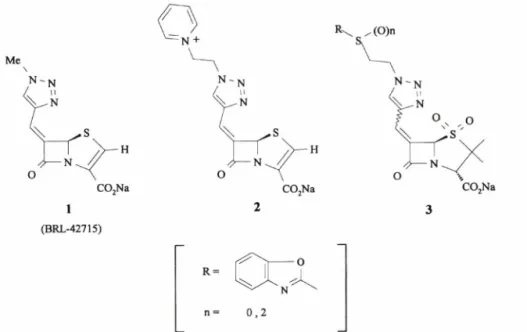
이러한 P-lactamase 억제제로 clavulanic acid2)가 의약품으로 개발에 성공한 이후, sulbactam3)과 tazo- bactam4)이 개발되어 임상에서 시용되고 있다. 특히, 6-triazolylmethylene penem인 1(BRL-42715)5’6)과 2 는 p-lactamase 억제제에 내성을갖는 대부분의 class
Ip-lactamase에 대하여도 매우 강력한 억제활성을 나
타내었다. 화합물 1의 N!위치를 변형시킨 화합물 2에 서 p-lactamase에 대한효소 억제력과미생물 세포벽 에 대한 투과성이 증가된다고 알려졌다.7) 최근 P- Lactamase 억제제로 6-exomethylene penam유도체들 이 개발되고 있고,8〉exomethylene penam과 sulfone 구조를갖는 화합물의 (3-lactamase에대한우수한 억 제효과가보고되었다.9) 이상의사실을바탕으로하여 본연구자는 보다우수한 p-lactamase 억제활성을갖 는 구조를 탐색할 목적으로 sulbactam과 tazobactam 의 penam구조와 1과 2의 6-triazolylmethylene구조를 결합시킨 6-triazolylmethylene penam유도체 3을 합 성하였다.
140
Fig. 1 - Structures of P-lactamase inhibitors.
실험방법
시약및분석기기
본실험에서 시용된 시약들은 Aldrich사와 Fluka사 의 것을사동하였으며 각종 용매는특급시약을 사용 하였다. ^-N M R spectra는 JEOL JNM-EX 90A (90 MHz)와 Varian Gemini 2000(300 MHz)을 사용 하여 얻었고,CDC13의 경우 TMS(tetramethylsilane)를 내부 표준물질로入!용하였고 DMS0-d6의 경우 잔류 하는 DMS0를 내부 표준물질로사용하였다. TLC는 Merck silica gel 60 F254(thickness 0.2 |im)를 사 용하였고, Reverse TLC로는 Merck RP-18F254S (thickness 0.25 mm)를 사용하였으며 UV Lamp로 spot을 확인하였다. 용점즉정은 BUhi Melting point B-540을 사용하였고, IR spectra는 Jasco FT/IR 300E을 사용하여 얻었다. Column chromatography 는 silica gel(Merck type 9355, 230 〜 400 mesh)을 시용하였고, 역상 column chromatography는 Comosil 75 C18-OPN을 사용하였다.
l-[2-(Benzoxazol-2-yl)thioethyl]-l,2,3-triazole-4- carbaldehyde (5)
l-(2-Hydroxyethyl)-l,2,3-triazole-4-carbaldehyde 4 5.00 g(35.43 mmol)을 무수 dichloromethane 80 m/에
녹인 용액에 triethylamine 5.00 m/을 가한 후, -15—
-20oC로 냉각하고 반응시킨다. 1시간 후,trifluo- romethanesulfonic anhydride(TFSA) 10.00 용을서서 히가하고 4시간더교반한다. 2-Mercaptobenzoxazole 5.35 g(35.39 m m olpf triethylamine 5.00 m/이 녹아있 는 dichloromethane 80 m/용액을 상기 반응혼합액에 -15〜-20oC에서 40분동안에 적가한후,실온에서 하루 방치한다. 반응혼합물을 dichloromethane으로추출하고 5% NaCl용액으로세척한후, 무수 Na2S04로탈수하고 감압농축하여 얻은생성물을 silica gel column0■■로정 제하여 화합물 5를 9.12g(94%) 얻었다 : Rf=0.33 (hexane : ethyl acetate=1:1); m .p.: 163~164°C; IR (CHC13) cm-1: 2860,1684 cm-1; ^-N M R (CDC13), 5:3.75 (t, 2H,/=6.9 Hz), 5.01 (t, 2H ,/=6.9 Hz), 7.25- 7.70 (m, 4H), 8.21 (s, 1H), 10.15 (s, 1H).
p-Methoxybenzyl 6-Bromo-6-[l-hydroxy-l-[l-[2- (benzoxazol-2-yl)thioethyl]-l,2,3-triazol-4-yl]me- thyl]penicillanate 1,1-Dioxide (7)
/)-Methoxybenzyl 6,6-dibromopenam-3-carboxylate 1,1-dioxide 6 0.60 g( 1.17 mmol)을 무수 THF 15 m/에 녹인 용액에 CH3MgBr 0.56 m/(2.50M ether 용액)을가한후, -78°C에서 20분간교반한다. 화합물 5 0.32 g(l. 17 mmol)을: dichloromethane 10 m/에 녹여
Vol. 45,No. 2, 2001
142 임채욱 • 오정석 • 임철부
서반응액에 가하고,상온에서 10시간반응한다. 10%
NH4C1용액을 가하여 반응을 정지시키고 ethyl
acetate로 추출하여 무수 Na2S04로 탈수시킨 후, 감 압 농축하여 얻은 생성물을 silica gel column 로 정제하여 stereoisomer 혼합물 7을 0.45 g(55%) 얻 었다: Rf=0.48(hexane: ethyl acetate=1:2); IR (CHC13) cm-1 : 1801, 1751, 1260 cm-1; ^-N M R (CDC13), 8: 1.18 (s,3H), 1.41 (s,3H), 2.13 (b rs,lH ), 3.57〜 3.79 (m, 5H), 4.39 (s, 1H), 4.67〜4.86 (m, 3H), 5.90-5.26 (m, 2H), 5.39 and 5.46 (two s, 1H), 6.62-6.81 (m, 2H), 7.12-7.59 (m, 6H), 7.83 (s, 1H).
/>Methoxybenzyl 6-Bromo-6-[l-acetoxy-l-[l-[2-
(benzoxazol-2-yl)thioethyl] -1,2,3-triazol-4-yl]me -
thyl]penicillanate 1,1-Dioxide (8)
화합물 7 0.64 g(0.91 mmol)을 무수 dichlorome- thane 10 m/에 녹인 용액에 pyridine 0.93 m/과 acetic anhydride 0.92 m/를가하고 실온에서 20시간 반응한 다. 반응 혼합물을 dichloromethane로 추출하고 1%
HC1, 5% NaHC03 및 5% NaCl 용액으로 세척한 후, 무수 Na2S O ^ 탈수하고감쌉농축한다. 생성물을 silica gel column0-^. 정제하여 stereoisomer 혼합물 8을 0.50 g(74%) 얻었다 : Rf=0.80(hexane : ethyl ace- tate= l:2); IR (CHC13): 1807,1755,1214 cm-1; lH- NMR (CDC13), 8: 1.12 (s, 3H), 1.41 (s, 3H), 2.07 (s, 3H), 3.62—3.81 (m, 5H), 4.32 and 4.41 (two s, 1H), 4.68-4.92 (m, 3H), 4.82-5.02 (m, 2H), 6.24 and 6.43 (two s, 1H), 6.69-6.88 (m, 2H), 7.12〜7.60 (m, 6H), 7.73 (s, 1H).
g과화합물 l o i: 2.10 g 얻었다.
화합물 (9): 50% yield; Rf=0.26(ethyl acetate : hexane=l:l); IR (CHC13) : 1783, 1755, 1249 cm-1;
]H-NMR (CDCI3), 6: 1.31 (s, 3H), 1.50 (s, 3H), 3.65 -3.86 (m, 5H), 4.42 (s, 1H), 4.90 (t, 2H, /=6.9 Hz), 5.21 (d, 2H, /=5.9 Hz), 5.57 (s, 1H), 6.82- 7.01 (m, 2H), 7.22-7.64 (m, 7H), 7.91 (s, 1H).
화합물(10): 26% yield; Rf=0.49 (ethyl acetate : hexane=l:l); IR (CHC13) : 1770, 1751,1173 cm-1;
!H-NMR (CDCI3), 5:1.44 (s, 3H), 1.69 (s, 3H), 3.97 (t, 2H, / = 6.8 Hz), 4.03 (s, 3H), 4.61 (s, 1H), 5.08 (t, 2H, / = 6.8 Hz), 5.32 (s, 1H), 5.37 (d, 2H, /=5.8 Hz), 7.01-7.14 (m, 2H), 7.23 (s, 1H), 7.41-7.88 (m, 6H), 8.98 (s, 1H).
p-Methoxybenzyl (6Z)-6-[l-[l-[2-(Benzoxazol-2- yl)sulfonylethyl]-l,2,3-triazol-4-yl]methylene]pe- nicillanate 1,1-Dioxide (11)
화합물 9 0.50 g(0.82 mmol)을 dichloromethane 10 m/에 녹이고, m-chloroperbenzoic acid(m-CPBA) 0.28 g l:넣고상온에서 20시간동안 반응시킨다. 반
응액을 5% NaHC03용액과 물로 세척하고 무수
Na2S04로 건조시킨 후,silica gel column0-로 정제하 여화합물 11을 0.24 g(46%)얻었다:
Rf=0.54(hexane : ethyl acetate=1:2); IR (CHC13):
1772, 1752, 1259 cm-1; •H-NMR (CDC13), 6: 1.32 (s, 3H), 1.53 (s, 3H), 3.82 (s, 3H), 4.23 (t, 2H, /= 7 Hz), 4.45 (s, 1H), 5.02 (t, 2H, J= 7 Hz), 5.21 (d, 2H, /=4.2 Hz), 5.63 (s, 1H), 6.86-7.01 (m, 2H), 7.14 (s, 1H), 7.28-7.66 (m, 6H), 7.89 (s, 1H).
/>Methoxybenzyl (6Z)-6-[l-[l-[2-(Benzoxazol-2-
yl)thioethyl]-l,2,3-triazol-4-yl]methylene]penicilla-
nate 1,1-Dioxide (9) and /?-Methoxybenzyl (6E)
-6-[l-[l-[2-(Benzoxazol-2-yl)thioethyl]-l,2,3-tria-
zol-4-yl]methylene]penicillanate 1,1-Dioxide (10) 화합물 8 10.00 g(13.36 mmol)을 CH3CN 100 m/
에 녹이고 acetic acid 1.61 용을 가한 후,Zn분말 4.37 邊 넣고 0oC에서 4시간 반응한다. 반응 혼합액 을dichloromethane로 추출하고 5% NaHC03으로 세 척한후, 무수Na2S04로탈수하고 농축하여 얻은생성 물을 silica gel column으로 정제하여 화합물 9 4.10
/>Methoxybenzyl (6E)-6-[l-[l-[2-(Benzoxazol-2- yl)sulfonylethyl]-l,2,3-triazol-4-yl]methylene]pe- nicillanate 1,1-Dioxide (12)
화합물 11 을 합성한 방법으로 화합물 10을 0.73g (1.20 mmol) 入!용하여 화합물 I2를 (U1 g(44%>§- 얻었다: Rf=0.68(ethyl acetate: hexane=2:l); IR (CHCI3) : 1771, 1750,1248 cm'1; ]H-NMR (CDC13), 8: 1.33 (s, 3H), 1.56 (s, 3H), 3.81 (s, 3H), 4.03 (t, 2H, / = 6.8 Hz), 4.47 (s, 1H), 5.07 (t, 2H, / = 6.8 Hz), 5.12-5.24 (m, 3H), 7.84-7.98 (m, 2H), 7.11 (s, 1H), 7.28〜7.87 (m, 6H), 8.80 (s, 1H).
J. Pharm. Soc. Korea
Sodium (6Z)-6-[ 1-[ 1 -[2-(Benzoxazol-2-yl)thioe- thyl]-l,2,3-triazol-4-yl]methylene]penicillanate 1.1-Dioxide (13)
화합물 9 0.50 g(0.82 mmol)을 무수 dichlorome- thane 10 m/과 anisole 5 m/에 녹여 -40oC로 냉각하 고,무수 aluminum chloride 0.27 g i 넣고 반응시 킨다. 1시간 후,물을 넣어 반응을 중지시키고 0.1N NaOH용액으로 pH를 7.0으로 조절한다. 수층을 역상
column0- ^ 정제하여 얻은 용액을동결 건조하여 화
합물 13을 0.26 g(62%) 얻었다: Rf=0.54 (water:
acetonitrile=l:l); IR(Nujol) 1770 cm-1; ^-N M R (D M S O ^, 8: 1.39 (s, 3H), 1.45 (s, 3H), 3.80 (s, 1H), 3.87 (t, 2H, /=6.2 Hz), 4.94 (t, 2H, /=6.2 Hz), 5.71 (s, 1H), 7.34〜7.38 (m, 3H), 7.66-7.69 (m, 2H), 8.48 (s, 1H).
위와 같은 방법으로 PMB ester 화합물인 10,11, 12를원료로사용■하여화합물 14,15 ,16를합성하였다.
Sodium (6E)-6- [ 1 - [ 1 - [2-(Benzoxazol-2-yl) thioe - thyl]-l,2,3-triazol-4-yl]methylene]penicillanate 1.1-Dioxide (14)
수득율 81%; Rf=0.47(water: acetonitrile=l:l); IR (Nujol) 1762 cm '1; ^-NM R, (DMSO-d6), 5: 1.39 (s, 3Ii), 1.47 (s, 3H), 3.85 (t, 2H, /=6.0 Hz), 4.97 (t, 2H, /=6.0 Hz), 4.97 (t, 2H, /=6.0Hz), 5.57 (s, 1H), 7.09 (s, 1H), 7.33〜7.38 (m, 2H), 7.64-7.68 (m, 2H), 8.85 (s, 1H).
Sodium (6Z)-6-[l-[l-[2-(Benzoxazol-2-yl)sulfony- lethyl]-l,2,3-triazol-4-yl]methylene]penicillanate 1.1-Dioxide (15)
수득율 76%; Rf=0.44 (water : acetonitrile=l:l);
IR(Nujol) 1766 cm'1; ^-NMR, (DMSO-^), 8: 1.39 (s, 3H), 1.44 (s, 3H), 3.81 (s, 1H), 4.11 (t, 2H, /=5.7 Hz), 4.81 (t, 2H, /=5.7 Hz), 5.79 (s, 1H),
7.34-7.95 (m, 5H), 8.47 (s, 1H).
Sodium (6E)-6-[l-[l-[2-(Benzoxazol-2-yl)sulfo- nylethyl] -1,2,3-triazol-4-yl]methylene]penicilla- nate 1 ,1-Dioxide (16)
수득율 69%; Rf=0.55 (water : acetonitrile=1:1);
IR(Nujol) 1774 cm '1; ^-NMR, (DMSO-십, 5: 1.37
(s, 3H), 1.46 (s, 3H), 3.82 (s, 1H), 4.10 (t, 2H, /=6.3 Hz), 4.77 (t, 2H, /= 6 .3 Hz), 5.54 (s, 1H),
7.09 (s, 1H), 7.31-7.91 (m, 4H), 8.78 (s, 1H).
결과 및 고찰
Hydroxyethyl 화합물 4를 trifluoromethanesulfonic anhydride로처리하여 trifluorosulfonyl 유도체로 만든 투, thiol 화합물과 반응시켜 2-치환 thioethyl 화합물 5를 94%의수득률로 합성하였다(Scheme 1).
6,6-Dibromopenam 화합물 6을 CH3MgBr로 처리 한 투,carbaldehyde 화합물 5와 반응하여 hydroxy 화합물 7을 55% 수득률로 얻었다. 이 화합물의 방- NMR 스펙트럼에서 CHOH의수소가 singlet이 아니 고 2개 이상의 peak를 보여주어서 화합물 7은 stereoisomer의혼합물임을 알수 있었다. 이 isomer 들은 silica gel column에서 분리가 되지 않았다. 화 합물 7을 acetic anhydride로처리하여 acetoxy화합물 8을 74%의 수득율로 얻었고, 이 화합물의 iH-NMR spectrum 에서 CHOAc의 peak가 56.24와 6.43 에서 크기가 약 3:1인 2개의 peak로 관찰되어서 가능한 stereoisomer 중에서 2개의 major isomer가 3:1의 비율로 존재함을 알 수 있었다. 화합물 8을 acetic acid와 Zn으로 처리하여 penam sulfone의 C6번 위치
에 exomethylene의 이중 결합을 도입하였고,Z-
isomer 9는 50% 표-isomer 10은 26%의 수득률로 얻었다. 화합물 9와 10에서 (Z)-form과 (표)-form의 구별을 triazole ring proton.0■로하였는데, 이와 유사 한 화합물의 논문을 보면 <Z-form의 triazole ring
Scheme 1 - Synthesis of l-(substituted thioethy 1)-1,2,3- txiazole-4-carbaldehyde.
Vol. 45,No. 2’ 2001
144 임채욱 • 오정석 • 임철부
PMB = p-Methoxybenzyl Scheme 2 - Synthesis of 6-exomethylene penams.
proton은 대개 5 8근처의 수치를 보여주고, £-form의 ring proton은 5 7.91 에서, 화합물 10의 triazole ring triazole ring proton은 이보다 왼쪽에서 peak를 보여주 proton은 5 8.98에서 각각 관찰되었다. 비슷한 결과가 었다.5〉^-NM R 스펙트럼 에서 화합물 9의 triazole sulfonyl 화합물 11과 12에서도 발견되었다(Scheme 2).
]. Pharm. Soc. Korea
9. z -form, n = 0 13. Z - form, n = 0
10. E- form, n = 0 14. E - form, n = 0
11. Z ■ form, n = 2 15. Z - form, n = 2
12. E ■ form, n = 2 16. E - form, n = 2
PMB = p-Methoxybenzyl
Scheme 3 - Synthesis of 6-exomethylene penam sodium salts.
p-Methoxy ester화합물 9~12은 A1C13로 처리하 여 free carboxylic 화합물로 만든 후, 0.1N NaOH 용액을 사용하여 pH를 7.0으로 조절하고 sodium salt 용액을 만들었다(Scheme 3). P-Lactam 링은 염 기에 약하기 때문에 pH 조절에서 0.1N NaOH 용액 을조금씩 적정해야 한다. 이렇게 얻은 sodium salt 용액을동결건조하고역상column으로 정제 한후, 다 시 동결 건조하여 화합물 13-16을 62-81%의 수 득율로 합성하였다.
문 헌
1) Neu, H. C .: The crisis in antibiotic resistance. Science.
257, 1064 (1992).
2) Reading, C. and Cole, M. : Clavulanic acid : A p- lactamase-inhibiting (3-lactam from Streptomyces clavuligerus. Antimicrob. Agents Chemother. 11,852 (1977).
3) English, A. R.,Retsema, J. A., Girard, A. E., Lynch, J. E. and Barth, W. E.: CP-45,899, a p- lactamase inhibitor that extends the antibacterial spectrum of p-lactams; initial bacteriological characterization. Antimicrob. Agents. Chemother., 14,414 (1978).
4) Micetich, R. G., Maiti, S. N., Spevak, E, Hall, T. W., Yamabe, S., Ishida, N.,Tanaka, M.,Yamazaki, T., Nakai, A. and Ogawa, K .: Synthesis and p-lactamase inhibitory properties of 2 p-[(l,2,3-txiazol-l-yl)me- thyl]-2a-methylpenam-3a-carboxylic acid 1,1- dioxide and related triazolyl derivatives. J. Med. Chem. 30, 1469 (1987).
5) Bennett, I. S., Brooks, G.,Broom, N. J. R, Calvert, S.
H., Coleman, K. and Francois, I. : 6-(Substituted methylene)penems, potent broad spectrum inhibitors of bacterial P-lactamase V Chiral 1,2,3-triazolyl derivatives. J. Antibiotics, 44, 969 (1991).
6) Bennett, I., Broom, N. J. R, Bruton, G., Calvert, S., Clarke, B. P, Coleman, K.,Edmondson, R., Edwards, R, Jones, D.,Osborne, N. E and Walker; G .: 6-(Substituted methylene)penems, potent broad spectrum inhibitors of bacterial (3-lactamase DL Structure-activity relation
ships of the 5-membered heterocyclic derivatives. J.
Antibiotics 44,331 (1991).
7) Broom, N. J. R, Brooks, G. and Clark, B. R : p- (Substituted methylene) penems Eur. Pat. Appl.
321187 A1 (1989).
8) Chen, Y. L., Chang, C. W. and Hedberg, K. : Synthesis of a potent p-lactamase inhibitor 1,1-
Vol. 45, No. 2,2001
146 임채욱 • 오정석 • 임철부
dioxo-6-(2-pyridyl)methylenepenicillanic acid and its reaction with sodium methoxide. Tetrahedron Lett.’ 27,3449 (1986).
9) Chen, Y. L., Chang, C. W., Hedberg, K., Guarino, K.,
Welch, W. M. and Kiessling, L. : Structure-activity relationships of 6-(heterocyclyl) methylene penam sulfones; a new class of p-lactamase inhibitors. J.
Antibiotics 40,803 (1987).
J. Pharm. Soc. Korea