Evaluation of the Bioactivity of Polygonium tinctorium Leaf: Potential Clinical Uses
Hwa-Jung Sung
1, Ok-Ja Choi
2, Jong-Yi-Park
3and Ho-Yong Sohn
1*
1Department of Food and Nutrition, Andong National University, Andong 36729, Korea
2Indigo World Gallery, Andong 36710, Korea
3Gyeongbuk Institute For Bio-Industry, Andong 36728, Korea
Received July 18, 2018 /Revised September 21, 2018 /Accepted September 21, 2018
The leave of Polygonum tinctorium (LPT) have been used for centuries as a traditional medicine and as a food ingredient and natural dye. The aim of the current study was to develop high-value added products using LPT. Hot water extract (HWE) and ethanol extract (EE) of LPT were prepared, re- spectively, and their bioactivity was evaluated. The extraction ratio for the HWE was 27.6%, which was two-fold higher than that of the EE. The contents of total polyphenol in the HWE and total sugar in the EE were 51.2 mg/g and 297.8 mg/g, respectively. The total flavonoid and reducing sugar con- tents were similar in the extracts, irrespective of the extraction solvent. The HWE did not show anti- microbial activity in a disc-diffusion assay, but the EE showed strong growth inhibition against gram-positive bacteria. The EE exhibited stronger DPPH and ABTS radical scavenging activities and reducing power than those of the HWE. The HWE was particularly effective as a scavenger of nitrite (RC
50of 6.0 μg/ml). In an antithrombosis activity assay, the EE showed significant anticoagulation ac- tivity as determined by an extended blood coagulation time (thrombin time, prothrombin time, and activated partial thromboplastin time), in addition to platelet aggregation activity. The HWE also showed platelet aggregation inhibitory activity. This report provides the first evidence of antith- rombosis activities of LPT. Our results suggest that LPT has potential as a new antioxidant and antith- rombosis agent.
Key words : Anti-microbial, anti-oxidation, anti-thrombosis, Polygonium tinctorium
*Corresponding author
*Tel : +82-54-820-5491, Fax : +82-54-820-6281
*E-mail : [email protected]
This is an Open-Access article distributed under the terms of the Creative Commons Attribution Non-Commercial License (http://creativecommons.org/licenses/by-nc/3.0) which permits unrestricted non-commercial use, distribution, and reproduction in any medium, provided the original work is properly cited.
Journal of Life Science 2019 Vol. 29. No. 1. 52~59 DOI : https://doi.org/10.5352/JLS.2019.29.1.52
서 론
천연염색은 나무, 꽃, 풀, 열매, 식물 뿌리, 흙, 돌, 벌레, 조개 등의 자연 속에서 쉽게 얻을 수 있는 천연 소재를 염재로 이용 하여 염색하는 것을 말하며, 친환경적이며 경제적이며, 자연 미와 전통미를 가진 독특한 색을 연출할 수 있는 장점이 있다 [28]. 대량생산되는 화학 염재를 사용하는 화학염색과는 달리, 천연염색은 전문가의 노하우와 노동력이 많이 소요되는 단점 이 있으나, 항균, 소취, 방충, 방향, 신경안정 등의 다양한 유용 생리활성을 나타내는 것으로 알려져 최근 사회적 관심과 수요 가 급증하고 있다[11, 24].
한편 쪽은 천연염료 중 유일한 청색으로 색이 아름답고 천 연직물에 염색성이 우수하며, 산과 알칼리에 저항력이 있고 세탁, 땀, 마찰 견뢰도가 좋으며 살충성 및 항균성 등 기능성도 우수하여 전통염료 중 매우 높은 관심을 받고 있는 우수한
염재이다[28]. 현재 전 세계적으로 약 300여종이 분포하며, 인 도 지역에서는 주로 인도람(Indogofera tinctoria)이, 중국 및 유 럽지역에서는 주로 대청(Isatis oblogata)이 재배되고 있으며, 한 국에서는 요람이라고도 불리는 쪽(Polygonium tinctorium)이 주로 재배되고 있다[2, 28]. 한국의 쪽은 마디풀과에 속하는 한해살이 풀로, 줄기는 곧고 높이는 60~90 cm 정도 되며, 잎은 잎자루가 짧고 어긋나며 긴 타원형이다. 국내의 경우, 통상 3월 하순에 종자를 묘상에 파종한 다음, 15 cm 가량 자랐을 때 비옥하고 수분이 많은 밭에 이식하며, 7, 8월에 두세 번 베어서 잎을 회수한다[2]. 수확전의 잎은 녹색이지만 채취하여 말리면 진한 남색으로 변하며[4], 어린순과 꽃잎은 차로 이용 하여 왔으며, 국수, 빵 및 떡의 부재료로도 이용되고 있다[1].
한편 성숙한 쪽잎은 염재로서 뿐만 아니라, 민간에서 해열,
해독, 소종 등의 약재로도 사용되어 왔다[26]. 또한 최근에는
쪽잎 추출물의 항산화[10] 및 대장암 생육억제[10, 21], 항염증
[4, 8, 9], 항알러지[5, 6, 18], Helicobacter pylori 및 피부 사상균
생육억제[7, 13], 콜레스테롤 합성억제 활성[17] 및 항 HIV 활
성[29] 등이 보고된 바 있다. 그러나 쪽잎의 다양한 유용생리
활성 평가는 아직 초보적인 단계에 있는 실정이다. 따라서 본
연구에서는 쪽잎의 열수 및 ethanol 추출물을 조제하여, 이들
의 항균, 항산화, 항당뇨 및 항혈전 활성을 평가하여 쪽잎이 화장
품 및 식의약품 소재로 개발 가능함을 제시하고자 하였다.
재료 및 방법
실험재료 및 시약
본 실험에 사용된 쪽잎은 2017년 경북 안동에서 재배된 쪽 잎으로, 대한민국 명인 512호(천연염색) 최옥자 선생님이 꽃봉 오리가 나타나기 시작할 때 수확한 후, 전통방식으로 음건하 여 만든 건조 쪽잎을 이용하였다. 쪽잎 열수 추출물은, 50~100 메쉬로 분쇄한 건조 쪽잎에 대해 20배의 증류수를 가한 후, 100℃에서 1시간 추출한 후 추출액을 filter paper (Whatsman No. 2)로 거른 후 감압 농축(Eyela Rotary evaporator N-1000, Tokyo Rikakikai Co., Ltd. Japan)하여 분말로 조제하였다. 쪽 잎 ethanol 추출물은, 건조 쪽잎에 대해 10배의 95% ethanol (Daejung Chemicals & Metals Co., Ltd. Korea)을 가한 후 상 온에서 3회 추출한 후 상기와 동일하게 분말로 조제하였다 [22]. 분말시료들은 DMSO에 적당한 농도로 녹여, 성분 분석, 및 생리활성 평가에 사용하였다. 항혈전 활성평가에 사용한 혈장은 시판 control plasma (MD Pacific Technology Co., Ltd, Huayuan Industrial Area, China)를 사용하였으며, PT re- agent와 aPTT reagent는 MD Pacific Hemostasis (MD Pacific Technology Co., Ltd, Huayuan Industrial Area, China)의 분 석시약을 사용하여 측정하였다[12]. 기타 시약은 Sigma Co.
(St. Louis, MO, USA)의 시약급 이상의 제품을 구입하여 사용 하였다. 실험에 사용한 쪽잎 시료는 안동대학교 식품영양학과 에서 보관하고 있다(voucher specimen 2017-PT).
항균 활성 평가 쪽잎 추출물의 항균
활성은 기존의 보고된 방법과 동일하게 disc-diffusion 법으 로 평가하였다[12]. 항세균 활성평가를 위한 그람 양성세균으 로는 Listeria monocytogenes KACC 10550, Staphylococcus epi-
dermidis ATCC 12228, Staphylococcus aureus KCTC 1916, Bacillus subtilis KCTC 1924를 사용하였으며, 그람 음성세균으로는 Escherichia coli KCTC 1682, Pseudomonas aeruginosa KACC 10186, Salmonella typhimurium KCTC 1926, Proteus vulgaris KCTC 2433를 사용하였고, 항진균 활성 평가를 위해서는 Candida
albicans KCTC 1940및 Saccharomyces cerevisiae IF0 0233를 사용하였다. 항세균 활성 평가의 경우, Nutrient broth (Difco Co., USA)에 각각의 세균을 접종하여 37℃에서 24시간 동안 배양 한 후, 각 균주를 OD
6000.1로 조정하여 Nutrient agar (Difco Co., USA) 배지를 포함하는 멸균 petri dish (90×15 mm, Green Cross Co., Ltd. Korea)에 100 μl 도말하고, 각각의 시료 5 μl를 멸균 disc-paper (지름 6.5 mm, Whatsman No.2)에 첨가하여, 37℃에서 48시간 동안 배양하였으며, 진균의 경우에는 Sabour- aud dextrose agar (Difco Co. USA) 배지를 이용하여 동일한 방법으로 30℃에서 24시간 동안 배양 후, 생육저지환의 크기 를 측정하여 항균활성을 평가하였다[12]. 대조구로는 항세균
제인 ampicillin과 항진균제인 miconazole (Sigma Co., St.
Louis, MO, USA)을 각각 1 μg/disc의 농도로 사용하였으며, 생육저지환의 크기는 육안으로 생육이 나타나지 않는 부분의 지름을 mm 단위로 측정하였고, 3회 이상 평가 후 대표 결과로 나타내었다.
항산화 활성 평가
쪽잎 추출물의 항산화 활성은 DPPH (1,1-diphenyl-2-picryl hydrazyl) anion scavenging activity (DSA), ABTS [2,2-azobis (3-ethylbenzothiazoline -6- sulfonate)] cation scavenging ac- tivity (ASA), nitrite scavenging activity (NSA) 및 환원력 측 정으로 평가하였다. 활성 평가는 기존의 방법[19]과 동일하게 사용하였으며, 대조구로는 vitamin C (Sigma Co., St. Louis, MO, USA)를 사용하였으며, 용매 대조구로는 DMSO를 사용 하였다. 각각의 활성 평가는 각각 3회 반복한 실험의 평균과 편차로 표시하였다.
항당뇨 활성
쪽잎 추출물의 항당뇨 활성은 α-amylase, β-amylase 및 α- glucosidase 저해 활성을 평가하여 나타내었다. 먼저 α-amy- lase 저해활성은 Lim 등[20]의 방법을 수정하여 사용하였다.
시료 2.5 μl와 50 mM phosphate buffer (pH 6.8)로 희석한 α-amylase (0.25 U/ml) 25 μl를 혼합하여 37℃에서 10분간 preincubation한 후, 0.5% soluble starch (Samchun Chemicals Co., Korea) 25 μl를 가하여 37℃에서 10분간 반응하였다. 이후 2 N aceticacid를 25 μl를 가하여 반응을 정지시켰으며, 반응액 에 0.75% KI/I
2용액 10 μl를 가하여 발색하였다. 발색액은 540nm에서 흡광도를 측정하였으며, 각각의 실험은 3반복한 후 평균값을 구하여 다음의 식으로 저해율을 계산하였다.
저해율(%)=시료 첨가구 효소활성/대조구 첨가구 효소활성
×100
한편 β-amylase 저해활성은 α-amylase 와 동일하게 반응 [20]한 후, 100℃에서 5분간 가열하여 반응을 정지시켰으며, 반응액에 150 μl의 DNS (3,5-dinitrosalicylic acid) 용액을 첨가 하여 100℃에서 5분간 가열, 발색한 후 상온에서 방냉하였다.
발색액은 96 well microplate reader (Tecan Co., USA)를 이용
하여 540 nm에서 흡광도를 측정하였으며, 각각의 실험은 3회
반복한 후 평균값을 구하여 하기 식으로 저해율을 계산하였
다. 한편 α-glucosidase 저해활성은, 쪽잎 시료 2.5 μl와 50 mM
sodium acetate buffer (pH 5.6)로 희석한 α-glucosidase (0.25
U/ml) 25 μl를 혼합하여 37℃에서 10분간 반응하고 1 mM
p-nitrophenol glucoside 용액 25 μl를 가하여 60℃에서 10분간
반응하였다. 이후 1M NaOH 25 μl를 첨가하여 반응을 정지시
키고, 405 nm에서 흡광도를 측정하여 저해율을 계산하였다
[16].
Fig. 1. Component analysis of the (1) hot water and (2) ethanol extract of jjok leaf (leaf of Polygonium tinctorium). Different superscripts within a column differ significantly (p<0.05).
저해율(%)=[1-(시료 첨가구 효소활성/대조구 첨가구 효소 활성)]×100
항응고 활성
쪽잎 추출물의 항응고 활성은 thrombin time (TT), pro- thrombin time (PT) 및 activated partial thromboplastin time (aPTT)을 각각 측정하여 평가하였다[16]. TT는 37℃에서 0.5 U thrombin (Sigma Co., St. Louis, MO, USA) 50 μl와 20 mM CaCl₂ 50 μl, 다양한 농도의 시료 10 μl를 Amelung coagul- ometer (Amelung, Lemgo, Germany) 튜브에 혼합하여 2분간 반응시킨 후, 혈장 100 μl를 첨가한 후 혈장이 응고될 때까지의 시간을 측정하였다. PT 측정은 혈장 70 μl와 다양한 농도의 시료 10 μl를 coagulometer 튜브에 첨가하여 37℃에서 3분간 가온 후, 130 μl의 PT reagent를 첨가하고 혈장이 응고될 때까 지의 시간을 측정하였다. 내인성 혈전 생성의 지표인 aPTT는, 표준혈장 70 μl와 다양한 농도의 시료 10 μl를 coagulometer 튜브에 첨가하여 37℃에서 3분간 가온 후, 65 μl의 aPTT re- agent를 첨가하고 다시 37℃에서 3분간 반응하였다. 이후 65 μl CaCl
2(35 mM)을 첨가한 후 혈장이 응고될 때까지의 시간 을 측정하였다. 모든 실험은 3회 반복하여 평균치로 나타내었 으며, 각각의 항응고 활성은 시료 첨가시의 응고 시간의 평균 치를 무첨가시의 응고시간의 평균치의 비로 나타내었다[14, 15].
혈소판 응집 저해 활성
쪽잎 추출물의 혈소판 응집저해 활성은 Whole Blood Aggregometer (Chrono-log, PA, U.S.A)를 사용하여 im- pedance 법으로 평가하였다[25]. 먼저 인간 농축 혈소판(plate- let rich plasma: PRP)을 전처리 및 수세한 후 최종 혈소판 농도 가 5×10
8/ml이 되도록 조정하여 사용하였으며, 응집유도제로 collagen (1 mg/ml)을 사용하였다. 응집반응은 collagen 첨가 후 12분간 측정하였으며 amplitude, slope, area under를 측정 하여 평가하였다[14, 25]. 시료의 혈소판 응집 저해 활성은 시 료 첨가시의 area under값과 무첨가시의 area under값의 비로
나타내었다[16].
기타 분석 및 통계분석
Total flavonoid (TF) 및 Total polyphenol (TP) 함량 측정은 기존의 보고된 방법[23]에 따라 측정하였으며, 각각 rutin과 tannic acid를 표준시약으로 사용하였다. 총당 정량의 경우에 는 phenol-sulfuric acid법을, 환원당 정량의 경우에는 DNS 변법을 이용하였다[27]. 각각의 분석결과는 3회 반복한 실험의 평균과 편차로 나타내었다. 실험 결과는 SPSS 23.0 버전을 사 용하여 mean ± SD로 나타내었으며, 각 군간의 차이는 ANOVA로 분석하였으며, 유의수준은 p<0.05로 하였다.
결과 및 고찰
쪽잎 추출물 조제 및 이의 성분 분석
쪽잎 분말의 열수 및 ethanol 추출물을 제조한 후 이의 유용 성분을 분석하였으며, 그 결과는 Fig. 1에 나타내었다. 추출 효율은 열수 추출물이 27.6%로 ethanol 추출효율보다 약 2배 높았으며, 쪽빛색은 ethanol 추출물이 더욱 선명하였다. 각각 의 추출물의 TP 함량 측정결과 열수 추출물이 ethanol 추출물 보다 유의적으로 높은 51.2 mg/g을 나타내었으나, 특이하게 ethanol 추출물의 총당 함량(297.8 mg/g)은 열수 추출물보다 1.2배 높게 나타났다, 반면 TF 및 환원당 함량은 열수 및 etha- nol 추출물에서 유사하게 나타났다(p<0.05). 이러한 TP 및 TF 함량은 기존 보고된(8) 쪽잎의 TP, TF 함량보다 2~3배 높게 나타났으나, 이는 사용 쪽잎의 수확시기, 성숙도 및 추출용매 에 영향을 받은 결과로 판단된다. 또한 쪽잎은 기존의 보고된 복분자[15], 마가목[14]에 비해서는 상대적으로 낮은 TP, TF 함량을 보였으나, 통상의 한약재 및 흑마늘보다는 약 2~3배 이상 높은 함량을 나타내었다[12].
쪽잎 추출물의 항균 활성 평가 조제
쪽잎 열수 및 ethanol 추출물을 각각 500 μg/disc농도로 항
세균 및 항진균 활성을 평가한 결과, 열수 추출물은 시험균
Table 1. Anti-microbial activities of the hot water and ethanol extract of jjok leaf (leaf of Polygonium tinctorium) against pathogenic and food spoilage microorganism
Extract/Chemical
Antimicrobial activity (Clear zone: mm)
Gram positive bacteria Gram negative bacteria Fungi
LM1 SE2 SA3 BS4 EC5 PA6 ST7 PV8 CA9 SC10
Hot water Ethanol Ampicillin Miconazole
-11 12.0 31.0 -
- 15.0 31.0 -
- 14.5 24.0 -
- 11.0 28.5 -
- - 15.5
-
- - 15.0
-
- - 40.0
-
- - 19.5
-
- - - 23
- - - 20 The concentration of extracts and chemicals (ampicillin or miconazole) used was 500 μg/disc and 1.0 μg/disc, respectively.
1LM: Listeria monocytogenes, 2SE: Staphylococcus epidermidis, 3SA: Staphylococcus aureus, 4BS: Bacillus subtilis, 5EC: Escherichia coli, 6PA:
Pseudomonas aeruginosa, 7ST: Salmonella typhimurium, 8PV: Proteus vulgaris, 9CA: Candida albicans, and 10SC: Saccharomyces cerevisiae,
11-: No activity.
Fig. 2. Anti-oxidation activities of the (1) hot water and (2) ethanol extract of jjok leaf (leaf of Polygonium tinctorium). The concentrations used for DPPH and ABTS scavenging activity assay, and nitrite scavenging activity assay were 500 μg/ml and 200 μg/ml, respectively. Different superscripts within a column differ significantly (p<0.05).
Table 2. Calculated RC50s of the hot water and ethanol extract of jjok leaf (leaf of Polygonium tinctorium)
Extracts RC501 (μg/ml)
DPPH ABTS Nitrite
Hot water Ethanol Vitamin C
1,036.5 650.9
10.5
165.9 98.2
4.5
6.0 78.4 10.2
1RC50: The concentration required to scavenger 50% of partic- ular radical under the standard conditions.
모두에 대해 항균력을 나타내지 않았으며, ethanol 추출물은
L. monocytogenes, S. epidermidis, S. aureus 및 B. subtilis의 그람양성균에 대해서만 강력한 항균력을 나타내었다(Table 1). 대 조구로 사용된 ampicillin에 비해 상대적으로 약한 항균활성이 나, 기존의 보고된 향신 식물[12]에 비해 강력한 활성으로 나타 났다. 따라서, 쪽잎의 항균 성분은 열수보다는 에탄올에 고농 도로 추출되는 지용성 성분으로 이해되며, 쪽으로부터 알려진 tryptanthrin, kaempferol이 그람 음성인 H. pyroli에 대한 항균 활성을 나타내므로[5, 13], 활성성분의 정제 및 고농도 사용시 에는 그람 양성 및 그람 음성세균에 대해 항균 활성을 나타낼 것으로 예상된다. 현재까지 쪽의 항균 활성은 매우 제한적으 로 알려져 있으며, 항균 스펙트럼에 대한 보고도 제한적이나, 본 연구 결과는 쪽잎 추출물을 이용한 그람양성균 특이적 항 균제 개발이 가능함을 제시하고 있다.
쪽잎 추출물의 항산화 활성
쪽잎 열수 및 ethanol 추출물의 활성 라디컬 소거능과 환원 력을 평가하였으며, 그 결과는 Fig. 2에 나타내었다. 쪽잎 추출 물의 경우, DSA보다는 ASA 및 NSA가 우수하게 나타났으며, ethanol 추출물이 열수 추출물보다 강력한 38.8%의 DSA, 84.5
%의 ASA와 환원력(OD
700=0.357)을 나타내었다. 다양한 농도 에서의 활성 라디컬 소거능을 평가한 결과를 바탕으로 RC
50을 계산하였으며, 그 결과는 Table 2에 나타내었다. 먼저 ethanol 추출물의 DSA, ASA 및 NSA의 RC
50은 각각 650.9, 98.2 및 78.4 μg/ml로 나타나, 열수 추출물의 1036.5, 165.9 및 6.0 μg/
ml과 큰 차이를 보였다. 특히 활성 대조구인 Vitamin C의
DSA, ASA 및 NSA의 RC
50이 각각 10.5, 4.5 및 10.2 μg/ml인
점을 감안하면, 열수 추출물은 매우 강력한 nitrite 소거 활성물
질을 포함하고 있음을 알 수 있다. 따라서 활성 음이온 및 양이
온 소거를 위해서는 쪽잎의 ethanol 추출물이 효과적이며[26],
Fig. 3. Effect of the extracts of jjok leaf (leaf of Polygonium tinctorium) on the activities of (A) α-amylase, (B) β-amylase, and (C) α-glucosidase. (1) acarbose (0.065 mg/ml), (2) acarbose (0.5 mg/ml), (3) hot water extract (0.5 mg/ml), (4) ethanol extract (0.5 mg/ml).
nitrite 소거를 위해서는 쪽잎의 열수 추출물이 효과적임을 확 인하였다.
쪽잎 추출물의 항당뇨 활성
쪽잎 추출물의 항당뇨 활성은 α-amylase, β-amylase, 및 α- glucosidase 저해 활성을 측정하여 Fig. 3에 나타내었다. 대조 구로는 임상에서 사용되고 있는 acarbose를 0.065 및 0.5 mg/
ml농도로 첨가하여 측정하였으며, α-amylase저해는 각각 24.8 및 32.8%로 나타났으며, β-amylase 저해는 각각 20.2% 및 49.2%, α-glucosidase 저해는 각각 53.2% 및 79.8%로 나타나 강력한 amylase 및 α-glucosidase 저해활성을 확인하였다. 반 면, 쪽잎 열수 및 ethanol 추출물은 α- 및 β-amylase에 대한 저해는 인정되지 않았으며, α-glucosidase 저해는 10%를 나타 내었다. 현재까지 쪽잎의 항당뇨 활성은 알려진 바 없으나, 쪽잎 추출물의 α-glucosidase 저해 활성에 대한 추가적인 연구 가 필요하다고 판단된다.
쪽잎 추출물의 혈액응고저해 활성
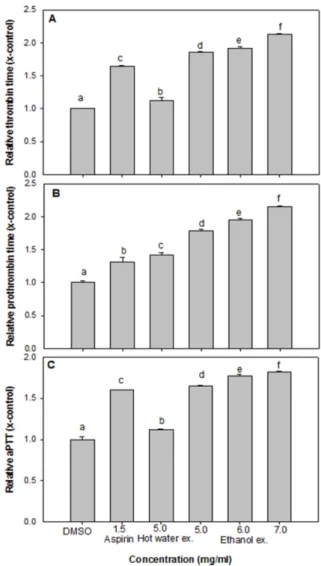
쪽잎 추출물의 항응고 활성을 TT, PT, aPTT를 각각 측정하 여 평가하였다[3]. 먼저 활성대조구인 aspirin은 1.5 mg/ml 농 도에서 무첨가구에 비해 TT, PT, aPTT를 각각 1.64, 1.31 및 1.60배 증가시켜 우수한 항응고 활성을 확인하였으며, 쪽잎 열수 추출물은 5 mg/ml 농도에서 무첨가구에 비해 TT는 1.12 배, PT는 1.42배, aPTT는 1.12배 연장시켜 약한 트롬빈, 프로트 롬빈, 혈액응고인자 저해 활성을 나타내었다(Fig. 4). 그러나, 쪽잎 ethanol 추출물은 5 mg/ml 농도에서 첨가구에 비해 TT 는 1.86배, PT는 1.79배, aPTT는 1.65배 연장시켜 매우 강력한 항응고 활성을 나타내었다. 이러한 항응고 활성은 농도 의존 적으로 증가되었으며, 현재까지 보고된 바 없는 실정이다. 상 기 결과는 향후 쪽잎을 이용한 항혈전 소재로의 개발이 가능 함을 제시하고 있다.
쪽잎 추출물의 혈소판 응집저해 활성
쪽잎 추출물의 혈소판 응집저해 활성을 평가하였으며, 그 결과는 Table 3 및 Fig. 5에 나타내었다. 먼저 혈소판 응집저해
Fig. 4. Effect of the hot water and ethanol extract of jjok leaf (leaf of Polygonium tinctorium) on blood coagulation.
Anti-coagulation activity is calculated on the clotting time of sample divided by the clotting time of solvent control in blood coagulation assay. The thrombin time (TT), prothrombin time (PT) and activated partial throm- boplastin time (aPTT) of solvent control (dimethylsul- foximide) were 36.7 sec, 20.4 sec and 103.95 sec, respec- tively. Data are means ± SD of triplicate determinations.
Table 3. Effect of the hot water and ethanol extract of jjok leaf (leaf of Polygonium tinctorium) on human platelet aggregation Extract/Chemical Conc. (mg/ml) Amplitude (ohm) Slope Lag time (sec) Area under PAA1 (%)
DMSO - 17 3 68 110.6 100.0
Aspirin
0.25 0.125 0.063
4 6 9
0 1 1
104 52 76
21.5 36.0 53.9
19.4 32.6 48.8
Hot water 0.25 10 1 56 64.5 58.3
Ethanol 0.25 26 9 2 260.6 235.7
1PAA: Platelet Aggregation Activity. Data are presented as representative result relative of independent three determinations.
Amplitude is expressed as ohms by maximum extent of platelet aggregation, and slope (rate of reaction) is determined by drawing a tangent through the steepest part of curve. Area under is a calculated area in descent drawing during platelet aggregation.
A B C D E F
Fig. 5. Diagram of impedance changes during platelet aggregation after addition of aspirin and the extracts of jjok leaf (leaf of Polygonium tinctorium) in whole blood aggregometer. (A) DMSO, (B) aspirin (0.25 mg/ml), (C) aspirin (0.125 mg/ml), (D) aspirin (0.065 mg/ml), (E) the hot water extract of jjok leaf, and (F) the ethanol extract of jjok leaf. Aggregation was induced by addition of 2.5 μl of collagen (1 mg/ml) into cuvette containing 50 μl of washed PRP and measured the impedance change for 12 min. The sample concentrations used were 0.25 mg/ml, respectively.
제인 아스피린은 0.25, 0.125 및 0.063 mg/ml 농도에서 각각 area under 21.5, 36.0 및 53.9를 나타내어, 무첨가구 area un- der 110.6에 비해 각각 19.4, 32.6 및 48.8%의 감소된 값을 나타 내어 농도 의존적인 강력한 혈소판 응집저해 활성을 나타내었 다. 쪽잎 열수 추출물은 0.25 mg/ml 농도에서 58.3%의 응집도 를 나타내어 우수한 응집저해를 나타낸 반면, ethanol 추출물 은 235.7%의 응집을 나타내어 빠르고 강력하게 혈소판 응집을 촉진하는 것을 확인하였다. 이러한 결과는, 동일한 쪽잎이라 도 열수 추출물은 혈전 생성 억제를, ethanol 추출물은 혈전 생성 촉진에 의한 지혈작용을 할 수 있음을 의미한다. 향후 각각의 추출물의 관련물질의 정제 및 기작 연구가 필요하다고 판단된다. 이상의 결과는, 천연염색에 사용되고 있는 쪽잎의 열수 추출물은 강력한 nitrite 소거능 및 혈소판 응집저해활성 을 나타내며, 쪽잎 ethanol 추출물은 그람양성균에 대한 항균 활성, 강력한 활성 라디컬 소거능, 혈액응고와 관련된 효소와 응고인자들에 대한 항응고 활성을 나타냄을 제시하고 있으며, 쪽잎 추출물을 이용한 다양한 식의약품, 화장품 소재로 개발
이 필요함을 제시하고 있다.
감사의 글
본 연구는 2017년도 산업통상자원부 바이오테라피산업기 반구축사업(과제번호 N0001805)에 의해 수행되었으며, 이에 감사드립니다.
References
1. Choi, O. J. 2010. Natural color comes into the world by old tradi- tion. pp 36-37,1st ed., Goho Publishing Co., Seoul, Korea, p 36.
2. Chung, I. M., Kim, H. B., Sung, G. B., Kim, Y. D. and Hong, I. P. 2005. Pure dyestuff extract from Polygonum tinctoria.
Kor. J. Seric. Sci. 47, 88-92.
3. Eikelboom, J. W., Zelenkofske, S. L. and Rusconi, C. P. 2010.
Coagulation factor IXa as a target for treatment and prophy- laxis of venous thromboembolism. Arterioscler. Thromb. Vasc.
Biol. 30, 382-387.
4. Go, I. H. and Choi, T. H. 2016. Characteristics of acid hydrol- ysis indigo extracted from indigo (Polygonum tinctorium L.) leaves. J. Korea TAPPI. 48, 57-65.
5. Han, N. R., Kang, S. W., Moon, P. D., Jang, J. B., Kim, H.
M. and Jeong, H. J. 2014. Genuine traditional Korean medi- cine, Naju Jjok (Chung-Dae, Polygonum tinctorium) improves 2,4-dinitrofluorobenzene-induced atopic dermatitis-like le- sional skin. Phytomedicine 21, 453-600.
6. Han, N. R., Park, J. Y., Jang, J. B., Jeong, H. J. and Kim, H. M. 2014. A natural dye, niram improves atopic dermatitis through down-regulation of TSLP. Environ. Toxicol. Pharma- col. 38, 982-900.
7. Honda, G., Tosirisuk, V. and Tabata, M. 1980. Isolation of an antidermatophytic, tryptanthrin, from indigo plants, Polygonum tinctorium and Isatis tinctoria. Planta Med. 38, 275- 276.
8. Ishihara, T., Okura, T., Kohno, K., Tanimoto, T., Ikegami, H. and Kurimoto, M. 2000. Polygonum tinctorium extract sup- presses nitric oxide production by activated macrophages through inhibiting inducible nitric oxide synthase expression.
J. Ethnopharmacol. 72, 141-150.
9. Iwaki, K., Ohashi, E., Arai, N., Kohno, K., Ushio, S., Taniguchi, M. and Fukuda, S. 2011. Tryptanthrin inhibits Th2 development, and IgE-mediated degranulation and IL-4 production by rat basophilic leukemia RBL-2H3 cells. J.
Ethnopharmacol. 134, 450-459.
10. Jang, H. G., Heo, B. G., Park, Y. S., Namiesnik, J., Barasch, D., Katrich, E., Vearasilp, K., Trakhtenberg, S. and Gorin- stein, S. 2012. Chemical composition, antioxidant and anti- cancer effects of the seeds and leaves of indigo (Polygonum tinctorium Ait.) plant. Appl. Biochem. Biotechnol. 167, 1986- 2004.
11. Ju, J. A. and Ryu, H. S. 2004. Dyeing on cellulose fibers by the solution extracted from natural fresh leaves of indigo plant. J. Kor. Soc. Dyers Finishers 16, 19-27.
12. Jung, I. C. and Sohn, H. Y. 2014. Antioxidation, antimicrobial and antithrombosis activities of aged black garlic (Allium sativum L.). Kor. J. Microbiol. Biotechnol. 42, 285-292.
13. Kataoka, M., Hirata, K., Kunikata, T, Ushio, S., Iwaki, K., Ohashi, K., Ikeda, M. and Kurimoto, M. 2001. Antibacterial action of tryptanthrin and kaempferol, isolated from the in- digo plant (Polygonum tinctorium Lour.), against Helicobacter pylori-infected Mongolian gerbils. J. Gastroenterol. 36, 5-9.
14. Kim, M. S., Seong, H. J. and Sohn, H. Y. 2016. In-vitro an- ti-thrombosis activity of different parts of Sorbus commixta from Ulleung island. J. Life Sci. 26, 289-295.
15. Kim, M. S., Shin, W. C., Kang, D. K. and Sohn, H. Y. 2016.
Anti-thrombosis activity of sinapic acid isolated from the lees of bokbunja wine. J. Microbiol. Biotechnol. 26, 61-65.
16. Kim, M. S. and Sohn, H. Y. 2015. Anti-coagulation and an- ti-platelet aggregation activity of the mature fruit of Sorbus commixa. Microbiol. Biotechnol. Lett. 43, 373-377.
17. Kimura, H., Tokuyama, S., Ishihara, T., Ogawa, S. and Yoko-
ta, K. 2015. Identification of new flavonol O-glycosides from indigo (Polygonum tinctorium Lour) leaves and their in- hibitory activity against 3-hydroxy-3-methylglutaryl-CoA reductase. J. Pharm. Biomed. Anal. 108, 102-112.
18. Kunikata, T., Tatefuji, T., Aga, H., Iwaki, K., Ikeda, M. and Kurimoto, M. 2000. Indirubin inhibits inflammatory re- actions in delayed-type hypersensitivity. Eur. J. Pharmacol.
410, 93-100.
19. Lee, J. N., Kim, M. S., Kim, D. H. and Sohn, H. Y. 2016.
Anti-oxidation and anti-thrombosis activities of different parts of Salicornia herbacea L. Microbiol. Biotechnol. Lett. 44, 311-316.
20. Lee, Y. S., Kim, M. S., Kim, D. J. and Sohn, H. Y. 2013.
A comparison of the components and biological activities of the ethanol extracts of Achyranthes japonica Nakai and Achyranthes bidentata Blume. Kor. J. Microbiol. Biotechnol. 42, 285-292.
21. Micallef, M. J., Iwaki, K., Ishihara, T., Ushio, S., Aga, M., Kunikata, T., Koya-Miyata, S., Kimoto, T., Ikeda, M. and Kurimoto, M. 2002. The natural plant product tryptanthrin ameliorates dextran sodium sulfate-induced colitis in mice.
Int. Immunopharmacol. 2, 565-578.
22. Ryu, H. Y., Ahn, S. M., Kim, J. S. and Sohn, H. Y. 2010.
Evaluation of in-vitro anticoagulation activity of 33 different medicinal herbs. J. Life Sci. 20, 922-928.
23. Singleton, V. L., Orthofer, R. and Lamuela-Raventos, R. M.
1999. Analysis of total phenols and other oxidation sub- strates and antioxidants by means of Folin-Ciocaleau re- agent. Methods Enzymol. 299, 152-178.
24. Song, S. W. and Cho, K. R. 2008. Dyeing properties of cotton fabrics dyed with extract from dry leaf of indigo plant.
Textile Color Finishing 20, 18-24.
25. Sweeney, J. D., Hoerning, L. A., Behrens, A. N., Novak, E.
and Swank, R. T. 1990. Thrombocytopenia after desmo- pressin but absence of in-vitro hypersensitivity to ristocetin.
Amer. J. Clin. Path. 93, 522-525.
26. Tokuyama-Nakai, S., Kimura, H., Ishihara, T., Jisaka, M. and Yokota, K. 2018. In vitro anti-inflammatory and antioxidant activities of 3,5,4'-Trihydroxy-6,7-Methylenedioxyflavone- O-Glycosides and their aglycone from leaves of polygonum tinctorium lour. Appl. Biochem. Biotechnol. 184, 414-431.
27. Valentina, U., Fabcic, J. and Stampar, F. 2007. Sugars, organ- ic acids, phenolic composition and antioxidant activity of sweet cherry (Prunus avium L.). Food Chem. 107, 185-192.
28. Yoo, W. S., Ahn, C. S., Narantuya, L. and Li, L. C. 2014.
Study on the improvement of dyeability of commercial in- digo leaf powder for the purpose of utilizing it in indigo dyeing. J. Kor. Soc. Clothing Textiles 38, 540-556.
29. Zhong, Y., Yoshinaka, Y., Takeda, T., Shimizu, N., Yoshizaki, S., Inagaki, Y., Matsuda, S., Honda, G., Fujii, N. and Yamamoto, N. 2005. Highly potent anti-HIV-1 activity iso- lated from fermented Polygonum tinctorium Aiton. Antiviral Res. 66, 119-128.
초록:쪽잎의 생리활성 평가
성화정
1․최옥자
2․박종이
3․손호용
1*
(1안동대학교 식품영양학과, 2인디고 월드갤러리, 3경북바이오산업연구원)