http://dx.doi.org/10.12925/jkocs.2017.34.1.132
대사에너지가 열 스트레스에 노출된 오리의 혈액 생체지표에 미치는 영향
심준보․최두형․김창래․박병성
✝ 강원대학교 동물생명과학대학(2017년 2월 26일 접수: 2017년 3월 28일 수정: 2017년 3월 30일 채택)
Influence of metabolizable energy on blood biomarkers in duck under heat stress
J. B. Sim․D. H. Choi․C. R. Kim․B. S. Park✝
College of Animal Life Science, Kangwon National University,
Chuncheon, Gangwondo, 200-701 Republic of Korea
(Received February 26, 2017; Revised March 28, 2017; Accepted March 30, 2017)
요 약 : 본 연구의 목표는 열 스트레스 하에서 오리사료 내 대사에너지(ME) 수준이 혈액 매개변수에 미치는 영향을 조사하는 것이었다. 총 240마리의 육용 오리 채리밸리((
Anas platyrhynchos
)를 4처리구 로 완전임의배치 한 후 42일 동안 사육하였다.처리구는 ME 2900 kcal/kg, ME 3000 kcal/kg, ME 3100 kcal/kg 및 ME 3200 kcal/kg로 구분하 였다. 혈액 지질 프로파일은 ME 3000과 비교할 때 ME 2900이 높았으나 ME 3100과 ME 3200은 낮 았다 (
p
< 0.05). 혈액 aspartate aminotransferase (AST)와 alanine aminotransferase (ALT) 수준은 ME 3000과 비교할 때 ME 3100과 ME 3200에서 증가하였다 (p
< 0.05). 혈액 적혈구와 혈소판 프로 파일은 ME 3000과 비교할 때 ME 3100과 ME 3200은 높아졌으나 ME 2900은 감소하였다 (p
<0.05). 혈액 전해질 가운데, chloride (Cl-) 농도는 ME 3000과 비교할 때 ME 2900에서 낮아졌다 (
p
<0.05). 혈액 가스와 PCO2는 ME 3000과 비교할 때 ME 2900에서 감소하였다 (
p
< 0.05). 혈액 면역물 질(IgG) 수준은 ME 3000과 비교할 때 ME 2900에서 줄어들었다 (p
< 0.05). 스트레스 호르몬, 코르티 코스테론은 ME 3000과 비교할 때 ME 2900에서 높아졌으나 ME 3100과 ME 3200은 낮아졌다 (p
<0.05).
주제어 : 오리, 열스트레스, 대사에너지, 혈액 생체지표, 스트레스호르몬
Abstract : The objective of this study was to determine the influence of dietary metabolic energy (ME) on blood parameters in duck under heat stress. A total of 240 meat ducks Cherry valley (
Anas platyrhynchos
) were assigned into four treatment groups with a randomized block design for 42 days. The four treatments were: ME 2900 kcal/kg, ME 3000 kcal/kg, ME 3100 kcal/kg, and
✝Corresponding author
(E-mail:[email protected])
ME 3200 kcal/kg. Blood lipid profiles was higher in ME 2900 but lower in ME 3100 and ME 3200 than that of ME 3000 (
p
< 0.05). Blood aspartate aminotransferase (AST) and alanine aminotransferase (ALT) levels were higher in ME 3100 and ME 3200 compared those in ME 3000 (p
< 0.05). The blood red cell and platelet profiles were increased in ME 3100 and ME 3200, but reduced in ME 2900 compared to those in ME 3000 (p
< 0.05). Among blood electrolytes, chloride (Cl-) concentration was decreased in ME 2900 compared to that in ME 3000. Blood gas PCO2 was reduced in ME 2900 compared to that in ME 3000 (p
< 0.05). Blood immunoglobulin (IgG) level was reduced in ME 2900 compared to that in ME 3000 (p
< 0.05). Level of stress hormone, corticosterone was increased in ME 2900, but decreased in ME 3100 and ME 3200 compared to that in ME 3000 (p
< 0.05).Keywords : Duck,, heat stress, metabolizable ehergy, blood biomarkers, stress hormone
1. 서 론
기후 변화로 인한 지구 온난화가 가속화되면서 무더운 여름철 열 스트레스는 동물복지를 위협하 고 가금의 폐사율을 높여서 농가소득을 낮춘다 [1, 2]. 혈액 생화학적 변수는 열 스트레스에 대 한 동물의 항상성과 관련한 건강, 영양상태 및 생체 대사작용 활성화를 평가하는데 있어서 중요 한 생체지표(biomarkers)이다 [3, 4]. 열 스트레 스를 받은 조류는 적혈구와 혈소판 프로파일 및 혈액가스 농도가 낮아지며 호흡을 통한 몸 밖으 로 CO2 방출양이 증가하고 혈액 pH가 상승하면 서 헐떡거리는 현상이 나타난다 [5-8]. 무더운 여름철 열 스트레스에 노출된 동물에서 적혈구의 감소는 빈혈을 일으키고 폐사율을 높이는 것으로 알려졌다 [9]. 조류가 열 스트레스를 받으면 분, 뇨를 통하여 potassium (K+), sodium (Na+) 배 설이 증가하며 전해질은 산염기 균형, 삼투압 및 세포막 전위를 유지하는 데 있어서 중요하다 [10]. 포유동물과 달리 피부에 땀샘이 거의 없는 오리는 적정 체온을 유지하기 어렵고 온몸이 깃 털로 덮여있어 열 스트레스에 취약하다 [11]. 열 스트레스는 면역세포의 발육 감소 및 부신피질 자극호르몬(adrenocorticotropic hormone, ACTH)의 혈중 농도를 변화시키며 이로 인해 림 프조직이 영향을 받아 면역력이 감소하고 열 스 트레스에 신체가 대항할 수 있도록 에너지를 동 원하는 스트레스 호르몬인 corticosterone의 분비 가 증가한다 [12, 13].
열 스트레스 기간 동안 육계의 성장능력을 개 선하기 위하여 ME 증가와 같은 영양, 생리학적
연구가 진행되었다 [14, 15]. 가금은 방광이 없으 며 배변과 오줌이 항문 근처에 있는 총배설강 (cloaca)이라는 소화기관을 통하여 함께 배설된 다. 이러한 이유로 가금 영양학에서는 총 에너지 (total energy, GE)에서 배변으로 배설되는 에너 지를 뺀 가소화 에너지 (digestible energy, DE) 개념보다는 배변과 오줌으로 배설되는 에너지를 뺀 대사에너지(metabolizable energy, ME) 값을 이용하고 있다 [16]. 일반환경에서 사육하는 브로 일러의 증체량은 사료 내 에너지 수준이 낮을 때 감소되며 에너지 수준을 증가 시킬수록 증가했다 는 결과 [17, 18] 및 산란계에서 에너지 수준이 증가할수록 증체량이 개선되었다는 연구 결과가 있다 [19]. 체온상승에 영향을 미치지 않는 양질 의 고에너지 사료와 과잉 에너지로 인한 비만을 피하기 위한 적정 ME 수준 등 다양한 연구가 진 행되지만 무더운 여름철 열 스트레스에 노출된 육용 오리의 항상성과 관련한 혈액변수에 대한 ME 수준의 연구결과는 거의 알려진 바 없다 [20]. 본 연구는 열 스트레스에 노출된 육용 오리 의 사료 내 조단백질을 18%로 고정하고 ME 수 준을 서로 다르게 조절하였을 때 혈액의 생화학 적 변수를 측정하여 생리적 항상성 메카니즘을 규명하였다.
2. 실 험
2.1. 실험설계
Cherry valley (
Anas platyrhynchos
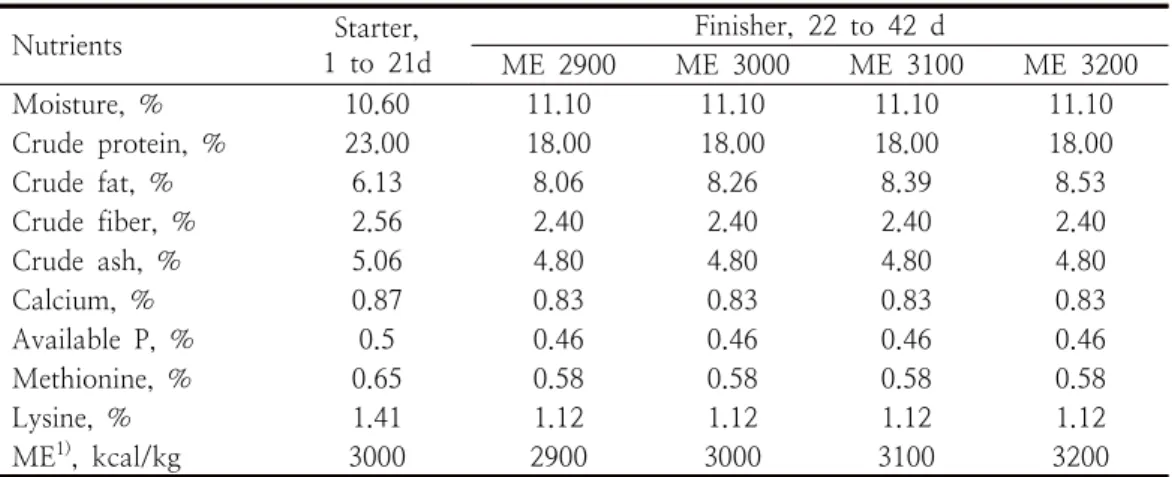
) 육용 오 리 240수를 오리 부화장으로부터 공급받아서 4처Nutrients Starter, 1 to 21d
Finisher, 22 to 42 d
ME 2900 ME 3000 ME 3100 ME 3200
Moisture, % 10.60 11.10 11.10 11.10 11.10
Crude protein, % 23.00 18.00 18.00 18.00 18.00
Crude fat, % 6.13 8.06 8.26 8.39 8.53
Crude fiber, % 2.56 2.40 2.40 2.40 2.40
Crude ash, % 5.06 4.80 4.80 4.80 4.80
Calcium, % 0.87 0.83 0.83 0.83 0.83
Available P, % 0.5 0.46 0.46 0.46 0.46
Methionine, % 0.65 0.58 0.58 0.58 0.58
Lysine, % 1.41 1.12 1.12 1.12 1.12
ME1), kcal/kg 3000 2900 3000 3100 3200
1) Metabolizable energy.
Table 1. Chemical analysis of experimental diets 리*3반복(반복 당 20수)으로 완전임의배치 한 후 42일 간 사육하였다. 오리 사양전기(1-21일) 사 료는 일반 상업용 시판사료를 구입하여 급여하였 다. 오리 사양후기(22-42일) 실험사료 내 조단백 질 수준을 18%로 고정하고 대사에너지의 수준을 각각 ME (kcal/kg) 2900, 3000, 3100, 3200으 로 조절하였다. 실험사료 내 서로 다른 ME 수준 은 미국에서 제시한 오리에 대한 영양소 요구량 의 사양표준 [21]에 의해 제시된 조단백질 18%, ME 3000 kcal/kg를 바탕으로 조절하였다. 시험 사료는 옥수수, 대두박 위주로 배합하였으며 영양 성분표는 Table 1과 같다. 사육실의 온도는 부화 1일째부터 3일까지는 33℃로 유지하였으며 그 다 음 기간부터 21일까지 주당 2-3℃씩 낮췄다. 실 험기간 동안 연속조명과 일반음수를 무제한 급여 하였다. 왕겨를 10cm높이로 깔짚으로 사용하였 다. 전기(1-21일)에는 일반사료를 무제한 급여하
였으며 후기(22-42일)에는 하루 5시간
(11:00-16:00)씩 인위적인 33-40℃의 열 부여와 함께 상대습도 70%로 조절하여 열 스트레스를 유도하였다. 동물 실험절차는 EEC Directive of 1986; 86/609/EEC에서 제시된 과학적이고 윤리 적인 규정을 따랐으며 강원대학교 동물실험윤리 위원회로부터 승인(KW-141027-1)을 얻었다.
2.2. 혈액채취 및 기관무게
실험 종료 전날부터 10시간 절식시킨 후 처리 군 당 평균 체중에 근접한 9마리를 선발하여 채 혈하였다. 혈액 3 mL를 plain tubes (Greine, Co
Ltd, Australia) 속으로 심장천공 방법을 이용하 여 각 조류로부터 얻었다. 혈액 시료를 원심분리 (4℃, 20분, 3000 rpm)하여 혈청을 분리하였다.
-196℃의 액체질소에서 급속 동결 한 후 생화학 적 분석 시까지 –20℃에서 냉동 보관하였다. 간, 면역기관인 근위(gizzard), 비장, F낭(bursa of Fabriciusburas)을 채취하여 무게를 측정 후 체중 100 g 당으로 환산하였다.
2.3. 혈액지질, 혈당, 및 간 기능 관련 효소 중성지방(triglyceride, TG), 총콜레스테롤(total cholesterol, TC), 저밀도 지단백 콜레스테롤(low density lipoprotein cholesterol, LDL-C), 고밀도 지단백 콜레스테롤(high density lipoprotein cholesterol, HDL-C), Glucose 및 간 기능 관련 효소인 AST(aspartate aminotransferase), ALT(alanine transferase)는 Diagnostic kit (Sigma chemical Co,, St, Louis, MO, USA)를 이용하여 자동분석장치(Hitachi 917, Japan)에 의 해서 측정하였다.
2.4. 혈액학적 특성
혈액학적 특성은 자동분석기 (Automated blood cell counter, Forcyte, Oxford Science, USA), 를 이용하여 RBC (total red blood cell counts), HCT (hematocrit), Hb (hemoglobin), MCV (mean corpuscular volume), MCHC (mean corpuscular hemoglobin concentration), RDW (red cell distribution width), PLT
Items ME (kcal/kg)
2900 3000 3100 3200
Liver 2.76±0.091) 2.75±0.09 2.70±0.14 2.69±0.12
Gizzard 2.41±0.13b 2.72±0.10a 2.70±0.09a 2.66±0.11a Spleen 0.06±0.01b 0.06±0.01b 0.08±0.01a 0.08±0.01a Bursa of Fabricius 0.07±0.01b 0.08±0.02b 0.10±0.01a 0.10±0.01a
1) Mean values±standard errors (n=9). a,bDifferent letters represent significant differences between groups (p<0.05).
Table 2. Organ weight by metabolizable energy (ME) in meat duck under heat stress (g/100g body weight)
(platelet count), PCT (plateletcrit), MPV (mean platelet volume)를 측정하였고, 혈액 전해질 (VetScan i-STAT 1 handheld analyzer, Abaxis, USA)과 혈액 가스(RAPIDChem 744/754 blood gas analyzers, Simens, USA)를 측정하였다.
2.5. 혈액 IgG 및 Corticosterone
면역물질 (Immunoglobulin G, IgG) 농도는 Chicken ELISA kit (Bethyl Laboratories, Montgomery, TX, USA), 스트레스 호르몬인 Coricosterone 농도는 HS EIA kit (Enzyme immunoassay kit, IDS, Boldon, UK)를 이용하여 측정하였다. 각 제조사의 프로토콜에 따라서 시료 에 대한 생화학적 처리를 실시한 후 precision microplate reader (Molecular Devices Inc, New York, USA)에 의해서 450 nm에서 흡광도를 측 정하여 정량하였다 [22].
2.6. 통계분석
모든 data는 IBM SPSS statistics 22 [23]를 이 용하여 평균 값과 표준오차를 산출하였으며 처리 군 사이의 통계적 유의차 검증을 위하여 일원 분 산분석을 실시하였다. Turkey’s multiple range test를 이용하여 95% 신뢰수준에서 자료의 통계 적인 유의차를 검정하였다 (P<0.05).
3. 결과 및 고찰
열 스트레스에 노출된 육용 오리에게 조단백질 을 18%로 고정하고 서로 다른 ME 수준의 사료
를 급여한 이후 조사된 면역기관 무게변화는 Table 2, Fig. 1과 같다. 간 무게는 처리군 간의 유의차가 나타나지 않았다. 근위 무게는 ME 3000과 비교할 때 ME 2900은 0.31 g 낮아져 11.40% 감소하였으나 (p<0.05) ME 3100, 3200 사이는 차이가 없었다. 비장 무게는 ME 3000과 비교할 때 ME 2900은 차이가 없었으나 ME 3100, 3200은 모두 0.02 g 높아져 33.33% 증가 하였다 (p<0.05). F낭 무게는 ME 3000과 비교할 때 ME 2900은 차이가 없었으며 ME 3100, 3200은 모두 0.02 g 높아져 25.00% 증가하였다 (p<0.05). 열 스트레스에 노출된 오리 사료 내 ME 수준의 증가가 간 세포의 정상적인 발육을 유지함과 동시에 근위 및 면역기관 세포의 발육 을 촉진시켰다. 열 스트레스 기간 동안 육계 사 료 내 ME 수준의 증가는 동물의 성장, 발육에 필요한 충분한 에너지 공급으로인한 근위 및 복 강지방 무게를 높이는 것으로 알려졌다 [24, 25].
열 스트레스에 노출된 육용 오리에서 측정한 혈액 지질 프로파일, 혈당 및 간 기능 관련 효소 AST, ALT 수준은 Table 3과 같다. 중성지방은 ME 3000과 비교할 때 ME 2900은 11.12% 증 가하였으나 ME 3100, 3200은 각각 31.78, 45.81% 감소하였다 (p<0.05). 총 콜레스테롤은 ME 3000과 비교할 때 ME 2900은 5.03% 증가 하였으나 ME 3100, 3200은 각각 17.87, 13.26% 감소하였다 (p<0.05). LDL-C는 ME 3000과 비교할 때 ME 2900은 33.62%가 증가하 였으나 ME 3100은 8.99% 감소하였다 (p<0.05).
HDL-C는 ME 3000과 비교할 때 ME 2900은 차이가 없었으나 ME 3100, 3200은 각각 13.29,
Fig. 1. Changes of organ weight by metabolizable energy (ME) in meat duck under heat stress (22-42 days). A: gizzard, B: spleen, C: bursa Fabricius. Comparison of ME 3000 versus ME 2900, 3100 and 3200.
Items2) ME (kcal/kg)
2900 3000 3100 3200
TG (mg/dL) 267.8±9.38a1) 241.0±9.68b 164.4±9.26c 130.6±26.29d TC (mg/dL) 348.6±18.41a 331.9±9.11b 272.611.34c 287.9±18.04c LDL-C (mg/dL) 230.5±18.68a 172.5±9.78b 157.0±9.04c 172.8±9.41b HDL-C (mg/dL) 71.49±6.07b 74.47±6.15b 84.37±6.09a 78.98±6.64ab Glucose (mg/dL) 184.3±8.70b 201.5±9.77a 190.3±9.50b 205.2±9.74a AST (IU/L) 34.33±5.15b 37.51±4.64b 64.84±4.87a 67.67±4.34a ALT (IU/L) 36.67±4.48b 35.33±4.34b 47.52±4.37a 46.83±4.63a
1)Mean values±standard errors (n=9), 2)TG: triglycerides, TC: total cholesterol, LDL-C: Low density lipoprotein-cholesterol, HDL-C: High density lipoprotein-cholesterol, AST: Aspartate aminotransferase, ALT: Alanine aminotransferase. a,b,c,dDifferent letters represent significant differences between groups (p<0.05).
Table 3. Blood lipid profile, glucose, AST and ALT by metabolizable energy (ME) in meat duck under heat stress
Items2) ME (kcal/kg)
2900 3000 3100 3200
RBC
HCT (%) 43.48±5.01b1) 49.88±5.06a 47.31±4.36ab 50.51±4.62a RBC (M/µL) 4.57±0.90c 6.77±0.89b 6.71±0.90b 8.47±1.17a Hb (g/dL) 8.92±0.87b 10.04±0.94b 12.06±1.24a 11.82±1.00a MCV (fL) 140.2±9.09b 139.3±8.88b 155.1±9.43a 159.9±9.09a MCHC (g/dL) 37.59±2.87 40.01±2.71 39.04±2.76 40.26±3.01 RDW (%) 7.03±0.90b 9.48±0.98a 9.50±1.24a 9.17±1.13a
Platelets
PLT (K/µL) 44.06±4.72 44.46±4.49 47.67±4.53 49.13±4.41 PCT (%) 0.05±0.02b 0.07±0.01a 0.08±0.01a 0.08±0.01a
MPV (fL) 18.48±1.45 18.42±1.65 18.66±1.53 18.39±1.58
1)Mean values±standard errors (n=9), 2)RBC: red blood cell, HCT: Hematocrit, Hb:
Hemoglobin, MCV: Mean corpuscular volume, MCHC: Mean corpuscular hemoglobin concentration, RDW: Red cell volume distribution width, PLT: Platelet, PCT: Platelet crit, MPV:
Mean plasma volume. a,b,c Different letters represent significant differences between groups (p<0.05).
Table 4. Red blood cell and platelet profiles by metabolizable energy (ME) in meat duck under heat stress
6.06% 증가하였다 (p<0.05). 혈당은 ME 3000과 비교할 때 ME 2900, 3100은 각각 8.54, 5.56%
감소하였으나 (p<0.05) ME 3200은 차이가 없었 다. AST는 ME 3000과 비교할 때 ME 2900은 차이가 없었으나 ME 3100, 3200은 각각 72.86, 80.41% 증가하였다 (p<0.05). ALT는 ME 3000 과 비교할 때 ME 2900은 차이가 없었으나 3100, 3200은 각각 34.50, 32.55% 증가하였다 (p<0.05). 결과는 열 스트레스 하에서 오리 사료 내 ME 수준의 증가는 간 기능 손상을 나타내는 AST, ALT 수준을 높이는 것으로 나타났다. 이는 과잉의 에너지 부담으로 인한 간에서 영양소 대 사가 장애를 받았을 것으로 볼 수 있다 [26]. 고 온환경에 노출된 육계에서 혈당, AST, ALT가 증 가하는 것으로 보고되었다 [27] 일반 환경에서 육계사료 내 ME 수준의 증가는 혈액지질 프로파 일, 혈당을 증가하는 경향이 있으며 혈액 AST 수준을 높이는 것으로 보고되었다 [28].
열 스트레스에 노출된 육용 오리의 혈액 생화 학적 변수는 Table 4와 같다. 적혈구 프로파일 가운데 Hematocrit (HCT)는 ME 3000과 비교
할 때 ME 2900, 3100은 각각 12.83, 5.15% 감 소하였으나 (p<0.05) ME 3200은 차이가 없었다.
Red blood cell (RBC)는 ME 3000과 비교할 때 ME 2900은 32.50% 감소하였으나 ME 3100은 차이가 없었고 ME 3200은 25.11% 증가하였다 (p<0.05). Hemoglobin (Hb)은 ME 3000과 비교 할 때 ME 2900은 차이가 없었으나 ME 3100, 3200은 각각 20.12, 17.73% 증가하였다(p<0.05).
Mean corpuscular volume (MCV)은 ME 3000 과 비교할 때 ME 2900은 차이가 없었으나 ME 3100, 3200은 각각 11.34, 14.79% 증가하였다 (p<0.05). Red cell volume distribution width (RDW)는 ME 3000과 비교할 때 ME 2900은 25.84% 감소하였으나 (p<0.05) ME 3100, 3200 사이는 차이가 없었다. 혈소판 프로파일 가운데 Plateletcrit (PCT)는 ME 3000과 비교할 때 ME 2900은 28.57% 감소하였으나 (p<0.05) ME 3100, 3200 사이는 차이가 없었다. Paltelet (PLT), Mean corpuscular hemoglobin concentration (MCHC), (Mean corpuscular volume (MCV)은 처리구 사이의 차이가 없었다.
Items ME (kcal/kg)
2900 3000 3100 3200
Sodium (Na+) 147.9±8.831) 148.0±8.83 147.9±8.70 147.3±9.34 Potassium (K+) 4.73±1.08 4.58±0.94 4.14±0.88 4.57±0.94 Chloride (Cl-) 102.7±9.62b 116.0±9.53a 116.3±9.34a 114.0±8.96a
1)Mean values±standard errors (n=9). a,b Different letters represent significant differences between groups (p<0.05).
Table 5. Blood electrolytes by metabolizable energy (ME) in meat duck under heat stress
Items2) ME (kcal/kg)
2900 3000 3100 3200
pH 7.43±0.051) 7.41±0.04 7.41±0.05 7.41±0.04
PCO2 (mmHg) 35.15±4.55b 44.86±4.55a 45.65±4.49a 46.19±4.55a HCO3 (mmol/L) 22.16±4.36 26.33±4.43 26.04±4.42 26.20±4.38 AnGap (mmol/L) 14.05±1.75 15.43±1.91 15.61±1.96 15.00±1.74 TCO2 (mmol/L) 23.78±4.33 26.04±4.38 25.58±4.36 25.30±4.36
1)Mean values±standard errors (n=9), 2)PCO2: partial pressure of carbon dioxide, HCO3: Bicarbonate, AnGap: Anion gap, TCO2: Total carbon dioxide. a,b Different letters represent significant differences between groups (p<0.05).
Table 6. Blood pH and gas concentration by metabolizable energy (ME) in meat duck under heat stress
열 스트레스에 노출된 오리 사료 내 ME 수준의 증가가 혈액 생화학적 변수를 일정하게 유지시켰 다. 동물이 열 스트레스를 받으면 적혈구 손상 및 적혈구 숫자와 크기의 감소에 기인하여 HCT 가 낮아지는 것으로 보고되었다 [29]. 열 스트레 스는 세포 밖으로 나오는 수분증발을 구성하는 혈장용적의 변화가 없어도 물 섭취증가로써 혈액 희석이 일어나고 궁극적으로 이들 수준이 낮아질 수 있다 [9]. 열 스트레스에 노출된 육계에서 혈 액 생화학적 매개변수는 감소하는 것으로 보고되 었다 [30]. 혈액학적 소견은 동물의 건강과 영양 상태 평가 및 가금에서 스트레스 반응에 대하여 민감한 혈액학적 지표, 그리고 면역기능에 대한 일반 생체 표지자로서 중요한 것으로 보고되었다 [4].
열 스트레스에 노출된 육용 오리에서 혈액 전 해질 농도는 Table 5와 같다. Chloride는 ME 3000과 비교할 때 ME 2900은 11.47% 감소하였
으나 (p<0.05) ME 3100, 3200 사이에는 차이가 없었다. Sodium과 Potassium은 처리군간 차이가 없었다. 오리를 비롯한 가금이 열 스트레스에 노 출되면 전해질 농도가 낮아지는 것으로 알려져 있다 [10]. 열 스트레스를 받은 가금은 분과 소변 에서 Na+, K+배설이 증가하며 전해질 Na+, K+와 Cl−은 산과염기의 균형, 세포막 전위 및 삼투압 을 유지하는 데 있어서 중요하다 [31].
열 스트레스에 노출된 육용오리의 혈액 pH, 가스 농도는 Table 6과 같다. 혈액 pH는 처리군 간의 유의차가 나타나지 않았다. 혈액 가스 PCO2는 ME 3000과 비교할 때 ME 2900은 21.65% 감소하였으나 (p<0.05) ME 3100, 3200 은 차이가 없었으며, HCO3, AnGap, TCO2,는 유의차가 나타나지 않았다. 가금에서 열 스트레스 는 혈액가스를 낮추는 것으로 알려져 있으나 오 리에 대해서는 거의 보고되지 않았다 [5].
열 스트레스에 노출된 육용오리에서 측정한 혈
Items ME (kcal/kg)
2900 3000 3100 3200
IgG2) 254.6±9.33b1) 280.4±8.98a 287.1±8.98a 282.0±9.55a Corticosterone 72.97±4.89a 53.12±4.68b 41.71±4.54c 41.35±4.88c
1)Mean values±standard errors (n=9), 2)Immunoglobulin G. a,bDifferent letters represent significant differences between groups (p<0.05).
Table 7. Blood IgG and corticosterone levels by metabolizable energy (ME) in meat duck under heat stress (ng/mL)
액 면역물질 IgG와 스트레스호르몬
corticosterone 농도는 Table 7과 같다. 혈액 IgG 는 ME 3000과 비교할 때 ME 2900은 9.20%
감소하였으나 (p<0.05) ME 3100, 3200 사이는 차이가 없었다. corticosterone은 ME 3000과 비 교할 때 ME 2900은 37.37% 증가하였으나 ME 3100, 3200은 각각 21.48, 22.16% 감소하였다 (p<0.05). 스트레스를 받으면 가금(poultry)은 스 트레스 호르몬인 corticosterone 농도가 높아지고 면역물질이 낮아지는 것으로 보고되었다 [32]. 그 러나 열 스트레스 하에서 오리 사료 내 ME 수준 의 증가에 따른 보고는 거의 없다.
4. 결 론
본 연구결과는 여름철 열 스트레스에 노출된 오리의 후기(22-42일) 사료 내 단백질 수준을 18%로 고정하고 ME (kcal/kg) 수준을 3000 이 상으로 증가해주면 간 세포의 정상적인 발육을 유지함과 동시에 면역세포인 비장과 F낭의 발육 을 촉진시키는 것으로 나타났으며 혈액 생화학적 변수를 일정하게 유지하였고 스트레스 호르몬인 혈액 Corticosterone 수준을 낮추는 것으로 나타 났다. 결론적으로, 열 스트레스에 노출된 오리에 서 ME 수준을 증가해주면 생체조직의 발육 촉진 및 혈액 생화학적 변수의 수준을 일정하게 유지 해줌으로써 항상성을 조절하여 열 스트레스 피해 를 줄일 수 있음을 나타낸다.
감사의 글
본 연구수행에 있어서 동물사육장을 제공해주 신 강원대학교 동물자원공동연구소에 감사를 드
립니다.
References
1. L. Tomanek, Variation in the heat shock response and its implication for predicting the effect of global climate change on species' biogeographical distribution ranges and metabolic costs,
J. Exp. Biol
, 213, 971-979 (2010)2. S. Sharma, K. Ramesh, I. Hyder, S.
Uniyal, V. P. Yadav, R. P. Panda, V. P.
Maurya, G. Singh, P. Kumar and A.
Mitra, Effect of melatonin administration on thyroid hormones, cortisol and expression profile of heat shock proteins in goats (Capra hircus) exposed to heat stress,
Small Ruminant Res.
, 112, 216-223 (2013)3. N. J. Daghir, Poultry production in hot climates, CAB International, (2008) 4. B. Habibu, N. Ikira, H. Buhari, T.
Aluwong, M. Kawu, L. Yaqub, M.
Tauheed and H. Isa, Effect of molasses supplementation on live weight gain, haematologic parameters and erythrocyte osmotic fragility of broiler chickens in the hot-dry season,
Inter. J. Vet. Sci
, 3, 181-188 (2014)5. S. Borges, A. F. Da Silva, A. Majorka, D.
Hooge and K. Cummings, Physiological responses of broiler chickens to heat stress and dietary electrolyte balance (sodium plus potassium minus chloride,
milliequivalents per kilogram),
Poult. sci
, 83, 1551 -1558 (2004)6. M. Toyomizu, M. Tokuda, A. Mujahid and Y. Akiba, Progressive alteration to core temperature, respiration and blood acid-base balance in broiler chickens exposed to acute heat stress,
Jpn. Poult.
Sci
, 42, 110-118 (2005)7. R. J. Etches, T. M. John and A. M. V.
Gibbins, Behavioural, physiological, neuroendocrine and molecular responses to heat stress, in: N. J. Daghir (Ed.), Poultry production in hot climates, Cromwell press, Trowbridge, 49 (2008)
8. M. H. Tamzil, R. R. Noor, P. S.
Hardjosworo, W. Manalu and C.
Sumantri, Hematological response of chickens with different heat shock protein 70 genotypes to acute heat stress,
Int. J.
Poult. Sci
, 13, 14-20 (2014)9. M. K. Türkyilmaz, The effect of stocking density on stress reaction in broiler chickens during summer,
Turk. J. Vet, Anim. Sci
, 32, 31-36 (2008)10. M. A. M. Sayed and J. Downing, The effects of water replacement by oral rehydration fluids with or without betaine supplementation on performance, acid-base balance, and water retention of heat-stressed broiler chickens,
Poult. Sci
, 90, 157-167 (2011)11. S. Temim, A. M. Chagneau, S.
Guillaumin, J. Michel, R. Peresson and S.
Tesseraud, Does excess dietary protein improve growth performance and carcass characteristics in heat-exposed chickens?,
Poult. Sci
, 79, 312-317 (2000)12. S. B. A. El-Soud, T. A. Ebeid and Y. Z.
Eid, Physiological and antioxidative effects of dietary acetyl salicylic acid in laying Japanese quail (Coturnix japonica) under high ambient temperature,
J. Poult. Sci
, 43, 255-265 (2006)13. A. R. Jahejo, N. Rajput, N. M. Rajput, I.
H. Leghari, R. R. Kaleri, R. A. Mangi, M. K. Sheikh and M. Z. Pirzado, Effects
of Heat Stress on the Performance of Hubbard Broiler Chicken,
Cells Anim.
Ther.
, 2, 1-5 (2016)14. A. Ghazalah, M. Abd-Elsamee and A. Ali, Influence of dietary energy and poultry fat on the response of broiler chicks to heat therm,
Int. J. Poult. Sci
, 7, 355-359 (2008)15. E. K. Barbour, I. Tayeb, H. Shaib and M.
Ibraim, Physiological and carcass traits in heat-stressed broilers differing in heat acclimatization, chemical or feed restriction treatments,
Agric. Biol. J. N. Am
, 1, 65-74 (2010)16. R.R. Alvarenga, M.G. Zangeronimo, P.B.
Rodrigues, L.J. Pereira, R.C. Wolp and E.C. Almeida, Formulation of diets for poultry: The importance of prediction equation to estimate the energy values,
Arch. Zootec,
62, 1-11 (2013).17. M. Ghaffari, M. Shivazad, M. Zaghari and R. Taherkhani, Effects of different levels of metabolizable energy and formulation of diet based on digestible and total amino acid requirements on performance of male broiler,
Int. J. Poult.
Sci
, 6, 276-279 (2007)18. S. Nahashon, N. Adefope, A. Amenyenu and D. Wright, Effects of dietary metabolizable energy and crude protein concentrations on growth performance and carcass characteristics of French guinea broilers,
Poult. sci
, 84, 337-344 (2005) 19. J. Philippe, Energy levels and feedpresentation for laying hens: Effects on performance and intake, ISA, 10, 1-10 (2009)
20. S. Syafwan, R. Kwakkel and M.
Verstegen, Heat stress and feeding strategies in meat-type chickens,
World's Poult. Sci. J
, 67, 653-673 (2011)21. NRC, Guide for the care and use of laboratory animals, W.D.C. USA (2010) 22. S. O. Park, H. W. Jong, B. S. Park and
H. C. Choi, Effects of inverse lighting and extreme heat diet on short chain fatty acid
and blood lipid profile in extreme heat stress-exposed broilers,
Korean J. Oil Chemists’ Soc
, 30, 400-410 (2013)23. IBM SPSS, IBM SPSS statistics 22 Algorithms (2013)
24. M. A. Al-Harthi, A. A. El-Deek and B.
L. Al-Harbi, Interrelation ships among triiodothyronine (T3), energy and sex on nutritional and physiological responses of heat stressed broilers,
Egypt Poult. Sci
, 22, 349-385 (2002)25. Q. U. Zaman, T. Mushtaq, H. Nawaz, M.
A. Mirza, S. Mahmood, T. Ahmad, M. E.
Babar and M. M. H. Mushtaq, Effect of varying dietary energy and protein on broiler performance in hot climate,
Anim.
Feed Sci
, 146, 302-312 (2008)26. S. Yalcin, S. Yalcin, K. Uzunoglu, H.M.
Duyum and O. Eltan, Effects of dietary yeast autolysate (
Saccharomyces cerevisiae
) and black cumin seed (Nigella sativa
L.) on performance, egg traits, some blood characteristics and antibody production of laying hens,Livest. Sci
, 145, 13-20 (2012).27. W.A. Khan, A. KhN, A.D. Anjum and Z.U. Rehman. 2002. Effects of induced heat stress on some biochemical values in broiler chicks. Int. J. Agric. Biol. 4:
74-75.
28. M. Corduk, N. Ceylan and F. Ildiz, Effects of dietary energy density and L-carnitine supplementation on growth performance, carcass traits and blood parameters of broiler chickens,
S. Afr. J.
Anim
, 37, 65-73 (2007)29. P. E. Hillman, N. R. Scott and A. Van Tienhoven, Physiological responses and adaptations to hot and cold environments, in: M. K. Yousef (Ed.), stress physiology in livestock. Vol. III. Poultry, CRC Press, Boca Raton, Florida, pp 2-71 (1985) 30. W. Aengwanich, Effects of high
environmental temperature on blood indices of Thai indigenous chickens, Thai indigenous chickens crossbred and broilers,
Int. J. Poult. Sci
, 6, 427-430 (2007) 31. H. T. Bang, J. Hwangbo, H. K. Kang andB. S. Park, Effect of different feeding times using a diet containing betaine on production, blood profile and a short chain fatty acid in meat ducks exposed to a scorching heat wave,
Korean J. oil Chemist's Soc
, 32, 427-438 (2015)32. F. Fraisse and J. Cockrem, Corticosterone and fear behaviour in white and brown caged laying hens,