Representative Volume Element Analysis of Fluid-Structure Interaction Effect on Graphite Powder Based Active Material for Lithium-Ion Batteries
Jin Chul Yun and Seong Jin Park *
Department of Mechanical Engineering, Pohang University of Science and Technology, 77 Cheongam-Ro, Nam-Gu, Pohang, Gyeongbuk 37673, Republic of Korea (Received December 5, 2016; Revised January 17, 2017; Accepted January 20, 2017)
···
Abstract In this study, a finite element analysis approach is proposed to predict the fluid-structure interaction behavior of active materials for lithium-ion batteries (LIBs), which are mainly composed of graphite powder. The porous matrix of graphite powder saturated with fluid electrolyte is considered a representative volume element (RVE) model. Three different RVE models are proposed to consider the uncertainty of the powder shape and the porosity. P- wave modulus from RVE solutions are analyzed based on the microstructure and the interaction between the fluid and the graphite powder matrix. From the results, it is found that the large surface area of the active material results in low mechanical properties of LIB, which leads to poor structural durability when subjected to dynamic loads. The results obtained in this study provide useful information for predicting the mechanical safety of a battery pack.
Keywords: Graphite powder, Lithium-ion battery, Electrolyte, Active material, Fluid-structure interaction
···
1. Introduction
To address the depletion of fossil fuels and environ- mental pollution, there has been growing interest in elec- tric vehicles (EVs) as alternatives to gasoline and diesel vehicles. Moreover, demand for hybrid electric vehicles (HEVs) with maximal fuel efficiency is gradually increasing. For EVs and HEVs, a rechargeable second- ary battery is generally used as the electrical energy source. There are various types of secondary battery, such as lithium-ion, nickel-cadmium, and nickel-metal hydride devices. Among them, the lithium-ion battery (LIB) is used most widely because it has no memory effect, a high energy density, and a high voltage [1]. LIBs are currently used as the power sources for various mobile devices because their feasibility has been demon- strated. When using LIBs in automobiles, however, all possibilities in accidents than could occur should be con- sidered to guarantee the safety of passengers. In particu- lar, the weight of LIBs required to drive a single EV is in the hundreds of kilograms. Thus, it is important to under-
stand mechanical behaviors of LIBs for the optimum design of EVs [2].
LIBs are mainly composed of the anode & cathode electrode, which are coated with the porous active mate- rials, soaked in the fluid electrolyte. Porous active materi- als for the anode and the cathode electrode are mainly composed of the graphite powder and the lithium oxide metal, respectively. Since the active materials are porous, fluids are filled in the pore of the matrix. Thus, interac- tion between the solid matrix and the fluid should be examined to predict mechanical behaviour of LIBs accu- rately. Porous media saturated with fluid has been studied in various fields such as soil mechanics, biomechanics, hydromechanics, etc [3-5]. But there are little studies about the mechanical behaviour of LIBs active materials, com- posed of the porous matrix saturated with electrolyte.
In this study, a fluid-structure interaction (FSI) modelling approach is proposed to predict the mechanical behavior of the anode active materials for lithium-ion battery (LIB).
Porous matrix saturated with fluid electrolyte is consid- ered as a representative volume element (RVE) model. 3
*Corresponding Author: Seong Jin Park, TEL: +82-54-279-2182, FAX: +82-54-279-5899, E-mail: [email protected]
<PM리뷰>
different RVE models are proposed to consider the uncer- tainty of the actual microstructure of the active materials.
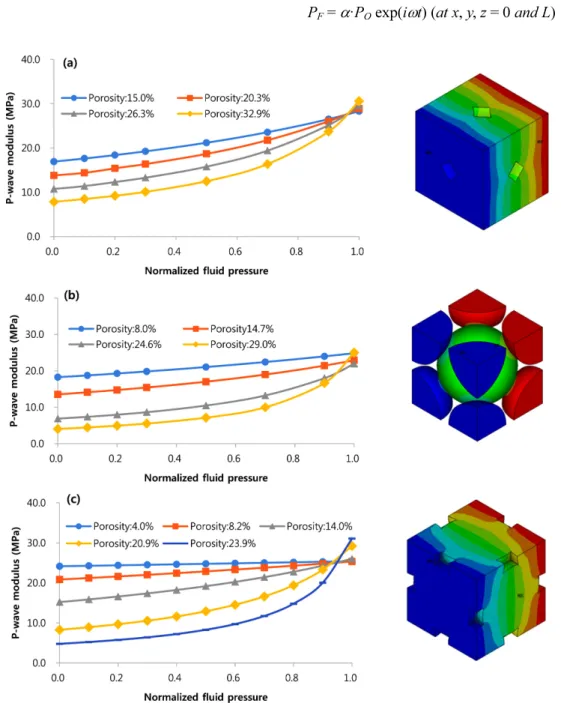
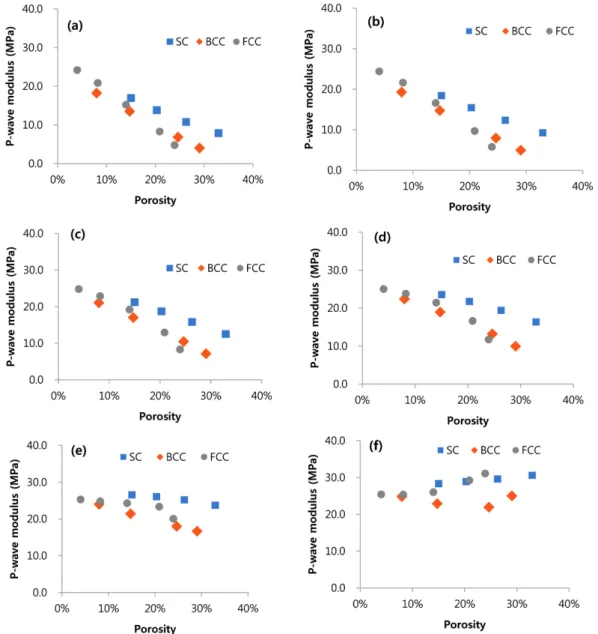
P-wave modulus of RVE model is estimated from har- monic analyses. From defined models, parametric studies were conducted to analyze the effect of the microstructure and the interaction between the fluid electrolyte and the graphite powder matrix.
2. Microstructures of Active Materials
Active materials of the anode electrolyte for LIBs are focused in this study. Graphite powder with size of 30~80 μm are generally applied for anode electrode [6].
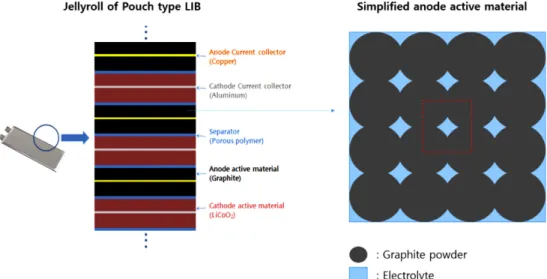
Graphite powders are attached to each other by poly- meric PVDF binder [7]. The compacted graphite powder forms porous matrix, which is fully saturated with fluid electrolyte (Fig. 1).
3. Representative Volume Element analysis
3.1. Definition of RVE models
To apply RVE analysis for the active materials, some assumptions were applied as below:
1) Graphite powders are basically spherical with same diameter (65 μm), which can be overlapped as the compac- tion ratio increases.
2) Graphite powders and the polymeric binders are simplified to have equivalent stiffness and considered as one body.
3) Porous matrix has simplified periodic structures such as simple cubic (SC), body centered cubic (BCC) and face centered cubic (FCC) system.
The RVE must be sufficiently large to contain all of the microscale properties of the components so as to represent equivalent material properties exactly. However, the accu- racy of the RVE increases as its size decreases because of the boundary effect in macroscopic conditions [8]. Thus, the minimum size of RVE that contains every component and microstructure was determined in this study (Fig. 2).
3.2. Microstructure of the graphite powder matrix LIBs of the pouch type cell is generally assembled to the module under the uniform pressure. As the assembly pressure increases, porosity of the active material decreases Fig. 1. Schematic view of the anode active material in pouch type Li-ion battery.
Fig. 2. 3 types of RVE of the anode active material.
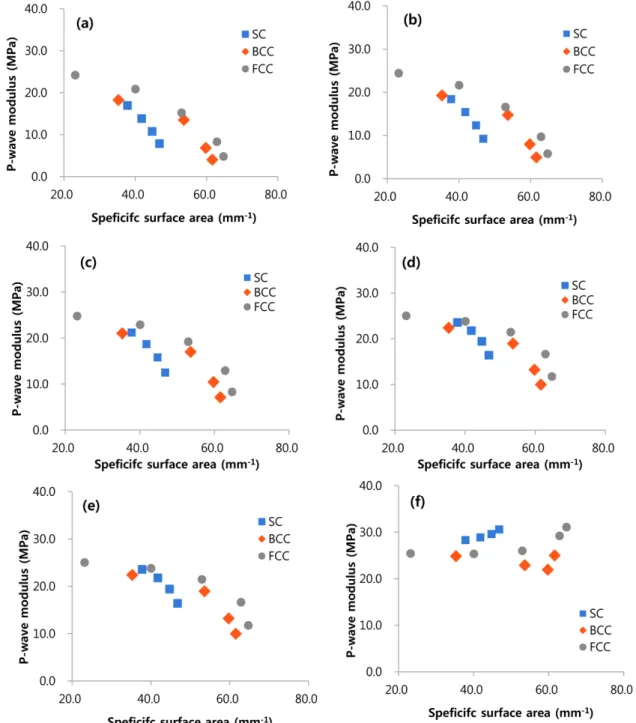
by the change of the microstructure of the graphite powder based matrix. Porosity is defined by the ratio of the volume of the fluid to the volume of the RVE. To identify the effect of the assembly pressure condition to the FSI behavior of the active material, parametric studies were conducted on the porosity of the powder matrix. Porosity was con- trolled by the volume of the overlapped graphite pow- ders in the different types of RVEs. As the microstructure of the RVE changes, geometrical characteristics showed dif- ferent characteristics (Fig. 3). As the porosity increases,
“specific surface area” (ratio of the interface surface area to the RVE volume) increases for all types of RVEs. But
“overlapped powder volume coefficient” (ratio of the overlapped powder volume to the RVE volume) is decreased as the porosity increased.
3.3. Governing equation
To predict fluid-structure interaction of the active materi- als, acoustic harmonic analysis were conducted by using ANSYS Multiphysics. Governing equation of the solid matrix follows the well-known equation of motion:
(1)
Where [M
s], [C
s] and [K
s] are the mass, damping, and stiffness matrices, respectively, and {f
s} and {u
e} is the external force and the displacement vector in the solid matrix, respectively. Acoustic wave equation for the fluid electrolyte in the porous matrix follows the modified
equation of Stoke’s flow:
(2) where [M
F], [C
F] and [K
F] are the mass, damping, and stiffness matrices, respectively, and {f
F} and {p
e} is the external force and the pressure vector in the acoustic fluid, respectively. Interaction between the solid matrix and the fluid assumes: a) there is no friction between the solid and acoustic fluid on the interface b) the solid stress equals to the fluid pressure imposed on the interface. To solve the harmonic behavior of the RVEs with both solid and fluid, a fully coupled finite element dynamic matrix equation is formulated:
(3)
where [R] is the coupled matrix and represents the cou- pling conditions on the interface between the acoustic fluid and the solid matrix. All mechanical properties applied to the analysis are listed in Table 1.
M
S[ ] u [ ] C ··
e+ [ ] u·
S{ } K
e+ [ ] u
S{ }
e= { } f
SM
F[ ] p [ ] C ··
e+ [ ] p·
F[ ] K
e+ [ ] p
F{ }
e= { } f
FMS
[ ] 0 ρo[ ]RT[ ]MF
u··e
{ } pe
{ }··
⎩ ⎭
⎨ ⎬
⎧ ⎫ [ ] 0CS
0 C[ ]F
u·e
{ } p·e
⎩{ }⎭
⎨ ⎬
⎧ ⎫ [ ]KS –[ ]R ρo[ ]RT[ ]KF
ue
{ } pe
⎩{ }⎭
⎨ ⎬
⎧ ⎫ { }fs
fF
⎩{ }⎭
⎨ ⎬
⎧ ⎫
=
+ +