• 검색 결과가 없습니다.

A Study on the Recovery of Li<sub>2</sub>CO<sub>3</sub> from Cathode Active Material NCM(LiNiCoMnO<sub>2</sub>) of Spent Lithium Ion Batteries

N/A
N/A
Protected

Academic year: 2021

Share "A Study on the Recovery of Li<sub>2</sub>CO<sub>3</sub> from Cathode Active Material NCM(LiNiCoMnO<sub>2</sub>) of Spent Lithium Ion Batteries"

Copied!
6
0
0

로드 중.... (전체 텍스트 보기)

전체 글

(1)

ISSN 1225-7591(Print) / ISSN 2287-8173(Online)

A Study on the Recovery of Li 2 CO 3 from Cathode Active Material NCM(LiNiCoMnO 2 ) of Spent Lithium Ion Batteries

Jei-Pil Wang a *, Jae-Jung Pyo a , Se-Ho Ahn a , Dong-Hyeon Choi a , Byeong-Woo Lee b and Dong-Won Lee c

a Department of Metallurgical Engineering, Pukyong National University, Busan 48547, Republic of Korea

b Department of Materials System Engineering, Pukyong National University, Busan 48547, Republic of Korea

c Titanium Department, Korean Institute of Materials Science(KIMS), Changwon 51508, Republic of Korea (Received August 16, 2018; Revised August 18, 2018; Accepted August 20, 2018)

···

Abstract In this study, an experiment is performed to recover the Li in Li

2

CO

3

phase from the cathode active material NMC (LiNiCoMnO

2

) in waste lithium ion batteries. Firstly, carbonation is performed to convert the LiNiO, LiCoO, and Li

2

MnO

3

phases within the powder to Li

2

CO

3

and NiO, CoO, and MnO. The carbonation for phase separation proceeds at a temperature range of 600

o

C~800

o

C in a CO

2

gas (300 cc/min) atmosphere. At 600~700

o

C, Li

2

CO

3

and NiO, CoO, and MnO are not completely separated, while Li and other metallic compounds remain. At 800

o

C, we can confirm that LiNiO, LiCoO, and Li

2

MnO

3

phases are separated into Li

2

CO

3

and NiO, CoO, and MnO phases. After completing the phase separation, by using the solubility difference of Li

2

CO

3

and NiO, CoO, and MnO, we set the ratio of solution (distilled water) to powder after carbonation as 30:1. Subsequently, water leaching is carried out. Then, the Li

2

CO

3

within the solution melts and concentrates, while NiO, MnO, and CoO phases remain after filtering. Thus, Li

2

CO

3

can be recovered.

Keywords: NCM(LiNiCoMnO

2),

Carbonation, Li

2

CO

3

, Water leaching

···

1. Introduction

The cathode active material NMC(LiNiCoMnO

2

) of waste lithium ion batteries is one of the compounds of the cathode active materials of various lithium secondary batteries. The materials of the ternary system have the same structure as LiCoO

2

and capacity per volume and the operating voltage is similar to LiCoO

2

and has low content of Co, so the price benefit is good and a stable cycle is possible inside the high voltage domain [1].

Small home appliances and mobile phones mainly use LiCoO

2

(LCO), but this is unsuitable to be used in medium/large batteries, which require a large output, due to the price rise of cobalt and danger of explosion. So, ter- nary cathode active material, which is a cathode material to replace LCO, which uses a lot of high-priced cobalt, has been highlighted. It mainly consists of three metals, nickel, cobalt, and manganese. Currently, Li(Ni

x

Co

y

Mn

z

)O

2

(NCM)

has been applied as a high capacity cathode material for hybrid electric vehicles (HEV). For the cathode material of the NCM system for electric cars, which is expected to be produced in earnest, the necessity for recycling and repro- cessing scrap is on the rise [2-5].

Many studies on how to recover the valuable metals from the cathode of waste lithium ion batteries have been performed.

In research at the beginning of the 2000s, Lee and Kim studied the leaching behavior of nitric acid or sulfuric acid to recover lithium and cobalt from LiCoO

2

, which is the cathode material separated from waste lithium ion batteries, and how to improve the leaching rate. They used reducing agents such as Na

2

S

2

O

3

and H

2

O

2

and investigated the optimal leaching conditions of LiCoO

2

[10]. In addition, in 2001, Lee and Kim studied the behavior of reduction leaching of LiCoO

2

in sulfuric acid solution in detail and established conditions for the con-

*Corresponding Author: Jei-Pil Wang, TEL: +82-51-629-6741, FAX: +82-51-629-6742, E-mail: [email protected]

(2)

centration of sulfuric acid, leaching temperature, density of the beginning pulp, dosage of hydrogen peroxide and reaction temperature [9].

In 2005, Swalin et al. leached LiCoO

2

into sulfuric acid and used a solvent extraction method and did research to recover more than 99.99% of the cobalt solution from sulfuric acid. In 2010, Lee and Chung5) leached LiCoO

2

into sulfuric acid, separated and refined it for solvent extraction, used an alkaline reagent, and produced more than 99.98% of cobalt trioxide through cobalt hydroxide and heat treatment. They also performed research to manufacture lithium by using sodium carbonate [7].

Also, for the NCM system, Kim et al. produced a precur- sor of cathode active material of nickel, cobalt, and man- ganese through physical/chemical treatment of waste lithium ion battery packs of electric cars. Using a copre- cipitated filtrate, they performed a study to make lithium carbonate [17]. However, for the recycling method of cathode active material of the original secondary battery, valuable metals such as cobalt, nickel, and manganese are recovered and lithium is recovered in the form of lith- ium carbonate by using sodium carbonate. In this case, sodium is an impurity and the fact that many washing processes are required is a disadvantage.

This research studied the pyrometallurgical recovery process of waste lithium battery cathode material in the NCM system that is eco-friendly and can obtain the recovery of material with high purity with simple pro- cessing for Li metal to be recovered in the waste lithium battery powder in the NCM system. Following heat treat- ment in a reducing atmosphere(mixed atmosphere of CO and CO

2

or independent atmosphere of CO

2

), after isolat- ing the phases of Li, Ni, Mn, and Co, the recovery of lithium was performed through water leaching by using the solubility difference of Ni, Co, and Mn.

2. Experimental

2.1. Experiment Materials

Cathode active material NMC(LiNiCoMnO

2

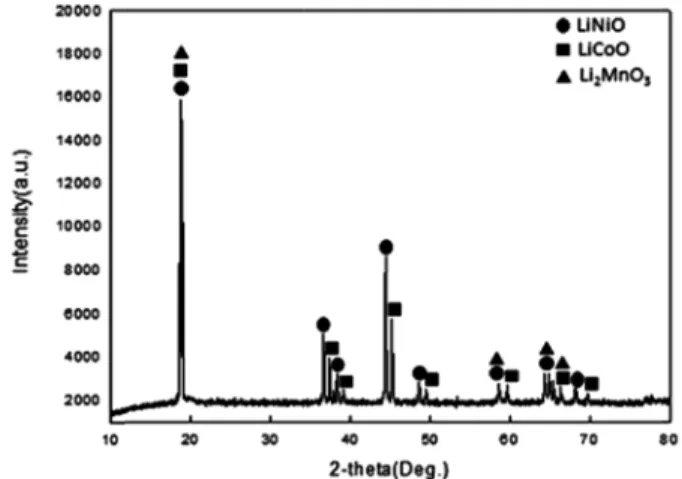
) powder of waste lithium ion batteries was used in the experi- ment. The chemical composition of the experiment mate- rials was analyzed with X-ray diffraction (XRD) and energy-dispersive X-ray spectroscopy (EDS) and three phases in the forms of LiNiO, LiCoO, and Li

2

MnO

3

were

composed. The XRD results are shown in Fig. 1, and the EDS results are shown in Table 1. The lithium content of experiment materials was measured with ICP analysis, and we confirmed that it was composed of 6.521% lith- ium. The results are shown in Table 1.

2.2. Carbonation

To extract Li from the cathode active material NMC (LiNiCoMnO

2

) powder of waste lithium ion batteries, carbonation was performed to separate Li and Ni, Mn, and Co. An electric furnace was used for the experiment apparatus, and the scheme for that is shown in Fig. 2.

Using an SUS crucible, a white lubricated release agent was spread to prevent the sample from being absorbed into the crucible. A 30g sample was used.

For the experiment temperature, the heating rate was set as 10

o

C/min and it was maintained for 2 hours at 600

o

C, 700

o

C, and 800

o

C and then reduced by 10

o

C/min.

An Ar atmosphere was used during heat rising and CO

2

atmosphere in the maintenance step after heat rising, and Fig. 1. XRD pattern of waste lithium-ion battery powder in this study.

Table 1. Chemical composition of waste lithium-ion battery powder (wt. %)

Element EDS(Weight%) ICP(Weight%)

Li - 6.521

C 18.60 -

O 28.15 -

Al 0.81 -

Mn 8.21 -

Co 27.56 -

Ni 16.67 -

(3)

CO

2

gas was blown in at 300cc per minute. At the stage of heat reduction after maintenance, the Ar atmosphere was maintained again.

2.3. Water Leaching

After heat treatment with CO

2

, the experiment was per- formed by pulverizing the battery powder of waste lith- ium batteries in the NCM system, which was sintered.

By using the solubility difference of Li

2

CO

3

and metallic oxides (NiO, MnO, CoO), an experiment to separate Li

2-

CO

3

and metallic oxides (NiO, MnO, CoO) through water leaching was performed. For experiment appara- tus, a mixer and beaker were used. Distilled water was usedas the solvent for water leaching, and the ratio of distilled water to NMC(LiNiCoMn) powder of the cath- ode active material of waste lithium ion batteries was set to be 30:1. The time for water leaching was 5 hours.

3. Result and Discussion

3.1. Carbonation

First, the thermal behavior of cathode active material NMC(LiNiMnCoO

2

) of waste lithium batteries was con- firmed with a thermogravimetric apparatus (TGA) and the heat rising temperature was 995

o

C/min and heat ris- ing speed was 5

o

C/min, and they were measured in a CO

2

atmosphere. The results are shown in Fig. 3.

As a result of TGA analysis, a big weight change was observed between 650

o

C and 800

o

C and the phase change occurred in this temperature range.

In the TGA experiment results, the battery powder of the NCM system carbonated at 600

o

C, 700

o

C, and 800

o

C and to see the phase change during the process, XRD

analysis was performed. The XRD analysis results are shown in Fig. 4. Looking at the XRD analysis results, when carbonation was performed at 600

o

C and 700

o

C, Li

2

CO

3

and NiO, CoO, and MnO were not completely separated, and Li and the compounds of other metals remained. It was confirmed that the phase of the raw sample, which was LiNiO, LiCoO, and Li

2

MnO

3

, was completely separated into NiO, CoO, and Li

2

CO

3

phases by carbonation at 800

o

C. The Chemical composition after Carbonation is shown in Table 2. It was observed that lithium content was not changed during thermal treat- ment.

3.2. Water Leaching

After pulverizing the sintered sample after carbon- ation, water leaching was performedby using the solubil- ity difference of Li

2

CO

3

and Ni, CoO phases. Table 3.

shows the solubility difference according to the tempera- ture of Li

2

CO

3

and Ni, CoO phases.

In Table 3, in the case of Ni and CoO, they do not melt in water, and in the case of Li

2

O

3

, because solubility decreases as temperature rises, flushing at a lower tem- perature is more favorable.

If we consider that Li content in the raw sample is Fig. 2. Schematic diagram of experimental apparatus for

carbonation of NCM system waste Li-ion battery powder.

Fig. 3. TGA curve of NMC waste Li-ion battery powder.

(4)

6.52wt.% and the analyzed solution is 10 ml, when the ratio of the weight of distilled water to powder after car- bonation is 30:1, we can predict that Li

2

CO

3

in the sam- ple after carbonation was completely dissolved in water.

During water leaching, the ratio of distilled water to

Fig. 4. XRD patterns of (a) Raw sample (b) After carbonation at 600

o

C (c) After carbonation at 700

o

C (d) After carbonation at 800

o

C.

Table 2. Chemical composition of NMC after carbonation

Element EDS(Weight%) ICP(Weight%)

Li - 6.021

C 22.61 -

O 41.87 -

Al 0.48 -

Mn 6.38 -

Co 18.31 -

Ni 10.34 -

Table 3. Solubility of Li

2

CO

3

, NiO, CoO and MnO in water Molecular formula Solubility in water

Li

2

CO

3

1.54 g/100mL(0ºC) 1.32 g/100mL(20ºC) 1.00 g/100mL(60ºC) 0.72 g/100mL(100ºC)

NiO, CoO, MnO Insoluble

Fig. 5. XRD patterns of NMC system waste Li-ion battery

powders after water leaching. (a) After carbonation at

800

o

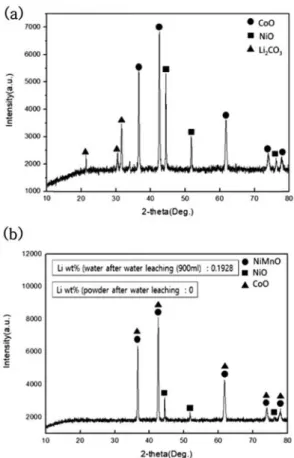
C (b) Powder After water leaching

(5)

NMC sample after carbonation was set as 30:1 and was done for 5 hours, and powder and solution were sepa- rated through a decompressed filter after water leaching.

The phase change during water leaching of dried powder after filtering was observed through XRD analysis, and the resultsare shown in Fig. 5. Also, to confirm the Li

2-

CO

3

amount dissolved in the solution, ICP of powder and ICP analysis of the solution were performed, and the results are shown in Table 4.

When the water leaching of NMC powder after carbon- ation was processed, Li

2

CO

3

phase was all dissolved in the solvent and concentrated and we confirmed that only NiO, CoO, and NiMnO phases remained in the powder after the decompressed filter

3.4. Li Behavior during the Overall Process

Along with the results of the weight change of the sample during the overall process and ICP analysis results, Li content by step is shown in Table 4.

Powder after water leaching and lithium content in the solution after water leaching were calculated and are shown in Table 4. The ratio of distilled water to powder after carbonation was set to be 30:1, and after water leaching for 5 hours, 1.735 g of Li was dissolved in NMC powder after carbonation and we confirmed that it was completely dissolved in water without Li

2

CO

3

and concentrated in the solution. Based on the results, when leaching three times ata 10:1 ratio or water leaching of distilled water to sample at a ratio of 30:1 was pro- cessed, we confirmed that Li

2

CO

3

was completely dis-

solved and concentrated in the solution.

4. Conclusions

Though phase separation and water leaching followed by carbonation of the cathode active material NMC(LiNi- CoMn) powder of waste lithium ion batteries, the follow- ing results for Li

2

CO

3

recovery after separating Li

2

CO

3

and metallic oxides (NiO, MnO, CoO) were obtained.

1) The phase separation for waste lithium battery pow- der in the NCM system in CO

2

gas atmosphere through carbonation occurred at 650

o

C~800

o

C and the phase sep- aration of Li

2

CO

3

and metallic oxides (NiO, MnO, CoO) occurred.

2) Only some had phase separations at 600

o

C, 700

o

C and 800

o

C, and there was phase separation of three phases such as LiNiO, LiCoO, and Li

2

MnO

3

into NiO, CoO, and Li

2

CO

3

phases after CO

2

carbonation.

3) By using the solubility difference of Li

2

CO

3

and NiO, CoO, and MnO phases, water leaching was pro- cessed and the ratio of distilled water to NMC powder after carbonation was set to be 30:1 and was done for 5 hours. When a decompressed filter was used, Li

2

CO

3

was completely dissolved and concentrated in the solution.

NiO, MnO, and CoO phases remained inside the powder after filtration and Li

2

CO

3

and metallic oxides (NiO, MnO, CoO) were completely separated.

Acknowledgement

This study was supported by the R&D Center for Valu- able Recycling(Global-Top R&BD Program) of the Min- istry of Environment.(Project No.:2016002220001) and was also supported by the BB21+ Project in 2018.

References

[1] S. W. Lee and S. A. Choi: Ceramist, 13 (2010) 32.

[2] H. C. Jung, G. H. Kim, H. S. Hong and D. W. Kim: J.

Korean Powder Metall. Inst., 17 (2010) 175.

[3] H. K. Park: J. Korean Electrochem. Soc., 11 (2008) 197.

[4] H. S. Hong, H. C. Jung, G. H. Kim and Y. D. Ko: Trends in Metals & Materials Engineering, 24 (2011) 26.

[5] G. C. Shim: Trends in Metals & Materials Engineering, 24 (2011) 49.

[6] J. J. Lee and J. D. Chung: J. of Korean Inst. of Resources Table 4. Weight change of sample and change of Li content

in the overall process and content of Li in the process Process Raw sample After carbonation

Weight (gram) 30 32.07

Chemical

Composition of Li 6.52 6.05

Li Weight (gram) 1.95 1.93

Process Solution after water leaching

Powder after water leaching Volume (milliliter)

or Weight (gram) 900 ml 26.24 g

Chemical Composition

of Li 0.1928 Non detect

Li Weight (gram) 1.735 Non detect

(6)

Recycling, 19 (2010) 51.

[7] B. Swain, J. K Jeong, M. S Kim, J. C. Lee and J. S Sohn:

J. of Korean Inst. of Resources Recycling, 14 (2005) 28.

[8] C. K. Lee and D. H. Yang: J. Korean Ind. Eng. Chem., 12 (2001) 890.

[9] C. K. Lee and N. H. Kim : J. of Korean Inst. of Resources Recycling, 10 (2001) 9.

[10] C. K. Lee and T. H. Kim: J. of Korean Inst. of Resources Recycling, 9 (2000) 37.

[11] L. Li, J. Ge, R.J Chen, F. Wu, S. Chen and X. X Zhang:

Waste Management, 30 (2010) 2615.

[12] Y. Yamaji, G. Dodbiba, S. Matsuo, K. Okaya, A. Shi- bayama and T. Fujita: Resource Processing, 58 (2011) 9.

[13] C. Liang, T. Xin-cun, Z. Yang, Q. Yi, Z. Min: The Chi- nese Journal of Nonferrous Metals, 21 (2011) 1192.

[14] M. Petranikova, A. Miskufova, T. Havlik, O. Petranikova and A. Pehkonen: Acta Metallugica Slovaca, 17 (2011) 106.

[15] E. M. Garcia, Hosane A, T. Matencio, R. Z. Domingues, J. A. F dos Santos and M. B. J. G de Freitas: J. Appl.

Electrochem., 41 (2011) 1373.

[16] T. Georgi-Maschler, B. Friedrich, R. Weyhe, H. Heegn and M. Rutz: J. Power Sources, 207 (2012) 173.

[17] S. K. Kim: The 2011 spring meeting and 36the confer-

ence, Korean Inst. of Resources Recycling, (2011) 84.

수치

Table 1. Chemical composition of waste lithium-ion battery powder (wt. %)
Fig. 3. TGA curve of NMC waste Li-ion battery powder.
Fig. 5. XRD patterns of NMC system waste Li-ion battery powders after water leaching. (a) After carbonation at 800 o C (b) Powder After water leaching

참조

관련 문서

Among the sub-factors of autonomy support coaching behavior, strategy recognition had the most direct influence on the grit of athletes, followed by

For job characteristics sub-factors, while the average of functional diversity was high in graduate school graduates, the average of task importance, job

Second, as a result of the IPA analysis of the sub-factors of audience perception, the factors of entry route were located in the first quadrant, the

This study was conducted to recognize the importance of self - management of dance major students and to understand the relationship between the sub -

Third, looking at the sub-factors in terms of textbooks and software by priority, they were in the order of development of textbooks and learning tools

Improved electrolytes for Li-ion batteries: Mixtures of ionic liquid and organic electrolyte with enhanced safety and electrochemical performance.. Journal

For the sub-factors of selection attributes and customer value according to screen golf course handicap, convenience, professionality, facilities, price,

The results of this study are as follows: ⑴ 4 basic directions, 16 themes, and 64 sub-themes of the vocational high school development are established, and