Isolation and Characterization of a Nitric Oxide-induced Gene in Sweetpotato
Il Hwan Lee
1†, Donghwan Shim
1†, Kang Lok Lee
2, Ki Jung Nam
2, Shin-Woo Lee
3and Yun-Hee Kim
2*
1Department of Forest Bio-resources, National Institute of Forest Science, Suwon 16631, Korea
2Department of Biology Education, IALS, Gyeongsang National University, Jinju 52828, Korea
3Department of Agronomy & Medicinal Plant Resources, Gyeongnam National University of Science & Technology, JinJu 52725, Korea Received March 11, 2019 /Revised April 8, 2019 /Accepted April 22, 2019
A new nitric oxide-induced (NOI) gene was isolated by screening ESTs from a cDNA library of dehy- dration-treated fibrous roots of sweetpotato (Ipomoea batatas). The 720 bp cDNA fragment, IbNOI, was sequenced, from which a 77 amino acid residue protein was deduced. A search of the protein BLAST database identified significant similarity to other plant NOI protein sequences. Quantitative RT-PCR analysis revealed diverse expression patterns of IbNOI in various tissues of the intact sweetpotato plant, and in leaves exposed to different stresses. The IbNOI gene was highly expressed in storage roots and suspension-cultured cells. In leaf tissues, IbNOI showed strong expression during
sodium nitroprusside (SNP)-induced NO accumulation and chemical stress treatments. Expression of IbNOIwas also induced under various abiotic stress conditions, such as dehydration, salt, and bacterial pathogen infection. These results suggest that IbNOI is involved in plant responses to diverse abiotic stresses and pathogen infection through a NO-related pathway.
Key words : Ipomoea batatas, nitric oxide, reactive oxygen species, stress
†Authors contributed equally.
*Corresponding author
*Tel : +82-55-772-2237, Fax : +82-55-772-2239
*E-mail : [email protected]
This is an Open-Access article distributed under the terms of the Creative Commons Attribution Non-Commercial License (http://creativecommons.org/licenses/by-nc/3.0) which permits unrestricted non-commercial use, distribution, and reproduction in any medium, provided the original work is properly cited.
Journal of Life Science 2019 Vol. 29. No. 6. 631~636 DOI : https://doi.org/10.5352/JLS.2019.29.6.631
Introduction
Nitric oxide (NO) is a gaseous free-radical and key signal- ing molecule in different physiological processes of animals and plants [9, 10]. In plants, NO is a relatively stable para- magnetic free-radical molecule involved in many physio- logical processes, where it functions as a synchronizing chemical messenger involved in cytotoxicity and pro- grammed cell death during pathogen attack [2, 10]. NO is implicated in the response to some abiotic stresses in differ- ent plant species [1, 3]. The NO intracellular signaling cas- cade is activated in plant cells in response to pathogens or elicitors [4]. At the transcriptional level, a microarray study obtained from NO donor-treated Arabidopsis cells indicates that NO modulates the expression of several defense-related genes, including genes encoding pathogenesis-related (PR) and secondary metabolism-related proteins [11, 13].
Sweetpotato (Ipomoea batatas) is a relatively drought-re-
sistant crop and represents one of the most important root crops grown on marginal lands. Although sweetpotato is recognized as a comparatively drought-tolerant plant, the molecular mechanisms underlying drought tolerance are not well defined. Previously, expressed sequence tags (ESTs) from a full-length enriched cDNA library prepared from de- hydration-treated fibrous roots of sweetpotato were isolated and characterized [6]. Expression analysis showed that some sweetpotato antioxidant genes isolated from the EST library of dehydration-treated fibrous roots were also induced in response to various environmental stresses [7]. Therefore, the investigation of sweetpotato EST pools might yield val- uable genetic information about the regulatory networks in- volved in stress-response processes of sweetpotato.
In this study, we isolated and characterized the NO-in- duced IbNOI gene from an EST library of dehydration-treated fibrous roots of sweetpotato. To better understand the func- tion of the IbNOI gene, we analyzed its expression under various stress conditions. The results suggest that the IbNOI gene plays a role in responses to abiotic stress and pathogen infection in sweetpotato.
Materials and Methods
Plant materials
Sweetpotato (Ipomoea batatas L. Lam. cv. White Star) was
obtained from Bioenergy Crop Research Center, National
Crop Research Institute, RDA, Muan, Jeonnam, Korea. Plants were cultivated in a growth chamber in soil at 25℃ with a photoperiod of 16 hr light/8 hr dark for 50 days.
Analysis of DNA and protein sequences
Sequence identities were determined using the National Center for Biotechnology Information (NCBI) BLAST search tool (https://blast.ncbi.nlm.nih.gov/), and multiple sequence alignments were performed using the Clustal X (www.
clustal.org/clustal2/) and GeneDoc programs. The deduced proteins were predicted using the ExPasy (http://www.ex- pasy.org/tools) programs.
Stress treatment
Sweetpotato plants grown at 25℃ for 50 days were used for stress treatments. For stress treatment conditions, sweet- potato plants were incubated in a growth chamber at 25±3℃
under a photoperiod of 16 hr light/8 hr dark, and 70% rela- tive humidity) with a light intensity of 200 μmol s
−1m
−2provided by fluorescent and metal halide lamps. For sodium nitroprusside (SNP) treatment, the third leaf from the top was removed from each plant and transferred to Petri dishes containing 50 ml of each solution at different concentrations (0, 0.1, 0.5, 1, 5, 10, and 50 mM) for 24 hr. For treatments with hydrogen peroxide (H
2O
2, 400 mM), methyl viologen (MV, 0.05 mM), cadmium (Cd, 0.5 mM), and copper (Cu, 0.5 mM), sweetpotato leaves were incubated in conical tubes containing 30 ml of each chemical solution at 25℃ for 24 hr under light conditions. Sterile water was used as a control for chemical stress treatments. For dehydration treatment, the plants were carefully pulled out, transferred onto filter papers and allowed to dry. Sweetpotato leaves were col- lected at 0 (untreated control), 1, 2, 4, 8, 16, and 24 hr after treatment. For treatments with NaCl, the third leaf from the top was removed from each plant and placed into conical tubes containing 30 ml of sterile water (control), or 100 mM NaCl, and then incubated at 25℃ for 24 hr. For bacterial treatment, Pectobacterium chrysanthemi (Erwinia chrysanthemi, KCTC 2569) was used according to Jang et al. [5]. P. chrys- anthemi was grown on nutrient agar medium at 30℃. For infection with P. chrysanthemi, nine leaf discs (18 mm in di- ameter) placed in a Petri-dish (87×15 mm) were inoculated with P. chrysanthemi (1.3×10
4cells per ml). Bacterial cell num- bers were estimated by measuring the optical density at 600 nm. For Mock treatment, leaf discs were treated with dis- tilled water. All treated plant materials were frozen immedi-
ately in liquid nitrogen after treatment and stored at -70℃
until further use.
Gene expression analysis
Total RNA was isolated from sweetpotato using TRIzol reagent (Invitrogen, Carlsbad, CA, USA) and treated ex- tensively with RNase-free DNase I to remove any con- taminating genomic DNA. For quantitative expression anal- ysis of antioxidant genes, first strand cDNA was generated from total RNA (2 μg) using MMLV reverse transcriptase (Promega, Madison, WI, USA) in accordance with the manu- facturer’s instructions. Quantitative RT-PCR (qRT-PCR) was performed in a fluorometric thermal cycler (DNA Engine Opticon 2, MJ Research, Waltham, MA, USA) using Ever Green fluorescent dye, according to the manufacturer’s instructions. The inter-experimental quality control compar- isons of repeated samples were assessed using CT values between the three replications. Linear data were normalized to the mean CT of α-tubulin as a reference gene. Gene-specif- ic primers used for PCR reactions were as follows: the IbNOI primer set (5’-GCCAGCCAGAATCACCAACAAA-3’, 5’-TCC ACATGCAAAATGTGGGGAT-3’) used to amplify a 180 bp product from cDNA coding for IbNOI; and alpha-tubulin gene-specific primers (5’-CAACTACCAGCCACCAACTGT- 3’, 5’-CAAGATCCTCACGAGCTTCAC-3’) to amplify the tu- bulin gene as an internal standard.
Statistical analyses
Data were analyzed by one-way analysis of variance (ANOVA). The subsequent multiple comparisons were ex- amined based on the least significant difference (LSD) test.
All statistical analyses were performed using the Statistical Package for the Social Sciences (SPSS 12), and statistical sig- nificance was set at p<0.05 and p<0.01.
Results
Isolation and sequence analysis of the IbNOI
To analyze the ESTs from the cDNA library of dehy-
dration-treated sweetpotato fibrous roots [9], we searched
the sequences using the NCBI database. The classification
was based on the best homology match of BLASTX searches
against Arabidopsis and other plant protein sequences. The
novel nitric oxide-induced (NOI) gene was found among the
most abundant ESTs. Its cDNA is 712 bp in length and enc-
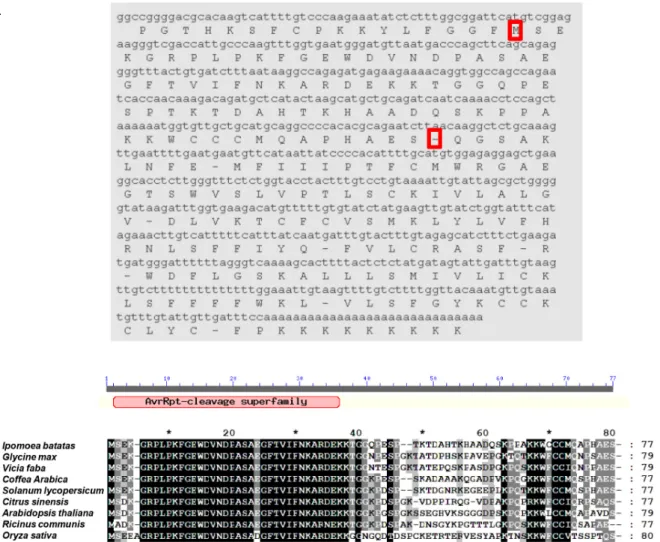
odes a deduced 77 amino acid residue protein (Fig. 1A).
A
B
Fig. 1. Sequence analysis of the IbNOI full-length cDNA. (A) Nucleotide and deduced amino acid sequences of IbNOI cDNA.
(B) Multiple alignments of the amino acid sequences of INOI proteins isolated from various plants. Conserved AvrRpt-cleavage superfamily domain was shown in red box. Ipomoea batatas (MK455780), Glycine max (XP_003532179.1), Vicia faba (BAJ78239.1), Coffea Arabica (XP_027062349.1), Solanum lycopersicum (XP_004244039.1), Citrus sinensis (XP_006474872.1), Arabidopsis thaliana (AAB86938.1), Ricinus communis (XP_002532206.1), Oryza sativa (BAD69095.1).
Database searches revealed that the amino acid sequence of the IbNOI protein contains a conserved, 33 amino acid se- quence homologous to the AvrRpt-cleavage superfamily do- main that is present in a large family of plant AvrRpt-cleav- age proteins (Fig. 1B). Alignment and comparison of its ami- no acid sequence with those of other NOI genes isolated from various plant species showed that it shares 83% homol- ogy with coffee NOI and 79% homology with tomato NOI (Fig. 1B). Therefore, we suggest that IbNOI can be classified as a member of the plant NOI proteins, and is likely to have a similarly important role in NO-related stress responsive gene expression.
Differential expression of IbNOI in intact sweet- potato tissues
The expression patterns of the IbNOI gene were inves- tigated in various whole plant tissues (L, leaf; S, stem; FR, fibrous root; TR, thick pigmented root; SR, storage root; SUS, suspension-cultured cells) by RT-PCR analysis (Fig. 2). The results demonstrate that there is considerable variation in the levels of IbNOI expression in different sweetpotato tissues. The IbNOI gene was strongly expressed in storage root and suspension-cultured cell conditions, whereas it was weakly expressed in leaf, stem, and fibrous root tissues.
Differential responses of sweetpotato IbNOI to SNP and chemical stresses
To investigate the NO-induced responses of sweetpotato
IbNOI, gene expression changes in response to increasing
concentrations of SNP in leaves of sweetpotato were ana-
Fig. 2. Expression patterns of IbNOI in various intact tissues of sweetpotato. Total RNAs were extracted from the leaf (L), stem (S), fibrous root (FR), thick pigmented root (TR), and storage root (SR), and suspension-cultured cells (SUS). Alpha-tubulin was utilized as a control for equal loading. RT-PCR analyses were repeated at least three times.
A B
0 hr 24 hr 24 hr
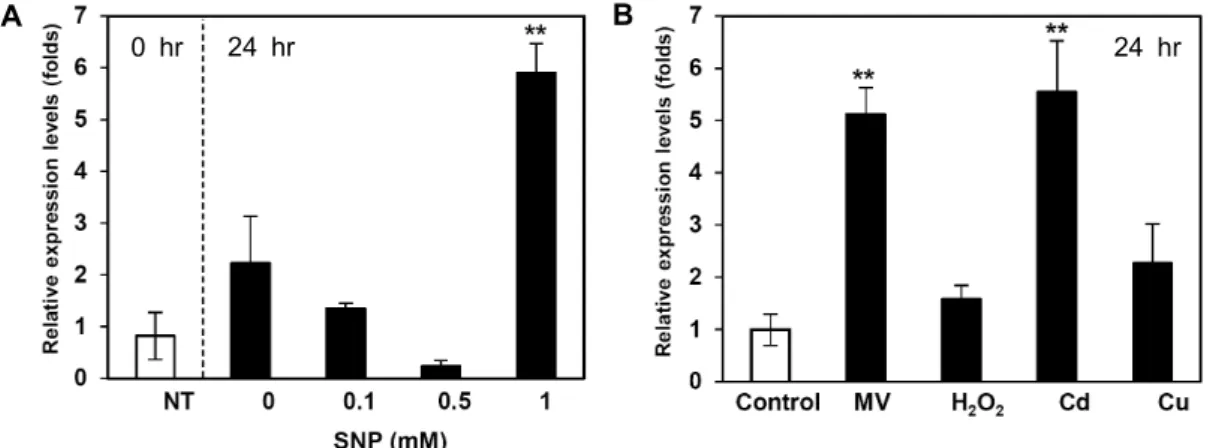
Fig. 3. Expression patterns of IbNOI under SNP and chemical stress conditions. (A) Expression patterns of IbNOI leaves in response to SNP treatment for 12 hr. (B) Expression patterns of IbNOI under stress-related chemical treatments (0.05 mM MV, 400 mM H2O2, 0.5 mM Cd, and 0.5 mM Cu) for 24 hr. Data represent the average of three replicates from two experiments, and error bars indicate SD of the means. Statistical significance of differences between the control and treatment groups was determined by one-way ANOVA with the LSD post hoc test (*p<0.05; **p<0.01).
lyzed by qRT-PCR. The IbNOI gene exhibited different ex- pression patterns in response to increasing concentrations of SNP (Fig. 3A). The IbNOI gene was strongly expressed in response to 1 mM SNP. IbNOI expression was induced by various reactive oxygen species and heavy metal in sweetpotato leaves (Fig. 3B).
Differential expression of IbNOI in response to pathogen infection and abiotic stresses
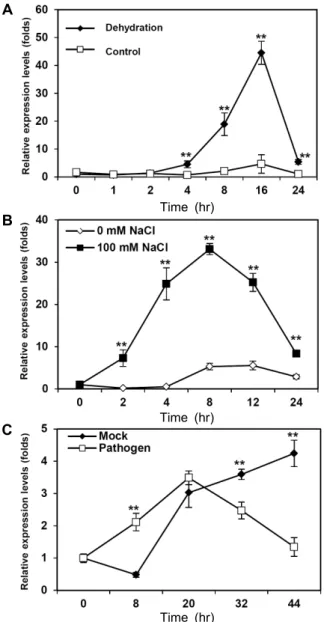
The expression patterns of IbNOI in response to abiotic stress treatment and pathogenic infection were investigated by qRT-PCR. Following dehydration, IbNOI was differ- entially expressed in leaves (Fig. 4A). IbNOI expression in- creased strongly 4 hr after dehydration, whereas in the con- trol conditions expression was slightly up-regulated at 16 h. In leaves, expression of the IbNOI gene was induced with- in 2 hr by treatment with 100 mM NaCl (Fig. 4B). Expression patterns of the IbNOI gene were also investigated in the leaves after infection with a bacterial pathogen (P. chrys-
anthemi) (Fig. 4C). IbNOI expression was strongly induced by bacterial infection from 8 to 20 hr, and increased under untreated control conditions after 20 hr. These results sug- gest that IbNOI responds differently to various kinds of abio- tic stress and pathogen infection.
Discussion
In this study, IbNOI was isolated from dehydration-treated fibrous roots of sweetpotato, and the response to abiotic stress and pathogen infection was characterized. A compar- ison of stressed and unstressed plants revealed that the ex- pression levels of the IbNOI gene increased in response to high concentration of SNP (1 mM), dehydration, NaCl, MV, Cd treatment, and bacterial pathogen infection (Fig. 3, Fig.
4). However, the expression levels of IbNOI did not change significantly in response to H
2O
2and Cu treatments. These results suggest that the IbNOI gene is involved in responses to NO-related abiotic stresses and pathogen defense-medi- ated plant stresses in sweetpotato.
IbNOI was also found to be expressed differentially in var- ious tissues of whole plants and under cell culture con- ditions of sweetpotato (Fig. 2). Interestingly, they showed the highest expression during growth as cell suspension cultures. Cell suspension cultures result in the exposure of cells to higher levels of oxidative stress compared with whole plants [8]. The results of the present study showed that the expression of the IbNOI gene increased following oxidative stress treatment, such as with MV and Cd (Fig.
3). These findings indicate that the expression of the IbNOI
A
B
C
Time (hr)
Time (hr)
Time (hr)
Fig. 4. Expression patterns of IbNOI under different abiotic stress and pathogen infection conditions. (A) Expression pat- terns of IbNOI in leaves under dehydrated conditions for 24 hr. (B) Expression patterns of IbNOI in leaves treated with 100 mM NaCl for 24 hr. (C) Expression patterns of IbNOI following infection of sweetpotato leaves with a bacterial pathogen (P. chrysanthemi). The mock in- volved treatment with 10 mM MgCl2. Data represent the average of three replicates from each of two experiments, and error bars indicate SD of the means. Statistical sig- nificance of differences between the control and treat- ment groups was determined by one-way ANOVA with the LSD post hoc test (*p<0.05; ** p<0.01).
gene might be regulated in cell suspension cultures and un- der stress-related chemical treatment-mediated oxidative stress conditions.
Interestingly, IbNOI gene was markedly expressed in re- sponse to bacterial infection, and this gene expression was
also lately increased in mock treatment by wounding effects (Fig. 4) . In the previously study, expression patterns of 10 peroxidase genes were investigated in sweetpotato during P. chrysanthemi infection [5]. The peroxidase genes also showed the induced gene expression in mock treatment was well matched with the induction by wounding in their pre- vious study [13]. Strong induction by wounding was shown in sweetpotato peroxidase gene swpa4 which also showed strong response to pathogen infection similarly with IbNOI.
These results suggested that IbNOI gene contribute to a de- fense mechanism against pathogen attack.
The data presented here suggest that IbNOI might have roles in NO-related abiotic stress tolerance and pathogenic resistance. Further investigation will be required to elucidate the exact role of the IbNOI gene in the regulation of the de- fense signal pathway in sweetpotato under stress conditions.
For analyses of its role in the stress tolerance mechanism in plants, transgenic sweetpotato expressing the IbNOI gene will be generated. We expect that these studies involving the overexpression or suppression of the sweetpotato IbNOI gene in transgenic plants will provide valuable information for the development of crops with enhanced tolerance to a variety of stresses.
Acknowledgment
This research was supported by the Basic Science Re- search Program through the National Research Foundation of Korea (NRF) funded by the Ministry of Science, ICT, and Future Planning (2018R1A1A1A05018446).
References
1. Airaki, M., Leterrier, M., Mateos, R. M., Valderrama, R., Chaki, M., Barroso, J. B., del Rio, L. A., Palma, J. M. and Corpas, F. J. 2012. Metabolism of reactive oxygen species and reactive nitrogen species in pepper (Capsicum annuum L.) plants under low temperature stress. Plant Cell Environ.
35, 281-295.
2. Besson-Bard, A., Pugin, A. and Wendehenne, D. 2008. New insights into nitric oxide signaling in plants. Annu. Rev.
Plant Biol. 59, 21-39.
3. Corpas, F. J., Chaki, M., Fernandez-Ocana, A., Valderrama, R., Palma, J. M., Carreras, A., Begara-Morales, J. C., Airaki, M., del Rio, L. A. and Barroso, J. B. 2008. Metabolism of reactive nitrogen species in pea plants under abiotic stress conditions. Plant Cell Physiol. 49, 1711-1722.
4. Garcı´a-Brugger, A., Lamotte, O., Vandelle, E., Bourque, S., Lecourieux, D., Poinssot, B., Wendehenne, D. and Pugin,
초록:고구마에서 질소 유도성 유전자의 분리 및 특성분석
이일환
1†․심동환
1†․이강록
2․남기정
2․이신우
3․김윤희
2*
(1국립산림과학원 산림생명자원연구부, 2국립경상대학교 생물교육과(농업생명과학연구원), 3국립경남과학기술대
학교 생명과학대학 농학ㆍ한약자원학부)
본 연구에서는 산화질소 유도성(nitric oxide-induced, NOI) 유전자를 건조 처리된 고구마 실뿌리의 EST 라이브 러리에서 분리하였다. 분리된 IbNOI 유전자의 cDNA는 712 bp의 길이이며, 77개의 아미노산으로 구성되어 있었 다. Blast 데이터베이스를 분석한 결과, 식물에서 보고된 NOI 단백질에 속하는 것으로 확인되었다. RT-PCR과 re- altime-PCR을 통해 IbNOI 유전자의 발현수준을 고구마 식물체의 조직별로 조사한 결과, 저장뿌리와 현탁배양세 포에서 높은 발현 수준을 보였다. 잎에서 산화질소를 유도하는 SNP와 화합물 스트레스들을 처리시, IbNOI의 발 현이 증가함을 확인할 수 있었다. 또한 고염, 건조와 같은 비생물학적 스트레스 및 병원균 감염에 의해서도 IbNOI 의 발현이 유도됨을 확인할 수 있었다. 본 연구의 결과들을 통해 IbNOI 유전자는 다양한 비생물학적 스트레스 및 병원균 감염 동안 산화질소와 연관된 조절기작을 통해 식물의 방어기능에 관여할 것으로 생각되는 바이다.
A. 2006. Early signaling events induced by elicitors of plant defences. Mol. Plant Microbe. Interact. 7, 711-724.
5. Jang, I. C., Park, S. Y., Kim, K. Y., Kwon, S. Y., Kim, G.
K. and Kwak, S. S. 2004. Differential expression of 10 sweet- potato peroxidase genes in response to bacterial pathogen, Pectobacterium chrysanthemi. Plant Physiol. Biochem. 42, 451- 455.
6. Kim, S. H., Song, W. K., Kim, Y. H., Kwon, S. Y., Lee, H.
S., Lee, I. C. and Kwak, S. S. 2009. Characterization of full- length enriched expressed sequence tags of dehydration- treated white fibrous roots of sweetpotato. BMB Rep. 42, 271-276.
7. Kim, Y. H., Jeong, J. C., Lee, H. S. and Kwak, S. S. 2013.
Comparative characterization of sweetpotato antioxidant genes from expressed sequence tags of dehydration-treated fibrous roots under different abiotic stress conditions. Mol.
Biol. Rep. 40, 2887-2896.
8. Kwak, S. S., Kim, S. K., Lee, M. S., Jung, K. H., Park, I.
H. and Liu, J. R. 1995. Acidic peroxidase from suspension
cultures of sweetpotato. Phytochemistry 39, 981-984.
9. Murad, F. 2004. Discovery of some of the biological effects of nitric oxide and its role in cell signaling. Biosci. Rep. 24, 452-474.
10. Neill, S. J., Desikan, R. and Hancock, J. T. 2003. Nitric oxide signaling in plants. New Phytol. 159, 11-35.
11. Parani, M., Rudrabhatla, S., Myers, R., Weirich, H., Smith, B., Leaman, D. W. and Goldman, S. L. 2004. Microarray anal- ysis of nitric oxide responsive transcripts in Arabidopsis.
Plant Biotechnol. J. 2, 359-366.
12. Park, S. Y., Ryu, S. H., Kwon, S. Y., Lee, H. S., Kim, G.
K. and Kwak, S. S. 2003. Differential expression of six novel peroxidase cDNAs from cell cultures of sweetpotato on re- sponse to stress. Mol. Gen. Genomics 269, 542-552.
13. Polverari, A., Molesini, B., Pezzotti, M., Buonaurio, R., Marte, M. and Delledonne, M. 2003. Nitric oxide-mediated transcriptional changes in Arabidopsis thaliana. Mol. Plant Microbe. Interact. 16, 1094-1105.