• 검색 결과가 없습니다.

Fabrication of Macroporous Carbon Foam with Uniform Pore Size Using Poly(methyl methacrylate) Particles As The Template

N/A
N/A
Protected

Academic year: 2021

Share "Fabrication of Macroporous Carbon Foam with Uniform Pore Size Using Poly(methyl methacrylate) Particles As The Template"

Copied!
6
0
0

로드 중.... (전체 텍스트 보기)

전체 글

(1)

DOI: 10.4150/KPMI.2011.18.2.129

Fabrication of Macroporous Carbon Foam with Uniform Pore Size Using Poly(methyl methacrylate) Particles As The Template

Jin Sil Kim, Young-Mok Rhym

a

, and Sang Eun Shim *

Department of Chemical Engineering, Inha University, Incheon 402-751 Korea

a

Korea Institute of Materials Science, Gyeongnam 641-841, Korea

(Received February 28, 2011; Revised March 11, 2011; Accepted March 21, 2011)

Abstract Herein, macroporous carbon materials were readily prepared by carbonization of cured body of resorcinol and formaldehyde using poly(methyl methacrylate) colloid microspheres which were employed as the template in the gelation of resorcinol with formaldehyde. The gel in the water was solvent exchanged with meth- anol and the wet gel was dried. After carbonization of the template-gel composite at 800

o

C, it was found that pores were left corresponding to the size of the template, yielding carbon materials with a fine porous structure with enlarged surface area and significant porosity. Properties of the carbon foams including the structure, morphology, thermal stability, and porosity were investigated. Finally, it was concluded that the method using polymer colloids as the template provided a facile route to prepare carbon foams.

Keywords : Carbon foam, Porosity, Colloid, Template method, Sol-gel process

1. Introduction

Porous carbon materials have received a great deal of attention due to their diverse application areas such as gas separation, water purification, catalyst supports, electrodes for electrochemical double layer capacitors, and fuel cells because of their versatile properties, including high surface area with open structure, superior thermal conductivity, electrical conductivity, and controllable pore size [1-3].

The porous carbon materials have been synthe- sized using various methods such as carbonization of a polymer aerogel synthesized under supercritical drying conditions [4], catalytic activation of carbon precursors using metal salt or organometallic com- pounds [5] and a combination of the physical and chemical activation processes [6]. Although many porous carbon materials have been developed using the above-mentioned methods, the synthesis of car- bon foams having uniform pores is still very chal-

lenging.

In the traditional method, well-defined pores are created by dissolving the template, generally inor- ganic silica, zeolite, anodic alumina membranes, using either hydrofluoric acid (HF) or concentrated alkali [7]. However, this method of dissolving template is not an environmentally friendly process due to the use of strong acid or base. Therefore, the synthesis of the porous carbon using an organic polymer as the template has been suggested recently. The incorpo- rated polymer colloidal templates are removed during carbonization process. Carbon foams by using this method have been usually synthesized from resorci- nol/formaldehyde (R/F), phenol/furfural (P/F), melamine/formaldehyde (M/F), polyureas, and poly- urethanes via sol-gel process. Among these materi- als, R/F has been known to be simple to use and the foam size could be easily controlled in R/F by chang- ing preparation conditions, such as concentration, reac- tion time, temperature, and the presence of strong

*Corresponding Author : [Tel : +82-32-860-7475; E-mail : [email protected]]

(2)

acid or base, and this template method has been a successful way to prepare porous materials. There- fore, it has been successfully applied to fabricate porous carbons [8].

In this work, uniformly-sized PMMA microspheres were used as template in the R/F sol-gel polyconden- sation process to prepare porous carbon materials. R/

F sols are anionic and capable of hydrogen bonding because of the phenol functional group of resorci- nol. Therefore, the template particles will disperse homogeneously in the solution in R/F gels contain- ing PMMA particles due to electrostatic repulsion of the R/F sols and template particles [8]. The R/F wet- gel with PMMA particles was dried and carbonized to yield carbon with a fine porous structure, high surface area, and enhanced porosity. The structure and properties of foamed carbon materials depend- ing on the concentration of the PMMA template were investigated.

2. Experimental

Uniform PMMA microspheres were prepared by dispersion polymerization according to the method proposed by Shen et al. [9]. It is noted that PMMA undergoes complete decomposition above 500

o

C with- out leaving any carbonaceous residue. Therefore, PMMA is an ideal template to produce porous struc- ture of carbon foam. However, it has not been used for the preparation of carbon foams. Methyl meth- acrylate (2.5 g) and methanol (18.475 g) were mixed beforehand, and 1.0 g of polyvinylpyrrolidone (PVP, MW=40,000 g/mol) was added to the mixture. Stir- ring was carried out for about 30 min at 200 rpm with purging nitrogen. Then, transparent solution was heated to 60

o

C and the mixture of methanol (3.0 g) and 2,2- azobisisobutyronitrile (AIBN, 0.025 g) was add to the solution to start dispersion polymerization to pro- duce PMMA microspheres. After stirring for 48 h, the obtained PMMA particles were washed with methanol several times to remove monomers. The number-average diameter of the synthesized PMMA

microspheres was 4.6 mm as seen in Fig. 1(a).

Polycondensation process of resorcinol and form-

aldehyde was carried out in the presence of suspend-

ing PMMA particles according to the method

proposed by Pekala et al . [4]. Resorcinol (3.3 g) and

sodium bicarbonate (0.005 g) were thoroughly dis-

solved in water (30 mL) for a sol-gel process. In

short, sodium bicarbonate was used as a catalyst to

accelerate dehydrogenation of resorcinol. During

polycondensation process, resorcinol and formalde-

hyde are consumed to form highly cross-linked solid

PF resin and the aggregated PMMA particles become

interconnected after gelation [10-12]. Various weight

percents of the PMMA particles for R/F sols were

added to the reaction system, and then formalde-

hyde (4.86 ml) was added slowly into the solution to

form a wet gel. With stirring the resulting sol, it was

placed at room temperature for 24 hour. After four

Fig. 1. SEM microphotographs of (a) pure PMMA parti-

cles and (b) cured body of resorcinol/formaldehyde con-

taining 150 wt% PMMA particles after gelation.

(3)

days of gelation at 85

o

C, the water in the aquagel was exchanged with methanol to thoroughly dry water. It is noted that methanol was used instead of commonly used acetone since acetone can dissolve PMMA particles during the formation of P/F wet gel. Then, the wet gels were dried at 333 K for 2 days and 298 K for 1 day, and subsequently heated to 800

o

C at a heating rate of 2

o

C/min under nitrogen atmosphere. When carbonization was completed, the porous carbon foams with various contents of pores arisen from the PMMA particles were obtained.

3. Results and Discussion

Fig. 1 shows scanning electron microscope (SEM, Hitachi S-4300) microphotographs of PMMA tem- plate and cured gel containing the PMMA particles.

Anionically stabilized PMMA particles (Fig. 1(a)) were employed as templates in the gelation of resorcinol with formaldehyde. The sol particles with anionic charges at basic environment would not bond with

the template particles due to the electrostatic repul- sion of the R/F sols and template particles as the charge of the template particle surface is anionic.

Therefore, the template particles would disperse homogeneously in the solution and would not dis- turb the R/F sol-gel process. After pyrolysis of the R/F gel containing PMMA particles, there should be pores left corresponding to the size of the particles.

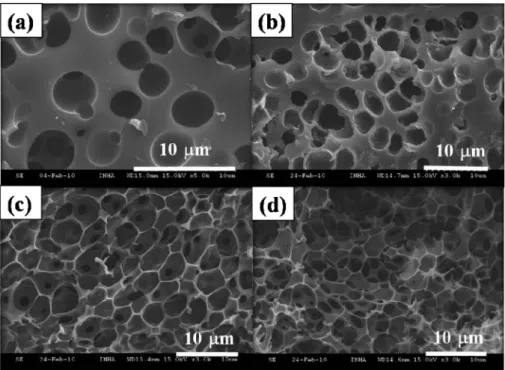
Fig. 1(b) indicates that R/F sols were allowed to form gel in the presence of the suspending PMMA particles and the resultant was an interconnected gel filled with R/F and PMMA particles. Fig. 2 shows the SEM microphotographs of prepared carbon foam templated by various amounts of PMMA particles.

In the case of the carbon foam with 100 wt% (Fig.

2(b)), the shrinkage of the pores was observed due to the carbonization process. Also, since the carbon foam with 200 wt% (Fig. 2(d)) had an excessive amount of PMMA particles which are weak at high temperature, it contributed to the collapse of walls.

However, the carbon foam with 150 wt% PMMA

Fig. 2. SEM microphotographs of carbon foams using (a) 50 wt%, (b) 100 wt%, (c) 150 wt%, and (d) 200 wt% PMMA

microspheres as the template.

(4)

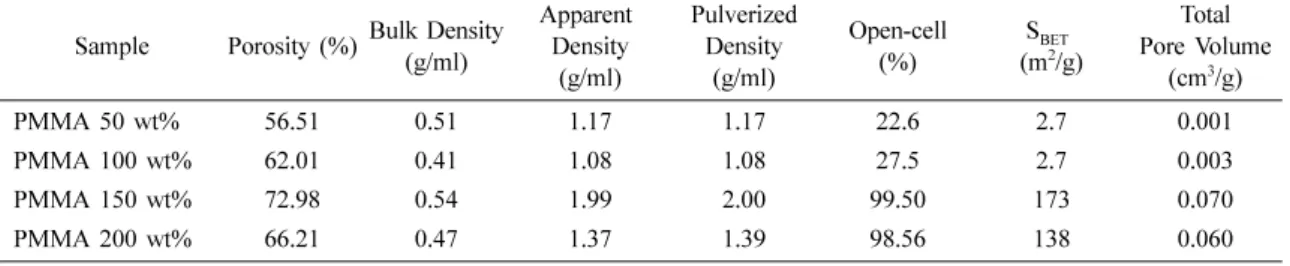
(Fig. 2(c)) showed the uniform pore structure with open-cells. The open-cells imply that the pores have other pores in those which could interconnect each other. Thus, it was found that the optimum amount of PMMA particles to fabricate the carbon foam having uniform pore size, open-cells, and high porosity was 150 wt%. The open-cell was abruptly increased for 150 wt% PMMA particles then slightly decreased due to the collapse of the wall structure (Table 1).

X-ray diffraction (XRD, Rigaku D/MAX 2200V) patterns for four carbon foam samples are shown in Fig. 3. Two peaks of the foam could be seen at 2 θ = 23° and 43° corresponding to the (002) and (101) diffraction peaks of graphite, respectively. From XRD characterization, it can be inferred that the resulting

carbon foam was partially crystalline, but had less crystallinity than graphite. The decrease of the dif- fraction intensity indicates that the crystallization degrees decrease with the increase of added amount of PMMA particles. However, the carbon foam with 150 wt% PMMA had the broadest peak compared to the foam prepared with 200 wt% because the former has the finest structure [13].

An as-prepared porous carbon material (cured body) was easily converted to carbon foams through PMMA particles by heating at a high temperature.

Thermogravimetric analysis (TGA, TG/DTA6300, Perkin Elmer) was performed at a heating rate of 20

o

C/min under a nitrogen atmosphere. TGA weight loss curves observed on the starting pure PMMA particles and R/F sols are compared with the pre- Table 1. General properties of the carbon foams prepared with various amounts of PMMA microspheres as the template

Sample Porosity (%) Bulk Density (g/ml)

Apparent Density

(g/ml)

Pulverized Density

(g/ml)

Open-cell

(%) S

BET

(m

2

/g)

Total Pore Volume

(cm

3

/g)

PMMA 50 wt% 56.51 0.51 1.17 1.17 22.6 2.7 0.001

PMMA 100 wt% 62.01 0.41 1.08 1.08 27.5 2.7 0.003

PMMA 150 wt% 72.98 0.54 1.99 2.00 99.50 173 0.070

PMMA 200 wt% 66.21 0.47 1.37 1.39 98.56 138 0.060

Fig. 3. XRD patterns for carbon foams with various amounts

of PMMA particles. Fig. 4. TGA weight loss curves of pure PMMA template and

the carbon foam prepared by 150 wt% PMMA particles.

(5)

pared carbon foam with 150 wt% PMMA in Fig. 4.

There is a sharp mass loss between 250-300

o

C for the decomposition of pure PMMA and it hardly remains residual char above 400

o

C because PMMA is vulnerable to pyrolysis. Again, it is noteworthy that PMMA is a representative example of polymers which completely decompose without leaving a car- bonaceous char. Therefore, the choice of PMMA as a template to produce pores in the fabrication of car- bon foam is promising. On the other hand, weight loss of the prepared carbon foam made by R/F sol- gel process and subsequent carbonization occurs at about 500

o

C. Since R/F sols are consumed to form highly cross-linked gel during polycondensation pro- cess, this foam becomes more robust in structure, durable, and thermally superior. However, the case of polyurethane/polyimide foams synthesized from polyimide film shows weight loss at around 300

o

C and already 30% weight loss at 400

o

C [14]. Also, in the other case for polyarylacetylene foam, the TGA curves initially decrease at around 400

o

C [15]. This indicates that thermally durable carbon foam using R/F sols can be prepared through this organic poly- mer template method.

The synthesized carbon foams having the most uniform and open-cell surface have the BET surface area of 173 m

2

/g and the total pore volume of 0.070 cm

3

/g (Table 1). Fig. 5 shows nitrogen adsorption isotherms of the carbon foams with various amounts of PMMA template at 77 K measured on an adsorp- tion analyzer (BEL Belsorp-mini 2). Initial region of the isotherm in Fig. 5 for the carbon foams prepared with 150 and 200 wt% PMMA experience a sharper rise at low P/P

o,

which indicates the presence of micropores (less than 2 nm) due to the addition of pores in the gel structure. However, it seems that 200 and 100 wt% PMMA particles are not enough to fabricate carbon foam having fine pore structure, thus there was no rise at low P/P

o

for those two sam- ples. These micropores indicate that the addition of template has increased micropore surface areas to a considerable extent, probably caused by water gener- ated from pyrolysis of the PMMA template [8]. In addition, the lower part of a curve for carbon foam with 150 wt% represents the vacancy of the pores, while the upper part represents the filling of the pores. It can be seen that the isotherms for carbon foams are shifted to the top between the P/P

o

ranges of 0.2-1.0 with the increase in the amount of PMMA particles, and the greatest amount absorbed among four samples was found in the carbon foam pre- pared with PMMA 150 wt%. This indicates the development of porosity and formation of dominant pores during gelation process in carbon foam with 150 wt% PMMA.

4. Conclusions

In this work, macroporous carbon foams derived from the polycondensation of resorcinol and formal- dehyde and subsequent carbonization at 800

o

C were prepared. In order to fabricate macropores with uni- form pore size with open-cell structure, PMMA microspheres having a uniform particle size of 4.6 mm were embedded during the polycondensation reaction. Since PMMA is a purely volatile material Fig. 5. Adsorption isotherms of N

2

on the carbon foam

with various amounts of PMMA particles at 77 K.

(6)

above 400

o

C, macroporous carbon foams were readily prepared. Upon changing the amount of PMMA par- ticles, the structure and properties of the carbon foams were investigated. Above 150 wt% PMMA particles, the well-defined macroporous carbon foam was prepared with high open-cell content, porosity, and surface area. Finally, it was revealed that the method employing combustible organic polymer colloid as the template is a facile route to prepare carbon foams with controllable structure and pore size.

Acknowledgement

This work was supported by a grant (M2009010020) from the Fundamental R&D Program for Core Tech- nology of Materials funded by the Ministry of Knowledge Economy (MKE), Republic of Korea.

References

[1] F. Rodriguez-Reinoso: Adv. Mater., 10 (1998) 1157.

[2] J. Lee, J. Kim and T. Hyeon: Adv. Mater., 18 (2006) 2073.

[3] T. Kyotani: Carbon, 38 (2000) 269.

[4] R. W. Pekala: J. Mater. Sci., 24 (1989) 3221.

[5] H. Marsh and B. Rand: Carbon, 9 (1971) 63.

[6] Z. Hu, M. P. Srinivasan and Y. Ni: Adv. Mater., 12 (2000) 62.

[7] S. Woo, K. Dokko, K. Sasajima, T. Takei and K. Kan- amura: Chem. Commun., 39 (2006) 4099.

[8] T. Guo, J. Zhu, X. Chen, M. Song and B. Zhang: J.

Noncry. Sol., 353 (2007) 2893.

[9] S. Shen, E. D. Sudol and M. S. El-Aasser: J. Polym.

Sci. Part A: Polym. Sci., 32 (1994) 1087.

[10] M. Mizaeian and P. J. Hall: Elecrochim. Acta, 54 (2009) 7444.

[11] H. Tamon, H. ishizaka, M. Mikami and M. Okazaki:

Carbon., 35 (1997) 791.

[12] C. R. Silva and C. Airoldi: J. Colloid Interf. Sci., 187

(1997) 381.

[13] P. Lorjai, S. Wongkasemjit and T. Chaisuwan: Mater.

Sci. Eng. A, 527 (2009) 77.

[14] M. Inagaki, T. Morishita, A. Kuno, T. Kito, M. Hirano, T.

Suwa and K. Kusakawa: Carbon, 42 (2004) 497.

[15] S. Zhang, M. Liu, L. Gan, F. Wu, Z. Xu, Z. Hao and L.

Chen: New Carbon Mater., 25 (2010) 9.

수치

Fig. 1 shows scanning electron microscope (SEM, Hitachi S-4300) microphotographs of PMMA  tem-plate and cured gel containing the PMMA particles.
Fig. 3. XRD patterns for carbon foams with various amounts

참조

관련 문서

The solidification process of metal alloy was expressed by the change of solid fraction, and the solid fraction was controlled by varying size and

It was to demonstrate what relations the assessed corporation tax amount decided after the audit of corporations by the tax authorities as a substitute

Then humeral head prosthetic design of a Bigliani-Flatow (BF) shoulder system was used to do simulation humeral arthroplasty surgery and the humeral head size

After the experiment, driver’s drowsiness was identified accurately by using the method of summing up the state of driver’s eyes open and closes over time and

Secondly, it was found that the coach knowledge of the amateur golfers perceived the leader’s preference as the leader’s coaching knowledge according to

As the frequency of participation and the period of participation increased, the score for leisure satisfaction was high, and as the external motivation

In the present study, consistent to that report, up-regulation of VEGF mRNA was observed in the colon cancer cell with the acquired resistance to 5-FU and this

The lateral size of the defect obtained from the deformation amount and the defect detection test using the shearing interferometer, width and depth of