Tests for the exponential distribution based on Type-II censored samples
Suk-Bok Kang 1) ․ Young-Suk Cho 2) ․ Sei-Yeon Choi 3)
Abstract
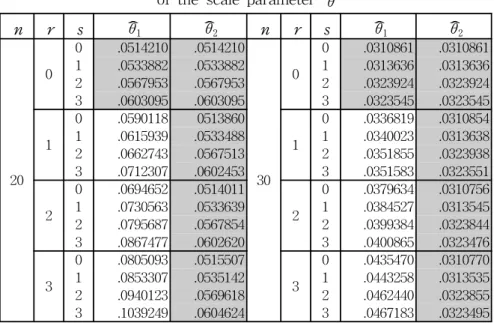
Two explicit estimators of the scale parameter in an exponential distribution based on Type-II censored samples are proposed by appropriately approximating the likelihood function. Then two type tests, including the modified Cramer-von Mises test and Kolmogorov-Smirnov test are developed for the exponential distribution based on Type-II censored samples by using the proposed estimators.
For each test, Monte Carlo techniques are used to generate critical values. The powers of these tests are investigated under several alternative distributions.
Keywords : Exponential distribution, Type-II censored samples, Cramer-von Mises test, Kolmogorov-Smirnov test
1. Introduction
Consider an exponential distribution with the probability density function (pdf) f( x ;θ) = 1
θ e
- x /θ, x >0, θ >0 (1.1)
and the cumulative distribution function (cdf)
1) Professor, Department of Statistics, Yeungnam University, 214-1, Daedong, Kyongsan, Kyoungbuk, 712-749, Korea
E-mail: [email protected]
2) Full-time Lecturer, Department of Applied Economics, Miryang National University 1025-1, Naeidong, Miryang, Kyoungnam, 627-130, Korea
3) Department of Statistics, Yeungnam University, 214-1, Daedong, Kyongsan, Kyoungbuk,
712-749, Korea
F( x ;θ) = 1 - e
- x /θ, x >0 , θ >0 (1.2) The exponential distribution has been used as models in analyzing life-time data quite extensively. Kambo (1978) proposed the maximum likelihood estimators of the location and scale parameters of the exponential distribution from a censored sample. Balakrishnan (1990) studied the maximum likelihood estimation of the parameters in the exponential distribution based on multiplying Type-II censored sample. Balasubramanian and Balakrishnan (1992) proposed the approximate maximum likelihood estimation of parameters based on censored samples under one-parameter and two-parameter exponential distributions.
The Cramer-von Mises goodness-of-fit test statistics is given by W n
2= n ⌠ ⌡
∞
- ∞