키랄 컬럼을 사용한 아미노산 에스테르의 니트로벤조옥사디아졸 유도체의 광학분리
윤원남, 김지연1, 이원재*
Enantiomer Separation of α-Amino Acid Esters as Nitrobenzoxadiaz- ole Derivatives Using Chiral Columns
Won Nam Yun, Ji Yeon Kim1, and Wonjae Lee*
접수: 2013년 8월 7일 / 게재승인: 2013년 11월 21일
© 2013 The Korean Society for Biotechnology and Bioengineering
Abstract: A new convenient derivatization method of α- amino acid esters as nitrobenzoxadiazole (NBD) derivatives for chiral resolution was introduced and the enantiomer sepa- ration of α-amino acid esters as NBD derivatives was per- formed by normal HPLC using chiral columns based on poly- saccharide derivatives. The NBD derivatives were readily prepared by stirring NBD-Cl and α-amino acid methyl ester HCl with NaHCO3 in ethanol. The performance of Chiralpak IA was superior to the other chiral stationary phases for enan- tiomer resolution of NBD derivatives of several α-amino acid methyl esters. Owing to fluorescence detection as well as strong UV absorption, it is expected that the convenient ana- lytical method developed in this study will be very useful for enantiomer separation of α-amino acid esters as NBD deriva- tives on polysaccharide-derived chiral columns.
Keywords: Enantiomer separation, Amino acid ester, NBD derivative, Chiral column
1. 서론
최근 본 연구실에서 키랄 의약품을 개발하는데 중요한 물질 로 알려진 α-amino acid나 이들 유도체들의 광학분리 연구결 과를 보고하여 왔다. 효율적인 광학분리를 위해 의약품개발 에서 흔히 사용되는 amino group이 보호된 α-amino acid 나 이들 유도체들의 광학분리를 수행하였다 [1-3]. 특히 α-amino acid ester의 경우에는 benzophenone imine Schiff base나 9- anthraldimine으로 이들을 유도체화 한 후에, 여러 키랄 고정 상에서 광학분리하는 새로운 분석법도 발표하였다 [4-6]. 지 난 선행연구에서 α-amino acid esters의 광학분리를 위해 사 용된 benzophenone imine이나 9-anthraldimine group의 역할 은 두가지 측면에서 고려되었다 [4,6]. 먼저 α-amino acid ester 화합물보다 이들 benzophenone imine이나 9-anthraldimine 유 도체 그룹은 상당히 강하게 자외선을 흡수하는 성질을 가지 고 있으므로 이를 이용해서 분석물질을 쉽게 검출하는 장점 을 이용하고자 하였다. 또 다른 측면은 α-amino acid esters을 benzophenone imine 이나 9-anthraldimine 유도체로 만들어 키랄컬럼에서 광학분리하고자 할 때, 이들 유도체의 두개의 phenyl이나 anthryl 같은 aromatic group이 키랄인지부위 (chi- ral recognition interaction site)로 작동되어 효과적인 광학분 리가 되도록 의도하였고 좋은 광학분리 결과를 얻을 수 있었 다 [4-6]. 이러한 광학분리 연구와 연관되어 본 연구실에서는, α-amino acid esters의 새로운 유도체 물질로 앞에서의 두 가 지 역할을 할 수 있는 nitrobenzoxadiazole (NBD) 그룹에 주목 하였다. 평면구조의 NBD 그룹은 hydrophobic한 aromatic 성 질의 구조적 특성으로 키랄인지부위로 작용할 수 있으리라 조선대학교 약학대학 약학과
College of Pharmacy, Chosun University, Gwangju 501-759, Korea Tel: +82-62-230-6376, Fax: +82-62-222-5414
e-mail: [email protected]
1조선대학교 대학원 식품의약학과
1Department of Food and Drug, Graduate School, Chosun University, Gwangju 501-759, Korea
단보
기대되었다. 또한 NBD 그룹은 상당히 강한 자외선 흡수만이 아니라 형광흡수 성질까지 가지고 있기 때문에 본 연구의 광 학분리에 응용될 경우, 매우 유익한 장점이 많으리라 예상하 였다. 한편 다른 연구실에서 NBD-Cl와 NBD-F를 이용하여 amine이나 amino acid의 NBD 유도체를 만들어 분리·분석하 는 실험결과가 보고되어 왔다 [7-13]. 특히 amino acid의 NBD 유도체의 광학분리에서 Sumochiral OA 2500S, Chiralpak QN-AX, teicoplanin 키랄 컬럼을 이용하였지만 그리 큰 광학 분리 결과를 주지는 못하였다 [9-13]. 또한 amino acid의 NBD 유도체를 제조하는 경우 sodium borate 같은 염기성 완충용액 에서 NBD-F와 반응시킨 후 반응물을 acid로 quenching하여 분석하였고, amine 의 NBD 유도체를 제조하는 경우 methyl alcohol 수용액에서 NaHCO3를 base로 사용하여 합성하는 것 으로 보고되었다 [7,11,12]. 이러한 기존 분석방법은 광학분 리 분석조건으로 모두 역상 크로마토그래피를 사용하였기 때문에 분석시료 유도체화 조건도 완충용액이나 수용액 상 태에서 진행하였다. 그러나 본 연구의 광학분리 분석조건에 서는 순상 크로마토그래피를 사용하기 때문에 순상조건에 적합하면서도 좀더 편리한 nonaqueous 상태의 분석시료 유 도체화 방법을 필요로 하였다. 현재까지 기존 연구에서 amino acid ester의 NBD 유도체를 분석하고자 유도체화 된 적은 없 으며 또한 이를 순상 크로마토그래피에서 광학분리 연구로 아직까지 보고된 바도 없다. 따라서 본 연구에서는 순상 크 로마토그래피 분석에 적합하면서도 기존 실험방법과 다른 amino acid ester의 NBD 유도체화 방법을 개발하고자 하였다.
그리고 이 개발된 유도체화 방법을 이용하여 다당 유도체에 서 기초한 여러 키랄 고정상에서의 광학분리를 수행하고자 하였다 [4,5].
2. 재료 및 방법 2.1. 재료 및 시약
HPLC 용매나 유도체 반응을 위한 용매는 모두 J. T. Baker (Phillipsburg, NJ)에서, NaHCO3등의 여러 base, NBD-chloride (4-chloro-7-nitro-2,1,3-benzoxadiazole)와 α-amino acid methyl ester 분석물질은 모두 Aldrich (Milwaukee, WI), Sigma (St.
Louis, MO), Advanced ChemTech (Louisville, KY) 회사로부 터 구입하였다.
2.2. 분석기기 및 방법
고성능 액체 크로마토그래피 실험은 Agilent의 1100 series HPLC 기기를 사용하여 수행하였다. 키랄 컬럼으로 Chiralpak IA, Chiralpak IB, Chiralpak IC (250 mm L× 4.6 mm i.d., 5 µm, 일본 Daicel Chemical 회사)를 사용하였다. 이동상 용매 로 20~30% 2-propanol/hexane(V/V)을 사용하였고 유속은 1 mL/min, 검출기는 UV detector와 fluorescence detector를 on-line으로 연결하여 자외선 검출은 UV 337 nm, 형광검출은 excitation 470 nm, emission 530 nm 하에서 동시분석하였다.
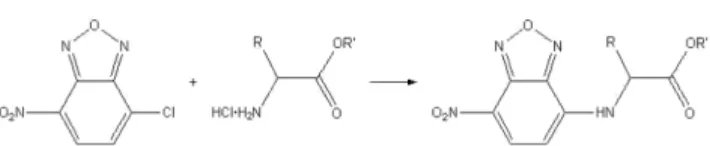
분석물질의 α-amino acid ester의 NBD 유도체를 합성하는 방법은 다음과 같다 (Fig. 1). 5 mL의 ethanol 용매에 α-amino acid ester HCl 0.25 mmol, NBD-Cl 0.5 mmol, base로 NaHCO3
2.5 mmol 을 가하여 12시간 동안 상온에서 반응시킨 후, 용 액의 불용물을 여과하고 농도를 10분의 1로 희석한 여과용 액을 HPLC injector에 직접 주입하여 광학분리 실험을 수행 하였다.
3. 결과 및 고찰
먼저 본 연구에서 α-amino acid ester의 NBD 유도체 합성법 을 최적화하기 위해 다음과 같은 실험을 진행하였다. 이를 위 해 amine분석을 위해 NBD-Cl를 사용했던 유도체화 방법을 변화시켜 응용하였다 [7]. 먼저 racemic leucine methyl ester HCl을 반응용매에 녹인 다음, NaHCO3를 base로 사용하여 해 당 NBD 유도체를 합성하였는데 Fig. 2는 여러 용매에서 반응 시간에 따른 유도체화 결과를 보여주고 있다. Fig. 2에서 보 여주고 있는 바와 같이, Hao group에서 사용하였던 methyl alcohol용매에서 가장 반응이 빠르게 진행되었고 [7] 그 다음 으로 acetonitrile (ACN), ethyl alcohol 순이었으며 isopropyl alcohol (IPA)에서 가장 반응이 느리게 진행되었다. 그러나 methyl alcohol과 acetonitrile 용매의 경우, 유도체화 반응이 빠른 대신 methoxy NBD의 원치 않는 impurity 물질이 같이 생성되었다. 비록 ethanol을 용매로 사용할 때는 methanol에 비해 유도체화 반응이 느리기는 하지만 그러한 impurity는 생 Fig. 1. Preparation of α-amino acid esters as NBD derivatives. NBD derivatives were prepared by stirring NBD-Cl and α-amino acid methyl ester HCl with NaHCO3 in ethanol.
Fig. 2. Solvent effect on synthesis of racemic leucine methyl ester as NBD derivative in NaHCO3. Column: Chiralpak IA; Mobile phase:
20% 2-propanol/hexane (V/V); Flow rate: 1 mL/min; Detection UV 337 nm.
성되지 않기 때문에 본 연구에서는 ethanol을 유도체화 용매 로 사용하기로 결정하였다. 또한 amino acid ester 의 NBD 유 도체 합성법을 최적화하기 위해 여러 종류의 base를 시험하 여 사용하였다. 이를 위해 Hao group에서 유도체화할 때 사용 하였던 NaHCO3 만이 아닌 Na2CO3,Na2B4O7, triethylamine, DBU 같은 여러 종류의 base를 사용하였다 [6,7]. 그런데 다른 base들에 비해 triethylamine과 DBU를 사용할 경우에는 예상 치 않게 반응초기부터 여러 종류의 impurity들도 원하는 생 성물과 같이 많이 생성됨으로 그로 인한 정확한 측정이 어려 워 Fig. 3 결과에서 제외하였다. 실험에 사용한 base에 따른 유도체화 결과를 Fig. 3에서 보여주고 있는 바와 같이, Na2CO3 에서 반응이 가장 빠르게 일어나고 NaHCO3 에서 반 응이 가장 느리게 일어난다. 그러나 Na2CO3, Na2B4O7의 경우 에는 시간이 지날수록 원하는 NBD유도체 반응만이 아니라 예상치 않는 impurity가 함께 증가하였기 때문에 본 연구에서 사용할 base로 NaHCO3를 선택하였다. 유도체화 반응에서 염 기성이 강한 base를 사용할수록 impurity 가 많이 생성될 것이 예상되기 때문에 가장 mild base 중 하나인 NaHCO3를 사용 하는 것이, 반응속도는 비록 느리지만 impurity가 거의 생성 되지 않는 장점이 있다. 최종적으로 본 연구의 분석물질인 α-amino acid methyl ester의 NBD 유도체를 합성하기 위하여 용매로 ethyl alcohol을, base로 NaHCO3를 사용하였다.
본 연구에서 개발한 유도체화 방법으로 여러 종류의 α- amino acid methyl ester의 NBD 유도체를 합성하였고, 다당 유도체에 기초한 키랄 컬럼을 이용하여 이들의 광학분리를 수행하였다. Table 1~3은 다당 유도체의 키랄 선택자가 고정 상에 공유결합된 Chiralpak IA, Chiralpak IB, Chiralpak IC에 서 9개의 α-amino acid methyl ester의 NBD 유도체를 광학분 리한 결과를 보여주고 있다. 검출파장으로 UV 337 nm과 형 광흡수 측정을 동시분석하는 방법으로 광학분리가 시도되 었다. Table 1의 결과에서 보여주는 것처럼, 모든 α-amino acid methyl ester의 NBD 유도체가 Chiralpak IA 키랄 컬럼에 서 훌륭하게 광학분리되었고 (α=1.34~2.28, Rs=4.62~12.61) Fig. 3. Base effect on synthesis of racemic leucine methyl ester as NBD derivative in ethanol. Column: Chiralpak IA; Mobile phase:
20% 2-propanol/hexane (V/V); Flow rate: 1 mL/min; Detection UV 337 nm.
Table 1. Separation of the enantiomers of α-amino acid esters as NBD derivatives on Chiralpak IA
Analyte α k'1 Rs Conf.*
Alanine methyl ester 1.37 2.99 5.64 L Leucine methyl ester 2.00 1.71 11.01 L Methionine methyl ester 1.66 3.39 9.92 L Norleucine methyl ester 2.28 1.70 12.61 L Norvaline methyl ester 1.72 1.82 7.98 L Phenylalanine methyl ester 1.94 3.10 11.77 L Phenylglycine methyl ester 1.37 6.10 4.32 L Serine methyl ester 1.34 6.38 4.62 L Valine methyl ester 1.45 2.08 7.41 L
α: Separation factor,
k'
1: Capacity factor of the first eluted enantiomer, Rs: resolution factor.
Mobile phase: 20% 2-propanol/hexane (V/V); Flow rate: 1 mL/min;
See experimental for detection conditions;
*indicates the absolute configuration of the second eluted enantiomer.
Table 2. Separation of the enantiomers of α-amino acid esters as NBD derivatives on Chiralpak IB
Analyte α k'1 Rs Conf.*
Alanine methyl ester 1.04 5.92 0.54 L Leucine methyl ester 1.08 5.07 1.17 L Methionine methyl ester 1.02 2.76 0.29 L Norleucine methyl ester 1.04 8.82 0.49 L Norvaline methyl ester 1.08 6.32** 1.24 L Phenylalanine methyl ester 1.12 6.42 1.81 D Phenylglycine methyl ester 1.05 10.68 0.44 L Serine methyl ester 1.06 11.12 1.22 L Valine methyl ester 1.11 7.68** 1.67 L
α: Separation factor,
k'
1: Capacity factor of the first eluted enantiomer, Rs: resolution factor.
Mobile phase: 20% 2-propanol/hexane (V/V); Flow rate: 1 mL/min;
See experimental for detection conditions.
*indicates the absolute configuration of the second eluted enantiomer.;
**10% 2-propanol/hexane (V/V).
Table 3. Separation of the enantiomers of α-amino acid esters as NBD derivatives on Chiralpak IC
Analyte α k'1 Rs Conf.*
Alanine methyl ester 1.10 9.75 1.92 L
Leucine methyl ester 1.00 6.75 - -
Methionine methyl ester 1.16 13.12 3.92 D Norleucine methyl ester 1.10 8.56 1.61 L Norvaline methyl ester 1.09 9.75 1.73 L Phenylalanine methyl ester 1.00 12.19 - - Phenylglycine methyl ester 1.10 12.52 2.51 D
Serine methyl ester 1.04 5.98 0.45 D Valine methyl ester 1.14 9.91 2.38 L
α: Separation factor,
k'
1: Capacity factor of the first eluted enantiomer, Rs: resolution factor.
Mobile phase: 30% 2-propanol/hexane (V/V); Flow rate: 1 mL/min;
See experimental for detection conditions.
*indicates the absolute configuration of the second eluted enantiomer.
분석물질 모두 기준분리되었다. 이러한 광학분리 결과는 여 러 amino acid NBD 유도체를 광학분리하기 위해 Hamase group의 Sumochiral 2500S, Chiralpak QN-AX 컬럼을 이용한 분석결과나 Liu group의 teicoplanin 컬럼을 이용해 얻은 분 석결과보다 우수하게 나타났다 [11-13]. 한편 Table 1의 Chi- ralpak IA 키랄 컬럼을 사용한 결과에 비해, Table 2와 3에서 의 Chiralpak IB와 Chiralpak IC 키랄 컬럼을 사용할 경우 일 반적으로 낮은 광학분리 결과를 보여주었다. 특히 Table 3에 서의 Chiralpak IC 키랄 컬럼을 사용할 경우, 두 개 시료에서 는 전혀 광학분리되지 않았지만 이들을 제외한 다른 분석시 료에서는 대체적으로 좋은 분리능을 보여주었다. Table 1, 2 의 Chiralpak IA와 Chiralpak IB 키랄 컬럼에서 α-amino acid ester의 NBD 유도체의 광학분리를 수행할 경우, 20% 2- propanol/hexane (V/V)을 사용하였지만 Table 3의 Chiralpak IC 키랄 컬럼에서 광학분리를 할 때에는 효율적인 분석을 위 하여 30% 2-propanol/hexane (V/V)을 사용하였다.
또한 α-amino acid ester 의 NBD 유도체의 광학분리 실험 과 함께 그 용리순서에 대한 실험을 진행하였다. Table 1의 Chiralpak IA에서 모든 분석물질의 L-이성질체가 두 번째로 용리되어 전체적으로 일관성있는 광학분리를 보여주었다.
이러한 실험 결과는 Chiralpak IA에서의 키랄 고정상과 α- amino acid ester의 NBD 유도체의 키랄인지 매커니즘이 분석 물질의 화학구조에 영향을 받지 않고 일관성있게 작용하고 있음을 의미한다. 본 연구와 마찬가지로 Sumochiral 2500S, Chiralpak QN-AX 컬럼을 사용한 연구결과에서는 amino acid
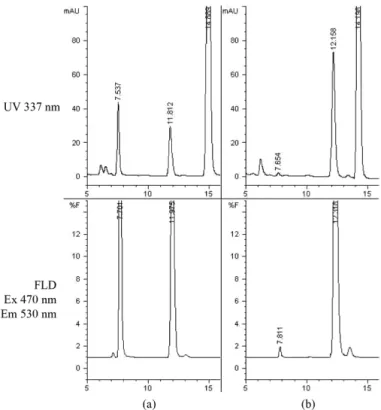
ester의 NBD 유도체의 L-이성질체가 두 번째로 용리되었으 나, teicoplanin 컬럼을 사용한 연구결과에서는 D-이성질체가 두 번째로 용리되었다 [11-13]. 또한 Table 2의 Chiralpak IB에 서는 일반적으로 분석물질들이 Table 1의 Chiralpak IA와 같 이 L-이성질체가 두 번째로 용리되었지만 phenylalanine 유도 체는 예외적으로 반대의 용리순서를 나타내었고 Table 3의 Chiralpak IC에서는 분석물질에 따라 용리순서가 불규칙하였 다. Fig. 4는 현재 시판되고 있는 L-leucine methyl ester와 race- mic leucine methyl ester 의 NBD 유도체 물질을 Chiralpak IA 에서 광학분리한 대표적인 chromatogram이다. UV detector와 fluorescence detector를 on-line으로 연결하여 UV 337 nm, 형 광검출로 excitation 470 nm, emission 530 nm 하에서 동시분 석한 결과를 보여주고 있다. 동시분석에서 형광검출이 UV 337 nm에서의 검출보다 뛰어난 감도를 주는 장점을 쉽게 발 견할 수 있다. 또한 흥미롭게도 Fig. 4의 UV 337 nm에서 검출 되는 chromatogram 에서는 leucine methyl ester의 NBD 유도 체 뿐만 아니라 반응되지 않은 NBD-Cl, 일부 impurity도 함께 나타난다. 그러나 fluorescence detector를 사용하는 chromato- gram에서는, 반응되지 않은 NBD-Cl는 전혀 형광검출이 되지 않고 impurity도 거의 없어, 원하는 leucine methyl ester NBD 유도체 peak만이 선택적으로 검출된다. 이러한 특징적인 분 석적 측면을 amino acid ester의 NBD 유도체 화합물의 여러 광학분리 실험에 응용함으로 fluorescence detection의 선택적 이면서 뛰어난 감도를 주는 장점을 효율적으로 이용할 수 있 으리라 기대한다.
Fig. 4. Chromatograms of the resolution of NBD derivative on Chiralpak IA at simultaneous on-line UV and fluorescence detection (FLD).
(a) racemic leucine methyl ester, (b) L-leucine methyl ester (D:L = 1.5:98.5). The unreacted NBD-Cl peak is shown about 15 min on the top chromatograms observed under UV 337 nm. See experimental for chromatographic conditions.
4. 결론
본 연구에서 다당 유도체가 키랄선택자로 사용된 키랄 컬럼 을 사용하여 α-amino acid ester의 NBD 유도체의 광학분리를 수행하였다. 순상 크로마토그래피 분석에 용이한 유도체화 분석물질을 얻기 위해 α-amino acid methyl ester HCl과 NBD- Cl, NaHCO3 를 ethanol 용매에서 반응시킴으로써 NBD 유도 체를 합성하는 매우 편리한 유도체화 방법을 개발하였다. 이 렇게 합성된 α-amino acid ester 의 NBD 유도체를 광학분리 한 결과, Chiralpak IA를 사용했던 경우가 다른 컬럼들에 비 해 여러 α-amino acid ester NBD 유도체 시료를 모두 기준분 리하면서 매우 훌륭한 광학분리 결과를 보여주었다. 또한 α- amino acid ester의 NBD 유도체의 분석은 UV detection 뿐만 아니라 fluorescence detection에서 선택적이고 뛰어난 감도를 주는 훌륭한 장점을 가지고 있다. 그러므로 본 연구에서 개발 한 순상 크로마토그래피에서 α-amino acid ester의 NBD 유도 체의 광학분리 분석법이 많은 연구에 활용되어 매우 유용하 게 사용될 수 있으리라 기대한다.
감사
이 논문은 2013학년도 조선대학교 학술연구비의 지원을 받 아 연구되었음.
참고문헌
1. Jin, J. Y., S. K, Bae, and W. Lee (2009) Comparative studies bet- ween covalently immobilized and coated chiral stationary phases based on polysaccharide derivatives for enantiomer separation of N-protected α-amino acids and their ester derivatives, Chirality, 21:
871-877.
2. Jin, J. Y., W. Lee, J. H. Park, and J. J. Ryoo (2007) Liquid chro- matographic enantiomer separation of N-phthaloyl protected α- amino acids on coated and immobilized chiral stationary phases derived from polysaccharide derivatives. J. Liq. Chrom. Rel. Tech.
30: 1-9.
3. Li, Y. H., and W. Lee (2005) Liquid chromatographic enantiomer resolution of N-fluorenylmethoxycarbonyl α-amino acids and their ester derivatives on polysaccharide-derived chiral stationary phases.
J. Sep. Sci. 28: 2057-2060.
4. Huang, H., W. J. Xu, J. Y. Jin, J. H. Hong, H. J. Shin and W. Lee (2012) A convenient method for the enantiomeric separation of α- amino acid esters as benzophenone imine Schiff base derivatives.
Arch. Pharm. Res. 35: 1015-1019.
5. Huang, H., J. Y. Jin, and W. Lee (2012) Liquid chromatographic resolution of α-amino acid esters as benzophenone imine deriva- tives. Kor. Soc. Biotech. Bioeng. J. 27: 167-171.
6. Huang, H., J. Y. Jin, and W. Lee (2011) Chromatographic enanti- omer separation and determination of optical purity for α-amino acid esters as 9-anthraldimine derivatives using polysaccharide based chiral columns. Kor. Soc. Biotech. Bioeng. J. 26: 139-142.
7. Hao, F., T. Lwin, W. J. Bruckard, and J. T. Woodcock (2004) Deter- mination of aliphatic amines in mineral flotation liquors and re- agents by high-performance liquid chromatography after derivati- zation with 4-chloro-7-nitrobenzofurazan, J. Chromatogr. A. 1055:
77-85.
8. Breda, M., P. Marrari, E. Pianezzola, and M. S. Benedetti (1996) Determination of ethambutol in human plasma and urine by high- performance liquid chromatography with fluorescence detection, J. Chromatogr. A. 729: 301-307.
9. Hamase, K., H. Homma, Y. Takigawa, T. Fukushima, T. santa, and K. Imai (1997) Regional distribution and postnatal changes of D- amino acids in rat brain, Biochim. Biophys. Acta. 1334: 214-222.
10. Inoue, T., K. Hamase, A. Morikawa, and K. Zaitsu (2000) Deter- mination of minute amounts of D-leucine in various brain regions of rat and mouse using column-switching high-performance liquid chromatography, J. Chromatogr. B. 744: 213-219.
11. Hamase, K., A. Morikawa, T. Ohgusu, W. Lindner, and K. Zaitsu (2007) Comprehensive analysis of branched aliphatic D-amino acids in mammals using an integrated multi-loop two-dimensional column-switching high-performance liquid chromatographic system combining reversed-phase and enantioselective columns, J. Chro- matogr. A. 1143: 105-111.
12. Hamase, K., Y. Miyoshi, K. Ueno, H. Han, J. Hirano, A. Morikawa, M. Mita, T. Kaneko, W. Lindner, and K. Zaitsu (2010) Simultaneius determination of hydrophilic amino acid enantiomers in mamma- lian tissues and physiological fluids applying a fully automated micro-two-dimensional high-performance liquid chromatographic concept, J. Chromatogr. A. 1217: 1056-1062.
13. Song, Y., M. Shenwu, S. Ahao, D. Hou and Y. M. Liu (2005) Enantiomeric separation of amino acids derivatized with 7-fluoro- 4-nitrobenzoxadiazole by capillary liquid chromatography/tandem mass spectrometry. J. Chromatogr. A. 1091: 102-109.