• 검색 결과가 없습니다.

The Effectiveness of Real-Time PCR Assay, Compared with Microbiologic Results for the Diagnosis of Pulmonary Tuberculosis

N/A
N/A
Protected

Academic year: 2021

Share "The Effectiveness of Real-Time PCR Assay, Compared with Microbiologic Results for the Diagnosis of Pulmonary Tuberculosis"

Copied!
7
0
0

로드 중.... (전체 텍스트 보기)

전체 글

(1)

The Effectiveness of Real-Time PCR Assay, Compared with Microbiologic Results for the Diagnosis of Pulmonary Tuberculosis

Seo Woo Kim, M.D.

1

, Sae In Kim, M.D.

1

, Seok Jeong Lee, M.D.

1

, Jin Hwa Lee, M.D.

1

, Yun Ju Ryu, M.D.

1

, Sung Shine Shim, M.D.

2

, Yookyoung Kim, M.D.

2

, Mi Ae Lee, M.D.

3

and Jung Hyun Chang, M.D., Ph.D.

1

1

Division of Pulmonary and Critical Care Medicine, Department of Internal Medicine, Departments of

2

Radiology and

3

Laboratory Medicine, Ewha Womans University School of Medicine, Seoul, Korea

Background: The incidence of tuberculosis (TB) in Korea is relatively high compared to the other Organisation for Economic Co-operation and Development (OECD) countries, with a prevalence of 71 per 100,000 in 2012, although the incidence is declining. Real-time polymerase chain reaction (PCR) has been introduced for the rapid diagnosis of TB.

Recently, its advantage lies in higher sensitivity and specificity for the diagnosis of TB. This study evaluated the clinical accuracy of real-time PCR using respiratory specimens in a clinical setting.

Methods: Real-time PCR assays using sputum specimens and/or bronchoscopic aspirates from 2,877 subjects were reviewed retrospectively; 2,859 subjects were enrolled. The diagnosis of TB was determined by positive microbiology, pathological findings of TB in the lung and pleura, or clinical suspicion of active TB following anti-TB medication for more than 6 months with a favorable response.

Results: Sensitivity, specificity, and accuracy were 44%, 99%, and 86% from sputum, and 65%, 97%, and 87% from bronchoscopic aspirates, respectively. For overall respiratory specimens, sensitivity was 59%, specificity was 98%, and accuracy increased to 89%.

Conclusion: Positivity in real-time PCR using any respiratory specimens suggests the possibility of active TB in clinically suspected cases, guiding to start anti-TB medication. Real-time PCR from selective bronchoscopic aspirates enhances the diagnostic yield much more when added to sputum examination.

Keywords: Diagnosis; Sputum; Bronchoscopy; Real-Time Polymerase Chain Reaction; Tuberculosis, Pulmonary

Copyright © 2015 The Korean Academy of Tuberculosis and Respiratory Diseases. All rights reserved.

Address for correspondence: Jung Hyun Chang, M.D., Ph.D.

Division of Pulmonary and Critical Care Medicine, Department of Internal Medicine, Ewha Womans University School of Medicine, 1071 Anyangcheon- ro, Yangcheon-gu, Seoul 158-710, Korea

Phone: 82-2-2650-5686, Fax: 82-2-2655-2076, E-mail: [email protected] Received: Aug. 13, 2014

Revised: Nov. 10, 2014 Accepted: Dec. 11, 2014

cc
It is identical to the Creative Commons Attribution Non-Commercial License (http://creativecommons.org/licenses/by-nc/3.0/).

(2)

Introduction

The prevalence of tuberculosis (TB) in Korea is declining, but is still high among the Organisation for Economic Co- operation and Development (OECD) countries. Korea had a TB prevalence of 71 per 100,000 in 2012

1

. TB is an important infectious disease, and the Korean government is making an effort to provide rapid diagnosis and treatment through na- tional support and project execution

2

.

Traditionally, the diagnosis of pulmonary TB is made by bacteriological verification from respiratory specimens. The acid-fast bacilli (AFB) smear test is the gold standard for di- agnosis and offers rapid results, but has the disadvantage of low sensitivity and it does not discriminate TB from non-TB mycobacterial infections

3,4

. AFB culture is a useful method for confirming a diagnosis but can take up to 6 weeks

5

.

The polymerase chain reaction (PCR) is used widely for early diagnosis of TB

6-8

. Real-time PCR (RT-PCR) has been used recently because it is more rapid than conventional PCR and has excellent reproducibility

9,10

. However, most previous studies of PCR focused on its accuracy and were limited to proven cases with positive results on AFB smear or culture

11-13

. Our findings emphasized the clinical accuracy of the RT-PCR assay using sputum or bronchoscopic aspiration, in the pres- ence of clinical suspicion of active TB.

Materials and Methods

1. Subjects

Subjects who had RT-PCR performed on sputum and/or bronchoscopic aspirates at the Ewha Womans University Mokdong Hospital, Seoul, Republic of Korea between January 2008 and September 2011 were enrolled. This research was approved by the Institutional Review Board of Ewha Medical Center, Seoul, Republic of Korea (No. 12-11-04). From 2,877 patients taking RT-PCR assay during above period, 2,859 pa- tients were evaluated as the final study population with the exclusion of 18 subjects with positive RT-PCR: 6 subjects due to incomplete medical records and 12 subjects even with anti- TB medication because of inadequacy of 6 months’ treatment period. In this group, 888 patients were evaluated human im- munodeficiency virus (HIV) infection. Among them, HIV-test was positive in six patients and they had all negative results of RT-PCR. Two patients were treated as active pulmonary TB in that period.

AFB smear and culture were requested for all subjects who were suspected of having active TB in their respiratory system.

Their medical records, radiological findings and pathological information were reviewed retrospectively. Active TB was confirmed if one or more of the following criteria were met:

(1) Microbiologic diagnosis based on AFB smear positiv- ity with no evidence of nontuberculous mycobacteria (NTM) or AFB culture positivity.

(2) Histological diagnosis of TB.

(3) Biochemical evidence of TB in pleural fluid based on ad- enosine deaminase exceeding 50 U/L with lymphocytic predominance and exclusion of any other diseases.

(4) Clinical diagnosis confirmed by the patient taking anti- TB medication for more than 6 months with a favorable response, based on laboratory and radiographic data despite not meeting categories (1)–(3).

We excluded patients who had NTM positive results in RT- PCR regardless of AFB positive result in smear and who had been identified to NTM in AFB culture.

2. AFB smear and culture

The respiratory samples were liquefied and decontaminat- ed by the N-acetyl-L-cysteine 2% sodium hydroxide method

14

. Following concentration, a part of the sediment from each specimen was used for AFB staining. After using by auramine- rhodamine stain, positive staining specimen was confirmed by Ziehl-Neelsen (ZN) staining. AFB smear was examined using the guidelines of the Centers for Disease Control and Prevention

5

. Respiratory specimen was inoculated into 3%

Ogawa’s medium (Eiken Co., Tokyo, Japan). Since July 2008, it was inoculated into a mycobacteria growth indicator tube, BD BBL MGIT 960 (Beckton Dickinson, Sparks, MD, USA) at the same time. Culture using MGIT 960 was performed according to the manufacturer’s instructions. MGIT bottles were incu- bated and monitored for 6 weeks. Positive sample in MGIT system was collected 0.1 mL for confirming AFB by ZN stain- ing and was performed to identify. Three precentage Ogawa’s medium was also incubated at 37

o

C and examined for growth every week for 8 weeks, until which a final result was reported.

Culture positive specimen was identified by MoleculTech

MTB-ID v3 (Youngdong Int., Yongin, Korea), which method

was to distinguish Mycobacterium tuberculosis (MTB) and

MTB-complex by on-tube nested/multiplex PCR. NTM infec-

tion was identified by Myco-ID (M&D Inc., Wonju, Korea)

using PCR–restriction fragment length polymorphism since

2006. After April 2011, GenoType Mycobacterium CM & AS

kit (Hain Lifescience GmbH, Nehren, Germany) was used for

identifying NTM subgroup. All methods for identifying infec-

tion were performed according to the manufacturer’s instruc-

tions. Before the start of TB treatment, at least two sputum

samples were collected by self-expectoration or by induction

with 3% saline. Bronchoscopic aspirates were collected with

saline irrigation from the affected part through conventional

bronchoscopy.

(3)

3. RT-PCR

In the 654 subjects, RT-PCR assays were conducted using both sputum and bronchoscopic aspirate samples. RT-PCR was performed using the AdvanSure TB/NTM RT-PCR kit (LG Life Science, Seoul, Korea) according to the manufacturer’s instructions

13,15

. Three channels were used in the RT-PCR reaction (M. tuberculosis complex, mycobacteria, internal control). Signals for FAM, HEX, and Cy5 (fluorescent material fixed to the TaqMan probe) were measured in each channel. A cycle threshold (Ct) under 35 PCR cycles of rpoB was specific for acid-fast bacteria. M. tuberculosis was considered present if the Ct of rpoB was less than 35 on each signal and greater than or equivalent to that of IS6110. If the Ct of rpoB was less than 35 on each signal, but less than that of IS6110, the results were interpreted as indicative of M. tuberculosis complex with a small number of IS6110 copies or probable co-infection be- tween M. tuberculosis and a non-TB mycobacterium

16

. A Ct of rpoB less than 35 and Ct of IS6110 over 35 was interpreted as

a non-TB mycobacterial infection

13

. 4. Statistical analysis

Sensitivity, specificity, positive and negative predictive val- ues, and accuracy were calculated based on TB diagnosis data using preselected criteria. The SPSS version 20.0 software (SPSS Inc., Chicago, IL, USA) was used for the statistical analy- sis.

Results

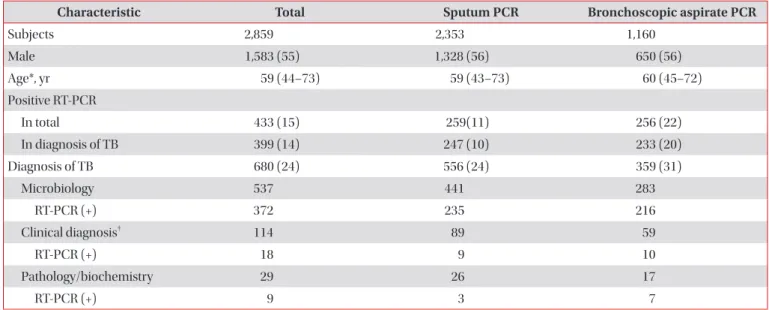
The demographic data for 2,859 subjects are listed in Table 1. The median age was 59 years (interquartile range, 44–73 years), and 55% of the subjects were male. According to the above criteria, 680 subjects (24%) were diagnosed with TB.

The diagnosis of active TB among the 680 subjects was based on microbiological positivity in 537 subjects (79%), clinical di- agnosis in 114 subjects (17%), and pathology or biochemical data of pleural effusion in 29 subjects (4%). RT-PCR was posi- tive in 22% of the bronchoscopic aspirates, two-fold that from sputum samples (11%). The diagnostic yield of active TB was 24% from sputum samples and 31% from bronchoscopic aspi- rates. Computed tomography results were available for 81% of the total subjects.

1. RT-PCR of sputum specimens

Among the 2,353 subjects whose sputum was tested, 556 were diagnosed with active TB, but only 259 subjects had positive RT-PCR results (Table 1). The RT-PCR assay provided a discrepant diagnosis due to the following: pneumonia infec- tion (28%), active TB (24%), radiologic inactive TB scar (14%), radiological lung mass (11%), bronchiectasis (7%), idiopathic chronic cough (6%), combined pleural effusion (5%), and other medical conditions (5%). Sensitivity of RT-PCR for the prediction of TB infection from sputum specimens was 44%

and specificity was 99%, with a positive predictive value of 95%, a negative predictive value of 85%, and an accuracy of

Table 1. Demographic data of all subjects

Characteristic Total Sputum PCR Bronchoscopic aspirate PCR

Subjects 2,859 2,353 1,160

Male 1,583 (55) 1,328 (56) 650 (56)

Age*, yr 59 (44–73) 59 (43–73) 60 (45–72)

Positive RT-PCR

In total 433 (15) 259(11) 256 (22)

In diagnosis of TB 399 (14) 247 (10) 233 (20)

Diagnosis of TB 680 (24) 556 (24) 359 (31)

Microbiology 537 441 283

RT-PCR (+) 372 235 216

Clinical diagnosis

114 89 59

RT-PCR (+) 18 9 10

Pathology/biochemistry 29 26 17

RT-PCR (+) 9 3 7

Values are presented as number (%).

*Median (25th–75th percentile).

Clinical diagnosis is clinical suspicion of active tuberculosis (TB) following anti-TB medication for more than 6 months with a favorable response, despite the lack of microbiological or pathological confirmation.

RT-PCR: real-time polymerase chain reaction.

(4)

86% (Table 2).

As observation period continued to more than 6 months, 12 subjects were considered false-positives, despite being positive by RT-PCR: nine subjects had negative results in AFB cultures for all respiratory samples and had no evidence of active TB; and three were judged to have inactive TB based on clinical and radiological findings.

Among the 441 subjects with RT-PCR testing of sputum and microbiological evidence, subgroup analysis was performed in 423 who had positive sputum AFB smear or culture, exclud- ing the 18 cases who had bronchoscopic aspirates positive on either AFB smear or culture. The RT-PCR positivity rate in this

subgroup was 55% (232/423). In the 123 subjects whose spu- tum AFB smear and culture were both positive, the RT-PCR positivity rate was increased to 87% (107/123) (Table 3).

2. RT-PCR of bronchoscopic aspirates

Among the 1,160 subjects whose bronchoscopic aspirates were subjected to RT-PCR, 359 were diagnosed with active TB, and 256 had positive RT-PCR results. The reasons for conducting an RT-PCR assay were as follows: suspicion of ac- tive TB (28%), differential diagnosis of pneumonia (27%), ra- diological lung mass (19%), bronchiectasis (9%), radiological Table 3. RT-PCR of sputum or bronchoscopic aspirate in cases of microbiologic diagnosis

RT-PCR

Acid-fast bacilli (AFB)

Total Culture (+)

Smear (+)

Culture (+) Smear (–)

Culture (–) Smear (+)

Culture (–) Smear (–) RT-PCR according to AFB positivity in sputum

Positive 107 121 4 3 235

Negative 16 171 4 15 206

Total 123 292 8 18* 441

RT-PCR according to AFB positivity in bronchoscopic aspirates

Positive 64 122 1 29 216

Negative 5 15 0 47 67

Total 69 137 1 76

283

*AFB positivity in bronchoscopic aspirates.

AFB positivity in sputum.

RT-PCR: real-time polymerase chain reaction.

Table 2. Results of RT-PCR of respiratory specimens

Real-time PCR Diagnosis of tuberculosis No evidence of tuberculosis Total Accuracy of RT-PCR of sputum*

Positive 247 12 259

Negative 309 1,785 2,094

Total 556 1,797 2,353

Accuracy of RT-PCR of bronchoscopic aspirates

Positive 233 23 256

Negative 126 778 904

Total 359 801 1,160

Accuracy of RT-PCR of all respiratory specimens

Positive 399 34 433

Negative 281 2,145 2,426

Total 680 2,179 2,859

*Sensitivity 44%, specificity 99%, positive predictive value 95%, negative predictive value 85%, accuracy 86%.

Sensitivity 65%, specificity 97%, positive predictive value 91%, negative predictive value 86%, accuracy 87%.

Sputum and/or bronchoscopic aspirate. Sensitivity 59%, specificity 98%, positive predictive value 92%, negative predictive value 88%, accuracy 89%.

RT-PCR: real-time polymerase chain reaction.

(5)

inactive TB scaring (6%), combined pleural effusion (5%), and other medical conditions (6%). The sensitivity of RT-PCR for the prediction of TB infection from bronchoscopic aspirates was 65% and specificity was 97%, for a positive predictive value of 91%, a negative predictive value of 86%, and an accu- racy of 87% (Table 2). During over 6 months of observation, 23 subjects were determined to have false-positive results despite being positive by RT-PCR: 13 subjects had negative results in AFB cultures of all respiratory samples and had no evidence of active TB; eight were judged to have inactive TB based on clinical and radiological findings; and two were diagnosed with lung cancer and had negative culture results.

Among the 283 subjects with RT-PCR testing of broncho- scopic aspirates and microbiological evidence, subgroup analysis was performed for 207 who had bronchoscopic aspirates positive on either AFB smear or culture, excluding the 76 cases who were positive on either sputum AFB smear or culture. The rate of RT-PCR positivity in this subgroup was 90% (187/207), which was considerably higher than the 55%

in sputum. In the 69 subjects in whom the AFB smear and culture of bronchoscopic aspirates were both positive, the RT- PCR positivity rate was 93% (64/69), slightly higher than that of sputum (Table 3).

3. RT-PCR of all respiratory specimens

Of the 2,859 subjects, the sputum and bronchoscopic sam- ples of 654 were subjected to RT-PCR testing. If one of these samples was positive, the subject was classified as RT-PCR positive. If both results were negative, the subject was classi- fied as RT-PCR negative. The sensitivity of RT-PCR for the pre- diction of TB infection in any respiratory specimen was 59%, and the specificity was 98%, for a positive predictive value of 92%, a negative predictive value of 88%, and an accuracy of

89% (Table 2). Of the 654 subjects whose two specimens were both subjected to RT-PCR, 82 were positive by RT-PCR in both specimens, and 99% were diagnosed with active TB. A total of 73 subjects were negative by RT-PCR for both specimens, and only 15% were diagnosed with active TB.

4. Comparison of accuracy among specimens

The accuracy of RT-PCR was compared among the sam- ples: sputum, bronchoscopic aspirates, or both. Using both data, the TB detection accuracy was 89% when both samples were used, which was higher than the accuracy of any single specimen (Figure 1).

Discussion

RT-PCR is recommended for any respiratory specimen when TB is suspected clinically, as it has additional benefit in TB detection. Anti-TB medication can be started in a PCR- positive case without waiting for the culture result.

The prevalence of TB is decreasing annually, but it remains an important health issue globally due to its high infectious- ness

1

. Along with the development of molecular biology for rapid diagnosis, several PCR tests for the early detection of M.

tuberculosis have been developed since 1990

8

. PCR results are available in a short time and the tests have relatively high sensitivity and specificity, compared to conventional AFB smear or AFB culture. The gene X-pert (Cepheid, Sunnyvale, CA, USA) assay was introduced recently. Its advantage lies in higher sensitivity and specificity for the diagnosis of TB, to- gether with detection of drug resistance

17

. The relative costs of gene X-pert and RT-PCR differ among countries. RT-PCR has the advantage of detecting non-tuberculous mycobacteria as well as M. tuberculosis.

Most reports have evaluated PCR using known AFB-positive samples

17-19

. In smear-positive specimens, the sensitivity and specificity of PCR are in the range 90%–100%, with a positive predictive value of >95%, whereas in smear-negative speci- mens, the sensitivity of PCR is reduced to <50%

17

. In this study, the sensitivity of RT-PCR in AFB smear-positive specimen was observed 89%. Our study differed from previous works in terms of its design. On repeated requests for AFB smear of respiratory specimen, RT-PCR test was sent at one time under the unknown status of smear results, which occurs in clini- cal practice. The RT-PCR positivity rates in the AFB-positive subjects in both sputum and bronchoscopic aspirates were increased to 55% and 90%, respectively, from 11% and 22%

for all subjects, which is comparable with previous reports

18,20

. Factors that affect RT-PCR sensitivity include the individual effort expended for sputum collection and clinician bias with regard to diagnostic approaches

13

.

In this study, the RT-PCR specimens were respiratory sam- Figure 1. Sensitivity, specificity, and accuracy of real-time poly-

merase chain reaction with sputum or bronchoscopic aspirate for

the detection of Mycobacterium tuberculosis.

(6)

ples, including bronchoscopic aspirates. Bronchoscopy is an important tool for the evaluation of pulmonary diseases and is useful especially for differential diagnosis between TB and other conditions

21,22

. Selective aspirates obtained using the bronchoscopic approach is useful in cases in which little spu- tum can be obtained or in an AFB-smear-negative subject

21

. The current results suggest that RT-PCR is more sensitive for detection of M. tuberculosis in bronchoscopic aspirates than in sputum. However, when any respiratory sample is RT- PCR positive, it is recommended that anti-TB medication be started in clinically suspected TB. If two specimens are RT- PCR positive, anti-TB medication is strongly recommended regardless of the results of smear and culture. Conversely, in cases in which both specimens are negative, other pulmonary disorders should be considered.

In our study, the false-positive rate was 0.5% in sputum and 2.0% in bronchoscopic aspirates. False-positivity in PCR has been reported to be due to carry-over contamination between specimens, cross-reactions with isolated NTM, or dead tis- sue debris from previous TB scarring in highly endemic ar- eas

13,23,24

.

This study had several limitations. It was retrospective in design and included only one institution. In addition, bias ac- cording to the indications considered by the clinician when RT-PCR was requested could have affected the results, as mentioned previously.

RT-PCR tests of all available respiratory specimens could increase the TB diagnostic yield further, and RT-PCR of bron- choscopic aspirates is more useful than that of sputum. As various PCR methods for the diagnosis of TB are introduced, verification and comparison is needed. Further, large-scale studies are warranted to confirm our findings.

Conflicts of Interest

No potential conflict of interest relevant to this article was reported.

Acknowledgements

Authors thank Kyung Ae Kong, M.D. for her contribution to the analysis of data.

References

1. World Health Organization. Global tuberculosis report 2013 [Internet]. Geneva: World Health Organization; 2013 [cited 2014 Jun 30]. Available from: http://www.who.int/tb/publica- tions/global_report/en/.

2. Dye C, Watt CJ, Bleed DM, Hosseini SM, Raviglione MC. Evo-

lution of tuberculosis control and prospects for reducing tu- berculosis incidence, prevalence, and deaths globally. JAMA 2005;293:2767-75.

3. Levy H, Feldman C, Sacho H, van der Meulen H, Kallenbach J, Koornhof H. A reevaluation of sputum microscopy and culture in the diagnosis of pulmonary tuberculosis. Chest 1989;95:1193-7.

4. Ritchie SR, Harrison AC, Vaughan RH, Calder L, Morris AJ.

New recommendations for duration of respiratory isolation based on time to detect Mycobacterium tuberculosis in liquid culture. Eur Respir J 2007;30:501-7.

5. Diagnostic Standards and Classification of Tuberculosis in Adults and Children. This official statement of the American Thoracic Society and the Centers for Disease Control and Prevention was adopted by the ATS Board of Directors, July 1999. This statement was endorsed by the Council of the In- fectious Disease Society of America, September 1999. Am J Respir Crit Care Med 2000;161(4 Pt 1):1376-95.

6. Drosten C, Panning M, Kramme S. Detection of Mycobacte- rium tuberculosis by real-time PCR using pan-mycobacterial primers and a pair of fluorescence resonance energy transfer probes specific for the M. tuberculosis complex. Clin Chem 2003;49:1659-61.

7. Greco S, Rulli M, Girardi E, Piersimoni C, Saltini C. Diagnos- tic accuracy of in-house PCR for pulmonary tuberculosis in smear-positive patients: meta-analysis and metaregression. J Clin Microbiol 2009;47:569-76.

8. Bartlett JM, Stirling D. A short history of the polymerase chain reaction. Methods Mol Biol 2003;226:3-6.

9. Espy MJ, Uhl JR, Sloan LM, Buckwalter SP, Jones MF, Vetter EA, et al. Real-time PCR in clinical microbiology: applications for routine laboratory testing. Clin Microbiol Rev 2006;19:165- 256.

10. Mdivani N, Li H, Akhalaia M, Gegia M, Goginashvili L, Ker- nodle DS, et al. Monitoring therapeutic efficacy by real-time detection of Mycobacterium tuberculosis mRNA in sputum.

Clin Chem 2009;55:1694-700.

11. Rosso F, Michelon CT, Sperhacke RD, Verza M, Olival L, Conde MB, et al. Evaluation of real-time PCR of patient pleu- ral effusion for diagnosis of tuberculosis. BMC Res Notes 2011;4:279.

12. Min JW, Yoon HI, Park KU, Song JH, Lee CT, Lee JH. Real-time polymerase chain reaction in bronchial aspirate for rapid de- tection of sputum smear-negative tuberculosis. Int J Tuberc Lung Dis 2010;14:852-8.

13. Hwang S, Oh KJ, Jang IH, Uh Y, Yoon KJ, Kim HY, et al. Evalu- ation of the diagnostic performance of the AdvanSure TB/

NTM real-time PCR kit for detection of mycobacteria. Korean J Clin Microbiol 2011;14:55-9.

14. Master RN. Digestion-decontamination procedures, part 3.4.

In: Isenberg HO, editor. Clinical microbiology procedures

handbook. Vol. 1. Washington, DC: American Society for Mi-

crobiology; 1992. p. 341-4.

(7)

15. Lee H, Park KG, Lee G, Park J, Park YG, Park YJ. Assessment of the quantitative ability of AdvanSure TB/NTM real-time PCR in respiratory specimens by comparison with phenotypic methods. Ann Lab Med 2014;34:51-5.

16. Hwang SM, Lim MS, Hong YJ, Kim TS, Park KU, Song J, et al. Simultaneous detection of Mycobacterium tuberculosis complex and nontuberculous mycobacteria in respiratory specimens. Tuberculosis (Edinb) 2013;93:642-6.

17. Rapid diagnostic tests for tuberculosis: what is the appropri- ate use? American Thoracic Society Workshop. Am J Respir Crit Care Med 1997;155:1804-14.

18. Cohen RA, Muzaffar S, Schwartz D, Bashir S, Luke S, McGart- land LP, et al. Diagnosis of pulmonary tuberculosis using PCR assays on sputum collected within 24 hours of hospital ad- mission. Am J Respir Crit Care Med 1998;157:156-61.

19. Kivihya-Ndugga L, van Cleeff M, Juma E, Kimwomi J, Githui W, Oskam L, et al. Comparison of PCR with the routine pro- cedure for diagnosis of tuberculosis in a population with high prevalences of tuberculosis and human immunodeficiency virus. J Clin Microbiol 2004;42:1012-5.

20. Tamura A, Shimada M, Matsui Y, Kawashima M, Suzuki

J, Ariga H, et al. The value of fiberoptic bronchoscopy in culture-positive pulmonary tuberculosis patients whose pre- bronchoscopic sputum specimens were negative both for smear and PCR analyses. Intern Med 2010;49:95-102.

21. Tueller C, Chhajed PN, Buitrago-Tellez C, Frei R, Frey M, Tamm M. Value of smear and PCR in bronchoalveolar lavage fluid in culture positive pulmonary tuberculosis. Eur Respir J 2005;26:767-72.

22. Chen X, Yang Q, Kong H, Chen Y. Real-time PCR and Am- plified MTD(R) for rapid detection of Mycobacterium tu- berculosis in pulmonary specimens. Int J Tuberc Lung Dis 2012;16:235-9.

23. Araj GF, Talhouk RS, Itani LY, Jaber W, Jamaleddine GW.

Comparative performance of PCR-based assay versus mi- croscopy and culture for the direct detection of Mycobacte- rium tuberculosis in clinical respiratory specimens in Leba- non. Int J Tuberc Lung Dis 2000;4:877-81.

24. Boehme CC, Nabeta P, Hillemann D, Nicol MP, Shenai S,

Krapp F, et al. Rapid molecular detection of tuberculosis and

rifampin resistance. N Engl J Med 2010;363:1005-15.

수치

Table 1. Demographic data of all subjects
Table 2. Results of RT-PCR of respiratory specimens

참조

관련 문서

Real time RT-PCR for flavivirus detection from female mosquitoes collected in Jeju Island, 2017. All collected female mosquitoes except Anopheles sinensis were negative

After detecting NTM in the MTB PCR- negative clinical samples with the AdvanSure and the Real- Q, two cases showed mismatching results, while one other case turned out to be

Comparative results of multiplex real-time PCR using Anyplex TM VanR Real-time Detection kit and culture method for the detection of VRE..

When 6 specimens that were smear-positive and NTM culture- positive were tested, the real-time PCR assay showed NTM-pos- itive results in 5 samples and an NTM-negative result in 1