• 검색 결과가 없습니다.

Effect of Eleutheroside E from <i>Eleutherococcus senticosus</i> on the Contractility of Rabbit Penile Corpus Cavernosum Smooth Muscle

N/A
N/A
Protected

Academic year: 2021

Share "Effect of Eleutheroside E from <i>Eleutherococcus senticosus</i> on the Contractility of Rabbit Penile Corpus Cavernosum Smooth Muscle"

Copied!
5
0
0

로드 중.... (전체 텍스트 보기)

전체 글

(1)

DOI 10.17480/psk.2020.64.4.307

Effect of Eleutheroside E from Eleutherococcus senticosus on the Contractility of Rabbit Penile Corpus Cavernosum Smooth Muscle

Min-Ji Kim*, Yun-Sik Choi*

,

**, Young-Ah Jang**, and Hye Kyung Kim*

,

***

,#

*College of Pharmacy, Kyungsung University

**Convergence Research Center for Smart Healthcare, Kyungsung University

***Department of Urology, Medical School, Chonbuk National University

(Received April 30, 2020; Revised June 20, 2020; Accepted June 25, 2020)

Abstract The relaxant effect of extract, fractions and major component, eleutheroside E, from Eleutherococcus senticosus was evaluated on penile corpus cavernosum smooth muscle (PCCSM) in a rabbit. The PCCSM contracted with 10 µM phenylephrine (Phe) was treated with extract and three fractions partitioned with n-hexane, ethyl acetate and n-butanol at a range of 1-4 mg/m l. Eleutheroside E was tested at final concentrations of 0.1, 1, 10 and 100 µM. The interaction of eleutheroside E with phosphodiesterase type 5 (PDE5) inhibitor, udenafil, was also evaluated on PCCSM tension. The relaxations induced by ethanol extract and three fractions on PCCSM were effective in a dose-dependent manner and the relaxation of ethyl acetate fraction was the highest. Eleutheroside E dose-dependently induced the PCCSM relaxation and showed an additive effect with udenafil on PCCSM. The extract, ethyl acetate fraction and eleutheroside E from E.

senticosus relaxed the Phe-precontracted PCCSM and eleutheroside E enhanced the udenafil-induced relaxation. It can be an alternative or supplement for patients with erectile dysfunction who want herbal medicines to improve penile erection or who do not completely respond to udenafil.

Keywords Eleutherococcus senticosus, eleutheroside E, penile corpus cavernosum smooth muscle, phosphodiesterase type 5 inhibitor

Introduction

Erectile dysfunction (ED) has been used to signify an inability of the male to achieve an erect penis as part of the overall multifaceted process of male sexual function.

1)

The Cologne Male Survey study reported that the prevalence of ED was severely related with age: the prevalence of ED was increased from 2.3% in 30s to 53.4% in 70s.

2)

Hypertension, hyperlipidemia, diabetes mellitus and depression were prevalent in patients with ED.

3-5)

Smoking and obesity were also cor- related with a greater probability of ED in men with cardiovascular disease.

6-7)

For penile erection, the penile arteries should be dilated and the smooth muscle of corpus cavernosum should be relaxed, thereby penile venous occlusion decreases the blood outflow.

8)

Nitric oxide (NO) produced both in cavernosal nerves and endothelium plays an important role in mediating penile erection. NO is formed in nitrergic nerves or endothelial cells and then it diffuses into smooth muscle

cells and activates soluble guanylyl cyclase.

9)

This enzyme causes an increase in the formation of cyclic guanosine monophosphate (cGMP), that acts on the calcium channels and decreases the intracel- lular level of calcium ions, leading to corpus cavernosum smooth muscle relaxation.

10)

Eleutherococcus senticosus (Rupr. & Maxim.) Maxim., a member of Araliaceae, has traditionally been used as a natural product medi- cine for stroke, hypertension and diabetes in Northeast Asia and Sibe-

ria.

11-13)

Several lignans have been isolated from E. senticosus,

including eleutheroside E, syringaresinol, eleutheroside B and sesa- min.

14-18)

Eleutheroside E inhibited inflammation by inhibiting the nuclear factor NF–κB and activator protein–1 (AP–1) and is effective in reducing physical fatigue and improving physical strength.

19-20)

It also exhibited antidiabetic effect through improvement of insulin sig- naling in the genetic diabetic model mice.

21)

Furthermore, E. sentico- sus extract has been shown to induce endothelium-dependent vascular relaxation through the activation mechanism of eNOS in the arteries of dogs and rats.

22)

The purpose of this study was to investigate the effect of ethanol extract and its active component, eleutheroside E, from E. senticosus on the contractility of penile corpus cavernosum smooth muscle (PCCSM) in a rabbit.

#
Corresponding author

Hye Kyung Kim, College of Pharmacy, Kyungsung University, 309 Suyeong-ro, Nam-gu, Busan 48434, Republic of Korea

Tel: +82-51-663-4883 Fax: +82-51-663-4809

E-mail: [email protected]

(2)

Preparation of plant extract and fractions

The dried samples of E. senticosus were purchased from Kyung- dong market, Seoul, Korea, in July 2016. The voucher specimen (accession number KSES–201601) has been deposited at the Herbar- ium of College of Pharmacy, Kyungsung University. The shade–dried roots and stems of E. senticosus (2.2 kg) were extracted with ethanol (2400 ml × 3) at room temperature for 3 hrs using an ultrasonic bath (model 8510 DHT; Branson, CT, USA). After filtration, extract was evaporated in vacuo and lyophilized to yield the total extract (78.8 g).

The ethanol extract (45.3 g) was successively partitioned with n–hex- ane, ethyl acetate and n–butanol. Before using, all samples were stored at 4

o

C. Extract and three fractions were freshly dissolved in HEPES buffer and subsequently diluted in the buffer to final concen- tration (1, 2, 3 and 4 mg/ ml)

Chemicals and reagents

L–phenylephrine (Phe) and ethanol were purchased from Sigma–

Aldrich (St. Louis, MO, USA) and udenafil was donated from Dong- A ST Company (Seoul, Korea). Rompun

®

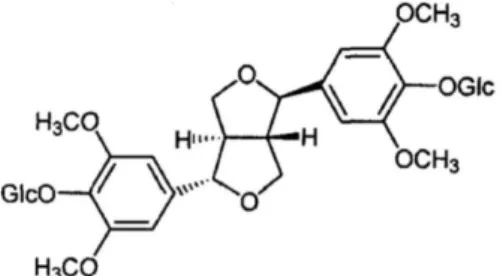
(xylazine hydrochloride) was purchased from Bayer Korea (Ansan, Korea). Eleutheroside E (Fig. 1), a major component from E. senticosus, was also purchased from Wako Pure Chemical Industries (Osaka, Japan). All other chem- icals and reagents were purchased from standard suppliers. Agents were dissolved in distilled water. Eleutheroside E was dissolved in 100% ethanol and subsequently diluted in the buffer to the final con- centration (0.1, 1, 10 and 100 μM). The ethanol concentration in the final sample was 0.1%.

Corpus cavernosum strip preparation

All animal procedures for this study were performed in accordance with the regulations of the care and use of laboratory animals guide which were approved by the Institutional Animal Care and Use Com- mittee of Chonbuk National University Laboratory Animal Center (cuh–IACUC–2016–12) and all efforts were made to minimize animal suffering. The healthy male New Zealand white rabbits (2.5–3.0 kg) were housed in a controlled environment, one in each cage, at 18 ±

mated in such an environment for the first week and randomly allo- cated into the experiment, respectively. The rabbits were intravenously anesthetized with 50 mg/kg ketamine plus 25 mg/kg xylazine hydro- chloride and exsanguinated. The penis was excised rapidly and PCCSM was carefully dissected free from the surrounding tunica albuginea. During the preparation, each step was taken cautiously to prevent damage of functional endothelium or overstretching of PCCSM.

Organ chamber studies

Strip of PCCSM (1.5 × 1.5 × 7 mm) was vertically placed in a 2 ml organ chamber. One end was connected with a thread to the prong of a force transducer (FT03, Grass Telefactor; West Warwick, RI, USA) and the other end was secured with a thread to a holder for isometric tension measurement. The organ chamber containing a HEPES buffer (36

o

C) was constantly aerated with 100% O

2

. After mounting, the strip was equilibrated for 60 mins with several adjustments of length until a baseline force stabilized at 1 g and the oxygenated buffer was replaced every 15 mins. After stabilization, 10 μM Phe was added to adjust the maximal contractile tension and then the samples were added to the organ chamber with the desired final concentration. The effects of ethanol extract and fractions from E. senticosus were stud- ied by cumulative addition at concentrations of 1, 2, 3 and 4 mg/ml from the plateau of the Phe-induced contraction. Eleutheroside E was tested at final concentrations of 0.1, 1, 10 and 100 μM. The change in isometric force was measured and recorded using the PowerLab data 400 acquisition system (Software Chart, version 5.2; AD Instruments, Castle Hill, Australia).

Interaction of eleutheroside E with phosphodiesterase type 5 (PDE5) inhibitor on PCCSM tension

The PCCSM tissue was pre-incubated with PDE5 inhibitor, udena- fil (0.1 μM), for 30 mins and then eleutheroside E (0.1 μM) was added to the organ chamber after Phe-induced contraction. Contrarily, udenafil was added to the chamber of PCCSM, which was pre-incu- bated with eleutheroside E for 30 mins, after Phe-induced contraction.

Statistical analysis

For the control, contractions induced by Phe alone were considered as the 100% values. All subsequent responses to samples were expressed as the percent reversal of Phe–induced contractions. All results are presented as means ± standard derivations (SD) and n refers to the number of tissue samples examined. The statistical sig- nificance of differences was calculated by one-way analysis of vari- ance (ANOVA) followed by Bonferroni’s multiple comparison test. A value of P < 0.05 was considered to be significant.

Fig. 1. Chemical structure of eleutheroside E

(3)

Results

Cumulative effect of ethanol extract from E. senticosus on PCCSM

Experiments were performed to investigate the responses of cumu- lative relaxation to the ethanol extract from E. senticosus on the Phe pre–contracted PCCSM. The ethanol extract from E. senticosus had dose-dependently relaxant effect with the maximum effect obtained at 4 mg/ml (Fig. 2). The relaxations induced by 1, 2, 3 and 4 mg/ml of ethanol extracts from E. senticosus were 32.19 ± 2.93%, 38.32 ± 4.95%, 61.12 ± 5.99% (p < 0.05) and 73.86 ± 6.55% (p < 0.01), respec- tively.

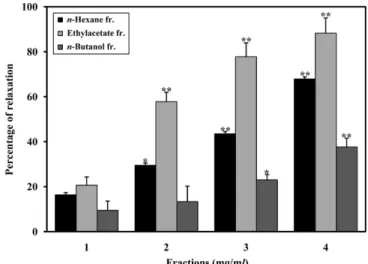
Cumulative effects of fractions from ethanol extract on PCCSM The Phe pre–contracted PCCSMs were treated with n–hexane, ethyl acetate and n–butanol fractions. The relaxant effect of ethyl ace- tate fraction was the most significant among three fractions. The ethyl acetate fraction with a range of 1–4 mg/ml dose-dependently relaxed the PCCSM with a maximum value at 4 mg/ml (Fig. 3). The amount of relaxation induced by 1, 2, 3 and 4 mg/ml of ethyl acetate fraction was 20.67 ± 3.68%, 57.79 ± 4.21% (p < 0.01), 77.74 ± 6.21% (p <

0.01) and 88.24 ± 64.79% (p < 0.01) , respectively.

Effect of eleutheroside E on the contractility of PCCSM Experiments were performed to investigate the effect of eleuthero-

side E from the ethyl acetate fraction of E. senticosus on the contrac- tility of Phe pre–contracted PCCSM. Eleutheroside E with a range of 0.1, 1, 10 and 100 μM relaxed the PCCSM in a dose-dependent man- ner with a maximum level of 85.59 ± 2.19% (p < 0.01) at a concen- tration of 100 μM (Fig. 4).

Fig. 2. Percentage of relaxation induced by ethanol extract from E.senticosus (n = 6). The pre–contracted penile corpus cavernosum smooth muscle (PCCSM) with 10 µM L–phenylephrine (Phe) was treated at four concentrations of ethanol extracts (1, 2, 3 and 4 mg/m l). The submaximal penile contractile responses induced by Phe were taken as the 100% values, and all subsequent responses to E. senticosus ethanol extracts were expressed as a percentage of this value. Each point represents the mean ± SD of the percentages. Statistical analysis was carried out by ANOVA followed by Bonferroni’s test (* p < 0.05 vs 1 mg/ml, **p < 0.01 vs 1 mg/m l)

Fig. 3. Percentage of relaxation induced by fractions partitioned with n–hexane, ethyl acetate and n–butanol (n = 6). The pre–

contracted penile corpus cavernosum smooth muscle (PCCSM) with 10 µM L–phenylephrine (Phe) was treated at four concentrations of each fraction (1, 2, 3 and 4 mg/m l). The submaximal penile contractile responses induced by Phe were taken as the 100% values, and all subsequent responses to to E.

senticosus fractions were expressed as a percentage of this value.

Each point represents the mean ± SD of the percentages.

Statistical analysis was carried out by ANOVA followed by Bonferroni’s test (* p < 0.05 vs 1 mg/ml, **p < 0.01 vs 1 mg/ml)

Fig. 4. Percentage of relaxation induced by eleutheroside E of E.senticosus (n = 6). The pre–contracted penile corpus cavernosum smooth muscle (PCCSM) with 10 µM L–phenylephrine (Phe) was treated at four concentrations of eleutheroside E (0.1, 1, 10 and 100 µM). The submaximal penile contractile responses induced by Phe were taken as the 100% values, and all subsequent responses to scoparone were expressed as a percentage of this value. Each point represents the mean ± SD of the percentages.

Statistical analysis was carried out by ANOVA followed by

Bonferroni’s test (** p < 0.01 vs 0.1 µM)

(4)

Effect of eleutheroside E on udenafil pre-incubated PCCSM The relaxation induced by a single dose of udenafil (0.1 μM) on Phe pre–contracted PCCSM was 10.08 ± 1.47% and the single dose of eleutheroside E (0.1 μM)-induced relaxation on Phe pre–con- tracted PCCSM was 11.78 ± 2.11% (Fig. 5). The relaxation of eleuth- eroside E was 22.75 ± 1.18% (p < 0.01) on Phe pre–contracted PCCSM, which had been pre-incubated with udenafil. The relaxation of udenafil was 20.62 ± 1.27% (p < 0.05) on Phe pre–contracted PCCSM, which had been pre–incubated on eleutheroside E. Eleuth- eroside E had an additive effect with udenafil on Phe pre–contracted PCCSM.

Discussion

This study presented that the ethanol extract from E. senticosus dose–dependently relaxed the Phe–precontracted PCCSM at a range of 1–4 mg/ml. The relaxation induced by eleutheroside E, that was the major component in the ethyl acetate fraction, was in a cumulatively dose–dependent manner with a range of 0.1 to 100 μM. Furthermore, eleutheroside E showed an additive effect with udenafil on PCCSM.

Multiple medical approaches such as hormones, intraurethral sup- positories, intracavernosal injections, surgery and PDE5 inhibitors have been used for treating ED.

23)

PDE5 inhibitor such as udenafil has been used for the first line therapy in the treatment of ED patients but adverse reactions such as visual disorder, headache, facial flushing, rhinitis and dyspepsia have been reported.

24-25)

Furthermore, clinical researches have been reported that approximately 30% to 50% of patients with erectile dysfunction were improved by treating with

Our results indicated that eleutheroside E additionally improved udenafil–induced relaxation. This result shows us that eleutheroside E may have a good effect to ED patients who do not respond to udena- fil. Though many medicines are available for ED, many researchers are searching for a new medicine or an alternative medicine to improve erectile function. Eleutheroside E may be an effective medi- cal treatment in ED patients who do not completely respond to erec- tile dysfunction-treating medicine. Understanding its mechanism of action is still important study field.

The primary intracellular pathway of PCCSM relaxation is medi- ated through NO–cGMP signal pathway.

27)

NO stimulates the soluble guanylyl cyclase in corpus cavernosum smooth muscle, which con- verts GTP to intracellular second messenger cGMP.

28)

An increase of cGMP leads a decrease in intracellular calcium, leading to the relax- ation of PCCSM.

29)

The mechanism of eleutheroside E–induced relax- ation on PCCSM is not known until now. Therefore, it seems worthy to research about clarifying the mechanism of action.

Conclusion

In conclusion, eleutheroside E from E. senticosus efficiently relaxed Phe pre–contracted PCCSM and increased udenafil–induced relax- ation. Our findings provide the possibility that eleutheroside E may be a potential candidate of medicine or supplement to develop new med- icines from herbal products with clinical applications for ED. E. sen- ticosus extract also can be an alternative medicine for patients who want natural products to improve penile erection.

Acknowledgment

This research was supported by a grant (NRF-2017R1D1A1B 03028138) of the Basic Science Research Program through the National Research Foundation of Korea (NRF) funded by the Minis- try of Education.

Conflict of Interest

All authors declare that they have no conflict of interest.

References

1. NIH Consensus Conference on Impotence. NIH Consensus Development Panel on Impotence. JAMA 270, 83 (1993).

2. Braun, M., Wassmer, G., Klotz, T., Reifenrath, B., Mathers, M.

and Engelmann, U. : Epidemiology of erectile dysfunction: results of the ‘Cologne Male Survey’. Int. J. Impot. Res. 12, 305 (2000).

3. Rosen, R. C., Fisher, W. A., Eardley, I., Niederberger, C., Nadel, A. and Sand, M. : The multinational Mens Attitudes to Life Fig. 5. Interaction of eleutheroside E (ELEU, 0.1 µM) with

udenafil (UDE, 0.1 µM) (n = 6). UDE + ELEU means the relaxation induced by eleutheroside E in pre–incubated penile corpus cavernosum smooth muscle (PCCSM) with udenafil. ELEU + UDE means the relaxation induced by udenafil in pre-incubated PCCSM with eleutheroside E. Each point represents the mean ± SD of percentages of maximal relaxation of the preceding sub- maximal contractile responses. Statistical analysis was carried out by ANOVA followed by Bonferroni’s test (* p < 0.05 vs UDE,

** p < 0.01 vs UDE)

(5)

Events and Sexuality (MALES) study. I. Prevalence of erectile dysfunction and related health concerns in the general population.

Curr. Med. Res. Opin. 20, 607 (2004).

4. Seftel, A. D., Sun, P. and Swindle, R. : The prevalence of hypertension, hyperlipidemia, diabetes mellitus and depression in men with erectile dysfunction. J. Urol. 171, 2341 (2004).

5. Ahn, T. Y., Park, J. K., Lee, S. W., Hong, J. H., Park, N. C., Kim, J. J., Park, K. S., Park, H. S. and Hyun, J. S. : Prevalence and Risk Factors for Erectile Dysfunction in Korean Men: Results of an Epidemiological Study. J. Sex. Med. 4, 1269 (2007).

6. Feldman, H. A., Goldstein, I., Hatzichristou, D. G., Krane, R. J.

and McKinlay, J. B. : Impotence and its medical and psychosocial correlates: results of the Massachusetts Male Aging Study. J. Urol.

151, 54 (1994).

7. Robert, J. F. and Abdulmaged, M. T : Obesity and Erectile Dysfunction: Is Androgen Deficiency the Common Link?. T.S.W.

Urol. 9, 676 (2009).

8. Anderson, K. E. : Pharmacology of lower urinary tract smooth muscles and penile erectile tissues. Pharmacol. Rev. 9, 676 (2009).

9. Mcmahon, C. G., Samali, R. and Johnson, H. : Efficacy, safety and patient acceptance of sildenafil citrate as treatment for erectile dysfunction. J. Urol. 164, 1192 (2000).

10. Ghalayini, I. F. : Nitric oxide–cyclic GMP pathway with some emphasis on cavernosal contractility. Int. J. Impot. Res. 16, 459 (2004).

11. Ryu, K. S., Lee, D. H. and Seo, Y. K. : Program the annual convention of the Korean society of pharmacognosy: Studies on the Lignan group from Acanthopanax sessiliflorum. Kor. J.

Pharmacogn. 7, 255 (1976).

12. Kim, S. K., Kim, Y. G., Lee, M. K., Han J. S., Lee, J. H. and Lee, H. Y. : Comparision of biological activity according to extracting solvents of four acanthopanax root bark. Kor. J. Med.

Crop Sci. 8, 21 (2000).

13. Arouca, A. and Grassi-Kassisse, D. M. : Eleutherococcus senticosus: Studies and effects. Health (London). 5, 1509 (2013).

14. Ryu, J. Y., Son, D. W., Kang, J. G., Kim, H. S., Kim, B. K. and Lee. S. H. : A benzenoid from the stem of Acanthopanax senticosus. Arch. Pharm. Res. 27, 912 (2004).

15. Li, Q., Jia, Y., Xu, L., Wang, X., Shen, Z., Liu, Y. and Bi, K. : Simultaneous determination of protocatechuic acid, syringin, chlorogenic acid, caffeic acid, liriodendrin and isofraxidin in Acanthopanax senticosus HARMS by HPLC-DAD. Biol. Pharm.

Bull. 29, 532 (2006).

16. Nhiem, N. X., Kiem, P. V., Minh, C. V., Tai, B. H., Quang, T. H., Soung, K. S., Koo, J. E., Kho, Y. S. and Kim, Y. H. : Anti- inflammatory activity on LPS-stimulated dendritic cells of lupanetype triterpenoids from the leaves of Acanthopanax koreanum.

Arch. Pharm. Res. 34, 1593 (2011).

17. Nhiem, N. X., Kim, K. C., Kim, A. D., Hyun, J. W., Kang, H. K., Kiem, P. V., Minh, C. V., Thu, V. K., Tai, B. H., Kim, J. A. and Kim, Y. H. : Phenylpropanoids from the leaves of Acanthopanax

koreanum and their antioxidant activity. J. Asian Nat. Prod. Res.

13, 56 (2011).

18. Li, N., Lee, H. S., Zhang, N., Sun, Y. N., Li, J. L., Xing, S. S., Chen, J. G. and Cui, L. : Two new diphenyl ethers from Acanthopanax senticosus (Rupr. & Maxim.) harms with PTP1B inhibitory activity. Phytochem. Lett. 13, 286 (2015).

19. Huang, L., Zhao, H., Huang, B., Zheng, C., Peng, W. and Qin, L. : Acanthopanax senticosus: review of botany, chemistry and pharmacology. Pharmazie. 66, 83 (2011).

20. Huang, L. Z., Wei, L., Zhao, H. F., Huang, B. K., Rahman, K., and Qin, L. P. : The effect of Eleutheroside E on behavioral alterations in murine sleep deprivation stress model. Eur. J.

Pharmacol. 658, 150 (2011).

21. Ahn, J., Um, M. Y., Lee, H., Jung, C. H., Heo, S. H. and Ha, T.

Y. : Eleutheroside E, An Active Component of Eleutherococcus senticosus, Ameliorates Insulin Resistance in Type 2 Diabetic db/

db Mice. Evidence-Based Complementary and Alternative Medicine.

2013, 9 (2013).

22. Kwan, C. Y., Zhang, W. B., Sim, S. M., Deyama, T. and Nishibe.

S. : Vascular effects of Siberian ginseng (Eleutherococcus senticosus):

endothelium-dependent NO- and EDHF-mediated relaxation depending on vessel size. Naunyn Schmiedebergs Arch. Pharmacol. 369, 473 (2004).

23. Wespes, E., Amar, E., Hatzichristou, D., Hatzimouratidis, K., Montorsi, F., Pryor, J. and Vardi, Y. : EAU Guidelines on erectile dysfunction: an update. Eur. Urol. 49, 806 (2006).

24. Palit, V. and Eardley, I. : An update on new oral PDE5 inhibitors for the treatment of erectile dysfunction. Nat. Rev. Urol. 7, 603 (2010).

25. Huang, S. A. and Lie, J. D. : Phosphodiesterase-5 (PDE5) inhibitors in the management of erectile dysfunction. P. T. 38, 407 (2013).

26. Hatzichristou, D., Rosen, R. C., Broderick, G., Clayton, A., Cuzin, B, Derogatis, L., Litwin, M., Meuleman, E., O'Leary, M., Quirk, F., Sadovsky, R. and Seftel, A. : Clinical evaluation and management strategy for sexual dysfunction in men and women. J. Sex. Med.

1, 49 (2004).

27. Kim, N. N., Huang, Y., Moreland, R. B., Kwak, S. S., Goldstein, I. and Traish, A. : Cross-regulation of intracellular cGMP and cAMP in cultured human corpus cavernosum smooth muscle cells.

Mol. Cell Biol. Res. Commun. 4, 10 (2000).

28. Nimmegeers, S., Sips, P., Buys, E., Decaluwé, K., Brouckaert, P.

and Van de Voorde, J. : Role of the soluble guanylyl cyclase alpha1-subunit in mice corpus cavernosum smooth muscle relaxation.

Int. J. Impot. Res. 20, 278 (2008).

29. Bredt, D. S., Ferris, C. D. and Snyder, S. H. : Nitric oxide synthase regulatory sites. phosphorylation by cyclic AMP-dependent protein kinase, protein kinase C, and calcium/calmodulin protein kinase; identification of flavin and calmodulin binding sites. J.

Biol. Chem. 267, 10976 (1992).

수치

Fig. 1. Chemical structure of eleutheroside E
Fig. 2. Percentage of relaxation induced by ethanol extract from E.senticosus (n = 6)

참조

관련 문서

L-NAME: Nω -Nitro-L-arginine methyl ester hydrochloride; SC: Schisandra chinensis ; GA: gomisin A; eNOS: endothelial nitric oxide synthase; nNOS: neuronal nitric oxide