• 검색 결과가 없습니다.

Quercetin Relaxed the Smooth Muscle of Rabbit Penile Corpus Cavernosum by Activating the NO-cGMP Signaling Pathway

N/A
N/A
Protected

Academic year: 2022

Share "Quercetin Relaxed the Smooth Muscle of Rabbit Penile Corpus Cavernosum by Activating the NO-cGMP Signaling Pathway"

Copied!
6
0
0

로드 중.... (전체 텍스트 보기)

전체 글

(1)

https://doi.org/10.20307/nps.2017.23.3.169

169

Quercetin Relaxed the Smooth Muscle of Rabbit Penile Corpus Cavernosum by Activating the NO-cGMP Signaling Pathway

Bo Ram Choi

1

, Hye Kyung Kim

2,

*, and Jong Kwan Park

1,

*

1

Department of Urology, Chonbuk National University and Research Institute of Clinical Medicine of Chonbuk National University-Biomedical Research Institute and Clinical Trial Center of Medical Device of Chonbuk National University,

20, Geonji-ro, Deokjin-gu, Jeonju 54896, Korea

2
College of Pharmacy, Kyungsung University, 309 Suyeong-ro, Nam-gu, Busan 48434, Korea

Abstract − The aim of this study was to investigate the effect and action mechanism of quercetin on penile corpus cavernosum smooth muscle (PCCSM). PCCSM precontracted with phenylephrine (Phe) was treated with four different concentrations of quercetin (10

−7

, 10

−6

, 10

−5

and 10

−4

M). PCCSM were preincubated with N-Nitro-L- arginine methyl ester hydrochloride (L-NAME) and 1H-[1,2,4]oxadiazolo[4,3-a]quinoxalin-1-one (ODQ) to block nitric oxide synthase and guanylate cyclase, respectively. The changes in PCCSM tension were recorded, and cyclic nucleotides in the perfusate were measured by radioimmunoassay. The interactions of quercetin with phosphodiesterase type 5 inhibitors (PDE5-Is) such as sildenafil, udenafil and mirodenafil, were also evaluated.

PCCSM relaxation induced by quercetin occurred in a concentrationdependent manner. The application of quercetin to PCCSM pre-treated with L-NAME and ODQ significantly inhibited the relaxation. Quercetin significantly increased cGMP in the perfusate. Furthermore, quercetin enhanced PDE5-Is-induced relaxation of PCCSM.

Quercetin relaxed the PCCSM by activating the NO-cGMP signaling pathway, and it may be a therapeutic candidate or an alternative treatment for patients with erectile dysfunction who do not completely respond to PDE5-Is.

Keywords − Quercetin, Penile corpus cavernosum smooth muscle, NO-cGMP pathway, Phosphodiesterase type 5 inhibitors

Introduction

Erectile dysfunction (ED) is defined as the inability to attain and/or maintain a penile erection sufficient for satisfactory sexual performance.

1

The Massachusetts Male Aging Study reports that ED is believed to affect more than 150 million men worldwide.

2

ED shares common risk factors with cardiovascular and neurological diseases, physical activity and a number of modifiable lifestyle factors.

3

For the treatment for ED, PDE5-Is are used worldwide and they have a 60% therapeutic effect in patients who have ED.

4

For erection to take place, the penile arteries should be

dilated and corpus cavernosum smooth muscle should be relaxed, thereby penile venous occlusion decreases the blood outflow.

5

Nitric oxide (NO), which is produced both in cavernosal nerves and endothelium, has been recognized to play an important role in mediating penile erection.

6

Upon penile erection, NO is formed in niterergic nerves or endothelial cells and then it diffuses into the smooth muscle cells and activates soluble guanylyl cyclase.

7

This enzyme causes an increase in the formation of cyclic guanosine monophosphate (cGMP), which acts on the calcium channels and decreases the intracellular level of calcium ions, leading to cavernosum smooth muscle relaxation.

5

Quercetin belongs to a subclass of naturally occurring compounds, and it is one of the most widely distributed bioflavonoids.

8

It is found in frequently consumed dietary foods, such as apples, berries, onion, tea, red wine, nuts, seeds and vegetables, which form an integral part of the human diet.

9

Many studies have demonstrated the anti- oxidative, anti-inflammatory and oxygen radical scavenging activities of quercetin.

10

In addition, it has also been shown that quercetin has vasorelaxant activity on the

*Author for correspondence

Jong Kwan Park, Department of Urology, Chonbuk National Uni- versity and Research Institute of Clinical Medicine of Chonbuk National University-Biomedical Research Institute and Clinical Trial Center of Medical Device of Chonbuk National University, 567 Baekje-daero, Deokjin-gu, Jeonju 54896, Korea.

Tel: +82-63-250-1510; E-mail: [email protected]

Hye Kyung Kim, College of Pharmacy, Kyungsung University, 309 Suyeong-ro, Nam-gu, Busan 48434, Korea Korea.

Tel: +82-51-663-4883; E-mail: [email protected]

(2)

thoracic aorta in rats through the endothelial NO pathway.

11

The objective of present study was to clarify the relaxant effect of quercetin on penile corpus cavernosum smooth muscle and to determine the possible mechanism of action of quercetin in ED. The study also examined the additive effect of quercetin on PDE5-Is-induced relaxation of penile corpus cavernosum smooth muscle (PCCSM).

Experimental

Chemicals and reagents – N-Nitro-L-arginine methyl ester hydrochloride (L-NAME), 1H-[1,2,4]Oxadiazolo[4,3- a]quinoxalin-1-one (ODQ), L-phenylephrine (Phe), dimethyl sulfoxide (DMSO) and quercetin (Fig. 1) were purchased from Sigma-Aldrich (St. Louis, MO, USA). Sildenafil citrate and udenafil were donated by Dong-A ST Company (Seoul, Korea) and mirodenafil hydrochloride was provided by SK Chemicals Life Science (Seoul, Korea).

All other chemicals were purchased from standard suppliers. Agents were dissolved in distilled water. ODQ was dissolved in DMSO and the highest DMSO concentration in various test systems was < 1%, (v/v).

Quercetin was dissolved in 100% ethanol, and subsequently diluted in the buffer to the final concentration (10

−7

, 10

−6

, 10

−5

and 10

−4

M).

Ex vivo tissue preparation – All animal procedures in this study were performed in accordance with the regulations of the care and use of laboratory animals guide, which were approved by the Institutional Animal Care and Use Committee of Chonbuk National University Laboratory Animal Center (IACUC, cuh-IACUC-2016- 12), and all efforts were made to minimize animal suffering.

The rabbits were intravenously anesthetized with 50 mg/

kg ketamine plus 25 mg/kg rumpun (xylazine hydrochloride) (Bayer, Ansan, Korea) and exsanguinated. The penis was excised rapidly.

For the ex vivo penile perfusion model, penis was prepared as described previously.

12

The entire penis, including the urethra, was rapidly excised from the pubic bone. The urethra was dissected free from the penile body. The glans penis was cut out until the corpus cavernosum was exposed to air through a small opening with a diameter of 5 mm. Two small polyethylene tubes (inner diameter, 1.2 mm; outer diameter, 1.7 mm; Natsume, Tokyo, Japan) were inserted into the proximal opening of the cruses for inflow and ligated with a purse string silk suture to prevent leakage. The distal cut of the corpus cavernosum was opened to allow flow out of the penis.

The distal end was secured with a cotton thread to a

holder of the bottom of the chamber. The cannulated penis was mounted vertically in a 50 mL fully humidified organ chamber without buffer outside the penis. The penis was immediately perfused interstitially through the cannula with the HEPES buffer using a peristaltic pump (0.5 mL/

min). The hollow organ chamber was covered with parafilm to maintain the temperature and humidity in the organ chamber at 36

o

C. After mounting, the tissue was equilibrated for 100 minutes with several adjustments of length until a baseline force was stabilized at 10 g. The chamber for penile perfusion had a hole at the bottom to allow collection of the perfusate. The penis was perfused with quercetin for 2 hours, to measure the cGMP concentra- tion in the perfusate.

Measurement of tension on PCCSM – The PCCSM was then carefully dissected free from the surrounding tunica albuginea. A strip of PCCSM (1.5 × 1.5 × 7 mm) was prepared from healthy male New Zealand white rabbits weighing 2.5 – 3.0 kg and it was vertically placed in a 2 mL organ chamber with one end connected with a thread to the prong of a force transducer (FT03, Grass Telefactor; West Warwick, RI, USA), and the other end secured with a thread to a holder for isometric tension measurement. After mounting, the strip was equilibrated for 60 minutes with several adjustments of length until a baseline force stabilized at 1 g, and the oxygenated buffer was replaced every 15 minutes. After stabilization, 10

−5

M Phe was added to adjust the maximal contractile tension, and then the samples were added to the organ chamber with the desired final concentration. Quercetin (10

−7

, 10

−6

, 10

−5

and 10

−4

M) was added to the perfusion medium in sequence, each for 10 minutes. The PCCSM was prein- cubated with L-NAME (10

−3

M) for 30 minutes to block NOS or it was preincubated with ODQ (10

−5

M) for 30 minutes to block guanylate cyclase.

Radioimmunoassay (RIA) for the measurement of

cGMP concentration – For the measurement of cGMP

concentration in the perfusate, 100 µL of the perfusate

was treated with trichloroacetic acid (300 µL) to a final

concentration of 6% for 15 minutes at room temperature

Fig. 1. The structure of quercetin.

(3)

and centrifuged at 4

o

C. The supernatant (100 µL) was extracted three times with water-saturated ether, and then dried using a Speedvac concentrator. The dried samples were suspended in 100 µL sodium acetate buffer (50 mM, pH 4.8) and used for cGMP measurement.

Levels of cGMP were measured with a specific RIA, as described previously.

13

Briefly, standards or samples were made up to a final volume of 100 µL of 50 mM sodium acetate buffer (pH 4.8) containing theophylline (8 mM), then 100 µL of diluted cGMP antiserum (Calbiochem- Novabiochem) and iodinated 2’-O-monosuccinyl-guanosine 3’,5’-cyclic monophosphate tyrosyl methyl ester [125 I- ScGMP-TME, 10,000 counts/min (cpm) per 100 µL] were added for the measurement of cGMP. For the acetylation reaction, 5 µL of a mixture of acetic anhydride and triethylamine (1:2 dilution) were added to the assay tube before antiserum and tracer were added. The bound form was separated from the free form by charcoal suspension.

The amount of cGMP was expressed in femtomoles per milligram of the PCCSM.

Interaction of quercetin with PDE5-Is on PCCSM tension – The strip of PCCSM was preincubated with sildenafil citrate (10

−8

M), udenafil (10

−7

M) or mirodenafil hydrochloride (10

−8

M) for 30 minutes, and then quercetin (10

−5

M) was added to the organ chamber after Phe-induced contraction. Inversely, the penile tissue preincubated with quercetin was also added with sildenafil citrate, udenafil or mirodenafil hydrochloride after Phe-induced contraction.

Statistical evaluation – The submaximal penile contractile responses induced by Phe were considered to be the 100% values, and all subsequent responses to quercetin were expressed as a percentage of this value. The results were expressed as the mean ± SD, and n represents the

number of tissues in each group. Statistical significance of differences was calculated by one-way analysis of variance (ANOVA), followed by Bonferroni’s multiple comparison test. Concentration-dependent responses before and after treatment with blockers were compared by Student’s paired t-test. A probability value < 0.05 was considered statistically significant.

Results

Cumulative effect of quercetin on PCCSM with/

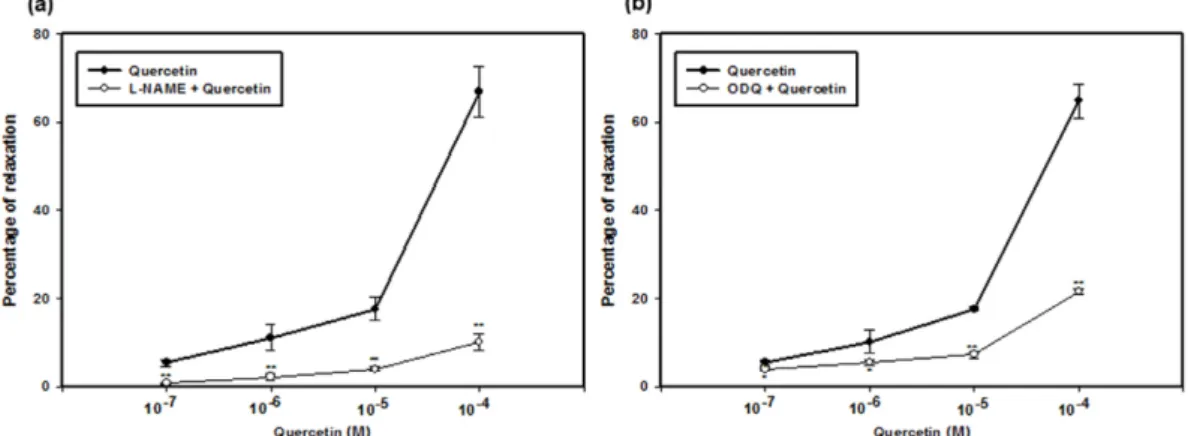
without L-NAME preincubation – Quercetin exerted a significant and concentration-dependent relaxation of PCCSM (Fig. 2). The relaxations induced by 10

−7

, 10

−6

, 10

−5

and 10

−4

M of quercetin were 5.34 ± 0.86%, 11.10 ± 2.94%, 17.60 ± 2.56% and 66.92 ± 5.81%, respectively (Fig. 2A). The application of quercetin to PCCSM preincubated with L-NAME significantly decreased the relaxation. The relaxation induced by quercetin in L- NAME-preincubated PCCSM was 0.72 ± 0.16%, 2.15 ± 0.72%, 3.97 ± 0.53% and 10.01 ± 1.85%.

Cumulative effect of quercetin on PCCSM with/

without ODQ preincubation – Quercetin in a range of 10

−7

– 10

−4

M relaxed the PCCSM in a concentration- dependent manner with a maximum value of 64.87 ± 3.92%. The relaxations induced by quercetin in ODQ- preincubated PCCSM were significantly inhibited (Fig.

2B). Preincubation with ODQ also reduced the relaxation to 4.01 ± 0.49%, 5.44 ± 0.77%, 7.18 ± 0.69% and 21.61 ± 0.57%.

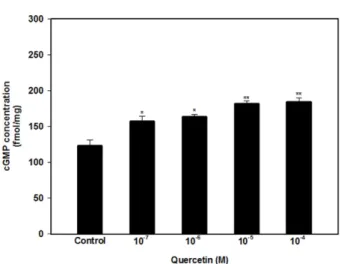
Effect of quercetin on cGMP in the perfusate – The yield of cGMP was significantly increased by quercetin in the perfusate (Fig. 3). The highest yield of cGMP was

Fig. 2. Relaxation effect of quercetin in L-phenylephrine (Phe)-induced contraction (n = 4). PCCSM contracted by Phe (10

−5

M) that was

preincubated with N-Nitro-L-arginine methyl ester hydrochloride (L-NAME, 10

−3

M) (a) or 1H-[1,2,4]Oxadiazolo[4,3-a]quinoxalin-1-one

(ODQ, 10

−5

M) (b) was treated with four concentrations of quercetin (10

−7

, 10

−6

, 10

−5

and 10

−4

M). The submaximal penile contractile

responses induced by Phe were taken as the 100% values, and all subsequent responses to quercetin were expressed as a percentage of this

value. Each point represents the mean ± SD of the percentages. Statistical analysis was carried out by ANOVA, followed by Bonferroni’s

test (* p < 0.05 compared to quercetin, **p < 0.01 compared to quercetin).

(4)

obtained at 10

−4

M. The yield of cGMP was increased in a concentration-dependent manner. The maximum value of cGMP induced by quercetin was 184.08 ± 5.86 fmol/mg.

Effect of quercetin on PCCSM incubated with sildenafil – The relaxation induced by a single dose of sildenafil citrate (10

−8

M) in Phe-precontracted PCCSM was 10.23 ± 2.24%, and quercetin (10

−5

M) -induced relaxation in Phe-precontracted PCCSM after its single use was 22.09 ± 2.23%. The relaxation induced by a combination of sildenafil citrate and quercetin was 34.88 ± 1.99% in sildenafil citrate-preincubated PCCSM, and

38.03 ± 2.78% in quercetin-preincubated PCCSM, respec- tively. Quercetin efficiently enhanced sildenafil citrate- induced relaxation, as shown in Fig. 4.

Effect of quercetin on PCCSM preincubated with udenafil – The relaxation value induced by a single dose of udenafil in Phe-precontracted PCCSM was 9.47 ± 1.48% (Fig. 5). On the other hand, quercetin-induced relaxation in Phe-precontracted PCCSM was 18.51 ± 1.62%. The combined relaxation value of udenafil and Fig. 3. Effect of quercetin (10

−7

, 10

−6

, 10

−5

and 10

−4

M) on the

cGMP level in the perfusate. Each point represents the mean ± SD of the percentages. Statistical analysis was carried out by ANOVA, followed by Bonferroni’s test (* p < 0.05 compared to control, **p < 0.01 compared to control).

Fig. 4. Interaction of quercetin (QUER, 10

−5

M) with sildenafil (SILD, 10

−8

M) (n = 4). SILD + QUER indicates quercetin-induced relaxation in sildenafil citrate-preincubated PCCSM. QUER + SILD indicates sildenafil citrate-induced relaxation in QUER- preincubated PCCSM. Each point represents the mean ± SD of percentages of maximal relaxation of the preceding submaximal contractile responses. Statistical analysis was carried out by ANOVA, followed by Bonferroni’s test (** p < 0.01 compared to SILD).

Fig. 5. Interaction of quercetin (QUER, 10

−5

M) with udenafil (UDE, 10

−7

M) (n = 4). UDE + QUER indicates quercetin-induced relaxation in udenafil-preincubated PCCSM. QUER + UDE indicates udenafil-induced relaxation in QUER-preincubated PCCSM. Each point represents the mean ± SD of percentages of maximal re- laxation of the preceding submaximal contractile responses.

Statistical analysis was carried out by ANOVA, followed by Bonferroni’s test (** p < 0.01 compared to UDE).

Fig. 6. Interaction of quercetin (QUER, 10

−5

M) with mirodenafil (MIRO, 10

−8

M) (n = 4). MIRO + QUER indicates quercetin-induced relaxation in mirodenafil hydrochloride-preincubated PCCSM.

QUER + MIRO indicates mirodenafil hydrochloride-induced relaxa-

tion in QUER-preincubated PCCSM. Each point represents the

mean ± SD of percentages of maximal relaxation of the preceding

submaximal contractile responses. Statistical analysis was carried

out by ANOVA, followed by Bonferroni’s test (**p < 0.01 com-

pared to MIRO).

(5)

quercetin was 28.72 ± 1.95% in udenafil-preincubated PCCSM, and 31.67 ± 2.25% in quercetin-preincubated PCCSM, respectively. Quercetin significantly enhanced udenafil-induced relaxation more than three-fold.

Effect of quercetin on PCCSM incubated with mirodenafil – The relaxation induced by single use of mirodenafil hydrochloride (10

−8

M) in Phe- precontracted PCCSM was 6.63 ± 1.61%. The relaxation induced by quercetin was 19.29 ± 1.14% in Phe-contracted PCCSM (Fig. 6). The relaxation induced by the combination of quercetin and mirodenafil hydrochloride was 28.18 ± 2.59% in quercetin-preincubated tissue, and 29.23 ± 2.88% in mirodenafil hydrochloride-preincubated PCCSM, respectively. Quercetin preincubation efficiently improved mirodenafil hydrochloride-induced relaxation more than four-fold.

Discussion

Penile erection is a complex neurovascular process that is induced by both increased arterial inflow and restricted venous outflow, resulting from PCCSM relaxation.

14

Normal penile erection is dependent upon NO.

15

NO is supplemented by its release from the vascular endothelium and this leads to relaxation of PCCSM in the penile arteries.

16

NO activates soluble guanylate cyclase to increase cellular second messenger cGMP in smooth muscle cells.

17

Binding of cGMP to cGMP-dependent protein kinases activates the Ca

2+

pump, and Ca

2+

activated K

+

channels result in reduction of intracellular calcium, leading to the relaxation of PCCSM.

18

This in vitro study showed that quercetin had a significant relaxation effect on PCCSM in a concentration- dependent manner. Quercetin also increased the cGMP levels in the perfusate. These results suggest that quercetin may have a good effect on erectile function and it may be possibly involved in the NO-cGMP signaling pathway.

McDonald and Murad demonstrated that NO causes relaxation of vascular smooth muscle through activation of soluble guanylate cyclase, increasing the intracellular cGMP.

19

In this study, PCCSM incubation with specific inhibitors, L-NAME and ODQ, abolished the relaxation response induced by quercetin. This demonstrates that quercetin may be involved in penile erection by activating the NO-cGMP signaling pathway.

Although many drugs have been used to treat ED, finding an alternative medicine for treating ED and understanding its molecular mechanism of action is still a significant field of study. Current pharmacological treatment for ED includes intracavernosal injections of vasoactive

agents, venous or arterial surgery and oral route of administration of medicines.

20

Oral PDE5-Is, including avanafil, mirodenafil, sildenafil, tadalafil, udenafil and vardenafil, have been currently used for first-line therapy of patients with ED.

21

Although PDE5-Is pharmacotherapy is effective in a wide range of individuals, it is not efficacious in all patients.

7

Our results showed that quercetin (10

−5

M) efficiently increased sildenafil (10

−8

M), udenafil (10

−7

M) and mirodenafil (10

−8

M)-induced relaxation. Quercetin significantly enhanced mirodenafil- induced relaxation more than four-fold. Many researchers are also searching for alternative medicines to improve erectile function. Quercetin enhanced PDE5-Is -induced relaxation as a supplementary drug and it may improve erectile dysfunction in patients who do not completely respond to PDE5-Is.

In conclusion, quercetin had a significant relaxant effect on PCCSM and it increased PDE5-Is-induced relaxation. The increased cGMP levels in the perfusate and the inhibition of quercetin-induced relaxation with L- NAME and ODQ suggested that quercetin may be involved in penile erection through the NO-cGMP signaling pathway. Therefore, quercetin may be a good drug candidate for the treatment of ED. The combination of quercetin with PDE5-Is may be helpful for the patients with ED who do not completely respond to PDE5-Is.

Acknowledgements

This research was supported by grant (NRF-2017 R1D1A1B03028138) from the National Research Foun- dation of Korea.

References

(1) Kouidrat, Y.; Zaitouni, A.; Amad, A.; Diouf, M.; Desailloud, R.;

Loas, G.; Lalau, J. D. J. Diabetes Complicat. 2017, 31, 108-113.

(2) Sheweita, S. A.; Wally, M.; Hassan, M. Oxid. Med. Cell Longev.

2016, 2016, 1-9.

(3) Matos, G.; Hirotsu, C.; Alvarenga, T. A.; Cintra, F.; Bittencourt, L.;

Tufik, S.; Andersen, M. L. Andrology 2013, 1, 872-878.

(4) Hatzichristou, D.; Rosen, R. C.; Broderick, G.; Clayton, A.; Cuzin, B.; Derogatis, L.; Litwin, M.; Meuleman, E.; O'Leary, M.; Quirk, F.;

Sadovsky, R.; Seftel, A. J. Sex. Med. 2004, 1, 49-57.

(5) Chiou, W. F.; Chen, C. F. Eur. J. Pharmacol. 2002, 446, 151-159.

(6) Sullivan, M. E.; Thompson, C. S.; Dashwood, M. R.; Khan, M. A.;

Jeremy, J. Y.; Morgan, R. J.; Mikhailidis, D. P. Cardiovasc. Res. 1999, 43, 658-665.

(7) Deng, W.; Bivalacqua, T. J.; Hellstrom, W. J. G.; Kadowitz, P. J. Int.

J. Impot. Res. 2005, 17, S57- S63.

(8) Yan, L.; Zhang, J. D.; Wang, B.; Lv, Y. J.; Jiang, H.; Liu, G. L.;

Qiao, Y.; Ren, M.; Guo, X. F. PLoS One 2013, 8, 1-14.

(9) Bhutada, P.; Mundhada, Y.; Bansod, K.; Bhutada, C.; Tawari, S.;

Dixit, P.; Mundhada, D. Neurobiol. Learn. Mem. 2010, 94, 293-302.

(6)

(10) Ranawat, P.; Pathak, C. M.; Khanduja, K. L. Phytother. Res. 2013, 27, 802-810.

(11) Senggunprai, L.; Kukongviriyapan, V.; Prawan, A.;

Kukongviriyapan, U. Phytother. Res. 2014, 28, 841-848.

(12) Erden Inal, M.; Kahraman, A. Toxicology 2000, 154, 21-29.

(13) Chen, C. K.; Pace-Asciak, C. R. Gen. Pharmacol. 1996, 27, 363- 366.

(14) Zhao, C.; Chae, H. J.; Kim, S. H.; Cui, W. S.; Lee, S. W.; Jeon, J.

H.; Park, J. K. J. Sex. Med. 2010, 7, 1419-1428.

(15) Cui, X.; Lee, S. J.; Kim, S. Z.; Kim, S. H.; Cho, K. W. Eur. J.

Pharmacol. 2000, 402, 129-137.

(16) Li, X.; Oh, H. C.; Son, S. B.; Lee, Y. J.; Kang, D. G.; Lee, H. S.

Evid. Based Complement. Alternat. Med. 2012, 2012, 1-10.

(17) Feng, X. T.; Qin, C. B.; Leng, J.; Tang, Q. L.; Shi, H.; Zhai, L. N.;

Li, S. L. Biosci. Biotechnol. Biochem. 2012, 76, 257-263.

(18) Nimmegeers, S.; Sips, P.; Buys, E.; Decaluwé, K.; Brouckaert, P.;

Van de Voorde, J. Int. J. Impot. Res. 2008, 20, 278-284.

(19) Eardley, I. Br. J. Diabetes Vasc. Dis. 2002, 2, 272-276.

(20) Hosogai, N.; Takakura, S.; Manda, T.; Mutoh, S. Eur. J.

Pharmacol. 2003, 473, 65-70.

(21) Choi, B. R.; Kumar, S. K.; Zhao, C.; Zhang, L. T.; Kim, C. Y.; Lee, S. W.; Jeon, J. H.; Soní, K. K.; Kim, S. H.; Park, N. C.; Kim, H. K.; Park, J. K. Int. J. Impot. Res. 2015, 27, 225-232.

Received April 10, 2017

Revised May 8, 2017

Accepted May 8, 2017

수치

Fig. 2. Relaxation effect of quercetin in L-phenylephrine (Phe)-induced contraction (n = 4)
Fig. 4. Interaction of quercetin (QUER, 10 −5 M) with sildenafil (SILD, 10 −8 M) (n = 4)

참조

관련 문서