• 검색 결과가 없습니다.

Relaxant Effect of Rhynchophylline from the Hooks and Stems of <i>Uncaria sinensis</i> on Penile Corpus Cavernosum Smooth Muscle in a rabbit

N/A
N/A
Protected

Academic year: 2021

Share "Relaxant Effect of Rhynchophylline from the Hooks and Stems of <i>Uncaria sinensis</i> on Penile Corpus Cavernosum Smooth Muscle in a rabbit"

Copied!
6
0
0

로드 중.... (전체 텍스트 보기)

전체 글

(1)

DOI 10.17480/psk.2017.61.5.254

Relaxant Effect of Rhynchophylline from the Hooks and Stems of Uncaria sinensis on Penile Corpus Cavernosum Smooth Muscle in a rabbit

Hye Kyung Kim

#

Department of Urology, Medical school, Chonbuk National University, Jeonju 54896, Republic of Korea College of Pharmacy, Kyungsung University, Busan 48434, Republic of Korea

(Received September 15, 2017; Revised October 23, 2017; Accepted October 25, 2017)

Abstract- The relaxant effect of ethanol extract and its active indole alkaloid, rhynchophylline, from the hooks and stems of Uncaria sinensis was evaluated on penile corpus cavernosum smooth muscle (PCCSM) in a rabbit. The PCCSM relax- ations induced by ethanol extract and fractions (1, 2, 3 and 4 mg/ml) were in a concentration-dependent manner and the relaxant effect of ethyl acetate fraction was the most significant. Rhynchophylline also induced PCCSM relaxation in a con- centration-dependent manner and significantly enhanced udenafil-induced relaxation. Rhynchophylline relaxed the smooth muscle of rabbit penile corpus cavernosum and it can be an alternative medicine for patients who want natural products to improve penile erection or who do not completely respond to erectile dysfunction-treating medicine.

Keywords Uncaria sinensis, rhynchophylline, penile corpus cavernosum smooth muscle, penile erection, udenafil

Erectile dysfunction (ED), also known as impotence, is defined as the consistent inability to maintain a penile erection of sufficient quality to permit satisfactory sexual intercourse.

1)

ED prevalence and severity increase with age. ED prevalence has been reported as 7% among men aged 18 to 29 yr, 2 to 9%

among men aged 30 to 39 yr, 9 to 11% among men aged 40 to 49 yr, 16 to 18% among men aged 50 to 59 yr, 34% among men aged 60 to 69 yr and 53% among men aged 70 to 80 yr.

2)

Although the prevalence of ED was strongly associated to age, a higher probability was also correlated with heart disease, hypertension, diabetes, associated medications, and indexes of anger and depression. Cigarette smoking was related with a greater probability of complete ED in men with heart disease and hypertension.

3)

Worldwide prevalence of ED has been pre- dicted to increase to 322 million cases by 2025.

4-5)

Penile erection depends on two key events: increased arte- rial inflow and restricted venous outflow and relaxation of the smooth muscle of penile corpus cavernosum.

6)

Normal penile

erection is associated with increase cellular second messenger cGMP and is mediated by nitric oxide (NO) release from the vascular endothelium.

7)

cGMP in turn activates a specific pro- tein kinase, which phosphorylates certain proteins and ion channels, resulting in opening of the potassium channels and hyperpolarization.

8)

These pathways decreased the intracellu- lar calcium concentration leading to cavernosum smooth mus- cle relaxation.

9)

The dried hooks and stems of Uncaria sinensis (Oliv.) Haviland ( U. sinensis), a member of Rubiaceae, have tradition- ally been used as an oriental medicine for hypertension and cerebrovascular disorders in Asian countries.

10-14)

Several indole alkaloids have been isolated from U. sinensis, including rhyn- chophylline, isorhynchophylline, corynoxeine and isocorynox- eine.

15-19)

Rhynchophylline has been known as antihypertensive and neuroprotective compound.

20-22)

Furthermore, it has also been shown that rhynchophylline has induced the vascular relaxation in the isolated rat aorta.

10)

Here, we have investi- gated the possible ex vivo effects of rhynchophylline from U.

sinensis ethanol extract on the smooth muscle of penile cor- pus cavernosum in a rabbit.

The objective of this study was to examine the relaxant effect of ethanol extract from U. sinensis and its active com-

#

Corresponding Author Hye Kyung Kim

College of Pharmacy, Kyungsung University, 309 Suyeong-ro, Nam-gu, Busan 48434, Republic of Korea

Tel.: 051-663-4883 Fax.: 051-663-4809 E-mail: [email protected]

Short Report

종설

(2)

pound, rhynchophylline, on penile corpus cavernosum smooth muscle (PCCSM) to evaluate a therapeutic effect of rhyncho- phylline on penile erection. The study also examined the syner- gistic effect of rhynchophylline on udenafil-induced relaxation.

Experimental methods

Plant extraction

The dried hooks and stems of U. sinensis were purchased from Kyung-dong market, Seoul, Korea, in May 2016. The voucher specimen (accession number KSUS-201601) has been deposited at the Herbarium of College of Pharmacy, Kyungsung University.

Extraction and fractionation

The shade- dried hooks and stems of U. sinensis (1.2 kg) were ground to a fine powder and extracted with ethanol (2400 m l × 3) at room temperature for 3 hrs using an ultra- sonic bath (model 8510 DHT; Branson, CT, USA). After filtra- tion, extract was evaporated in vacuo and lyophilized to yield the total extract (43.1 g). The ethanol extract (22.3 g) was par- titioned with hexane, ethyl acetate and n-butanol. All samples were stored at 4

o

C until use. Extract and fractions were dis- solved in HEPES buffer and subsequently diluted in the buffer to final concentration (1, 2, 3 and 4 mg/m l).

Chemicals and reagents

Dimethyl sulfoxide (DMSO) and L-phenylephrine (Phe) were purchased from Sigma-Aldrich (St. Louis, MO, USA).

Udenafil was donated from Dong-A ST Company (Seoul, Korea). Rhynchophylline (Fig. 1), a major compound from U.

sinensis, was also purchased from ChemFaces (Wuhan, Hubei, PRC). All other chemicals were purchased from standard sup- pliers. Agents were dissolved in distilled water. Rhynchophyl- line was dissolved in 100% ethanol and subsequently diluted in the buffer to the final concentration (10

-7

, 10

-6

, 10

-5

and 10

-4

M). The ethanol concentration in the final sample was 0.1%.

Tissue preparation

All animal procedures for this study were performed in accordance with the regulations of the care and use of labora- tory animals guide which were approved by the Institutional Animal Care and Use Committee of Chonbuk National Univer- sity Laboratory Animal Center (cuh-IACUC-2016-12) and all

efforts were made to minimize animal suffering. The healthy male New Zealand white rabbits (2.5-3.0 kg) were housed in a controlled environment, 1 in each cage, at 18±1

o

C and under relative humidity 62±5%. These rabbits were acclimated in such an environment for the first week. The animals were ran- domly allocated into the experiment, respectively. The rabbits were intravenously anesthetized with 50 mg/kg ketamine plus 25 mg/kg xylazine and exsanguinated. The penis was excised rapidly and PCCSM was carefully dissected free from the sur- rounding tunica albuginea. During the preparation, each step was undertaken cautiously to prevent damage of functional endothelium or overstretching of the tissue.

Measurement of tension on PCCSM

Strip of PCCSM (1.5 × 1.5 × 7 mm) was prepared from healthy male New Zealand white rabbit weighing 2.5-3.0 kg and was vertically placed in a 2 m l organ chamber with one end connected with a thread to the prong of a force trans- ducer (FT03, Grass Telefactor; West Warwick, RI, USA), and the other end secured with a thread to a holder for isometric tension measurement. The organ chamber containing a HEPES buffer (36

o

C) was constantly aerated with 100% O

2

. After mounting, the strip was equilibrated for 60 mins with several adjustments of length until a baseline force stabilized at 1 g, and the oxygenated buffer was replaced every 15 mins.

After stabilization, 10

-5

M Phe was added to adjust the maxi-

mal contractile tension, and then the samples were added to

the organ chamber with the desired final concentration. The

relaxation effects of ethanol extract and fractions from U. sinen-

sis were studied by cumulative addition at concentrations from

1-4 mg/m l at the plateau of the Phe-induced contraction. Rhyn-

chophylline was tested at final concentrations of 10

-7

, 10

-6

, 10

-5

Fig. 1 − Chemical structure of rhynchophylline from Uncaria sinensis.

(3)

and 10

-4

M. The change in isometric force was measured and recorded using the PowerLab data 400 acquisition system (Software Chart, version 5.2; AD Instruments, Castle Hill, Australia). The relaxation was expressed as a percentage decrease from the maximal contractile tension induced by 10

-5

M Phe.

Interaction of rhynchophylline with udenafil on PCCSM tension

The PCCSM tissue was pre-incubated with udenafil (10

-7

M) for 30 mins, then rhynchophylline (10

-6

M) was added to the organ chamber after Phe-induced contraction. Inversely, udena- fil was added to the chamber of PCCSM, which was pre-incu- bated with rhynchophylline for 30 mins, after Phe-induced contraction.

Statistical evaluation

The submaximal penile contractile responses induced by Phe were considered to be the 100% values and all subsequent responses to extract, fractions or rhynchophylline were expressed as a percentage of this value. The results were expressed as the mean±SD, and n represents the number of tissues in each group. The statistical significance of differences was calculated by one-way analysis of variance (ANOVA), followed by Bonfer- roni’s multiple comparison test. A probability value < 0.05 was considered significant.

Results

Cumulative Effect of U. Sinensis Ethanol Extract on PCCSM

Experiments were performed to investigate the cumulative dose-dependent relaxation responses to ethanol extract from U. sinensis on the pre-contracted PCCSM with Phe. U. sinen- sis ethanol extract had a concentration-dependent relaxant effect (Fig. 2). The relaxations induced by 1, 2, 3 and 4 mg/m l of ethanol extracts were 30.65±4.06, 49.77±4.65 ( p<0.05), 67.24±7.12 ( p<0.01) and 79.89±5.10% (p<0.01), respectively.

Cumulative Effects of U. Sinensis Fractions on PCCSM The Phe pre-contracted PCCSM was treated with the frac- tions partitioned with hexane, ethyl acetate and n-butanol. The relaxant effect of ethyl acetate fraction was the most signifi- cant compared with that of hexane and n-butanol fractions. The

ethyl acetate fraction with a range of 1, 2, 3 and 4 mg/m l relaxed the PCCSM in a concentration-dependent manner with a maximum value of 89.82±4.64% ( p<0.01) (Fig. 3).

Fig. 2 − Percentage of relaxation induced by ethanol extract of U.

sinensis (n=6). The pre-contracted PCCSM with 10

-5

M L- phenylephrine (Phe) was treated with four concentrations of ethanol extracts. The submaximal penile contractile responses induced by Phe were taken as the 100% values, and all subsequent responses to U. sinensis ethanol extracts were expressed as a percentage of this value. Each point represents the mean±SD of the percentages.

Statistical analysis was carried out by ANOVA followed by Bonferroni’s test (*p<0.05 vs 1 mg/ml, **p<0.01 vs 1 mg/

ml).

Fig. 3 − Percentage of relaxation induced by fractions partitioned

with hexane, ethyl acetate and n-butanol (n=6). The pre-

contracted PCCSM with 10

-5

M L-phenylephrine (Phe)

was treated with four concentrations of each fraction. The

submaximal penile contractile responses induced by Phe

were taken as the 100% values, and all subsequent

responses to to U. sinensis fractions were expressed as a

percentage of this value. Each point represents the

mean±SD of the percentages. Statistical analysis was

carried out by ANOVA followed by Bonferroni’s test

(*p<0.05 vs 1 mg/ml, **p<0.01 vs 1 mg/ml).

(4)

Evaluation of Cumulative Dose of Rhynchophylline Experiments were performed to investigate the cumulative dose-dependent relaxation of rhynchophylline in the ethyl ace- tate fraction of U. sinensis on the pre-contracted PCCSM with Phe. Rhynchophylline relaxed dose-dependently the PCCSM with a maximum value of 91.85±4.65% ( p<0.01) at a concen- tration of 10

-4

M (Fig. 4).

Effect of Rhynchophylline on PCCSM incubated with Udenafil

The relaxation induced by a single dose of udenafil (10

-7

M) on Phe pre-contracted PCCSM was 9.08±1.26% and the single use of rhynchophylline (10

-6

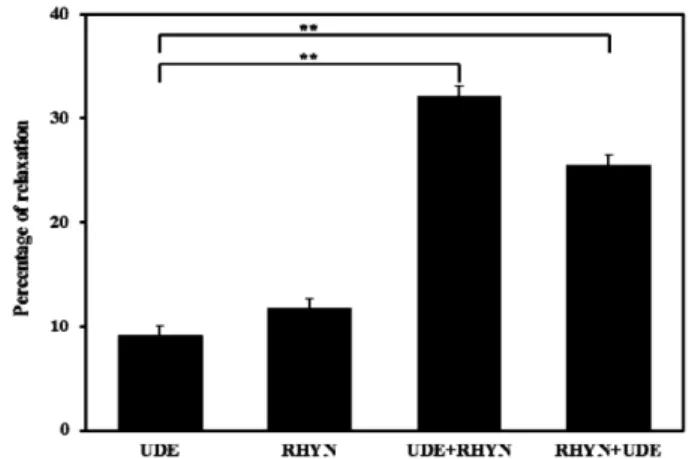
M)-induced relaxation on Phe pre-contracted PCCSM was 11.71±1.41%(Fig. 5). The relaxation of rhynchophylline was 32.10±1.27% ( p<0.01) on Phe pre-contracted PCCSM, which had been pre-incubated with udenafil. The relaxation of udenafil was 25.45±0.92%

( p<0.01) on Phe pre-contracted PCCSM, which had been pre- incubated on with rhynchophylline. The active indole alkaloid, rhynchophylline, efficiently enhanced udenafil-induced relaxation more than three-fold.

Discussion

The present study showed that U. sinensis ethanol extract had a significant relaxation effect in a concentration-dependent manner on rabbit PCCSM at a range of 1, 2, 3 and 4 mg/m l.

The relaxation on Phe pre-contracted PCCSM induced by rhynchophylline, which is the major compound in the ethyl acetate fraction from U. sinensis, was in a cumulatively dose- dependent manner with a range of 10

-7

to 10

-4

M.

Current pharmacological treatment for ED includes hor- mones, vacuum constriction devices, intraurethral supposito- ries, intracavernosal injections, surgery and oral administration.

Oral administration is the most effective therapy for ED and has the highest patients’ compliance.

23-24)

Oral phosphodiesterase type 5 inhibitors (PDE5-Is) such as udenafil have been used commonly for the first line therapy in the treatment of ED patients.

25-26)

However, there are many adverse reactions such as visual disorder, headache, facial flushing, rhinitis and dys- pepsia.

27-30)

In addition, PDE5-Is were only able to improve the erections of approximately 30% to 50% of the patients.

31)

This study showed that the relaxant effect of rhynchophylline on udenafil pre-incubated PCCSM was higher than that on rhyn- chophylline pre-incubated PCCSM. The result shows us that Fig. 4 − Percentage of relaxation induced by rhynchophylline of U.

sinensis (n=6). The pre-contracted PCCSM with 10

-5

M L- phenylephrine (Phe) was treated with four concentrations of rhynchophylline. The submaximal penile contractile responses induced by Phe were taken as the 100% values, and all subsequent responses to rhynchophylline were expressed as a percentage of this value. Each point represents the mean±SD of the percentages. Statistical analysis was carried out by ANOVA followed by Bonferroni’s test (* p<0.05 vs 10

-7

M, ** p<0.01 vs 10

-7

M).

Fig. 5 − Interaction of rhynchophylline (RHYN, 10

-6

M) with udenafil (UDE, 10

-7

M) (n = 6). UDE + RHYN means the relaxation induced by rhynchophylline in pre-incubated PCCSM with udenafil. RHYN+UDE means the relaxation induce by udenafil in pre-incubated PCCSM with rhynchophylline. Each point represents the mean±SD of percentages of maximal relaxation of the preceding submaximal contractile responses. Statistical analysis was carried out by ANOVA followed by Bonferroni’s test (** p

< 0.01 vs UDE).

(5)

rhynchophylline may have a good therapeutic effect to about 50% of ED patients who were not treated with udenafil. Fur- thermore, the active compound, rhynchophylline significantly improved udenafil-induced relaxation more than three-fold.

Although various medicines are available for ED, searching for a new medicine or a complementary medicine to improve erectile function and understanding its mechanism of action is still significant study field. Rhynchophylline may improve ED in patients who do not completely respond to erectile dysfunc- tion-treating medicine.

The primary intracellular pathway for corpus cavernosum smooth muscle relaxation appears to be mediated through the NO-cGMP signal pathway.

32-34)

NO stimulates guanylyl cyclase in the smooth muscle, which converts GTP to the intracellular second messenger cGMP.

35)

An increase of cGMP produces a decrease in intracellular calcium, leading to the relaxation of PCCSM.

36)

The mechanism for the PCCSM relaxation of rhyn- chophylline is still not known. Therefore, it seems worthy to continue the research to clarify the mechanism of action and to develop new medicines from natural products with a clinical application for ED.

In conclusion, rhynchophylline from U. sinensis significantly had a relaxant effect on Phe pre-contracted PCCSM and increased udenafil-induced relaxation. This research may pro- vide the possibility that rhynchophylline of U. sinensis may be a good candidate of medicine or supplement for the treatment of ED and can be an alternative medicine for patients who want natural products to improve penile erection.

Acknowledgement

This research was supported by Kyungsung University Research Grants in 2016.

References

1) Lue, T. F. : Erectile dysfunction. N. Engl. J. Med. 342, 1802 (2000).

2) Prins, J., Blanker, M. H., Bohnen, A.M., Thomas, S. and Bosch, J.

L. : Prevalence of erectile dysfunction: a systematic review of population-based studies. Int. J. Impot. Res. 14, 422 (2002).

3) Braun, M., Wassmer, G., Klotz, T., Reifenrath, B., Mathers, M.

and Engelmann, U. : Epidemiology of erectile dysfunction:

results of the 'Cologne Male Survey'. Int. J. Impot. Res. 12, 305 (2000).

4) Matos, G., Hirotsu, C., Alvarenga, T. A., Cintra, F., Bittencourt, L., Tufik, S. and Andersen, M. L. : The association between TNF- α and erectile dysfunction complaints. Andrology 1, 872 (2013).

5) McVary, K. T. : Clinical practice. Erectile dysfunction. N. Engl.

J. Med. 357, 2472 (2007).

6) Krane, R. J., Goldstein, I. and Saenz de Tejada, I. : Impotence.

N. Engl. J. Med. 321, 1647 (1989).

7) Kim, N., Vardi, Y., Padma-Nathan, H., Daley, J., Goldstein, I.

and Saenz de Tejada, I. : Oxygen tension regulates the nitric oxide pathway. Physiological role in penile erection. J. Clin.

Invest. 91, 437 (1993).

8) Christ, G. J. and Lue, T. : Physiology and biochemistry of erections. Endocrine 23, 93 (2004).

9) Hawksworth, D. J. and Burnett, A. L. : Pharmacotherapeutic management of erectile dysfunction. Clin. Pharmacol. Ther. 98, 602 (2015).

10) Kuramochi, T., Chu, J. and Suga, T. : Gou-teng (from Uncaria rhynchophylla Miquel)-induced endothelium-dependent and - independent relaxations in the isolated rat aorta. Life Sci. 54, 2061 (1994).

11) Itoh, T., Shimada, Y. and Terasawa, K. : Efficacy of Choto-san on vascular dementia and the protective effect of the hooks and stems of Uncaria sinensis on glutamate-induced neuronal death. Mech. Ageing Dev. 111, 155 (1999).

12) Lin, Y. W. and Hsieh, C. L. : Oral Uncaria rhynchophylla (UR) reduces kainic acid-induced epileptic seizures and neuronal death accompanied by attenuating glial cell proliferation and S100B proteins in rats. J. Ethnopharmacol. 135, 313 (2011).

13) Tan, S. N., Yong, J. W., Teo, C. C., Ge, L., Chan, Y. W. and Hew, C. S. : Determination of metabolites in Uncaria sinensis by HPLC and GC-MS after green solvent microwave-assisted extraction. Talanta 83, 891 (2011).

14) Heitzman, M. E., Neto, C. C., Winiarz, E., Vaisberg, A. J. and Hammond, G. B. : Ethnobotany, phytochemistry and pharmacology of Uncaria (Rubiaceae). Phytochemistry 66, 5 (2005).

15) Ahn, S. M., Kim, H. N., Kim, Y. R., Oh, E. Y., Choi, Y. W., Shin, H. K. and Choi, B. T. : Neuroprotective effect of 1- methoxyoctadecan-1-ol from Uncaria sinensis on glutamate- induced hippocampal neuronal cell death. J. Ethnopharmacol.

155, 239 (2014).

16) Park, M. K., Kim, J. M. and Hwang, G. S. : The Constituents of Uncaria Hooks. Yakhak Hoeji 40, 36 (1996).

17) Shi, J. S., Yu, J. X., Chen, X. P. and Xu, R. X. : Pharmacological actions of Uncaria alkaloids, rhynchophylline and isorhynchophylline. Acta Pharmacol. Sin. 24, 97 (2003).

18) Kang, T. H., Murakami, Y., Takayama, H., Kitajima, M., Aimi, N.,

Watanabe, H. and Mat-sumoto, K. : Protective effect of

rhynchophylline and isorhynchophyllineon in vitro ischemia-induced

(6)

neuronal damage in the hippocampus: putativeneurotransmitter receptors involved in their action. Life Sci. 76, 331 (2004).

19) Yuan, D., Ma, B., Yang, J. Y., Xie, Y. Y., Wang, L., Zhang, L. J., Kano, Y. and Wu, C .F. : Anti-inflammatory effects of rhynchophylline and isorhynchophylline in mouseN9 microglial cells and the molecular mechanism. Int. Immunopharmacol. 9, 1549 (2009).

20) Zhou, J. and Zhou, S. : Antihypertensive and neuroprotective activities of rhynchophylline: the role of rhynchophylline in neurotransmission and ion channel activity. J. Ethnopharmacol.

132, 15 (2010).

21) Ho, T. Y., Tang, N. Y., Hsiang, C. Y. and Hsieh, C. L. : Uncaria rhynchophylla and rhynchophylline improved kainic acid-induced epileptic seizures via IL-1 β and brain-derived neurotrophic factor.

Phytomedicine 21, 893 (2014).

22) Zhou, J. Y., Mo, Z. X. and Zhou, S. W. : Rhynchophylline down- regulates NR2B expression in cortex and hippocampal CA1 area of amphetamine-induced conditioned place preference rat.

Arch. Pharm. Res. 33, 557 (2010).

23) Wespes, E., Amar, E., Hatzichristou, D., Hatzimouratidis, K., Montorsi, F., Pryor, J. and Vardi, Y. : EAU Guidelines on erectile dysfunction: an update. Eur. Urol. 49, 806 (2006).

24) Wespes, E., Amar, E., Hatzichristou, D., Montorsi, F., Pryor, J.

and Vardi, Y. : Guidelines on erectile dysfunction. Eur. Urol. 41, 1 (2002).

25) Montorsi, F., Salonia, A., Deho, F., Cestari, A., Guazzoni, G., Rigatti, P. and Stief, C. : Pharmacological management of erectile dysfunction. BJU Int. 91, 446 (2003).

26) Palit, V. and Eardley, I. : An update on new oral PDE5 inhibitors for the treatment of erectile dysfunction. Nat. Rev. Urol. 7, 603 (2010).

27) DeBusk, R. F., Pepine, C. J., Glasser, D. B., Shpilsky, A., DeRiesthal, H. and Sweeney, M. : Efficacy and safety of sildenafil citrate in men with erectile dysfunction and stable coronary artery disease. Am. J. Cardiol. 93, 147 (2004).

28) Kloner, R. : Erectile dysfunction and hypertension. Int. J.

Impot. Res. 19, 296 (2007).

29) Thorve, V. S., Kshirsagar, A. D., Vyawahare, N. S., Joshi, V. S., Ingale, K. G. and Mohite, R. J. : Diabetes-induced erectile dysfunction: epidemiology, pathophysiology and management. J.

Diabetes Complications 25, 129 (2011).

30) Deng, W., Bivalacqua, T. J., Hellstrom, W. J. and Kadowitz, P. J. : Gene and stem cell therapy for erectile dysfunction. Int. J. Impot.

Res. 17, 57 (2005).

31) Hatzichristou, D., Rosen, R. C., Broderick, G., Clayton, A., Cuzin, B, Derogatis, L., Litwin, M., Meuleman, E., O'Leary, M., Quirk, F., Sadovsky, R. and Seftel, A. : Clinical evaluation and management strategy for sexual dysfunction in men and women. J. Sex. Med. 1, 49 (2004).

32) Kim, N. N., Huang, Y., Moreland, R. B., Kwak, S. S., Goldstein, I. and Traish, A. : Cross-regulation of intracellular cGMP and cAMP in cultured human corpus cavernosum smooth muscle cells. Mol. Cell Biol. Res. Commun. 4, 10 (2000).

33) Klotz, T., Bloch, W., Zimmermann, J., Ruth, P., Engelmann, U.

and Addicks, K. : Soluble guanylate cyclase and cGMP- dependent protein kinase I expression in the human corpus cavernosum. Int. J. Impot. Res. 12, 157 (2000).

34) Recio, P., Lopez, P. G., Hernandez, M., Prieto, D., Contreras, J.

and García-Sacristán, A. : Nitrergic relaxation of the horse corpus cavernosum. Role of cGMP. Eur. J. Pharmacol. 351, 85 (1998).

35) Nimmegeers, S., Sips, P., Buys, E., Decaluwé, K., Brouckaert, P. and Van de Voorde J. : Role of the soluble guanylyl cyclase alpha1-subunit in mice corpus cavernosum smooth muscle relaxation. Int. J. Impot. Res. 20, 278 (2008).

36) Bredt, D. S., Ferris, C. D. and Snyder, S. H. : Nitric oxide synthase regulatory sites. phosphorylation by cyclic AMP- dependent protein kinase, protein kinase C, and calcium/

calmodulin protein kinase; identification of flavin and

calmodulin binding sites. J. Biol. Chem. 267, 10976 (1992).

수치

Fig. 3 − Percentage of relaxation induced by fractions partitioned with hexane, ethyl acetate and  n-butanol (n=6)
Fig. 5 − Interaction of rhynchophylline (RHYN, 10 -6  M) with udenafil (UDE, 10 -7  M) (n = 6)

참조

관련 문서