ABSTRACT
This study surveyed the central mountain area of Demilitarized Zone (DMZ) from March to October 2018 to reveal the appearance patterns of freshwater fish. We collected 7,744 individuals of 43 species in 12 families with skimming nets and cast nets in 12 stations during the survey. The dominant species was Zacco koreanus (30.3%), and the subdominant species was Z. platypus (18.5%), followed by Rhynchocypris oxycephalus (10.0%), R. steindachneri (6.7%), Microphysogobio yaluensis (5.9%), Acheilognathus signifer (4.5%), Pungtungia herzi (4.2%), and Orthrias nudus (2.6%). Among the collected species, four were legally protected.
중부산악 DMZ 민통선이북지역의 담수어류 출현양상 1a
명라연 2 ⋅서형수 3 ⋅고명훈 4*
Appearance Patterns of Freshwater Fish in Central Mountain Area of DMZ, Korea 1a Ra-Yeon Myung 2 , Hyung-Soo Seo 3 , Myeong-Hun Ko 4*
요 약
중부산악 DMZ 민통선이북지역의 담수어류 출현양상을 밝히기 위해 2018년 5월부터 10월까지 조사를 실시하였다. 조사기 간동안 24개 지점에서 족대와 투망으로 12과 43종 7,744개체를 채집하였고, 우점종은 참갈겨니(30.3%), 아우점종은 피라미 (18.5%)였으며, 그 다음으로 버들치(10.0%), 버들개(6.7%), 돌마자(5.9%), 묵납자루(4.5%), 돌고기(4.2%), 대륙종개 (2.6%), 등의 순으로 우세하게 출현하였다. 출현종 중 법정보호종은 천연기념물 어름치 1종, 환경부지정 멸종위기야생생물 II급의 다묵장어, 묵납자루, 가는돌고기 3종 등 모두 4종이, 한국고유종은 20종(46.5%)이 채집되었다. 또한 기후변화민감종 (냉수성어류)은 금강모치와 새미, 둑중개 3종이, 육봉형 어류는 다묵장어와 둑중개와 밀어 3종이, 외래종은 배스 1종이 출현하 였다 . 지점별 우점종은 참갈겨니(15개 지점), 피라미와 버들치(4개), 둑중개(1개)였으며, 우점도는 상류부에서 하류부(김화남 대천 본류 )로 갈수록 낮아지고, 반대로 다양도와 종풍부도는 상류부에서 하류부로 갈수록 높아졌다. 군집구조는 크게 최상류, 상류, 한강, 임진강으로 구분되었다. 선행조사와 비교한 결과, 본 조사에서 가장 많은 종(43종)이 채집되었고, 새로 채집된 어류는 2종(참중고기, 배스), 채집되지 않은 종은 6종(쏘가리, 대농갱이, 열목어, 흰줄납줄개, 왜매치, 왜몰개)이었다. 김화남대 천은 법정보호종 (4종)을 비롯한 많은 종이 서식하고 다양도와 풍부도지수가 높아 생물학적 가치가 높았고, 끝으로 이 지역의 보전방안에 대해 논의하였다 .
주요어: 어류상, 군집구조, 멸종위기종, 김화남대천
1 접수 2020년 9월 2일, 수정 (1차: 2020년 10월 27일), 게재확정 2020년 11월 2일
Received 2 September 2020; Revised (1st: 27 October 2020); Accepted 2 November 2020
2 이화여자대학교 에코과학부 석사과정 Division of EcoScience, Ewha Womans University, 52 Ewhayeodaegil Seodaemun-gu, Seoul-si, 03760, Korea ([email protected])
3 국립생태원 전임연구원 National Institute of Ecology, 1210 Geumgangro Maseo-myeon Seocheon-gun, 33657, Korea ([email protected]) 4 고수생태연구소 소장 Kosoo Biology Institute, 49 Mokdongjungangnamro14gagil, Yangcheon-gu, Seoul-si, 07955, Korea
a 이 논문은 2018 DMZ 일원 생태계조사 민통선이북지역 중부산악권역(NIE-수탁연구-2018-07)에 의하여 연구되었음.
* 교신저자 Corresponding author: [email protected]
They included Hemibarbus mylodon, which was a natural monument, and Lethenteron reissneri, A. signifer, and Pseudopungtungia tenuicorpa, which were class II endangered wildlife designated by the Ministry of Environment. Twenty Korean endemic species (46.5%) and one exotic species, Micropterus salmoides, were also collected. Additionally, three climate-change sensitive species, R. kumgangensis, Ladislavia taczanowskii, and Cottus koreanus, and three landlocked species, L. reissneri, C. koreanus, and Rhinogobius brunneus appeared. The dominant species in each station were Z. koreanus (15 stations), Z. platypus (four stations), R.
oxycephalus (four stations), and C. koreanus (one station). The species dominance index decreased from upstream to downstream (mainstream of Gimhwanamdae Stream), while the species diversity index and the species richness index increased. The community structure of the rivers was divided into the uppermost stream, upper stream, Han River, and Imjin River. Compared to antecedent surveys, this study collected the highest number of species. Two new species (Sarcocheilichthys variegatus wakiyae and Micropterus salmoides) were caught, while six species (Siniperca scherzeri, Leiocassis ussuriensis, Brachymystax lenok tsinlingensis, Rhodeus ocellatus, Abbottina springeri, Aphyocypris chinensis) did not appear. Gimhwanamdaecheon Stream has high biological value with the inhabitation of many species, including species under legal protection and high diversity and richness index scores. This paper also discussed a protection plan for this area.
KEY WORDS: FISH FAUNA, COMMUNITY STRUCTURE, ENDANGERED SPECIES, GIMHWANAMDAE STREAM
서 론
한반도 중부를 동서로 가로지르는 군사분계선(Military Demarcation Line, MDL)은 한국전쟁의 정전협정(1953년 7 월 27일)으로 생성되었으며, 비무장지대(Demilitarized Zone, DMZ)는 군사분계선을 따라 남북으로 각각 2 km 이내에 해당 하는 지역이다. 정전협정 이후 약 70년 동안 DMZ 및 DMZ 인접지역은 민간인의 출입이 제한되면서 개발에 의한 훼손이 거의 없어 자연적 생태계를 유지하였다. 첫 생태계 조사는 1972 년부터 1974년까지 문화재관리국과 한국자연보존연구소의 공 동조사로 처음 실시되었고(BCP, 1974), 이후 환경부 및 문화 재청, 산림청, 해당지자체인 경기도와 강원도 등에 의해 생태계 조사가 이루어졌다. 이 지역의 생태계 조사는 군사적 특수성으 로 인해 출입이 제한되어 국방부의 사전승인 및 협조가 필요하 며 미확인 지뢰지대가 많아 조사에 어려움이 많았으며, 조사의 한계에도 불구하고 높은 생물다양성을 보이고 법정보호종을 포함한 많은 생물들이 서식하는 것으로 보고되어 왔다(BCP, 1974; KFS, 1995-2000; Gyonggido, 1987; Gangwondo, 1987; CHA, 2005; 2006; 2007; NIER, 2010; 2012; 2013;
NIE, 2014). 2015년에는 DMZ 인접지역에서 이루어진 생태 계 조사를 모두 정리한 총서가 발간되었다(NIE, 2015).
DMZ 인접지역의 조사는 전체를 조사하거나(BCP, 1974;
KFS, 1995-2000) 경기도와 강원도로 나누어서(Gyonggido, 1987; Gangwondo, 1987), 또는 3개 권역인 동부, 중부, 서부
로 나누어 조사를 실시하였다(CHA, 2005; 2006; 2007;
NIER, 2010; 2012; 2013; NIE, 2014). 최근에는 5개 권역인 동부해안, 동부산악, 중부산악, 서부평야, 서부임진강하구로 구 분하여 조사가 이루어지고 있는데, 본 조사 지역인 중부산악권 역은 철원군 김화읍 도창리의 한탄강 경계부터 화천군 화천읍 풍산리의 북한강 경계까지이며 주요 산으로 성제산과 대성산, 적근산 , 백암산이 있고 주요하천은 철원군의 김화남대천, 화천 군의 화천천, 금성천 등이 포함된다(NIE, 2015; Kwater, 2007). 본 지역의 담수어류 조사는 강원도(Gangwondo, 1987)와 산림청(KFS, 1995-2000), 제3차 전국자연환경조사 (Ko and Yoo, 2008; Lee and Jang, 2008a; 2008b; 2008c;
2008d; Yoon and Kim, 2008a; 2008b), 국립환경과학원 (NIER, 2010; 2013) 등이 있다.
담수어류는 하천생태계의 먹이사슬 최상위 소비자로써 하천 생태계를 대표하고 과거로부터 현재까지 이어진 지질학적 역사 를 통한 어류의 이동 및 종분화와 생태적 사건의 상호작용을 통해 현재의 독특한 분포양상을 보인다(Nishimura, 1974;
Choi et al., 1990; Kim, 1997; Moyle and Cech, 2000).
특히 최근에는 농경의 치수관리 목적에 의한 저수지나 댐 , 하굿
둑의 건설과 하천정비공사, 외래종의 도입, 상업종의 남획 등
인위적인 요인으로 인해 어류상 및 군집구조에 큰 영향을 미치
고 있다(Jang et al., 2006; Kwater, 2007; NIBR, 2011; Ko
et al., 2017). 이러한 측면에서 DMZ 민통선이북지역은 국립공원, 백두대간 등과 함께 인간의 간섭이 최소화된 지역으로
비교적 자연적 생태계가 잘 유지되는 곳으로 주목받고 있다 (NIER, 2011; NIE, 2015; NPRI, 2019).
본 연구는 DMZ 중부산악권역의 담수어류 서식현황 및 하 천환경 등을 조사하여 담수어류의 출현양상 및 군집 특성을 밝히고 보전대책 수립을 위한 기초자료를 제공하고자 하였다.
연구방법
1. 조사 기간 및 지점
조사는 2018년 1차(5월 13~18일)와 2차(9월 16~21일)로 실시하였는데, 집중호우로 인한 미조사지점은 추가조사(1차 7 월 22~25일, 2차 10월 1~2일) 기간에 실시하여 보완하였다.
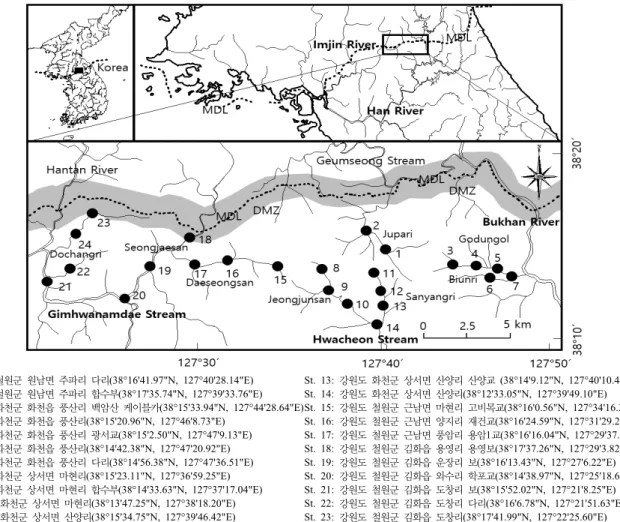
조사지점은 중부산악권역에 포함되는 화천(주파리(St. 1~2), 고둔골(St.3~5), 비운이(St. 6~7), 적근산(St. 8~10), 산양리
(St. 11~14))과 철원(대성산(St. 15~17), 성제산(St. 18~20), 도창리(St. 21~24))의 8개 지역에서 2~5 km 간격으로 24개 지점을 Figure 1과 같이 선정하였다.
2. 채집 및 조사방법
어류의 채집은 투망(망목 6×6 mm, 10회)과 족대(망목 4×4 mm, 30분)를 이용하여 지점별로 200 m구간 내에서 실시하였고, 채집된 개체는 현장에서 육안으로 동정 및 개수한 후 생태계 보전을 위하여 바로 방류하였다. 어류의 동정은 Kim(1997), Kim et al.(2005), Kim and Park(2007) 등을 따랐으며 분류체 계는 Nelson(2006)에 따라 목록을 정리하였다. 서식지 환경은 거리 측정용 망원경(Yardage pro Tour XL, BUSHNELL, Japan)과 줄자를 이용하여 하폭과 유폭, 수심 등을 측정하였고, 하천형은 Kani(1944), 하상구조는 Cummins(1962)의 방법에 따라 구분하였다 .
St. 1: 강원도 철원군 원남면 주파리 다리(38°16'41.97"N, 127°40'28.14"E) St. 2: 강원도 철원군 원남면 주파리 합수부(38°17'35.74"N, 127°39'33.76"E) St. 3: 강원도 화천군 화천읍 풍산리 백암산 케이블카(38°15'33.94"N, 127°44'28.64"E) St. 4: 강원도 화천군 화천읍 풍산리(38°15'20.96"N, 127°46'8.73"E)
St. 5: 강원도 화천군 화천읍 풍산리 광서교(38°15'2.50"N, 127°47'9.13"E) St. 6: 강원도 화천군 화천읍 풍산리(38°14'42.38"N, 127°47'20.92"E) St. 7: 강원도 화천군 화천읍 풍산리 다리(38°14'56.38"N, 127°47'36.51"E) St. 8: 강원도 화천군 상서면 마현리(38°15'23.11"N, 127°36'59.25"E) St. 9: 강원도 화천군 상서면 마현리 합수부(38°14'33.63"N, 127°37'17.04"E) St. 10: 강원도 화천군 상서면 마현리(38°13'47.25"N, 127°38'18.20"E) St. 11: 강원도 화천군 상서면 산양리(38°15'34.75"N, 127°39'46.42"E) St. 12: 강원도 화천군 상서면 산양리(38°14'56.28"N, 127°40'2.76"E)
St. 13: 강원도 화천군 상서면 산양리 산양교 (38°14'9.12"N, 127°40'10.44"E St. 14: 강원도 화천군 상서면 산양리(38°12'33.05"N, 127°39'49.10"E) St. 15: 강원도 철원군 근남면 마현리 고비목교(38°16'0.56"N, 127°34'16.39"E) St. 16: 강원도 철원군 근남면 양지리 재건교(38°16'24.59"N, 127°31'29.26"E) St. 17: 강원도 철원군 근남면 풍암리 용암1교(38°16'16.04"N, 127°29'37.57"E) St. 18: 강원도 철원군 김화읍 용영리 용영보(38°17'37.26"N, 127°29'3.82"E) St. 19: 강원도 철원군 김화읍 운장리 보(38°16'13.43"N, 127°27'6.22"E) St. 20: 강원도 철원군 김화읍 와수리 학포교(38°14'38.97"N, 127°25'18.63"E) St. 21: 강원도 철원군 김화읍 도창리 보(38°15'52.02"N, 127°21'8.25"E) St. 22: 강원도 철원군 김화읍 도창리 다리(38°16'6.78"N, 127°21'51.63"E) St. 23: 강원도 철원군 김화읍 도창리(38°17'41.99"N, 127°22'25.60"E) St. 24: 강원도 철원군 근북면 유곡리 다리(38°18'24.96"N, 127°22'37.65"E)
Figure 1. Study stations of central mountain area of DMZ, Korea. MDL: Military Demarcation Line (dotted line), DMZ:
Demilitarized Zone (gray area).
3. 군집 분석 및 구조
어류의 군집 특성을 밝히기 위해 우점도(dominance index)와 다양도 (diversity index), 균등도(evenness index), 풍부도(richness index) 지수를 산출하였다(Margalef, 1958; McNaughton, 1967; Pielou, 1966; 1975). 군집구조는 조사지점별 출현 종과 개체수를 근거로 Primer 5.0 (PRIMER E Ltd, UK)을 이용하 여 Bray–Curtis 유사도를 계산한 후 도식화하였다.
결 과
1. 서식지 특성
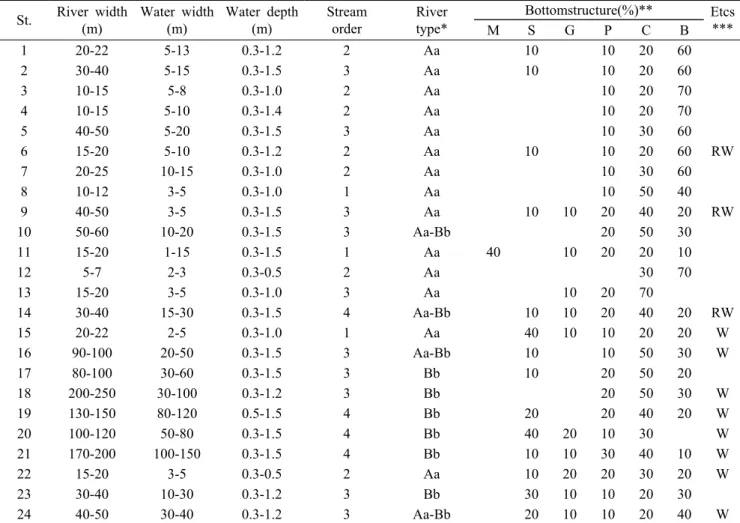
조사지역은 한강과 임진강으로 나눠져 있는데, 한강 조사지 점(St. 1~14) 대부분은 산악지역으로 자연환경이 잘 보전되어 있었으며 특별한 오염원이 없었고 수질이 양호하였다. 하천차 수 1~3차 하천으로 유폭이 대부분 20 m 이내, 수심 0.3~1.5 m의 소규모 하천이고 하천형은 계곡형(Aa type)이었으며 하상 은 큰돌(boulder, >256 mm)과 돌(cobble, 64-256 mm)의 비 율이 높았다. St. 6, 10, 14는 하천공사나 다리공사가 진행되어 서식지가 일부 교란되어 있었다. 임진강 조사지점(St. 15~24) 은 최상류지역만이 산간지역이고 대부분 평지의 농경지가 주를 이루고 있었으며 비교적 자연환경이 잘 보전되어 있고 특별한 오염원이 없고 수질이 양호하였다. 하천형은 평지형(Bb type) 이며, 하천차수는 1~4차 하천이고 유폭은 2~150 m로 다양하 였으며 하상은 대부분 자갈(pebble, 16-64 mm)과 큰돌의 비율 이 높았으나 일부지점은 펄(mud, <0.1 mm), 모래(sand, 0.1-2 mm) 또는 자갈의 비율이 높았다. 많은 지점(St. 15~16, 18~22, 24)에 보가 설치되어 있었고 이들 중 St. 20만이 어도가 설치되 어 있어 하천에 설치된 보는 어류의 소상에 큰 장애물로 작용하 고 있었다. St. 20과 St. 21 사이의 김화남대천은 하천정비공사 가 진행되어 수변부의 식생이 사라지고 하천이 평탄화되어 어 류의 서식지가 크게 교란되었다(Table 1).
2. 어류상
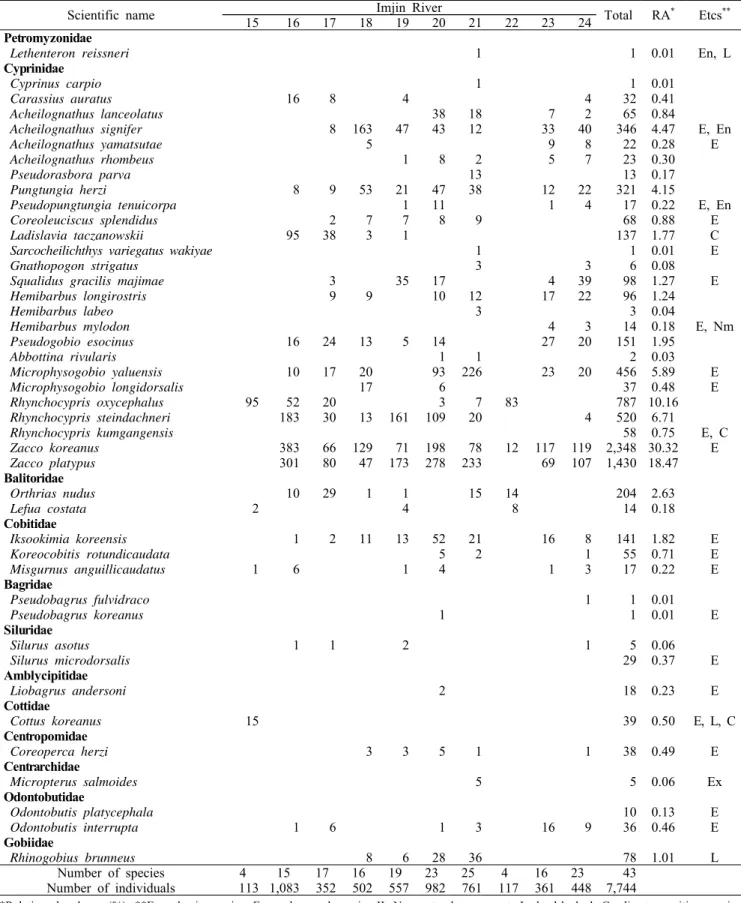
중부산악 DMZ 인접지역에서 채집된 어류는 모두 12과 43 종 7,744개체였고, 이중 우점종은 참갈겨니(Zacco koreanus, 30.3%), 아우점종은 피라미(Zacco platypus, 18.5%)였으며, 그 다음으로 버들치 (Rhynchocypris oxycephalus, 10.0%), 버들개 (Rhynchocypris steindachneri, 6.7%), 돌마자(Microphysogobio
yaluensis, 5.9%), 묵납자루(Acheilognathus signifer, 4.5%),돌고기(Pungtungia herzi, 4.2%), 대륙종개(Orthrias nudus, 2.6%), 모래무지(Pseudogobio esocinus, 2.0%), 참종개
(Iksookimia koreensis, 1.8%), 새미(Ladislavia taczanowskii, 1.8%), 긴몰개(Squalidus gracilis majimae, 1.3%), 참마자 (Hemibarbus longirostris, 1.2%) 등의 순으로 우세하게 출현 하였다 (Figure 2C). 출현종 중 법정보호종은 천연기념물인 어 름치(Hemibarbus mylodon)와, 환경부지정 멸종위기야생생 물 II급인 다묵장어(Lethenteron reissneri), 묵납자루, 가는돌 고기(Pseudopungtungia tenuicorpa)로 모두 4종이 채집되었 으며, 한국고유종은 묵납자루, 줄납자루(Acheilognathus ya-
matsutae), 가는돌고기, 쉬리(Coreoleuciscus splendidus), 참중고기(Sarcocheilichthys variegatus wakiyae), 긴몰개, 어름 치 , 돌마자, 배가사리(Microphysogobio longidorsalis), 금강 모치 (Rhynchocypris kumgangensis), 참갈겨니, 참종개, 새코미 꾸리 (Koreocobitis rotundicaudata), 눈동자개(Pseudobagrus
koreanus), 미유기(Silurus microdorsalis), 퉁가리(Liobagrus andersoni), 둑중개(Cottus koreanus), 꺽지(Coreoperca herzi),동사리(Odontobutis platycephala), 얼록동사리(Odontobutis
interrupta) 등 총 20종(46.5%)이었다. 또한 기후변화민감종(냉수성어류)은 금강모치와 새미, 둑중개 3종이, 육봉형어류는 다묵장어와 둑중개 , 밀어(Rhinogobius brunneus) 3종이 채집 되었으며, 외래종은 배스(Micropterus salmoides) 1종이 출현 하였다(Table 2).
중부산악 DMZ 인접지역 중 한강수역(St. 1~14)에서는 8과 19종 2,324개체가 채집되었고, 이 중 우점종은 참갈겨니 (47.6%), 아우점종은 버들치(21.4%)였으며, 그 다음으로 피라 미(5.8%), 대륙종개(5.4%), 돌고기(4.5%), 금강모치(2.4%), 돌마자 (1.9%) 등의 순으로 우세하였다(Figure 2A). 출현종 중 법정보호종은 천연기념물인 어름치 1종이 채집되었고, 한국고 유종은 쉬리, 배가사리, 돌마자, 금강모치, 참갈겨니, 참종개, 새코미꾸리 , 미유기, 퉁가리, 둑중개, 꺽지, 동사리 12종 (63.2%)이었으며, 기후변화민감종은 금강모치와 둑중개 2종 이, 육봉형어류는 둑중개 1종이 출현하였다(Figure 2A).
임진강수역(St. 15~24)에서는 12과 41종 5,276개체가 채집
되었고 , 이 중 우점종은 피라미(24.4%), 아우점종은 참갈겨니
(22.2%)였으며, 그 다음으로 버들개(9.9%), 돌마자(7.8%), 묵
납자루 (6.6%), 버들치(4.6%), 돌고기(4.0%), 새미(2.6%), 참
종개(2.4%), 모래무지(2.3%) 등의 순으로 우세하게 출현하였
다(Figure 2B). 출현종 중 법정보호종은 천연기념물 어름치 1
종 , 환경부지정 멸종위기야생생물 II급의 다묵장어, 묵납자루,
가는돌고기 3종 등 모두 4종이 채집되었으며, 한국고유종은 묵
납자루, 줄납자루, 가는돌고기, 쉬리, 참중고기, 긴몰개, 어름치,
돌마자 , 배가사리, 금강모치, 참갈겨니, 참종개, 새코미꾸리, 눈
동자개, 퉁가리, 둑중개, 꺽지, 동사리, 얼록동사리 19종
(46.3%)이었다. 그리고 기후변화민감종(냉수성어류)은 금강모
치와 새미, 둑중개 3종이, 육봉형어류는 둑중개와 밀어 2종이
채집되었으며, 외래종은 배스 1종이 출현하였다(Figure 2B).
3. 군집분석 및 군집구조
조사지점별 우점종은 참갈겨니가 15개 지점, 피라미와 버들 치가 4개 지점, 둑중개가 1개 지점이었으며, 아우점종은 피라 미가 5개 지점, 버들치 4개 지점, 참갈겨니와 대륙종개가 각각 3개 지점, 돌고기, 버들개, 금강모치, 참종개, 새코미꾸리, 미유 기, 둑중개, 꺽지가 각각 1개 지점에서 아우점종이었다(Table 2). 우점도는 상류에서 하류로 갈수로 낮아지는 경향을 보였는 데, 종수가 1~2종이 채집된 St. 3, 8, 11이 1.00으로 가장 높았 고, 하천규모가 큰 김화남대천 본류부(St. 17~21, 23~24)와 화천천 하류(St. 14)는 0.41~0.60으로 낮았고 그 외의 소규모 하천들은 0.60~0.97로 비교적 높았다. 다양도와 풍부도는 상 류에서 하류로 갈수록 높아지는 경향을 보였는데, 다양도는 김 화남대천 본류부와 화천천 하류가 1.84~2.34로 높았으나 그
외 지역은 0.53~1.61으로 낮은 편이었고, 종풍부도 또한 김화 남대천 본류부가 2.41~3.62으로 높았으나 그 외 지역은 0.25~2.03으로 낮았다. 균등도는 0.38~0.83으로 비교적 다양 하게 나타났는데, 가장 낮은 지점은 St. 15 (0.38)였고, 가장 높은 지점은 St. 17 (0.83)이었다(Table 3).
군집구조를 조사한 결과, 한강수역은 최상류(St. 3, St. 8)와 북한강 상부지류(St. 1~2, 4~7), 화천천(St. 9~14)으로, 임진강 수역은 최상류(St. 15, 22), 상류(St. 16, 17), 중류(St. 18~19, 23~24), 하류(St. 20, 21)로 구분되었다. 한강과 임진강을 합한 전체의 군집구조에서는 최상류 (St. 3, 8), 상류(St. 11~12, 22), 한강(St. 1~2, 4~7, 9~13), 임진강(St. 14~24)로 구분되어 최 상류와 상류 일부 지점들을 제외하면 한강과 임진강이 구분되 는 특징을 보였다 (Figure 3).
St. River width (m)
Water width (m)
Water depth (m)
Stream order
River type*
Bottomstructure(%)** Etcs
M S G P C B ***
1 20-22 5-13 0.3-1.2 2 Aa 10 10 20 60
2 30-40 5-15 0.3-1.5 3 Aa 10 10 20 60
3 10-15 5-8 0.3-1.0 2 Aa 10 20 70
4 10-15 5-10 0.3-1.4 2 Aa 10 20 70
5 40-50 5-20 0.3-1.5 3 Aa 10 30 60
6 15-20 5-10 0.3-1.2 2 Aa 10 10 20 60 RW
7 20-25 10-15 0.3-1.0 2 Aa 10 30 60
8 10-12 3-5 0.3-1.0 1 Aa 10 50 40
9 40-50 3-5 0.3-1.5 3 Aa 10 10 20 40 20 RW
10 50-60 10-20 0.3-1.5 3 Aa-Bb 20 50 30
11 15-20 1-15 0.3-1.5 1 Aa 40 10 20 20 10
12 5-7 2-3 0.3-0.5 2 Aa 30 70
13 15-20 3-5 0.3-1.0 3 Aa 10 20 70
14 30-40 15-30 0.3-1.5 4 Aa-Bb 10 10 20 40 20 RW
15 20-22 2-5 0.3-1.0 1 Aa 40 10 10 20 20 W
16 90-100 20-50 0.3-1.5 3 Aa-Bb 10 10 50 30 W
17 80-100 30-60 0.3-1.5 3 Bb 10 20 50 20
18 200-250 30-100 0.3-1.2 3 Bb 20 50 30 W
19 130-150 80-120 0.5-1.5 4 Bb 20 20 40 20 W
20 100-120 50-80 0.3-1.5 4 Bb 40 20 10 30 W
21 170-200 100-150 0.3-1.5 4 Bb 10 10 30 40 10 W
22 15-20 3-5 0.3-0.5 2 Aa 10 20 20 30 20 W
23 30-40 10-30 0.3-1.2 3 Bb 30 10 10 20 30
24 40-50 30-40 0.3-1.2 3 Aa-Bb 20 10 10 20 40 W
*River type: by Kani (1944); **M: mud (<0.1 ㎜), S: sand (0.1-2 ㎜), G: gravel (2-16 ㎜), P: pebble (16-64 ㎜), C: cobble (64-256
㎜), B: boulder (>256 ㎜) -modified Cummins (1962). ***W: weir; RW: river work
Table 1. Physicochemical environments at the study stations in central mountain area of DMZ, Korea, 2018
Scientific name Han River
1 2 3 4 5 6 7 8 9 10 11 12 13 14
Petromyzonidae
Lethenteron reissneriCyprinidae
Cyprinus carpio Carassius auratus
Acheilognathus lanceolatus Acheilognathus signifer Acheilognathus yamatsutae Acheilognathus rhombeus Pseudorasbora parva
Pungtungia herzi 5 17 5 7 2 5 2 6 62
Pseudopungtungia tenuicorpa
Coreoleuciscus splendidus 3 2 4 2 3 8 3 2 8
Ladislavia taczanowskii
Sarcocheilichthys variegatus wakiyae Gnathopogon strigatus
Squalidus gracilis majimae
Hemibarbus longirostris
3 3 1 10Hemibarbus labeo
Hemibarbus mylodon 7
Pseudogobio esocinus 8 3 21
Abbottina rivularis
Microphysogobio yaluensis 47
Microphysogobio longidorsalis 5 2 7
Rhynchocypris oxycephalus 45 75 199 65 25 118
Rhynchocypris steindachneri
Rhynchocypris kumgangensis 3 10 45
Zacco koreanus 103 117 27 83 46 52 173 230 28 69 247
Zacco platypus 37 105
Balitoridae
Orthrias nudus 5 3 22 56 17 17 3 11
Lefua costata
Cobitidae
Iksookimia koreensis 3 14
Koreocobitis rotundicaudata 9 7 1 6 5 6 1 1 11
Misgurnus anguillicaudatus 1
Bagridae
Pseudobagrus fulvidraco Pseudobagrus koreanus Siluridae
Silurus asotus
Silurus microdorsalis 1 2 2 5 8 8 3
Amblycipitidae
Liobagrus andersoni
7 5 2 1 1Cottidae
Cottus koreanus
1 12 3 1 6 1Centropomidae
Coreoperca herzi 4 6 8 2 3 2
Centrarchidae
Micropterus salmoides
Odontobutidae
Odontobutis platycephala 4 5 1
Odontobutis interrupta
Gobiidae
Rhinogobius brunneus
Number of species 7 12 1 9 10 8 9 2 6 7 2 4 7 13
Number of individuals 144 173 12 51 133 76 105 53 263 377 216 111 102 652
Table 2. List of fish species and number of individual fish collected in central mountain area of DMZ, Korea, 2018
Scientific name 15 16 17 18Imjin River19 20 21 22 23 24 Total RA* Etcs**
Petromyzonidae
Lethenteron reissneri 1 1 0.01 En, L
Cyprinidae
Cyprinus carpio 1 1 0.01
Carassius auratus 16 8 4 4 32 0.41
Acheilognathus lanceolatus 38 18 7 2 65 0.84
Acheilognathus signifer 8 163 47 43 12 33 40 346 4.47 E, En
Acheilognathus yamatsutae 5 9 8 22 0.28 E
Acheilognathus rhombeus 1 8 2 5 7 23 0.30
Pseudorasbora parva 13 13 0.17
Pungtungia herzi 8 9 53 21 47 38 12 22 321 4.15
Pseudopungtungia tenuicorpa 1 11 1 4 17 0.22 E, En
Coreoleuciscus splendidus 2 7 7 8 9 68 0.88 E
Ladislavia taczanowskii 95 38 3 1 137 1.77 C
Sarcocheilichthys variegatus wakiyae 1 1 0.01 E
Gnathopogon strigatus 3 3 6 0.08
Squalidus gracilis majimae 3 35 17 4 39 98 1.27 E
Hemibarbus longirostris
9 9 10 12 17 22 96 1.24Hemibarbus labeo 3 3 0.04
Hemibarbus mylodon 4 3 14 0.18 E, Nm
Pseudogobio esocinus 16 24 13 5 14 27 20 151 1.95
Abbottina rivularis 1 1 2 0.03
Microphysogobio yaluensis 10 17 20 93 226 23 20 456 5.89 E
Microphysogobio longidorsalis 17 6 37 0.48 E
Rhynchocypris oxycephalus 95 52 20 3 7 83 787 10.16
Rhynchocypris steindachneri 183 30 13 161 109 20 4 520 6.71
Rhynchocypris kumgangensis 58 0.75 E, C
Zacco koreanus 383 66 129 71 198 78 12 117 119 2,348 30.32 E
Zacco platypus 301 80 47 173 278 233 69 107 1,430 18.47
Balitoridae
Orthrias nudus 10 29 1 1 15 14 204 2.63
Lefua costata 2 4 8 14 0.18
Cobitidae
Iksookimia koreensis 1 2 11 13 52 21 16 8 141 1.82 E
Koreocobitis rotundicaudata 5 2 1 55 0.71 E
Misgurnus anguillicaudatus 1 6 1 4 1 3 17 0.22 E
Bagridae
Pseudobagrus fulvidraco
1 1 0.01Pseudobagrus koreanus
1 1 0.01 ESiluridae
Silurus asotus 1 1 2 1 5 0.06
Silurus microdorsalis 29 0.37 E
Amblycipitidae
Liobagrus andersoni
2 18 0.23 ECottidae
Cottus koreanus
15 39 0.50 E, L, CCentropomidae
Coreoperca herzi 3 3 5 1 1 38 0.49 E
Centrarchidae
Micropterus salmoides 5 5 0.06 Ex
Odontobutidae
Odontobutis platycephala 10 0.13 E
Odontobutis interrupta 1 6 1 3 16 9 36 0.46 E
Gobiidae
Rhinogobius brunneus 8 6 28 36 78 1.01 L
Number of species 4 15 17 16 19 23 25 4 16 23 43
Number of individuals 113 1,083 352 502 557 982 761 117 361 448 7,744
*Relative abundance (%), **E: endemic species, En: endangered specise II, Nm: natural monument; L: land-locked, C: climate-sensitive species, Ex: exotic species.
Table 2. Continued
Figure 2. Relative abundance of the fish species found in central
mountain area of DMZ, Korea, Korea, 2018.
고 찰
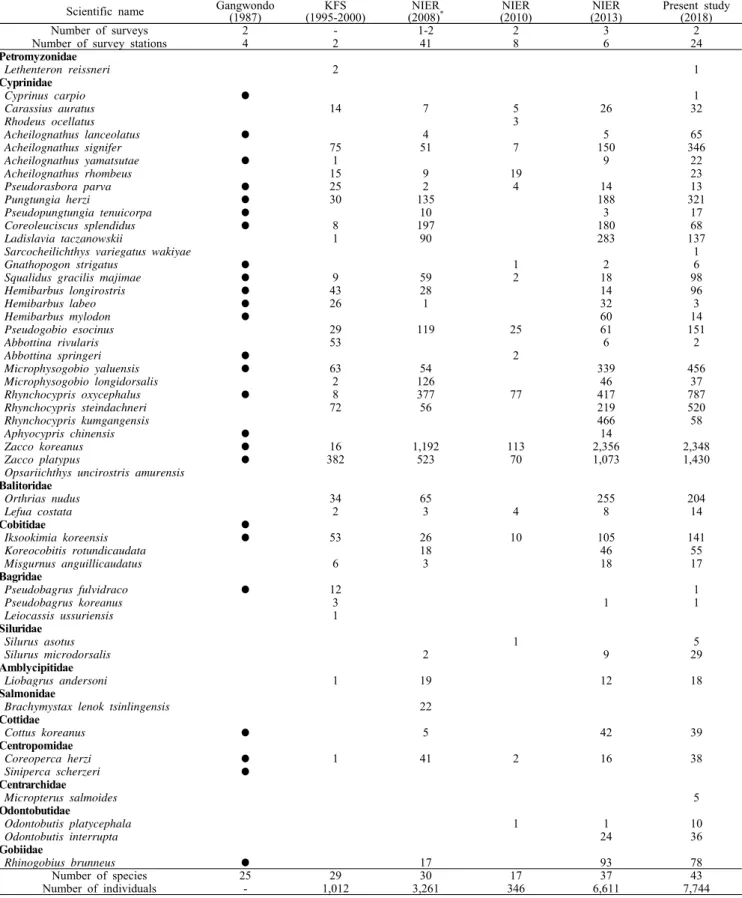
DMZ 인접지역 중 중부산악권역의 담수어류 선행연구는 1987년부터 이루어졌는데, 조사횟수는 1~3회, 조사지점은 2~41개 지점으로 다양하였으며, 출현종수는 1987년 6과 25종 (Gangwondo, 1987), 1995-2000년 7과 29종 (KFS, 1995- 2000), 2018년 전국자연환경조사로 8과 30종(Ko and Yoo, 2008; Lee and Jang, 2008a; 2008b; 2008c; 2008d; Yoon and Kim, 2008a; 2008b), 2010년 6과 17종(NIER, 2010), 2013년 9과 37종(NIER, 2013)이었다(Table 3). 본 조사는
24개 지점을 2회 조사하여, 12과 43종을 채집하였는데, 이러한 종수는 선행연구들 보다 많은 종수였다. 이렇게 많은 종수가 채집된 이유는 본 조사가 5개 권역 중 중부산악권역만을 한정 하여 많은 지점(24개)을 집중 조사하였기 때문으로 생각된다.
비록 2008년의 전국자연환경조사에서 41개 지점이 조사되었 으나 조사횟수가 1회인 경우가 많고 하천 본류보다는 소하천 지점이 많이 포함되었기 때문에 본 조사보다 출현종수가 적은 것으로 판단되었다.
선행연구에서 출현하지 않았으나 본 조사에 처음으로 채집 된 어류는 참중고기와 배스 2종이었는데, 모두 김화남대천 최 Figure 3. Dendrogram for the cluster analysis based on similarity index of the fish species found among the study
stations in central mountain area of DMZ, Korea, 2018.
Scientific name Gangwondo
(1987) KFS
(1995-2000) NIER
(2008)
*NIER
(2010) NIER
(2013) Present study (2018)
Number of surveys 2 - 1-2 2 3 2
Number of survey stations 4 2 41 8 6 24
Petromyzonidae
Lethenteron reissneri 2 1
Cyprinidae
Cyprinus carpio
●1
Carassius auratus 14 7 5 26 32
Rhodeus ocellatus 3
Acheilognathus lanceolatus
●4 5 65
Acheilognathus signifer 75 51 7 150 346
Acheilognathus yamatsutae
●1 9 22
Acheilognathus rhombeus 15 9 19 23
Pseudorasbora parva
●25 2 4 14 13
Pungtungia herzi
●30 135 188 321
Pseudopungtungia tenuicorpa
●10 3 17
Coreoleuciscus splendidus
●8 197 180 68
Ladislavia taczanowskii 1 90 283 137
Sarcocheilichthys variegatus wakiyae 1
Gnathopogon strigatus
●1 2 6
Squalidus gracilis majimae
●9 59 2 18 98
Hemibarbus longirostris
●43 28 14 96
Hemibarbus labeo
●26 1 32 3
Hemibarbus mylodon
●60 14
Pseudogobio esocinus 29 119 25 61 151
Abbottina rivularis 53 6 2
Abbottina springeri
●2
Microphysogobio yaluensis
●63 54 339 456
Microphysogobio longidorsalis 2 126 46 37
Rhynchocypris oxycephalus
●8 377 77 417 787
Rhynchocypris steindachneri 72 56 219 520
Rhynchocypris kumgangensis 466 58
Aphyocypris chinensis
●14
Zacco koreanus
●16 1,192 113 2,356 2,348
Zacco platypus
●382 523 70 1,073 1,430
Opsariichthys uncirostris amurensis Balitoridae
Orthrias nudus 34 65 255 204
Lefua costata 2 3 4 8 14
Cobitidae
●Iksookimia koreensis
●53 26 10 105 141
Koreocobitis rotundicaudata 18 46 55
Misgurnus anguillicaudatus 6 3 18 17
Bagridae
Pseudobagrus fulvidraco
●12 1
Pseudobagrus koreanus 3 1 1
Leiocassis ussuriensis 1
Siluridae
Silurus asotus 1 5
Silurus microdorsalis 2 9 29
Amblycipitidae
Liobagrus andersoni 1 19 12 18
Salmonidae
Brachymystax lenok tsinlingensis 22
Cottidae
Cottus koreanus
●5 42 39
Centropomidae
Coreoperca herzi
●1 41 2 16 38
Siniperca scherzeri
●Centrarchidae
Micropterus salmoides 5
Odontobutidae
Odontobutis platycephala 1 1 10
Odontobutis interrupta 24 36
Gobiidae
Rhinogobius brunneus
●17 93 78
Number of species 25 29 30 17 37 43
Number of individuals - 1,012 3,261 346 6,611 7,744
*The 3rd nation environment investigation (Ko and Yoo, 2008; Lee and Jang, 2008a; 2008b; 2008c; 2008d; Yoon and Kim, 2008a; 2008b).
Table 3. Historical record of ichthyofauna in central mountain area of DMZ, Korea, 2018
하류 지점인 St. 21에서 채집되었다. 참중고기는 임진강 중·하 류에 넓게 분포하는 종으로(Kim, 1997; Kim and Park, 2007), 이들 개체 일부가 김화남대천으로 소상하여 채집된 것 으로 판단된다. 배스는 임진강 토교저수지에 1973년에 방류되 면서 도입되었고(MAFRA, 2010) 최근 저수지나 하류부로 확 산된 것으로 보고되었는데, 김화남대천에서도 상류의 잠곡지 에 서식이 확인되었다(NIE, 2018). 본 조사에서 채집된 배스는 잠곡지에 도입된 배스가 집중호우시 하류로 유출된 개체이거나 본류에 서식하던 개체가 소상한 것으로 추정되었다. 배스는 하 천생태계의 최상위 포식자로 최근 우리나라의 하천과 댐, 저수 지에 급격히 확산되면서 심각한 생태계를 교란시키는 것으로 보고되었기 때문에(Ko et al., 2008; 2017; Lee et al., 2009;
MAFRA, 2010; Park et al., 2018; NIE, 2018), 김화남대천 에서의 배스 확산여부를 지속적으로 모니터링 할 필요가 있다.
본 조사에서 출현하지 않았으나 선행연구에서 출현한 어류 는 1987년 쏘가리(Gangwondo, 1987), 1995-2000년 대농갱 이(KFS, 1995-2000), 2008년 열목어(Lee and Jang, 2008a), 2010년 흰줄납줄개와 왜매치(NIER, 2010), 2013년 왜몰개 (NIER, 2013) 등 총 6종이다. 이중 대농갱이와 흰줄납줄개, 왜매치, 왜몰개 등은 소수의 개체가 1회 채집된 바 있어 현재 이 종들은 조사지점 또는 조사시기에 따른 차이로 인해 확인되 지 않았을 것으로 추정된다. 쏘가리는 북한강 본류 DMZ인 오작교에서 서식이 확인되었는데(Gangwondo, 1987; Ko and Yoo, 2008), 본 조사지역이 북한강 본류를 포함하지 않았기 때문에 채집되지 않았다. 멸종위기종 열목어는 2008년 금성천 주파리의 2개 지점에서 22개체가 채집되었다. 열목어는 산란 및 성장을 위해 상류와 하류를 회유하는 것으로 보고된 바 있어 (Kim, 1997; Kim et al., 2015), 본 조사에서 채집되지 않은 것은 조사지점 및 조사시기의 차이 때문으로 추정되나 최근 개체수가 급격히 감소하였기 때문일 수도 있어 추후 확인이 필요하다.
DMZ 인접지역은 정전협정 이후 약 70년간 민간인의 출입 이 제한되어 생태계가 잘 유지되어온 곳으로 생태계의 보고로 알려져 왔다(KFS, 1995-2000; CHA, 2005; NIER, 2011).
본 조사에서 지점별 출현종수는 1~25종이 서식하는 것으로 나타났는데, 특히 김화남대천 본류구간(St. 18~21)과 지류 하 류부에서 많은 어류(15~25종)가 서식하고 있었다. 또한 법정 보호종 어름치와 다묵장어, 묵납자루, 가는돌고기 4종과 기후 변화민감종(냉수성어종) 둑중개, 금강모치, 새미 3종이 서식하 여 주목되었다. 화려한 체색을 가진 천연기념물 어름치(제259 호)는 산란기 느린 여울부에 산란탑을 만드는 독특한 번식행동 을 보이며 한강수계와 금강수계에만 서식하는데(Choi and Baek, 1972; Kim, 1997; Kim and Park, 2007), 본 조사구역 에서는 북한강지류 주파리의 St. 1에서 7개체가, 김화남대천지 류 St. 23, 24에서 각각 3, 4개체가 채집되었다. 환경부지정
멸종위기야생생물은 II급의 묵납자루, 가는돌고기, 다묵장어가 출현하였는데 , 공통적으로 김화남대천에서만 서식하였다. 묵 납자루는 체색이 화려하고 담수조개에 산란하는 독특한 산란습 성을 가졌으며 한강수계인 한강과 임진강에만 서식한다(Kim, 1997; Baek, 2005; Kim and Park, 2007; Kim, 2014). 본 조사에서는 김화남대천 본류(St. 18~21) 및 지류(St. 17, 23~24)에 집단으로 서식하고 있어 주목되었다. 가는돌고기는 산란기에 탁란 및 틈새산란을 하는 독특한 번식생태를 가지며 한강수계인 한강과 임진강에만 서식한다(Kim, 1997; Kim and Park, 2007; Lee, 2011). 본 조사에서는 김화남대천 본류 St. 19~20와 지류 St. 23~24에서 다수 서식하는 것이 확인되 었다. 다묵장어는 원구류에 속하는 화석종으로 러시아와 중국, 일본 , 우리나라에 서식하며, 우리나라에서는 최근 개체수가 급 격히 감소하고 있는데, 특히 한강수계집단은 매우 빠른 속도로 감소하여 현재 서식지가 극소수만 남아 있는 것으로 보고되었 다 (Kim, 1997; Ko et al., 2013). 본 조사에서는 김화남대천 본류인 St. 21에서 1개체가 채집되었고, 선행연구에서는 KFS (1995-2000)가 2개체, Ko et al. (2013)이 13개체를 채집한 바 있다 . 기후변화민감종 중 냉수성어종은 최근 기후온난화로 인해 서식지가 점차적으로 축소되고 있는 종들로, 본 조사구역 에서 둑중개는 북한강지류(St. 2~7)와 김화남대천 최상류(St.
15)에서, 금강모치는 한강에 속한 최상류 지점인 St. 4, 6, 8에 서 서식하고 있었으며, 새미는 St. 16~19에서 출현하였는데, 특히 St. 16~17에서 많은 개체가 서식하고 있어 주목되었다.
한강과 임진강은 같은 한강수계에 포함되며 대부분의 어류
들이 공통적으로 서식하는 특징을 보인다(Kim, 1997; Kim
and Park, 2007). 하지만 본 조사지역의 군집구조를 조사한
결과 최상류와 상류 일부 지점들을 제외하고 한강과 임진강으
로 크게 구별되는 특징을 보였다. 이러한 차이는 한강 지점들은
유폭이 작고 하천형이 대부분 계곡형인데 반해 임진강 지점들
은 유폭이 비교적 넓으며 하천형이 대부분 평지형으로 서식지
와 서식어류에서 큰 차이를 보였기 때문으로 생각된다. 한강
지점들에서 채집된 어류는 8과 19종, 법정보호종 1종(어름치),
임진강 지점에서 채집된 어류는 11과 41종, 법정보호종 4종(어
름치, 다묵장어, 묵납자루, 가는돌고기)으로 임진강이 2배 이상
많은 어류가 서식하였고 법정보호종의 수도 많았다 . 특히 김화
남대천 본류구간(St. 18~21) 및 일부 지류구간(St. 16~17,
23~24)은 15~25종의 많은 종수가 서식하고 종 다양성과 풍부
도지수가 높아 학술적으로도 매우 주목되었다. 최근 김화남대
천 일부구간 (St. 20과 St. 21 사이)은 공원조성 및 하천정비공
사로 인해 하천 수변부는 대부분 벌목되고 하천 내는 평탄화되
고 인공구조물이 들어서면서 심각하게 생태계가 교란되고 있었
다. 따라서 김화남대천의 안정적인 어류 서식 및 보존을 위해서
는 서식지를 훼손시키는 하천공사 등은 반드시 지양하여야 하
고 , 주민홍보를 통한 지역민의 감시 및 보호가 필요하며, 최근
서식이 확인된 생태계교란종 배스의 지속적인 모니터링 및 대 책이 요구되며, 더 나아가 천연기념물지정 또는 자연보전지구 지정, 생태경관보존지역 등 적극적인 관리방안이 요구된다.
REFERENCES
Baek, H.M.(2005) Ecological studies on the Korean bitterling,
Acheilognathus signifer (Cyprinidae) in Korea. Doctoral
Thesis, Kangwon National University, Chuncheon, 186pp. (in Korean)BCP(Bureau of Cultural Property)(1974) The reports on the scientific survey of near the DMZ. The Report of the Korean Association for Conservation of Nature No. 7, 316pp. (in Korean)
CHA(Cultural Heritage Administration)(2005) The reports on the basal resources survey of natural miscarriage in near the DMZ (central region). Gyeogmun Publishing Co. Ltd., Daejeon, 474pp. (in Korean)
CHA(Cultural Heritage Administration)(2006) The reports on the basal resources survey of natural miscarriage in near the DMZ (western region). Gyeogmun Publishing Co. Ltd., Daejeon, 463pp. (in Korean)
CHA(Cultural Heritage Administration)(2007) The reports on the basal resources survey of natural miscarriage in near the DMZ (eastern region). Gyeogmun Publishing Co. Ltd., Daejeon, 378pp. (in Korean)
Choi, K.C. and Y.K. Baek(1972) On the life-history of Gobiobotia
macrocephalus Mori. Korean Journal of Limnology 5: 45-57.
(in Korean with English abstract)
Choi, K.C., S.R. Jeon, I.S. Kim and Y.M. Son(1990) Coloured illustrations of the freshwater fishes of Korea. Hyangmun Publishing Co. Ltd., Seoul, 277pp. (in Korean)
Cummins, K.W.(1962) An evolution of some techniques for the collection and analysis of benthic samples with special emphasis on lotic water. The American Midland Naturalist 67:477-504.
Gangwondo(1987) Regional resources survey report of near DMZ area of Gangwondo, Korea. Gangwondo. (in Korean) Gyonggido(1987) Regional resources survey report of near DMZ
area of Gyonggi-do, Korea. Gyonggido. (in Korean)
Jang, M.H., G.J. Joo and M.C. Lucas(2006) Diet of introduced largemouth bass in Korean rivers and potential interactions with native fishes. Ecology of Freshwater Fish 15: 315-320.
Kani, T.(1944) Ecology of the aquatic insects inhabiting a mountain stream. In H. Furukawa(Ed.), Insects I. Kenkyu-sha, Tokyo, pp.
171-317. (in Japanese)
KFS(Korea Forest Service)(1995-2000). Forest ecosystem survey
comprehensive report in DMZ area and neighboring area.
Korea Forestry Research Institute, Seoul, pp. 358-387. (in Korean)
Kim, H.S.(2014) Spawning ecology and conservation of the Korean bittering, Acheilognathus signifer (Cyprinidae). Doctoral Thesis, Chonbuk National University, Jeonju, 158pp. (in Korean)
Kim, I.S. and J.Y. Park(2007) Freshwater fishes of Korea. Kyohak Publishing, Seoul, 467pp. (in Korean)
Kim, I.S.(1997) Illustrated encyclopedia of fauna & flora of Korea, freshwater fishes. Ministry of Education, Yeongi, 629pp. (in Korean)
Kim, I.S., Y. Choi, C.L. Lee, Y.J. Lee, B.J. Kim and J.H. Kim(2005) Illustrated book of Korean fishes. Kyohak Publishing, Seoul, 615pp. (in Korean)
Kim, J.H., J.D. Yoon, J.B. Jo and M.H. Jang(2015) The study on daily movement patterns of Brachymystax lenok tsinlingensis inhabit in the upper part of the Nakdong River. Journal of Limnology 48: 139-145. (in Korean with English abstract) Ko, M.H. and M.J. Yoo(2008) The 3rd nation environment
investigation. Fresh water fishes of the Wondong whole area.
Ministry of Environment and National Institute of Environmental Research, 4pp. (in Korean)
Ko, M.H., J.Y. Park and Y.J. Lee(2008) Feeding habitats of an introduced large mouth bass, Micropterus salmoides (Perciformes; Centrachidae), and its influence on ichthyofauna in the Lake Okjeong, Korea. Korean Journal of Ichthyology 20:
36-44. (in Korean with English abstract)
Ko, M.H., S.J. Moon, Y.G. Hong and I.C. Bang(2013) Distribution status and habitat characteristics of the endangered species,
Lethenteron reissneri (Petromyzontiformes: Petromyzontidae)
in Korea. Korean Journal of Ichthyology 25: 189-199. (in Korean with English abstract)Ko, M.H., Y.S. Kwan, W.K. Lee and Y.J. Won(2017) Impact of human activities on changes of ichthyofauna in Dongjin River of Korea in the past 30 years. Animal Cells and Systems 21:
207-216.
Kwater(2007) A guidebook of rivers in South Korea. Kwater, Daejeon, 582pp. (in Korean)
Lee, H.H. and J.H. Jang(2008a) The 3rd nation environment investigation. Fresh water fishes of the Jupa whole area.
Ministry of Environment and National Institute of Environmental Research, 3pp. (in Korean)
Lee, H.H. and J.H. Jang(2008b) The 3rd nation environment investigation. Fresh water fishes of the Yangji whole area.
Ministry of Environment and National Institute of Environmental Research, 4pp. (in Korean)
Lee, H.H. and J.H. Jang(2008c) The 3rd nation environment investigation. Fresh water fishes of the Damok whole area.
Ministry of Environment and National Institute of Environmental Research, 4pp. (in Korean)
Lee, H.H. and J.H. Jang(2008d) The 3rd nation environment investigation. Fresh water fishes of the Sangseo whole area.
Ministry of Environment and National Institute of Environmental Research, 4pp. (in Korean)
Lee, H.H.(2011) Reproductive strategies of genus Pseudopungtungia and Pungtungia. Doctoral Thesis, Kunsan National University, Gunsan, 131pp. (in Korean)
Lee, W.O., H. Yang, S.W. Yoon and J.Y. Park(2009) Study on the feeding of Micropterus salmoides in Lake Okjeong and Lake Yongdam, Korea. Korean Journal of Ichthyology 21: 200-207.
(in Korean with English abstract)
MAFRA(Ministry of Agriculture, Food and Rural Affairs)(2010) The national survey of low head dams and development of database in Korea and National Institute of Environmental Research, 275pp. (in Korean)
Margalef, R.(1958) Information theory in ecology. General Systems 3: 36-71.
McNaughton, S.J.(1967) Relationship among functional properties of California glassland. Nature 216: 144-168.
Moyle, P.B. and J.J. Cech(2000) Fishes: An Introduction to Ichthyology(4th ed.). Prentice Hall. Inc. New Jersey, 612pp.
Nelson, J.S.(2006) Fishes of the world(4th ed.). John Wiley & Sons, Inc., Hoboken, New Jersey, 601pp.
NIBR(National Institute of Biological Resources)(2011) Breeding manual of endangered freshwater Fish. National Institute of Biological Resources, Incheon, 239pp. (in Korean)
NIE(National Institute of Ecology)(2014). Ecosystem survey of western DMZ area. National Institute of Ecology, Seocheon, 296pp. (in Korean)
NIE(National Institute of Ecology)(2015) Comprehensive report on biodiversity in the DMZ. National Institute of Ecology, Seocheon, 375pp. (in Korean)
NIE(National Institute of Ecology)(2018) Nationwide survey of non-native species in Korea(IV). National Institute of Ecology, Seocheon, 705pp. (in Korean)
NIER(National Institute of Environmental Research)(2010)
Ecosystem survey report of central DMZ area. National Institute of Environmental Research, Incheon, 278pp. (in Korean)
NIER(National Institute of Environmental Research)(2011) Comprehensive report on the ecosystem survey of Baekdudaegan protection area. National Institute of Environmental Research, Incheon, 196pp. (in Korean) NIER(National Institute of Environmental Research)(2012)
Ecosystem survey of DMZ area. Institute of Environmental Research, Incheon, 283pp. (in Korean)
NIER(National Institute of Environmental Research)(2013) Ecosystem survey of central DMZ area. National Institute of Environmental Research, Incheon, 233pp. (in Korean) NIER(National Institute of Environmental Research)(2016)
Survey and evaluation method for river and stream ecosystem health assessment. National Institute of Environmental Research, Incheon, 313pp. (in Korean)
Nishimura, S.(1974) History of Japan sea: Approach from biogeography. Tsukiji-Shokan, Tokyo, 274pp. (in Japanese with English abstract)
NPRI(National Park Research Institute)(2019) 2019 National Park resource survey. Freshwater fishes. National Park Research Institute, Wonju, 97pp. (in Korean)
Park, J.S., S.H. Kim, H.T. Kim, J.G. Kim, J.Y. Park and H.S.
Kim(2018) Study on feeding habits of Micropterus salmoides in habitat types from Korea. Korean Journal of Ichthyology 1:
39-53. (in Korean with English abstract)
Pielou, E.C.(1966) Shannon's formula as a measure of diversity.
The American Naturalist 100: 463-465.
Pielou, E.C.(1975) Ecological diversity. John Wiley, New York, 165pp.
Yoon, H.N. and J.M. Kim(2008a) The 3rd nation environment investigation. Fresh water fishes of the Geumhwa whole area.
Ministry of Environment and National Institute of Environmental Research, 4pp. (in Korean)
Yoon, H.N. and J.M. Kim(2008b) The 3rd nation environment investigation. Fresh water fishes of the Yasu whole area.
Ministry of Environment and National Institute of Environmental Research, 4pp. (in Korean)