1)1. 서 론
기후변화에 관한 정부간 협의체(Intergovernmental
Panel on Climate Change, IPCC)에서는 인위적 온실 가스 배출로 인해 평균 기온 상승과 강수 패턴이 변화하 는 등 기후변화가 심화되고 있다고 발표하였다(IPCC,
Received 25 August, 2020; Revised 6 October, 2020;
Accepted 7 October, 2020
*Corresponding author: Hee Ju Lee, Vegetable Research Division, National Institute of Horticultural & Herbal Science, Wanju 55365, Korea
Phone : +82-63-238-6661 E-mail : [email protected]
ⓒ The Korean Environmental Sciences Society. All rights reserved.
This is an Open-Access article distributed under the terms of the Creative Commons Attribution Non-Commercial License (http://
creativecommons.org/licenses/by-nc/3.0) which permits unrestricted non-commercial use, distribution, and reproduction in any medium, provided the original work is properly cited.
ORIGINAL ARTICLE
생육 초기의 저온·저일조가 고추의 수량과 품질에 미치는 영향
위승환 이희주* 유인호 장윤아 여경환 안세웅 이진형 김성겸1)
농촌진흥청 국립원예특작과학원 채소과, 1)경북대학교 농업생명과학대학 원예학과
Effects of Low Air Temperature and Low Radiation Conditions on Yield and Quality of Hot Pepper at the Early Growth Stage
Seung Hwan Wi, Hee Ju Lee*, In Ho Yu, Yoon Ah Jang, Kyung Hwan Yeo, Se Woong An, Jin Hyong Lee, Sung Kyeom Kim1)
Vegetable Research Division, National Institute of Horticultural & Herbal Science, Wanju 55365, Korea
1)Department of Horticultural Science, College of Agriculture & Life science, Kyungpook National University, Daegu 41566, Korea
Abstract
This study was conducted to determine the effect of low temperature and low radiation conditions on the yield and quality of hot pepper at an early growth stage in Korea. In plastic greenhouses, low temperature, low temperature with covered shading treatments were set 17 to 42 days after transplanting. The pepper growing degree days decreased by 5.5% due to the low temperature during the treatment period. Radiation decreased by 74.7% due to the covered shading. After commencing treatments, pepper plant growth decreased with low temperature and low radiation. Analysis of the yield showed that the first harvest was delayed by low radiation. The cumulative yields of 119 days after transplanting were 1,956, 2,171, and 2,018 g/m2 for control, low temperature, and low temperature with low radiation respectively. Capsaicin and dihydrocapsaicin concentrations in pepper fruit decreased with low temperature and low radiation. To investigate the photosynthetic characteristics according to the treatment, the carbon dioxide reaction curve was analyzed using the biochemical model of photosynthesis. Results showed that the maximum photosynthetic rate, Vcmax (maximum carboxylation rate), J (electric transportation rate), and TPU (triose phosphate utilization) decreased at low temperatures; the maximum photosynthetic rate, J, and gm (dark respiration rate) were reduced by shading. These results indicate that low temperature and low radiation can retard early growth, yield, and quality, but these can also be recovered 119 days after planting. Based on the results, the yield and quality of pepper can recover from abiotic stresses with proper cultivation.
Key words : Hot pepper, Low temperature, Low radiation, Yield, Quality
2014). 근래 장기간 동안 장마가 지속되는 등 이상기상 의 발생 빈도 및 강도가 높아지는 추세이다. 여타 산업과 달리 농업은 생산 환경에 인위적 조절이 어렵기 때문에 이러한 기후변화에 큰 영향을 받고 있다. 즉, 이상기상은 작물의 생육과 수량 및 품질에 악영향을 주고 있어 농작 물의 안정생산을 어렵게 하며, 물가상승이 발생하는 등 사회경제에 미치는 악영향이 크다(Moriondo et al., 2011; Lim et al., 2015). 특히 봄철에 빈번하게 발생하 는 저온 및 저일조 현상은 영농일정을 지연시키거나 정 식한 작물의 활착을 방해하여 피해를 입히는 등 큰 문제 가 되고 있다.
고추는 대표적 양념채소로 한국인이 즐겨 먹는 김치 의 주 재료로서 안정적인 생산과 공급이 요구되고 있다. 고추는 고온에 노출될 경우 착화율과 착과율이 감소하고 기형과 및 소과 발생률이 증가하며 수량 또한 감소한다 (Song et al., 2014; Song et al., 2016). 저온에 노출될 경우에도 착화율이 감소하며 잎에 수침상이 발생되어 생 육이 저하되며, 수확일이 지연되고 수량이 감소된다(Lee et al., 2013). 이와 같이 온도에 따른 고추의 생육에 대하 여 연구가 이루어졌으나, 저일조에 의한 영향에 대하여 구명되어 있지 않으며 생육초기에 저온 및 저일조와 같 은 복합 이상기상환경에 의한 영향 또한 보고되지 않았 기에 안정생산 기술을 개발하기 위해서는 이에 대한 연 구가 필요하다. 본 연구는 저온·저일조 조건이 고추 ‘슈 퍼마니따’의 생육 및 생리적 반응에 미치는 영향을 구명
하기 위하여 수행되었다.
2. 재료 및 방법
2.1. 공시작물 및 환경요인 설정
본 실험에 사용한 식물재료는 ‘슈퍼마니따’ 고추 (Capsicum annuum L. cv. Supermanita, Nongwoo bio Co., Ltd. Korea)로 2019년 1월 29일에 시판 상토인 바이오 상토 1호(Hungnong seed Co., Korea)를 72구 육묘용 플러그 트레이(50 mL/셀)에 충전하고 종자를 1 립씩 파종 후 평균 기온이 25℃로 유지되는 벤로형 온실 에서 자연광 하에 77일간 육묘하였다. 이후 2019년 4월 17일에 국립원예특작과학원 채소과 시험포장(36°50` N 127°57` E, 30 elevation)의 자동 측창제어가 가능한 비 가림 하우스(40 m × 6 m) 2동(Fig. 1)에 90 cm × 45 cm 간격으로 정식하였고 8월 12일(정식 후 119일)까지 실 험을 수행하였다. 정식 후 농촌진흥청 표준 영농재배법 에 준하여 관리하였으며, 점적호스를 이용하여 충분히 관수 하였다. 생육 초기 저온 및 저일조 환경을 구현하기 위하여 정식 후 17일인 5월 2일부터 정식 후 42일인 5월 27일까지 26일간 완전임의배치법 3반복으로 저온, 저온 차광 처리하였다. 하우스 L동은 측창을 열어 두어 기온 이 외부 기상과 동일하게 설정하여 저온처리를 하였으며, 하우스 M동은 외기온도가 15℃ 이하로 내려가면 측창이 닫히도록 설정하여 저온피해를 받지 않도록 온도를 유지 Fig. 1. Plastic green houses that control temperature using a ventilation system. (M) maintained at more than 15℃ (L)
treated with low temperature using ventilation system from May 2 to May 27.
하였다. 차광 처리는 하우스 L동에서 구역을 나누어 차 광막을 설치하였다. 처리기간 동안 각 처리구의 기온과 일사량 데이터를 온습도센서(S-THB-M002, Onset, USA)와 일사량센서(S-LIB-M003, Onset, USA)를 활 용하여 1시간 간격으로 수집하였다.
2.2. 고추의 생육 및 생리 특성 조사
고추의 생육 분석을 위하여 정식일(4월 17일)과 정식 후 49일(6월3일), 119일(8월 12일)에 초장, 생체중, 건 물중, 엽수, 엽면적(LI-3100, Area meter, LI-COR Inc., USA) 등을 처리구당 3주씩 파괴 조사하였다. 수량조사 는 과색이 90% 착색되었을 때 수확하여 생체중과 건물 중을 처리구당 20주씩 9회 조사하였다. 고추의 품질요소 인 capsaicin과 dihydrocapsaicin의 농도 분석을 위하여 동결 건조한 분말시료와 Acetonitrile을 1:10 비율로 1시 간 교반 후 80℃에서 4시간 중탕한 후 원심분리하고 상 등액을 필터로 여과하여 UPLC(Acquity UPLC H-Class, Waters, USA)로 분석하였다. 또한 작물에 대 한 기온의 영향을 분석하기 위하여 시험처리 기간 동안 의 생육도일(Growing Degree Days, GDDs)을 조사하 여 활용하였다. 생육도일의 계산 방법 중 일 최고온도, 일 최저온도 및 기본온도(10℃)를 조합하여 산출하는 방식 을 활용하였으며 계산식은 아래와 같다.
GDDs = ∑ [(Tmax + Tmin)/2 –Tb]
위 식에서 Tmax, Tmin, Tb는 각각 일 최고온도, 일 최저 온도, 기본온도를 나타내며, GDD 값이 음수로 될 경우 0 으로 처리하였다. 기본온도는 작물에 따라서 달라지는데
본 연구에서는 선행 연구자료(Maynard and George, 2013)를 참조하여 고추의 생육 최저온도인 10℃를 기준 으로 설정하였다.
저온 및 저일조가 고추의 광합성에 미치는 영향을 조 사하기 위하여 정식 후 31일부터 35일에 휴대용 광합성 측정기(LI-6400XT, Li-cor Biosciences, USA)을 사용 하여 처리구당 3개의 CO2반응곡선을 작성하였다. 광합 성 속도는 측정기 잎챔버 내부 기온 25℃, 상대습도 70~80%, 광량 500 μmol/m2/s 및 공기 유속 300 mol/s 로 유지하였으며, 이산화탄소 농도는 50~1,500 μ mol/mol으로 변화해 가면서 측정하였다. 작성된 CO2반 응곡선 값을 가지고 광합성 기구의 생화학적 모델에 적 용하여 Vcmax(최대 카르복실화 속도), J(전자전달계효 율), TPU(삼인산화율), gm(엽육 이산화탄소 전달저항) 등의 광합성 특성인자를 산출하였다(Farquhar et al., 1980; Sharkey T. D., 1985; Sharkey et al., 2007, Sharkey, T. D., 2016).
고추의 생육 및 광합성 데이터 분석을 위하여 R 통계 패키지(3.0.3, R Foundation)를 이용하였으며, LSD검 정(Fisher’s least significant difference test, p<0.05)으 로 평균치 간의 차이에 대한 유의성 검정을 하였다.
3. 결과 및 고찰
3.1. 생육초기 저온 저일조에 의한 고추의 생육
온도에 의한 영향을 평가하기 위하여 비가림하우스 내부 기온과 일사량을 조사하였다(Fig. 2). 처리기간 동 안의 기온을 조사한 결과 측창 개폐로 보온이 되는 M동 의 생육도일은 272이며 측창이 항시 열려있는 L동의 Fig. 2. (A). Difference in daily mean air temperature between control and low temperature treatment. (B)Difference in daily
mean radiation between control, covered shade cloth.
생육도일은 257로 L동이 M동보다 5.5% 더 낮았다. L동 내부 처리구 내에서의 온도 변화가 있는지 조사하였으나 차광에 의한 온도 차이는 없었다. 차광 처리에 대한 평균 일사량을 분석한 결과 무차광, 차광은 각각 16.9, 4.3 MJ/m2 이였으며, 무차광에 비하여 74.7% 감소하였다.
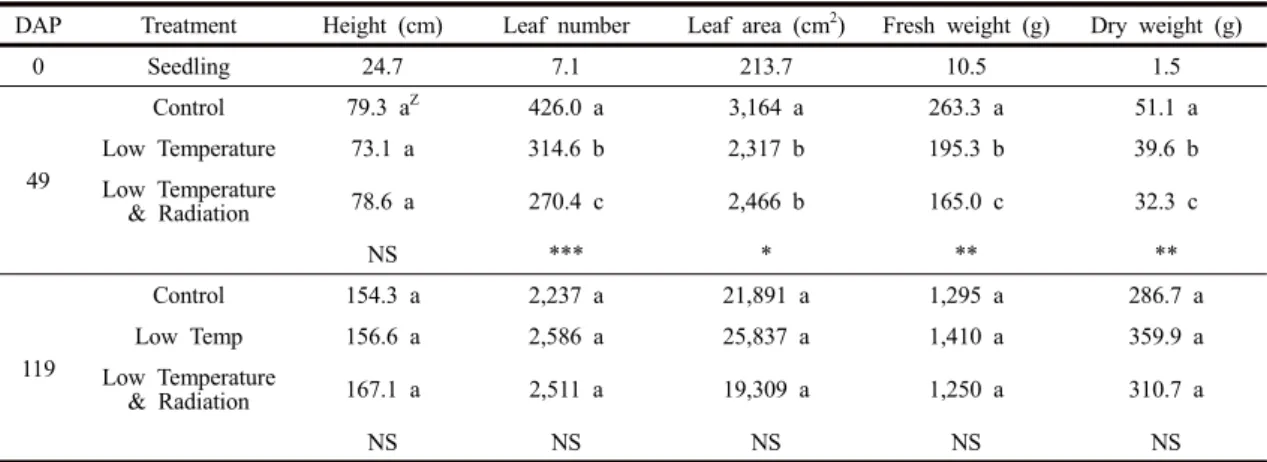
생육초기 저온 및 차광 처리에 따른 고추의 생육을 조 사하였다(Table 1). 저온 및 차광 처리가 끝난 후인 정식 후 49일의 엽수, 생체중, 건물중은 무처리, 저온처리, 저 온차광처리 순으로 값이 높은 것을 확인할 수 있었다. 이 는 고추가 적정온도보다 낮은 환경에 노출될 경우 생육 이 저해된다는 보고(Lee et al., 2013)와 일치하였다. 엽
면적은 저온처리와 저온차광처리에서 감소한 것을 확인 할 수 있었으며, 초장은 처리에 따른 차이를 확인할 수 없 었다. 생육 후기인 정식 후 126일의 경우 초장, 엽수, 엽 면적, 생체중, 건물중 모두 처리구에 따른 차이가 나타나 지 않았으며 이는 생육이 진행됨에 따라 피해가 희석되 어 차이를 보이지 않게 된 것으로 사료된다.
3.2. 생육초기 저온 저일조에 따른 고추의 수량 및 품질 생육초기 저온 저일조의 영향을 분석하기 위하여 시 기별 고추의 수량을 조사하였다(Table 2). 고추 과실을 조사한 결과 대조구와 저온처리구의 첫 수확일은 정식
119
Control 154.3 a 2,237 a 21,891 a 1,295 a 286.7 a
Low Temp 156.6 a 2,586 a 25,837 a 1,410 a 359.9 a
Low Temperature
& Radiation 167.1 a 2,511 a 19,309 a 1,250 a 310.7 a
NS NS NS NS NS
ZMeans followed by the same letter are not significantly different from each other (P<0.05 ANOVA followed by LSD test).
NS, *, **, *** means Nonsignificant, significant at P<0.05, 0.01, and 0.001, respectively.
Control Low Temperature Low Temperature & Radiation
Fresh Weight (g/m2)
Dry Weight (g/m2)
Fresh Weight (g/m2)
Dry Weight (g/m2)
Fresh Weight (g/m2)
Dry Weight (g/m2)
Jun 21 29.7 5.8 7.8 1.5 0 0
Jun 24 7.4 1.4 24.5 4.7 0 0
Jun 26 8.1 1.1 16.4 3.1 0 0
Jul 1 2.2 0.3 1.7 0.2 28.9 5.5
Jul 5 22.6 3.3 8.7 1.6 1.5 0.2
Jul 10 33.4 5.4 32.4 5.5 9.5 1.5
Jul 18 274.3 72.3 168.5 43.5 181.9 32.4
Jul 26 737.9 134.9 482.8 91.5 368.3 88.3
Aug 2 840.8 126.7 1429.1 231.7 1428.2 226.7
Table 2. Change of pepper yield on under normal, low temperature, low temperature with shading condition(n=30)
Treatment Control Low Temp Low Temperature
& Radiation
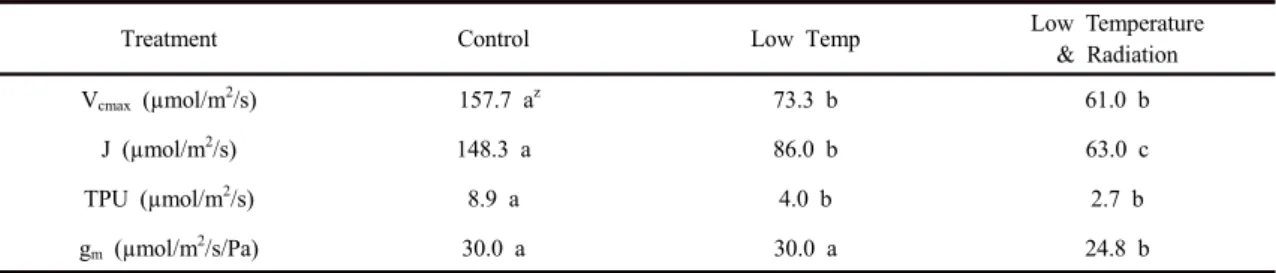
Vcmax (µmol/m2/s) 157.7 az 73.3 b 61.0 b
J (µmol/m2/s) 148.3 a 86.0 b 63.0 c
TPU (µmol/m2/s) 8.9 a 4.0 b 2.7 b
gm (µmol/m2/s/Pa) 30.0 a 30.0 a 24.8 b
Vcmax, maximum Rubisco carboxylation efficiency; J, electron transport for the given light intensity; TPU, maximum rate of trios phosphate use; gm, mesophyll conductance to CO2 transfer. Z Means followed by the same letter are not significantly different from each other(P<0.05 ANOVA followed by LSD test).
Table 3. Estimated Photosynthetic parameters of biochemical model for pepper(n=3)
Fig. 3. Cumulative yields of pepper on normal, low temperature, and low temperature with shading condition.
Fig. 4. Capasicin and dihydrocapsacin concentration of pepper fruit under normal, low temperature, low temperature with covered shading condition.
후 67일이였으나 저온차광 처리구의 경우 정식 후 77일 이였으며, 이는 차광에 의한 생육 지연이 원인인 것으로 보인다. 정식 후 81일 대조구, 저온처리구, 저온차광구의 누적 수량은 각각 70.1, 59.1, 30.4 g/m2로 저온과 차광 에 의한 차이를 보이나, 이 차이는 점차 감소하여 최종 수 확일인 정식 후 119일에는 누적수량이 무처리, 저온처 리, 저온차광 순으로 각각 1,956, 2,171, 2,018 g/plant 로 큰 차이를 보이지 않았다(Fig. 3). 이는 생육이 진행됨 에 따라 생육초기 저온 및 저일조의 영향이 희석된 것으 로 보이며 저온 및 저일조에 노출되더라도 적절한 관리 를 통해 수량을 확보할 수 있다는 것을 확인할 수 있었다. 저온 및 저일조에 의한 과실의 품질 변화를 구명하기 위하여 정식 후 81에 수확한 과실의 capsaicin 함량을 분 석한 결과 대조구, 저온처리구, 저온차광 처리구 순으로
각각 92.0, 56.3, 36.7 mg/100g으로 저온과 차광에 의하 여 함량이 감소하였다.
Dihidrocapsacin의 경우 각각 72.1, 40.3, 28.4 mg/100g로 capsaicin과 유사한 결과를 나타냈다(Fig.
4). 이는 sweet pepper 재배 중 높은 기온에 노출되었을 경우 capsaicin의 농도가 증가하였다는 보고와 유사하였 으며(Rahman and Inden, 2012), 고추의 품질요소인 capsaicin 함량을 유지하기 위해서는 적절한 환경관리가 필요하다는 것을 확인할 수 있었다. 정식 후 119일에 수 확한 과실의 capsaicin과 dihidrocapsaicin을 분석하였 으나 처리구별 유의미한 차이를 보이지 않았으며 고추의 생육과 마찬가지로 저온 및 저일조의 영향이 희석된 것 으로 보인다.
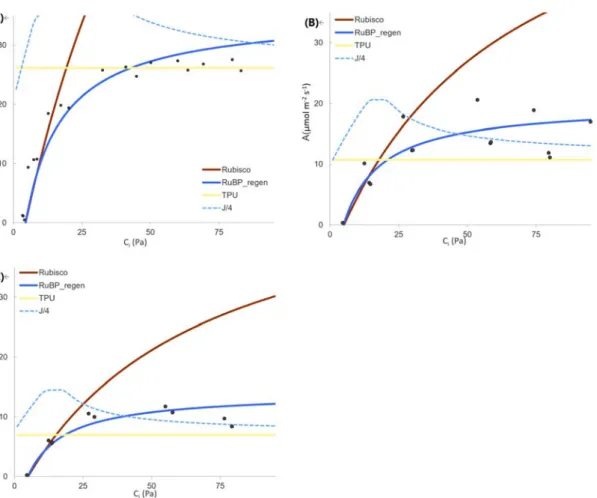
Fig. 5. A-Ci curve of pepper under low temperature(B) treatment, low temperature with shading(C), and control(A).
3.3. 저온 저일조에 따른 광합성 특성
생육초기 저온 및 저일조에 따른 고추의 광합성 특성 을 구명하기 위하여 처리구별 CO2반응 곡선을 작성하였다 (Fig. 5). CO2 반응 곡선을 분석한 결과 무처리, 저온처 리, 저온 차광처리의 최대 순 광합성 속도가 각각 26.7, 15.9, 11.7 μmol Co2/m/s 이었으며 저온과 저일조에 의 하여 최대값이 낮아지는 것을 확인할 수 있었다. 이는 처 리구별 CO2 반응곡선과 광합성 기구의 생화학적 모델을 활용하여 얻은 광합성 특성에서도 확인할 수 있다. 광합 성 특성을 분석한 결과 J(전자전달계효율)값은 무처리, 저온, 저온차광 순으로 값이 감소하였으며, Vcmax(최대 카르복실화 속도)와 TPU(삼인산화율) 값은 저온에 의하 여 값이 감소하였으나 차광에 의한 감소는 보이지 않았 고, gm(엽육 이산화탄소 전달저항)값의 경우 차광처리에 서 감소되는 것을 확인할 수 있었다(Table 3). 이는 저온 에 의하여 Vcmax와 Jmax(최대 전자전달계효율)가 감소한 다는 보고와(Dreyer et al., 2000), 작물이 온도환경에 순 응하여 최대 광합성 속도 및 광합성 특성에 변화가 생긴 다는 보고(Way and Yamori, 2013)와 일치 하였다.
4. 결 론
본 연구는 생육초기 저온 저일조 조건이 고추의 수량 및 품질에 미치는 영향을 구명하기 위해서 수행되었다. 비가림 하우스에서 정식 후 17일에 측창 개폐와 차광막 을 이용하여 26일간 저온, 저온차광 처리하였다. 처리기 간 동안의 고추의 GDD를 산출한 결과 저온 처리로 인해 GDD가 5.5% 감소하였다. 차광 처리에 의한 평균 일사 량을 분석한 결과 무차광 대비 25.3% 수준이였다. 생육 초기 저온 및 저온차광 처리한 결과 처리 직후의 엽면적 은 저온에 의하여 생육이 저하되었고, 엽수, 생체중, 건물 중은 저온 및 저일조에 의하여 저하된 것을 확인할 수 있 었으나, 생육이 진행되면서 처리에 따른 차이가 나타나 지 않았다. 과실의 경우 저일조에 의하여 첫 수확이 지연 되었으며 수량 또한 저온과 차광에 의하여 감소하였다. 그러나 생육이 진행됨에 따라서 차이가 줄어들면서 최종 수확일인 정식 후 119일에는 누적수량에 유의미한 차이 를 확인할 수 없었다. 고추의 품질요소인 capsaicin과 dihydrocapsaicin 농도를 분석한 결과 저온 및 차광에 의해 농도가 감소한 것을 확인할 수 있었다. 처리에 따른
광합성 특성을 조사하기 위하여 이산화탄소반응 곡선을 작성한 결과 최대 광합성 속도가 저온 및 차광에 의하여 감소하였다. 광합성 기구의 생화학적 모델을 활용하여 분석한 결과 J는 저온과 차광에 의하여 값이 감소되었으 며, Vcmax, TPU는 저온에 의하여 값이 감소하였고, gm의 경우 차광에 의하여 값이 감소한 것을 확인할 수 있었다.
고추가 생육초기에 저온 및 저일조 환경에 노출될 경 우 생육, 수량, 품질 및 광합성이 저해되었으나, 생육이 진행함에 따라 생육, 수량, 품질에 대한 격차가 줄어들어 최종적으로는 저온 및 저온저일조에 의한 차이를 보이지 않았으며, 이는 적절한 재배적 관리가 이루어질 경우 피 해를 완화시킬 수 있다는 것을 확인하였다.
감사의 글
본 성과물은 농촌진흥청 연구사업(세부과제번호: PJ 01196501)의 지원에 의해 이루어졌음.
REFERENCES
Choi, Y. H., Kwon, J. K., Lee, J. H., Kang, N. J., Cho, M. W., Kang, J. S., 2004, Effect of night and daytime temperatures on growth and yield of paprika ‘Fiesta’ and
‘Jubilee’, Protected Horticulture and Plant Factory, 13(4), 226-232.
Dreyer, E., Le Roux, X., Montpied, P., Daudet, F. A., Masson, F., 2001, Temperature response of leaf photosynthetic capacity in seedlings from seven temperate tree species, Tree physiqology, 21(4), 223-232.
Farquhar, G. D., von Caemmerer, S. V., Berry, J. A., 1980, A Biochemical model of photosynthetic CO2 assimilation in leaves of C 3 species, Planta, 149(1), 78-90.
IPCC, 2014, Annex II: Glossary [Mach, K.J., S. Planton and C.
von Stechow (eds.)], In: Climate Change 2014: Synthesis Report. Contribution of Working Groups I, II and III to the Fifth Assessment Report of the Intergovernmental Panel on Climate Change [Core Writing Team, R.K. Pachauri and L.A. Meyer (eds.)], IPCC, Geneva, Switzerland, 117-130.
Lee, S. G., Choi, C. S., Lee, J. G., Jang, Y. A., Nam, C. W., Lee, H. J., Kang, J. S., 2013, Influence of daytime temperature on the time required for fruit harvest and yield of hot pepper, Journal of Environmental Science
plants, In VII International Symposium on Light in Horticultural Systems, 956, 545-552.
Lorenz, Oscar A., Maynard, Donald N., 1980, Hochmuth.
Knott's Handbook for Vegetable Growers, John Wiley &
Sons., New Jersey, 31-72.
Moriondo, M., Giannakopoulos, C., Bindi, M., 2011, Climate change impact assessment: the role of climate extremes in crop yield simulation, Climatic change, 104. (3-4), 679-701.
Rahman, M. J., 2012, Capsaicin content in sweet pepper(Capsicum annuum L.) under temperature stress, Acta horticulturae, 936(1), 195-201.
Sharkey, T. D., 1985, Photosynthesis in intact leaves of C 3 plants: physics, physiology and rate limitations, The Botanical Review, 51(1), 53-105.
Sharkey, T. D., Bernacchi, C. J., Farquhar, G. D., Singsaas, E.
L., 2007, Fitting photosynthetic carbon dioxide response curves for C3 leaves, Plant, cell & environment, 30(9), 1035-1040.
Sharkey, T. D., 2016., What gas exchange data can tell us about photosynthesis, Plant, Cell & Environment, 39(6), 1161-1163.
Song, E. Y., Moon, K. H., Son, I. C., Kim, C. H., Lim, C. K., Son, D., Oh, S. J., 2014, Impact of elevated temperature in growing season on growth and fruit quality of pepper (Capsicum annuum L.), Korean Journal of Agricultural and Forest Meteorology, 16(4), 349-358.
Researcher. Seung-Hwan Wi
Vegetable Research Division, National Institute of Horticultural
& Herbal Science [email protected] Researcher. Hee-Ju Lee
Vegetable Research Division, National Institute of Horticultural
& Herbal Science [email protected] Senior Researcher. In-Ho Yu
Vegetable Research Division, National Institute of Horticultural
& Herbal Science [email protected] Researcher. Yoon-Ah Jang
Vegetable Research Division, National Institute of Horticultural
& Herbal Science [email protected]
Researcher. Kyung-Hwan Yeo
Vegetable Research Division, National Institute of Horticultural
& Herbal Science [email protected] Researcher. Se-Woong An
Vegetable Research Division, National Institute of Horticultural
& Herbal Science [email protected]
Postdoctoral Researcher. Jin-Hyong Lee
Vegetable Research Division, National Institute of Horticultural
& Herbal Science [email protected]
Assistant Professor. Sung-Kyeom Kim
Department of Horticultural Science, College of Agriculture
& Life Science [email protected]