DOI: https://doi.org/10.3339/jkspn.2017.21.2.61 ISSN 2384-0250 (online)
Clinical Features and Prognosis of Henoch-Schönlein Purpura in Children and Adults: A 13-Year Retrospective Study at a Single Centre
Purpose: To investigate differences in clinical features, blood/urinary findings, and prognosis in different age groups of patients with Henoch-Schönlein purpura (HSP).
Methods: A total of 469 patients with HSP were analyzed retrospectively from June 2003 to February 2016. We classified patients into child or adult groups based on their age.
Results: The adult group had more patients with anemia (child vs. adult; 7.5% vs.
16.4%), and higher immunoglobulin A (IgA) (30.0% vs. 50.0%) levels, C-reactive protein (34.2% vs. 54.0%) and uric acid (3.1% vs. 12.1%) levels than the child group. The child group was highly positive for Mycoplasma pneumoniae immu- noglobulin M (IgM) (34.4%). More patients in the child group presented with high levels of antistreptolysin O (24.7% vs. 2.9%) and high C4 (11.5% vs. 4.2%). Low C3 (1.1% vs. 10.2%) levels, and renal involvement with gross hematuria (8.6% vs. 21.5
%), nonnephrotic proteinuria (1.1% vs. 11.2%), and nephrotic syndrome (1.1% vs.
6.0%) were common in the adult group. Adults also had poorer renal outcomes [persistent hematuria/proteinuria (10.5% vs. 32.8%), and chronic kidney disease (0% vs. 11.2%)] than the child group. Risk factors for renal involvement such as older age and higher level of uric acid were only found in the child group. The risk factors for poor renal outcome were nephrotic syndrome in the child group and gross hematuria in the adult group.
Conclusion: In this study, child and adult groups presented with different clinical manifestations of HSP. We found that risk factors for renal involvement included age and high uric acid level in the child group. Moreover, nephrotic syndrome in the child group and gross hematuria in the adult group increased the risk of poor renal outcome.
Key words: Henoch-Schönlein Purpura, Children, Adult, Clinical feature, Prognosis
Do Young Jung, M.D. 1 Ye Rim Kwon, M.D. 1 Min Heui Yu, B.S. 2
Mee Kyung Namgoong, M.D. 1
Department of Pediatrics
1, Yonsei University Wonju College of Medicine, Wonju, Korea, Center of Biomedical Data Science
2, Yonsei University Wonju College of Medicine, Wonju, Korea
Corresponding author:
Mee Kyung Namgoong, M.D.
Department of Pediatrics, Yonsei University Wonju College of Medicine, 20 Ilsan-ro, Ilsan-ong, Wonju-si, Kangwon-do 26426, Korea
Tel: +82-33-741-1282 Fax: +82-33-732-6229 E-mail: [email protected] Received: 21 August 2017 Revised: 21 September 2017 Accepted: 27 September 2017
This is an open-access article distributed under the terms of the Creative Commons Attribu tion Non-Commercial License (http://
crea tivecom mons.org/licenses/by-nc/4.0/) which permits unrestricted non-commercial use, distribution, and reproduction in any medium, provided the original work is properly cited.
Copyright © 2017 The Korean Society of Pediatric Nephrology
Introduction
In children, Henoch-Schönlein purpura (HSP) is a common form of sys-
temic vasculitis that is known to generally have a favorable prognosis
1,2). Con-
versely, in adults, the prevalence of HSP is low, but is also more likely to show
renal involvement, resulting in a poor prognosis
3,4). However, although reports
have compared the differences between children and adults with respect to
HSP, the studies were limited by the lack of cases and short observation pe-
riods, and there have been few reports on experimentally or clinically specific differences and prognoses
5-7). In the present study, we retrospectively reviewed 469 cases of HSP in children and adults, over a period of 13 years, and examined differences in their clinical characteristics, exa- mination outcomes, and prognoses.
Material and methods
We performed a retrospective study using medical re- cords from a total of 469 inpatients and outpatients who had been diagnosed with HSP at the Department of Pedia- trics, Department of Nephrology, Department of Rheu- matology, or Department of Dermatology at the Wonju Severance Christian Hospital, between June 2003 and Fe- bruary 2016. The patients were divided into a child group aged 18 years or younger (353 patients) and an adult group aged over 18 years (116 patients). In accordance with the criteria of the European League against Rheumatism/Pae- diatric Rheumatology International Trials Organization/
Paediatric Rheumatology European Society (EULAR/
PRINTO/PRES), all patients were diagnosed with HSP if they showed palpable purpura and had at least one of the following accompanying conditions: a) abdominal pain;
b) arthritis or arthralgia; c) biopsy of affected tissue de- monstrating predominant immunoglobulin A (IgA) de- position; and/or d) renal involvement
8).
Predisposing factors were classified as upper respiratory tract infection (URI), cancer, or drugs. In terms of clinical manifestations, we investigated skin lesions, joint pain, and gastrointestinal (GI) symptoms. The laboratory studies performed were erythrocyte sedimentation rate (ESR), hemoglobin, white blood cell (WBC) count, C-reactive protein (CRP), blood urea nitrogen (BUN), uric acid, C3/
C4, PCR for eight strains of respiratory virus (adenovirus, corona virus, influenza A and influenza B, respiratory syncytial virus (RSV), metapneumovirus, rhinovirus, pa- rainfluenza virus), antistreptolysin O (ASO), Mycoplasma Pneumoniae-immunoglobulin M (IgM), and IgA, perfor- med at the time of initial admission to the hospital. Test results were classified as demonstrating an increase or a decrease, based on the reference values in the 20
thedition of the Nelson Textbook of Pediatrics and the 19
thedition of
the Harrisons Principles of Internal Medicine
9,10). Renal involvement was categorized in terms of micro- scopic/gross hematuria, proteinuria, nephrotic syndrome, and normal, based on urinalysis performed throughout the period of care. Renal outcome was classified as normal urine, persistent hematuria±proteinuria, or chronic kidney disease (CKD; denoted by continually elevated Cr, or by the patient being a recipient of dialysis or kidney transplant).
Persistent urinary abnormalities or CKD were defined as poor renal outcome, and a binary logistic regression an- alysis was performed.
SPSS 18.0 (IBM Corp., Armonk, NY, USA) was used for statistical analysis, and chi-square test or Fisher’s exact test was used to compare categorical variables. A binary logistic regression analysis was performed. P<0.05 was defined as a statistically significant result.
Results
1. Patients characteristics
There were a total of 469 patients included in this study.
The mean age was 7.62±3.76 years in the child group (353 patients; 1-18 years) and 47.8±18.0 years in the adult group (116 patients; 19-87 years). In terms of sex ratio, male pati- ents were more common in both groups (child vs. adult;
53.8% vs. 52.6%, P=0.905). The mean follow-up duration was 392.5 days for the child group and 565.1 days for the adult group.
In terms of predisposing factors, URI was the most com- mon in the child group (45.9% vs. 23.3%, P<0.001).
Drug use was reported in 17 adults solely (colchicine, dapsone, triamcinolone, antidiabetic/antihypertensive drugs, 13.8%), and cancer was reported in three adults only (Hodgkin’s lymphoma, adenocarcinoma, ovarian cancer, 2.6%). Spring was the highest frequency for both group (30.3% vs. 27.6%, P=0.66), antithetically summer was the lowest frequency for both group (14.7% vs. 19.0%, P=0.347).
In terms of skin lesions, purpura was observed on the
lower limb in 85.5% of child patients and 59.5% of adult
patients, and could be seen frequently in other locations in
adults ( P<0.001). Joint pain was significantly more frequent
in the child group than in the adult group (54.4% vs. 27.6%,
P<0.001). Overall GI symptoms were more frequent in the
adult group (36.8% vs. 37.1%, P=0.510) than in the child group, but there was no significant difference between two groups. In terms of specific symptoms, abdominal pain was more frequent in the child group (31.2% vs. 26.6%, P=
0.411) than in the adult group, while nausea/vomiting (2.0
% vs. 2.6%, P=0.711), and hematochezia (1.4% vs. 7.1%, P=
0.007) were more frequent in the adult group, differences of hematochezia were statistically significant (Table 1).
2. Laboratory outcomes
The mean test results for platelet count (372,030±120,726
×10
6/L vs. 278,786±108,779×10
6/L, P<0.001) were signifi- cantly higher in the child group. Compared with the child group, the adult group showed a greater increase in anemia (7.5% vs. 16.4%, P=0.006), C3 hypocomplementemia (1.1%
vs. 10.2%, P=0.002), C3 hypercomplementamia (3.6% vs.
4.1%, P=1.0), and C4 hypocomplementemia (1.8% vs. 2.1%, P=0.302). While the child group were common in C4 hy- percomplementemia (11.5% vs. 4.2%, P=0.033) than the adult group. Uric acid showed a higher mean value in adult patients than in child patients (4.09±1.2 mg/dL vs. 5.50±1.5
mg/dL, P<0.001); the number of patients showing hyper- uricemia was also higher in the adult group than in the child group (3.1% vs. 12.1%, P=0.042) (Table 2).
Mycoplasma antibody was detected in 34.4% of cases in the child group. The positive rate of polymerase chain reac- tion (PCR) for respiratory viruses were 8.8%, adenovirus, RSV type A, and rhinovirus were detected in child.
High ASO (24.7% vs. 2.9%, P<0.001) was more common in the child group. The level of high IgA (30.0% vs. 50.0%, P<0.001) was greater in the adult group than that in the
child group.
3. Renal involvement and poor renal outcomes Renal involvement was significantly more common in adult patients than in child patients (gross hematuria 8.6%
vs. 21.5%, P<0.001; nonnephrotic proteinuria, 1.1% vs. 11.2
%, P<0.001; nephrotic syndrome, 1.1% vs. 6.0%, P=0.007).
Microspcopic hematuria was no significantly difference between two groups (21.4% vs. 26.7%, P=0.293) (Table 2).
With this, poor renal outcomes were more common in the adult group (10.5% vs. 44%, P<0.001) than in the child
Table 1. Clinical Characteristic between Child and Adult Group
Variable Total n=469 Child group n=353 (75.3%) Adult group n=116 (24.7%) P value
No. of patients (%)
Male(%) 251 (53.5) 190 (53.8) 61 (52.6) 0.902
Season 0.696
Spring 139 (29.6) 107 (30.3) 32 (27.6) 0.66
Summer 74 (15.8) 52 (14.7) 22 (19.0) 0.347
Fall 130 (27.7) 97 (27.5) 33 (28.4) 0.934
Winter 126 (26.9) 97 (27.5) 29 (25.0) 0.688
Predisposing factor <0.001
URI 189 (40.3) 162 (45.9) 27 (23.3) <0.001
Drug 16 (3.4) 0 (0) 16 (13.8) <0.001
Cancer 3 (0.6) 0 (0) 3 (2.6) 0.009
Purpura sites <0.001
Lower extremities 371 (79.1) 302 (85.5) 69 (59.5) <0.001
Trunk 17 (3.6) 2 (0.6) 15 (12.9) <0.001
Lower and Upper extremities 37 (7.9) 29 (8.2) 8 (6.9) 0.796
Whole body 44 (9.4) 20 (5.7) 24 (20.7) <0.001
Joint pain 224 (47.8) 192 (54.4) 32 (27.6) <0.001
Gastrointestinal symptoms 173 (36.9) 130 (36.8) 43 (37.1) 0.510
Abdominal pain 140 (30.0) 110 (31.2) 30 (26.6) 0.411
Nausea/vomiting 10 (2.2) 7 (2.0) 3 (2.6) 0.711
Diarrhea 10 (2.2) 8 (2.3) 2 (1.8) 1.0
Hematochezia 13 (2.8) 5 (1.4) 8 (7.1) 0.007
group, and cases that progressed to CKD were only ob- served in adults (11.2%). The majority of child patients had a normal outcome (whereas approximately half the adult patients had a normal outcome (89.5% vs. 56.0%, P<0.001).
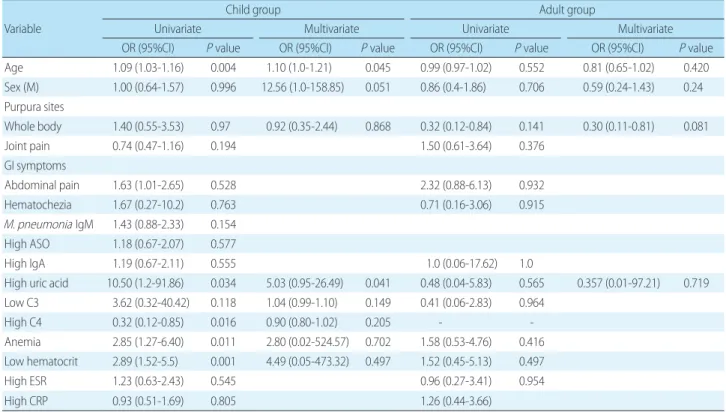
4. Univariate and multivariate logistic regression and odd ratio for renal involvement and outcomes A univariate logistic regression analysis was used to an- alyze several factors that might influence renal involvement.
Of these, the factors with a statistically significant effect on renal involvement were age (OR 1.09, P=0.004 in the uni- variate analysis OR 1.10, P=0.045 in the multivariate an- alysis), high uric acid (OR 10.50, P=0.034 in the univariate analysis OR 5.03, P=0.041 in the multivariate analysis in child group). There was no significant risk factor on renal involvement in adult group (Table 3).
Another univariate logistic regression analysis was used to analyze the factors that might influence renal outcomes.
The factors significantly associated with renal outcomes in this analysis were then subjected to an additional multiva-
riate logistic regression analysis. The child group were pre- sented nephrotic syndrome (OR 258.9, P=0.013 in the uni- variate analysis and OR 249.71, P=0.016 in the multivariate analysis). And adult group show gross hematuria (OR 49.3, P=0.014 in the univariate analysis and 100.63, P=0.006 in
the multivariate analysis) (Table 4).
Discussion
Since this study included a total of 469 HSP patients, it can be considered a large-scale study as compared with pre- vious research. With respect to the clinical observations made involving adults and children from several prior studies on fewer patients, the present study generally shows a greater difference in prognoses
11,12).
Among predisposing factors in the present study, the incidence of URI was significantly high in the child group.
This is similar to trends seen in previous studies. The etio- logy of URI was only tested in some child patients in this
Table 2. Laboratory Results between Child and Adult Group
Total n=469 Child group n=353 (75.3%) Adult group n=116 (24.7%) P value No. of patients (%)
WBC (x10
6/L) 9,744.5±3,695.9 9,919±3,580.7 9,224.7±3,990.3 0.08
Platelet (x10
6/L) 348,567±124,492 372,030±120,726 278,786±108,779 <0.001
IgA (mg/dL) 205.9±96.7 191.5±82.7 321.4±121.8 <0.001
Uric acid (mg/dL) 4.3±1.3 4.1±1.2 5.5±1.5 <0.001
Anemia (n=461) 45 (9.8) 26 (7.5) 19 (16.4) 0.009
High CRP (n=291) 112 (38.5) 78 (34.2) 34 (54.0) <0.001
High uric acid (n=226) 10 (4.4) 6 (3.1) 4 (12.1) 0.042
High IgA (n=270) 87 (32.2) 72 (30.0) 15 (50.0) <0.001
Low C3 (n=327) 8 (2.5) 3 (1.1) 5 (10.2) 0.002
High C4 (n=327) 34 (10.4) 32 (11.5) 2 (4.2) 0.033
M. pneumoniae IgM(+) (n=296) 102 (34.4%) 102 (34.4) No data
High ASO (n=321) 72 (22.4) 71 (24.7) 1 (2.9) <0.001
Renal involvement <0.001
Microscopic hematuria 106 (22.7) 75 (21.4) 31 (26.7) 0.293
Gross hematuria 55 (11.8) 30 (8.6) 25 (21.5) <0.001
Nonnephrotic proteinuria 17 (3.6) 4 (1.1) 13 (11.2) <0.001
NephroticSyndrome 11 (2.4) 4 (1.1) 7 (6.0) 0.007
Renal outcome <0.001
Normal urine 380 (81.2) 315 (89.5) 65 (56.0) <0.001
Persistent hematuria/proteinuria 75 (16.0) 37 (10.5) 38 (32.8) <0.001
Chronic kidney disease 13 (2.8) 0 (0) 13 (11.2) <0.001
*Plus-minus values are means ±SD.
Abbreviations: WBC, white blood cell; ESR, erythrocyte sedimentation rate; CRP, C-reactive protein; ASO, antistreptolysin O.
Table 3. Results of Univariate and Multivariate Logistic Regression Analysis of the Risk of Renal Involvement in HSP Patients Variable
Child group Adult group
Univariate Multivariate Univariate Multivariate
OR (95%CI) P value OR (95%CI) P value OR (95%CI) P value OR (95%CI) P value
Age 1.09 (1.03-1.16) 0.004 1.10 (1.0-1.21) 0.045 0.99 (0.97-1.02) 0.552 0.81 (0.65-1.02) 0.420
Sex (M) 1.00 (0.64-1.57) 0.996 12.56 (1.0-158.85) 0.051 0.86 (0.4-1.86) 0.706 0.59 (0.24-1.43) 0.24 Purpura sites
Whole body 1.40 (0.55-3.53) 0.97 0.92 (0.35-2.44) 0.868 0.32 (0.12-0.84) 0.141 0.30 (0.11-0.81) 0.081
Joint pain 0.74 (0.47-1.16) 0.194 1.50 (0.61-3.64) 0.376
GI symptoms
Abdominal pain 1.63 (1.01-2.65) 0.528 2.32 (0.88-6.13) 0.932
Hematochezia 1.67 (0.27-10.2) 0.763 0.71 (0.16-3.06) 0.915
M. pneumonia IgM 1.43 (0.88-2.33) 0.154 High ASO 1.18 (0.67-2.07) 0.577
High IgA 1.19 (0.67-2.11) 0.555 1.0 (0.06-17.62) 1.0
High uric acid 10.50 (1.2-91.86) 0.034 5.03 (0.95-26.49) 0.041 0.48 (0.04-5.83) 0.565 0.357 (0.01-97.21) 0.719 Low C3 3.62 (0.32-40.42) 0.118 1.04 (0.99-1.10) 0.149 0.41 (0.06-2.83) 0.964
High C4 0.32 (0.12-0.85) 0.016 0.90 (0.80-1.02) 0.205 - -
Anemia 2.85 (1.27-6.40) 0.011 2.80 (0.02-524.57) 0.702 1.58 (0.53-4.76) 0.416 Low hematocrit 2.89 (1.52-5.5) 0.001 4.49 (0.05-473.32) 0.497 1.52 (0.45-5.13) 0.497
High ESR 1.23 (0.63-2.43) 0.545 0.96 (0.27-3.41) 0.954
High CRP 0.93 (0.51-1.69) 0.805 1.26 (0.44-3.66)
Abbreviations: OR, odd ratio; CI, confidence interval; WBC, white blood cell; ESR, erythrocyte sedimentation rate; CRP, C-reactive protein; ASO, antistreptolysin O.
Table 4. Results of Univariate and Multivariate Logistic Regression Analysis of the Risk of Poor Renal Outcome in HSP Patients Variable
Child group Adult group
Univariate Multivariate Univariate Multivariate
OR (95%CI) P value OR (95%CI) P value OR (95%CI) P value OR (95%CI) P value
Age 1.08 (0.99-1.17) 0.085 1.02 (1.00-1.04) 0.1
Sex (M) 1.30 (0.65-2.60) 0.458 1.16 (0.50-2.68) 0.735 1.57 (0.75-3.29) 0.234 2.34 (0.79-6.91) 0.124 Purpura sites
Whole body 1.54 (0.43-5.54) 0.554 0.84 (0.38-1.88) 0.685 0.36 (0.13-1.03) 0.047 0.36 (0.13-1.03) 0.047
Joint pain 0.68 (0.34-1.35) 0.269 1.18 (0.52-2.67) 0.697
GI symptoms
Abdominal pain 2.07 (1.02-4.20) 0.937 0.67 (0.27-1.64) 0.925
M. pneumonia IgM 1.22 (0.59-2.55) 0.593
High ASO 1.02 (0.44-2.38) 0.971
High IgA 0.75 (0.31-1.86) 0.54 2.41 (0.52-11.10) 0.260
High uric acid 1.76 (0.20-15.85) 0.615 2.44 (0.23-26.30) 0.463
Low C3 3.78 (0.33-42.85) 0.289 0.23 (0.02-2.21) 0.971
High C4 0.22 (0.03-1.67) 0.126 - -
Anemia 1.63 (0.53-5.03) 0.54 0.91 (0.34-2.47) 0.859
Renal involvement
Microscopic hematuria 30.9 (8.89-107.4) 0.774 28.89 (8.27-100.97) 0.65 10.16 (2.57-40.8) 0.35 17.07 (2.91-100.15) 0.719
Gross hematuria 28.3 (7.0-114.68) 0.953 22.55 (5.38-94.53) 0.91 49.3 (10.6-228.1) 0.014 100.63 (14.03-721.77) 0.006
Nonnephrotic proteinuria 78.0 (8.0-752.56) 0.22 47.45 (3.50-643.86) 0.489 19.73 (3.90-99.9) 0.597 26.44 (3.47-201.23) 0.674
Nephrotic syndrome 285.9 (18.57-2,947.95) 0.013 249.71 (19.63-1,336.4) 0.016 73.9 (6.57-833.7) 0.071 78.63 (3.71-851.53) 0.209
Abbreviations: OR, odd ratio; CI, confidence interval; WBC, white blood cell; ESR, erythrocyte sedimentation rate; CRP, C-reactive protein; ASO, antistreptolysin
O.
study; adenovirus, RSV type A, and rhinovirus were de- tected in one case each, and the overall virus positive ratio was 8.8%. There was a suspicion that these infections were preceded, but there was no relation with the rate of kidney involvement. According to previous studies, the main causes of URI are viruses (parvovirus, rhinovirus)
13)and bacteria (staphylococci, streptococci)
14).
Medication with drugs prior to HSP onset was only com- mon in adult patients, and that didn’t show an effect on renal prognosis in our study. The drugs taken included col- chicine, dapsone, triamcinolone, and antidiabetic/antihy- pertensive drugs. In previous studies, quinolones
15)and clarithromycin
16)were reported to be associated with HSP.
Cancer was observed in only three cases involving adult patients; the types of cancer were Hodgkin’s lymphoma, adenocarcinoma, and ovarian cancer, and these had an effect on renal prognosis. Other studies have reported lung (nonsmall-cell) cancer
17), multiple myeloma
18), prostate cancer
19), Hodgkin's lymphoma
20)and non-Hodgkin's lym- phoma
21).
In terms of purpura distribution, a study by Kang
11)re- ported significantly higher involvement of the upper and lower limbs in the adult group; the present study also found that purpura was not limited to the lower limbs in 40.5%
of cases for adults ( vs. 14.4% for children). Joint pain was known to be more frequent in children in previous studies, and was also frequently observed in child patients in the present study. GI symptoms did not show any major diffe- rences between in the child vs. the adult patients in previous studies. Our study also found no differences in overall GI symptoms. But in terms of specific symptoms, we observed only abdominal pain was common in child patients, whe- reas abdominal pain with hematochezia more frequently in adult patients.
Renal involvement itself is a controversial issue, but ge- nerally previous studies have shown a pattern of more in- volvement in adults. Carlos
5)and Hung et al.
11)reported that only microscopic hematuria and renal insufficiency were more common in adults. In contrast, the present study found that microscopic hematuria had not difference of frequency, whereas gross hematuria, nonnephrotic protei- nuria, and nephrotic syndrome were more common in adults. Previous studies documented the risk factors of renal involvement in child were increased level of plasma
creatinine and hypertension
22). Whereas we found that risk factors for renal involvement include older age and high level of serum uric acid in the child group. The adult group didn’t show any risk factors for renal involvement in this study.
Renal outcomes showed significantly better prognoses for children (89.5% vs. 56%, P<0.001) than for adults. Pre- vious studies have reported proteinuria, hypertension, and anemia as major negative factors
5,11,23). Other studies asserted that the risk factors of renal outcomes were presence of nephrotic syndrome, severe case of histologic findings of kidney in child group
24,25). Butani and Morgenstern claimed that no apparent risk factor of poor renal outcomes in child- ren
26). Other risk factors reported to be associated with worse prognosis in adults are severe renal symptoms at on- set, female sex (during and after pregnancy), and increased serum creatinine level and proteinuria on renal biopsy
27-29). We found that factors affecting persistent or proceeding renal dysfunction were nephrotic syndrome in child group and gross hematuria in adult group.
A previous study demonstrated that hyperuricemia in IgA nephropathy patients was a predictive factor for pro- gressive nephropathy and that allopurinol could improve hypertension
30). Our study show hyperuricamia was risk factor of renal involvement in child group, but that was not relation to poor renal outcomes. We postulate that the rea- son for the difference between the results obtained in this study and those reported in previous studies is that we performed uric acid studies in fewer patients in the adult group and the prognosis of renal outcomes in the child group was generally better than that in the adult group.
There have been reports that blood IgA level is elevated in more than half of HSP patients, and that renal involve- ment is associated with higher IgA
31-33). In our study, rates of increased IgA level were 32.2% on all patients and we also found a clear increase in mean IgA levels in the adult group. The rate of kidney involvement was also more com- mon in adults, that was consistent with previous studies.
But high IgA level was not risk factor of renal involvement in the multivariate analysis.
Studies on complements in children have reported that
some patients show a temporary decrease in C3, but that
complement levels are not a prognostic factor for renal
involvement
34,35). Kawasa et al.
36)reported that terminal
complement complex showed increased levels in the blood in 83% of patients in the acute phase, and that it was asso- ciated with relapse during follow-up, but that C3 and C4 showed normal or elevated levels. However, there have also been reports that it is impossible to prove that complement activation is involved in the pathogenic mechanism of HSP
37)