49
I. Introduction
Sinusoidal Phase modulation of continuous wave (CW) laser generates evenly spaced comb like spectral lines, which is called the optical frequency comb source. This technique has been extensively researched in the past decades due to its wide variety of applications in the fields of science and technology. It has the ability to generate high repetition rate optical frequency combs and maintains high spectral coherence over the entire bandwidth [1]. The method is also very flexible in independent tuning of repetition rate and optical center frequency [2]. The simplicity of this technique
Variable and Flexible Optical Frequency Comb Source using Dual Mach Zehnder Modulator
and Phase Modulator
Abbas Naveed
*, Bong-Soo Choi
**, ThanhTuanTran
*, Dongsun Seo
*★Abstract
We demonstrated experimentally a variable optical frequency comb source using a cascaded dual parallel Mach Zehnder modulator (DPMZM) and a phase modulator (PM). With this simple configuration and applying low drive voltages, we generated variable comb source composed of spectral lines 3, 5, 7, 9 and 11 with 10-GHz frequency spacing, also generated 2 and 3 spectral lines with 20 GHz frequency spacing. The generated comb source maintains high spectral coherence across the entire bandwidth with good spectral flatness (within 1-dB for 2, 3, 5, 7 comb lines, within 2-dB for 9-comb lines and within 3-dB for 11 comb lines). The flat and variable comb source is mainly achieved by manipulating 6 operating parameters of DPMZM, setting RF amplifier gain, connected at phase modulator and phase shifters. Hence the method is simple and offers great flexibility in achieving flat and variable comb spectrum, which is experimentally demonstrated. This brings advantages of power efficiency due to low driving voltages, simplicity and cost effectiveness to the system.
key words: Optical comb source, Mach Zehnder modulator, Phase modulator, Microwave photonics, Optical communication
* Dept. of Electronics, Myongji University
**LiComm Co., Ltd, Yongin, Kyonggi 1705.8 Korea
★
Corresponding author
e-mail : [email protected], tel: 031-330-6369
※ Acknowledgment
This work was supported by Basic Science Research Program through the National Research Foundation of Korea (NRF) funded by the Ministry of Education, Science and Technology (#2011-0021743/#2016R1D1A1B04930224) and by the IITP funded by the Ministry of Science, ICT, and Future Planning (#B0101-15-1347).
Manuscript received Sep. 23, 2016; revised Oct. 25, 2016 ; accepted Nov. 15, 2016
This is an Open-Access article distributed under the terms of
the Creative Commons Attribution Non-Commercial License
(http://creativecommons.org/licenses/by-nc/3.0) which permits
unrestricted non-commercial use, distribution, and reproduction
in any medium, provided the original work is properly cited.
along with its inherent features makes it an ideal candidate for the applications like optical communication, spectroscopy, metrology, generation of RF-frequencies using photonic techniques, optical arbitrary waveform generation (OAWG) and in implementing Microwave Photonic Filters (MWPF). Optical frequency combs can also be used as a multi-wavelength source in Dense Wave Length Division Multiplexing Systems (DWDM). This makes system simple and reduces the cost of using separate lasers for different channels [3-4]. Optical frequency comb sources are ideal for orthogonal frequency division multiplexing (OFDM) which requires highly coherent frequency locked carriers [5].
Aside from all these attractive properties which an optical frequency comb source offers, it is extremely difficult to achieve good spectral flatness of the comb source, although the degree of flatness depends upon the desired application. Several techniques were experimented to resolve this problem. Some well-known are placing in tandem several amplitude and phase modulators, employing linearly chirped fiber grating (LCFG) with electro-optic modulators and so on [6]. Since Spectral flatness is severely affected using only phase modulation (PM), hence resulted in poor spectral flatness. This problem can be resolved using an intensity modulator (IM) before phase modulator, which generates flat-topped pulse train in time domain. In this configuration, the IM acts to generate flat-topped pulses from CW laser source. The phase modulator applies quadratic phase on each flat-topped pulse hence working as a time lens. This results in much flat spectral profile of the frequency combs [7-8].
In this work, we proposed a technique using a DPMZM and a PM. The choice of the DPMZM is to exploit its six operating
parameters to flexibly flatten comb spectrum or shape it into the desired spectral profile according to the target application. As in case of microwave photonic filters (MWPF), it is required to shape the comb spectrum in the Gaussian profile right in the generation process to achieve optimal filter characteristics [9].
Most of the comb generation techniques use large driving signals and cascade of several intensity and phase modulators [1-3], which either become power inefficient or expensive to employ for general applications. In our setup, we applied low driving signals and used a single DPMZM and a PM for the generation of variable comb source. Optical frequency comb reported in [10] is limited to 5 and 7 spectral lines. The setup consists of a single DPMZM and comb source is generated by adjusting dc bias voltage of the parallel arm modulator of DPMZM. By cascading a PM with DPMZM, we generated a variable comb source with greater variability, number of spectral lines and flatness, also experimentally demonstrated the Gaussian comb profile without the need for any expensive pulse shapers by flexibly adjusting operating parameters of DPMZM and tailoring RF-signal using RF-amplifiers gains, attenuators and phase shifters. This makes the system more flexible and cost-effective as compared to other configurations
Sinusoidal Phase modulation of continuous
wave (CW) laser generates evenly spaced comb
like spectral lines, which is called the optical
frequency comb source. This technique has
been extensively researched in the past decades
due to its wide variety of applications in the
fields of science and technology. It has the
ability to generate high repetition rate optical
frequency combs and maintains high spectral
coherence over the entire bandwidth [1]. The
method is also very flexible in independent
tuning of repetition
II. Principle
As depicted in Fig. 1, the experimental setup of the comb generator consists of a comb module (see Fig. 2), a phase modulator and a 10-GHz RF-source .The comb module consists of a DPMZM, RF-amplifier, attenuator and a phase shifter. It can generate five highly stable and flat comb lines. The PM is cascaded outside the comb module, in series with DPMZM.
When a continuous wave (CW) laser is launched into the DPMZM (inside the comb module), first Y-junction divides the light into two equal parts which follow the two parallel arms of DPMZM. The 10-GHz signal from the RF source is amplified by RF-amplifier and splitted using 1x2 splitter. Light signal in one arm of DPMZM is modulated directly using one ouput of 1x2 splitter while series attenuator and phase shifter are employed after second ouput of 1x2 splitter to modulate the light signal in the other arm of DPMZM. This all process takes place inside the packaged comb module.
The PM is driven using first and second harmonics of the sinusoidal drive signal
Fig. 1. Configuration of optical frequency comb source forvariable number of comb lines and frequency spacing.
Fig. 2. Comb module with built-in DPMZM RF-amplifier, attenuator and phase shifter.
with power ratio of 24-dB and phase shift of 180◦. This gives a reasonable approximation for impressing quadratic phase onto quasi flat-top pulses from DPMZM [12].
The output of DPMZM can be written as [13].
where E
out_MZAand E
out_MZBare output fields of two sub-modulators, V
bias_cand V
pare the bias and half-wave voltage of the main modulator of DPMZM respectively.
III. Experimental results
We experimentally generated variable frequency
comb source using a simple setup, which is
composed of a Dual Parallel Mach Zehnder
Modulator (DPMZM) and a Phase Modulator
(PM). The DPMZM offers great flexibility in
shaping the comb spectral profile due its six
operating parameters which are two parallel
arm sub-modulator dc biases (MZM1 bias and
MZM2 bias), phase bias positive and negative offers greater resolution in adjusting the phase between two optical signals in the parallel arms of DPMZM and to optimize the comb spectral flatness. By adjusting the power of RF signals to the parallel arm modulators, stable seed spectrum is obtained which is then applied to PM, to scale the number of comblines.
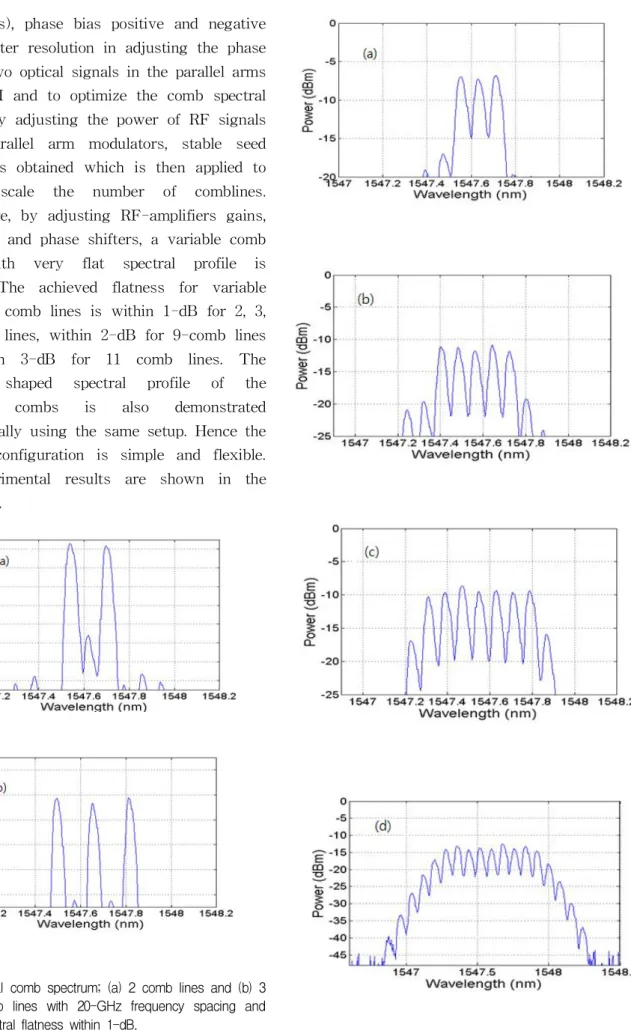
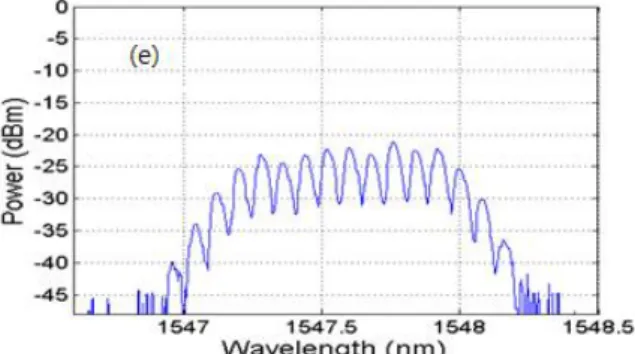
Furthermore, by adjusting RF-amplifiers gains, attenuators and phase shifters, a variable comb source with very flat spectral profile is obtained. The achieved flatness for variable number of comb lines is within 1-dB for 2, 3, 5, 7 comb lines, within 2-dB for 9-comb lines and within 3-dB for 11 comb lines. The Gaussian shaped spectral profile of the frequency combs is also demonstrated experimentally using the same setup. Hence the proposed configuration is simple and flexible.
The experimental results are shown in the Figs. (3-5).
Fig. 3. Optical comb spectrum; (a) 2 comb lines and (b) 3
comb lines with 20-GHz frequency spacing and
spectral flatness within 1-dB.
Fig. 4. Optical comb spectrum; (a) 3 comb lines, (b) 5 comb lines, (c) 7 comb lines, (d) 9 comb lines, and (e) 11 comb lines with 10-GHz frequency spacing. They show spectral flatness within 1-dB for 3, 5, 7 comb lines, within 2-dB for 9 comb lines, and within 3-dB for 11 comb lines.
Fig. 5. Gaussian shaped optical frequency comb spectrum.
Using commercially available Optsim simulation platform, we studied the relation among the parameters of the system and choose optimum values for better performance. We observed that the number of spectral lines is proportional to the gain of RF-amplifier at PM. The gain is adjusted according to the desired number of comb lines. For generating 11 comb lines 20.5-dBm RF-signal was applied to the PM. As shown in Figs. 3 (a) and (b), the 2 and 3 comb lines respectively, with 20-GHz frequency spacing, are obtained by setting parallel arm modulators of DPMZM to maximum and null points respectively and adjusting the relative phase. Again as shown in Figs. 4(a), (b), (c), (d), and (e), the 3, 5, 7, 9, and 11 comb lines respectively, with 10-GHz frequency spacing, are obtained by adjusting dc biases of parallel
modulators of DPMZM and adjusting the gain of RF-amplifier at PM according to the desired number of comb lines. The Gaussian comb profile is obtained in Fig. 5, by adjusting the power and relative phase shift between the two RF-signals applied to DPMZM and tailoring the RF-signal to the phase modulator by mixing the first and second harmonic of the sinusoidal drive signal and adjusting the gain of RF-amplifier at the PM.
Ⅲ. Conclusion
We experimentally demonstrated that a variable and flexible optical frequency comb source can be generated using a DPMZM and a PM with relatively low driving voltages. With the simple configuration, we generated 3, 5, 7, 9, and 11 comb lines with 10-GHz frequency spacing and 2, and 3 comb lines with 20-GHz frequency spacing. The comb source has good spectral flatness (within 1-dB for 2, 3, 5, and 7 comb lines, within 2-dB for 9-comb lines, and within 3-dB for 11 comb lines) and high spectral coherence over the entire bandwidth. We also experimentally demonstrated the Gaussian comb profile with the same setup, which shows the flexibility of the configuration. The generated comb source is power efficient due to low driving voltages, cost effective, with greater flexibility and variability.
References
[1] T.Sakamoto, T.Kawanishi, and M.
Izutsu,"Widely wavelength-tunable ultra-flat frequency comb generation using conventional dual-drive Mach-Zehnder modulator," Electron.
Lett., vol. 43, no.19, pp.103-1040, Sep. 2007.
[2] Rui Wu, D. E. Leaird, and A. Weiner,
"Bandwidth reconfigurable radio-frequency
photonic filters based on directly generated Gaussian-shaped comb," Proc. 2012 Conf. on Lasers and Electro-Optics (CLEO), 2012, pp.1-2.
[3] Ioan L. Gheorma and Ganesh K.
Gopalakrishnan, "Flat frequency comb generation with an integrated dual-parallel modulator," IEEE Photon. Technol. Lett., vol.
19, no. 13, pp. 1011-1013, Jul. 2007.
[4] V. Torres-Company, J. Lancis, and P.
Andres, "Lossless equalization of frequency combs," Opt. Lett., vol. 33, no. 16, pp.
1822-1824, Aug. 2008.
[5] V. R. Supradeepa and A. M. Weiner,
“Bandwidth scaling and spectral flatness enhancement of optical frequency combs from phase modulated continuous-wave lasers using cascaded four-wave mixing," Proc. Opt. Fiber Comm. Conf. and Exp. (OFC/NFOEC), 2011 and National Fiber Optic Engr. Conf., 2011, pp.1-3.
[7] N. Yokota and H. Yasaka, "Operation strategy of InP Mach–Zehnder modulators for flat optical frequency comb generation," IEEE J. Quantum Electron., vol. 52, no. 8, Aug. 2016.
[8] T. T. Tran and D. S. Seo,"A flexible and tunable Microwave Photonic filter based on adjustable optical frequency comb source," j.
Inst. Kor. Electr. Electron. Eng, vol. 19, no.1, pp. 27-32, Mar. 2015.
[9] R. Wu, C. M. Long, D. E. Leaird, and A.
M. Weiner, "Directly generated Gaussian-shaped optical frequency comb for microwave photonic filtering and picosecond pulse generation,"
IEEE Photo. Tech. Lett., vol. 24, no. 17, pp.
1484-1486, Sep., 2012.
[10] L. Shang, Y. Li, L. Ma, and J. Chen, "A flexible and ultra-flat optical frequency comb generator using a parallel Mach Zehnder modulator with a single Dc bias," Opt. Comm., Vol. 356, pp.70–73, Dec. 2015.
[11] M. Song, V. Torres-Company, A. Metcalf, and A. Weiner, "Multitap microwave photonic
filters with programmable phase response via optical frequency comb shaping," Opt. Lett., vol. 37, no. 5, pp. 845-847, 2012.
[12] R. Wu, “Comb-based radio frequency photonic filtering: principles, applications and opportunities,” Ph.D Dissertation, Purdue Univ., 2013.
[13] Q. Chang, J. Gao, and Y. Su, "Generation of optical comb frequency signal with high spectral flatness using two cascaded optical modulators," in Proc. Opt. Fiber Comm. &
Optoelectron. Exp. & Conf., 2008. AOE 2008.
Asia (OSA/AOE), 2008, pp. 1-3.
BIOGRAPHY
Naveed, Abbas (Member)
2012:BS degree in Electronics, Sir Syed University of Engineering and Technology, Karachi, Pakistan.
2015~Present: MS student, Dept. of Electronics, Myongji University
Bong-Soo Choi
(Member)
1994:B.S.degree in Electronics, Myongji University.
1996:M.S.degreein Electronics, Myongji University.
1996-2000: Senior Engineer, Daewoo Telecom Co., Ltd.
2 0 0 0 ~ P r e s e n t : D i r e c t o r , LiComm Co., Ltd.
<Research interests> Optical amplifier,
Optical transmission system.
Tran, Thanh Tuan (Member)