ORIGINAL ARTICLE
Korean J Biol Psychiatry 2014;21:14-20
ISSN 1225-8709 / eISSN 2005-7571
서 론
양극성 장애와 단극성 우울증의 감별하는 것은 쉽지 않다.
그 이유는 양극성 장애를 가진 환자들의 경과에서 가장 많고 두드러지는 증상이 우울 증상이기 때문이다. 1형 양극성 장애 에서 우울 증상과 조증 증상의 나타난 기간에 대한 비율은 3 : 1이며 2형 양극성 장애에서는 37 : 1이다.1) 따라서 환자로 부터 자세한 병력의 청취 및 가족이나 친밀한 관계를 맺는 정
보 제공자와의 면담이 이루어지지 않으면 양극성 장애를 다 른 진단으로 오진할 수도 있다. 2000년대 초반 Ghaemi 등2)은 경조증과 조증 삽화가 없는 환자들도 양극성 장애의 특성을 가질 수 있다고 주장하였다. 그들은 이런 환자들을 양극성 스 펙트럼 장애(bipolar spectrum disorder)로 진단하였고 이에 대한 진단 기준을 개발하였다.2) 이러한 진단 기준에 따르면 우 울 삽화가 발생한 환자에서 가족력에서 양극성 장애가 있거 나 과거 항우울제에 의한 경조증이나 조증 전환의 과거력의 2
주요우울증 환자에서 일주기 형태에 따른 양극성 경향 , 자살 사고 ,
청각유발전위와의 관련성 : 예비 연구
인제대학교 의과대학 일산백병원 정신건강의학교실
박 영 민 ·이 승 환
Chronotype in Relation to Bipolarity, Suicidal Ideation, and Auditory Evoked Potentials in Patients with Major Depressive Disorder : Preliminary Study
Young-Min Park, MD, Seung-Hwan Lee, MD
Department of Psychiatry, Ilsan Paik Hospital, Inje University College of Medicine, Goyang, Korea
ObjectivesZZThe current study investigated the putative relationship between chronotype and suicidality or bipolarity in patients with major depressive disorder (MDD).
MethodZZNineteen outpatients who met the criteria for MDD according to the fourth edition of the Diagnostic and Statistical Manual of Mental Disorders-text revision were recruited for the current study. The subjects were divided into two subgroups based on their Ba- sic Language Morningness (BALM) scores (dichotomized according to the median BALM score). The Loudness Dependence of Auditory Evoked Potentials (LDAEP) was evaluated by measuring the auditory event-related potentials before beginning medication with sero- tonergic agents. In addition, K-Mood Disorder Questionaire (K-MDQ), Beck Scale for Suicidal Ideation (BSS), Beck Hopelessness Scale (BHS), Barratt Impulsiveness Scale (BIS) were applied.
ResultsZZThe K-MDQ, BSS, BHS, BIS score was higher for the eveningness group than for the morningness group. However, the LDAEP, Hamilton Depression Rating Scale, Hamilton Anxiety Scale scores did not differ significantly between them. There were nega- tive correlations between the total BALM score and the total K-MDQ, BSS, and BHS scores (r = -0.64 and p = 0.0033, r = -0.61 and p = 0.0055, and r = -0.72 and p = 0.00056, respectively).
ConclusionsZZDepressed patients with eveningness are more vulnerable to the suicidality than those with morningness. Eveningness is also associated with bipolarity.
Key WordsZZChronotype ㆍLDAEP ㆍMajor depressive disorder ㆍBipolarity ㆍBipolar spectrum disorder.
Received: October 4, 2013 / Revised: October 22, 2013 / Accepted: December 26, 2013 Address for correspondence: Young-Min Park, MD
Department of Psychiatry, Ilsan Paik Hospital, Inje University College of Medicine, 170 Juhwa-ro, Ilsanseo-gu, Goyang 411-706, Korea Tel: +82-31-910-7260, Fax: +82-31-910-7268, E-mail: [email protected]
가지를 가장 중요한 진단 기준으로 삼았고 여기에 추가 기준 으로 이른 발병, 잦은 발병, 짧은 삽화, 비전형적 증상, 정신병 적 증상 9가지 기준을 제시하였다. 그들에 의하면 이러한 환 자에게 항우울제 단독으로 치료를 한다면 불안정정동이 나타 날 수 있고 나아가서 경조증이나 조증 전환이 될 수 있다며 양 극성 스펙트럼 장애(bipolar spectrum disorder)의 중요성을 역설하였다. 따라서 경조증이나 조증이 없는 환자에서 양극성 장애를 예측하는 요소들을 찾는 것이 매우 중요한 의미를 갖 게 되었다.
Ghaemi 등2)의 진단 기준에는 없지만 일주기 리듬 또한 우 울 장애, 양극성 장애, 혹은 계절성 정동 장애와의 연관성에 대 한 연구 결과들이 제시되고 있다. 6071명의 일반 인구를 대상 으로 일주기 형태와 우울증 여부를 조사한 결과 우울증이 있 는 사람은 저녁형의 일주기 형태를 유의하게 더 많이 가지고 있 었다.3) 또한 수면위상지연증후군(delayed sleep phase synd- rome)을 가진 환자들에서 우울 증상과 불안 증상이 높은 빈 도를 보였다는 보고도 있었다.4)5) 반면에 주요우울증 환자에서 아침형 일주기 형태를 보이면 이는 좋은 예후를 나타낸다는 보고도 있었다.6) 하지만 위의 연구들은 주로 우울증상에 초 점을 맞추었기 때문에 일주기 형태를 통해 단극성 우울증과 양극성 우울증을 구별하려는 연구는 아니었다. 양극성 장애의 경우 Ahn 등7)은 저녁형의 일주기 리듬이 정상 대조군보다 양 극성 장애 I형 환자에서 통계적으로 더 유의한 빈도를 보였음 을 보고하였다. 또한 Robillard 등8)은 양극성 우울증 환자와 단극성 우울증 환자에서 수면위상지연(delayed sleep phase) 의 빈도를 비교하였는데 양극성 환자에서는 62%, 단극성 환 자에서는 30%, 정상 대조군에서 10%로 통계적으로 유의한 차 이를 보였다. Lee 등9)은 수면위상지연증후군(delayed sleep phase syndrome)을 보이는 피험자가 그렇지 않은 피험자보다 3.3배 많은 계절성 정동 장애를 보인다고 보고하였다. 이러한 결과는 계절성 양상이 양극성 장애와 관련이 있다는 이전 결
과들10)11)로 볼 때 일주기 리듬을 포함한 주기의 문제가 양극성
장애와 관련이 있음을 시사한다. 이렇듯이 양극성 장애와 일 주기 리듬과 관련된 연구들은 이미 존재하지만 주요우울삽화 를 가지고 있으며 양극성 장애의 특성을 가지고 있으나 조증 혹은 경조증 삽화의 병력은 없는 양극성 스펙트럼 장애(bipo- lar spectrum disorder)와 주요우울증 환자를 비교한 연구는 없는 상태이다. 따라서 본 고의 저자들은 양극성 스펙트럼 장 애와 우울증의 일주기 리듬을 비교해 보려고 하였다.
수면은 세로토닌과 관련이 많다. 최근 세로토닌이 일주기 리 듬과 관련되어 하루 중 빛의 양에 따라 수면을 조절한다는 주 장이 제기되었다.12) 세로토닌이 각성을 증가시키고 렘수면을 저 해하는 역할을 한다는 주장도 제기되었다.13) 최근에 세로토닌
수송체 유전자(SCL6A4)와 카테콜-O-메틸트란스퍼라제(ca- techol-O-methyltransferase) 유전자다형성에 따라 일주기 형 태가 차이가 있었다고 보고되었다.14) 따라서 아직 연구는 적지 만 세로토닌이 일주기 형태와 관련이 있을 가능성도 있다. 1990 년대 초반 청각유발전위를 이용하여 세로토닌 활성도를 측정 할 수 있는 방법이 소개되었다.15)16) 이는 사건유발전위(event re- lated potential)를 이용하는 것으로써 청각 자극을 통해 개인 간의 반응성이 다르다는 차이를 응용한 것이다. 자극 시작 이 후 50 ms, 100 ms, 200 ms 후에 발생하는 전위를 각각 P1, N1, P2라고 하는데 청각 자극의 강도를 증가시키면 개인마다 독특한 진폭의 변화가 나타나게 된다. 이러한 진폭의 변화량, 즉 청각 자극이 증가함에 따라 생기는 진폭의 변화량(기울기) 을 청각유발전위(Loudness Dependence of Auditory Evok- ed Potentials, 이하 LDAEP)라고 한다.15)16) 청각 자극에 대한 뇌의 반응은 주로 primary auditory cortex에서 처리되며 이 곳에 세로토닌 신경원들이 과밀하게 분포되어 있다. 따라서 청 각 자극에 대한 뇌의 반응은 세로토닌과 연관되어 있을 것으 로 가정되었고 이후 연구를 통해 확인되었다.15)16) 이후 많은 연 구자들은 이러한 LDAEP가 클수록 낮은 세로토닌 활성도를 나타내고, LDAEP가 작을수록 높은 세로토닌 활성도를 나타 낸다는 것을 보고하였고 이를 활용하여 정신 질환의 감별, 치 료 반응성, 임상 상태의 판단에 이용하였다.17-21)
본 연구는 주요우울증 환자이면서 급성 우울 삽화로 내원 한 환자에서 일주기 리듬에 따라 양극성 성향과 자살 사고 등 과 같은 임상 양상의 차이점이 존재하는지와 청각유발전위를 측정하고 이를 통하여 LDAEP를 계산하여 세로토닌 활성도 의 차이점이 존재하는지를 확인하기 위한 예비 연구이다. 또 한 이를 통해 양극성 우울증과 단극성 우울증을 감별할 수 있는 후보 요인들을 찾으려 한다.
방 법
연구 대상
2012년 7월부터 2013년 5월까지 인제대학교 부속 일산백 병원 외래에 내원한 18~50세 사이의 신환을 대상으로 하였다.
Diagnostic and Statistical Manual of Mental Disorders, fourth edition의 진단 기준에 의거하여 주요우울증으로 진단 된 환자 총 19명이 등록되었다. 등록된 환자 모두 과거 조증이 나 경조증의 삽화는 없었으며 최소 6개월 이상 항우울제를 포 함한 정신신경계 약물을 복용한 적이 없었다. 두부 외상의 병 력이 있었거나 신경학적 질환이 있는 환자들은 모두 제외하였 다. 또한 세로토닌이나 도파민에 영향을 주는 약물을 복용하 고 있는 환자들도 제외하였다. 본 연구는 인제대학교 일산백병
원의 임상 연구 윤리 심의위원회의 승인을 받아 시행되었으며, 모든 피험자들은 연구에 대한 설명을 듣고 연구 참여에 자발 적으로 서면으로 동의한 후 참여하였다.
연구 방법
항우울제를 투여하기 전 우울증의 심각도를 평가하기 위하 여 Hamilton Depression Rating Scale(이하 HAMD)22)을 사 용하였다. 그밖에 Beck Hopelessness Scale(이하 BHS),23) Barratt Impulsiveness Scale(이하 BIS),24) Hamilton Anxi- ety Scale(이하 HAMA), Beck Scale for Suicidal Ideation(이 하 BSS),25) K-Mood Disorder Questionaire(이하 K-MDQ)26-28) 를 이용하여 평가하였다. 특히 K-MDQ는 최근 표준화된 척 도이며 질문 1만 활용하여 7점 이상을 양극성 경향이 있음으 로 판단하는 척도이다. 질문 1은 모두 13개의 문항으로 구성되 어 있다. ‘예’ 혹은 ‘아니오’로 표시하게 되어 있으며 기분의 들 뜸, 흥분, 자신감, 수면 문제, 말의 속도 및 양, 생각, 집중, 에너 지, 활동성, 외향성, 성행위, 위험한 행동, 돈 문제에 관한 질문 으로 구성되어 있다. 한 문항당 ‘예’일 경우 1점으로 계산한다.
일주기 리듬은 Basic Language Morningness(이하 BALM)29) 으로 측정하였다. 또한 LDAEP 값을 세로토닌계 약물의 영향 을 받지 않고 계산하기 위하여 선택적 세로토닌 재흡수 억제 제(Selective Serotonin Reuptake Inhibitor)를 투여하기 전 미리 청각유발전위를 측정하였다. 측정 방법은 다음과 같다.
Neuroscan Synamp amplifier(Conpumedics USA, El Paso, TX, USA)와 Ag-AgCl elctrodes가 10~20 체계에 의해 심어 져 있는 Quick Cap을 사용하여 총 64개 전극에서 뇌파를 측 정하였다. 전극 저항은 10 kΩ 이하가 되게 하였으며, 통과 주 파수(bandpass)는 0.5~100 Hz로 하였고, sampling rate는 1000 Hz였다. 자극은 5가지 종류의 청각자극을 사용하였는데 55, 65, 75, 85, 95 dB 5가지 종류의 1000 Hz 소리자극을 사용 하였고 자극 제시시간은 80 ms였다. 상승하강은 10 ms, 자극 간의 간격은 500~900 ms 사이를 무작위로 하였다. 소리자극 은 헤드폰(MDR-D777, Sony, Tokyo, Japan)을 통해 피험자 에게 제시되었다. 제시된 총 자극 개수는 1000개였으며 총 검 사시간은 약 15분 이내였다. 자극의 제시 및 뇌파와의 동기화 는 E-Prime(Psychology Software Tools, Inc., Pittsburgh, PA, USA)을 통해 시행되었다. 측정된 뇌파는 Scan 4.3(Com- pumedics USA, El Paso, TX, USA)프로그램을 이용하여 분 석하였다. 눈 깜빡거림(eye blinks)은 기존에 검증된 수학적 방 법론에 의해 제거되었다.30) 잡파 제거는 측정된 전체 채널에서 파형의 진폭이 70 μV를 넘으면 잡파로 간주하여 제거하였다.
사용된 band pass filtering은 1~30 Hz였다. N100은 Cz 전극 위치에서 자극 제시 후 80~130 ms 사이의 가장 큰 음성 전위
값을 보인 것으로 하였다. N100 전위 값은 N100 꼭짓점과 P200 (N100 이후 나타나는 첫 번째 양성전위) 꼭짓점의 차이(N1 peak to P2 peak)로 측정하였고 N100 잠복기는 자극 제시 시 점으로부터 음성 전위극점까지의 시간으로 측정하였다. LDA- EP는 5가지 제시된 소리에 반응하는 N100 진폭을 선형회기 (linear regression)식에 의거하여 10/dB 기준에 따라 계산하 였다. Cz에서 LDAEP 값이 구해졌다.
통계 분석
통계분석을 위하여 Statistical Analysis System version 9.3 과 Intelligent Statistical Analysis Tool 2.5 프로그램을 사용 하였다. 각 척도들, LDAEP와 일주기 리듬과의 상관을 검증하 기 위하여 Spearman 상관 분석을 실시하였다. 또한 BALM 점수를 중간 값을 기준으로 두 군으로 나누어 Mann-Whitn- ey U test를 이용하여 각 척도들의 총점을 비교하였다. 빈도 분석은 chi-square test를 이용하였다. 모든 통계는 양측 기준 으로 p < 0.05에 따랐다.
결 과
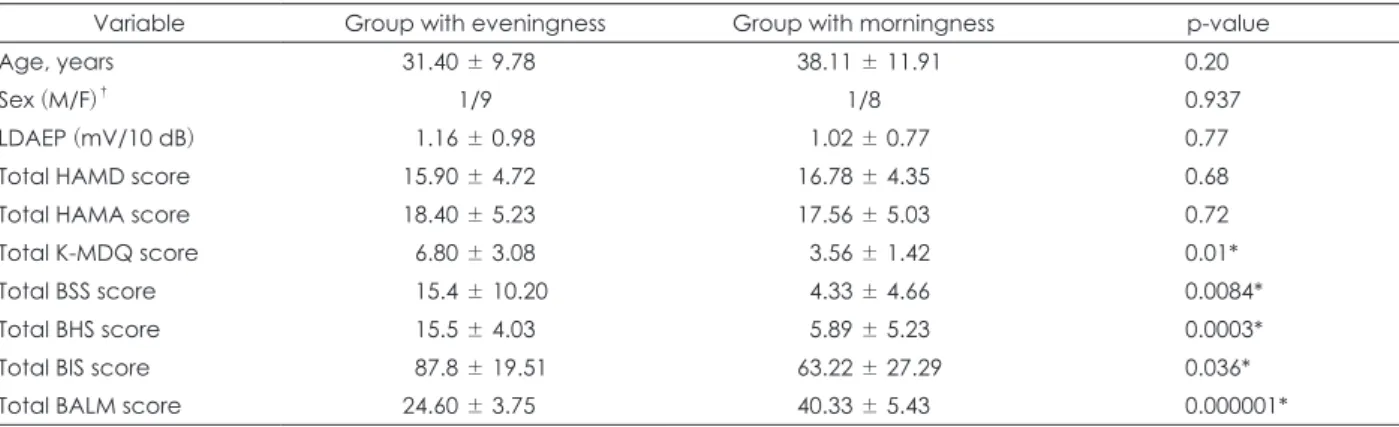
BALM 척도를 이용하여 환자들의 일주기 리듬의 성향을 조 사하였고 중간 값을 기준으로 하여 두 군으로 나누어 임상 양 상과 청각유발전위를 비교하였다(Table 1). BALM 총점이 높 은 군(아침형)과 낮은 군(저녁형) 사이에 몇 가지 척도에서 통 계적으로 유의한 차이를 보여 주었다. K-MDQ(p = 0.018), BSS (p = 0.009), BHS(p = 0.003), BIS(p = 0.03) 총점에서 두 군 간 의 유의한 차이가 있었다. 하지만 HAMD, HAMA의 총점과 LDAEP에서의 차이는 없었다.
K-MDQ 척도를 이용하여 양성을 보이는 환자와 음성을 보 이는 환자로 나누어 비교 분석하였다(Table 2). HAMA(p = 0.023), BSS(p = 0.02), BALM(p = 0.005) 총점에서 두 군 간의 유의한 차이가 있었다. 반면에 HAMD와 LDAEP에서의 차 이는 없었다.
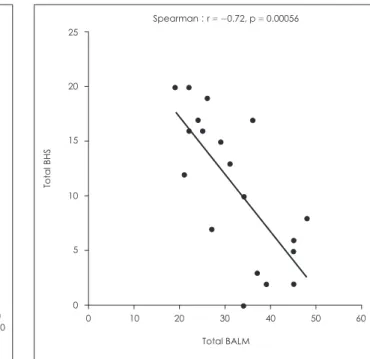
마지막으로 Spearman 상관 분석을 이용하여 변수 간의 상 관성을 분석하였다. 먼저 BALM 총점과 다른 변수의 총점과 의 상관성을 분석하였는데 그 중에서 K-MDQ(r = -0.64, p = 0.0033), BSS(r = -0.61, p = 0.0055), BHS(r = -0.72, p = 0.00056) 와 역의 상관 관계를 보였다(Fig. 1-3). 반면에 BALM 총점과 LDAEP를 포함한 다른 변수들과는 상관 관계가 없었다. 두 번째로 K-MDQ 총점과 다른 변수의 총점과의 상관성을 분석 하였다. 그 중에서 HAMA(r = 0.47, p = 0.04), BSS(r = 0.58, p = 0.009), BHS(r = 0.52, p = 0.022)와 양의 상관 관계를 보 였다. 반면에 다른 변수들과는 상관성을 보이지 않았다.
고 찰
본 연구는 주요우울증 환자에서 일주기 형태에 따른 임상 양상과 LDAEP 수치를 이용하여 청각유발전위의 차이를 비 교하려고 하였다. 분석 결과 일주기 리듬이 저녁형의 양상을 보 이는 환자일수록 K-MDQ가 유의하게 높았으며 이는 저녁형 의 양상이 양극성 경향과 관련이 있음을 의미한다. 이전 연구 에서도 이미 양극성 장애와 지연 수면 양상이 관련이 있음을 보고하였지만,7)8) 본 연구에서처럼 지연된 수면 양상, 즉 저녁형 에 가까운 주요우울증 환자들이 더 강한 양극성 경향이 있음 을 확인한 연구는 없었다. 이런 결과는 기존의 단극성 우울증 과 양극성 우울증을 이분법으로 보는 현 진단 체계보다는 기 분 장애를 하나의 범주로 보아 단극성 우울증과 양극성 우울 증 사이에 겹치는 부분이 존재하는 연속성의 개념으로 볼 수 있는 근거 중 하나가 될 수 있겠다.31) 하지만 본 연구 결과와 대
조되는 연구 결과도 존재한다. 1형 양극성 장애, 2형 양극성 장 애, 재발성 우울 장애 환자들을 대상으로 일주기 형태를 비교 하였는데 2형 양극성 장애 환자들이 1형 양극성 장애 환자들 보다 더 강한 저녁형 일주기 양상을 보였으며 1형 양극성 장애 환자들은 재발성 우울 장애 환자들보다 더 강한 아침형 일주 기 양상을 보였다.32) 따라서 양극성이 강할수록 더 강한 저녁 형 일주기 형태를 갖는다는 가설은 향후 더 많은 연구로 검증 되어야 할 것이다.
본 연구의 결과 중 또 하나의 임상적으로 의미 있는 결과는 저녁형 양상을 보이는 환자들이 아침형 양상을 보이는 환자들 에 비해 자살 사고와 관련된 BSS, 무망감을 나타내는 BHS, 충동성을 나타내는 BIS가 유의미하게 증가되어 있었던 반면, HAMD에서는 유의한 차이가 없었다는 점이다. 이는 저녁형 혹은 지연성 수면 양상을 보이는 환자들에 있어서는 아침형과 유사한 우울증 심각도를 보이더라도 저녁형에서 자살 위험성 Table 1. Age, sex, LDAEP, and psychometric ratings of patients with major depression according to chronotype (morningness or eve- ningness)
Variable Group with eveningness Group with morningness p-value
Age, years 31.40 ± 9.78 38.11 ± 11.91 0.20
Sex (M/F)† 1/9 1/8 0.937
LDAEP (mV/10 dB) 1.16 ± 0.98 1.02 ± 0.77 0.77
Total HAMD score 15.90 ± 4.72 16.78 ± 4.35 0.68
Total HAMA score 18.40 ± 5.23 17.56 ± 5.03 0.72
Total K-MDQ score 6.80 ± 3.08 3.56 ± 1.42 0.01*
Total BSS score 15.4 ± 10.20 4.33 ± 4.66 0.0084*
Total BHS score 15.5 ± 4.03 5.89 ± 5.23 0.0003*
Total BIS score 87.8 ± 19.51 63.22 ± 27.29 0.036*
Total BALM score 24.60 ± 3.75 40.33 ± 5.43 0.000001*
Data were expressed as mean ± SD values or frequencies. * : statistically significant difference at p < 0.05, † : Fisher's exact test.
LDAEP : Loudness Dependence of Auditory Evoked Potentials, HAMD : Hamilton Depression Rating Scale, HAMA : Hamilton Anxiety Scale, K-MDQ : Korean Mood Disorder Questionnaire, BSS : Beck Scale for Suicidal Ideation, BHS : Beck Hopelessness Scale, BIS : Bar- ratt Impulsiveness Scale, BALM : Basic Language Morningness
Table 2. Age, sex, LDAEP, and psychometric ratings of patients with major depression according to bipolarity
Variable Bipolarity (-)(n = 14) Bipolarity (+)(n = 5) p-value
Age, years 36.71 ± 11.29 28.60 ± 8.79 0.17
Sex (M/F)† 1/13 1/4 0.468
LDAEP (mV/10 dB) 1.23 ± 0.86 0.72 ± 1.44 0.31
Total HAMD score 15.79 ± 4.78 17.80 ± 5.12 0.40
Total HAMA score 16.57 ± 4.78 22.00 ± 3.39 0.033*
Total K-MDQ score 3.79 ± 1.42 9.40 ± 1.52 0.0000009*
Total BSS score 6.50 ± 5.88 20.40 ± 11.50 0.0026*
Total BHS score 9.07 ± 6.70 16.20 ± 2.86 0.036*
Total BIS score 70.36 ± 26.35 92.40 ± 18.93 0.11
Total BALM score 35.36 ± 8.52 22.8 ± 1.64 0.0051*
Data were expressed as mean ± SD values or frequencies. * : statistically significant difference at p < 0.05, † : Fisher's exact test.
LDAEP : Loudness Dependence of Auditory Evoked Potentials, HAMD : Hamilton Depression Rating Scale, HAMA : Hamilton Anxiety Scale, K-MDQ : Korean Mood Disorder Questionnaire, BSS : Beck Scale for Suicidal Ideation, BHS : Beck Hopelessness Scale, BIS : Bar- ratt Impulsiveness Scale, BALM : Basic Language Morningness
이 더 높을 수 있음을 시사한다. 한편 두 군 간의 LDAEP의 차 이는 없었는데 이는 두 군 간의 세로토닌 활성도의 차이는 없 었음을 의미하며 일주기 형태의 차이가 세로토닌 활성도에 크 게 영향을 받지 않음을 의미한다. 이는 세로토닌 수송체의 유 전자형에 따라 일주기 형태가 영향을 받지 않는다는 이전의 연 구33)와 유사한 의미로 보인다.
K-MDQ를 이용하여 양성과 음성의 두 군으로 나누어 임상
척도와 LDAEP를 비교하였다. 양극성 경향을 보이는 환자들 이 그렇지 않은 환자들에 비해 자살 사고와 관련된 BSS, 무망 감을 나타내는 BHS, 불안의 정도를 나타내는 HAMA가 유의 미하게 증가되어 있고 BALM은 유의하게 감소되어 있는 반면 HAMD에서는 유의한 차이가 없었다. 이 역시 양극성 경향이 높은 환자일수록 자살에 더 취약함을 의미하며 유사한 우울 증 심각도를 보일 때는 양극성 경향이 있는 환자에서 그렇지 않은 환자에 비해 더 자살 위험성이 높음을 시사한다. 이는 이 전 연구와도 일치되는 소견이다.34)
상관 분석에서도 앞의 결과와 유사한 결과들이 이어졌다. BA- LM 점수와 K-MDQ, BSS, BHS와 역의 상관 관계를 보였다.
이는 저녁형에 가까울수록 양극성 경향, 자살 사고, 무망감 등 이 증가함을 의미한다. K-MDQ 점수 역시 HAMA, BSS, BHS 와 양의 상관 관계를 보였다. 이 또한 양극성 경향이 강하면 강 할수록 불안, 자살 사고, 무망감 등이 증가함을 의미한다. LDA- EP는 BALM과 K-MDQ 모두에서 상관 관계가 없었다. 이는 세로토닌 활성도가 일주기 리듬과 양극성 경향에 영향을 주 지 못함을 의미한다. 이 또한 이전의 연구와 일치하는 결과이
다.33)35) 하지만 이에 대해서는 상반되는 연구도 있기 때문에 후
속 연구가 필요할 것으로 보인다.14)
본 연구는 몇 가지 제한점이 존재한다. 첫 번째로 표본 크기 가 작았다는 점이다. 하지만 본 연구는 처음 시도되는 것으로 예비적인 연구의 성격을 지니고 있다. 향후 대규모 환자를 대 상으로 추가 후속 연구를 진행할 것이다. 두 번째로 K-MDQ 는 질문 1만 합산해서 양극성 성향을 판단하므로 본래 개발
12
10
8
6
4
2
0
Total K-MDQ
0 10 20 30 40 50 60 Total BALM
Spearman : r = -0.64, p = 0.0033
Fig. 1. Correlation between Basic Language Morningness (BA- LM) and Korean Mood Disorder Questionnaire (K-MDQ) score.
40
30
20
10
0
Total BSS
0 10 20 30 40 50 60 Total BALM
Spearman : r = -0.61, p = 0.0055
Fig. 2. Correlation between Basic Language Morningness (BA- LM) and Beck Scale for Suicidal Ideation (BSS) score.
25
20
15
10
5
0
Total BHS
0 10 20 30 40 50 60 Total BALM
Spearman : r = -0.72, p = 0.00056
Fig. 3. Correlation between Basic Language Morningness (BA- LM) and Beck Hopelessness Scale (BHS) score
된 MDQ와는 약간 차이가 있다는 것이다. 하지만 K-MDQ의 표준화를 통해 민감도와 특이도를 최적화한 것이므로 이 자 체도 의미가 있다 하겠다.26)
향후에 표본 크기를 늘려서 일주기 양상과 세로토닌, 그리 고 자살과의 관련성을 규명하기 위한 연구가 계속 되어야 할 것이다. 또한 양극성 경향을 잘 구분하기 위한 도구들을 더 다 양하게 준비하고 고민해야 할 것으로 보인다. 일주기 리듬과 평가와 관련되어서도 더 다양한 척도에 대한 검토가 필요할 것이며 국내 표준화가 우선 필요할 것으로 보인다. 또한 저녁 형, 아침형을 더 정확하게 분석하기 위해 피험자의 수면-각성 주기의 확인이 필요할 것으로 판단된다. 그밖에 일주기뿐만 아니라 계절성의 평가도 피험자의 주기 및 양극성 경향을 규 명하는 데 중요할 것이다.
중심 단어:일주기 형태·청각유발전위·주요우울증·양극성·
양극성 스펙트럼 장애.
Acknowledgments
This study was supported by a grant from National Research Foundation of Korea (NRF), funded by Ministry of Education and Science Technology (MEST)(2011-0010562). The authors would like to thank Lee Yoo Jin for her assistance with data collection.
Conflicts of interest
The authors have no financial conflicts of interest.
REFERENCES
1) Manning JS. Difficult-to-treat depressions: a primary care perspec- tive. J Clin Psychiatry 2003;64 Suppl 1:24-31.
2) Ghaemi SN, Ko JY, Goodwin FK. “Cade’s disease” and beyond: mis- diagnosis, antidepressant use, and a proposed definition for bipolar spectrum disorder. Can J Psychiatry 2002;47:125-134.
3) Merikanto I, Lahti T, Kronholm E, Peltonen M, Laatikainen T, Var- tiainen E, et al. Evening types are prone to depression. Chronobiol Int 2013;30:719-725.
4) Reid KJ, Jaksa AA, Eisengart JB, Baron KG, Lu B, Kane P, et al. Sys- tematic evaluation of Axis-I DSM diagnoses in delayed sleep phase disorder and evening-type circadian preference. Sleep Med 2012;13:
1171-1177.
5) Abe T, Inoue Y, Komada Y, Nakamura M, Asaoka S, Kanno M, et al.
Relation between morningness-eveningness score and depressive symptoms among patients with delayed sleep phase syndrome. Sleep Med 2011;12:680-684.
6) Selvi Y, Aydin A, Boysan M, Atli A, Agargun MY, Besiroglu L. Asso- ciations between chronotype, sleep quality, suicidality, and depres- sive symptoms in patients with major depression and healthy con- trols. Chronobiol Int 2010;27:1813-1828.
7) Ahn YM, Chang J, Joo YH, Kim SC, Lee KY, Kim YS. Chronotype distribution in bipolar I disorder and schizophrenia in a Korean sam- ple. Bipolar Disord 2008;10:271-275.
8) Robillard R, Naismith SL, Rogers NL, Ip TK, Hermens DF, Scott EM, et al. Delayed sleep phase in young people with unipolar or bipolar affective disorders. J Affect Disord 2013;145:260-263.
9) Lee HJ, Rex KM, Nievergelt CM, Kelsoe JR, Kripke DF. Delayed sleep phase syndrome is related to seasonal affective disorder. J Af-
fect Disord 2011;133:573-579.
10) Choi J, Baek JH, Noh J, Kim JS, Choi JS, Ha K, et al. Association of seasonality and premenstrual symptoms in bipolar I and bipolar II disorders. J Affect Disord 2011;129:313-316.
11) Kim DR, Czarkowski KA, Epperson CN. The relationship between bipolar disorder, seasonality, and premenstrual symptoms. Curr Psy- chiatry Rep 2011;13:500-503.
12) Imeri L, Mancia M, Bianchi S, Opp MR. 5-Hydroxytryptophan, but not L-tryptophan, alters sleep and brain temperature in rats. Neuro- science 2000;95:445-452.
13) Monti JM. Serotonin control of sleep-wake behavior. Sleep Med Rev 2011;15:269-281.
14) Ojeda DA, Perea CS, Suárez A, Niño CL, Gutiérrez RM, LÓpez-LeÓn S, et al. Common functional polymorphisms in SLC6A4 and COMT genes are associated with circadian phenotypes in a South Ameri- can sample. Neurol Sci 2014;35:41-47.
15) Hegerl U, Juckel G. Intensity dependence of auditory evoked poten- tials as an indicator of central serotonergic neurotransmission: a new hypothesis. Biol Psychiatry 1993;33:173-187.
16) Juckel G, Molnár M, Hegerl U, Csépe V, Karmos G. Auditory-evoked potentials as indicator of brain serotonergic activity--first evidence in behaving cats. Biol Psychiatry 1997;41:1181-1195.
17) Park YM, Lee SH, Kim S, Bae SM. The loudness dependence of the auditory evoked potential (LDAEP) in schizophrenia, bipolar disor- der, major depressive disorder, anxiety disorder, and healthy controls.
Prog Neuropsychopharmacol Biol Psychiatry 2010;34:313-316.
18) Gudlowski Y, Ozgürdal S, Witthaus H, Gallinat J, Hauser M, Win- ter C, et al. Serotonergic dysfunction in the prodromal, first-episode and chronic course of schizophrenia as assessed by the loudness de- pendence of auditory evoked activity. Schizophr Res 2009;109:141- 19) Park YM, Kim DW, Kim S, Im CH, Lee SH. The loudness dependence 147.
of the auditory evoked potential (LDAEP) as a predictor of the re- sponse to escitalopram in patients with generalized anxiety disorder.
Psychopharmacology (Berl) 2011;213:625-632.
20) Kim DH, Park YM. The association between suicidality and seroto- nergic dysfunction in depressed patients. J Affect Disord 2013;148:
72-76.
21) Park YM, Lee SH, Lee HJ, Kang SG, Min JA, Chae JH. Association between BDNF gene polymorphisms and serotonergic activity us- ing loudness dependence of auditory evoked potentials in healthy subjects. PLoS One 2013;8:e60340.
22) Hamilton M. A rating scale for depression. J Neurol Neurosurg Psy- chiatry 1960;23:56-62.
23) Beck AT, Weissman A, Lester D, Trexler L. The measurement of pes- simism: the hopelessness scale. J Consult Clin Psychol 1974;42:861- 24) Patton JH, Stanford MS, Barratt ES. Factor structure of the Barratt 865.
impulsiveness scale. J Clin Psychol 1995;51:768-774.
25) Beck AT, Kovacs M, Weissman A. Assessment of suicidal intention:
the Scale for Suicide Ideation. J Consult Clin Psychol 1979;47:343- 26) Jon DI, Hong N, Yoon BH, Jung HY, Ha K, Shin YC, et al. Validity 352.
and reliability of the Korean version of the Mood Disorder Question- naire. Compr Psychiatry 2009;50:286-291.
27) Hirschfeld RM, Holzer C, Calabrese JR, Weissman M, Reed M, Da- vies M, et al. Validity of the mood disorder questionnaire: a general population study. Am J Psychiatry 2003;160:178-180.
28) Miller CJ, Klugman J, Berv DA, Rosenquist KJ, Ghaemi SN. Sensi- tivity and specificity of the Mood Disorder Questionnaire for detect- ing bipolar disorder. J Affect Disord 2004;81:167-171.
29) Brown FM. Psychometric equivalence of an improved Basic Lan- guage Morningness (BALM) scale using industrial population with- in comparisons. Ergonomics 1993;36:191-197.
30) Semlitsch HV, Anderer P, Schuster P, Presslich O. A solution for re- liable and valid reduction of ocular artifacts, applied to the P300 ERP.
Psychophysiology 1986;23:695-703.
31) Cardoso de Almeida JR, Phillips ML. Distinguishing between uni- polar depression and bipolar depression: current and future clinical and neuroimaging perspectives. Biol Psychiatry 2013;73:111-118.
32) Chung JK, Lee KY, Kim SH, Kim EJ, Jeong SH, Jung HY, et al. Circa- dian Rhythm Characteristics in Mood Disorders: Comparison among Bipolar I Disorder, Bipolar II Disorder and Recurrent Major Depres- sive Disorder. Clin Psychopharmacol Neurosci 2012;10:110-116.
33) Barclay NL, Eley TC, Mill J, Wong CC, Zavos HM, Archer SN, et al.
Sleep quality and diurnal preference in a sample of young adults: as- sociations with 5HTTLPR, PER3, and CLOCK 3111. Am J Med Genet B Neuropsychiatr Genet 2011;156B:681-690.
34) Manchia M, Hajek T, O’Donovan C, Deiana V, Chillotti C, Ruzicko- va M, et al. Genetic risk of suicidal behavior in bipolar spectrum dis- order: analysis of 737 pedigrees. Bipolar Disord 2013;15:496-506.
35) Park YM, Lee SH. Can the Loudness Dependence of Auditory Evoked Potentials and Suicidality Be Used to Differentiate between Depres- sive Patients with and without Bipolarity. Psychiatry Investig 2013;10:
143-147.