KISEP Case Report 생물 정신의 학 Vol. 13, No. 1, February 2006
치매가 동반된 특발성 기저핵 석회화 1례
신 희 영1)·신 일 선1)2)3)†
A Case of Idiopathic Basal Ganglia Calcification with Dementia
Hee-Young Shin, M.D., Ph.D.,1) Il-Seon Shin, M.D., Ph.D.1)2)3)†
he case of a 66- year-old woman with coexisting idiopathic basal ganglia calcification(IBGC) and de- mentia was presented. The calcification was detected in bilateral basal ganglia, dentate nucleus, and thalamus by brain imaging. Serum calcium and phosphorus levels were normal. The underlying diseases of calcification of basal ganglia such as parathyroid dysfunction and other infectious, toxic, or metabolic illness were excluded. The patient had memory impairment and frontal executive dysfunction without aphasia, agnosia, apraxia, and visuospatial impairment in neuropsychological test. It suggested that the cognitive impairment might be due to the dysfunction of frontal-subcortical circuit.
KEY WORDS:Basal ganglia·Calcification·Dementia·Neuropsychiatric symptom.
서 론
특발성 기저핵 석회화(idiopathic basal ganglia cal-
cification, 이하 IBGC)는 Fahr 증후군이라고 알려진 드 문 신경학적 질환이다. IBGC는 기저핵 등의 운동조절에 관여하는 뇌 부위에 칼슘이 비정상적으로 침착되어, 운 동장애와 신경정신과적 증상을 보인다.1) 소아 또는 청 소년기에 발병할 수 있지만, 30~60대에 주로 발병한 다.2) IBGC에 대한 효과적인 치료는 아직 없는 실정이다.2)
IBGC는 운동장애와 더불어 점진적인 인지기능 저하 를 초래할 수 있다. 치매는 IBGC의 경과 중 늦게 나타나 며, 집중력, 최근 기억, 계산 및 추상적 사고능력의 장애, 구음장애(dysarthria), 동어반복증(palilalia) 등을 보일 수 있다.3) 인지기능 저하가 동반된 IBGC 증례가 외국에 서는 여러 차례 보고되었지만,3-6) 국내에서는 아직 보고 된 바 없다. 저자들은 기억력 저하를 호소하는 IBGC 환 자를 경험하였기에 증례보고와 함께 이와 관련된 문헌을 고찰하고자 하였다.
T
ABSTRACT
1)전남대학교병원 임상시험센터
Clinical Trial Center, Chonnam National University Hos- ipital, Kwangju, Korea
2)전남대학교 의과대학 정신과학교실
Department of Psychiatry, Chonnam National University Me- dical School, Gwangju, Korea
3)화순전남대학교병원 정신과
Department of Psychiatry, Hwasun Chonnam National University Hospital, Hwasun, Korea
†교신저자:신일선, 501-746 광주광역시 동구 학동 5
†교신저자:전남대학교 의과대학 정신과학교실
†교신저자:전화) (061) 379-7762, 전송) (062) 225-2351
†교신저자:E-mail) [email protected]
증 례
환자는 66세 여자이며, 서서히 진행되는 기억력 저하 를 주소로 치매 평가를 위해 아들과 함께 2004년 11월 본원 정신과를 방문하였다.
환자는 무학으로 온화하고 내성적인 성격이었다고 하 며, 젊어서 남편을 사별하였고 현재는 큰 아들과 함께 살 고 있었다. 과거력상 환자는 약 10년 전에 안면마비가 있 었다가 회복되었다고 하며, 내원 당시 당뇨병, 고혈압 및 천식으로 약물복용 중이었다. 정신과적 과거력이나 치매 가족력은 없었다고 하였다.
아들의 보고에 의하면 환자는 내원 1~2년 전부터 물건 을 두고 잘 찾지 못하고, 가스불을 켜놓고 잊는 등의 기억 력 저하가 점차 심해진다고 하였다. 최근에는 아파트 문 을 잠그지 않은 채 열고 다니고, 당뇨가 있는데도 음식조 절을 하지 않고 많이 드시고, 빨래를 구분하지 않고 삶는 등의 변화가 나타났다고 한다. 또한 전에 비해 적적하고 외로워하였고, 활동이 줄어 주로 집에 혼자 지내면서 하 루 종일 TV만 본다고 하였다.
정신상태 검사상 협조적이었으나, 피곤해 보였고 묻는 말에 자신없는 태도를 보였다. 의식상태는 명료하였으나 집중력, 시간 지남력, 집중력 및 단기 기억력이 저하되어 있었다. 두드러진 사고나 지각장애는 보이지 않았고, 약간
우울한 기분이었다. 이학적 검사상 특이소견은 없었으며, 신경학적 검사상 운동장애 등의 이상소견은 발견되지 않 았다.
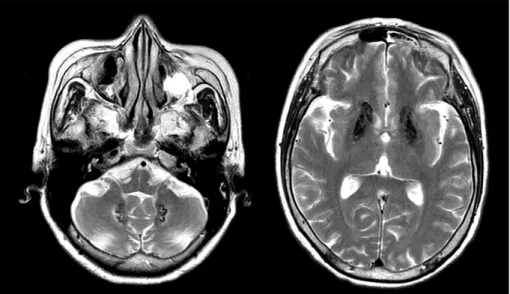
검사소견상 흉부 X선 검사, 심전도 및 갑상선기능검사 는 정상이었고, 일반 혈액검사, 간기능검사, 매독검사는 정 상 범위였다. 당뇨로 인한 혈당증가(209), 소변당(1+)이 있었고, 혈청 BUN, 마그네슘이 정상범위보다 약간 높았 다. ApoE 유전자형은 ε2/ε3였고, 비타민 B12, 엽산, homocysteine은 정상범위였다. 뇌자기공명 T2 강조영 상에서 양측 기저핵, 치아핵(dentate nucleus), 시상(tha- lamus) 부위에 다발성으로 광범위한 저강도 병변, 전반 적 대뇌와 소뇌 위축을 보였다(그림 1). 뇌자기공명영상 소견상 과석회증(hypercalcinosis), 가성부갑상선기능 저하증(pseudohypoparathyroidism) 또는 독성물질 침 착 등이 의심되어 정확한 진단적 평가를 위해 내분비대사 내과에 의뢰하였다. 진단적 평가를 위해 시행된 뇌전산화 단층촬영상 양측 기저핵, 치아핵, 시상 부위에 다발성으 로 광범위하게 낮은 감약(low attenuated) 병변이 있었 다(그림 2). 혈청 칼슘과 인(phosphorus)은 정상범위로 부갑상선기능저하증(hypoparathyroidism)과 가성부갑 상선기능저하증 등의 부갑상선기능 이상은 배제되었다.
인지기능검사상 한국형 간이정신상태검사(Korean ver- sion of mini-mental sate examination)가 14점이었 고, 집중력, 언어기능, 비언어적 기억력 및 시공간 능력은
Fig. 1. T2-weighted brain magnetic image showing multifocal diffuse low signal intensity lesions in bilateral basal ganglia, dentate nucleus, and thalamus.
비교적 적절하게 유지되었다. 그러나 언어적 자극에 대 한 정보의 회상 특히 재인과정에서는 심각한 기억결함을 보였으며, 전두엽의 집행기능을 평가하는 contrasting program, Go-No-Go 검사, fist-edge-palm 검사에서 도 심각한 결함을 보였다. 기본적 일상생활을 수행하는데 장애는 없었지만, 도구적 일상생활을 수행하는데 몇 가지 장애를 보였다. 한국형 노인우울검사(geriatric depres- sion scale)상 22점으로 우울증상을 보고하였다.
상기 검사결과를 종합할 때, 본 증례는 IBGC으로 인한 피질하(sucortical) 치매로 진단할 수 있었다. 환자와 보 호자에게 고혈압, 당뇨 등의 혈관성 위험요인에 대한 지 속적인 치료와 함께 일반적인 치매 관리에 대해서도 교 육하였다. IBGC에 대한 효과적인 치료방법이 없었기 때 문에 비타민 E와 tanamine을 처방하였으나, 환자는 외래 방문을 중단하였다.
고 찰
본 증례는 양측 뇌 기저핵 석회화와 함께 치매가 동반된 경우이다. 뇌전산화단층촬영상 기저핵 석회화가 약 0.3~
12.5%에서 흔하게 발견되지만, 대부분의 석회화는 임상 증상과 연관성이 없다고 보고되었다.7-9) 반면에 IBGC는 다양한 운동장애나 신경정신과적 증상이 동반된다.3)10) IBGC는 상염색체 우성으로 유전되는 경향이 있지만, 산발
적으로 발병될 수 있다.2)4) 유전되는 경우 염색체 14q와 의 연관성이 보고되었다.1) 본 증례는 가족력이 없이 발병 한 IBGC이다.
IBGC의 진단을 위해서는 양측 기저핵의 비정상적 석회 화 소견이 있어야 한다.4) IBGC에서 보이는 석회화는 기 저핵의 담창구(globus pallidus)에서 가장 흔하며 치아 핵, 시상, 대뇌 백색질(cerebral white matter), 소뇌, 속 섬유망(internal capsule) 등에서도 보일 수 있다.1)3) 대 부분의 비정상적인 기저핵 석회화의 원인은 부갑상선기 능 이상 [부갑상선기능저하증, 가성부갑상선기능저하증, 가성가성부갑상선기능저하증(pseudopseudohypothy- roidism), 부갑상선기능항진증(hyperparathyroidism)]
이다.2)3) 그 외의 원인으로는 선천성 및 조기발병 유전
장애[Cockayne 증후군, 결정경화증(tuberous sclerosis), 유전조로증양(progeria-like) 증후군, Kearns-Sayre 증후군], 염증 및 감염상태[후천성면역결핍증(acquired immunodeficiency syndrome), 세포거대봉입체병(cy- tomegalic inclusion disease), 뇌염(encephalitis), 톡 소포자충증(toxoplamosis)], 독성 및 무산소(anoxic)장 애[일산화탄소중독, 납중독, 출생 무산소증, 방사선 치료, methotrexate 치료], 사립체병증(mitochondriopathy) 등이 있다.2)3)11) IBGC에서 보이는 석회화에 대한 많은 병리적 생화화적 연구에도 불구하고 이에 대한 원인은 아 직 밝혀지지 않았다.12)13) 진단을 위해서는 비정상적 석회 Fig. 2. Brain computed tomography showing multifocal diffuse low attenuated lesions in bilateral basal ganglia,
dentate nucleus, and thalamus.
화의 알려진 원인질환이 배제되어야 한다. 본 증례에서도 뇌석회화가 기저핵 뿐만 아니라 치아핵, 시상 부위에서 광 범위하게 발견되었다. 검사상 혈청 칼슘과 인은 정상범 위로 부갑상선기능저하증과 가성부갑상선기능저하증 등의 부갑상선기능 이상이 배제되었다. 기저핵의 비정상적 석회 화를 초래할 수 있는 다른 기저 원인들을 검사상 또는 임상적으로 배제하여 IBGC로 진단하였다.
IBGC는 운동장애나 신경정신과적 증상을 보이며, 임 상증상은 중추신경계통에 국한되어 나타난다. 핵심 증상 은 운동장애로 구음장애, 추체외로 징후 및 운동실조 등
이다.14)15) 그 외 근육긴장이상(dystonia), 무정위운동
(athetosis), 무도병(chorea), 운동이상증(dyskinesia) 등의 다양한 증상이 나타날 수 있다.2)16)17) 신경정신과 적 증상으로 정신증, 성격변화, 조울증, 우울증, 강박장애 및 치매 등이 보고되었다.10)18-20) 정신증의 경우 환청, 피 해망상, 관계망상 등의 정신증상이 보고되었다.15)21-23) 치매의 경우 기억력 저하, 실행기능 저하 및 인지과정의 완만함이 보고된 반면, 언어상실증(aphasia), 인식불능증 (agnosia) 및 실행증(apraxia) 등은 보고되지 않았다.3)6)20) 이와 같은 인지기능장애는 헌팅턴병이나 파킨슨병에서와 유사하였다. PET상 양측 기저핵 석회화 병변 환자들에 서 전전두엽(prefrontal cortex)의 대사 저하가 보고되 었다.10) 이는 해마(hippocampus) 등의 내측 측두엽의 이상보다는 피질하의 기능 이상으로 인한 전두엽-피질 하 회로의 장애를 시사한다. 본 증례의 경우 운동장애는 보이지 않았지만, 경도의 우울증과 함께 치매 증상을 보 였다. 인지기능검사상 기억력 장애와 전두엽 집행기능의 현저한 장애를 보였다. 신경영상검사상 양측 기저핵 등의 피질하 부위의 광범위한 석회화 병변을 보였지만, 해마를 포함한 내측 측두엽의 위축이나 다른 병변은 관찰되지 않 았다. 따라서 본 증례를 IBGC으로 인한 피질하 치매로 진단할 수 있겠다.
치매는 다양한 뇌질환으로 인해 발생될 수 있으므로 원 인적 평가를 위해서는 신경영상검사가 필요하다. 신경영 상검사는 특히 치매의 조기발병, 비전형적인 임상양상 및 인지기능의 최근 또는 급격한 악화 등을 보일 때 시행되 어야 한다. 또한 뇌종양, 경막하 출혈 및 수두증 등과 같 은 치료 가능한 원인질환을 배제하기 위해서도 신경영상 검사가 중요하다.24)25) 본 증례에서는 신경영상검사를 통 해 치매의 드문 원인질환인 IBGC을 발견할 수 있었다.
신경영상검사를 시행하지 않았다면 다른 유형의 치매로
오진하여 불필요한 치료를 시행했을 가능성이 있었다.
저자들은 본 증례를 통하여 IBGC의 진단과 함께 동반 될 수 있는 신경정신과적 증상에 대해 살펴보았다.
중심 단어:기저핵·석회화·치매·신경정신과적 증상.
참 고 문 헌
1. Geschwind DH, Loginov M, Stern JM. Identification of a locus on chromosome 14q for idiopathic basal ganglia calcification (Fahr disease). Am J Hum Genet 1999;65:
764-772.
2. Manyam BV. What is and what is not ‘Fahr’s disease’.
Parkinsonism Relat Disord 2005;11:73-80.
3. Cummings JL, Gosenfeld LF, Houlihan JP, McCaffrey T. Neuropsychiatric disturbances associated with idiopa- thic calcification of the basal ganglia Biol Psychiatry 1983;18:591-601.
4. Moscowitz MA, Winickoff RN, Heinz ER, Familial cal- cification of the basal ganglions. A metabolic and genetic study. N Engl J Med 1971;285:72-77.
5. Konig P. Psychopathological alterations in cases of sym- metrical basal ganglia sclerosis. Biol Psychiatry 1989;25:
459-468.
6. Avrahami E, Cohn DF, Feibel M, Tadmor R. MRI de- monstration and CT correlation of the brain in patients with idiopathic intracerebral calcification. J Neurol 1994;
241:381-384.
7. Koller WC, Cochran JW, Klawans HL. Calcification of the basal ganglia: computerized tomography and clinical correlation. Neurology 1979;29:328-333.
8. Sanchetee P, Venkataraman S, Mohan C, Shetty DD, Iyengar G. Basal ganglia calcification. J Assoc Physi- cians India 1999;47:507-509.
9. Gomille T, Meyer RA, Falkai P, Gaebel W, Konigsh- ausen T, Christ F. Prevalence and clinical significance of computerized tomography verified idiopathic calcinosis of the basal ganglia. Radiology 2001;41:205-210.
10. Laplane D, Levasseur M, Pillon B, Dubois B, Baulac M, Mazoyer B, et al. Obsessive-compulsive and other behavioral changes with bilateral basal ganglia lesions.
A neuropsychological, magnetic resonance imaging and positron tomography study. Brain 1989;112:699-725.
11. Finsterer J, Kopsa W. Basal Ganglia calcification in mitochondrial disorders. Metab Brain Dis 2005;20:219- 226.
12. Manyam BV, Bhatt MH, Moore WD, Devleschoward AB, Anderson DR, Calne DB. Bilateral striopallidodentate calcinosis: cerebrospinal fluid, imaging, and electrophy- siological studies. Ann Neurol 1992;31:379-384.
13. Kobari M, Nogawa S, Sugimoto Y, Fukuuchi Y. Fa- milial idiopathic brain calcification with autosomal do-
minant inheritance. Neurology 1997;48:645-649.
14. Lowenthal A. Striatopallidodentate calcifications. In:
Vinken P, Bruyn G, Klawans H, editors, Handbook of clinical neurology. Vol 49. Amsterdam: Elsevier Science Publkshers;1986. p.417-436.
15. Flint J, Goldstein LH. Familial calcification of the basal ganglia: a case report and review of the literature. Psychol Med 1992;22:581-595.
16. Larsen TA, Dunn HG, Jan JE, Calne DB. Dystonia and calcification of the basal ganglia. Neurology 1985;35:
533-537.
17. Chiu HF, Lam LC, Shum PP, Li KW. Idiopathic calci- fication of the basal ganglia. Postgrad Med J 1993;69:
68-70.
18. Trautner RJ, Cummings JL, Read SL, Benson DF.
Idiopathic basal ganglia calcification and organic mood disorder. Am J Psychiatry 1988;145:350-353.
19. Rosenberg DR, Neylan TC, el-Alwar M, Peters J, Van Kammen DP. Neuropsychiatric symptoms associated with idiopathic calcification of the basal ganglia. J Nerv
Ment Dis 1991;179:48-49.
20. Lopez-Villegas D, Kulisevsky J, Deus J, Junque C, Pujol J, Guardia E, et al. Neuropsychological altera- tions in patients with computed tomography-detected basal ganglia calcification. Arch Neurol 1996;53:251-256.
21. Francis A, Freeman H. Psychiatric abnormality and brain calcification over four generations. J Nerv Ment Dis 1984;172:166-170.
22. Chabot B, Roulland C, Dollfus S. Schizophrenia and familial idiopathic basal ganglia calcification: a case report. Psychol Med 2001;31:741-747.
23. Shakibai SV, Johnson JP, Bourgeois JA. Paranoid delu- sions and cognitive impairment suggesting Fahr’s disease.
Psychosomatics 2005;46:569-572.
24. Alexander EM, Wagner EH, Buchner DM, Cain KC, Larson EB. Do surgical brain lesions present as isolated dementia? A population-based study. J Am Geriatr Soc 1995;43:138-143.
25. Moseley I. Imaging the adult brain. J Neurol Neurosurg Psychiatry 1995;58:7-21.