655
"J. Korean Soc. Radiol., Vol. 11, No. 7, December 2017"
Image Reconstruction of Sinogram Restoration using Inpainting method in Sparse View CT
Daehong Kim,1 Cheol-Ha Baek2,3,4,*
1Department of Radiological Science, Eulji University
2Department of Radiological Science, Dongseo University
3Department of Health Science, Dongseo University
4Center for Radiological Environment & Health Science, Dongseo University
Received: November 28, 2017. Revised: December 25, 2017. Accepted: December 31, 2017
ABSTRACT
Sparse view CT has been widely used to reduce radiation dose to patient in radiation therapy. In this work, we performed sinogram restoration from sparse sampling data by using inpainting method for simulation and experiment. Sinogram restoration was performed in accordance with sampling angle and restoration method, and their results were validated with root mean square error (RMSE) and image profiles. Simulation and experiment are designed to fan beam scan for various projection angles. Sparse data in sinogram were restored by using linear interpolation and inpainting method. Then, the restored sinogram was reconstructed with filtered backprojection (FBP) algorithm. The results showed that RMSE and image profiles were depended on the projection angles and restoration method. Based on the simulation and experiment, we found that inpainting method could be improved for sinogram restoration in comparison to linear interpolation method for estimating RMSE and image profiles.
Keywords: Sparse view CT, Sinogram, Inpainting
Ⅰ. INTRODUCTION
A computed tomography (CT) has been developed to produce a three-dimensional model of the patient.[1,2] The merits of CT is fast scan speed and improvement of anatomical data, which has helped disease diagnosis and therapy. However, continuous X-ray scan and its rotation could induce increasing radiation dose to patient. The issue of radiation dose to the patient during procedures, such as CT examinations, has been investigated to reduce the radiation dose while maintaining image quality. Therefore, the efforts to reduce radiation dose and maintain image quality has been published.[1-4] Especially, image reconstruction methods have been developed via sparse view
projection data. The goal of using a sparse view CT is to reduce the radiation dose and maintain the images.
There are two categories in sparse view reconstruction method. One is iterative image reconstruction from few-view projections such as total variation (TV) minimization method and prior image-constrained sparse-view reconstruction algorithm (PICCS) method.[3,4] It has been extensively studied and developed. However, reconstruction time is long, which make difficulty to clinically apply the iterative reconstruction. The other is sinogram interpolation method in sparse sampling with filtered backprojection (FBP) reconstruction.[1,2,5] They include various types of interpolation methods such as linear, spline, and polynomial. A sinogram is a 2D image of a CT scan, where each column represents a single row in the
* Corresponding Author: Cheol-Ha Baek E-mail: [email protected] Tel: +82-51-320-2719 https://doi.org/10.7742/jksr.2017.11.7.655
projection image arranged in increasing angular order. Typically, the horizontal axis represents the angle of the X-ray detector and the vertical axis is the distance from the rotation center in the detector row.
The interpolation is performed based on propagation direction method and the boundary condition for defining missing columns in the sinogram.[6,7] These works dealt with image gradient and propagation along isophotes that is lines of equivalent intensity levels. Also, the method repeats the image update step to restore image until stop when update value is negligible. Thus, the sinogram interpolation methods have been introduced and developed in previous work. The challenge of sparse tomographic imaging is insufficient image quality caused by the inadequate number of projection images. Our efforts to achieve image restoration were focused on dependence of projection angles and restoration method.
Therefore, the purpose of this work was to validate sinogram restoration by using inpainting in sparse view CT.
Streak artifact is caused by missing data in sparse view projection. The missing data is restored by using inpainting method, and their results were compared to that by using linear interpolation for both simulation and experiment.
Ⅱ. MATERIAL AND METHODS
1. Inpainting Method
Inpainting is propagation of intensity along isophote according to smoothness.[8,9] The basic concept of inpainting is assuming that Ω is a small area to be inpainted and ∂Ω is its boundary. Since Ω is a small, the inpainting can be approximated by an isotropic diffusion process that propagates information from ∂Ω into Ω. The algorithm consists of initializing Ω by clearing its image intensity information and repeatedly convolving the region to be inpainted with a diffusion kernel.
2. Simulation and Experiment
We first simulated the sinogram restoration with Matlab (MathWorks, Ver. 2013, U.S.) by using linear interpolation and inpainting method. In simulation study, Shepp-Logan
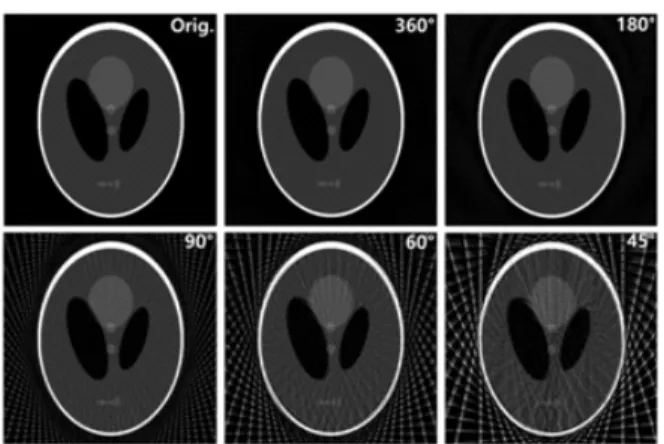
Fig. 1. Reconstructed image from various projection angles by using FBP. Image degradation such as streak artifact is obviously appeared at fewer projections due to the missing data.
phantom is generated and the phantom image matrix is 512×512. Fanbeam scan mode is used to obtain sinogram and source-to-isocenter distance is 720 mm. The projection angles are for 360°, 180°, 90°, 60°, and 45°, respectively.
Then, the sinogram is restored with linear interpolation and inpainting, and the image reconstruction was performed with FBP. We validated the reconstructed image of linear interpolation and inpainting method in according to projection numbers. The reconstructed images are compared by using image profile and root-mean square error (RMSE).
The RMSE is as following equation
×
(1)
where is original or reference image and is restored image by using linear interpolation or inpainting method. N is the number of image matrix.
After the simulation work, we applied inpainting method to patient image. The patient image is obtained from acquired CT image. We set the patient image from CT is the original image.
We performed that the patient image was re-projected for 360°, 180°, 90°, 60°, and 45°, respectively. Then, the sinogram restoration was performed by using linear interpolation and inpainting, and reconstruction was implemented by using FBP.
Finally, reconstructed image was validated with RMSE measurement.
"J. Korean Soc. Radiol., Vol. 11, No. 7, December 2017"
Fig. 2. Restored sinogram image by using linear interpolation and inpainting according to projection data acquisition degrees. Interpolation process was applied from 180° to 45°.
Fig. 3. Phantom images were reconstructed by using linear interpolation. Streak artifacts in the image were still appeared.
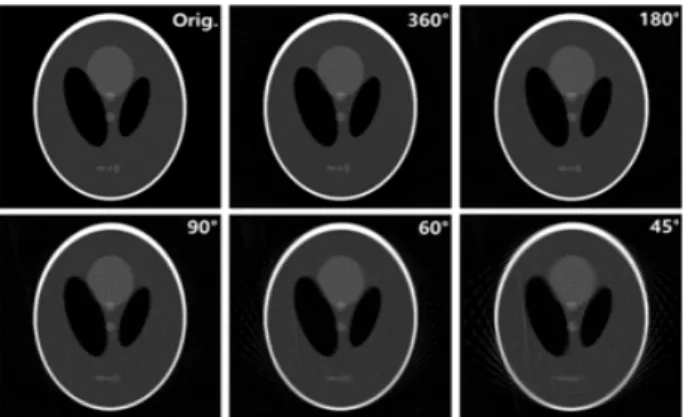
Fig. 4. Phantom images were reconstructed by using inpainting. Streak artifacts in the inpainting image were reduced in comparison to the image acquired with linear interpolation.
Ⅲ. RESULTS
Figure 1 is reconstructed image with FBP algorithm from various projection angles. Reconstructed images were degraded with streak artifact on the image due to the missing data. In figure 2, restored sinograms from missed data are displayed at various projection angles. Linear interpolation and inpainting were performed to restore missed projection data. However, sinogram of 360° projection angle is without interpolation.
Based on the restored sinogram, image reconstruction was performed with FBP algorithm.
Figure 3 is the phantom images reconstructed by using linear interpolation. Streak artifacts were appeared in the image with linear interpolation. The streak artifact increased as projection number decreased. In figure 4, axial images are reconstructed with FBP, and the streak artifacts were reduced in the phantom image in comparison to image in figure 3.
RMSE measurement was performed between original phantom image and reconstructed images. As shown in figure 5, RMSE values were decreased as projection number is increased on both linear interpolation and inpainting.
Fig. 5. RMSE measurement in reconstructed phantom image. Difference between original image and restored image is lower when inpainting method were performed.
Fig. 6. Image profiles to compare linear interpolation and inpainting. On both profile (a) and (b), profiles of inpainting image is closed to the original image.
Assuming the reconstructed image at 360° projection angles as a reference image, consistencies between reference image and restored image are dependent on projection angles and restoration method. RMSE of inpainting is lower than that of linear interpolation.
In figure 6, profile on the image is illustrated for 180° and 90° projection angles. Noise of inpainting image is decreased than that of linear interpolation image in figure (a) and (b). Therefore, inpainting image is closed to original image.
We used inpainting to verify the restoration effect in patient image. The images were reconstructed from 360° to 180° projection angles because fewer angles are degraded image quality such as increasing noise and streak artifact. In figure 7, linear interpolation and inpainting image were displayed.
Fig. 7. Patient images were reconstructed from linear interpolation and inpainting. Streak artifact was reduced in the image with inpainting.
Fig. 8. RMSE measurement in reconstructed patient image. RMSE values of inpainting image are lower than that of linear interpolation.
We assumed the patient’s pelvis image obtained from CT as original image, and the image is re-projected by using software that we want to acquire projection angles. The streak artifact were appeared in the image acquired with linear interpolation at 180°
projection angles. However, the streak artifact is reduced in inpainting image.
RMSE measurement was performed between linear interpolation and inpainting images in patient image.
As shown in figure 8, RMSE values were decreased as projection number is increased on both linear interpolation and inpainting image. RMSE values were dependent on projection angles and restoration method. RMSE of inpainting image is lower than that
"J. Korean Soc. Radiol., Vol. 11, No. 7, December 2017"
Ⅳ. DISCUSSION AND CONCLUSION In this study, the effects of inpainting method were demonstrated by simulation and experiment. Inpainting method outperformed than linear interpolation aspect of noise reduction and image restoration. This can be observed from the subjective image quality in figures 2-4 and 7. See also the profiles in figure 6. Linear interpolation is the simplest form of interpolation, connecting two data points with a straight line.
However, inpainting is considering gradient of boundary, isophotes, and smoothness. Therefore, the noise in restored image could be reduced.
Based on the results of restored sinogram in figure 2, missing data was filled by using linear interpolation and inpainting method. In the sinogram, restored image showed straight line as decreased sampling data. Especially, sinogram restored based on linear interpolation has more block shape between two data point. This phenomenon is considered that the sinogram is originated from sine shaping in accordance with projection view position. Therefore, the restored sinogram affect to reconstructed image with FBP algorithm, and it is cause to produce streak artifact in the reconstructed image. Figures 3 and 4 are the phantom images reconstructed by using linear interpolation and inpatinting. Streak artifacts were appeared in the restored image with linear interpolation. However, the streak artifact decreased when inpainting is applied. It is found that inpainting method is appropriate for sinogram restoration in comparison to linear interpolation method.
To estimate agreement with original phantom image, RMSE measurement was performed. As shown in figure 5, The trend of RMSE values were decreased as projection number is increased on both linear interpolation and inpainting. Restored image obtained with inpainting method is well agree with original image from 180° to 45°. Although consistencies between original image and restored
image are dependent on projection angles and restoration method, inpainting method is outperformed than linear interpolation.
Noise between linear interpolation and inpainting is evaluated by using image profiles. As shown in figure 6, noise of inpainting image is decreased than that of linear interpolation image in figure (a) and (b). It is thought that smoothness of inpainting affect to restored image. Finally, simulation results showed that inpainting method could be applied to data restoration sparse sinogram.
From the simulation results, we used inpainting to verify the restoration effect in patient image. The images were reconstructed from projection angles, but we showed reconstructed image from 360° to 45°
because fewer angles cause increasing noise and streak artifact. As shown in figure 7, the streak artifact is disappeared in inpainting image, while the streak artifact were appeared in the image acquired with linear interpolation at 180° projection angles. We found that inpainting method improved image quality in patient image. Also, RMSE was measured between linear interpolation and inpainting method in patient image as shown in figure 8. The trend of RMSE values were decreased as projection number is increased on both linear interpolation and inpainting image. RMSE of inpainting image is lower than that of linear interpolation image. It is mean that the original image are well matched to restored image when using inpainting method.
The present paper demonstrates that inpainting is a reliable method for image restoration for reducing radiation dose in CT examination. The image restoration is dependent on both projection angles and restoration method. Since the inpainting for sinogram restoration reduced streak artifact and improved image quality, the inpainting method could be adopted to reduce dose reduction while maintaining image quality in CT imaging.
Acknowledgement
This research was supported by the National Foundation of Korea(NRF) funded by the Ministry of Education, Science and Technology (2017R1C1B5018415).
Reference
[1] M. Kalke, S. Siltance, "Sinogram interpolation metho d for sparse-angle tomography", Applied Mathematics, Vol. 5, pp. 423-441, 2014.
[2] R. A. Brooks, G. H. Weiss, A. J. Talbert, "A new a pproach to interpolation in computed, J. Comput. Ass isted Tomography", Vol. 2, No. 5, pp. 577-585, 197 8.
[3] E. Y. Sidky, Y. Duchin, X. Pan, C. Ullberq, "A con strained, total-variation minimization algorithm for lo w-intensity x-ray CT", Medical. Physics. Vol. 38, pp.
117-125, 2011.
[4] H. Wang, A Kaestner, Y. Zou, Y. Lu, Z. Guo, "Spar se-view reconstruction of dynamic processes by neutr on tomography", Physics Procedia, Vol. 88, pp. 290-2 98, 2017.
[5] H. Zhang, M. Kruis, JJ. Sonke, "Directional sinogram interpolation for motion weighted 4D cone-beam CT reconstruction", Physics in Medicine & Biology, Vol.
62, No. 6, pp. 2254-2275, 2017.
[6] C. Zhe, B. Parker, D. Feng, "Temporal compression f or dynamic positron emission tomography via princip al component analysis in the sinogram domain," IEE E nuclear science symposium conference record, 200 3.
[7] H. Kostler, M. Prummer, U. Rude, J. Hornegger, "A daptive variational sinogram interpolation of sparsely sampled CT data", The 18thInternational conference o n Pattern recognition, 2006.
[8] A. Rosa, "Study and evaluation of text inpainting tec hniques for images and video", https://fenix.tecnico.uli sboa.pt/downloadFile/1126295043834175/ResumoAdelci oRosa.pdf
[9] M. Bertalmio et al., Image inpainting, 27th Conf. on Computer graphics and interactive techniques. USA, 2 000.
"J. Korean Soc. Radiol., Vol. 11, No. 7, December 2017"
Sparse view CT에서 inpainting 방법을 이용한 사이노그램 복원의 영상 재구성
김대홍,1 백철하2,3,4
1을지대학교 방사선학과
2동서대학교 보건의료계열 방사선학과
3동서대학교 일반대학원 보건과학과
4동서대학교 방사선보건환경센터
요 약
방사선 치료 전 환자 위치 확인을 위해 수행하는 콘빔 CT 촬영에서 환자 선량 감소를 위해 Sparse view CT가 사용되고 있다. 본 연구는 시뮬레이션과 실험을 통해 선형보간법과 inpainting 방법을 이용하여 사이 노그램의 sparse 데이터 복원하고 평가하는 것이다. 사이노그램 복원은 여러 간격의 각도로 획득된 영상에 적용되었다. 복원된 사이노그램은 역투영재구성법으로 재구성되었고, 그 결과를 평균제곱근오차와 영상의 프로파일로 나타내었다. 결과에 따르면, 평균제곱근오차와 영상 프로파일은 투영 각도와 복원법에 의존하 였다. 시뮬레이션과 실험 결과에서 inpainting 복원법은 선형보간법에 비해 사이노그램의 복원 측면에서 개 선된 결과를 보여주었다. 따라서, inpainting 방법은 환자 선량을 감소시키면서 영상화질을 유지시키는데 기 여할 수 있을 것이다.
중심단어: Sparse view CT, 사이노그램 복원, Inpainting