
Journal of Internet Computing and Services(JICS) 2018. Aug.: 19(4): 95-105 95
Effect of Movile Communication during Non-Worktime: Increasing Worker’s Stress in
the IT Industry ☆
함 상 우* SangWoo, Hahm
ABSTRACT
As the IT industry has developed, the frequency of mobile communication usage has increased sharply. Mobile communication has many advantages such as improving work performance, communication beyond time and local constraints, and rapid and vast amounts of information exchange. However, mobile communication also allows supervisors to give their subordinates work at any time.
Thus, mobile communication may also have a negative impact on workers' stress levels during non-work time. This study examined required time, urgent business, personal engagement, and trivial matters as sub-dimensions of mobile communication messages that workers could receive during non-work time. Further, the nature of the relationship between team leaders and members explains how these messages may increase the stress levels of workers. Supervisors should prohibit the use of such mobile communication, and efforts should be made at the enterprise level. Through this research, we aim to explain the dual nature of mobile communication, and understand how to optimize the usage of this innovative technology
☞ keyword : mobile communication, IT industry, non-work time, worker’s stress
1. Introduction
Mobile communication has had a profound impact on human life. In particular, from the onset of the information age to the fourth industrial revolution era, information has played a particularly valuable role. Mobile communication ensures that we can exchange information quickly, accurately and at any time or place. Mobile communication has led to dramatic changes in communication, and it has generally had a positive impact on the performance of workers. By using mobile communication, workers can overcome time and space constraints and share information with coworkers more quickly.
Today, with the continued advancement of information technology (IT), mobile communication has allowed workers
* College of Business Administration, Soongsil University, Seoul, 06978, Korea.
* Corresponding author ([email protected])
[Received 30 April 2018, Reviewed 15 May 2018(R2 6 July 2018), Accepted 17 July 2018]
☆ A preliminary version of this paper was presented at ICONI 2017 and was selected as an outstanding paper.
to exchange vast amounts, quantities, and types of information. In the future, as computer science develops, mobile communication will be even more extensively used in e-business fields related to big data and business intelligence [1-3]. Therefore, we should make better use of mobile communication in order to improve both the quality of life and business performance in enterprises [3-4].
Mobile communication has certainly increased business opportunities for many enterprises. The evolution of smart phones has allowed workers to exchange information in real time, which has clearly played a significant role in improving business performance. Through mobile communication, the overall pace of work has accelerated.
Furthermore, mobile communication has improved efficiency in the workplace. Inarguably, mobile communication has shown distinct advantages during worktime [1], [5].
However, we also need to question the impact of mobile communication on non-work times, as the advantages conferred by mobile communications during work times can turn into disadvantages during non-work times [6], [7].
Mobile communication has enabled workers to communicate ISSN 1598-0170 (Print) / ISSN 2287-1136 (Online)
http://www.jics.or.kr Copyright ⓒ 2018 KSII
without restrictions of time and space. Thus, supervisors are able to give work orders to subordinates at any time, including non-work time. Through mobile communication, a supervisor can make personal requests to a worker who has left work. If a supervisor or co-worker uses a mobile communication to send a message during non-worktime, the employee being contacted may be stressed. Therefore, mobile communication may have a negative effect rather than a positive effect outside of formal work hours.
This study posits that mobile communication used during non-work time can increase the stress of workers.
Additionally, the nature of the relationship between the supervisor sending messages through mobile communication and the subordinate receiving them may increase the degree of stress being felt. Furthermore, empirical analysis aims to demonstrate that the degree of stress produced by messages through mobile communication can be increased by the relationship between supervisor and subordinate.
Mobile communication and other technologies have distinct advantages and disadvantages depending on how people use it. Traditionally people have been focused on developing the merits of mobile communication to improve work performance and quality of life. Mobile communication, however, can in certain cases have disadvantages that confer negative impacts. Thus, this study argues that the use of mobile communication during non-work time should be drastically reduced to decrease work stress. We should strive to use technologies such as mobile communication solely to improve the quality of life and improve our performance.
2. Literature review
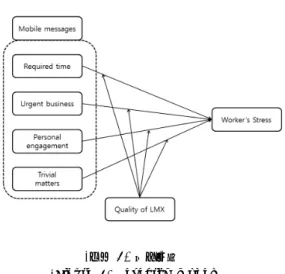
Mobile messages that can be sent to a subordinate during non-work time may be divided into four categories, namely required time, urgent business, personal engagement and trivial matters[3]. Required time and urgent business are related to time disturbances, thus those who dislike urgent work will be more stressed by these messages [3], [8].
Personal engagement and trivial matters are related to human relations, thus they will be more stressful in the case of workers who have a bad relationship with their supervisor
[3], [8-9]. The characteristics of each message are different.
Hence, the negative impact on the performance of the messages will be different, thus, the relationship between each message and its impact on stress levels might be different.
2.1 Required time
Workers sometimes spend a lot of time solving work-related problems. These kinds of problems are usually solved during normal business hours. Nonetheless, a supervisor can give a subordinate job instruction that require the expenditure of a large amount of time during non-work hours. Required time is a type of message whereby the instruction or task the message contains requires a long time to satisfactorily complete [3]. For instance, a supervisor can send the following message to a subordinate: “You need to organize work-related materials and send them to me now.”
(a task that requires about an hours’ investment). This message is not a work order for a problem that can be easily solved in a very short period of time, and compliance with it will interrupt the down-time of the worker and force them to give up their personal time. These messages are essentially an extension of work. Such additional and often excessive work causes stress [8-9]. When a worker receives a required time message during non-work time, their break is interrupted and rest time reduced, and a new task must be begun. Most workers would prefer to start new tasks the following day Furthermore, it can be stressful enough for a subordinate to simply receive instructions that will take a long time to complete, whether or not they intend to start the work immediately.
2.2 Urgent business
Mobile communication allows people to quickly and easily exchange large amounts of information in real time.
Thus, a supervisor can easily send an urgent business message at any time, and a subordinate can take a job promptly and reply immediately. Urgent business is a message that needs to be responded to quickly. For example, a supervisor can send the following message to a subordinate: “I want to organize tomorrow’s schedule, please
send me any relevant materials within 5 minutes”. Hence, the message receiver has to pause their break time and provide feedback immediately [3].
Urgent liaison can give people tension. In the case of impatient or laid-back people, responding to urgent liaison may be different [8], [10].
When a person who likes to tackle new tasks as soon as they can on non-work time receives an urgent business message, they tend to solve the problem quickly, even though they will be under the double stress of investing their time and doing things in a hurry. In contrast, for a laid-back person an urgent deadline can be even more stressful.
Moreover, it is not always easy for individuals on non-work time to suddenly throw themselves back into work, and trying to solve tasks in a hurry can cause mistakes [3], [10].
2.3 Personal engagement
The nature of relationships between superiors and subordinates within a company can take many forms. There may be genuine respect and like for each other, or, on the other hand, genuine discomfort or dislike. Relationships can be formal or informal, and the supervisor and the subordinate can have a close relationship. In this regard, personal engagement is a request for something, which is usually the undertaking of an extra role, usually of a personal nature. For example, a personal engagement message might be along the lines of: "I will have dinner with my family, so please make a reservation at a restaurant for me". A supervisor’s request for to be involved in their private affairs can itself be stressful to his / her subordinates.
Positions such as supervisors and subordinates exist within the organization. Thus, in an out-of-context situation, especially in the case of non-work time, personal engagement messages will increase the stress on workers.
Moreover, at rest, few people like to spend their personal time undertaking tasks for a supervisor who is not friendly or close to them.
2.4 Trivial matters
The tasks that a supervisor directs to their subordinates are not always serious or important. Sometimes they can be
trivial enough to question why they even need to be done.
Trivial matters are messages that content is not important, or something that does not need to be completed immediately.
An example of such a message is “We should deposit money into the bank tomorrow”. [3]. There is no one willing to waste precious time in order to deal promptly with such unimportant things. However, these annoying messages may cause workers to be disturbed and stressed. Occasionally, workers may be wondering why they were sent these trivial messages. Too much information or too many alternatives in decision making can have a negative impact on workers [11]. These trivial messages annoy workers. The motivation of workers to deal with unimportant things can be compromised [12].
2.5 Stress and mobile messages
Stress is a state of tension experienced by individuals facing extraordinary work, demands, constraints, or opportunities [7]. Job stress is a workers’ perceived intensity, severity, and frequency of the occurrence of stressful working conditions. Job stress usually negatively affects the psychological well-being of workers [8]. Workers are subjected to various types of stress in the ordinary course of their work. The type of communication between supervisors and subordinates influences whether workers experience burnout or stress. Proper communication can improve job engagement, but improper communication can lead to burnout, which is related to stress [13]
Hence, in the relationship between supervisor and subordinate, communication methods such as mobile messages can cause stress at any time, as mobile messages in non-work times are mostly in the form of commands such as work orders and requests for personal favors. In certain hierarchy based cultures, when the power gap between supervisors and workers is very high, a supervisor can give unfair job instructions to subordinates [14]. In this case, the subordinate may have to obey the supervisor's orders.
Contacting workers during non-work time and issuing work orders or making personal requests can obviously be perceived as overtime. And when a worker perceives an excess burden, stress increases. As such, non-work time messages will generally be stressful to the recipients [3].
Furthermore, if workers are deprived of their breaks or are urgently required to work, their levels of stress can increase.
In addition, urgent and time consuming work is stressful enough in itself, and even more likely to make workers unhappy during their downtime [6].
All four types of messages (required time, urgent business, personal engagement, and trivial matters) received during non-work time may be stressors for the worker.
Based on this relationship, the following hypotheses were established.
H1. Mobile messages during non-work time will increase workers’ stress.
H1-1 Required time messages during non-work time will increase workers’ stress.
H1-2 Urgent business messages during non-work time will increase workers’ stress.
H1-3 Personal engagement messages during non-work time will increase workers’ stress.
H1-4 Trivial matter messages during non-work time will increase workers’ stress
2.5 Moderating effect of LMX
One leader has relationships with multiple members.
Leader-member exchange (LMX) theory assumes that the leader does not have an equal relationship with all of their team members. Instead, the leader has differential relevance to individual members. Members of a specific team perform various roles while performing their duties. As such, the leader expects different roles from the individual members.
These differences lead to differences in the relationship between leaders and members [15]. The quality of LMX is determined by the degree to which a leader and team members like, respect and trust each other. For example, if a member respects the professionalism of a leader, is loyal to the leader, and likes the leader, the quality of LMX will be higher. Members who possess a higher quality of LMX are referred to as being in-group, and conversely, members with a lower -quality of LMX are referred to as being out-group. In-group members with a high quality of LMX have a positive relationship with the leader compared to the
out-group members, and can also achieve higher performance [16-17]. Depending on the quality of the LMX, the members perception of their leader may vary. For example, if the quality of LMX is high, the members tend to trust their leader more, and have more faith in their leader's actions or behavior. As such, depending on the quality of the LMX, the reaction of the members to a message from, or the influence of their leader can also vary [18]. If a leader and a member are on good terms and have a good relationship, the member will generally receive less stress because of a leader’ contacting them [3],[9], [18].
When a supervisor sends a message to subordinates during non-work time, the workers’ stress levels tend to increase. However, if the relationship between the leader and the member is good, the member will generally be less stressed. Conversely, if the quality of the LMX is low, a worker's stress from non-work time messages will increase.
Therefore, the quality of LMX can moderate the relationship between the messages sent by the supervisor during non-work time and subordinates’ stress levels. Therefore, the following hypothesis was set.
H2. Quality of LMX will moderate the relationship between messages during non-work time and workers’ stress.
In particular, if the quality of LMX is low, workers will be more stressed because of messages received during non-work time.
H2-1 Quality of LMX will moderate the relationship between required time messages and workers’ stress.
H2-2 Quality of LMX will moderate the relationship between urgent business messages and workers’ stress.
H2-3 Quality of LMX will moderate the relationship between personal engagement messages and workers’ stress.
H2-4 Quality of LMX will moderate the relationship between trivial matter messages and workers’ stress.
Component
1 2 3
required time1 .846 -.081 .222 required time2 .879 -.096 .203 required time3 .872 -.183 .194 urgent business1 .831 -.115 .247 urgent business2 .843 -.126 .212 urgent business3 .873 -.097 .215 personal engagement1 .869 -.131 .171 personal engagement2 .832 -.075 .206 personal engagement3 .837 -.069 .173 trivial matters1 .857 -.025 .185 trivial matters2 .843 -.129 .193 trivial matters3 .793 -.136 .129 (그림 1) 연구모형
(Figure 1) Research model
3. Participants and Measurement
Data was randomly collected from 184 workers. The demographic characteristics of these workers were as follows: There were 143 males (71.4%) and 52 females (28.1%); 81 were in their twenties (43.8%), 71 were in their thirties (38.4%), 27 were in their forties (14.6%), and 5 were older than 50 (2.7%) (missing=1); 25 had completed high school (13.5%), 104 had bachelor degrees (56.2%), 41 had master degrees (22.2%), and 11 had doctorates (5.9%) (missing=4). , 44 had worked for less than 1 year at their current place of employment (23.8.8%), 40 had worked 1-2 years (21.6%), 30 had worked 2-3 years (16.2%), 21 had worked 3-5 years (11.4%), and 45 had worked longer than 5 years (24.3%) (missing=5).
In addition, all items were measured by a Likert 7 point scale.
LMX was measured by 12 items, including, “My supervisor is the kind of person one would like to have as a friend” (affect), “My supervisor defends my work actions to superiors, even without complete knowledge of the issue in question” (loyalty), “I am willing to apply extra efforts, beyond those normally required, to further the interests of my work group” (contribution), “I respect my supervisor's knowledge of and competence in the job” (professional respect) [17].
Stress was measured by 13 items, including, “I
sometimes dread the telephone ringing at home because the call might be job-related”, “I spend so much time at work, I can't see the forest for the trees”, “Sometimes when I think about my job I get a tight feeling in my chest” [8].
Mobile messages was measured by 12 items, including
“During non-work time, I have received work related instructions from my supervisor requiring me to invest my personal time (required time message)”, “During non-work time, my supervisor has given me a job order that needs to be resolved quickly via a mobile message (urgent business message)”, “During non-work time, through a mobile message, my supervisor has asked me to assist in their personal affairs (personal engagement message), “My supervisor has sent me trivial mobile messages (trivial matters message)”.
4. Analysis
For empirical analysis of this study, we used exploratory factor analysis (EFA) and confirmatory factor analysis (CFA) for the validity test, Cronbach's α for the reliability test, correlation of Pearson, and a liner regression analysis [19-21].
Table 1 indicates the results of the EFA, and Table 2 shows the results of the CFA. The results of the analysis show that all measurements of this research have significant validity. Hence all items in measurement are adopted [19].
(표 1) 탐색적 요인분석 결과 (Table 1) Results of EFA
Component
1 2 3
lmx1 -.052 .853 -.103
lmx2 -.001 .774 -.099
lmx3 -.137 .877 -.061
lmx4 -.177 .857 -.040
lmx5 -.019 .883 -.118
lmx6 -.117 .873 -.092
lmx7 -.156 .894 -.105
lmx8 -.035 .924 -.056
lmx9 -.164 .920 -.085
lmx10 -.087 .888 .015
lmx11 -.153 .867 -.036
lmx12 -.114 .838 .010
stress1 .010 .010 .672
stress2 .159 -.064 .805
stress3 .294 -.049 .813
stress4 .207 -.073 .846
stress5 .143 -.107 .854
stress6 .215 -.107 .826
stress7 .092 -.105 .885
stress8 .175 -.097 .885
stress9 .207 -.124 .864
stress10 .145 .077 .672
stress11 .395 -.149 .705
stress12 .384 -.024 .739
stress13 .253 -.096 .866
eigen value 9.487 9.374 8.986
% of Variance 25.642 25.335 24.286 Cumulative % 25.642 50.977 75.263
KMO=.927 (sig.000)
AVE Composite Reliability
Mobile messages .725 .912
LMX .740 .908
Stress .668 .870
absolute fit index X2=1064.668 X2/df=1.832 RMSEA=.067 incremental fit index TLI=.937, CFI=.945, IFI=.945 parsimonious fit index PNFI=.774, PGFI=.641 (표 2) 확인적 요인분석 결과
(Tab 2) Results of CFA
Table 3 indicates all factors’ reliability and their descriptive statics. For reliability, all Cronbach's α values are higher than 0.8 [20]. Hence, all variables have satisfactory reliability (see Table 3).
(표 3) 신뢰도와 기술통계
(Table 3) Reliability and descriptive statistics Cronbach's α Mean Std.
Deviation Mobile messages .972 2.414 1.565
Required time .954 2.676 1.774 Urgent business .948 2.586 1.784 Personal engagement .965 2.052 1.541 Trivial matters .917 2.344 1.681
LMX .973 4.553 1.626
Stress .963 6.667 1.645
Table 4 indicates the results of the correlation. All variables have significant relationships. In particular, stress has a positive relationship with mobile messages (required time, urgent business, personal engagement, and trivial matters). Therefore, hypothesis 1 (including H1-1, H1,-2, H1-3, and H1-4) was supported. In addition, LMX has a negative relationship with all factors including stress and mobile messages (required time, urgent business, personal engagement, and trivial matter).
(표 4) 상관관계 분석
(Table 4) Correlation analysis
***:p<.001, **:p<.01, *:p<.05
1=mobile messages, 2=required time, 3=urgent business, 4=personal engagement, 5=trivial matters, 6=LMX, 7=stres
1 2 3 4 5 6 7
1 -
2 .942*** -
3 .932*** .916*** -
4 .893*** .744*** .737*** - 5 .921*** .799*** .768*** .843*** - 6 -.241** -.238** -.230** -.202** -.217** - 7 .464*** .440*** .454*** .410*** .407*** -180** -
Tables 5 to Table 9 show results from the regression analysis. According to the suggested results, LMX has no moderating effects on the relationship between all mobile messages (required time, urgent business, personal engagement, and trivial matters), and stress (no β values are significant). These results indicate that hypothesis 2 (including H2-1, H2,-2, H2-3, and H2-4) was NOT supported [22-23].
dependent : stress independent
/moderate
step 1 step 2 step 3
Β t β t β t VIF
mobile messages
.464
*** 7.091 .447
*** 6.628 .437
*** 6.151 1.174
LMX -.072 -1.065 -.076 -1.111 1.079
interaction -.031 -.446 1.108
R2
(Adj-R2) .216 (.211) .220(.212) .221(.208)
⊿R2
(Adj-R2) - .004(.001) .001(-.004)
F 50.283*** 25.727*** 17.142***
dependent : stress independent
/moderate
step 1 step 2 step 3
β t β t β t VIF
required time
.440
*** 6.620 .421
*** 6.159 .408
*** 5.834 1.111
LMX -.079 -1.162 -.085 -1.243 1.072
interaction -.057 -.833 1.051
R2
(Adj-R2) .193(.189) .199(.190) .202(.189)
⊿R2
(Adj-R2) - .006(.001) .003(-.001)
F 43.825*** 22.630*** 15.293***
dependent: stress independent
/moderate
step 1 step 2 step 3
Β t β t β t VIF
urgent business
.454
*** 6.893 .436
*** 6.446 .433
*** 6.115 1.155
LMX -.079 -1.173 -.080 -1.175 1.066
interaction -.008 -.111 1.094
R2
(Adj-R2) .206(.202) .212(.203) .212(.199)
⊿R2
(Adj-R2) - .006(.001) .000(-.004)
F 47.519*** 24.497*** 16.247***
dependent: stress independent
/moderate
step 1 step 2 step 3
β t β t β t VIF
personal engagement
.410
*** 6.076 .389
*** 5.673 .378
*** 5.229 1.151
LMX -.101 -1.469 -.105 -1.514 1.055
interaction -.037 -.519 1.106
R2
(Adj-R2) .168(.163) .178(.169) .179(.165)
⊿R2
(Adj-R2) -
F 36.922*** 19.657*** 13.142***
dependent: stress independent
/moderate
step 1 step 2 step 3
β t β t β t VIF
trivial matters .407
*** 6.036 .387
*** 5.607 .362
*** 4.953 1.181
LMX -.096 -1.388 -.105 -1.510 1.069
interaction -.071 -.994 1.129
R2
(Adj-R2) .166(.161) .175(.1660 .179(.166)
⊿R2
(Adj-R2) -
F 36.435*** 19.273*** 13.177***
(표 5) 모바일 커뮤니케이션과 스트레스의 관계에서 LMX의 조절효과
(Table 5) The moderating effect of LMX on the relationship between mobile
communication and stress
***:p<.001, **:p<.01, *:p<.05
(표 6) 시간요구와 스트레스의 관계에서 LMX의 조절효과 (Table 6) The moderating effect of LMX on the
relationship between required time and stress
***:p<.001, **:p<.01, *:p<.05
(표 7) 긴급한 업무와 스트레스의 관계에서 LMX의 조절효과 (Table 7) The moderating effect of LMX on the relationship
between required time and stress
***:p<.001, **:p<.01, *:p<.05
(표 8) 개인적 용무와 스트레스의 관계에서 LMX의 조 절효과
(Table 8) The moderating effect of LMX on the
relationship between personal
engagement and stress
***:p<.001, **:p<.01, *:p<.05
(표 9) 사소한 일과 스트레스의 관계에서 LMX의 조절 효과
(Table 9) The moderating effect of LMX on the relationship between trivial matters and stress
***:p<.001, **:p<.01, *:p<.05
These results mean that when a supervisor sends a mobile message to a subordinate (regardless of the type of message), their stress levels are elevated. Furthermore, the results show that a higher quality of LMX does not reduce the stress caused by messages sent by a supervisor. Thus, the results of this research show that mobile messages are all stressors for workers, and stress is not affected by the quality of LMX when a supervisor sends messages to their subordinates.
Figures 2 through 6 show the moderating effect of LMX as a simple slope graph. As clearly shown in all the figures, when a supervisor sends a large number of messages to their subordinates, the subordinates’ stress increases linearly.
Further, the worker’s stress increased regardless of whether the quality of LMX was high or low [21]. (See Figure 2 ~ Figure 7).
(그림 2) 모바일 커뮤니케이션과 스트레스의 관계에서 LMX의 조절효과에 대한 그래프
(Figure 2) Graph showing the moderating effect of LMX on the relationship between frequency of mobile communication and stress
(그림 3) 시간요구와 스트레스의 관계에서 LMX의 조절효과에 대한 그래프
(Figure 3) Graph showing the moderating effect of LMX on the relationship between required time and stress
(그림 4) 긴급한 업무와 스트레스의 관계에서 LMX의 조절효 과에 대한 그래프
(Figure 4) Graph showing the moderating effect of LMX on the relationship between urgent business and stress
(그림 5) 개인적 용무와 스트레스의 관계에서 LMX의 조절효 과에 대한 그래프
(Figure 5) Graph showing the moderating effect of LMX on the relationship between personal engagement and stress
(그림 6) 사소한 일과 스트레스의 관계에서 LMX의 조절효과 에 대한 그래프
(Figure 6) Graph showing the moderating effect of LMX on the relationship between trivial matters and stress
5. Conclusion
5.1 Conclusion and Implications
There is a large amount of existing research on the many advantages and remarkable technology involved in mobile communication. However, we also need to acknowledge and understand that mobile communications may also have drawbacks. This study focuses on the negative impact of using mobile communication for work related matters during non-work time. The results of this study showed that all types of mobile messages, namely required time, urgent business, personal engagement, and trivial matters proved to increase the stress of workers. Further, all messages sent by a supervisor to workers during non-work time have negative effects (stress enhancement or performance inhibition).
Hence, it follows that supervisors should not send these kinds of messages to subordinates during non-work time.
The implications of these findings are as follows.
First, messages sent at non-work time cause stress to workers. The type of stress they cause is not positive stress (called eu-stress), but negative stress that may lead to burnout and performance degradation. Many workers may not be able to tolerate this stress [9], [24]. Thus, supervisors should drastically reduce the sending of messages using mobile devices during non-work time. The sending of excessive work related instructions can easily be understood as problematic. Modern technology makes this easy to do, even during non-work hours. It is thus necessary to understand the negative influence of messages sent during non-work time, and efforts should be made to minimize this behaviour. Moreover, organizational support is needed to allow subordinates to confidently reject these messages.
Second, if the quality of the LMX is high, work related stress tends to be lower. Thus, a high quality of LMX has a positive impact on workers, as suggested by previous studies [16-18]. However, a high quality of LMX does not guarantee that workers are less stressed by mobile communications during non-work time. A team leader cannot send a mobile message to a team member outside of work hours simply because their relationship is good.
Rather, we need to understand that mobile messages sent during non-work time are always stressful, regardless of the relationship between a leader and team member.
Finally, lots of corporations, governments, and academies around the world are making various attempts to improve the quality of working life (QWL) in today. Improving the QWL and protecting the rights and interests of workers can affect the development of enterprises. The samples in this study are workers belonging to companies in Korea.
Recently, corporations in Korea are making efforts such as shortening working hours as a way to improve the QWL. It would be possible to shorten work time, reduce work-family conflicts, and improve the QWL. However, the behavior of a supervisor contacting a subordinate in non-worktime through mobile communication is against the issue of shortening working time. In addition, when the working time is shortened, it is possible that the supervisor is able to contact the subordinate after work. The messages at
non-worktime will fundamentally increase the stress of workers, which will negatively affect both working life and daily life quality. Therefore, people should strive to reduce the messages during non-work time to suit the current business environment. Government policies, corporate culture, and the perception of workers at all hierarchy in organizations should be related to reducing messages during non-work time.
5.2 Limitations and Potential Areas of Future Study
This study focused on the relationship between team leaders and members as a factor affecting stress. However, future studies will need to examine the influence of other factors (i.e. the personalities of members, leadership style, and organizational climate) that may be expected to have more modulatory effects.
Further, this study demonstrates that mobile messages increase stress. Whether mobile messages affect other factors besides stress should also be investigated. For example, mobile messages during non-work time could hamper the performance of work hours or increase turnover intention.
In addition, we need to understand how leaders who frequently contact workers during non-work time exercise leadership during working hours. If a leader gives excessive work orders during work hours or, conversely, allows workers more autonomy in business hours, the influence of mobile messages during non-work time may also change.
Additionally, in this study, bias may exist as data was collected via self-report questionnaires. In future studies, it would be constructive if leaders and members responded to questionnaires together. Finally, we did not verify differences in the types of mobile messages through factor analysis, which we hope to undertake in future research
참 고 문 헌(Reference)
[1] S. M. Lee, “User Behavior of Mobile Enterprise Applications,” KSII Transactions On Internet &
Information Systems, Vol. 10, no. 8, pp. 3972-3985, 2016.
http://dx.doi.org/10.3837/tiis.2016.08.030
[2] I. Diaz, D. S. Chiaburu, R. D. Zimmerman, and W.
R. Boswell, “Communication Technology: Pros and Cons of Constant Connection to Work,” Journal of Vocational Behavior, Vol. 80, no. 2, pp. 500-508, 2012.
https://doi.org/10.1016/j.jvb.2011.08.007
[3] S. W. Hahm, “Effect of Mobile Communication Traits during Non-worktime on Work-to Non-work Conflict:
The Mediating Effect of Stress and Anger,” KSII The 8th International Conference on Internet (ICONI) 2016 Symposium, 2016.
[4] C. T. Lu, C. E. Yeh, Y. C. Wang, and C. S. Yang,
“The Performance Study of a Virtualized Multicore Web System,” TIIS Transactions On Internet &
Information Systems, Vol. 10, no. 11, pp. 5419-5436, 2016.
http://dx.doi.org/10.3837/tiis.2016.11.012
[5] I. Ghani, and M. Bello, “Agile Adoption in IT Organizations,” KSII Transactions on Internet &
Information Systems, Vol. 9, no. 8, pp. 3231-3248, 2015.
http://dx.doi.org/10.3837/tiis.2015.08.029
[6] M. M. Butts, W. J. Becker, and W. R. Boswell, “Hot Buttons and Time Sinks: The Effects of Electronic Communication during Nonwork Time on Emotions and Work-nonwork Conflict,” Academy of Management Journal, Vol. 58, no. 3, pp. 763-788, 2015.
http://dx.doi.org/10.5465/amj.2014.0170
[7] W. R. Boswell, and J. B. Olson-Buchanan, “The Use of Communication Technologies after Hours: The Role of Work Attitudes and Work-life Conflict,” Journal of Management, Vol. 33, no. 4, pp. 592-610, 2007.
https://doi.org/10.1177/0149206307302552
[8] D. F. Parker, and A. D. Thomas, “Organizational Determinants of Job Stress,” Organizational Behavior and Human Performance, Vol. 32, no. 2, pp. 160-177, 1983.
https://doi.org/10.1016/0030-5073(83)90145-9 [9] C. D. Spielberger, “Job stress survey,” NY: John Wiley
& Sons, 2010.
[10] C. S. Bruck, and T. D. Allen, “The Relationship between Big Five Personality Traits, Negative Affectivity, Type A Behavior, and Work–family
Conflict,” Journal of Vocational Behavior, Vol. 63, no.
3, pp. 457-472, 2003.
https://doi.org/10.1016/S0001-8791(02)00040-4 [11] I. L. Janis, and L. Mann, “Decision Making: A
Psychological Analysis of Conflict, Choice, and Commitment,” New York, NY, US: Free Press, 1977.
[12] C. E. Shalley, L. L. Gilson, and T. C. Blum,
“Interactive Effects of Growth Need Strength, Work Context, and Job Complexity on Self-reported Creative Performance,” Academy of Management Journal, Vol.
52, no. 3, pp. 489-505, 2009.
https://doi.org/10.5465/AMJ.2009.41330806
[13] S. W. Hahm, “Communication Strategies of Online- Based Leadership and Members' Work Engagement and Job Burnout,” Journal of Internet Computing and Services (JICS), Vol. 18, no. 5, pp. 103-112, 2017.
https://doi.org/10.7472/jksii.2017.18.5.103
[14] B. L. Kirkman, G. Chen, J. L. Farh, Z. X. Chen, and K. B. Lowe, “Individual Power Distance Orientation and Follower Reactions to Transformational Leaders:
A Cross-level, Cross-cultural Examination,” Academy of Management Journal, Vol. 52, no. 4, pp. 744-764, 2009.
https://doi.org/10.5465/AMJ.2009.43669971
[15] G. B. Graen, R. C. Liden, and W. Hoel, “Role of Leadership in the Employee Withdrawal Process,”
Journal of Applied Psychology, Vol. 67, no. 6, pp.
868-872, 1982.
https://doi.org/10.1037/0021-9010.67.6.868
[16] G. B. Graen, and M. Uhl-Bien, “Relationship-based Approach to Leadership: Development of Leader-member Exchange (LMX) Theory of Leadership over 25 Years: Applying a Multi-level Multi-domain Perspective,” The Leadership Quarterly, Vol. 6, no. 2, pp. 219-247, 1995.
https://doi.org/10.1016/1048-9843(95)90036-5 [17] R. C. Liden, and J. M. Maslyn, “Multidimensionafity
of Leader-member Exchange: An Empirical Assessment through Scale Development,” Journal of Management, Vol. 24, no. 1, pp. 43-72, 1998.
https://doi.org/10.1177/014920639802400105 [18] D. T. Hooper, and R. Martin, “Beyond Personal Leader
–member Exchange (LMX) Quality: The Effects of
◐ 저 자 소 개 ◑
함 상 우(SangWoo Hahm) 2004년 숭실대학교 경영학과(경영학학사) 2007년 숭실대학교 경영학과(경영학석사) 2014년 숭실대학교 경영학과(경영학박사)
2015년~현재 숭실대학교 경영학부 조교수(경영학박사) 관심분야 : 조직행동, 융합연구, e-business, information E-mail : [email protected]
Perceived LMX Variability on Employee Reactions,”
The Leadership Quarterly, Vol. 19, no. 1, pp. 20-30, 2008.
https://doi.org/10.1016/j.leaqua.2007.12.002
[19] B. Thompson, “Exploratory and Confirmatory Factor Analysis: Understanding Concepts and Applications,”
American Psychological Association, Washington DC, 2004.
[20] J. R. A. Santos, “Cronbach’s Alpha: A Tool for Assessing the Reliability of Scales,” Journal of Extension, Vol. 37, no. 2, pp. 1-5, 1999.
[21] J. Cohen, “Statistical Power Analysis for the Behavioral Sciences,” 2nd Edition, Lawrence Earlbaum Associates, Hilsdale, 1977.
[22] R. M. Baron, and D. A. Kenny, “The Moderator-
mediator Variable Distinction in Social Psychological Research: Conceptual, Strategic, and Statistical Considerations,” Journal of Personality and Social Psychology, Vol. 51, no. 6, pp. 1173-1182, 1986.
http://dx.doi.org/10.1037/0022-3514.51.6.1173 [23] P. A. Frazier, A. P. Tix, and K. E. Barron, “Testing
Moderator and Mediator Effects in Counseling Psychology Research,” Journal of Counseling Psychology, Vol. 51, no. 1, pp. 115-134, 2004.
http://dx.doi.org/10.1037/0022-0167.51.1.115
[24] S. W. Hahm, “Effect of General/Job Stress Mindset to Decrease the Influence of Job Stress to Burnout,”
International Information Institute (Tokyo).
Information, Vol. 19, no. 11B, pp. 5365-5372, 2016.
![Table 3 indicates all factors’ reliability and their descriptive statics. For reliability, all Cronbach's α values are higher than 0.8 [20]](https://thumb-ap.123doks.com/thumbv2/123dokinfo/4715538.508459/6.808.80.382.106.876/table-indicates-factors-reliability-descriptive-statics-reliability-cronbach.webp)
