• 검색 결과가 없습니다.

Research on the Components of Children's Educational Game Achievement System

N/A
N/A
Protected

Academic year: 2021

Share "Research on the Components of Children's Educational Game Achievement System"

Copied!
12
0
0

로드 중.... (전체 텍스트 보기)

전체 글

(1)

1. INTRODUCTION

1.1 Background of the study

The global market of Digital educational games (DEG) will reach US $24 billion in 2024, and the Chinese market will reach RMB 33.62 billion to be- come the largest DEG market in the world Fig. 1.

At the same time, DEG has become a necessary part of children's lives, learning, and entertainment [1]. The global market of DEG has entered a boom period According to Piaget's theory of cognitive development stage, in the middle stage of childhood (6-12 years old), children's abstract ability and concentration ability are limited, and their self-

control ability is weak. DEG has incomparable ad- vantages in improving the above problems and learning quality compared with traditional educa- tion. Among them, DEG's achievement systemis a tool to balance entertainment and learning. We can never overlook its value and advantages in im- proving game experience, prolonging the game re- tention rate, and improving learning.

1.2 Research Questions

At present, the research and design of children's DEG achievement systems are seriously lagging behind. Most of them are simple copies of success- ful commercial entertainment game achievement

Research on the Components of Children's Educational Game Achievement System

Kun Shi

, Dong Min Cho

††

ABSTRACT

Under the background of the rapid development of digital educational games, we have to evidently research the elements of the achievement system of children’s DEG (Digital Educational Game), and analyze the relations between the elements and make a profound study on the achievement system and its components on the impact of player’s attitude. Compared with the existing research, the research contents and methods are innovative and reliable. The results show that players have a positive attitude towards the DEG achievement system, DEG achievement system has important value and role for educational games. Which is made of five elements: symbol, reward, logic, social interaction, and knowledge. The five elements interact with each other and have a positive impact on players' attitudes.

DEG achievement system with five elements will bring players a positive experience. These findings provide a detailed study of the components of the achievement system. With all of these, we can explain the role and relationship of the components, and provide new ideas and empirical evidence for the design and development of children's educational game achievement system. The above findings provide a detailed description of the components of the DEG achievement system, explain the role and value of each component, and the relationships and patterns among the components, it provides a new perspective and empirical evidence for the design and development of the children's system DEG results.

Key words: Digital Educational Games, Game Achievement System, Children, Player's Attitude, Game Experience, Learning

※ Corresponding Author : Dong-Min Cho, Address:

(54896) 567, Baekje-daero, Deokjin-gu, Jeonju-si, Jeolla-

buk-do, Korea, TEL : FAX : +82-63-

270-3755, E-mail : [email protected]

Receipt date : Jun. 4, 2021, Revision date : Sep. 10, 2021

Approval date : Sep. 15, 2021

††

Dept. of Design & Manufacturing Engineering, Jeonbuk National University

(E-mail : [email protected])

††

Dept. of Industrial Design, Jeonbuk National University

(2)

systems, which led to poor applicability and expe- rience in DEG and affect the quality of learning.

Existing research on game achievement systems, there is a lack of targeted research on educational games, user groups with different characteristics (Galli, Luca, Achievement Systems Explained) [2].

This thesis is an in-depth and specific study of the achievement system with educational games for children aged 6-12 in China, with a higher refer- ence value. Existing studies have conducted some research on digital badges, rewards, in educational games (McDaniel, Rudy, Building Better Digital Badges: Pairing Completion Logic With Psycho- logical Factors) [3], (Groening, Christopher, “Achieve- ment unlocked!” - The impact of digital achieve- ments as a gamification element on motivation and performance) [4], However, there is a lack of in- depth research on achievement system, confusion in the definition of achievement system of digital educational games, and confusion in the concept of achievement system. In this paper, the definition, functions, values, components, and interactions, and relationships among the components of the achievement system are studied in-depth, and a clear view is presented. The application of gamifi- cation in education has been explored in existing studies (Rouse, Kelly Elizabeth, Gamification in Science Education: The Relationship of Educatio- nal Games to Motivation and Achievement) [5].

However, it is too limited and ignores the integrity

and independence of educational games. The re- search in this paper emphasizes the value and role of achievement systems in educational play set- tings, with broader applicability and reference value. Most of the existing studies on game ach- ievement systems are based on case studies (Xbox 360 Achievements help boost review scores &

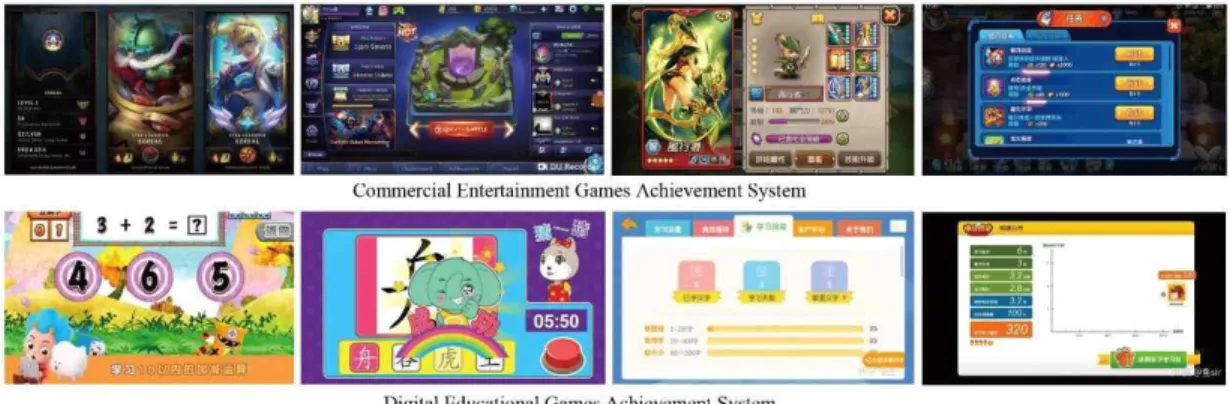
sales) [6], the normative research approach is dom- inant, and empirical research on the components of achievement systems is lacking. This thesis adopts an empirical research method to study the achieve- ment system, and the results are more innovative and valid Fig. 2.

1.3 Purpose and necessity of the study Purpose of the study: (1) To propose compo- nents of a child DEG achievement system through empirical research and to verify the reliability and validity of the components. (2) Analyze and explore the correlations, mechanisms, and patterns of in- teractions among the constituent elements of the DEG achievement system. (3) Study the relation- ship between the DEG achievement system and users' attitudes, and the influence of achievement system components on users' attitudes. The meth- ods of the research fill the research gap in this field, correct the wrong views, and provides empirical evidence. It is of guiding significance to the design and research of the achievement system of educa- tional games.

Fig. 1. Global and Chinese Educational Games Market.

(3)

1.4 Research Methods

The overall structure of the thesis is divided into several parts, such as introduction, theoretical study, empirical analysis, and conclusion. Problems in the design of educational game achievement systems are identified through background analy- sis and theoretical research. By extracting ach- ievement elements from the achievement systems of representative commercial digital entertainment games, Collect and extract the representative ele- ments. Combined with literature analysis and ex- pert interviews, the research method of influencing factors of children's digital educational game ach- ievement system is proposed. Literature analysis and expert interviews were conducted to form a questionnaire, and the investigators adopted the interviewing method, a questionnaire survey was conducted among Chinese primary school children

aged 6-12. After retrieving the data, an empirical analysis was conducted, through exploratory factor analysis, correlation analysis, multiple linear re- gression analysis, empirical analysis of the results, the final conclusion Fig. 3.

2. LITERATURE REVIEW

2.1 Digital Education Games for Children Digital Education Games (DEG) is a game used for educational purposes [7]. DEG contains both learning and game mechanics that can provide en- joyment and an active learning environment and it is considered the most promising and effective learning tool today [8-11]. A large number of re- search shows that DEG has enhanced students' learning motivation, brought changes in their learning attitude and behavior, and improved their Fig. 2. Comparison of commercial game achievement system and educational game achievement system.

Fig. 3. Thesis Research Pathway Map.

(4)

learning efficiency and learning performance. The children’s DEG is a learning tool developed specifi- cally for child users, which combines entertainment and learning to make children interested. So, it is regarded as the best way to stimulate children' s learning motivation [12-13].

2.2 The Game Achievement System

Achievement is a set of tasks defined by the game designer where the player can be rewarded by completing or reaching some state to reach a milestone and track the progress [14]. Achievement system is part of game, entertainment platforms, demonstrating, managing and sharing achievement across multiple systems [15]. The achievement system enriches the gameplay and game tasks and it is proved to be a way to extend the game life.

Players use different gameplay and difficulties to complete different achievements. The rewards are different so that they can produce different experi- ences and reduce development costs [16]. The re- cord in the achievement system preserves the player's memory during the game experience, en- abling the players to have emotional resonance and attachment. Also, the player loyalty of the game and the attraction of the game are improved.

Sharing and showing off game achievements with other players in the social process will also bring players' satisfaction and confidence, extending player retention and reputation for the game [17].

Achievement system is closely related to the play- er's action performance, enthusiasm and attitude.

3. METHODOLOGY

3.1 Methodology 1 3.1.1 Research Questions

Analyze and extract the achievements projects in the representative game achievement system, and extract the most representative achievement projects.

3.1.2 Participants

516 senior gamers were surveyed about the rele- vance of game genre and game achievement sys- tem, and 505 valid questionnaires were returned.

15 experts participated in the interview and review.

3.1.3 Research and Procedures

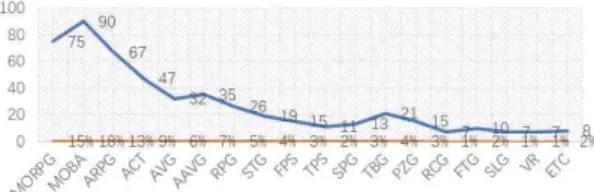
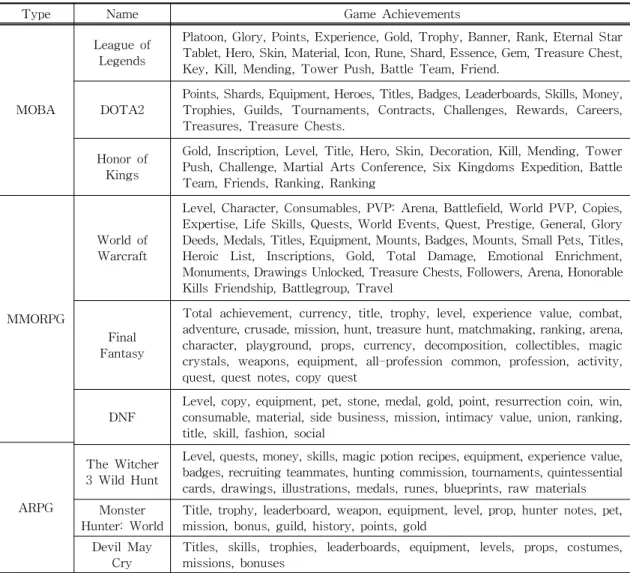
The representative game type analysis ques- tionnaire of the game achievement system used is composed of 4 (SQ) questions and 6 questions for research purposes. From the analysis of data of the questionnaires we found that the game types that players consider having a mature, sophisticated achievement system are MOBA, MMORPG, ARPG Fig. 4. According to Superdata global game rank- ing, IGN best game ranking in the last decade, IOS and Google Play game download ranking, we se- lected 9 famous games to analyze the achievement projects in the achievement system. Representative items of achievement were extracted by means of expert interviews Table 1.

Through expert interviews, the 183 extracted game achievement elements were classified and screened, and achievement items with similar functions and attributes were categorized under the same category based on expert opinions, forming 28 representative game achievement system items Table 2.

3.2 Methodology 2 3.2.1 Research Questions

To determine the questionnaire questions; To empirically study the components of the DEG ach- ievement system; To analyze the relationship be-

Fig. 4. Achievement system representative game type.

(5)

tween elements; To research the relationship be- tween the achievement system and the components and the user's attitude towards the necessity of the achievement system.

3.2.2 Participants

The participants were 220 children (aged 6-12)

from China, 105 boys and 107 girls, and eventually recovered 212 valid samples.

3.3 Research and Procedures

According to the literature and expert opinions, we added “knowledge” elements to measure the questions and form questionnaires. The inves- Table 1. Analysis of the achievement items in the game.

Type Name Game Achievements

MOBA

League of Legends

Platoon, Glory, Points, Experience, Gold, Trophy, Banner, Rank, Eternal Star Tablet, Hero, Skin, Material, Icon, Rune, Shard, Essence, Gem, Treasure Chest, Key, Kill, Mending, Tower Push, Battle Team, Friend.

DOTA2 Points, Shards, Equipment, Heroes, Titles, Badges, Leaderboards, Skills, Money, Trophies, Guilds, Tournaments, Contracts, Challenges, Rewards, Careers, Treasures, Treasure Chests.

Honor of Kings

Gold, Inscription, Level, Title, Hero, Skin, Decoration, Kill, Mending, Tower Push, Challenge, Martial Arts Conference, Six Kingdoms Expedition, Battle Team, Friends, Ranking, Ranking

MMORPG

World of Warcraft

Level, Character, Consumables, PVP: Arena, Battlefield, World PVP, Copies, Expertise, Life Skills, Quests, World Events, Quest, Prestige, General, Glory Deeds, Medals, Titles, Equipment, Mounts, Badges, Mounts, Small Pets, Titles, Heroic List, Inscriptions, Gold, Total Damage, Emotional Enrichment, Monuments, Drawings Unlocked, Treasure Chests, Followers, Arena, Honorable Kills Friendship, Battlegroup, Travel

Final Fantasy

Total achievement, currency, title, trophy, level, experience value, combat, adventure, crusade, mission, hunt, treasure hunt, matchmaking, ranking, arena, character, playground, props, currency, decomposition, collectibles, magic crystals, weapons, equipment, all-profession common, profession, activity, quest, quest notes, copy quest

DNF Level, copy, equipment, pet, stone, medal, gold, point, resurrection coin, win, consumable, material, side business, mission, intimacy value, union, ranking, title, skill, fashion, social

ARPG

The Witcher 3 Wild Hunt

Level, quests, money, skills, magic potion recipes, equipment, experience value, badges, recruiting teammates, hunting commission, tournaments, quintessential cards, drawings, illustrations, medals, runes, blueprints, raw materials Monster

Hunter: World Title, trophy, leaderboard, weapon, equipment, level, prop, hunter notes, pet, mission, bonus, guild, history, points, gold

Devil May

Cry Titles, skills, trophies, leaderboards, equipment, levels, props, costumes, missions, bonuses

Table 2. Typical achievement items in the game.

Typical items of game achievement system

Quest, level, title, skill, copy, kill, point, point, experience, total achievement, money, badge, trophy, weapon,

equipment, flag, character, pet, skin, treasure, treasure chest, material, decoration, rune, battle record, ranking,

evaluation, battle team

(6)

tigators were doing accessible surveys and ex- tracted data through SPSS22.0 and exploratory factor analysis to extract the elements and correla- tion of components; Then we used Multivariate linear regression analysis to research the influence on the user’s attitude towards achievement system caused by the elements.

4. RESULT

4.1 Exploratory factor analysis

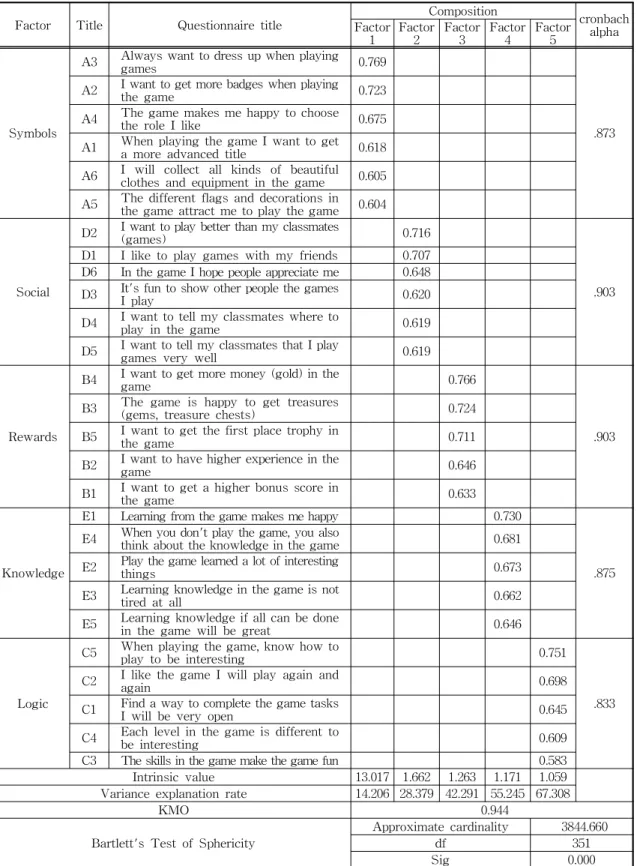
The results are shown in figure 8. KMO=0.944>

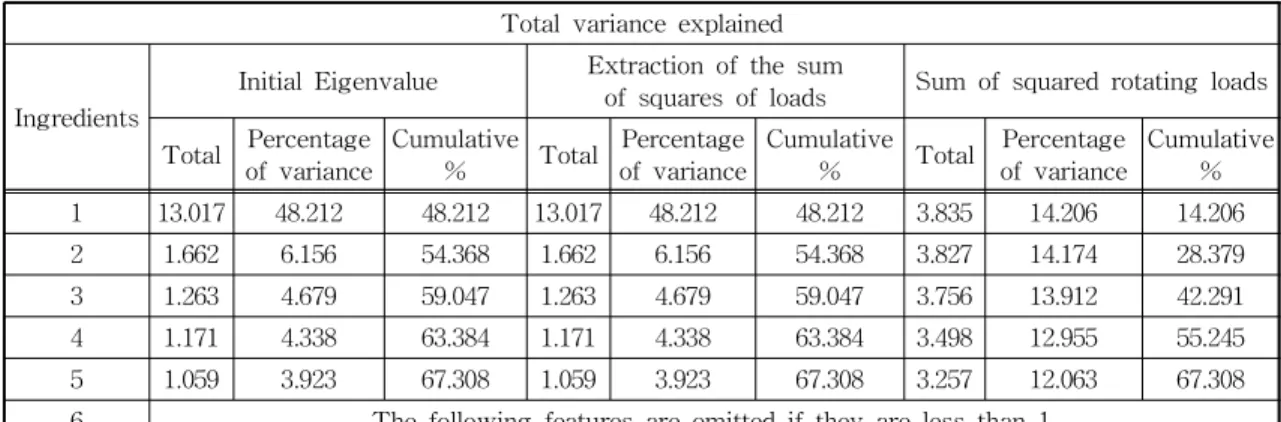
0.6, Sig=0.000<0.01. The data is suitable for factor analysis. We use main component analysis of sam- ple data and select the extraction factor with char- acteristic value greater than 1. Table 3 shows that a total of 5 factors are extracted and the cumulative interpretation variance is 67.308%.

The variance maximizes orthogonal rotation and determine the subordinate dimension of each index.

We arrange with cancellation coefficient absolute value less than 0.5 as shown in Table 4.

According to the theory of relevant scholars, each index item can only load more than 0.5 in one common factor but not in other public factors other wise abandoned. In this main component analysis, 5 factors were extracted, and the five factors were named "symbols", "rewards", "logic", "social" and

"knowledge". 27 questions are in total after the de- letion of non–conforming questions.

4.2 Reliability test

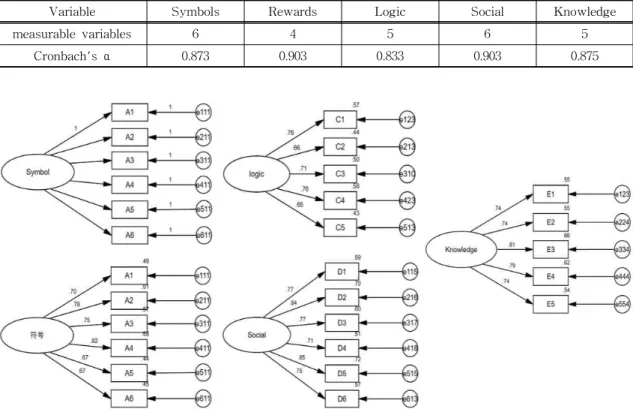
The results in Table 5 show that the Cronbach's α coefficient of each variable is greater than 0.7, indicating that the revised scales have a good reliability.

4.3 Validity inspection

We used the AMOS software to test the struc- tural validity of the questionnaire and examine the matching degree of the theoretical model and the survey data. First, with validation factor analysis,5 factors "symbol, reward, logic, social, knowledge"

were examined. Then we used maximum likelihood methods to finish model estimation. The results are shown in Fig. 5.

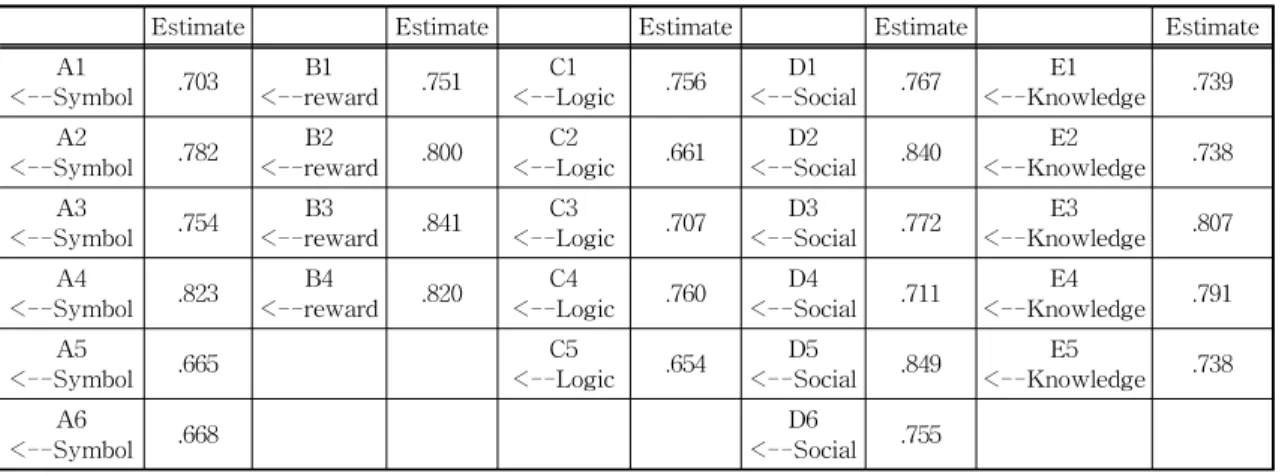
As can be seen from the above table that the factors of “symbol, reward, logic, social and knowl- edge”, the standardized factor load of the ver- ification factor analysis are greater than 0.5, in- dicating that the effect is good Table 6.

The evaluation indicators in Table 7 show the data fitness of the five factors models, "Symbol, Reward, Logic, Social, Knowledge", with the ratio of freedom X²/df are that symbol = 2.469, reward

= 2.064, logical = 2.376, social = 2.989, knowledge

= 1.172, all less than 5.The absolute fitting index GFI are that symbol = 0.965, Reward = 0.981, Logic

= 0.976, Social = 0.965, Knowledge = 0.989, all greater than 9. The relative fitting index CFI are

Table 3. Total variance explained.

Total variance explained

Ingredients

Initial Eigenvalue Extraction of the sum

of squares of loads Sum of squared rotating loads Total Percentage

of variance Cumulative

% Total Percentage

of variance Cumulative

% Total Percentage

of variance Cumulative

%

1 13.017 48.212 48.212 13.017 48.212 48.212 3.835 14.206 14.206

2 1.662 6.156 54.368 1.662 6.156 54.368 3.827 14.174 28.379

3 1.263 4.679 59.047 1.263 4.679 59.047 3.756 13.912 42.291

4 1.171 4.338 63.384 1.171 4.338 63.384 3.498 12.955 55.245

5 1.059 3.923 67.308 1.059 3.923 67.308 3.257 12.063 67.308

6 The following features are omitted if they are less than 1.

(7)

Table 4. Factor load of DEG achievement elements.

Factor Title Questionnaire title Composition cronbach

alpha Factor

1 Factor 2 Factor

3 Factor 4 Factor

5

Symbols

A3 Always want to dress up when playing

games 0.769

.873 A2 I want to get more badges when playing

the game 0.723

A4 The game makes me happy to choose

the role I like 0.675

A1 When playing the game I want to get

a more advanced title 0.618

A6 I will collect all kinds of beautiful clothes and equipment in the game 0.605 A5 The different flags and decorations in

the game attract me to play the game 0.604

Social

D2 I want to play better than my classmates

(games) 0.716

.903 D1 I like to play games with my friends 0.707

D6 In the game I hope people appreciate me 0.648 D3 It's fun to show other people the games

I play 0.620

D4 I want to tell my classmates where to

play in the game 0.619

D5 I want to tell my classmates that I play

games very well 0.619

Rewards

B4 I want to get more money (gold) in the

game 0.766

.903 B3 The game is happy to get treasures

(gems, treasure chests) 0.724

B5 I want to get the first place trophy in

the game 0.711

B2 I want to have higher experience in the

game 0.646

B1 I want to get a higher bonus score in

the game 0.633

Knowledge

E1 Learning from the game makes me happy 0.730

.875 E4 When you don't play the game, you also

think about the knowledge in the game 0.681

E2 Play the game learned a lot of interesting

things 0.673

E3 Learning knowledge in the game is not

tired at all 0.662

E5 Learning knowledge if all can be done

in the game will be great 0.646

Logic

C5 When playing the game, know how to

play to be interesting 0.751

.833 C2 I like the game I will play again and

again 0.698

C1 Find a way to complete the game tasks

I will be very open 0.645

C4 Each level in the game is different to

be interesting 0.609

C3 The skills in the game make the game fun 0.583

Intrinsic value 13.017 1.662 1.263 1.171 1.059

Variance explanation rate 14.206 28.379 42.291 55.245 67.308

KMO 0.944

Bartlett's Test of Sphericity

Approximate cardinality 3844.660

df 351

Sig 0.000

(8)

symbol = 0.976, Reward = 0.992, Logic = 0.981, Social = 0.976, Knowledge = 0.998, all greater than 0.9. RMSEA are symbol = 0.083, Reward = 0.071, Logic = 0.081, Social = 0.097, Knowledge = 0.029, less than 0.10 and CR values greater than 0.7. The factors have high factor convergence and AVE value is greater than 0.5. The evaluation indicators meet the requirements, indicating that the symbol, reward, logic, social and knowledge models fit the data well, and the scale has good structural validity.

4.4 Relevant analysis among various elements Symbol, reward, logic, social and knowledge factors show 0.01 level significance between the player's attitude to achievement system respec- tively, and the correlation coefficient values are greater than 0.4, indicating that these five factors have significant positive correlation between the relationship and attitude and the factors have

strong correlation. Among them, the necessity at- titude of achievement system and symbol and so- cial is the closest relationship (r=.724** \ r=.737**).

At the same time, there is also a significant pos- itive correlation between the factors. Social and Reward present the closest relationship (r=.729 **).

Knowledge and rewards also presented closely re- lated (r=.705**), other factors are also closely re- lated Table 8.

The analysis found that adjusting R² is 0.666, indicating that the 5 factors can explain the reason why sample necessity attitude have changed 66.6

%. Model P = 0.000, F = 84.979, P value of 5 factors are less than 0.05 and significantly indicate that 5 factors will affect the necessity attitude of achieve- ment system. The B value of regression coefficient is greater than 0, indicating that 5 factors will have positive impact on the necessity attitude of ach- ievement system Table 9.

Table 5. Reliability Testing.

Variable Symbols Rewards Logic Social Knowledge

measurable variables 6 4 5 6 5

Cronbach's α 0.873 0.903 0.833 0.903 0.875

Fig. 5. Validation Factor Analysis on Structural Equation Model.

(9)

Table 6. Factor loading coefficients for each of the 5 factor questions.

Estimate Estimate Estimate Estimate Estimate

A1

<--Symbol .703 B1

<--reward .751 C1

<--Logic .756 D1

<--Social .767 E1

<--Knowledge .739 A2

<--Symbol .782 B2

<--reward .800 C2

<--Logic .661 D2

<--Social .840 E2

<--Knowledge .738 A3

<--Symbol .754 B3

<--reward .841 C3

<--Logic .707 D3

<--Social .772 E3

<--Knowledge .807 A4

<--Symbol .823 B4

<--reward .820 C4

<--Logic .760 D4

<--Social .711 E4

<--Knowledge .791 A5

<--Symbol .665 C5

<--Logic .654 D5

<--Social .849 E5

<--Knowledge .738 A6

<--Symbol .668 D6

<--Social .755

Table 7. Factors validity.

Fitting index x²/df RMSEA GFI CFI TLI CR AVE

Symbols 2.469 .083 .965 .976 .961 .823 .540

Rewards 2.064 .071 .981 .992 .983 .940 .653

Logic 2.376 .081 .979 .981 .962 .834 .503

Social 2.989 .097 .965 .976 .959 .905 .614

Knowledge 1.172 .029 .989 .998 .996 .874 .583

Table 8. Correlation analysis.

Relevance

Elements Attitude Symbols Rewards Logic Social Knowledge

Attitude system attitude 1

Symbols .724** 1

Rewards .698** .658** 1

Logic .655** .663** .578** 1

Social .737** .690** .729** .672** 1

Knowledge .684** .645** .705** .616** .693** 1

**. At the 0.01 level (two-tailed), the correlation is significant.

Table 9. Summary of multiple linear regression analysis.

Y X

Unstandardized Coefficients standardized coefficient

Standardized

Coefficients t P R² Adjusted

R Square F

B Std. Error Beta

Achievement system use

attitude

(Constant) 30.195 2.645 - 11.418 0.000

0.673 0.666 84.979

Symbols 3.998 0.941 0.265 4.247 0.000

Rewards 2.658 1.026 0.168 2.590 0.010

Logic 2.294 1.061 0.127 2.162 0.032

Social 3.466 0.977 0.244 3.548 0.000

Knowledge 2.416 1.030 0.148 2.346 0.020

(10)

5. DISCUSSIONS & CONCLUSIONS

5.1 Conclusions

Through literature analysis, case analysis, ex- pert interview and empirical research, we evidently extracted and researched the elements of Chil- dren’s DEG achievement system and they pre- sented good reliability and validity. Relevant anal- ysis found the relationship and role between the elements. Regression analysis found that the ach- ievement system and composition elements are positively related to the player attitude. Conclusion is as follows:

(1) The components of Children’s DEG achieve- ment system are "symbol", "reward", "logic", "social"

and "knowledge",which meet the expected views of literature research and expert interviews and they can be explained by the comprehensive theory of motivation. Symbol and reward can bring ex- ternal motivation to gamers. Knowledge can bring inside motivation to gamers and social is the bridge of connection. Through appropriate logical meth- ods, they can improve the game experience, and will influence and improve the learning attitude, motivation, effectiveness. The composition of chil- dren's DEG achievement system has high refer- ence value for the design and development and theoretical research of educational games.

(2) We can see the necessity and value of DEG achievement system since the players have a pos- itive attitude towards it. The achievement system composition has a significant positive impact on the player attitude, indicating that the children's DEG achievement system can bring a better user experience, enhance the use motivation, and attract players to use. The five factors are closely related to the attitude of the players. The factors show high significance, which indicates that the five ele- ments of the achievement system are closely re- lated and linked with each other. The common ef- fect will have a positive effect on the attitude of the players. In the meantime, the elements are not

isolated but commonly linked. In the period, sym- bols, social factors have a strong relationship with the attitude of achievement system, which can be understood that the symbolic achievement ele- ments are the explicit achievement elements that players attach importance to. With this, players can have intuitive cognition and experiences as it can be paid more attention to. Social elements allow the players to share or compete with people in the game, which becomes a important kind of motiva- tion for the player’s achievements. It is in line with the expression of social comparison theory so that the players can pay attention to the elements [18].

(3) social and reward elements are the most closely related under the relationship between the elements of children’s achievement system, which can be explained that players can share their re- wards to more players by social methods. Sharing can bring greater satisfaction and the rewards in the competition and challenge environment will al- so bring a better experience. Knowledge and Reward are closely related. Rewards can constantly in- centive players to obtain more knowledge and knowledge is also another form of reward. Players not only hope to have knowledge in the educational game, but also hope to have more reward. Players can have better experiences if learning and re- wards can be balanced and it is in line with the concept of internal and external motivation to form motivation together.

Children's DEG achievement system is com- posed of five elements: "symbol", "reward", "logic",

"social" and "knowledge", each component inter- acts with each other and together has a significant positive effect on the player's attitude, make the game a better user experience and increase moti- vation. The proposed DEG system for children can effectively enhance the learning experience and improve the quality of learning.

5.2 Research limitations and future research

It is subjective to use interview questionnaires

(11)

to collect data. So the future researches will be conducted to improve the reliability and validity of the research conclusions. Due to time and energy, differences in systematic attitudes and preferences for different ages and gender have not been con- ducted and will be studied deeper in the future. The study on differences in achievement systems across different platforms, different theme types will also continue in subsequent studies.

REFERENCE

[ 1 ] Metaari, 2018-2023 Global Game-based Learn- ing Market. pp. 47, 2018.

[ 2 ] L. Galli and P. Fraternali, “Achievement Systems Explained,” Gaming Media and Social Effects-Trends and Applications of Serious Gaming and Social Media, Vol. 14, No. 3, pp. 25-50, 2014.

[ 3 ] R. McDaniel and J. Fanfarelli, “Building Better Digital Badges: Pairing Completion Logic With Psychological Factors,” Simulation &

Gaming, Vol. 47, No. 3, pp. 73-102, 2016.

[ 4 ] C. Groening and C. Binnewies, “Achievement Unlocked!”-The Impact of Digital Achievements as a Gamification Element on Motivation and Performance,” Computers in Human Behavior, Vol. 97, No. 8, pp. 151-166, 2019.

[ 5 ] K.E. Rouse, Gamification in Science Education:

The Relationship of Educational Games to Motivation and Achievement, Pro Quest LLC, Ann Arbor, Michigan, 2013.

[ 6 ] Xbox 360 Achievements help boost review scores & sales, https://www.neoseeker.com/

news/7241-xbox-360-achievements-help- boost-review-scores-sales/ (accessed October 17, 2007).

[ 7 ] B. Anđić, S. Kadić, and R. Grujičić, et al., “A Comparative Analysis of the Attitudes of Primary School Students and Teachers Re- garding the Use of Games in Teaching,”

IAFOR Journal of Education, Vol. 6, No. 2,

pp. 5-16, 2018.

[ 8 ] S. Arnab, T. Lim, and M.B. Carvalho, et al.,

“Mapping Learning and Game Mechanics for Serious Games Analysis: Mapping Learning and Game Mechanics,” British J ournal of Educational Technology, Vol. 46, No. 2, pp.

391-411, 2015.

[ 9 ] P. Wouters, C. Nimwegen, and H. Oostendorp, et al., “A Meta-Analysis of the Cognitive and Motivational Effects of Serious Games,”

J ournal of Educational Psychology, Vol. 105, No. 2, pp. 249-265, 2015.

[10] J.P. Gee, “What Video Games Have to Teach Us About Learning and Literacy,” J ournal of Literacy & Technology, Vol. 1, No. 1, pp. 4, 2003.

[11] M.J. Dondlinger, “Educational Video Game Design: A Review of the Literature,” J ournal of applied educational technology, Vol. 4, No.

1, pp. 11, 2007.

[12] B. Erickson and J. Kounios, The Patient Revolution, Insight, John Wiley & Sons, Ltd, San Francisco, Calif. 2015.

[13] S. Egenfeldt-Nielsen, “Overview of Research on the Educational Use of Video Games,”

Nordic Journal of Digital Literacy, Vol. 1, No.

1, pp. 184-213, 2006.

[14] L. Galli and P. Fraternali, “Achievement Systems Explained,” Trends and Applications of Serious Gaming and Social Media, Singapore: Springer Singapore, pp. 25-50, 2014.

[15] J. Hamari and V. Eranti, “Framework for Designing and Evaluating Game Achievements,” Digra Conference: Think Design P lay, pp. 20, 2011.

[16] M. Montola, T. Nummenmaa, and A. Lucero,

et al., “Applying Game Achievement Systems

to Enhance User Experience in a Photo Sharing

Service,” Proceedings of the 13th Internatio-

nal MindTrek Conference: Everyday Life in

the Ubiquitous Era on - MindTrek ’09, pp. 94,

(12)

2009.

[17] H.-B. Ham, “On Simulation for Normaliza- tion of Game Satisfaction Density Function,”

Journal of Korea Multimedia Society, Vol. 10, No. 9, pp. 1185-1196, 2007.

[18] G. Richter, D.R. Raban, and S. Rafaeli, “Stu- dying Gamification: The Effect of Rewards and Incentives on Motivation,” Gamification in Education and Business, pp. 21-46, 2015.

Kun Shi

2019~Currently Dept. of Design

& Manufacturing Engineering, Jeonbuk National University, PhD course

2010~2013 Harbin Normal University, Master Focus areas: Game design, Visual design

Dong-Min Cho 2009~Currently, Dept. of Design & Manufacturing Engineering, Jeonbuk National University, Professor

2008~2009, Sogang University

Game Education Institute,

full-time lecturer

2004~2006 AAU, San Francisco, USA MFA,

Focus areas: Game design, Visual design

수치

Fig. 1. Global and Chinese Educational Games Market.
Fig. 3. Thesis Research Pathway Map.
Fig. 4. Achievement system representative game type.
Table 2. Typical achievement items in the game.
+5

참조

관련 문서

The academic journals used at the time were ‘The Mathematical Education’ of The Korean Society of Mathematical Education, ‘Journal of Educational Research

The purpose of this study to investigate the background of revision, educational objectives, organization, contents of the high school earth science curriculum

웹 표준을 지원하는 플랫폼에서 큰 수정없이 실행 가능함 패키징을 통해 다양한 기기를 위한 앱을 작성할 수 있음 네이티브 앱과

_____ culture appears to be attractive (도시의) to the

S국은 국내법에 따라 과세할 권리를 기지고 있 지 않기 때문에 , 그리고 조세조약에 따라 소득이 귀속될 S국에 있는 Tco가 S국에 고정사업장을 가지고 있지

After first field tests, we expect electric passenger drones or eVTOL aircraft (short for electric vertical take-off and landing) to start providing commercial mobility

1 John Owen, Justification by Faith Alone, in The Works of John Owen, ed. John Bolt, trans. Scott Clark, &#34;Do This and Live: Christ's Active Obedience as the

Also by analysing changes of educational process, the seventh education course, and the direction of educational revision, I closely examined music