• 검색 결과가 없습니다.

Nematicidal Compounds from the Leaves of Schinus terebinthifoliusAgainst Root-knot Nematode, Meloidogyne incognita Infecting Tomato

N/A
N/A
Protected

Academic year: 2022

Share "Nematicidal Compounds from the Leaves of Schinus terebinthifoliusAgainst Root-knot Nematode, Meloidogyne incognita Infecting Tomato"

Copied!
12
0
0

로드 중.... (전체 텍스트 보기)

전체 글

(1)

https://doi.org/10.20307/nps.2018.24.4.272

272

Nematicidal Compounds from the Leaves of Schinus terebinthifolius Against Root-knot Nematode, Meloidogyne incognita Infecting Tomato

Fatma M. Abdel Bar

1,2

*, Dina S. Ibrahim

3

, Sahar R. Gedara

2

, Mohammed S. Abdel-Raziq

2

, and Ahmed M. Zaghloul

2

1

Department of Pharmacognosy, Faculty of Pharmacy, Prince Sattam Bin Abdulaziz University, Al-Kharj, 11942, Saudi Arabia

2

Department of Pharmacognosy, Faculty of Pharmacy, Mansoura University, Mansoura, 35516, Egypt

3

Department of Nematology, Plant Pathology Res. Inst., Agric. Res. Center, Giza, Egypt

Abstract − The root-knot nematode, Meloidogyne incognita caused a serious damage to many plants. The phenolic components of the leaves of Schinus terebinthifolius were investigated as potential nematicidal agents for M. incognita. Nine compounds were isolated and characterized as viz., 1,2,3,4,6-pentagalloyl glucose (1), kaempferol-3-O-α-L-rhamnoside (Afzelin) (2), quercetin-3-O-α-L-rhamnoside (Quercetrin) (3), myricetin (4), myricetin-3-O- α-L-rhamnoside (Myricetrin) (5), methylgallate (6), protocatechuic acid (7), quercetin (8), and gallic acid (9) using nuclear magnetic resonance (NMR) spectroscopy. Compound 1 showed pronounced nematicidal activity compared to Oxamyl as a positive control. It showed the lowest eggs-hatchability (34%) and the highest mortality in nematode population (21% after 72 hours of treatment) at a concentration of 200 μg/mL. It exhibited the best suppressed total nematode population, root galling and number of eggmasses in infected tomato plants.

The total carbohydrates and proteins were also significantly induced by 1 with reduction in total phenolics and increase in defense-related proteins. Thus, compound 1 could be a promising, more safe and effective natural nematicidal agent for the control of root-knot nematodes.

Keywords − Meloidogyne incognita; Schinus terebinthifolius; pentagalloyl glucose; nematicidal activity; root- knot nematode

Introduction

Schinus terebinthifolius Raddi (Anacardiaceae), known as “Brazilian pepper” is an evergreen tree, native to Brazil and introduced in different parts of the world. It has been used in folk medicine as anti-inflammatory, immunomo- dulatory, antipyretic, analgesic, detoxifying agent, chemo- preventive and in wound healing. In addition, it has been used in treating skin, mucous membranes, genitourinary, respiratory and GIT infections due to its antifungal and antibacterial properties.

1-8

Moreover, the ethanolic extract of leaves and stems of S. terebinthifolius inhibits quorum- sensing activity in methicillin-resistant Staphylococcus aureus infections and thus inhibits the production of virulence factors.

9

The leaves extract exhibits anticancer properties

10

and the fruits extract inhibits nitric oxide

production and shows antioxidant activity.

4

Also, the ethyl acetate fraction of leaves of S. terebinthifolius exhibits anti-allergic properties and inhibits histamine release and edema development in mice.

11

Diverse groups of phytochemicals including phenolics and terpenoids have been reported from leaves, barks and fruits of S. terebinthifolius. Several phenolic compounds including mono- and biflavonoids, coumaric acid and gallic acid derivatives have been reported.

6,13-16

A biphenyl compound namely, 4'-ethyl-4-methyl-2,2',6,6'-tetrahydroxy [1,1'-biphenyl]-4,4'-dicarboxylate, has been also isolated from leaves and stem of S. terebinthifolius.

6

However, fewer studies addressed the triterpenoid contents of this plants. For instance, tirucallane-type triterpenes such as masticadienoic acid and schinol have been isolated from the leaves S. terebinthifolius in large amounts.

17,18

Other triterpenoid groups including ursane-type ( α-amyrene, α- amyrenone and ursolic acid), bauerane-type (bauerenone) and adianane-type (simiarenol) triterpenes have been also isolated from this plant.

18,19

Plant parasites especially root-knot nematode is one of

*Author for correspondence

Fatma M. Abdel Bar, Department of Pharmacognosy, Faculty of Pharmacy, Prince Sattam Bin Abdulaziz University, Al-Kharj, 11942, Saudi Arabia

Tel: +966545403617;

E-mail: [email protected]; [email protected]

(2)

the leading problems in production of vegetables and other essential crops causing serious plant damage.

Meloidogyne sp. produced knots that prevent water and nutrients from reaching the leaves and fruits. Meloidogyne incognita, one of the widely distributed species, has been considered the most damaging of ten main genera of plant parasitic nematodes. It causes about 12.3% loss of the annual yield of world’s major crops.

20

The damage caused by M. incognita to tomato plant is massive and require safe and efficient control.

In the current research, the phenolic content of the methanol extract of the leaves of S. terebinthifolius was investigated. Nine phenolic compounds were isolated and characterized using spectroscopic methods. The isolated phenolic compounds (Fig. 1) 1 - 9 were evaluated for their nematicidal activity against root-knot nematode (M.

incognita) infecting tomato plant using in vitro and greenhouse experiments. The in vitro experiments were used to evaluate the number of eggmasses and larvae, while the greenhouse experiments were used to evaluate plant growth parameters including shoot length, shoot and root weight. Additionally, chemical analysis was used to assess carbohydrates, proteins, defense-related proteins

such as peroxidase (PO) and polyphenol oxidase (PPO) in both infected and control plants.

Experimental

General experimental procedures – The NMR spectros- copic experiments were performed on a Bruker Avance III 500 MHz Spectrometer (Bruker BioSpin Corp., Rhein- stetten, Germany). For column chromatography, stationary phases were silica gel G60, 70 - 230 mesh, (Catalogue # 1077345000, Merck, Germany) and Sephadex LH 20 (Catalogue # 17-0090-01, Sigma-Aldrich, USA). For TLC, silica gel plates F

254

(Catalogue # 1055540001, Merck, Germany) were used. Vanillin-sulfuric acid was used as a spray reagent. All chromatographic solvents were of reagent grade (El-Nasr Company, Egypt). The HR-MS experiments were conducted with a Bruker MicrOTof-Q (Bruker Daltonics, Bremen, Germany), where analytes were ionized using electrospray ionization (ESI) interface operated in the positive mode.

General methods

Phytochemical isolation of the phenolic compounds from the leaves of Schinus terebinthifolius − The leaves of S. terebinthifolius Raddi were collected from a farm at Damietta city, Egypt in July 2012, shade-dried, powdered and kept for further investigation. The plant was authenticated by Prof. Ibrahim Mashaly, at Ecology and Botany Department, Faculty of Science, Mansoura University. A voucher specimen was deposited at Phar- macognosy Department, Faculty of Pharmacy, Mansoura University (012-Mansoura-3). Powdered leaves of S.

terebinthifolius Raddi (4.0 kg) were macerated in a glass jar with methanol (4 × 6 L). The obtained methanol extract was concentrated using rotary evaporator at 45 C

o

and further dried to obtain a crude extract (817.4 g). The crude methanol extract was then dissolved in a suitable amount of methanol, and an equal amount of dist. H

2

O and partitioned with n-hexane, CH

2

Cl

2

and EtOAc. The obtained crops, were evaporated and dried to afford n- hexane (n-Hex, 124.7 g), CH

2

Cl

2

(34.7 g) and EtOAc (372 g) extracts. Finally, the left aqueous extract was passed over Diaion®, an ion exchange adsorbent, washed with water, eluted with methanol and evaporated under vacuum at 45 C

o

to afford a dry aqueous extract (86.0 g).

For isolation of the phenolic compounds, only the

aqueous and the EtOAc extracts were nominated to proceed

an intensive phytochemical isolation using different

chromatographic techniques. Fractionation and purification

of the components of the aqueous extract afforded six

compounds (1 - 6) as demonstrated in Fig. 2. Similarly,

Fig. 1. Structures of the isolated compounds.

(3)

Fig. 2. Isolation scheme of compounds 1 - 6 from the aqueous extract left after partitioning of the total MeOH extract using pet.ether, CH

2

Cl

2

and EtOAc, respectively.

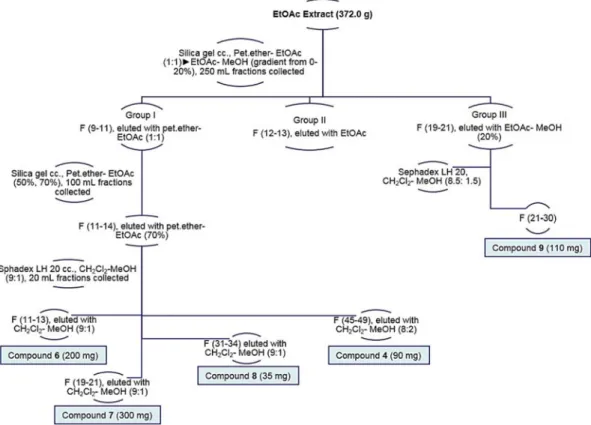
Fig. 3. Isolation scheme of compounds 4, 6 and 7 - 9 from the ethyl acetate extract.

(4)

the EtOAc extract was also purified to afford three other compounds (7 - 9), in addition to compounds 4 and 6 that were isolated before from the aqueous extract (Fig. 3).

Evaluation of the nematicidal activity of the extracts and the isolated compounds against root-knot nematode (M. incognita)

Preparation of Meloidogyne incognita inocula

21

M. incognita eggs inoculum – Eggmasses were collected from the roots of coleus plants, Coleus blumei L., heavily infected with M. incognita grown in horticultural nursery under greenhouse condition and propagated on coleus plants, a susceptible host, for 3 months at Nematological Research Unit (NERU), Faculty of Agriculture, Mansoura University, Mansoura, Egypt. Sodium hypochlorite (NaOCl) extraction method was used in order to collect the eggs of M. incognita. Infected roots were washed and cut into 2 - 3 cm parts and shacked in 200 mL of 1.0% NaOCl solution for 1 - 2 minutes.

21

NaOCl solution was quickly filtered through a 60-mesh sieve nested over a 400-mesh sieve to collect freed eggs and quickly placed under a stream of tap water to remove residual NaOCl.

M. incognita juveniles’ inoculum

22

– Fresh second stage juveniles of the root-knot nematode, M. incognita were obtained from pure culture maintained on coleus roots. Roots were incubated in a modified Baermann technique for hatching at room temperature for 5 - 7 days.

22

Experimental design Laboratory Experiments

Impact against eggs of root-knot nematode (M.

incognita)

23

– In order to evaluate the nematicidal properties of the extracts and isolated compounds against the eggs of root-knot nematode, M. incognita, the treatments were tested in Petri dishes, as triplicates at concentrations of 200, 100 and 50 μg/mL. Whereas, solvent and nematodes alone were used as negative control. To each dish, inoculum of 1 mL containing 100 eggs (M. incognita) was added to each treatment. The dishes were left for 10 days then the effect on egg hatching was examined under a microscope and compared to control.

Impact against larva of root-knot nematode (M.

incognita)

23

– In separate experiment, the extracts and the isolated compounds were added in Petri dishes, as triplicates at concentrations of 200, 100 and 50 μg/mL.

Solvent and nematodes alone were used as negative control. To each dish, inoculum of 1 mL containing 100 larvae (M. incognita) was added. The dishes were examined after 24, 48 and 72 h using microscope to study the effect of these treatments on the activity of larval second stage of root-knot nematode.

Greenhouse Experiment

24

Impact of the extracts and the isolated compounds on tomato plants infected with root-knot nematode (M. incognita) – A greenhouse experiment was conducted using sandy clayey soil in order to evaluate the nematicidal activity of the isolated compounds against the root-knot nematode, M. incognita. The resulting effects on plant growth parameters and on induced resistance (IR) were assayed through chemical composition and enzyme activities. In fifty-seven pots (15 cm in diameter) containing 800 g of sterilized soil, one seedling per pot of tomato plant was placed. Seedlings were then infected with 1000 viable larvae of M. incognita. After one week, infected plants were treated with the isolated compounds and extracts (200, 100 and 50 μg/mL) as soil drench.

Three pots were treated with Oxamyl® 10G as a standard nematicide at a concentration of 0.3 g per pot and three other pots were treated with DMSO (10 mL/pot) as a standard solvent. Additionally, three pots were left without nematode infection or any treatment and serve as control (N free). To three other pots nematodes were added alone without any treatment and served as control (N alone).

After then, in a greenhouse at 27 ± 3 ºC, pots were settled in three replicates as a random complete block design where they received water as required. After 45 days of nematode inoculation, plants were harvested and washed from adhering soil. Plant growth parameters including weight and length of both fresh or dried shoot and root were recorded. Nematodes were recovered from soil using sieving and modification of the Baermann method.

22

Root galling (eggmasses) were ranked according to the number of galls per root system using a scale of 0-5; 0 means “no galls”, 1 means “1 - 2 galls”, 2 means “3 - 10” galls, 3 means “11 - 30” galls, 4 means “31 - 100” galls and finally, 5 means “> 100 galls”.

23

Chemical analysis – For each treatment, dried shoot (1 g) was subjected to chemical analysis in order to evaluate crude protein, total carbohydrate and total phenols.

For the enzyme assays, enzyme extracts were prepared grinding dried root (0.5 g) of each treatment in 3 mL sod.phosphate buffer (pH 6.8) in a mortar and centrifuge at 1,500 × g 20 min at 6

o

C. The obtained supernatant was used for the evaluation of peroxidase (PO) and polyphenol oxidase (PPO) activities.

25

Crude protein – The protein content in supernatant of

fresh tomato plant from each treatment was estimated

according to the method of Bradford (1976)

26

by using

bovine serum albumin as a standard protein. Protein

content was adjusted to 2 mg/mL per sample.

(5)

Total carbohydrate – Total soluble sugars (reducing and non-reducing) were determined using the spectro- photometeric method described by Thomas and Dutcher, (1924)

27

using picric acid at λ

max

540 nm.

Total phenols – Total phenols were determined after harvesting of fresh whole plant using Folin-Ciocalteau reagent.

28

Total content of phenolic compounds in plant ethanolic extracts was calculated as catechol equivalents by the following equation:

Where, T; Total content of phenolic compounds (mg of catechol/100 g of fresh weight material). C; concentration of catechol established from the calibration curve (mg/

mL). V; volume of extract (mL). m; weight of pure plant ethanolic extract (g).

Peroxidase activity (PO) – Peroxidase was evaluated using the spectrophotometric method described by Amako et al. (1994).

29

The reaction was started by adding 20 μL of the enzyme solution to a mixture of 1,500 μL phosphate buffer, 480 μL H

2

O

2

and 1,000 μL pyrogallol. Blank was prepared using phosphate buffer instead of the enzyme extract. Absorbance of the solution was measured at λ

max

430 nm and compared to blank. One unit of enzyme activity was defined as the amount of the enzyme, which changing the optical density at 430 nm per min. at 25

o

C under standard assay conditions. Specific activity was expressed in units by dividing it to mg protein.

Polyphenol oxidase (PPO) – Polyphenol oxidase was evaluated using the spectrophotometric method described by Coseteng and Lee (1987).

30

The reaction was started by adding 0.05 mL of the enzyme solution to a mixture of 2.7 mL K.phosphate buffer (90.05 M, pH 6.2) and 0.25 mL catechol (0.25 M). Blank was prepared using phosphate buffer instead of the enzyme extract. Absorbance of the solution was measured at λ

max

420 nm and compared to blank. One unit of enzyme activity is defined as the amount of the enzyme that causes an increase of 0.001 absorbance unit per minute at 25

o

C.

Data Analysis – Statistical analysis of the obtained data was carried out using analysis of variance (ANOVA),

31

followed by Duncan's multiple range tests (MRT) to test for significant difference between means (Duncan, 1955).

32

Result and Discussion

Identification of the isolated compounds – Compound 1 was identified based on its spectral data including

1

H,

13

C NMR, IR and HR-ESIMS and by comparison with

previously reported data

33

as 1,2,3,4,6-pentagalloyl glucose which has been identified before from S. terebinthifolius.

16,34

Similarly, characterization of compounds 2 - 9 was established using their

1

H and

13

C NMR data and by comparison with previously reported data for similar structures. Based on these data, compound 2 was characterized as kaempferol-3-O- α-L-rhamnoside (Afzelin), compound 3 as quercetin-3-O- α-L-rhamnoside (Quercetrin), compound 4 as myricetin and compound 5 as myricetin- 3-O- α-L-rhamnoside (Myricetrin),

15,35,36

compound 6 methylgallate,

12,34,35

compound 7 as protocatechuic acid which is isolated for the first time from S. terebinthifolius,

37

compound 8 as quercetin,

34,36

and finally compound 9 as gallic acid.

12

1,2,3,4,6-Penta-O-galloyl- β-D-glucose 1 −

1

H NMR (CD

3

OD, 500 MHz); δ

H

6.22 (1H, d, J = 8.3 Hz, H-1), 5.56 (1H, dd, J = 9.7, 8.5 Hz, H-2), 5.88 (1H, t, J = 9.7 Hz, H-3), 5.60 (1H, t, J = 9.6 Hz, H-4), 4.50 (1H, d, J = 10.8 Hz, H-5), 4.36 (2H, m, H-6).

13

C NMR (CD

3

OD, 125 MHz); δ

C

92.4 (C-1), 70.8 (C-2), 72.7 (C-3), 68.4 (C- 4), 73.0 (C-5), 62.9 (C-6), Gal-A; 118.3 (C-1'), 109.2 (C- 2'/6'), 139.4 (C-3'/5'), 145.2 (C-4'), 164.8 (C-7'), Gal-B;

118.8 (C-1'), 109.0 (C-2'/6'), 139.0 (C-3'/5'), 145.0 (C-4'), 165.6 (C-7'), Gal-C; 118.9 (C-1'), 109.0 (C-2'/6'), 138.8 (C-3'/5'), 144.9 (C-4'), 165.9 (C-7'), Gal-D; 118.8 (C-1'), 109.1 (C-2'/6'), 139.0(C-3'/5'), 145.1 (C-4'), 165.5 (C-7'), Gal-E; 119.6 (C-1'), 108.9 (C-2'/6'), 138.6 (C-3'/5'), 145.0 (C-4'), 166.5 (C-7'); HRMS at m/z 963.1048 [M+Na]

+

, Calcd. for C

41

H

32

NaO

26

963.0180.

Kaempferol-3-O-α-L-rhamnoside (Afzelin) 2 −

1

H NMR (CD

3

OD, 500 MHz); δ

H

6.16 (1H, brs, H-6), 6.31 (1H, brs, H-8), 6.92 (2H, d, J = 7.6, H-3'/5'), 7.72 (2H, d, J = 7.7 Hz, H-2'/6'), 5.39 (1H, brs, H-1''), 4.28 (1H, brs, H-2''), 3.77 (1H, brd, J = 3.0 Hz, H-3''), 3.37 (1H, brs, H- 4''), 3.33 (1H, brs, H-5''), 0.95 (3H, brs, H

3

-6'').

13

C NMR (CD

3

OD, 125 MHz); δ

C

158.2 (C-2), 136.2 (C-3), 179.5 (C-4), 163.0 (C-5), 99.9 (C-6), 94.9 (C-8), 159.2 (C-9), 105.9 (C-10), 122.6 (C-1'), 132.0 (C-2'/6'), 116.5 (C-3'/5'), 161.4 (C-4'), 103.5 (C-1''), 72.0 (C-2''), 72.1 (C-3''), 73.3 (C-4''), 72.0 (C-5''), 17.7 (C-6'').

Quercetin-3-O- α-L-rhamnoside (Quercetrin) 3 −

1

H NMR (CD

3

OD, 500 MHz); δ

H

6.19 (1H, brs, H-6), 6.34 (1H, brs, H-8), 7.4 (1H, brs, H-2'), 6.92 (1H, d, J = 8.0 Hz, H5'), 7.30 (1H, d, J = 8.0 Hz, H-6'), 5.37 (1H, brs, H- 1''), 4.31 (1H, brs, H-2''), 3.80 (1H, d, J = 8.8, H-3''), 3.33 (1H, m, H-4''), 3.43 (1H, m, H-5''), 0.97 (3H, d, J = 5.5 Hz, H

3

-6'').

13

C NMR (CD

3

OD, 125 MHz); δ

C

159.3 (C- 2), 136.3 (C-3), 179.6 (C-4), 163.1 (C-5), 99.9 (C-6), 165.9 (C-7), 94.8 (C-8), 158.4 (C-9), 105.9 (C-10), 123.0 (C-1'), 116.4 (C-2'), 149.7 (C-3'), 146.3 (C-4'), 117.0 (C-

T CXV

--- 100 m ×

=

(6)

5'), 123.0 (C-6'), 103.5 (C-1''), 72.1 (C-2''), 72.1 (C-3''), 73.3 (C-4''), 71.9 (C-5''), 17.7 (C-6'').

Myricetin 4 −

1

H NMR (CD

3

OD, 500 MHz); δ

H

6.20 (1H, brs, H-6), 6.40 (1H, brs, H-8), 7.37 (2H, s, H-2'/6').

13
C NMR (CD

3

OD, 125 MHz); δ

C

148.0 (C-2), 136.9 (C- 3), 177.2 (C-4), 162.4 (C-5), 99.3 (C-6), 165.5 (C-7), 94.4 (C-8), 158.1 (C-9), 104.5 (C-10), 123.1 (C-1'), 108.6 (C-

2'/6'), 146.7 (C-3'/5'), 137.4 (C-4').

Myricetin-3-O-α-L-rhamnoside (Myricetrin) 5 −

1

H NMR (CD

3

OD, 500 MHz); δ

H

6.19 (1H, brs, H-6), 6.34 (1H, brs, H-8), 6.99 (2H, s, H-2'/6'), 5.35 (1H, brs, H-1''), 4.30 (1H, brs, H-2''), 3.86 (1H, d, J = 7.1 Hz, H-3''), 3.18 (1H, m, H-4''), 3.54 (1H, m, H-5''), 0.99 (3H, d, J = 5.0 Hz, H

3

-6'').

13

C NMR (CD

3

OD, 125 MHz); δ

C

146.3 (C- Table 1. Impact of treatments with n-hexane, EtOAc extracts and compounds (1 - 9), isolated from Shinus terbenthifolius leaves, against eggs and larvae of root-knot nematode Meloidogyne incognita under laboratory conditions.

Compds. Conc.

(μg/mL) Unhatched eggs Dead larvae

24 hr 48 hr 72 hr

1

200 66

a

14

d

16

c

21

a

100 59

a

9

f

10

e

16

c

50 59

a

7

g

5

h

10

c

2

200 27

e

3

i

5

h

6

g

100 20

d

5

h

7

g

14

d

50 10

i

2

i

3

i

8

f

3

200 21

f

3

i

4

h

4

h

100 35

c

5

h

11

e

5

h

50 44

b

2

i

8

g

10

e

4

200 19

g

3

i

8

f

9

f

100 23

d

11

e

9

f

12

d

50 10

i

9

f

7

g

4

h

5

200 29

e

2

i

5

h

4

h

100 34

c

7

g

8

f

8

f

50 30

d

6

g

2

i

5

h

6

200 58

c

5

h

8

f

13

d

100 48

b

8

f

14

d

11

e

50 32

d

6

g

3

i

8

f

7

200 59

c

4

h

9

f

13

d

100 43

b

8

f

7

g

19

b

50 22

f

4

h

4

h

7

g

8

200 26

e

5

h

7

g

9

f

100 33

c

8

f

13

d

15

d

50 26

e

7

g

3

i

5

h

9

200 23

f

4

h

9

f

12

d

100 36

c

8

f

9

f

17

c

50 12

g

3

i

7

g

5

h

EtOAc

200 60

b

5

h

7

g

9

f

100 39

c

9

f

10

e

9

f

50 31

d

8

f

5

h

4

h

n-Hex

200 47

d

6

g

6

g

6

g

100 53

a

7

g

9

f

10

e

50 31

d

5

h

4

h

5

h

DMSO solvent --- 17

h

2

i

2

i

2

i

Water Control --- 10

i

2

i

2

i

2

i

*Each value presented the mean of three replicates.

M. incognita; eggs (100 eggs / plant) or larvae (100 second stage larva / plant)

Means in each column followed by the same letter(s) did not differ at P ≤ 0.05 according to Duncan's multiple range test.

(7)

2), 136.3 (C-3), 179.6 (C-4), 158.4 (C-5), 100.0 (C-6), 165.7 (C-7), 94.9 (C-8), 158.2 (C-9), 105.8 (C-10), 122.0 (C-1'), 109.9 (C-2'/6'), 146.7 (C-3'/5'), 137.9 (C-4'), 103.5 (C-1''), 72.1 "(C-2''), 72.1 (C-3''), 73.4 (C-4''), 71.9 (C-5''), 17.8 (C-6'').

Methylgallate 6 −

1

H NMR (DMSO-d

6

, 500 MHz); δ

H

7.00 (2H, s, H-2/6), 3.72 (3H, s, OCH

3

).

13

C NMR (DMSO-d

6

, 125 MHz); δ

C

119.4 (C-1), 108.6 (C-2/6), 145.4 (C-3/5), 138.3 (C-4), 166.4 (C-7), 51.3 (OCH

3

).

Protocatechuic acid 7 −

1

H NMR (DMSO-d

6

, 500 MHz); δ

H

6.81 (1H, d, J = 6.9 Hz, H-5), 7.33 (1H, d, J = 6.7 Hz, H-6), 7.38 (1H, brs, H-2), 9.62 (1H, OH).

13

C NMR (DMSO-d

6

, 125 MHz); δ

C

121.6 (C-1), 116.4 (C- 2), 144.7 (C-3), 149.9 (C-4), 115.2 (C-5), 122.1 (C-6), 167.4 (C-7).

Quercetin 8 −

1

H NMR (CD

3

OD, 500 MHz); δ

H

6.20 (1H, brs, H-6), 6.40 (1H, brs, H-8), 7.75 (1H, brs, H-2'), 6.89 (1H, d, J = 8.0 Hz, H-5'), 7.64 (1H, d, J = 8.0 Hz, H- 6').

13

C NMR (CD

3

OD, 125 MHz); δ

C

148.8 (C-2), 137.3 (C-3), 177.3 (C-4), 162.5 (C-5), 99.2 (C-6), 165.6 (C-7), 94.4 (C-8), 158.2 (C-9), 104.5 (C-10), 124.1 (C-1'), 116.0 (C-2'), 146.2 (C-3'), 148.0 (C-4'), 116.2 (C-5'), 121.7 (C-6').

Gallic acid 9 −

1

H NMR (CD

3

OD, 500 MHz); δ

H

7.09 (2H, s, H-2/6).

13

C NMR (CD

3

OD, 125 MHz); δ

C

122.0 (C-1), 110.4 (C-2/6), 146.4 (C-3/5), 139.6 (C-4), 170.5 (C-7).

Impact against eggs and larva of root-knot nematode (M. incognita) – Data in Table 1 document the impact of screened materials (compounds 1 - 9, EtOA and n-hexane extracts) on in vitro controlling M. incognita.

Results revealed that nematode population were significantly suppressed by all tested treatments. Out of the tested materials, compound 1 at the concentration of 200 μg/mL achieved the lowest hatchability in eggs of root-knot nematode (34.0%) followed by EtOAc (40.0%) then compound 7 and 6 (41.0 and 42%, respectively) at the same concentration (Table 1, Fig. 4). Also, compound 1 at the concentration of 200 μg/mL achieved the highest mortality in root-knot nematode population after 72 hr (21.0%) followed by compound 7 and 6 (13.0%, each) at the same concentration after 72 hr of inoculation (Table 1, Fig. 5). Similar trend was noticed at the concentration of 100 and 50 μg/mL for the same treatments. Thus, com- pound 1, 6, 7, n-hexane and EtOAc extracts were selected for in vivo investigation on plant growth response of tomato plant var. 162 infected with M. incognita.

Impact of the extracts and the isolated compounds on tomato plants infected with root-knot nematode (M. incognita) – M. incognita infection caused a significant reduction in plant growth parameters (shoot and root length, shoot weight). Patel et al.

23

reported the effect of several plant extracts on the suppression of the population of M. incognita and M. javanica infecting tomato plants.

In this study, compounds 1, 6 and 7, in addition to n- hexane and EtOAc extracts from Schinus terebenthifolius showed remarkable increase in plant growth parameters in terms of shoot length, shoot and root weight with various degrees with all treatments (Table 2). It was evident that compound 1 enhanced plant growth parameters and caused

Fig. 4. Impact of treatments with EtOAc extracts and compounds (1, 6, 7), isolated from Shinus terbenthifolius leaves, on egg hatchability

of root-knot nematode Meloidogyne incognita under laboratory conditions.

(8)

Fig. 5. Impact of treatments with EtOAc extracts and compounds (1, 6, 7), isolated from Shinus terbenthifolius leaves, against larvae of root-knot nematode Meloidogyne incognita under laboratory conditions.

Table 2. Impact of treatment with n-hexane, EtOAc extracts and compounds 1, 6 and 7, isolated from Shinus terbenthifolius leaves, on plant growth response of tomato var. 162 infected with Meloidogyne incognita under greenhouse conditions (27 ± 3

o

C).

Compds. Treatment ( μg/mL)

*Plant growth response

Shoot Dry wt. (g) Inc.%

Length (cm) Plant fresh wt. (g)

Shoot Inc.% Root Inc.% Shoot Root Total Inc.%

1

50 16.0

d

45.5 9.0

c

50.0 2.3

c

1.6

b

3.6 143.75 1.3

b

116.7

100 19.0

b

72.7 10.0

b

66.7 2.4

c

1.4

c

3.8 137.5 1.0

d

66.7

200 23.0

a

109.1 11.5

a

91.7 3.0

a

1.9

a

4.9 206.25 1.5

a

150.0

6

50 11.7

g

6.4 9.0

c

50.0 2.3

c

0.8

f

3.1 93.75 0.8

e

33.3

100 13.0

f

18.2 10.0

b

66.7 2.9

b

0.8

f

3.7 131.25 1.1

c

83.3

200 16.0

d

45.5 10.5

b

75.0 3.0

a

1.2

d

4.2 162.5 1.4

b

133.3

7

50 15.0

e

36.4 9.5

c

58.3 2.7

b

1.0

e

3.7 131.25 0.9

e

50.0

100 16.0

d

45.5 10.0

b

66.7 2.6

b

1.6

b

4.2 162.5 1.3

b

116.7

200 17.5

c

59.1 10.5

b

75.0 3.1

a

1.3

c

4.4 175.0 1.5

a

150.0

n-Hex

50 13.0

f

18.2 6.0

e

0.0 1.8

d

1.2

d

3.0 87.5 0.7

f

16.7

100 13.0

f

18.2 6.0

e

0.0 2.6

b

1.2

d

3.8 137.5 0.9

e

50.0

200 17.0

d

54.5 8.0

d

33.3 2.7

b

1.5

c

4.2 162.5 1.0

d

66.7

EtOAc

50 13.0

f

18.2 9.0

b

50.0 1.0

f

1.0

e

2.0 25.0 0.7

f

16.7

100 16.0

d

45.5 11.0

a

83.3 1.5

e

1.1

d

2.6 62.5 0.9

e

50.0

200 18.0

b

63.6 11.0

a

83.3 1.8

d

1.3

c

3.1 93.75 1.1

c

83.3

DMSO 17.0

c

54.5 10.0

b

66.7 1.9

d

1.2

d

3.1 93.75 1.1

c

83.3

Oxamyl 18.5

b

68.2 10.0

b

66.7 2.6

b

1.1

d

3.7 131.25 0.7

f

16.7

N-free 12.5

f

13.6 9.0

b

50.0 1.8

d

1.2

d

3.0 87.5 1.1

c

83.3

N alone 11.0

g

0.0 6.0

e

0.0 1.0

f

0.6

g

1.6 0.0 0.6

g

0.0

*Each value presented the mean of three replicates.

N: M. incognita (1000 second stage (larva) / plant).

N-free: Plants free of M. incognita

Means in each column followed by the same letter (s) did not differ at P ≤ 0.05 according to Duncan's multiple range test.

(9)

Fig. 6. Impact of compounds 1, isolated from Shinus terbenthifolius leaves, on plant growth response of tomato var. 162 infected with Meloidogyne incognita under greenhouse conditions (27 ± 3

o

C).

Table 3. Impact of treatments with n-hexane, EtOAc extracts and compounds 1, 6 and 7, isolated from Schinus terbenthifolius leaves, on the development and reproduction of Meloidogyne incognita infecting tomato var. 162 grown under greenhouse conditions at 27 ± 3

o

C.

Compds. Treatment (μg/mL)

Nematode population

Final population

(Pf)

RF** Red. % No. of

galls ***RGI No. of

Eggmass ***EI Soil

Root Developmental

stages Females 1

50 1200.0

d

0.0

b

33.0

cd

1233.0 1.2 66.3 30.0

b

3.0 1.5

d

1.0

100 600.0

g

0.0

b

25.0

e

625.0 0.63 82.9 22.0

d

3.0 1.0

e

1.0

200 400.0

h

0.0

b

19.0

i

419.0 0.42 88.6 16.0

f

3.0 0.5

f

0.5

6

50 1600.0

c

0.0

b

28.0

d

1628.0 1.6 55.5 25.0

c

3.0 2.0

c

1.0

100 800.0

f

0.0

b

25.0

e

825.0 0.83 77.5 20.0

e

3.0 1.5

d

1.0

200 750.0

fg

0.0

b

20.7

h

770.7 0.77 78.9 16.0

f

3.0 1.5

d

0.5

7

50 1350.0

cd

0.5

ab

22.1g 1372.6 1.4 62.5 20.0

e

3.0 1.0

e

1.0

100 1000.0

de

0.5

ab

24.4

f

1024.9 1.0 72.0 20.0

e

3.0 1.0

e

1.0

200 950.0

e

0.0

b

28.2

d

978.2 0.98 73.3 25.0

c

3.0 0.5

f

0.5

n- Hex

50 1400.8

ab

0.8

ab

34.0

c

1434.8 1.4 60.8 30.0

b

3.0 2.0

c

1.0

100 1000.5

de

0.5

ab

28.0

d

1029.0 1.0 71.9 25.0

c

3.0 1.5

d

1.0

200 810.0

f

0.5

ab

24.0

f

834.5 0.84 77.2 16.0

f

3.0 1.0

e

1.0

EtOAc

50 1880.0

bc

0.0

b

30.0

cd

1910.0 1.9 47.8 25.0

c

3.0 1.5

d

1.0

100 1200.0

d

0.0

b

28.0

d

1228.0 1.2 66.4 25.0

c

3.0 1.5

d

1.0

200 900.0

e

0.0

b

28.0

d

928.0 0.93 74.6 25.0

c

3.0 1.0

e

1.0

DMSO 2000.0

ab

0.0

b

39.0

b

2039.0 2.0 44.3 30.0

b

3.0 3.0

b

2.0

Oxamyl 300.0

i

0.0

b

28.0

d

328.0 0.33 91.0 25.0

c

3.0 0.5

f

0.5

N alone 3500.0

a

1.4

a

56.0

a

3660.0 3.67 0.0 54.0

a

4.0 10.0

a

2.0

*Each value presented the mean of three replicates.

N = M. incognita (1000 larva/ plant).

Means in each column followed by the same letter (s) did not differ at P ≤ 0.05 according to Duncan's multiple range test.

** Reproduction factor (RF) = Nematode population in soil + No. of developmental stages + No. of females + No. of eggmasses.

No. of eggs inocula, * ** Root gall index (RGI) or egg-masses index (EI) was determined according to the scale given by Taylor and

Sasser (1978) as follows : 0 = no galls or eggmasses, 1 = 1-2 galls or eggmasses , 2 = 3-10 galls eggmasses, 3 = 11-30 galls or eggmasses,

4 = 31-100 galls or eggmasses and 5 = more than 100 galls or eggmas

(10)

a significant improvement in shoot length (109.1%), plant fresh weight (206.25%) and shoot dry weight (150.0%) at 200 μg/mL (Fig. 6). Also, compound 6 and 7 at 200 μg/

mL resulted in a pronounced improvement in plant growth (Table 2). Oxamyl as a standard nematicide showed moderate improvement in pervious criteria of tomato grown with shoot length (68.2%), plant fresh weight (131.25%) and dry shoot weight (16.7%).

Data in Table 3 displays the impact of screened materials on controlling M. incognita infecting tomato var. 162 grown in potted sandy-clayey soil. Results revealed that nematode population within soil and root were significantly suppressed by all tested treatments with reproduction factor ranged from 0.42 to 1.60. Compound 1 exhibited the best suppressed total nematode population (RF = 0.42), root galling (RGI = 3.0) and number of eggmasses (EI = 0.5), respectively at 200 μg/mL (Fig. 7).

Also, compound 6 at 200 μg/mL resulted in significant reduction in galling formation (78.9%). On the other hand, total nematode population was suppressed with oxamyl introduced to (RF = 0.33) root galling (RGI = 3.0) and number of eggmasses (EI = 0.5), respectively.

Biochemical activities

Total carbohydrates – Root knot nematode infection cause the formation of typical root galls that affect nutrients uptake and translocation of food materials in plants such as protein and sugar.

38

The adverse effect of M. incognita infection on total carbohydrates in leaves of tomato was investigated with percentage of reduction

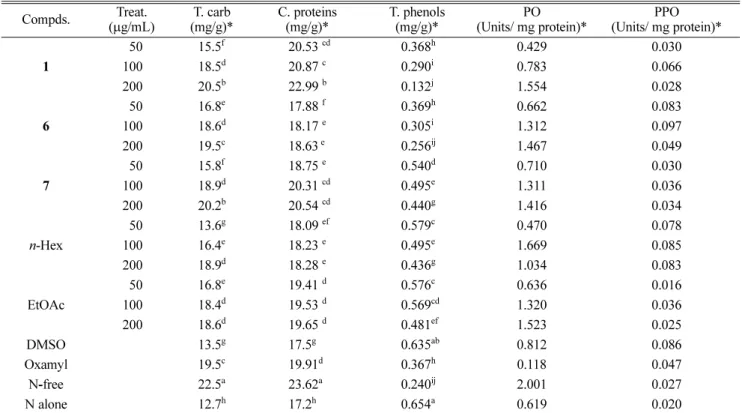
reached (Table 4). However, a detectable induction in total carbohydrates was recorded with all treatments. The greatest % induction in total carbohydrates was recorded for compound 1 (61.4%) at a concentration of 200 μg/mL compared to untreated plants (N alone).

The % induction =

Crude proteins – Untreated tomato infected with M.

incognita exhibited significant reduction in total proteins as compared with untreated plants with percentage of reduction reached (Table 4). However, a detectable induction in total proteins was recorded with all treatments.

The greatest induction in total proteins was recorded with compound 1 (33.66%) at the concentration of 200 μg/mL compared to untreated plants (N alone).

Defense mechanism against root knot nematode Plant nematodes, spend most of their life cycles in the roots of the host plant and thus subjected to diverse types of defense responses. Consequently, the root-knot nematode infection increased phenol content, peroxidase activity and polyphenol oxidase activities.

39

Thus, total phenols and defense-related proteins including peroxidase and polyphenol oxidase are biochemical markers in infested plants.

Total phenols – The total phenolics increased in infected plants compared to non-infected plants (Table 4). However, all treatments showed a reduction in total phenolics to various extents relative to infected plants. It was observed

Treated Control –

( )

Control

--- 100 ×

Fig. 7. Impact of compound 1 isolated from Schinus terbenthifolius leaves, on the reproduction of Meloidogyne incognita infecting

tomato var. 162 grown under greenhouse conditions at 27 ± 3

o

C. Reproduction factor (RF), Root gall index (RGI) or egg-masses index

(EI) were determined according to the scale given by Taylor and Sasser (1978).

(11)

that pots receiving compound 1 showed reduction in total phenolics comparable to the healthy plant.

Defense-related proteins – Data presented in Table 4 revealed that the least induction of PO and PPO was recorded in tomato plants untreated and inoculated with M. incognita. Oxamyl differed in its ability to stimulate peroxidase (PO) and polyphenol oxidase (PPO) activities in plant inoculated with nematodes. However, increased PO activity was observed for compound 1 followed by the EtOAc, compound 6 then 7 compared to untreated inoculated plants. On the other hand, the increased activity of PPO remained higher in plants treated with compound 6.

Conclusions

Biological control of plant pests including nematodes continues to inspire researchers in this field. Natural products are promising resources for biocontrol agents that are safer, environmentally friendly and cost-effective.

In this study, phenolic compounds isolated from the leaves of Schinus terebenthifolius were investigated for their nematicidal activity against the root-knot nematode

M. incognita and its infested tomato plant. The isolated compounds from S. terebenthifolius extract showed promising nematicidal activity compared to Oxamyl as a positive control. Compound 1 namely, 1,2,3,4,6-pentagalloyl glucose showed significant nematicidal activity in both in vitro and in vivo studies. It exhibited the best suppressed total nematode population, root galling and number of eggmasses. It also restored total carbohydrates, proteins and phenolics to normal and increased defense-related proteins. Thus, 1,2,3,4,6-pentagalloyl glucose could be a promising nematicidal agent against the root-knot nematode M. incognita.

References

(1) Amorim, M. M. R; Santos, L. C. Rev. Bras. Gincecol. Obstet. 2003, 25, 95-102.

(2) de Lima, M. R. F.; Luna, J. D.-S.; dos Santos, A. F.; de Andrade, M.

C. C., et al. J. Ethnopharmacol. 2006, 105, 137-147.

(3) Johann, S.; Pizzolatti, M.; Donnici, C. L.; de Resende, M. A. Braz.

J. Microbiol. 2007, 38, 632-637.

(4) Bernardes, N. R.; Heggdorne-Araújo, M.; Borges, I. F. J. C.;

Almeida, F. M.; Amaral, E. P.; Lasunskaia, E. B.; Muzitano, M. F.;

Oliveira, D. B. Rev. Bras. Farmacogn. 2014, 24, 644-650.

Table 4. Impact of treatment with n-hexane, EtOAc extracts and compounds 1, 6 and 7, isolated from Schinus terbinthifolius leaves, on the biochemical activities of the leaves of tomato var. 162 infected with Meloidogyne incognita and grown under greenhouse conditions at 27 ± 3

o

C.

Compds. Treat.

( μg/mL) T. carb (mg/g)*

C. proteins (mg/g)*

T. phenols (mg/g)*

PO (Units/ mg protein)*

PPO (Units/ mg protein)*

1

50 15.5

f

20.53

cd

0.368

h

0.429 0.030

100 18.5

d

20.87

c

0.290

i

0.783 0.066

200 20.5

b

22.99

b

0.132

j

1.554 0.028

6

50 16.8

e

17.88

f

0.369

h

0.662 0.083

100 18.6

d

18.17

e

0.305

i

1.312 0.097

200 19.5

c

18.63

e

0.256

ij

1.467 0.049

7

50 15.8

f

18.75

e

0.540

d

0.710 0.030

100 18.9

d

20.31

cd

0.495

e

1.311 0.036

200 20.2

b

20.54

cd

0.440

g

1.416 0.034

n-Hex

50 13.6

g

18.09

ef

0.579

c

0.470 0.078

100 16.4

e

18.23

e

0.495

e

1.669 0.085

200 18.9

d

18.28

e

0.436

g

1.034 0.083

EtOAc

50 16.8

e

19.41

d

0.576

c

0.636 0.016

100 18.4

d

19.53

d

0.569

cd

1.320 0.036

200 18.6

d

19.65

d

0.481

ef

1.523 0.025

DMSO 13.5

g

17.5

g

0.635

ab

0.812 0.086

Oxamyl 19.5

c

19.91

d

0.367

h

0.118 0.047

N-free 22.5

a

23.62

a

0.240

ij

2.001 0.027

N alone 12.7

h

17.2

h

0.654

a

0.619 0.020

*Each value presented the mean of three replicates. T. carb; total carbohydrates, C. proteins; crude proteins, T. phenols; total phenols, PO;

peroxidase, PPO; polyphenol oxidase. N = M. incognita (1000 larvae / plant). N-free: Plants free of M. incognita. Means are followed by

the same letter (s) did not differ at P ≤ 0.05 according to Duncan's multiple range test.

(12)

(5) Johann, S.; Silva, D. L.; Martins, C. V. B.; Zani, C. L.; Pizzolatti, M.

G.; Resende, M. A. World J. Microbiol. Biotechnol. 2008, 24, 2459-2464.

(6) Johann, S.; Sá, N. P.; Lima, L. A. R. S.; Cisalpino, P. S.; Cota, B. B.;

Alves, T. M. A.; Siqueira, E. P.; Zani, C. L. Annals of Clinical Microbiol.

Antimicrob. 2010, 9, 30-36.

(7) Carvalho, M. G.; Melo, A. G. N.; Aragao, C. F. S.; Raffin, F. N.;

Moura, T. F. A. L. Rev. Bras. Pl. Med. 2013, 15, 158-169.

(8) Fedel-Miyasato, L. E. S.; Kassuya, C. A. L.; Auharek, S. A.;

Formagio, A. S. N.; Cardoso, C. A. L.; Mauro, M. O.; Cunha-Laura, A.

L.; Monreal, A. C. D., Vieira, M. C.; Oliveira, R. J. Rev. Bras.

Farmacogn. 2014, 24, 565-575.

(9) Quave, C. L.; Plano, L. R. W.; Bennett, B .C. Planta Med. 2008, 74, 43.

(10) Queires, L. C.; Fauvel-Lafètve, F.; Terry, S.; De la Taille, A.;

Kouyoumdjian, J. C.; Chopin, D. K.; Vacherot, F.; Rodrigues, L. E.;

Crépin, M. Anticancer res. 2006, 26: 379-387.

(11) Carvalher-Machado, S. C.; Rosas, E. C.; Brito, F. A.; Heringe, A.

P.; de Oliveira, R. R.; Ka-Plan, M. A.; Figueiredo, M. R.; Henriques, M.

Int. Immunopharmacol. 2008, 8, 1552-1560.

(12) Santana, J. S.; Lago, P. S. J. H. G.; Matsuo, A. L. Quim. Nova 2012, 35, 2245-2248.

(13) Carvalho, M. G.; Freire, F. D.; Raffin, F. N.; Aragão, C. F. S.;

Moura, T. F. A. L. Chromatographia 2009, 69, 249-253.

(14) Farag, S. F. Bull. Pharm. Sci. 2008, 31, 319-329.

(15) Heringer, A. P.; Oliveira, R. R.; Figueiredo, M. R.; Kaplan, M. A.

C. In: 30a reunião anual da sociedade brasileira de química, 2007.

(16) Hayashi, T.; Nagayama, K.; Arisawa, M.; Shimizu, M.; Suzuki, S.;

Yoshizaki, M.; Morita, N.; Ferro, E.; Basualdo, I.; Berganza, L. H. J. Nat.

Prod. 1989, 52, 210-211.

(17) Morais, T. R.; da Costa-Silva, T. A.; Tempone, A. G.; Borborema, S. E. T.; Scotti, M. T.; de Sousa, R. M. F.; Araujo, A. C. C.; de Oliveira, A.; de Morais, S. A. L.; Sartorelli, P.; Lago, J. H. G. Molecules 2014, 19, 5761-5776.

(18) Campello, J. P.; Marsaioli, A. J. Phytochemistry 1975, 14, 2300- 2302.

(19) Lloyd, H. A.; Jaouni, T. M.; Evans, S. L.; Morton, J. F.

Phytochemistry 1977, 16, 1301-1302.

(20) Sasser, J. N.; Freckman, D. W. World perspective on nematology:

The role of the society, in Vistas on Nematology, eds. Veech, J.A.;

Dickson, D.W., Hayattsville: A Commemoration of the 25th Anniversary of the Society of Nematologists, Society of Nematologists, Inc., Hyattsville, Maryland 1987, pp 7-14.

(21) Hussey, R. S.; Barker, K. R. Plant Dis. Reptr. 1973, 57, 1925-1928.

(22) Goodey, J. B. Laboratory methods for work with plant and soil nematodes. Tech. Bull., 2, Min. Agric. Fish Ed. London 1957, pp 47.

(23) Taylor, A. L.; Sasser, J. N. Biology, identification and control of root-knot Nematodes (Meloidogyne spp.). Coop. Pub. Dept. Pl. pathol.

North Carolina State Univ. and U.S. Agency Int. Dev. Raleigh. N.C. 1978, p.111.

(24) Patel, D. J., Patel, H. V.; Patel, S. K.; Patel, B. A. Indian J. Pl.

Protect. 1993, 21, 242-244.

(25) Maxwell, D. P.; Bateman, D. F. Phytopathology. 1967, 57, 132-136.

(26) Bradford, M. M. Anal. Biochem. 1976, 72, 248-254.

(27) Thomas, W.; Dutcher, R. A. J. Am. Chem. Soc. 1924, 46, 1662- 1669.

(28) Kaur, C.; Kapoor, H.C. International J. Food. Sci, and Technolo.

2002, 37, 153-161.

(29) Amako, A.; Ghen, G. X.; Asala, K. Plant cell Physiol. 1994, 53, 497-507.

(30) Coseteng, M. Y.; Lee, C. Y. J. Food Sci. 1987, 52, 985-989.

(31) Gomez, K. A.; Gomez, A. A. Statistical Procedures for Agriculture Research. 2

nd

Ed., Press: John Wiley & Sons. Inc. New York 1984, pp.

101.

(32) Duncan, D. B. Biometrics 1955, 11, 1- 42.

(33) Dos Santos, R. T.; Hiramoto, L. L.; Lago, J. H. G.; Sartorelli, P.;

Tempone, A. G.; Pinto, E. G.; Lorenzi, H. Quim. Nova 2012, 35, 2229- 2232.

(34) Da Silva, M. M.; Iriguchi, E. K. K.; Kassuya, C. A. L.; Vieira, M.

D.-C.; Foglio, M. A.; de Carvalho, J. E.; Ruiz, A. L. T. G.; Souza, K. D.- P.; Formagio, A. S. N. Rev. Bras. Farmacogn. 2017, 27, 445-452.

(35) Ceruks, M.; Romoff, P.; Favero, A. O.; Lago, J. H. G. Quim. Nova 2007, 30, 597-599.

(36) Agrawal, P.K. Studies in Organic Chemistry Carbon-13 NMR of Flavonoids. Press: Elsevier, Amsterdam, 1989; pp. 334, 336, 338.

(37) Zhang, Z.; Liao, L.; Moore, J.; Wu, T.; Wan, Z. Food Chem. 2009, 113, 160-165.

(38) Gautam, S. K.; Poddar A. N. nt. J. Curr. Microbiol. App. Sci. 2014, 3, 470-478.

(39) El-beltagi, H. S.; Farahat A. A.; Alsayed A. A.; Mahfoud N. A.

Not. Bot. Horti. Agrobo. 2012, 40,132-142.

Received May 31, 2018

Revised August 17, 2018

Accepted August 18, 2018

수치

Fig. 3. Isolation scheme of compounds 4, 6 and 7 - 9 from the ethyl acetate extract.
Fig. 4. Impact of treatments with EtOAc extracts and compounds (1, 6, 7), isolated from Shinus terbenthifolius leaves, on egg hatchability of root-knot nematode Meloidogyne incognita under laboratory conditions.
Fig. 5. Impact of treatments with EtOAc extracts and compounds (1, 6, 7), isolated from Shinus terbenthifolius leaves, against larvae of root-knot nematode Meloidogyne incognita under laboratory conditions.
Table 3. Impact of treatments with n-hexane, EtOAc extracts and compounds 1, 6 and 7, isolated from Schinus terbenthifolius leaves, on the development and reproduction of Meloidogyne incognita infecting tomato var
+3

참조

관련 문서

Odor removal efficiency and maximum elimination capacity by biofilters are examined against inlet loading of 4 types of sulfur compounds, ammonia, acetaldehyde and toluene..

For an exacting investigation of the distance from root apex to outer surface of buccal cortical bone of mandibular first molar with 2R2C (2 separate

Efficacy of syringe irrigation, RinsEndo and passive ultrasonic irrigation in removing debris from irregularities in root canals with different apical

In teeth which have lateral foramen, major foramen deviated from the main axis of root, radiographic appearance of working length determined by electronic apex locator

As can be seen from examples of convergence with other fields already attempted in various fields of society and the integratio n of liberal arts and

Statistical analyses were performed using SPSS software (version 12.0, SPSS Inc, Chicago, IL, USA). Measurements of the alveolar bone thickness from the root

In this study, Sulgidduk was prepared with adding finger root ( Boesenbergia rotunda ) powder containing a large amount of functional substances, and the

It was disclosed from the results that the color extracted from eucalyptus leaves was reddish yellow tone that could be manifested in a wide spectrum of