• 검색 결과가 없습니다.

Repaglinide, but Not Nateglinide Administered Supraspinally and Spinally Exerts an Anti-Diabetic Action in D-Glucose Fed and Streptozotocin-Treated Mouse Models

N/A
N/A
Protected

Academic year: 2022

Share "Repaglinide, but Not Nateglinide Administered Supraspinally and Spinally Exerts an Anti-Diabetic Action in D-Glucose Fed and Streptozotocin-Treated Mouse Models"

Copied!
5
0
0

로드 중.... (전체 텍스트 보기)

전체 글

(1)

493 http://dx.doi.org/10.4196/kjpp.2013.17.6.493

ABBREVIATIONS: i.c.v., intracerebroventricular; i.t., intrathecal;

STZ., streptozotocin.

Received March 28, 2013, Revised September 26, 2013, Accepted October 17, 2013

Corresponding to: Hong-Won Suh, Department of Pharmacology, Institute of Natural Medicine, College of Medicine, Hallym Univer- sity, 39 Hallymdaehak-gil, Chuncheon 200-702, Korea. (Tel) 82-33- 248-2614, (Fax) 82-33-248-2612, (E-mail) [email protected]

This is an Open Access article distributed under the terms of the Creative Commons Attribution Non-Commercial License (http://

creativecommons.org/licenses/by-nc/3.0) which permits unrestricted non-commercial use, distribution, and reproduction in any medium, provided the original work is properly cited.

Repaglinide, but Not Nateglinide Administered Supraspinally and Spinally Exerts an Anti-Diabetic Action in D-Glucose Fed and Streptozotocin-Treated Mouse Models

Yun-Beom Sim

1

, Soo-Hyun Park

1

, Yu-Jung Kang

1

, Sung-Su Kim

1

, Chea-Ha Kim

1

, Su-Jin Kim

1

, Su-Min Lim

1

, Jun-Sub Jung

1

, Ohk-Hyun Ryu

2

, Moon-Gi Choi

2

, and Hong-Won Suh

1

1

Department of Pharmacology, Institute of Natural Medicine,

2

Division of Endocrinology and Metabolism, Department of Internal Medicine, College of Medicine, Hallym University, Chuncheon 200-702, Korea

W e have recently demonstrated that some anti-diabetic drugs such as biguanide and thizolidi- nediones administered centrally modulate the blood glucose level, suggesting that orally administered anti-diabetic drugs may modulate the blood glucose level by acting on central nervous system. The present study was designed to explore the possible action of another class of anti-diabetic drugs, glinidies, administered centrally on the blood glucose level in ICR mice. Mice were administered intracerebroventricularly (i.c.v.) or intrathecally (i.t.) with 5 to 30 μ g of repaglinide or nateglinide in D-glucose-fed and streptozotocin (STZ)-treated models. W e found that i.c.v. or i.t. injection with repaglinide dose-dependently attenuated the blood glucose level in D-glucose-fed model, whereas i.c.v.

or i.t. injection with nateglinide showed no modulatory action on the blood glucose level in D-glucose-fed model. Furthermore, the effect of repaglinide administered i.c.v. or i.t. on the blood glucose level in STZ-treated model was studied. W e found that repaglinide administered i.c.v. slightly enhanced the blood glucose level in STZ-treated model. On the other hand, i.t. injection with repaglinide attenuated the blood glucose level in STZ-treated model. The plasma insulin level was enhanced by repaglinide in D-glucose-fed model, but repaglinide did not affect the plasma insulin level in STZ-treated model.

In addition, nateglinide did not alter the plasma insulin level in both D-glucose-fed and STZ-treated models. These results suggest that the anti-diabetic action of repaglinide appears to be, at least, mediated via the brain and the spinal cord as revealed in both D-glucose fed and STZ-treated models.

Key Words: Blood glucose, Glinides, Spinal, Streptozotocin, Supraspinal

INTRODUCTION

Diabetes mellitus is one of the chronic diseases and is rapidly growing in prevalence worldwide. The complica- tions of diabetes mellitus contribute to a major health prob- lem in modern societies. Type 2 diabetes mellitus is charac- terized by highly elevated concentrations of glucose in the blood, which is caused by decreased secretion of insulin from the β-cells of pancreas and diminished action of insulin. Glinides are widely used oral drugs for the treat- ment of type II diabetes mellitus. Glinides exert their an- ti-diabetic pharmacological effects in type 2 diabetes melli-

tus by enhancing insulin release from the β-cells of pan- creas, thereby increasing circulating insulin to act [1-5].

Furthermore, several studies have reported that repag- linide bind to the “B” site in sulfonylurea receptor 1 (SUR1), and nateglinide bind to the “A” site bind to SUR1 subunit, in turn, inhibiting the β-cell K

+

/ATP channel. This action leads to the attenuated K

+

conductance, finally resulting in an increase of membrane depolarization of the β-cells [6-8]. In addition, the depolarization of plasma membrane opens voltage-gated Ca

2+

channels, and finally, causes the release of insulin from pancreatic β-cells [9,10].

Accumulating data have shown that the central nervous

system plays an important role for the regulation of the

blood glucose level. The numerous studies have demon-

strated that the several regions of the brain also play cru-

cial roles to keep the homeostatic status of the blood glucose

level [11]. Supraspinal injection of certain drugs such as

atropine methyl bromide (methylatropine) produces modu-

latory action in the regulation of the blood glucose and in-

sulin levels [12]. In addition, supraspinal administration of

IL-1 alpha produces a hyperglycemia, hyperglucagonemia

(2)

and hyperinsulinemia that resulted from an early increase in hepatic glucose production [13]. Several lines of evidence have demonstrated that the spinal cord is one of the im- portant sites for the regulation of the blood glucose level.

In an earlier clinical study, Sala et al. [14] have reported that less dose of insulin is used to regulate the blood glucose level in patients with spinal cord injury. Furthermore, sev- eral studies have reported that spinal administration of the saporin (anti-D beta H-SAP) such as ribosome inactivating protein modulate of the blood glucose level [15]. Further- more, we have recently reported that substance P or several pro-inflammatory cytokines such as tumor necrosis fac- tor-alpha (TNF-α), interferon-gamma (IFN-γ) and inter- leukin-1beta (IL-1β) administered spinally cause an ele- vation of the blood glucose level [16,17]. Taken together, both the brain and the spinal cord are important sites for the regulation of the blood glucose homeostasis.

We have recently reported that i.c.v. injection with met- formin or rosiglitazone modulates the blood glucose level in D-glucose-fed and STZ-treated models, suggesting that the anti-diabetic actions of metformin and rosiglitazone ap- pear to be centrally mediated [18]. However, central action of another class of anti-diabetic drugs, glinides, in the regu- lation of the blood glucose level has not been well studied yet. Thus, in the present study, we assessed the effects of glinides administered spinally or supraspinally on the regu- lation of the blood glucose level in D-glucose-fed and strep- tozotocin (STZ)-treated models.

METHODS

These experiments were approved by the Hallym Univer- sity Animal Care and Use Committee (Registration Num- ber: Hallym 2009-05-01). All procedures were conducted in accordance with the ‘Guide for Care and Use of Laboratory Animals’ published by the National Institutes of Health.

Experimental animals

Male ICR mice (MJ Co., Seoul, Korea) weighing 20∼25 g were used for all the experiments. Animals were housed 5 per cage in a room maintained at 22±0.5

o

C with an alter- nating 12 h light-dark cycle. Food and water were available ad libitum. The animals were allowed to adapt to the labo- ratory for at least 2 h before testing and were only used once. Experiments were performed during the light phase of the cycle (10:00∼17:00).

Oral, intracerebroventricular (i.c.v.), and intrathecal (i.t.) administrations

Oral administration was performed with gavage in a vol- ume of 1 ml/kg body weight. Mice were fasted overnight (16 h) and D-glucose (2 g/kg body weight) administered or- ally once. The blood glucose level was measured at 0, 30, 60, and 120 min after D-glucose administration.

I.t. administration was performed in conscious mice fol- lowing the method of Hylden and Wilcox using a 30-gauge stainless-steel needle attached to a 25 μl Hamilton micro- syringe was inserted between the lumbar 5 and lumbar 6 segments in unanesthetized mice [19]. The i.t. injection vol- ume was 5 μl and the injection site was verified by inject- ing a similar volume of 1% methylene blue solution and determining the distribution of the injected dye in the spi-

nal cord. The dye injected i.t. was distributed both rostrally and caudally but with short distance (about 0.5 cm) and no dye was found in the brain. The success rate for the injections was consistently found to be over 95%, before the experiments were done.

I.c.v. administration followed the method described by Haley [20]. Each mouse was grasped firmly without anes- thesia by the loose skin behind the head. The skin was pulled taut. A 30-guage needle attached to a 25 μl syringe was inserted perpendicularly through the skull into the brain and solution was injected. The injection site was 2 mm from either side of the midline on a line drawn through the anterior base of the ears. The i.c.v. injection volumes were 5 μl, and the injection sites were verified by injecting a similar volume of 1% methylene blue solution and de- termining the distribution of the injected dye in the ven- tricular space. The success rate for prior injections with this technique was over 95%.

STZ-induced diabetic mice

Diabetic mice were induced by a single intraperitoneal injection of STZ (150 mg/kg in citrate buffer, pH 4.5).

Normal groups received the buffer only. On the 6

th

day after STZ administration, animals with non-fasting blood glucose concentration above 400 mg/dl were considered to be dia- betic and used in current study.

Measurement of blood glucose level

Blood glucose measurements were obtained using blood samples collected by lateral tail vein laceration. The blood was collected shortly as soon as possible with a minimum volume (1 μl). The glucose level was measured using Accu- Chek Performa blood glucose monitoring system (glucome- ter) (Mannheim, Baden-Württemberg, Germany).

Insulin ELISA assay

In Mouse Insulin ELISA, biotin conjugated anti insulin, and standard or sample were incubated in monoclonal an- ti-insulin-coated wells. After horse radish peroxidase (HRP) conjugated streptavidin remaining in the wells were re- acted with a substrate chromogen reagent, and the reaction was stopped by addition of an acidic solution, and absorb- ance was measured spectrophotometrically at 450 nm.

Drugs

Repaglinide, nateglinide and D-glucose were purchased from Sigma Chemical Co. (St. Louis, MO, USA). STZ was purchased from USB Co. (Cleveland, OH, USA). Repagli- nide and Nateglinide were prepared following steps: (A) 1 g of repaglinide and nateglinide were dissolved in 0.5 ml of ethanol plus 0.5 ml of polyethylene glycol 400. (B) Se- parately, 100 mg of sodium carboxymethylcellulose was dis- solved in 9 ml of distilled water. (C) Finally, Solution (A) and Solution (B) were vigorously mixed. This solution (PEC) excluding repaglinide and nateglinide were used as vehicle control. All drugs were prepared just before use. Blood glu- cose meter, lancing device and strips were purchased from Roche Diagnostics (Accu-Chek Performa, Germany). The mouse insulin ELISA kit was purchased from Shibayagi Co.

(Shibukawa, Japan).

(3)

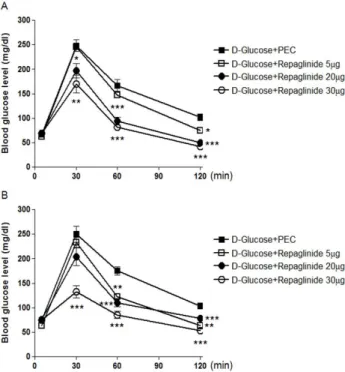
Fig. 1. Effects of repaglinide administered i.c.v. or i.t. on the blood glucose level in D-glucose-fed model. Mice were pretreated i.c.v. (A) and i.t. (B) with 5, 20 or 30 μg of repaglinide for 10 min. Then 2 g/kg of D-glucose were orally fed. The blood glucose level was measured at 30, 60 and 120 min after D-glucose administration.

The blood was collected from tail-vein. The vertical bars indicate the standard error of mean. Each quantified result was analyzed by one-way ANOVA with a Bonferroni post hoc test (**p<0.01,

***p<0.005; compared to D-Glucose+PEC group). The number of animal used in each group was 8∼10.

Fig. 2. Effects of nateglinide administered i.c.v. or i.t. on the blood glucose level in D-glucose- fed model. Mice were pretreated i.c.v. (A) and i.t. (B) with 5, 20 or 30 μg of repaglinide or nateglinide for 10 min. Then 2 g/kg of D-glucose were orally fed. The blood glucose level was measured at 30, 60 and 120 min after D-glucose administration.

The blood was collected from tail-vein. Each quantified result was analyzed by one-way ANOVA with a Bonferroni post hoc test. The number of animal used in each group was 8∼10.

Statistical analysis

The statistical significance of differences between groups was assessed with one-way ANOVA with Bonferroni’s post- hoc test using GraphPad Prism Version 4.0 for Windows XP (GraphPad Software, San Diego, CA, USA). p-values less than 0.05 were considered to indicate statistical signi- ficance. All values were expressed as the mean±S.E.M. In our study, we established the mean blood glucose value of the control group through many experiments under match- ing conditions. Selected mice of established blood glucose level were then used in replication experiments.

RESULTS

Effects of repaglinide and nateglinide administered i.c.v.

or i.t. on the blood glucose level in D-glucose-fed model Mice were pretreated i.c.v. or i.t. with 5, 20 or 30 μg of repaglinide or nateglinide for 10 min. Then 2 g/kg of D-glucose were orally fed. The blood glucose level was measured at 30, 60 and 120 min after D-glucose feeding.

As shown in Fig. 1A (F=0.7531; p=0.4984), 1B (F=1.141;

p=0.3616), 2A (F=0.02923; p=0.9713) and 2B (F=0.06676;

p=0.9359), repaglinide administered i.c.v. or i.t. dose-de-

pendently attenuated the blood glucose level in D-glucose- fed model. However, nateglinide administered i.c.v. or i.t.

did not affect the blood glucose level in D-glucose-fed model.

Effects of repaglinide administered i.c.v. or i.t. on the blood glucose level in STZ-treated model

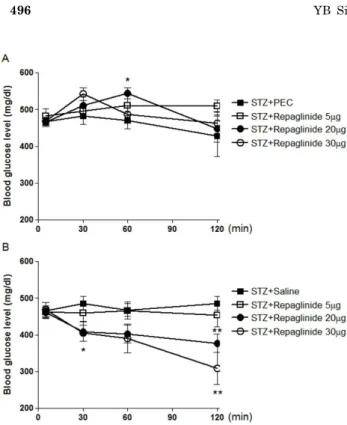
Since repaglinide administered was effective in attenuat- ing the blood glucose level in D-glucose-fed model, we as- sessed if repaglinide produces also anti-diabetic effect in STZ-treated model. Mice were pretreated intraperitoneally with STZ (150 mg/kg) for 6 days. And then, 5, 20 or 30 μg/5 μl of repaglinide were administered i.c.v. or i.t. As shown in Fig. 3, repaglinide administered i.c.v. (F=0.8940;

p=0.4424) slightly enhanced the blood glucose level in STZ-treated model. On the other hand, repaglinide ad- ministered i.t. (F=3.988; p=0.0575) dose-dependently atte- nuated the blood glucose level in STZ-treated model.

Effects of repaglinide and nateglinide administered i.c.v. or i.t. on the plasma insulin level in D-glucose- fed and STZ-treated models

Mice were pretreated i.c.v. or i.t. with 30 μg of re- paglinide or nateglinide for 10 min. Then 2 g/kg of D-glu- cose were orally fed. The plasma insulin level was meas- ured at 30 min after D-glucose feeding. As shown in Fig.

4A (F=9.579; p=0.0016) and 4B (F=1.557; p=0.2393), re-

paglinide administered i.c.v. or i.t. markedly enhanced the

(4)

Fig. 3. Effects of repaglinide administered i.c.v. or i.t. on the blood glucose level in STZ-treated model. Mice were pretreated intra- peritoneally with STZ (150 mg/kg) for 6 days. And then, 5, 20 or 30 μg/5 μl of repaglinide was administered treated i.c.v. (A) or i.t. (B) The blood glucose level was measured at 30, 60 and 120 min after repaglinide injection. The blood was collected from tail-vein. The vertical bars indicate the standard error of mean.

Each quantified result was analyzed by one-way ANOVA with a Bonferroni post hoc test (*p<0.05, **p<0.01; compared to STZ+

PEC group). The number of animal used in each group was 8∼10.

Fig. 4. Effects of repaglinide and nateglinide administered i.c.v. or i.t. on the plasma insulin level in D-glucose-fed and STZ-treated models. Mice were pretreated i.c.v. (A) and i.t. (B) with 30 μg of repaglinide and nateglinide for 10 min. Then 2 g/kg of D-glucose were orally fed. The plasma insulin level was measured at 30 min after D-glucose administration. In another experiment, mice were pretreated intraperitoneally with STZ (150 mg/kg) for 6 days. And then, 30 μg/5 μl of repaglinide and nateglinide was administered treated i.c.v. (C) or i.t. (D) The plasma insulin level was measured at 30 min after repaglinide and nateglinide injection. The vertical bars indicate the standard error of mean. Each quantified result was analyzed by one-way ANOVA with a Bonferroni post hoc test.

The number of animal used in each group was 6∼8.

plasma insulin level in D-glucose-fed model. However, nate- glinide administered i.c.v. or i.t. did not affect the plasma insulin level in D-glucose-fed model. Next, mice were pre- treated intraperitoneally with STZ (150 mg/kg) for 6 days.

And then, 30 μg/5 μl of repaglinide and nateglinide was administered i.c.v. or i.t. As shown in Fig. 4C (F=0.013;

p=0.9871) and 4D (F=1.159; p=0.3403), repaglinide and na- teglinide administered i.c.v or i.t. did not alter the plasma insulin level in STZ-treated model.

DISCUSSION

In the present study, the possible anti-diabetic action of glinides administered supraspinally or spinally was studied in ICR mice. We found for the first time that repaglinide administered supraspinally or spinally attenuates the blood glucose level in D-glucose-fed model. However, nateglinide, another glinide, administered supraspinally or spinally did not alter the blood glucose level in D-glucose-fed model.

These results clearly suggest that repaglinide exerts its hy- poglycemic effects, at least by acting on both the brain and the spinal cord. In contrasted to the effect of repaglinide, we found in the present study that surpraspinal or spinal administration of nateglinide is not effective for regulating the blood glucose level in D-glucose-fed model. These find- ings indicate that all glinides do not act by the same mecha- nism in the regulation of the blood glucose level when they

are administered supraspinally or spinally. The exact rea- sons of the differences between repaglinide and nateglinide in the regulation of blood glucose in D-glucose fed model are not currently clear. It has been well accepted that gli- nides produce their pharmacologic effects by acting on pe- ripheral pancreatic β-cells. It has been well known that glinides stimulate insulin release from the β-cells of pan- creas [1-5]. At the molecular level, it is well described that glinides inhibit the β-cell K

+

/ATP channel, ultimately re- sulting in membrane depolarization of the β-cells [6]. Al- though the exact mechanism involved in down-regulation of the blood glucose level induced by repaglinide ad- ministered supraspinally or spinally is currently obscure, a previous study have demonstrated that hypothalamic K

+

/ATP channel plays an important role for the regulation of the blood glucose level induced by repaglinide or gliben- clamide [21]. Thus, it can be speculated that repaglinide administered supraspinally or spinally may lower the blood glucose level by acting on K

+

/ATP channel located centrally.

Additional studies to delineate the exact mechanism in- volved in centrally administered repaglinide-induced hypo- glycemia in D-glucose-fed model are required in the future.

However, we found in the present study that supraspinal or spinal administration with nateglinide, another glinide, did not affect the blood glucose level in D-glucose-fed model.

Although the exact reasons for the differential action be- tween repaglinide and nateglinide administered centrally are not currently known, we found a similar result in our previous study in that centrally administered rosiglitazone lowers the blood glucose level, whereas pioglitazone ad- ministered centrally did not affect the blood glucose level in D-glucose-fed model [18].

Since repaglinide administered supraspinally or spinally exerted the hypoglycemic effect in D-glucose-fed model, we assessed if repaglinide administered supraspinally or spi- nally can regulate the blood glucose in STZ-treated model.

We found in the present study that repaglinide admini-

(5)

stered spinally significantly and dose-dependently attenu- ates the blood glucose level in STZ-treated model. This re- sult is in line with a finding that spinally administered met- formin also lowers the blood glucose level in STZ-treated model [18]. It has been well known that STZ destroys the β-cells of pancreas, resulting in the lack of insulin, in turn, leading to finally a type I diabetes mellitus [22,23].

Although repaglinide belongs to a class of anti-diabetic drugs to treat type II diabetes mellitus, the results of the present study suggest that the regulation of the blood glu- cose level induced by repaglinide administered supra- spinally or spinally appear to be different in STZ-treated diabetic model, and repaglinide administered spinally can be effective to reduce the blood glucose in type I diabetes mellitus. However, we found in the present study that su- praspinal administration of repaglinide did not cause any decrease of the blood glucose level in STZ-treated model.

These findings suggest that repaglinide administered into the brain sites and the spinal cord may differentially regu- late the blood glucose level in STZ-treated model.

In an attempt to characterize the mechanism involved in repaglinide-induced hypoglycemic effect, we measured the plasma insulin level in repaglinide-treated group. We found in the present study that supraspinal or spinal treat- ment with repaglinide increases the plasma insulin level in D-glucose-fed model. However, repaglinide administered supraspinally or spinally does not alter the plasma insulin level in STZ-treated model, suggesting that repaglinide-in- duced reduction of the blood glucose level in D-glucose-fed model appears to be due to an increment of the plasma in- sulin level, but lowering blood glucose level effect of re- paglinide administered spinally in STZ-treated model does not appeared to be mediated by insulin system. In addition, we additionally found that nateglinide administered supra- spinally or spinally does not affect the plasma insulin level in both D-glucose-fed and STZ-treated models, further sug- gesting that the blood glucose level is not modulated by nateglinide administered supraspinally or spinally.

In conclusion, although orally administered repaglinide is wide used as an anti-diabetic drug, our results suggest that the anti-diabetic action of repaglinide administered supra- spinally or spinally exerts the anti-diabetic action as revealed in both D-glucose-fed and STZ-treated models. The detailed study on anti-diabetic mechanism of repaglinide administered centrally should be carried out further in the future.

ACKNOWLEDGEMENTS

This research was supported by Priority Research Cen- ters (NRF-2009-0094071) and Basic Science Research (NRF-2011-0011156) Programs through the National Re- search Foundation of Korea (NRF) funded by the Ministry ofEducation, Science and Technology.

REFERENCES

1. Cheng AY, Fantus IG. Oral antihyperglycemic therapy for type 2 diabetes mellitus. CMAJ. 2005;172:213-226.

2. Farret A, Lugo-Garcia L, Galtier F, Gross R, Petit P. Pharm- acological interventions that directly stimulate or modulate insulin secretion from pancreatic beta-cell: implications for the treatment of type 2 diabetes. Fundam Clin Pharmacol. 2005;

19:647-656.

3. Horton ES, Clinkingbeard C, Gatlin M, Foley J, Mallows S, Shen S. Nateglinide alone and in combination with metformin improves glycemic control by reducing mealtime glucose levels in type 2 diabetes. Diabetes Care. 2000;23:1660-1665.

4. Perfetti R, Barnett PS, Mathur R, Egan JM. Novel therapeutic strategies for the treatment of type 2 diabetes. Diabetes Metab Rev. 1998;14:207-225.

5. Sunaga Y, Gonoi T, Shibasaki T, Ichikawa K, Kusama H, Yano H, Seino S. The effects of mitiglinide (KAD-1229), a new anti-diabetic drug, on ATP-sensitive K

+

channels and insulin secretion: comparison with the sulfonylureas and nateglinide.

Eur J Pharmacol. 2001;431:119-125.

6. Bokvist K, Hoy M, Buschard K, Holst JJ, Thomsen MK, Gromada J. Selectivity of prandial glucose regulators: nate- glinide, but not repaglinide, accelerates exocytosis in rat pan- creatic A-cells. Eur J Pharmacol. 1999;386:105-111.

7. Bryan J, Crane A, Vila-Carriles WH, Babenko AP, Aguilar- Bryan L. Insulin secretagogues, sulfonylurea receptors and K(ATP) channels. Curr Pharm Des. 2005;11:2699-2716.

8. Gribble FM, Reimann F. Differential selectivity of insulin sec- retagogues: mechanisms, clinical implications, and drug inte- ractions. J Diabetes Complications. 2003;17(2 Suppl):11-15.

9. Henquin JC. Pathways in beta-cell stimulus-secretion coupling as targets for therapeutic insulin secretagogues. Diabetes.

2004;53 Suppl 3:S48-58.

10. Islam MS. The ryanodine receptor calcium channel of beta- cells: molecular regulation and physiological significance. Dia- betes. 2002;51:1299-1309.

11. Benzo CA. Minireview. The hypothalamus and blood glucose regulation. Life Sci. 1983;32:2509-2515.

12. Ohnuma H, Yamatani K, Igarashi M, Sugiyama K, Manaka H, Tominaga M, Sasaki H. Intracerebroventricular injection of methylatropine suppresses insulin response to oral glucose load in rats. J Auton Nerv Syst. 1996;57:43-48.

13. Petit F, Jarrous A, Dickinson RD, Molina PE, Abumrad NN, Lang CH. Contribution of central and peripheral adrenergic stimulation to IL-1 alpha-mediated glucoregulation. Am J Physiol. 1994;267:E49-56.

14. Sala F, Menna G, Bricolo A, Young W. Role of glycemia in acute spinal cord injury. Data from a rat experimental model and clinical experience. Ann N Y Acad Sci. 1999;890:133-154.

15. Ritter S, Bugarith K, Dinh TT. Immunotoxic destruction of distinct catecholamine subgroups produces selective impair- ment of glucoregulatory responses and neuronal activation. J Comp Neurol. 2001;432:197-216.

16. Sim YB, Park SH, Kang YJ, Jung JS, Ryu OH, Choi MG, Suh HW. Interleukin-1β (IL-1β) increases pain behavior and the blood glucose level: possible involvement of sympathetic nervous system. Pharmacol Biochem Behav. 2012;102:170-176.

17. Sim YB, Park SH, Kang YJ, Jung JS, Ryu OH, Choi MG, Suh HW. Various pain stimulations cause an increase of the blood glucose level. Animal Cells and Systems. 2012;16:385-390.

18. Sim YB, Park SH, Kang YJ, Kim SS, Kim CH, Kim SJ, Jung JS, Ryu OH, Choi MG, Suh HW. Central anti-diabetic action of biguanide and thizolidinediones in D-glucose fed and strep- tozotocin-treated mouse models. Neurosci Lett. 2012;528:73-77.

19. Hylden JL, Wilcox GL. Intrathecal substance P elicits a caudally-directed biting and scratching behavior in mice. Brain Res. 1981;217:212-215.

20. Haley TJ. Pharmacological effects produced by intracerebral administration of drugs of unrelated structure to conscious mice. Arch Int Pharmacodyn Ther. 1957;110:239-244.

21. Zhang Y, Zhou J, Corll C, Porter JR, Martin RJ, Roane DS.

Evidence for hypothalamic K+(ATP) channels in the modula- tion of glucose homeostasis. Eur J Pharmacol. 2004;492:71-79.

22. Arison RN, Ciaccio EI, Glitzer MS, Cassaro JA, Pruss MP.

Light and electron microscopy of lesions in rats rendered diabetic with streptozotocin. Diabetes. 1967;16:51-56.

23. Mansford KR, Opie L. Comparison of metabolic abnormalities in diabetes mellitus induced by streptozotocin or by alloxan.

Lancet. 1968;1:670-671.

수치

Fig. 1. Effects of repaglinide administered i.c.v. or i.t. on the blood  glucose level in D-glucose-fed model
Fig. 3. Effects of repaglinide administered i.c.v. or i.t. on the blood  glucose level in STZ-treated model

참조

관련 문서

Therefore, the present study aimed to (i) investigate the effect of surfactant on the solubility of valsartan and (ii) improve the dissolution profiles of valsartan

_____ culture appears to be attractive (도시의) to the

이하선의 실질 속에서 하악경의 후내측에서 나와 하악지의 내측면을 따라 앞으로 간다. (귀밑샘 부위에서 갈라져 나와

Gastrointestinal toxicity with celecoxib vs nonsteroidal anti- inflammatory drugs for osteoarthritis and rheumatoid arthritis: the CLASS study: a

- Perform an annual test to assess urine albumin excretion in type 1 diabetic patients with diabetes duration of ≥ 5 years and in all type 2 diabetic patients starting at

When static keyword is used with the variables and the methods, it signifies that these members belongs to the class and these members are shared by all the objects of

The “Asset Allocation” portfolio assumes the following weights: 25% in the S&P 500, 10% in the Russell 2000, 15% in the MSCI EAFE, 5% in the MSCI EME, 25% in the

1 John Owen, Justification by Faith Alone, in The Works of John Owen, ed. John Bolt, trans. Scott Clark, "Do This and Live: Christ's Active Obedience as the