INTRODUCTION
Intellectual disability (ID) is characterized by impairment of cognitive and adaptive functions, with onset before age 18 years. ID is usually identified during infancy or early child- hood because of developmental delay (DD). However, ID is formally diagnosed upon obtaining an intelligence quotient
(IQ) score of less than 70.1,2 ID occurs in approximately 1−3%
of the population, and is largely caused by genetic abnormali- ties.1 However, it has extensive genetic heterogeneity, and 60%
of the cases of ID still do not have a known etiology.3 ID is of- ten accompanied by clinical features of dysmorphism, congen- ital anomalies, or epilepsy. Chromosomal microarray (CMA), with a higher diagnostic yield (15−20%) than that of the G- banded karyotype (~3%), is now a first-titer clinical diagnostic test for individuals with unexplained DD/ID, autism, or mul- tiple congenital anomalies.4 CMA has a 100-fold higher reso- lution than G-banded karyotype, and detects submicroscopic copy number variants (CNVs) across the entire genome. In many cases, the detected CNVs are disease-causing genomic alterations, although benign variants or variants of uncertain significance (VOUS) are also frequent. Although CMA and clinical data have extended the spectrum of understanding the genetic causes of ID, interpretation thereof and appropriate management, including genetic counseling, remain problems Received: June 12, 2017 Revised: December 13, 2017
Accepted: January 19, 2018
Corresponding author: Dr. Hyon J. Kim, Department of Medical Genetics, Konyang University College of Medicine,158 Gwanjeodong-ro, Seo-gu, Daejeon 35365, Korea.
Tel: 82-2-523-9230, Fax: 82-2-581-9230, E-mail: [email protected]
•The authors have no financial conflicts of interest.
© Copyright: Yonsei University College of Medicine 2018
This is an Open Access article distributed under the terms of the Creative Com- mons Attribution Non-Commercial License (http://creativecommons.org/licenses/
by-nc/4.0) which permits unrestricted non-commercial use, distribution, and repro- duction in any medium, provided the original work is properly cited.
Phenotypic Analysis of Korean Patients with Abnormal Chromosomal Microarray in Patients with Unexplained Developmental Delay/Intellectual Disability
Hyo Jeong Kim1, Chang Il Park2, Jae Woo Lim3, Gyung Min Lee3, Eunhae Cho4, and Hyon J. Kim5
1Department of Pediatrics, Gachon University Gil Medical Center, Incheon;
Departments of 2Rehabilitation Medicine, 3Pediatrics, and 5Medical Genetics, Konyang University College of Medicine, Daejeon;
4Green Cross Genome, Yongin, Korea.
Purpose: The present study aimed to investigate chromosomal microarray (CMA) and clinical data in patients with unexplained developmental delay/intellectual disability (DD/ID) accompanying dysmorphism, congenital anomalies, or epilepsy. We also aimed to evaluate phenotypic clues in patients with pathogenic copy number variants (CNVs).
Materials and Methods: We collected clinical and CMA data from patients at Konyang University Hospital between September 2013 and October 2014. We included patients who had taken the CMA test to evaluate the etiology of unexplained DD/ID.
Results: All of the 50 patients identified had DD/ID. Thirty-nine patients had dysmorphism, 19 patients suffered from epilepsy, and 12 patients had congenital anomalies. Twenty-nine of the 50 patients (58%) showed abnormal results. Eighteen (36%) were considered to have pathogenic CNVs. Dysmorphism (p=0.028) was significantly higher in patients with pathogenic CNVs than in those with normal CMA. Two or more clinical features were presented by 61.9% (13/21) of the patients with normal CMA and by 83.3% (15/18) of the patients with pathogenic CMA.
Conclusion: Dysmorphism can be a phenotypic clue to pathogenic CNVs. Furthermore, pathogenic CNV might be more fre- quently found if patients have two or more clinical features in addition to DD/ID.
Key Words: Chromosomal microarray, developmental delay, intellectual disability, dysmorphism
pISSN: 0513-5796 · eISSN: 1976-2437 Yonsei Med J 2018 May;59(3):431-437
https://doi.org/10.3349/ymj.2018.59.3.431
in a clinical setting.
Here, we present our CMA results with clinical data in pa- tients with unexplained DD/ID accompanying dysmorphism, congenital anomalies, failure to thrive (FTT), or epilepsy. We aimed to describe characteristics of clinical features in patients with pathogenic CNVs.
MATERIALS AND METHODS
Patients
We collected clinical and CMA data of the patients who visited Konyang University Hospital for evaluation of unexplained DD/ID in a period of one year. In total, 50 patients who had taken the CMA test to evaluate the etiology of unexplained DD/
ID between September 2013 and October 2014 were included.
DD/ID was defined by IQ lower than 70 or developmental quotient lower than 85. All the patients had severe DD/ID with or without congenital anomalies, growth failure, or epilepsy.
Exclusion criteria included 1) brain damage owing to hypoxic ischemic encephalopathy, periventricular leukomalacia, in- tracranial hemorrhage, infarction, or sequeale of encephalitis;
2) metabolic abnormalities, such as hypothyroidism, organic acidemia, amino acidopathy, peroxisomal disorder, etc.; and 3) recognizable chromosomal syndromes or single gene dis- orders, such as Down syndrome, Klinefelter syndrome, or Frag- ile-X syndrome. Phenotypes were described as follows. 1) Dys- morphism: anatomical structures or their measures are outside the normal range. 2) Major organ anomalies: CNS, heart, and uro-genital anomalies were included. 3) FTT: height and weight growth lie below the third percentile. 4) Microcephaly: head circumference is below third percentile. 5) Macrocephaly: head circumference is above the 97th percentile. 6) Epilepsy: recur- rent seizure disorder with abnormal EEG. 7) Autism: neuro- developmental disorder characterized by impaired social in- teraction, impaired verbal and non-verbal communication, and restricted and repetitive behavior.
Chromosomal microarray
DNA was extracted from peripheral blood leukocytes. CMA analysis was performed using CytoScan 750K (Affymetrix, Santa Clara, CA, USA). The array is characterized with >750436 CNV markers, including 200436 genotype-able SNP probes and >550000 non-polymorphism probes. The overall average marker space is 4127 base pairs. All data were visualized and analyzed with the Chromosome Analysis Suite (ChAS) soft- ware package (Affymetrix) using Human Genome build hg19.
This software for CytoScan 750K was designed to detect a minimal size of 200 kb aberrations.
Interpretation
All detected CNVs were compared with known CNVs databas- es, such as the Database of Genomic Variants (http://dgv.tcag.
ca), University of California Santa Cruz Genome Browser (http://genome.ucsc.edu), and DECIPHER (http://decipher.
sanger.ac.uk). In cases of potentially significant CNVs not list- ed in the above databases, literature searches in the PubMed database was performed. We classified CNVs as pathogenic, benign, or VOUS based on literature guidelines.3
Statistical analysis
Statistical analyses were performed using SPSS 19.0 (IBM Corp., Armonk, NY, USA). Clinical features of dysmorphism, FTT, microcephaly, and epilepsy in patients with pathogenic CNVs and normal CMA were compared using the chi-squared test. Fischer’s exact test was used in cases where expected num- bers of the patients were below 5, such as in the clinical features of CNS anomaly, heart anomaly, uro-genital anomaly, macro- cephaly, and autism. A p-value ≤0.05 was considered to indi- cate statistical significance.
Ethics statement
Approval was obtained from the Konyang University Hospital Institutional Review Board (2015-07-012-002). The title of the approved study is “Clinical utility of chromosomal microarray in patients with unexplained developmental delay/intellectu- al disability.” Written informed consent was obtained from the parents/legal guardians of all the participants. Written informed consent was about confirming that participants or parents/le- gal guardians understand CMA tests and agree for the genetic test and for their participation in human materials research.
Konyang University Hospital Institutional Review Board ap- proved this consent procedure.
RESULTS
CMA was performed in 50 patients, comprising 26 males and 24 females. The mean age at the time of study was 5.4±5.9 years (range: 0.1−32 years). All the patients had DD/ID. The other most common clinical features were dysmorphism in 39 patients, FTT in 27 patients, epilepsy in 19 patients, major or- gan anomalies in 12 patients, and autism in 9 patients (Table 1).
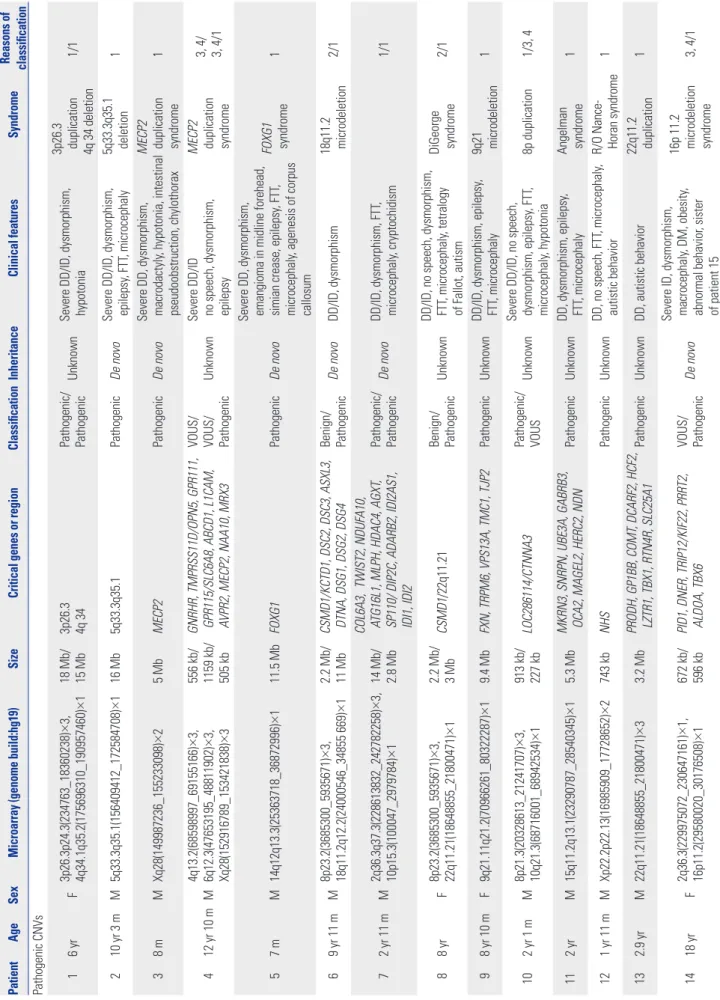
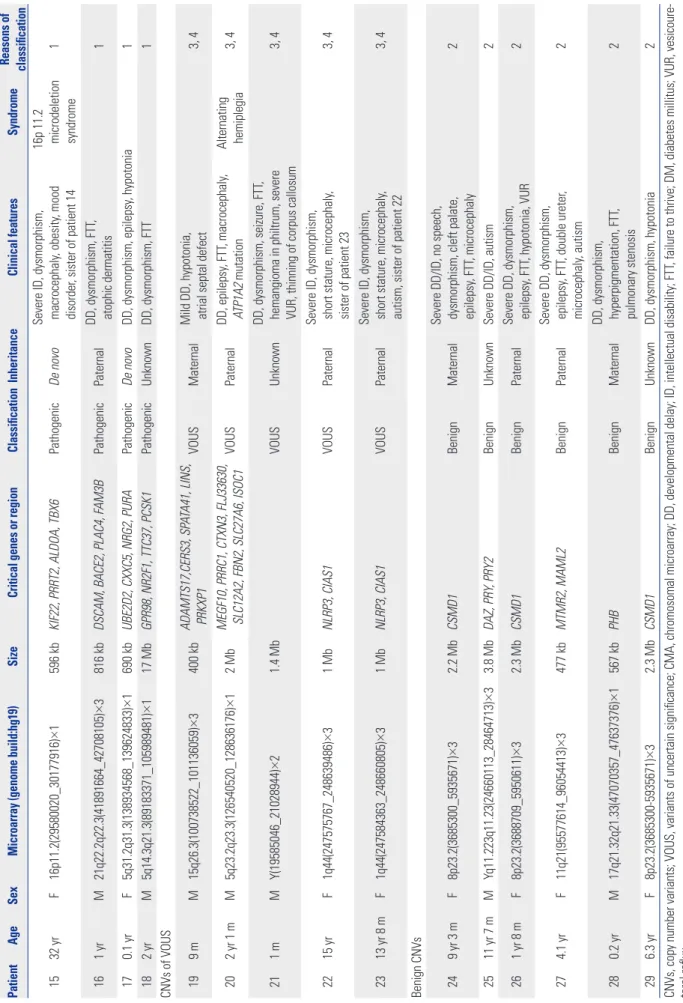
We identified 37 CNVs in 29 of the 50 (58.0%) patients. Among the 29 patients with abnormal CMA results, the CMA analysis of the parents was done for 16 patients, and a siblings study was done for one patient. The inheritance pattern consisted of eight de novo sporadic cases and nine familial cases. Paternal origin was observed in six patients and maternal origin in three patients. The CMA database and parental findings cate- gorized the abnormal CMA results as pathogenic CNVs in 18/29 (62.1%) patients, benign CNVs in 6/29 (20.7%), and VOUS in 5/29 (17.2%) patients. The diagnostic yield of detect- ing pathogenic CNVs was 18/50 (36.0%). The CMA results and clinical features are summarized in Table 2. Five out of 37 CNVs were sex chromosome rearrangements, 21 were duplications,
and 16 were deletions. The size of the CNVs ranged from 227 kb to 18 Mb.
Clinically known syndromes, such as the MECP2 duplica- tion syndrome, FOXG1 syndrome, DiGeorge syndrome, An- gelman syndrome, Nance-Horan syndrome, and other known microdeletion syndromes, were identified. DiGeorge syn- drome could be diagnosed without the CMA test because of its typical phenotype. However, the patient was suspected to have additional genomic alterations because of severe lan- guage impairment and autistic behavior. The results showed a 22q11.2 deletion and benign CNVs of 8p23.2 duplication. An- gelman syndrome in patient 11 was finally confirmed by meth- ylation PCR after CMA test. In this study, 14 patients present- ed reported rare CNVs (Table 2).
Among the nine familial patients, eight patients were found in VOUS and one patient (patient 16) was in pathogenic CNVs.
In the eight patients in VOUS, all the parents were normal, whereas the father of patient 16 manifested a mild phenotype, such as mild atophic dermatitis and low body weight during childhood.
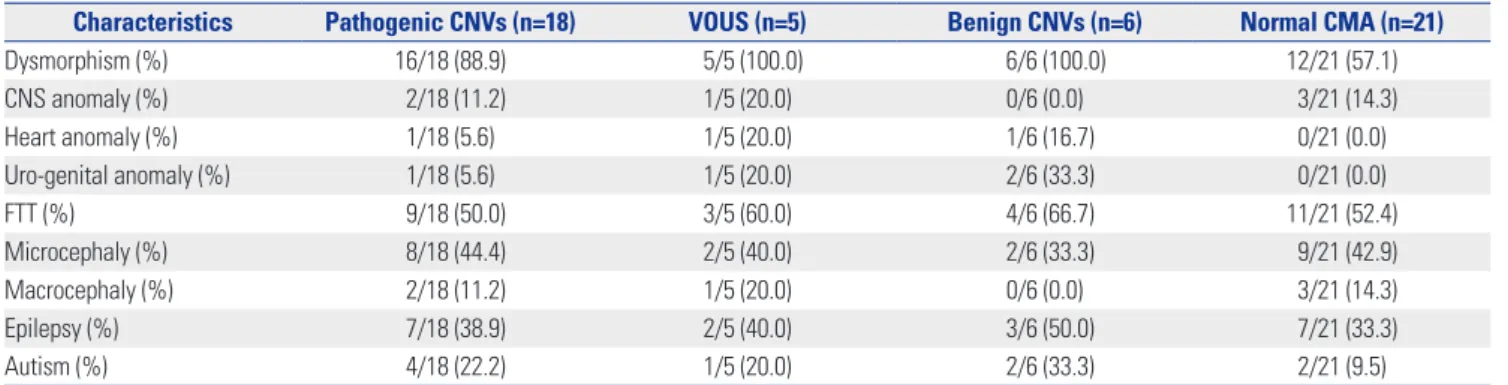
Further, phenotypes among the patients with pathogenic CNVs, VOUS, benign CNVs, and normal CMA were compared (Table 3). The clinical features most often seen in patients with pathogenic CNVs were dysmorphism (88.9%), FTT (50.0%), microcephaly (44.4%), epilepsy (38.9%), major organ anomaly (22.4%), and autism (22.2%), in the order of frequency. Patients with normal CNVs presented dysmorphism (57.1%), FTT (52.4%), microcephaly (42.9%), epilepsy (33.3%), major organ anomaly (14.3%), and autism (9.5%). Dysmorphism (p=0.028) was significantly more frequent in patients with pathogenic CNVs than in those with normal CMA (Fig. 1). Autism (p=0.387), epilepsy (p=0.718), and microcephaly (p=0.921) were more fre- quent in patients with pathogenic CNVs than in patients with normal CMA, although the difference was not significant (Fig. 1).
Among the nine clinical features listed in Table 3, patients with normal CMA presented 2.2±1.3 (range: 1−4) manifesta- tions, and patients with pathogenic CMA presented 2.8±1.3 (range: 1−5) manifestations. Two or more symptoms were presented by 61.9% (13/21) of the patients with normal CMA and by 83.3% (15/18) of the patients with pathogenic CMA.
DISCUSSION
In this study, we identified chromosomal imbalances in 58.0%
(29/50) of our patients. Of these, pathogenic CNVs were found in 62.1% (18/29), benign CNVs in 20.7% (6/29), and VOUS in 17.2% (5/29) of the patients. The overall diagnostic yield was, therefore, 36.0% (18/50). In recent reports, the diagnostic yield of CMA was shown to have increased up to 10−28% for genetic testing in patients with unexplained DD/ID, autism spectrum disorders, or multiple congenital anomalies, as compared to 3% for G-banded karyotype.4-11 In our study, the diagnostic yield
was higher than that found in previous reports with similar pa- tients. In Korea, the cost of CMA is not covered by Korean Health Insurance; therefore, patients for the CMA test were very carefully selected by a clinical geneticist, Hyon J. Kim.
The correct diagnosis included the MECP2 duplication syn- drome, FOXG1 syndrome, Angelman syndrome, and other known microdeletion or microduplication syndromes. In these cases, the diagnosis could be useful for predicting the clinical progress, preparing for symptoms not yet presented, and de- ciding the plan for the evaluation and management of the dis- ease. Furthermore, using a familial study, we can estimate a recurrent risk in the family and can give more information about the disease. A previous large-scale study showed that 54% of the abnormal variants generated a recommendation for clini- cal action.12 The CMA test is an important diagnostic test that influences medical management. It also influences medical management in cases of VOUS, although clinicians should pe- riodically review updated information in order to provide ap- propriate medical management. As data from genetic studies increase, CNV interpretation and useful information can be updated. Palmer, et al.13 reported that interpretation of CMA could change over time. For example, patients 22 and 23 sis- ters showed CNV of VOUS until now; however, the interpreta- tion of the 1q44 trisomy in these patients can change over time.
In our study, among the 21 patients who showed no abnor- malities in the CMA test, three patients were further tested us- ing whole exome sequencing. Two familial patients with ID, severe short stature, and macrodontia were diagnosed with the KBG syndrome, with confirmed ANKRD11 mutation.14 The other patient was diagnosed with Pitt-Hopkins syndrome, with confirmed missense mutation in TCF4. In cases where the CMA test did not allow diagnosis, whole exome or whole ge- nome sequencing could identify the genetic causes of ID. Fi- nally, genome sequencing could be applied as a single genetic test, with a higher diagnostic yield, in the majority of patients with severe ID.15
Some researchers have investigated the characteristics of CNVs in patients with DD/ID. Patients with ID and multiple congenital anomalies show higher burden of CNVs than those with ID alone.16 DD/ID risk is known to increase in relation to CNV size and craniofacial anomalies. Further, cardiovascular Table 1. Clinical Characteristics of the 50 Patients
Characteristics n=50
Gender (male:female) 26:24
Age (yr) (mean±SD) 5.4±5.9
Developmental delay/intellectual disability 50 (100.0%)
Craniofacial dysmorphism 39 (78.0%)
Failure to thrive 27 (54.0%)
Epilepsy 19 (38.0%)
Major organ anomalies 12 (24.0%)
Autism 9 (18.0%)
n, number; SD, standard deviation.
Table 2. Clinical and Genetic Features in 29 Patients with CNVs PatientAgeSex Microarray (genome build:hg19) SizeCritical genes or regionClassificationInheritanceClinical featuresSyndromeReasons of classification Pathogenic CNVs 16 yrF3p26.3p24.3(234763_18360238)×3, 4q34.1q35.2(175696310_190957460)×1 18 Mb/ 15 Mb 3p26.3 4q 34 Pathogenic/ Pathogenic
UnknownSevere DD/ID, dysmorphism, hypotonia
3p26.3 duplication 4q 34 deletion
1/1 210 yr 3 mM5q33.3q35.1(156409412_172584708)×116 Mb 5q33.3q35.1PathogenicDe novoSevere DD/ID, dysmorphism, epilepsy, FTT, microcephaly5q33.3q35.1 deletion1 38 mMXq28(149987236_155233098)×25 Mb MECP2PathogenicDe novoSevere DD, dysmorphism, macrodactyly, hypotonia, intestinal pseudoobstruction, chylothorax
MECP2 duplication syndrome1 412 yr 10 mM4q13.2(68598997_69155166)×3, 6q12.3(47653195_48811902)×3, Xq28(152916789_153421838)×3
556 kb/ 1159 kb/ 505 kb GNRHR, TMPRSS11D/OPN5, GPR111, GPR115/SLC6A8, ABCD1, L1CAM, AVPR2, MECP2, NAA10, MRX3
VOUS/ VOUS/Severe DD/ID Unknown no speech, dysmorphism, Pathogenic epilepsy
MECP2 duplication syndrome 3, 4/ 3, 4/1
57 mM14q12q13.3(25363718_36872996)×111.5 Mb FOXG1PathogenicDe novo
Severe DD, dysmorphism, emangioma in midline forehead, simian crease, epilepsy, FTT, microcephaly, agenesis of corpus callosum
FOXG1 syndrome1 69 yr 11 mM8p23.2(3685300_5935671)×3, 18q11.2q12.2(24000546_34855 669)×1
2.2 Mb/ 11 Mb CSMD1/KCTD1, DSC2, DSC3, ASXL3, DTNA, DSG1, DSG2, DSG4 Benign/ Pathogenic
De novoDD/ID, dysmorphism18q11.2 microdeletion2/1 72 yr 11 mM2q36.3q37.3(228613832_242782258)×3, 10p15.3(100047_2979784)×1
14 Mb/ 2.8 Mb COL6A3, TWIST2, NDUFA10, ATG16L1, MLPH, HDAC4, AGXT, SP110/ DIP2C, ADARB2, IDI2AS1, IDI1, IDI2
Pathogenic/ Pathogenic
De novoDD/ID, dysmorphism, FTT, microcephaly, cryptochidism1/1 88 yrF8p23.2(3685300_5935671)×3, 22q11.21(18648855_21800471)×1
2.2 Mb/ 3 Mb
CSMD1/22q11.21
Benign/ Pathogenic
UnknownDD/ID, no speech, dysmorphism, FTT, microcephaly, tetralogy of Fallot, autismDiGeorge syndrome2/1 98 yr 10 mF9q21.11q21.2(70966261_80322287)×19.4 Mb FXN, TRPM6, VPS13A, TMC1, TJP2PathogenicUnknownDD/ID, dysmorphism, epilepsy, FTT, microcephaly9q21 microdeletion1 102 yr 1 mM8p21.3(20328613_21241707)×3, 10q21.3(68716001_68942534)×1
913 kb/ 227 kb
LOC286114/CTNNA3
Pathogenic/ VOUS
UnknownSevere DD/ID, no speech, dysmorphism, epilepsy, FTT, microcephaly, hypotonia8p duplication1/3, 4 112 yrM15q11.2q13.1(23290787_28540345)×15.3 MbMKRN3, SNRPN, UBE3A, GABRB3, OCA2, MAGEL2, HERC2, NDNPathogenicUnknownDD, dysmorphism, epilepsy, FTT, microcephalyAngelman syndrome1 121 yr 11 mMXp22.2p22.13(16985909_17728652)×2743 kbNHSPathogenicUnknownDD, no speech, FTT, microcephaly, autistic behaviorR/O Nance- Horan syndrome1 132.9 yrM22q11.21(18648855_21800471)×33.2 Mb PRODH, GP1BB, COMT, DCARF2, HCF2, LZTR1, TBX1, RTN4R, SLC25A1PathogenicUnknownDD, autistic behavior 22q11.2 duplication1 1418 yrF2q36.3(229975072_230647161)×1, 16p11.2(29580020_30176508)×1
672 kb/ 596 kb PID1, DNER, TRIP12/KIF22, PRRT2, ALDOA, TBX6VOUS/ PathogenicDe novo
Severe ID, dysmorphism, macrocephaly, DM, obesity, abnormal behavior, sister of patient 15
16p 11.2 microdeletion syndrome3, 4/1
Table 2. Clinical and Genetic Features in 29 Patients with CNVs (continued) PatientAgeSex Microarray (genome build:hg19) SizeCritical genes or regionClassificationInheritanceClinical featuresSyndromeReasons of classification 1532 yrF16p11.2(29580020_30177916)×1596 kbKIF22, PRRT2, ALDOA, TBX6PathogenicDe novoSevere ID, dysmorphism, macrocephaly, obesity, mood disorder, sister of patient 14
16p 11.2 microdeletion syndrome1 161 yrM21q22.2q22.3(41891664_42708105)×3816 kbDSCAM, BACE2, PLAC4, FAM3BPathogenicPaternalDD, dysmorphism, FTT, atophic dermatitis1 170.1 yrF5q31.2q31.3(138934568_139624833)×1690 kb UBE2D2, CXXC5, NRG2, PURAPathogenicDe novoDD, dysmorphism, epilepsy, hypotonia1 182 yrM5q14.3q21.3(89183371_105989481)×117 Mb GPR98, NR2F1, TTC37, PCSK1PathogenicUnknownDD, dysmorphism, FTT1 CNVs of VOUS 199 mM15q26.3(100738522_101136059)×3400 kbADAMTS17,CERS3, SPATA41, LINS, PRKXP1VOUSMaternalMild DD, hypotonia, atrial septal defect3, 4 202 yr 1 mM5q23.2q23.3(126540520_128636176)×12 Mb MEGF10, PRRC1, CTXN3, FLJ33630, SLC12A2, FBN2, SLC27A6, ISOC1VOUSPaternalDD, epilepsy, FTT, macrocephaly, ATP1A2 mutationAlternating hemiplegia 3, 4 211 mMY(19585046_21028944)×21.4 MbVOUSUnknownDD, dysmorphism, seizure, FTT, hemangioma in philtrum, severe VUR, thinning of corpus callosum3, 4 2215 yrF1q44(247575767_248639486)×31 MbNLRP3, CIAS1VOUSPaternalSevere ID, dysmorphism, short stature, microcephaly, sister of patient 233, 4 2313 yr 8 mF1q44(247584363_248660805)×31 MbNLRP3, CIAS1VOUSPaternalSevere ID, dysmorphism, short stature, microcephaly, autism, sister of patient 223, 4 Benign CNVs 249 yr 3 mF8p23.2(3685300_5935671)×32.2 MbCSMD1BenignMaternalSevere DD/ID, no speech, dysmorphism, cleft palate, epilepsy, FTT, microcephaly2 2511 yr 7 mMYq11.223q11.23(24660113_28464713)×33.8 MbDAZ, PRY, PRY2BenignUnknownSevere DD/ID, autism2 261 yr 8 mF8p23.2(3688709_5950611)×32.3 MbCSMD1BenignPaternalSevere DD, dysmorphism, epilepsy, FTT, hypotonia, VUR2 274.1 yrF11q21(95577614_96054413)×3477 kb MTMR2, MAML2BenignPaternalSevere DD, dysmorphism, epilepsy, FTT, double ureter, microcephaly, autism2 280.2 yrM17q21.32q21.33(47070357_47637376)×1567 kb PHBBenignMaternalDD, dysmorphism, hyperpigmentation, FTT, pulmonary stenosis2 296.3 yrF8p23.2(3685300-5935671)×32.3 Mb CSMD1BenignUnknownDD, dysmorphism, hypotonia2 CNVs, copy number variants; VOUS, variants of uncertain significance; CMA, chromosomal microarray; DD, developmental delay; ID, intellectual disability; FTT, failure to thrive; DM, diabetes millitus; VUR, vesicoure-
teral reflux. 1. Overlapping with a known imbalance syndrome; 2. In the category of genomic imbalance in healthy individuals as per public da
tabase; 3. CNV is not a common polymorphism; 4. Genes in the CNV are not associ- ated with patient’s phenotype.
defects are enriched for large CNVs relative to epilepsy and autism spectrum disorder.17 Multiple large CNVs, including CNVs of unknown significance, are known to result in severe clinical presentation.18
We investigated the relation between other phenotypes and pathogenic CNV in patients with DD/ID. Dysmorphism (p=
0.028) alone was significantly more frequent in patients with pathogenic CNVs than in those patients with normal CMA. A previous study showed that congenital anomalies, microceph- aly, short stature, and FTT were more frequent in children with pathogenic CNVs.19 However, in our study, such pheno- types were not different between the two groups, because most of the patients with normal CNVs were also in the spec- trum of genetic variation that have yet to be identified by fur- ther testing, such as whole exome sequencing. Therefore, most of the phenotypes, such as congenital anomalies, micro- cephaly, and FTT were as frequent in patients with normal CMA as in patients with pathogenic CNVs. The number of phenotypes, however, was different. A greater number of pa- tients with pathogenic CMA, compared to those with normal CMA, presented two or more symptoms. We can, therefore, expect that in patients with unexplained DD/ID, the patho- genic CNV might be more frequently found if the patients have two or more phenotypes in addition to DD/ID.
Our results emphasize the importance of the CMA test in the clinical evaluation of patients with unexplained DD/ID.
This study was limited to a small number of patients; thus, di- verse statistical analysis was not possible. However, our data involving detailed phenotype analysis and CNVs can add to databases for future genetic studies for discovering new can- didate genes and molecular pathways underlying unex- plained DD/ID.
ORCID
Hyo Jeong Kim https://orcid.org/0000-0003-2191-5341 Hyon J. Kim https://orcid.org/0000-0002-2945-8731
REFERENCES
1. Leonard H, Wen X. The epidemiology of mental retardation: chal- lenges and opportunities in the new millennium. Ment Retard Dev Disabil Res Rev 2002;8:117-34.
2. Vissers LE, Gilissen C, Veltman JA. Genetic studies in intellectual disability and related disorders. Nat Rev Genet 2016;17:9-18.
3. Rauch A, Hoyer J, Guth S, Zweier C, Kraus C, Becker C, et al. Diag- nostic yield of various genetic approaches in patients with unex- plained developmental delay or mental retardation. Am J Med Genet A 2006;140:2063-74.
4. Miller DT, Adam MP, Aradhya S, Biesecker LG, Brothman AR, Table 3. Percentage of Presented Clinical Manifestations in Different CNVs Groups
Characteristics Pathogenic CNVs (n=18) VOUS (n=5) Benign CNVs (n=6) Normal CMA (n=21)
Dysmorphism (%) 16/18 (88.9) 5/5 (100.0) 6/6 (100.0) 12/21 (57.1)
CNS anomaly (%) 2/18 (11.2) 1/5 (20.0) 0/6 (0.0) 3/21 (14.3)
Heart anomaly (%) 1/18 (5.6) 1/5 (20.0) 1/6 (16.7) 0/21 (0.0)
Uro-genital anomaly (%) 1/18 (5.6) 1/5 (20.0) 2/6 (33.3) 0/21 (0.0)
FTT (%) 9/18 (50.0) 3/5 (60.0) 4/6 (66.7) 11/21 (52.4)
Microcephaly (%) 8/18 (44.4) 2/5 (40.0) 2/6 (33.3) 9/21 (42.9)
Macrocephaly (%) 2/18 (11.2) 1/5 (20.0) 0/6 (0.0) 3/21 (14.3)
Epilepsy (%) 7/18 (38.9) 2/5 (40.0) 3/6 (50.0) 7/21 (33.3)
Autism (%) 4/18 (22.2) 1/5 (20.0) 2/6 (33.3) 2/21 (9.5)
CNVs, copy number variants; VOUS, variants of uncertain significance; CMA, chromosomal microarray; CNS, central nervous system; FTT, failure to thrive.
(%)
Dysmorphism CNS anomaly Heart anomaly Uro-genital anomaly FTT Microcephaly Macrocephaly Epilepsy Autism 100
90 80 70 60 50 40 30 20 10 0
−
−
−
−
−
−
−
−
−
−
−
p=0.028
p=0.462 p=0.462
p=0.921
p=0.718
p=0.387 Pathogenic CNV Normal CMA
Fig. 1. Comparison of phenotypes between the patients with pathogenic CNVs and normal CMA. Dysmorphism (p=0.028) was significantly more fre- quent in patients with pathogenic CNVs than in those with normal CMA. Autism (p=0.387), epilepsy (p=0.718), and microcephaly (p=0.921) were more frequent in patients with pathogenic CNVs than in patients with normal CMA, but the difference was not significant. CNVs, copy number variants;
VOUS, variants of uncertain significance; CMA, chromosomal microarray; CNS, central nervous system; FTT, failure to thrive.
Carter NP, et al. Consensus statement: chromosomal microarray is a first-tier clinical diagnostic test for individuals with develop- mental disabilities or congenital anomalies. Am J Hum Genet 2010;86:749-64.
5. Battaglia A, Doccini V, Bernardini L, Novelli A, Loddo S, Capalbo A, et al. Confirmation of chromosomal microarray as a first-tier clinical diagnostic test for individuals with developmental delay, intellectual disability, autism spectrum disorders and dysmor- phic features. Eur J Paediatr Neurol 2013;17:589-99.
6. Zilina O, Teek R, Tammur P, Kuuse K, Yakoreva M, Vaidla E, et al.
Chromosomal microarray analysis as a first-tier clinical diagnos- tic test: Estonian experience. Mol Genet Genomic Med 2014;2:
166-75.
7. Chong WW, Lo IF, Lam ST, Wang CC, Luk HM, Leung TY, et al.
Performance of chromosomal microarray for patients with intel- lectual disabilities/developmental delay, autism, and multiple con- genital anomalies in a Chinese cohort. Mol Cytogenet 2014;7:34.
8. Howell KB, Kornberg AJ, Harvey AS, Ryan MM, Mackay MT, Free- man JL, et al. High resolution chromosomal microarray in undi- agnosed neurological disorders. J Paediatr Child Health 2013;
49:716-24.
9. Byeon JH, Shin E, Kim GH, Lee K, Hong YS, Lee JW, et al. Applica- tion of array-based comparative genomic hybridization to pediat- ric neurologic diseases. Yonsei Med J 2014;55:30-6.
10. Iourov IY, Vorsanova SG, Kurinnaia OS, Zelenova MA, Silvanovich AP, Yurov YB. Molecular karyotyping by array CGH in a Russian cohort of children with intellectual disability, autism, epilepsy and congenital anomalies. Mol Cytogenet 2012;5:46.
11. Uwineza A, Caberg JH, Hitayezu J, Hellin AC, Jamar M, Dideberg V, et al. Array-CGH analysis in Rwandan patients presenting de-
velopment delay/intellectual disability with multiple congenital anomalies. BMC Med Genet 2014;15:79.
12. Coulter ME, Miller DT, Harris DJ, Hawley P, Picker J, Roberts AE, et al. Chromosomal microarray testing influences medical man- agement. Genet Med 2011;13:770-6.
13. Palmer E, Speirs H, Taylor PJ, Mullan G, Turner G, Einfeld S, et al.
Changing interpretation of chromosomal microarray over time in a community cohort with intellectual disability. Am J Med Genet A 2014;164A:377-85.
14. Kim HJ, Cho E, Park JB, Im WY, Kim HJ. A Korean family with KBG syndrome identified by ANKRD11 mutation, and phenotypic comparison of ANKRD11 mutation and 16q24.3 microdeletion.
Eur J Med Genet 2015;58:86-94.
15. Gilissen C, Hehir-Kwa JY, Thung DT, van de Vorst M, van Bon BW, Willemsen MH, et al. Genome sequencing identifies major causes of severe intellectual disability. Nature 2014;511:344-7.
16. Girirajan S, Brkanac Z, Coe BP, Baker C, Vives L, Vu TH, et al. Rela- tive burden of large CNVs on a range of neurodevelopmental phe- notypes. PLoS Genet 2011;7:e1002334.
17. Cooper GM, Coe BP, Girirajan S, Rosenfeld JA, Vu TH, Baker C, et al. A copy number variation morbidity map of developmental de- lay. Nat Genet 2011;43:838-46.
18. Girirajan S, Rosenfeld JA, Coe BP, Parikh S, Friedman N, Gold- stein A, et al. Phenotypic heterogeneity of genomic disorders and rare copy-number variants. N Engl J Med 2012;367:1321-31.
19. Shoukier M, Klein N, Auber B, Wickert J, Schröder J, Zoll B, et al.
Array CGH in patients with developmental delay or intellectual dis- ability: are there phenotypic clues to pathogenic copy number vari- ants? Clin Genet 2013;83:53-65.