aAssociate Professor, bProfessor, Orthodontic Research Center and Department of Orthodontics, Faculty of Dentistry, Shiraz University of Medical Sciences, Shiraz, Iran.
cDentist in Private Practice, Shiraz, Iran.
dScientific Faculty Member and Lecturer, Department of Dental Morphology, Dental Branch, Islamic Azad University, Tehran, Iran.
Corresponding author:Vahid Rakhshan.
No 17, Siami Alley, Satarkhan Ave., Tohid Sq., Tehran 13185- 1678, Iran.
+9821-66439463; e-mail, [email protected].
Received May 4, 2011; Last Revision June 13, 2011; Accepted June 14, 2011.
http://dx.doi.org/10.4041/kjod.2011.41.6.440
Associations between normative and self-perceived orthodontic treatment needs in young-adult dental patients
Morteza Oshagh, DDS, MSc,a Parisa Salehi, DDS, MSc,a Hamidreza Pakshir, DDS, MSc,b Leyla Bazyar, DDS,c Vahid Rakhshan, DDSd
Objective: Our aim was to determine the correlation between dental treatment need as assessed by the components of the index of orthodontic treatment need (IOTN) and a self-evaluation questionnaire in a pop- ulation selected from the dental clinics of Shiraz, Iran. Methods: The dental treatment needs of 240 partic- ipants (120 men and 120 women) were measured on the basis of the IOTN dental health component (IOTN-DHC), IOTN aesthetic component (IOTN-AC), IOTN AC determined by the examiner (IOTN-ACE), and a self-evaluation questionnaire (SEQ). The correlations between the treatment needs assessed by all the methods as well as the correlations of the treatment needs with age and gender were assessed using a Spearman’s correlation coefficient (α = 0.01). Results: All methods were significantly correlated (p ≤ 0.001). The associations of IOTN-ACE with IOTN-DHC and SEQ were moderately significant (rho = 0.49 and 0.41, respectively). The associations of IOTN-AC with IOTN-DHC and SEQ were weakly significant (rho = 0.24 and 0.35, respectively). The IOTN-DHC was moderately associated with SEQ (rho = 0.53).
Gender and age were not associated with treatment needs estimated by any of the methods used (p > 0.06). Conclusions: The correlations between the self-evaluation and the IOTN components in young adults were close to those reported in children, and IOTN-ACE was more reliable than IOTN-AC. (Korean J Orthod 2011;41(6):440-446)
Key words: Index of orthodontic treatment need (IOTN), Self-perceived orthodontic treatment need, Normative assessment, Correlation, Young adults
INTRODUCTION
Clinical decision making in orthodontics depends primarily on detecting departures from defined norms,
which are available as various standardized indices.1 However, subjective psychosocial perceptions play an important role in orthodontics, and treatment might be more influenced by demand than by need,2 because the patient receiving treatment should be satisfied by the improved function and aesthetics. Therefore, the im- portance of patients’ perceptions regarding orthodontic treatment cannot be underestimated.3
While treatment demand is affected by perceived need and cost,4,5 patients’ concerns do not always co- incide with professional assessments of their treatment need.1,3,6 Controversial and diverse associations have been observed between self-perceived and normative treatment needs,2,5-9 ranging from moderate2,10 to weak.3,11,12 However, no correlations have exceeded 60%, and
there is a consensus that normative findings often in- dicate higher treatment needs than do perceived needs.1,2 The distinction between perceived and treatment needs has clear service-related implications, because the treat- ment need is usually determined by clinical examina- tion.1 The associations are of interest to orthodontists because they help establish relevant methods to assess treatment priority when selecting orthodontic patients in a publicly funded oral health care system;2 more- over, the success of care should be assessed on the ba- sis of whether it meets the expectations of both pa- tients and clinicians.13
Self-perception of body image may change with age.14,15 Some studies suggest that young adults may have higher expectations than children,4,11,15-18 whereas others have found a lower willingness toward treatment in young adults.14,16 There are also indications that younger participants might have appropriate self-con- cepts similar to those of older participants.10,19,20 These imply that findings of studies on children cannot be generalized to young adults and indicate the need for such studies in the latter group. However, only a few studies have assessed the correlations between norma- tive findings and self-perceived needs among young adults,11,13,14 and 2 of these enrolled less numbers of participants.11,14 The aim of this study was to evaluate the associations between a developed self-evaluation questionnaire (SEQ) and components of the index of orthodontic treatment need (IOTN),21,22 including the dental health component (DHC), aesthetic component (AC), and the AC determined by the examiner (ACE)23 in a sample of 18- to 22-year-old Iranian walk-in den- tal patients, during 2007 - 2008.
MATERIAL AND METHODS
On the basis of a pilot study, the sample size of this descriptive cross-sectional study was predetermined to be 240 participants (120 men and 120 women) to ob- tain a test power of 0.84. The participants were se- lected via the cluster sampling method from 6 govern- ment dental clinics in 6 different administrative resi- dential districts of Shiraz, Iran (40 patients from each district). The inclusion criteria were as follows: the presence of full permanent dentition excluding the third
molars, the absence of any orthodontic treatment his- tory, and age between 18 and 22 years. The ethics of the study were approved by the research committee of the Shiraz University of Medical Sciences.
IOTN-DHC
After obtaining informed consents, the IOTN-DHC was assessed clinically under the light of a dental unit, by a dentist who had been trained by one of the au- thors (H. P.). Scores 1 and 2 indicated no treatment need, score 3 indicated a moderate need, and scores 4 and 5 indicated a definite need for treatment.
IOTN-AC and IOTN-ACE
The patients were asked to select 1 of 10 colored photographs of the IOTN-AC which they felt most re- sembling their dental attractiveness (on a scale of 1 to 10), regardless of technical details such as open bite or class III malocclusion that were not present in the photographs. These images represented a range of den- tal appearances from the extremes of desirability to unattractiveness. The examiner also matched an IOTN- AC image for each participant (the IOTN-ACE). The AC images 1 to 4, 5 to 7, and 8 to 10 were assigned to the categories “no treatment need,” “moderate need,” and “definite need,” respectively.
SEQ
The SEQ consisted of more than 100 questions, partly borrowed from other studies,8,10,14,17,19
and was evaluated by 3 orthodontists and 2 psychologists. It consisted of eleven 5-point Likert scale questions with answers representing a range between 0 (“not at all”) and 4 (“certainly”) (Table 1). A pilot study of 60 pa- tients confirmed the high internal consistency of the questionnaire scores (Cronbach’s α = 0.88). The mean scores of the questionnaires were calculated. Rounded mean questionnaire scores of 0 and 4 were regarded as
“no perceived treatment need” and “definite treatment need,” respectively, and rounded mean scores of 1, 2, and 3 represented low, moderate, and high treatment needs, respectively.
Question
Frequency distribution of
the scores (%) Mean score
0 1 2 3 4
1. Do you experience any difficulties in chewing? 74.9 12.8 8.5 3.8 - 0.412 2. Are you satisfied with your appearance during smiling or laughing? 46.4 26.8 19.6 2.1 5.1 0.927 3. How do you rate the appearance of your teeth? 30.6 36.2 27.7 4.3 1.3 1.098 4. Has anybody ever teased/nicknamed you when laughing? 89.8 7.2 2.1 0.4 0.4 0.141 5. Do you experience difficulty in speaking (e.g., stuttering)? 75.6 15.8 4.3 2.1 2.1 0.390 6. Do you like the appearance of your teeth? 20.9 30.2 37.4 11.5 - 1.395 7. Are you proud of the appearance of your teeth? 21.7 36.2 37.9 3.8 0.4 1.250 8. Do you feel nervous about your dental appearance? 47.2 25.1 21.7 5.1 0.9 0.874 9. Would you like to change your dental appearance? 30.2 31.9 19.1 17 1.7 1.278 10. Have you ever wished you had another face? 41.7 35.3 14.5 8.1 0.4 0.902 11. Do you think you need orthodontic treatment? 32.8 29.8 21.7 11.9 3.8 1.241 Table 1. The frequency distribution (percentage) of answers given to each self-evaluation question, as well as the mean score of each question in the sample (n = 240)
Fig 1. The histogram of the IOTN-DHC scores (n = 120 men and 120 women). IOTN, Index of orthodontic treatment need; DHC, dental health component.
The patients also selected the most pressing com- plaints from the following options derived from the most frequent complaints observed in the pilot study:
(0) No orthodontic complaints, (1) crowding, (2) pro- truded upper incisors, (3) gummy smile, (4) occlusal interferences, and (5) diastema.
Reliability of the method
The IOTN scores of 40 patients who were randomly selected were reassessed by an experienced orthodont- ist, the main observer, and the patients (for the IOTN-AC).
Statistical analysis
The frequency distributions of the scores were cal- culated. The correlations between the variables were assessed using Spearman’s correlation coefficient and a chi-square test. The level of significance was set at 0.01.
RESULTS
The mean age of the patients was 20.37 ± 1.37 years. Within the group, 12.9% were aged 18 years,
15.8% were aged 19 years, 18.8% were aged 20 years, 25.8% were aged 21 years, and 26.7% were 22 years.
According to Cohen’s Kappa, the reliability of the in- terexaminer findings, the main examiner’s scores, and the patients’ IOTN-ACE scores were 75%, 84%, and 80%, respectively (p < 0.001).
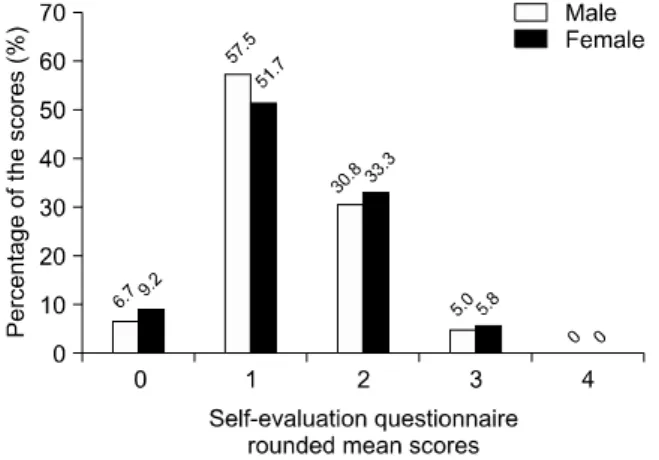
Figs 1 to 4 illustrate the distribution of treatment needs, established using the evaluation methods em- ployed. The average of all question scores in the SEQs (n = 240 × 11) was 0.900 (Table 1). The proportions of participants who selected chief complaint values
Fig 2. The histogram of the rounded mean scores (without decimal places) of the self-evaluation ques- tionnaire (n = 120 men and 120 women).
Fig 3. The histogram of the IOTN-AC scores (n = 120 men and 120 women). IOTN, Index of orthodontic treatment need; AC, aesthetic component.
Fig 4. The histogram of the IOTN-ACE scores (n = 120 men and 120 women). IOTN, Index of orthodontic treatment need; ACE, AC determined by the examiner.
Variable 1 Variable 2 Sample Male Female
SEQ IOTN-DHC 0.53 0.57 0.47
IOTN-ACE 0.41 0.34 0.44
IOTN-AC 0.35 0.32 0.38
IOTN-DHC IOTN-ACE 0.49 0.50 0.47
IOTN-AC 0.24 0.27 0.23
IOTN-ACE IOTN-AC 0.54 0.42 0.63
SEQ, Self-evaluation questionnaire; IOTN, index of orthodontic treatment need; DHC, dental health compo- nent; ACE, AC determined by the examiner; AC, aes- thetic component. All p-values < 0.001; Rho > 0.4 in bold.
Table 2. The rho values of the Spearman’s test used for evaluating the correlations between the assessment methods in the sample, males, and females
were 27.7% for 0, 38.7% for 1, 12.8% for 2, 6.4% for 3, 4.3% for 4, and 10.2% for 5. The proportions of the IOTN-AC categories “no treatment need,” “moderate need,” and “extreme need” were 93.2%, 5.6%, and 1.3%, respectively (Fig 3), whereas the proportions of the IOTN-ACE categories were 92.7%, 3.9%, and 3.4%, respectively (Fig 4).
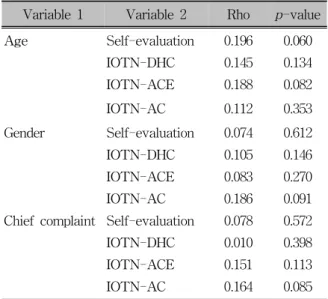
According to Spearman’s correlation coefficient, the scores of all of the evaluation methods were sig- nificantly correlated with each other (all p values ≤ 0.001; Table 2). Age, gender, and the patients’ chief complaints were not significantly associated with the results of any of the methods of assessing treatment need (Table 3).
The chi-square test showed that the score pro-
portions of the IOTN-DHC and the SEQ differed sig- nificantly in distribution patterns (p = 0.01. The dis- tribution of score proportions of the IOTN-AC and the IOTN-ACE were not significantly different (p = 0.086).
DISCUSSION
Among the methods used, the IOTN-ACE had mod- erate correlations with each of the other methods, whereas the IOTN-AC was moderately correlated only with the IOTN-ACE, which, not surprisingly, was the greatest correlation. The correlation between the IOTN-
Variable 1 Variable 2 Rho p-value
Age Self-evaluation 0.196 0.060
IOTN-DHC 0.145 0.134
IOTN-ACE 0.188 0.082
IOTN-AC 0.112 0.353
Gender Self-evaluation 0.074 0.612
IOTN-DHC 0.105 0.146
IOTN-ACE 0.083 0.270
IOTN-AC 0.186 0.091
Chief complaint Self-evaluation 0.078 0.572
IOTN-DHC 0.010 0.398
IOTN-ACE 0.151 0.113
IOTN-AC 0.164 0.085
IOTN, Index of orthodontic treatment need; DHC, den- tal health component; ACE, AC determined by the examiner; AC, aesthetic component.
Table 3. The correlations between the variables age, gender, and chief complaints with treatment need as- sessment methods calculated using Spearman’s coef- ficient
DHC and the self-evaluation approach was the second highest.
Self-evaluation
The patients’ chief complaints in this study were not associated with their normative or self-perceived ortho- dontic needs; this may point to the need for more comprehensive examinations rather than relying on the chief complaint. The observed discrepancy between the results of the SEQ and the IOTN-DHC might be attrib- uted to the patients’ attitudes and expectations, and in some cases, to the need for prosthodontic treatments rather than orthodontic treatments. The “high treatment need” group of the IOTN-DHC consisted of maloc- clusions in areas the patient might be unaware of, as was confirmed by the comparison of the IOTN-DHC and the IOTN-AC.2 On the other hand, certain maloc- clusions critical to the patient might be considered nor- mal according to the IOTN-DHC, or even be omitted from its criteria. These include gingival appearance and the presence of interdental spaces, which are consid- ered important in some patients’ opinions. Some au-
thors have reported a poor correlation between the IOTN-DHC scores and participants’ self-evaluation (e.g., 19%2 or 7 - 14%),3 whereas the results of others were in harmony with the correlation observed in this study (53%).8 The questionnaire presented in this study eclipsed the normative needs comparatively well. The correlation between the results of the SEQ and the IOTN-AC in our study (35%) was similar to that re- ported in other studies (47%,2 34%,8 31%,16 and 28 - 39%3).
As reported by Phillips and Beal,9 the correlation between the SEQ and the IOTN-AC was not mean- ingful (rho < 0.4). The IOTN-AC represents self-per- ceived severity of the malocclusion,9 whereas the ques- tionnaire included items related to positive feelings to- wards self, and not only dental appearance. This corre- lation also implied a high need for aesthetic improve- ments among the subjects despite their proper dental appearance. The finding was in contrast to that of a Finnish study in which most of the participants were not meant to receive orthodontic treatments despite their comparatively low satisfaction with their oral appearances.13 Apparently, the Finnish health care sys- tem places more emphasis on the functional aspects rather than on aesthetics.13,24 Moreover, a rather lower level of satisfaction could be expected since more than one-third of the treated Finnish adolescents still showed diastema and crowding afterwards.13 The IOTN-ACE showed a meaningful correlation with self- perceived needs in this study, indicating that its reli- ability was higher than that of the AC.
IOTN
The slightly lower correlation between the IOTN- DHC and the IOTN-AC found in this study as com- pared to that reported in another study3 might be be- cause of differences in ethnic backgrounds and psycho- social needs. The scores of the IOTN-AC and the IOTN-ACE were inclined to the attractive end. A sim- ilar pattern was observed in several other studies,2,16,23 but some studies showed an evenly distributed AC his- togram,25 or even an inclination to the unattractive end.3 The “no treatment need” scores of the AC might be redefined as “AC images 1 and 2” to make them
more consistent with the DHC or self-evaluation.13 Furthermore, a modified version of the IOTN-AC with more images on the attractive end might be advanta- geous for evaluating self-perception towards dental ap- pearance with higher accuracy. Throughout this study, the IOTN-AC scores were slightly closer to the attrac- tive end than were the scores of the IOTN-ACE; this finding was similar to that of other studies.2,8 This might be attributed to the dentists’ better knowledge of dental appearance as well as to the difficulties young adults may have in assessing their dental appear- ance;1,7,13 such a difference might increase if the exam- iner was an orthodontist.8
Age and gender
While men may show higher normative needs, the genders do not differ in perceived needs.2 In this study, the need for orthodontic treatment was slightly, but insignificantly, lower in men than in women. This finding was supported by those of previous stud- ies,8,19,20 but opposed by others that reported a sig- nificant difference between the genders.2,16,17 The age, race, level of expectations (probably affected by their culture), and socioeconomic status of each population might contribute to the controversy. The participants’
age did not correlate to their self-evaluation. This was in contrast to the findings of some other studies.13,16 Moreover, the consciousness regarding self-image might be more prominent during adolescence.15 Therefore, most of these patients might have had an appropriate self-evaluation method.
Limitations
The present study might be limited by some factors.
In this study, the subjects were selected from dental clinics that were not necessarily the most representa- tive of the local population, as dental patients might have a better insight towards their dental condition or appearance. Social background, which could influence orthodontic treatment needs (i.e., dental attractive- ness),2,15,17,18
was not assessed in this study. The IOTN- AC is composed of 10 photographs of 12-year-old children, which might affect the reliability of AC im-
ages selected by older patients.18 However, the correla- tion between the IOTN-AC and the IOTN-ACE might indicate an appropriate reliability.
The significant correlations found between the find- ings of the objective and subjective methods used in this study may indicate that self-perceived needs of young adults may moderately reflect their objective treatment need. However, because there was still a considerable difference between these, a treatment plan should address both the self-perceived and the norma- tive needs.
CONCLUSION
Within the limitations of this study, there were pos- itive and significant weak-to-moderate correlations be- tween the components of the IOTN and young-adult patients’ self-evaluation results.
1. The association found between the IOTN and self- evaluation in young adults was similar to that ob- served in children.
2. The IOTN-ACE seemed to be more reliable than the IOTN-AC in young adults.
3. The age and gender and the chief complaint did not correlate to the normative or self-perceived treat- ment needs.
ACKNOWLEDGMENTS
The authors would like to thank Dr. Hamid Rakhshan for technical contribution to the text as well as Annahita M. Ehsan and Farzan Clinical Research Institute for editorial assistance.
REFERENCES
1. Tsakos G. Combining normative and psychosocial perceptions for assessing orthodontic treatment needs. J Dent Educ 2008;
72:876-85.
2. Kerosuo H, Al Enezi S, Kerosuo E, Abdulkarim E. Associa- tion between normative and self-perceived orthodontic treat- ment need among Arab high school students. Am J Orthod Dentofacial Orthop 2004;125:373-8.
3. Shue-Te Yeh M, Koochek AR, Vlaskalic V, Boyd R, Richmond S. The relationship of 2 professional occlusal in- dexes with patients' perceptions of aesthetics, function, speech,
and orthodontic treatment need. Am J Orthod Dentofacial Orthop 2000;118:421-8.
4. Chu CH, Choy BH, Lo EC. Occlusion and orthodontic treat- ment demand among Chinese young adults in Hong Kong.
Oral Health Prev Dent 2009;7:83-91.
5. Tang EL, So LL. Correlation of orthodontic treatment demand with treatment need assessed using two indices. Angle Orthod 1995;65:443-50.
6. Nobile CG, Pavia M, Fortunato L, Angelillo IF. Prevalence and factors related to malocclusion and orthodontic treatment need in children and adolescents in Italy. Eur J Public Health 2007;17:637-41.
7. Sheats RD, McGorray SP, Keeling SD, Wheeler TT, King GJ.
Occlusal traits and perception of orthodontic need in eighth grade students. Angle Orthod 1998;68:107-14.
8. Birkeland K, Boe OE, Wisth PJ. Orthodontic concern among 11-year-old children and their parents compared with ortho- dontic treatment need assessed by index of orthodontic treat- ment need. Am J Orthod Dentofacial Orthop 1996;110:
197-205.
9. Phillips C, Beal KN. Self-concept and the perception of facial appearance in children and adolescents seeking orthodontic treatment. Angle Orthod 2009;79:12-6.
10. Mugonzibwa EA, Kuijpers-Jagtman AM, van't Hof MA, Kikwilu EN. Comparison between the opinions of Tanzanian parents and their children on dental attractiveness. Angle Orthod 2004;74:63-70.
11. Koochek AR, Yeh MS, Rolfe B, Richmond S. The relationship between Index of Complexity, Outcome and Need, and pa- tients' perceptions of malocclusion: a study in general dental practice. Br Dent J 2001;191:325-9.
12. Onyeaso CO, Sanu OO. Perception of personal dental appear- ance in Nigerian adolescents. Am J Orthod Dentofacial Orthop 2005;127:700-6.
13. Svedström-Oristo AL, Pietilä T, Pietilä I, Vahlberg T, Alanen P, Varrela J. Acceptability of dental appearance in a group of Finnish 16- to 25-year-olds. Angle Orthod 2009;79:479-83.
14. Stenvik A, Espeland L, Mathisen A. A longitudinal study on
subjective and objective orthodontic treatment need. Eur J Orthod 1997;19:85-92.
15. Bos A, Hoogstraten J, Prahl-Andersen B. Expectations of treat- ment and satisfaction with dentofacial appearance in ortho- dontic patients. Am J Orthod Dentofacial Orthop 2003;123:
127-32.
16. Abu Alhaija ES, Al-Nimri KS, Al-Khateeb SN. Self-perception of malocclusion among north Jordanian school children. Eur J Orthod 2005;27:292-5.
17. Mandall NA, McCord JF, Blinkhorn AS, Worthington HV, O'Brien KD. Perceived aesthetic impact of malocclusion and oral self-perceptions in 14-15-year-old Asian and Caucasian children in greater Manchester. Eur J Orthod 2000;22:175-83.
18. Johansson AM, Follin ME. Evaluation of the aesthetic compo- nent of the Index of Orthodontic Treatment Need by Swedish orthodontists. Eur J Orthod 2005;27:160-6.
19. Chew MT, Aw AK. Appropriateness of orthodontic referrals:
self-perceived and normative treatment needs of patients re- ferred for orthodontic consultation. Community Dent Oral Epidemiol 2002;30:449-54.
20. Al-Sarheed M, Bedi R, Hunt NP. Orthodontic treatment need and self-perception of 11-16-year-old Saudi Arabian children with a sensory impairment attending special schools. J Orthod 2003;30:39-44.
21. Brook PH, Shaw WC. The development of an index of ortho- dontic treatment priority. Eur J Orthod 1989;11:309-20.
22. Richmond S, Shaw WC, Stephens CD, Webb WG, Roberts CT, Andrews M. Orthodontics in the general dental service of England and Wales: a critical assessment of standards. Br Dent J 1993;174:315-29.
23. Hedayati Z, Fattahi HR, Jahromi SB. The use of index of or- thodontic treatment need in an Iranian population. J Indian Soc Pedod Prev Dent 2007;25:10-4.
24. Svedström-Oristo AL, Pietilä T, Pietilä I, Alanen P, Varrela J.
Morphological, functional and aesthetic criteria of acceptable mature occlusion. Eur J Orthod 2001;23:373-81.
25. Soh J, Sandham A. Orthodontic treatment need in Asian adult males. Angle Orthod 2004;74:769-73.