Correlation between skeletal and dental changes after mandibular setback surgery-first orthodontic treatment: Cone-beam computed tomography- generated half-cephalograms
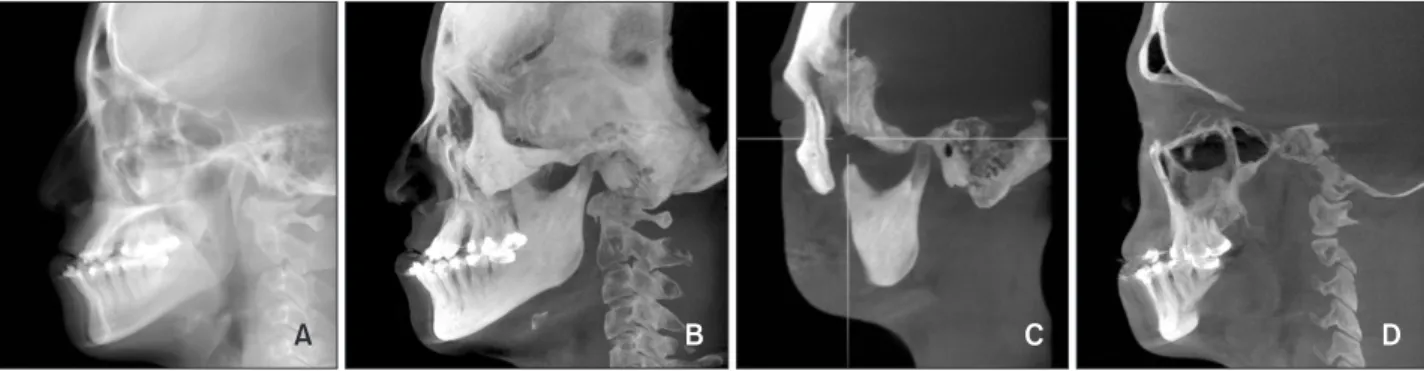
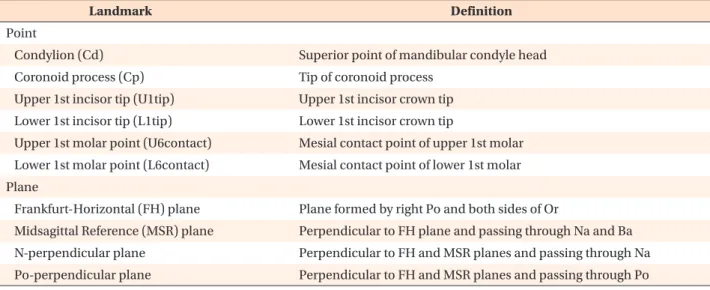
Objective: To investigate skeletal and dental changes after application of a mandibular setback surgery-first orthodontic treatment approach in cases of skeletal Class III malocclusion. Methods: A retrospective study of 34 patients (23 men, 11 women; mean age, 26.2 ± 6.6 years) with skeletal Class III deformities, who underwent surgery-first orthodontic treatment, was conducted. Skeletal landmarks in the maxilla and mandible at three time points, pre-treatment (T0), immediate-postoperative (T1), and post-treatment (T2), were analyzed using cone-beam computed tomography (CBCT)-generated half-cephalograms.
Results: The significant T0 to T1 mandibular changes occurred −9.24 ± 3.97 mm horizontally. From T1 to T2, the mandible tended to move forward 1.22
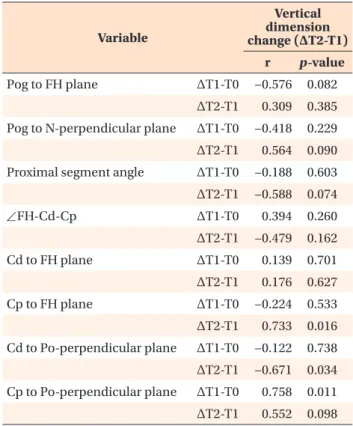
± 2.02 mm, while the condylar position (Cd to Po-perpendicular plane) shifted backward, and the coronoid process (Cp to FH plane) moved vertically. Between T1 and T2, the vertical dimension changed significantly (p < 0.05). Changes in the vertical dimension were significantly correlated to T1 to T2 changes in the Cd to Po-perpendicular plane (r = −0.671, p = 0.034), and in the Cp to FH plane (r = 0.733, p = 0.016), as well as to T0 to T1 changes in the Cp to Po- per pendicular plane ( r = 0.758, p = 0.011). Conclusions: Greater alterations in the vertical dimension caused larger post-treatment (T2) stage skeletal changes.
Stu dying the mandibular position in relation to the post-surgical vertical dimension emphasized the integral importance of vertical dimension control and proximal segment management to the success of surgery-first orthodontic treatment.
[Korean J Orthod 2015;45(2):59-65]
Key words: Three-dimensional cephalometrics, Computed tomography, Class III orthognathic surgery
Chang-Hoon Rhee
aYoun-Kyung Choi
bYong-Il Kim
b,cSeong-Sik Kim
cSoo-Byung Park
cWoo-Sung Son
ca
Private Practice, Busan, Korea
b
Department of Orthodontics, Biomedical Research Institute, Pusan National University Hospital, Busan, Korea
c
Department of Orthodontics, Dental Research Institute, Pusan National University Dental Hospital, Yangsan, Korea
Received April 24, 2014; Revised September 18, 2014; Accepted September 24, 2014.
Corresponding author: Yong-Il Kim.
Assistant Professor, Department of Orthodontics, Dental Research Institute, Pusan National University Dental Hospital, Geumoro20, Mulgeum-eup, Yangsan 626-787, Korea.
Tel +82-55-360-5153 e-mail [email protected]
*The Research Fund Program of Research Institute for Basic Sciences, Pusan National University, Korea, 2014, Project No. RIBS-PNU-2014, and the Busan Gyeongnam Ulsan branch of the Korean Association of Orthodontists supported this study.
© 2015 The Korean Association of Orthodontists.
The authors report no commercial, proprietary, or financial interest in the products or companies described in this article.
This is an Open Access article distributed under the terms of the Creative Commons Attribution Non-Commercial License (http://creativecommons.org/licenses/by-nc/3.0) which permits unrestricted non-commercial use, distribution, and reproduction in any medium, provided the original work is properly cited.