책임저자: 이혜순, 대전시 유성구 전민동 461-6
305-811, 한남대학교 간호학과
Tel: 042-629-8917, E-mail: [email protected] 접수: 2014년 2월 15일, 심사: 2014년 2월 25일 게재승인: 2014년 4월 7일
This is an open access article distributed under the terms of the Creative Commons Attribution Non-Commercial License (http://creativecommons.org/licenses/by-nc/3.0) which permits unrestricted non-commercial use, distribution, and reproduction in any medium, provided the original work is properly cited.
청소년의 우울 및 충동성이 흡연에 미치는 영향
한남대학교 간호학과
이 혜 순
Effects of Depression and Impulsive Behavior on Smoking of Adolescents Hea Shoon Lee
Department of Nursing, Hannam University, Daejeon, Korea
This study was to investigate the relationship between depression and impulsive behavior among adolescents. The data were collected using questionnaire from the sample of 452 middle and high school students. The data were collected from July 2 to 13, 2012. Data were analyzed using frequencies, means, χ2-test, t-test and logistic regression analysis (SPSS 20.0). The major findings of this study were as follows. Adolescents smoking rate were 19.2%. Firstly, Significant differences were found for Sex, school achievement levels, school of life satisfaction, family living together, parental relationship satisfaction between smoking group and non-smoking group. Secondly, Depression and impulsive behavior of smoking group were higher than non-smoking group.
Thirdly, The logistic regression analysis revealed that depression, motor impulsiveness, and school achievement levels were significantly associated with smoking. The results of this study offer basic data for the development of intervention programs to prevent adolescents smoking. (Korean J Str Res 2014;22:67∼76)
Key Words: Adolescent, Depression, Impulsive Behavior, Smoking
서 론
1. 연구 필요성
청소년기는 자기조절과 통제능력이 부족하여 주변 환경 의 유혹에 민감하게 반응하여 유해한 행동을 하기 쉽고
(Kwak YH, 2011), 흡연은 청소년기 대표적인 건강위험문제 로 성인기 생활습관으로 이어져 평생의 건강을 위협하는 잠재적 요소로 그 중요성이 강조되고 있다(da Costa e Silva VL et al., 2004).
청소년 흡연율은 2006년 이후 12∼13%가 지속되고 있으 며(Korea Centers for Disease Control and Prevention [KCDCP], 2012), 청소년의 63%가 중학교 재학 중 흡연을 처음 경험 하고(KCDCP, 2007), 흡연시작 연령도 낮아지고 있어 청소 년의 흡연문제는 심각한 것으로 보고되고 있다(Korean Association of Smoking & Health [KASH], 2007).
청소년 흡연은 성인에 비해 상대적으로 짧은 흡연기간 과 적은 흡연양일지라도 세포 및 조직에 치명적 피해와 유 전자 손상 및 자유라디칼 생성을 촉진시켜 신체적인 질환
을 유발하며, 성인이 되어 흡연을 시작하는 것보다 정신적 의존도가 높아져 니코틴 의존으로 이어지게 된다(Je MS et al., 2008). 흡연은 약물 남용 및 정신건강 문제들을 유발하 는 원인으로(Kang YG et al., 2002), 청소년 흡연을 감소시키 기 위한 적극적인 노력이 필요하다.
청소년 흡연 동기의 31%는 우울한 감정을 해소하기 위 한 것으로(Hahm JS, 2005), 공격성이나 비행 같은 문제행동 을 동반한 우울의 경우 흡연 위험성을 2배 이상 증가시킨 다(Whalen et al., 2001). 청소년기는 스트레스에 대한 정서적 인 증상으로 우울이 발생하며(Hahm JS, 2005), 우울수준이 높은 경우 흡연이나 약물남용과 같은 문제행동으로 대처 하는 것으로 나타났다(Moolchan et al., 2000). 이에 청소년에 서 흡연과 우울은 상호의존적인 관계이며(Martini et al., 2002), 우울은 흡연의 예측인자로 보고되었다(Breslau et al., 2000).
따라서 청소년의 흡연을 예방하고, 감소시키기 위한 방안 으로 흡연 시작의 위험 요소로 주목받고 있는 청소년 우울 에 대한 적극적인 관심이 필요하다.
청소년기 우울은 무기력함, 신경과민 등의 증상을 특징 으로 하는 성인기 우울과는 달리 화를 잘 내는 행동, 쉽게 흥분하는 것 등으로 대변되는 과민한 기분을 특징으로 하 고 있으며(Mash et al., 2005), 청소년기 우울증 발병은 충동 성을 조절하는 전두엽의 백질병변과 연관되어 우울증 환 자에서 충동성 점수가 높은 특징(Nam YY et al., 2005)을 고 려할 때 흡연은 우울과 관련이 있고, 우울은 충동성과 관 련이 있는 것으로 생각된다.
한편, 청소년 흡연은 충동성과 관련이 있고(Lane et al., 2003), 충동성은 흡연의 중요 변인으로 흡연을 시작하게만 하는 것이 아니라 흡연 의존에 영향을 미칠 수 있다(Suh KH et al., 2013). 또한 충동성이 높을수록 흡연량이 증가하 고(Jeon YC, 2010), 니코틴 중독군이 비중독군에 비해 충동 성이 높은 것으로 나타나(Kang YG et al., 2002), 충동성이 흡연과 관련된 중요 변수라고 할 수 있다.
그러나 선행연구에서는 청소년의 흡연과 우울에 대한 연구(Breslau et al., 2000; Moolchan et al., 2000; Whalen et al., 2001)가 보고되고는 있지만 대부분의 연구가 흡연과 우울 의 관계를 규명하는 연구로 청소년 우울 발생과 이로 인한 흡연 증가를 예방하기 위해, 우울 뿐 만 아니라 흡연에 영 향을 미치는 위험요인들을 확인할 필요가 있다.
따라서 본 연구에서는 흡연군과 비흡연군의 정서적 특 성인 우울 및 성격특성인 충동성을 파악하고, 흡연에 영향 을 미치는 위험요인을 파악하였다. 특히 충동성의 어떤 하
부요인이 흡연에 더 중요한 요인인지 파악함으로써 청소 년의 흡연 예방을 위한 중재프로그램의 기초 자료를 제공 하고자 한다.
2. 연구의 목적
본 연구의 구체적인 목적은 다음과 같다.
ㆍ흡연군과 비흡연군의 일반적 특성의 차이를 파악한다.
ㆍ흡연군과 비흡연군의 우울 및 충동성의 차이를 파악한다.
ㆍ흡연에 영향을 미치는 위험요인을 파악한다.
재료 및 방법
1. 연구설계
본 연구는 흡연군과 비흡연군 청소년의 우울 및 충동성 을 파악하고, 흡연에 영향을 미치는 위험요인을 파악하기 위한 서술적 조사연구이다.
2. 연구대상 및 자료수집 방법
본 연구 대상은 중학생과 고등학생이며, 자료 수집은 2012년 7월 2일부터 13일까지이며, 일 지역에 소재한 중학 교와 고등학교 중 연구 참여를 허락한 학교를 방문하여, 담임교사에게 연구의 목적을 설명하고 동의를 구하였다.
연구 참여에 동의한 각 학급 담당교사의 협조 하에 수업 종료 15분 전에 학생들에게 본 연구의 목적과 취지, 자료 의 비밀보장과 익명성, 연구 참여에의 철회 가능성 등을 설명하고 연구 참여 및 설문지 작성에 대한 동의를 구하였 다. 연구 참여 동의서를 작성한 학생에 한하여 자가보고식 설문지를 작성하게 하였으며, 설문지 작성 중 중도포기를 희망하는 학생들은 설문지를 제출하지 않도록 하였다. 설 문지 작성에 소요된 시간은 약 10분 정도였다.
표본수는 Cohen(1988)이 제시한 표본 크기 결정 방법에 근거하여 유의수준(α)은 .05, 회귀분석의 small effect size .02, 검정력(1-β)은 .80으로 산정한 결과 416명 이상의 대 상자가 요구되었으며, 무응답 또는 불완전 응답으로 제외 될 수 있는 설문지를 고려하여 총 485부를 배포하였다. 이 중 464부가 회수되었으며(회수율 95.6%), 불완전하게 응답 한 설문지 12부를 제외한 총 452부(응답률 93.2%)를 최종 분석에 사용하였다. 최종 대상자는 중학생 249명(55.1%), 고등학생 203명(44.9%)이었다.
3. 연구도구
1) 흡연군과 비흡연군 분류: 본 연구에서 흡연군과 비흡 연군 분류는 흡연 정의(KASH, 2007)에 근거하여 “매일 습 관적으로 1개비 이상 흡연하거나, 매일 흡연을 하지 않지 만 매 주말 짧은 시간에 규칙적으로 흡연을 하십니까?”로 조사하였다. 본 연구에서 흡연군 19.2% (87명), 비흡연군 80.8% (365명)로 나타났다.
2) 우울: 본 연구에서는 Radloff (1977)가 개발한 Center for Epidemiological Sudies-Depression (CES-D)을 Chon KK et al.(1992) 이 한국인을 대상으로 수정한 자가 보고형 우울도구(CES- D)를 사용하여 측정하였다. 본 도구는 총 20문항이며, 각 문항은 4점 척도로 최저 0점에서 최고 3점으로 점수화하였 다. 점수가 높을수록 우울 정도가 높은 것을 의미한다.
Boyed et al.(1982)의 기준에 따라 16점이상을 우울군, 16점 미만을 정상군으로 분류하였다. Chon KK et al.(1992) 연구 에서 신뢰도 Cronbach'sα=.85이었으며, 본 연구의 신뢰도 Cronbach'sα=.87이었다.
3) 충동성: 본 연구에서는 Barratt et al.(1969)이 개발한 Barratt impulsiveness scale II를 Lee HS(1992)가 수정한 도구를 사용하여 측정하였다. 본 도구는 3영역, 총 23개 문항으로 인지충동성(Cognitive impulsiveness: 어떤 일에든지 쉽게 몰 두 할 수 없으며, 신중하게 생각하지 않고 행동하는 특성) 6문항, 운동충동성(Motor impulsiveness: 자제력이 약하며 생 각 없이 말하고 하고 싶은 대로 행동하는 행동제지 능력의 저하) 8문항, 무계획충동성(Non-planning impulsiveness: 일을 시작하기 전 계획을 세우지 않고, 한 가지 일이 끝나기 전 에 또 다른 일을 계획 없이 시작하는 특성) 9문항의 하부 영역으로 구성되었다. 각 문항은 4점 척도로 최저1점에서 최고 4점으로 점수화하였으며, 점수가 높을수록 충동성이 높은 것을 의미한다. Lee HS(1992) 연구에서 신뢰도 Cron- bach’s α=.70이었으며, 본 연구의 신뢰도 Cronbach’s α=
.76이었다.
4. 자료분석 방법
수집된 자료는 SPSS WIN 20.0을 이용하여 분석하였다.
ㆍ대상자의 일반적 특성은 M (SD), n (%)로 분석하였다.
ㆍ흡연군과 비흡연군의 일반적 특성의 차이는 χ2-test로 분석하였다.
ㆍ흡연군과 비흡연군의 우울 및 충동성의 차이는 t-test와 χ2-test로 분석하였다.
ㆍ흡연에 영향을 미치는 위험요인을 파악하기 위해 Logis- tic regression analysis를 실시하였다
결 과
1. 흡연군과 비흡연군의 일반적 특성 비교
대상자 평균 연령은 14.98세이며, 중학생 흡연율은 16.5%, 고등학생 흡연율은 22.7%로 나타났다. 남학생 흡연율은 22.4%, 여학생 흡연율은 15.5%로 나타났다.
성별에서, 흡연군은 남학생이 63.2%, 반면 비흡연군은 남학생이 52.3%로 나타나, 흡연여부에 따라 차이가 있는 것으로 나타났다(χ2=5.35, p=.043).
학업성취수준에서, 흡연군은 중간수준이 47.1%, 반면 비 흡연군에서는 중간수준이 59.2%로 나타나 흡연여부에 따 라 차이가 있는 것으로 나타났다(χ2=15.21, p<.001).
학교생활 만족도에서, 흡연군은 보통이 48.3% 가장 많았 고, 반면 비흡연군은 만족이 56.7% 가장 많은 것으로 나타 나, 흡연여부에 따라 차이가 있는 것으로 나타났다(χ2= 11.28, p=.002).
가족 구성형태에서, 흡연군은 부모 78.2%, 반면 비흡연 군은 부모 86.0%로 나타나, 흡연여부에 따라 유의한 차이 가 있는 것으로 나타났다(χ2=11.99, p=.002).
부모관계 만족도에서, 흡연군은 만족이 60.9%, 반면 비 흡연군에서는 만족이 70.7%로 나타나 흡연여부에 따라 유 의한 차이가 있는 것으로 나타났다(χ2=7.76, p=.021)(Table 1).
2. 흡연군과 비흡연군의 우울, 충동성
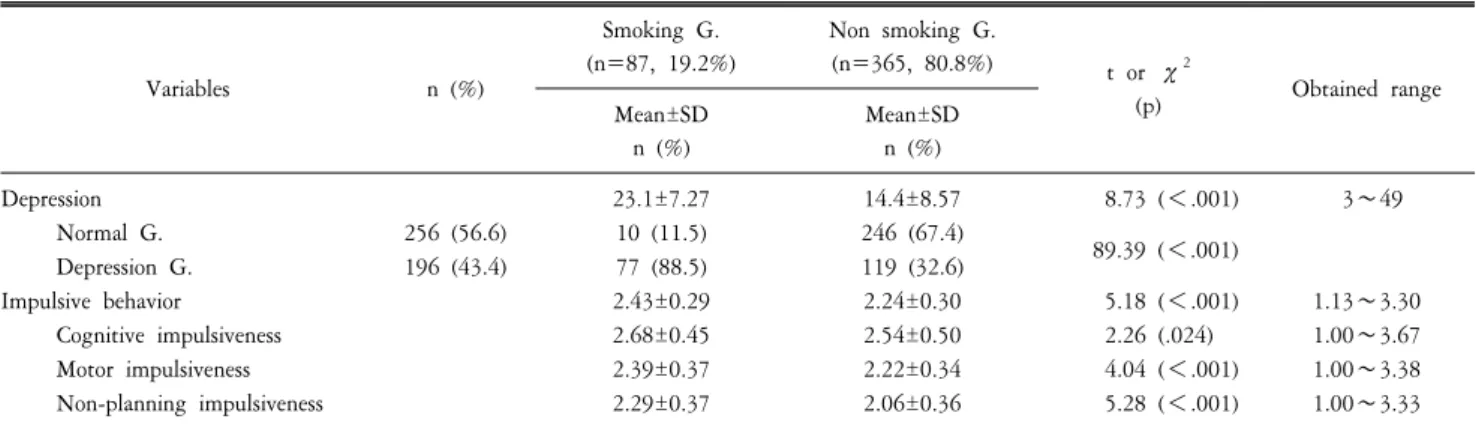
대상자 우울은 흡연군이 비흡연군 보다 높은 것으로 나 타났으며(t=8.73, p=.012), Boyed et al.(1982)의 우울기준에 따라 집단을 나누었을 때 우울군에 흡연군(88.5%)이 비흡 연군(32.6%)보다 많은 것으로 나타났다(χ2=89.39, p<.001).
대상자 충동성은 흡연군이 비흡연군 보다 높은 것으로 나타났다(t=5.18, p<.001)(Table 2).
3. 흡연에 영향을 미치는 위험요인
대상자 흡연에 영향을 미치는 요인을 파악하기 위해 우 울과 충동성의 하부 영역인 인지충동성, 운동충동성, 무계 획충동성, 일반적 특성 중 흡연군과 비흡군 간에 유의한 차이를 보인 변수를 독립변수로 하여 로지스틱 회귀분석 으로 검증하였다. 본 연구에서 로지스틱 회귀 모형의 −2LL
Table 1. Compared to general characteristics of the smoking and non-smoking group (N=452).
Variables Categories M±SD
n (%)
Smoking G.
(n=87, 19.2%)
Non smoking G.
(n=365, 80.8%) χ2 (p)
n (%) n (%)
Age 14.98±1.73
Grade Middle school Smoking G 41 (16.5) 249 (55.1) 41 (47.1) 208 (57.0) 2.76
(.097) Non smoking G 208 (83.5)
High school Smoking G. 46 (22.7) 203 (44.9) 46 (52.9) 157 (43.0) Non smoking G 157 (77.3)
Sex Male Smoking G. 55 (22.4) 246 (54.4) 55 (63.2) 191 (52.3) 535
(.043) Non smoking G 191 (77.6)
Female Smoking G. 32 (15.5) 206 (45.6) 32 (36.8) 174 (47.7)
Non smoking G 174 (84.5)
Religion Christian 60 (13.3) 12 (13.8) 48 (13.2) 2.00
(.571)
Catholic 28 (6.2) 4 (4.6) 24 (6.6)
Buddhism 126 (27.9) 29 (33.3) 97 (26.6)
None 238 (52.7) 42 (48.3) 196 (53.7)
School achievement levels
High 76 (16.8) 9 (10.3) 67 (18.4) 15.21
(<.001)
Medium 257 (56.9) 41 (47.1) 216 (59.2)
Low 119 (26.3) 37 (42.5) 82 (22.5)
School of life satisfaction
Satisfactory 241 (53.3) 34 (39.1) 207 (56.7) 11.28
(.004)
Average 180 (39.8) 42 (48.3) 138 (37.8)
Unsatisfactory 31 (6.9) 11 (12.6) 20 (5.5)
Family living together
Parents 382 (84.5) 68 (78.2) 314 (86.0) 11.99
(.007)
Father 22 (4.9) 6 (6.9) 16 (4.4)
Mother 29 (6.4) 5 (5.7) 24 (6.6)
Etc. (alone, elatives) 19 (4.2) 8 (9.2) 11 (3.0)
Parental relationship satisfaction
Satisfactory 311 (68.8) 53 (60.9) 258 (70.7) 7.76
(.021)
Average 131 (29.0) 29 (33.3) 102 (27.9)
Unsatisfactory 10 (2.2) 5 (5.7) 5 (1.4)
Table 2. Level of depression and impulsive behavior of the subject (N=452).
Variables n (%)
Smoking G.
(n=87, 19.2%)
Non smoking G.
(n=365, 80.8%) t or χ2
(p) Obtained range
Mean±SD n (%)
Mean±SD n (%)
Depression 23.1±7.27 14.4±8.57 8.73 (<.001) 3∼49
Normal G. 256 (56.6) 10 (11.5) 246 (67.4)
89.39 (<.001)
Depression G. 196 (43.4) 77 (88.5) 119 (32.6)
Impulsive behavior 2.43±0.29 2.24±0.30 5.18 (<.001) 1.13∼3.30
Cognitive impulsiveness 2.68±0.45 2.54±0.50 2.26 (.024) 1.00∼3.67
Motor impulsiveness 2.39±0.37 2.22±0.34 4.04 (<.001) 1.00∼3.38
Non-planning impulsiveness 2.29±0.37 2.06±0.36 5.28 (<.001) 1.00∼3.33
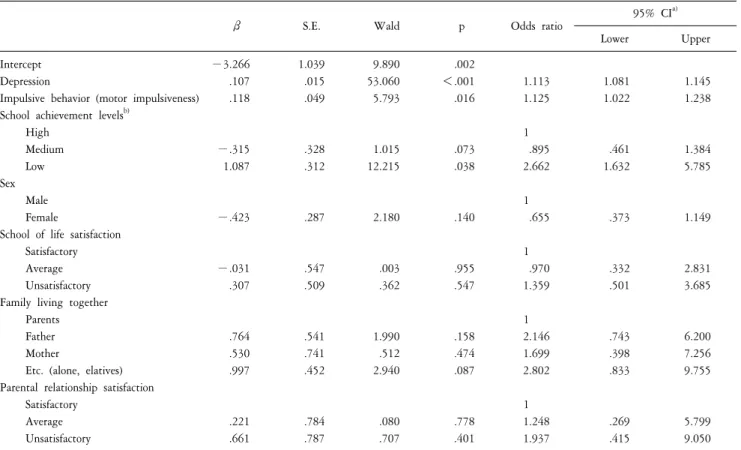
(−2 log likelihood) 값은 296.130, Nagelkerke’s R2은 .277, 카 이제곱(Chi-square)은 146.646 (p<.001), 예측정확도는 85.4%
로 나타났으며, 대상자의 흡연에 영향을 미치는 위험요인 은 우울, 운동충동성, 학업성취 수준으로 나타났다.
구체적으로 우울점수가 증가하면 흡연위험이 1.113배(95%
CI=1.081∼1.145) 높은 것으로 나타났으며, 운동충동성이 증가하면 흡연위험이 1.125배(95% CI=1.022∼1.238) 높은 것으로 나타났다. 또한 성적 하위군은 상위군보다 흡연위
Table 3. Predictors smoking using logistic regression (N=452).
β S.E. Wald p Odds ratio 95% CIa)
Lower Upper
Intercept −3.266 1.039 9.890 .002
Depression .107 .015 53.060 <.001 1.113 1.081 1.145
Impulsive behavior (motor impulsiveness) .118 .049 5.793 .016 1.125 1.022 1.238
School achievement levelsb)
High 1
Medium −.315 .328 1.015 .073 .895 .461 1.384
Low 1.087 .312 12.215 .038 2.662 1.632 5.785
Sex
Male 1
Female −.423 .287 2.180 .140 .655 .373 1.149
School of life satisfaction
Satisfactory 1
Average −.031 .547 .003 .955 .970 .332 2.831
Unsatisfactory .307 .509 .362 .547 1.359 .501 3.685
Family living together
Parents 1
Father .764 .541 1.990 .158 2.146 .743 6.200
Mother .530 .741 .512 .474 1.699 .398 7.256
Etc. (alone, elatives) .997 .452 2.940 .087 2.802 .833 9.755
Parental relationship satisfaction
Satisfactory 1
Average .221 .784 .080 .778 1.248 .269 5.799
Unsatisfactory .661 .787 .707 .401 1.937 .415 9.050
a)CI: confidence interval, b)School achievement levels: high (1) versus middle or low (0).
험이 2.662배(95% CI=1.632∼5.785) 높은 것으로 나타났다 (Table 3).
고 찰
본 연구에서는 “매일 습관적으로 1개비 이상 흡연하거 나, 매일 흡연을 하지 않지만 매 주말 짧은 시간에 규칙적 으로 흡연을 하고 있다”고 응답한 중학생 흡연율은 16.5%, 고등학생 흡연율은22.7%로 나타났다. 이와 같은 결과는 동 일도구로 흡연율을 측정한 제7차(2011년) 청소년건강행태 인터넷조사(KCDCP, 2012)에서 중학생 흡연율 8.1%, 고등 학생 흡연율 12.2%로, 본 연구의 중학생 및 고등학생 흡연 율이 높은 것으로 나타났다.
이러한 연구결과는 동일도구로 흡연율을 측정한 논문과 본 연구결과를 비교하기에 제한점이 있고, 흡연율 측정에 서 ‘최근 30일 동안 1일 이상 흡연한 사람의 분율’(Korea Centers for Disease Control and Prevention, 2012), ‘1일 흡연 개 비수와 흡연기간’(Byeon YS et al., 2008), “현재 흡연 여부”
등 다양한 방법으로 흡연율이 조사되고 있기 때문이라 생 각되며, 객관화된 표준 측정법에 의한 확인이 필요하다.
본 연구에서 남학생 흡연율은 22.4%, 여학생 흡연율은 15.5%로 나타났으며, 흡연 청소년 중 남학생 흡연율이 여 학생보다 높은 것으로 나타났다. Park IG(2013)의 연구에서 남학생 흡연율은 26.9%, 여학생 흡연율은 13.4%로 남학생 흡연율이 여학생 흡연율 보다 2배 이상 많고, 중ㆍ고등학 생 대상연구에서 남학생 흡연율이 여학생 흡연율보다 1.7 배 더 많은 것으로 나타났으며(Kim HC et al., 2006), 전국 중ㆍ고등학생 대상연구에서도 남학생 흡연율이 여학생 흡 연율보다 높은 것으로 보고되고 있어(Centers for Disease Control, 2012), 본 연구와 동일한 결과를 나타내었다.
본 연구에서 흡연군과 비흡연군의 학교생활 만족도에 차이가 있는 것으로 나타났는데 Won(2002)은 학교생활 만 족도가 낮을수록 부적응 행동을 하며, 부적응 행동의 대표 적 행위로 흡연을 하는 것으로 나타났으며, Chung HJ(2006) 의 연구에서도 학교생활 만족도가 낮을수록 청소년의 흡 연경험이 많은 것으로 나타나 본 연구의 결과를 지지하였
다.
이러한 연구결과는 청소년기 부모로부터 분리, 독립을 시작하여 친구관계가 중요한 시기로 청소년 흡연은 학교 생활에서 중요한 친구와의 관계유지를 위해 시작되며 (Lloyd-Richardson et al., 2002), 흡연을 통해 친구와의 관계를 개선하여 친근감을 느끼는 흡연 청소년의 특성(Mohan et al., 2002)과 관계가 있는 것으로 생각된다. 즉, 학교생활 만 족도 또한 청소년의 흡연을 유발하는 요인(Park WY, 2007) 이라고 할 수 있겠다.
본 연구에서 흡연군과 비흡연군의 가족 구성형태, 부모 관계 만족도에서도 차이가 있는 것으로 나타났다. 이러한 연구결과는 가족 구성원에 따라 가족기능에 차이가 있으 며(Helsen et al., 2000), 가족기능은 청소년의 자아개념과 정 서형성에 중요한 역할을 하여(Park JS et al., 2011), 가족기능 이 낮을수록 흡연가능성이 높아진다는 Lee SY et al.(2001) 연구, 가족생활 만족도가 증가할수록 흡연율은 감소한다 는 An HJ(2011) 연구 및 가족의 화목함이 흡연경험에 영향 을 미친다는 Choi WH et al.(2010) 연구와 본 연구는 유사한 결과를 나타내었다.
청소년 충동성에 영향요인으로 가족기능의 하부요인으 로 가족구성원들끼리 주어진 자극에 적절한 양과 질의 감 정을 나타내는 능력을 의미하는 정서적 반응성(Park WY, 2007)은 청소년에서 가족과의 적절한 정서 반응의 표출을 격려하여 가족 간의 의사소통을 강화할 수 있으며 청소년 들은 사회적 지지를 전달받고 올바른 발달을 경험할 수 있 게 된다(Gardner et al., 2004). 반면 가족기능 상실은 심리적 격동기에 있는 청소년에게 갈등과 스트레스로 작용하여 우울, 불안을 유발할 수 있으므로(Kim JE, 1998), 청소년에 게 발생되는 사건들에서 가족기능이 갖는 영향력을 간과 할 수 없어 청소년의 흡연과 같은 문제행동에 영향을 미치 는 것으로 생각된다.
본 연구에서 우울은 흡연군(23.1점)이 비흡연군(14.4점)보 다 높고, Boyed et al.(1982)의 우울기준에 따라 집단을 나누 었을 때 우울군에 흡연군(88.5%)이 비흡연군(32.6%)보다 많 은 것으로 나타났다. 청소년 우울을 측정한 Eoh YK(2005) 연구에서 17.7점으로 본 연구의 흡연군 보다는 낮고, 비흡 연군 보다는 높은 것으로 나타났다. Park JM(2007)의 청소 년 연구에서 우울은 41%였고, 우울에 대응 행동으로 흡연 과 음주를 하는 것으로 보고하여, 본 연구의 우울군은 43.4%로 유사한 결과를 나타내었다.
본 연구에서 충동성은 흡연군이 비흡연군보다 높은 것
으로 나타났는데, 선행연구에서 흡연군이 비흡연군에 비 해 충동적이며, 특히 충동성 중 즉흥적인 경향이 높은 것 으로 나타나(Kang YG et al., 2002) 본 연구의 결과를 지지하 였다. 이러한 연구결과는 충동성이 성급하고 즉각적으로 판단하거나 행위의 결과를 고려하지 않고 생각 없이 행동 하는 것으로(Madden et al., 2010), 문제행동의 유발요인(Kim JS, 2008)이 될 뿐만 아니라 니코틴 의존에 영향을 미치며 (Yoon YM et al., 2003), 금연의 장애요인이 되기(Rigotti, 2000) 때문이라고 생각된다. 또한 흡연으로 인해 요중 코티 닌 성분이 충동성을 유발함으로써(Cho SC et al., 2012). 충동 성으로 인해 흡연이 지속되고, 흡연으로 인해 충동성이 유 발됨으로써 악순환이 반복될 것으로 생각된다.
본 연구에서 흡연에 영향을 미치는 위험요인은 우울, 운 동충동성, 학업성취 수준으로 나타났다. 본 연구에서 우울 이 증가하면 흡연의 위험은 1.113배 높은 것으로 나타났다.
비흡연군에 비해 흡연시작군은 우울 점수가 1.5배, 흡연중 단군은 1.4배, 흡연유지군은 2배의 우울 점수를 보여 흡연 은 우울의 예측변수로 나타났다(Steuber et al., 2006). 선행연 구에서도 흡연군의 우울이 비흡연군 보다 높고(Chung SN, 2006), 우울이 높을수록 금연율이 낮아지고 금연유지 실패 율은 증가한다고 하였다(Breslau et al., 2000). 따라서 금연교 육 및 흡연 동기가 되는 우울을 해결하기 위한 대책 마련 이 필요하다.
이와 같은 결과는 흡연의 결정적인 위험 요소인 니코틴 이 중추신경계에 직접적인 영향을 미쳐 우울을 발현시키 고 이로 인해 흡연 청소년에서 우울이 증가하는 것으로 보 고하였다(Goodman et al., 2000), 우울은 흡연의 예측인자이 며(Breslau et al., 2000), 흡연군은 비흡연군에 비해 우울 등 의 정신건강 문제가 있는 것으로 보고하여(Kang YG et al., 2002), 본 연구의 결과를 지지하였다.
한편, 운동충동성이 증가하면 흡연 위험은 1.125배 높은 것으로 나타났다. 운동충동성은 자제력이 약하며 생각 없 이 말하고 하고 싶은 대로 행동하는 행동제지 능력의 저하 를 의미한다(Sin YS, 2012). 운동충동성은 화를 잘 내고 쉽 게 흥분하여 행동으로 표출되는 청소년 우울의 특징이 (Mash et al., 2005), 운동충동성에 의한 반응인 것으로 예측 할 수 있는 결과이다.
신경생물학적으로 흡연과 우울이 다양한 신경호르몬 및 신경전달물질의 변화에서 유의한 공통점을 갖고 있음이 보고되어 우울에 의해 흡연이 증가할 수도 있고 흡연에 의 해 우울이 발생할 수도 있어 상호관련성이 있다(Kim TS et
al., 2007). 운동충동성의 증가로 인해 청소년 우울이 나타 나고 청소년 우울은 흡연과 관련 있는 것으로 나타나, 운 동충동성이 흡연 위험요인으로 나타난 본 연구의 결과를 지지하였다.
반사회적 성격양상은 주로 15세 이전에 시작되어, 책임 감, 사회적 규범, 가치에 대한 신뢰감 및 준법정신의 결여, 자극성과 충동성 경향이 있으며, 문제행동에 대하여 죄책 감이나 후회가 없고 반복적으로 타인에게 해를 주는 성향 을 의미하며(American Psychiatric Association, 2013), 학생청소 년과 비행청소년 대상 연구에서 반사회적 성격양상이 비 행청소년에서 높은 것으로 나타났다(Kim HS, 2001).
본 연구에서는 반사회적 성격양상에 포함되어 있는 충 동성을 인지충동성, 운동충동성, 무계획충동성의 하부요인 에 따라 흡연과 같은 비행행동에 미치는 영향을 구체적으 로 확인하였고, 운동충동성이 영향을 미치는 것을 확인하 였다는 점에서 선행연구와 차이가 있다.
한편, 흡연은 알콜중독과 마찬가지로 물질중독의 일종으 로(Kang YG et al., 2002) 충동성은 중독에 영향을 미치며 (Cho HY, 2001), 충동성 조절을 통해 중독을 예방 할 수 있 다(Kwon JH, 2010). 그러므로 흡연 청소년의 충동성 조절을 위해서는 특히 운동충동성의 특성을 고려한 차별화된 접 근이 필요하다.
본 연구에서 성적 하위군은 상위군보다 흡연위험이 2.662배 높은 것으로 나타났다. 학업성적은 청소년 흡연에 영향요인이며(Kang LJ et al., 2005), 흡연군의 학업성적이 비 흡연군보다 낮은 것으로 나타났으며 스트레스 해소방안으 로 흡연이 시작되는 것으로 보고하여(An HJ, 2011) 본 연구 의 결과를 지지하였다.
본 연구에서는 흡연군과 비흡연군의 우울 및 충동성의 차이를 파악하고, 흡연에 영향을 미치는 위험요인으로 우 울, 학업성취 수준을 확인하였고, 특히 충동성의 하부요인 에서 운동충동성이 영향을 미치는 것을 실증적으로 확인 하였다는 점에서 의의가 있으며, 본 연구결과를 토대로 흡 연에 영향을 미치는 요인을 고려한 특성화된 간호중재 프 로그램을 개발, 적용하는 것이 필요하며, 개발된 중재 프로 그램의 흡연 예방 효과를 검증할 것을 제언한다.
참 고 문 헌
American Psychiatric Association (2013) Diagnostic and Statistical Manual of Mental Disorders. 5th Ed (DSM-V). American Psychiatric Publishing. Washington, DC.
An HJ (2011) Investigation of Relationship among The Family Structure, Misbehavior of Adolescence and School Outcomes.
Unpublished master's thesis, Sogang University, Seoul.
Barratt ES, White R (1969) Impulsiveness and anxiety related to medical students: performance and attitudes. J. of Medical Educa- tion. 44:604-607.
Boyed JH, Weissman MM, Thompson WD, et al. (1982) Screening for depression in a community sample. Understanding the discre- pancies between depression symptom and diagnostic scales.
Archives of General Psychiatry. 39:1195-1200.
Breslau N, Johnson EO (2000) Predicting smoking cessation and major depression in nicotine-dependent smokers. Am. J. Public Health. 90:1122-1127.
Bruchinal MR, Roberts JE, Zeisel SA, et al. (2008) Social risk and pro- tective factors for African American children's academic achieve- ment and adjustment during the transition to middle school.
Developmental Psychology. 44:286-292. http://dx.doi.org/10.1037/
0012-1649.44.1.286
Byeon YS, Lee HS (2008) Relation of the depression and attention concentration by smoking status among adolescents. Korean Journal of Adult Nursing. 20:231-238.
Centers for Disease Control (2012) The seventh (2011) Youth Health Behavior Online Survey Statistics. Centers for Disease Control:
Seoul.
Cho HY (2001) A study on the juvenile internet game addiction and personality traits: self-efficacy, self-control, aggression and impul- sivity focused on. Unpublished master's thesis, Hanyang Univer- sity, Seoul.
Cho SC, Hong YC, Kim JW, et al. (2012) Association between urine cotinine levels, continuous performance test variables, and atten- tion deficit hyperactivity disorder and learning disability symp- toms in school-aged children. Psychological Medicine. 21:1-11. http://
dx.doi.org/10.1017/S0033291712001109
Choi WH, Je MS, Lee SS (2010) Factors related to smoking behavior among high school students. Journal of Korean Academy of Public Health Nursing. 24:226-236.
Chon KK, Rhee MK (1992). Preliminary development of Korean version of CES-D. The Korean Journal of Clinical Psychology. 11:
65-76.
Chung HJ (2006). The association of smoking and fat distribution among korean male adults. Unpublished master's thesis, Ewha Womans University, Seoul.
Chung SN (2006) Relationship of stress, depression and vocational high school girls. Unpublished master's thesis, Seoul National University, Seoul.
Cohen J (1988) Statistical power analysis for the behavioral science (2nd ed.). Lawrence Eribaum Associates, Hillsdale New Jersey.
da Costa e Silva VL, Fishburn B (2004) Tobacco use and control:
Determinants of consumption, intervention strategies, and the role of the tobacco industry. Toxicology. 198:9-18.
Eoh YK (2005) The effects of the vulnerable family on the depression and behavioral problems of adolescents: the protective effect of social supports and personal features. Unpublished master's thesis, Yonsei University, Seoul.
Farrington DP (2003). Key results from the first forty years of the Cambridge study of delinquent development. Kluwer, New York.
Gardner KA, Cutrona CE (2004) Social support communication in families, In A. Vangeilisti (ed.), Handbook of family communica- tion. L. Erlbaum Associates, NJ.
Gil-Rivas V, Greenberger E, Chen C, et al. (2002) Understanding depressed mood in the context of a family-oriented culture.
Adolescence. 39:93-109.
Goodman E, Capitman J (2000) Depressive symptoms and cigarette smoking among teens. Pediatrics. 106:748-755.
Hahm JS (2005) The effect of Stress, Significant others` smoking and smoking belief on smoking behavior in adolescents. Unpublished master's thesis, Chung-Ang University, Seoul.
Han DS, Ko MK, Kim DW, et al. (2007). The Effect of a Cigarette Smoking on Smokers' Stress. Journal of Stress Research. 15:171- 176.
Helsen M, Vollebergh W, Meeus W (2000) Social support from parents and friends and emotional problems in adolescence.
Journal of Youth and Adolescence. 29:319-335.
Je MS, Choi WH (2008) The factors related to delinquent behaviors among high school students. Korean Living Science Association. 17:
807-819.
Jeon YC (2010) A study on the risk factors of adolescents' drinking and smoking behavior. Studies on Welfare of Future Society. 1:89- 109.
Kang LJ, Kim HS (2005) Risk and protective factors related to cigarette smoking among Korean male high school students.
Journal of Korean Consumption Culture Association. 8:121-142.
Kang YG, Kim HW, Paik KC, Lee KK, Lim MH (2002). A com- parative study on impulsivity, depression and anxiety between smokers and non-smokers of the college students in Cheonan.
Journal of the Korean Neuropsychiatric Association. 41:1089-1098.
Kim HC, Kim EK, Choi ES, et al. (2006) Korean middle and high school youth smoking by type of sex determining factors and school. Journal of Preventive Medicine and Public Health. 39:379- 388.
Kim HS (2001) The influence of a family dynamic environment, personality, and smoking on delinquent behavior among Korean adolescents. Journal of Korean Academy of Nursing. 31:641-655.
Kim JE (1998) A study on the family functioning and its relation juvenile delinquency-focused on average adolescents and juvenile delinquents. Unpublished master's thesis, Catholic University of
Daegu-Hyosung, Gyeongsan.
Kim JS (2008) Personality dispositions of crime youth. The Journal of the Korea Contents Association. 8:268-277. http://dx.doi.org/10.5392/
JKCA.2008.8.10.268
Kim MS (2003) The outcome oomparison study of cognitive beha- vioral smoking abstinence program and behavioral smoking- abstinence program for smoking teenagers. Unpublished doctoral dissertation, Korea University. Seoul.
Kim NY, Woo JM (2006) Stress and derpession. Journal of Stress Research. 14:85-90.
Kim TS, Kim DJ (2007) The Association between smoking and depression. The Korean Journal of Psychopharmacology. 18:393-398.
Korean Association of Smoking & Health (2007) (2005, November).
Korean adolescent smoking actual condition list(in 2006). Re- trieved January 15, 2007, From Korean Association of Smoking
& Health Web site: http://www.kash.or.kr
Korea Centers for Disease Control and Prevention (2007) Adolescent smoking status and improvement of survey, Korea Centers for Disease Control and Prevention: Chungbuk.
Korea Centers for Disease Control and Prevention (2012) The seventh (2011) Behaviors of Adolescent Health online survey statistics, Korea Centers for Disease Control and Prevention:
Chungbuk.
Kwak YH (2011) The study of factors of parents and peers influen- cing on the adolescent smoking. Unpublished master's thesis, Silla University, Busan.
Kwon JH (2010) The mediation model verification of interpersonal skills on impulsivity, aggression and game addiction: comparative analysis on school levels. J. Korea Soci. Com. Infor. 15:87-98.
Lane SD, Cherek DR, Rhoades HM, et al. (2003). Relationship among laboratory and psychometric measures of impulsivity; Im- plication in substance abuse and dependence. Addictive Disorders
& Their Treatment. 2:33-40.
Lee HS (1992) Impulsiveness test guide. Hankook guidance, Seoul.
Lee SY, Chon EY (2001) Psychological factors associated with adolescent smoking. Korean Journal of Youth Studies. 8:197-217.
Lloyd-Richardson EE, Papandonatos G, Kazura A, et al. (2002) Differentiating stages of smoking intensity among adolescents:
Stage-specific psychological and social influences. Journal of Consulting and Clinical Psychology. 70:998-1009.
Madden GJ, Johnson PS (2010) A delay-discounting primer. In Madden, GJ & Bickel WK(Eds.). Impulsivity, the behavioral and neurological science of discounting, 11-37. Washington, DC.
Martini S, Wagner FA, Anthony JC (2002) The association of tobacco smoking and depression in adolescence: Evidence from the United States. Substance Use and Misuse. 37:1853-1867.
Mash EJ, Wolfe DA (2005) Abnormal child psychology (3rd ed.).
Belmont, CA: Wadsworth.
Mohan S, Sankara SP, Thankappan KR (2002) Access to pocket money and low educational performance predict tobacco use among adolescent boys in Kerala, India. Preventive Medicine. 41:685-692.
Moolchan E, Ernst E, Henning FJ (2000) A review of tobacco smoking in adolescent ;Treatment implication. J. Am. Acad. Child Adolesc Psychiatry. 39:682-693.
Nam YY, Lee SK, Jang DP et al. (2005) H-MRS study on the frontal lobe white matter metabolites in female patients with depression: relations to impulsivity. The Korean Journal of Psycho- pharmacology. 16:309-316.
Park IG (2013) Gender Differences in factors that predict smoking experiences among middle school students. Unpublished master's thesis, Soongill University, Seoul.
Park JM (2007) A Study on adolescents level of depression and anti depressive coping behaviors. Unpublished master's thesis, Hyungang University, Seoul.
Park JS, Lee MS, Moon JW (2011). Effect of functional deficiency in family on self-esteem, depression, and suicidal inclination of adolescents. The Journal of the Korean Society of School Health. 24:
199-209.
Park WY (2007) The actual condition of elementary school students smoking and the influence of their smoking attitude. Unpubli- shed master's thesis, Korea National University of Education, Chungbuk.
Radloff LS (1977) The CES-D scale: a self report depression scale or research in the general population. Educational and Psychological Measurement. 1:385-401.
Rigotti NA (2000) Clinical practice treatment of tobacco use and dependence. N. Engl. Med. 346:506-512.
Sin YS (2012) The influence of sensation seeking, inpulsiveness and aggression on mobile phone addiction of undergraduate students.
Unpublished master's thesis, Chungbuk National University, Chungbuk.
Steuber TL, Danner F (2006) Adolescent smoking and depression:
Which comes first? Addictive Behaviors. 31:133-136.
Suh KH, Seo JY (2013) An exploratory study on factors related with smoking styles and tobacco dependence proneness among adole- scent smoker. Korean Journal of Health Psychology. 18:567-581.
Whalen CK, Jamner LD, Henker BR et al. (2001) Smoking and moods in adolescents with depressive and aggressive dispositions:
Evidence from surveys and electronic diaries. Health Psychology.
20:99-111.
Won SH (2002) An influence factor research of adolescence smoking.
Unpublished master's thesis, Daejeon University, Daejeon.
Yoon YM, Choi MS (2003) Affecting factors of deviant behaviors of Korean high school students. Child Health Nursing Research. 9:
323-331.
= 국문초록 =
본 연구는 흡연군과 비흡연군 청소년의 우울 및 충동성을 파악하고, 흡연에 영향을 미치는 위험요인을 파악하기 위해 시도되었다. 연구 대상은 2012년 7월 2일부터 13일까지 일 지역에 재학 중인 중학생 249명(55.1%), 고등학생 203명(44.9%)이었으며, 수집된 자료는 χ2-test, t-test, Logistic regression analysis를 실시하여 분석하였다. 연구결과는 다 음과 같다. 청소년(중ㆍ고등학생) 흡연율은 19.2%로 나타났다. 첫째, 흡연군과 비흡연군의 일반적 특성에서 차이가 나타난 변수는 성별, 학업성취 수준, 학교생활 만족도, 가족 구성형태, 부모관계 만족도이다. 둘째, 우울과 충동성은 흡연군이 비흡연군 보다 높은 것으로 나타났다. 우울군에 흡연군(88.5%)이 비흡연군(32.6%)보다 많은 것으로 나타났 다. 셋째, 흡연에 영향을 미치는 위험요인은 우울, 운동충동성, 학업성취 수준으로 나타났다. 본 연구결과를 바탕으 로 청소년의 흡연 예방을 위한 중재프로그램의 기초 자료를 제공하고자 한다.
중심단어: 청소년, 우울, 충동성, 흡연