Corresponding author: So Young Shin, Department of Physiological Nursing, School of Nursing, University of California, San Francisco, 120-2004 LG Metrocity Apt., Yongho-dong, Nam-gu, Busan, Korea
Tel: +82-51-931-7221, E-mail: [email protected] Received April 8, 2012, Revised June 10, 2012
Accepted June 30, 2012
Gender-Specific Factors of Self-Concept in Korean Middle School Students
*Department of Nursing, College of Medicine, Inje University, Busan, Korea,
†
Department of Physiological Nursing, School of Nursing, University of California, San Francisco, USA
Jeongyee Bae*, So Young Shin
†This study investigated gender differences in the level of self-concept and identified predictors affecting self-concept in Korean middle school students. The sample of this study included 920 male and 968 female middle school students in Busan. Subjects completed self-report questionnaire during in-person study visits. Six 4-point Likert scales, ranging from 1 (strongly disagree) to 4 (strongly agree), were used to measure self-concept and its seven related-factors. Scheffe’s test, Pearson’s correlation, and multiple regression were used to analyze the data. The degree of self-concept was higher in males than females. Age, economic status, education of parents, academic ranking, running away, invalid school absences, getting into fights, and suicidal attempts showed significant differences in both male and female self-concept. However, self-concept was not significantly different in terms of students’ religion and sexual experience in both genders. Predictors of self-concept in both genders were family satisfaction, social support (peer and teacher), school adjustment, and school achievement. However, parental acceptance was significantly associated with female self-concept only. The findings of this study suggest the importance of learning gender-specific predictors affecting adolescent self-concept. Developing and implementing appropriate and effective gender-specific programs is critical to promote high self-concept for today’s youth. (Korean J Str Res 2012;20:87∼95)
Key Words: Adolescence, Self-concept, Sex difference, Mental health
INTRODUCTION
Many past events have indicated that adolescent issues contribute to serious social problems if they are not recognized, prevented, and treated earlier (Shavelson et al., 1976; Dusek et al., 1981; Sim HS et al., 1998; Jang HJ et al., 2002; Lee CS et al., 2006; Phillips et al., 2007). Previous studies have reported that
self-concept is one of the most important factors in preventing, adjusting to, and coping with mental and behavioral problems encountered by most adolescents (Dekovic et al., 1997; Kim SA et al., 1998; Park JW, 2003; Kim UC et al., 2006; Rhee D et al., 2007; Ybrandt, 2008). These mental and behavioral problems such as anxiety and depression are important predisposing factors that may result in delinquent behaviors in adolescence (Bae JY, 2008).
During adolescence, physical, psychological, social, and environ- mental changes occur as self-concept development progresses.
However, the changes in males differ from those experienced by
females (Rosenberg et al., 1975). Many researchers in western
countries have investigated the issue of gender differences in
self-concept (Rosenberg et al., 1975; Byrne et al., 1987; Marsh,
1993; Hay, 2000; Raty et al., 2005), however, only a paucity of studies was conducted in eastern counties. Cultural backgrounds may play an important role on this issue due to different role ex- pectations and social status by gender. Eastern culture is more male-dominated compared to western counties. Therefore, consid- ering gender differences in the development of self-concept and gender-specific predictors of self-concept may be more important in eastern culture compared to that of western countries. In east- ern countries including Korea, existing sexual discrimination to- wards achieving better social status may have strong but different impact on the development of self-concept by gender (Liu et al., 2005).
Most studies about Korean adolescents have focused on influ- encing factors of self-concept including family (autonomy, family satisfaction, and parental acceptance), social support (peer and teacher support), and school (school achievement and adjustment) (Kim GJ, 1984; Bae JY et al., 2008). However, there is lack of information on the gender differences in the level of self-concept.
Adolescence is an important period of establishing self-concept. If adolescents could not properly resolve conflicts and impulses and fail to establish self-concept, this may result indelinquent behav- iors and social problems. According to Kim HS(2002), there was a difference in prevalence of delinquent behaviors, dysfunctional family environments, antisocial personality, and depression be- tween male and female adolescents. The author also found a gen- der difference in contributing factors of these delinquent behaviors.
Because alcohol, drug, and smoking problems in females have been increased in these days and delinquent behaviors in females is linked to severer social problemssuch as prostitution, abortion, or single mother than males (Kim HS, 2002), examining gender differences in adolescents is important.
The purpose of this study was to investigate gender differences in the level of self-concept and to identify gender-specific predicting factors affecting self-concept in Korean middle school students. The issue of self-concept in middle school students is not just an individual matter but needs a comprehensive approach in the context of interrelations among students, family, and school. Therefore, we examined individual, family, and school related factors as potentialcontributing factors of self-concept.
MATERIALS AND METHODS
1. Sample and settings
This study utilized a cross-sectional descriptive research design.
To be gender-specific, this study treated the sample in three ways: males only, females only, and overall.
Using a convenient sampling method, 920 (48.7%) male and 968 (51.3%) female students (Total N=1,888) from Busan co-ed- ucational middle schools in Korea were included in this study.
Data collection was conducted through visit-surveys using self-re- port questionnaire. Prior to class visits, the primary investigator acquired permission from school administrators and teachers of the chosen middle schools explaining the nature of the study.
During the scheduled class visits, brief and clear instructions were given to students in answering the questionnaires. Participants were assured that there were no right or wrong answers and they were encouraged to ask any questions that might occur to them anytime regarding the process. In addition, students were in- formed that their identities were to be kept confidential.
2. Measures
The participants accomplished the questionnaire in about 10∼
15 minutes. Six 4-point Likert-type scales, ranging from 1 (strongly disagree) to 4 (strongly agree), were used to measure self-concept and its seven related-factors. Validity and reliability of each instrument was verified and tested for this study.
Thirty items were derived from the Self-concept Scale for Adolescents developed by Park NS et al.(1992) to assess students’
self-concept. This tool included statements such as “I am proud of myself” and “I will be successful in the future.” A higher score indicated high positive self-concept. Cronbach’s alpha coefficient was .89.
Parental child-bearing attitude was assessed with 12 items derived from a 4-point Likert-type tool developed by Kim GJ (1984) assessing parental acceptance-refusal (6 items) and autono- my-control (6 items). A total score ranged from 12 to 48 with a higher score indicating a high degree of acceptant and autonomous parental attitude. Cronbach’s alpha coefficients were .80 for autonomy and .77 for control, respectively.
Family satisfaction was assessed with 10-items derived from the
Table 1. Degree of self-concept according to general characteristics.
Characteristics N (%) Mean±SD t or F p (Scheffe)
Male (N=920) Female (N=968) Male Female Male Female Male Female
Grade 1
stgrade
a2
ndgrade
b3
rdgrade
cEconomic state Very poor
aRather poor
bAverage
cRather rich
dVery rich
eNo response Religion Protestant Catholic Buddhism None No response Father’s education Middle school High school
aCollege
bGraduate
cNo response Mother’s education Middle school
aHigh school
bCollege
cGraduate
dNo response Academic ranking ≥5
a6∼10
b11∼20
c21∼30
d<30
eNo response
317 (34.5) 235 (25.5) 368 (40.0)
14 (1.5) 89 (9.7) 627 (68.2) 161 (17.5) 18 (1.9) 11 (1.2)
201 (21.9) 73 (7.9) 309 (33.6) 336 (36.5)
1 (0.1)
21 (2.3) 274 (29.8) 436 (47.4) 128 (13.9) 61 (6.6)
20 (2.2) 380 (41.3) 382 (41.5) 76 (8.3) 62 (6.7)
132 (14.3) 152 (16.5) 315 (34.2) 231 (25.1) 79 (8.7) 11 (1.2)
286 (29.5) 325 (33.6) 357 (36.9)
11 (1.1) 103 (10.6) 691 (71.4) 146 (15.1) 11 (1.1) 6 (0.7)
255 (26.3) 49 (5.1) 326 (33.7) 330 (34.1) 8 (0.8)
21 (2.2) 334 (34.5) 481 (49.7) 93 (9.6) 39 (4.0)
30 (3.1) 460 (47.5) 384 (39.7) 54 (5.6) 40 (4.1)
149 (15.4) 178 (18.4) 273 (28.2) 249 (25.7) 92 (9.5) 27 (2.8)
83.63±11.41 81.68±12.33 80.82±10.67
75.71±18.91 78.66±13.70 81.26±10.38 86.34±11.78 89.85±10.59
82.39±11.49 82.77±11.49 82.20±12.24 81.42±10.60
82.41±11.82 80.35±11.61 82.82±11.25 84.45±11.24
81.11±13.79 81.44±11.64 82.63±10.75 84.06±12.62
86.23±12.26 84.19±10.46 82.10±10.74 79.76±10.81 77.10±13.02
82.06±12.04 78.93±12.35 79.95±11.78
68.00±16.44 74.69±11.33 80.17±11.73 86.33±10.97 84.36±17.16
79.45±13.17 82.49±11.90 80.55±11.45 80.74±12.06
76.65±13.31 77.87±11.23 81.74±12.54 82.71±11.85
73.03±11.68 79.35±11.84 81.98±12.13 81.59±12.87
85.41±10.29 83.70±11.37 81.46±11.89 76.41±11.57 73.31±12.07
5.32
12.06
0.50
4.51
1.47
12.32
7.46
18.93
1.10
8.68
7.29
27.57
.005 a>b
<.001 d, e>a, b, c
.680
.004 a<b, c
.220
<.001 a>c, d, e
<.001 a>b, c
<.001 d, e>a, b, c
.347
<.001 a<b, c
<.001 c, d>a, b
<.001 d, e<a, b, c Korean Life Satisfaction Scale for Adolescence (KLSSA) (Kwak KJ,
1995). The KLSSA is a 4-point Likert-type tool that included statements such as “I’m very happy when I spend time with my family.” A total score ranged from 10 to 40 with a higher score indicating thata child was highly satisfied with his/her family.
Cronbach’s alpha coefficient was .90.
School adjustment was assessed using Sim HS and Kim MK’s (1998) questionnaire measuring students’ school attachment, adaptation, and adjustment. Nine out of 10 items were derived that included items such as “I study hard and do my best in
school.” A high score indicated high school adjustment.
Cronbach’s alpha coefficient was .65.
The 6-item self-report Perceived Competence Scale (PCS) developed by Harter (1982) was used to assess school achievement that included items such as “I think I study well.” A high score indicated high academic skills. Cronbach’s alpha coefficient was .85.
The Social Support Appraisal (SS-A) scale was originally
developed by Vaux et al. (1986) to assess social support. It had
two subcategories, i.e., peer support and teacher support, and
Table 1. Continued.
Characteristics N (%) Mean±SD t or F p (Scheffe)
Male (N=920) Female (N=968) Male Female Male Female Male Female
Running away from home None
aThought of
bOnce
cTwice and up
dNo response
Sexually related experience None
1∼2 times 3∼4 times ≥5 times No response Invalid school absences None
a1∼2 times 3∼4 times
b≥5 times No response Getting into fights None
a1∼2 times
b3∼4 times
c≥5 times
dNo response Suicidal attempt None
aThought of
bAttempted
cNo response
398 (43.3) 437 (47.5) 33 (3.6) 28 (3.0) 24 (2.6)
802 (87.2) 65 (7.1) 18 (2.0) 21 (2.3) 13 (1.4)
841 (91.3) 52 (5.7) 9 (1.0) 9 (1.0) 9 (1.0)
728 (79.1) 120 (13.0) 17 (1.8) 36 (3.9) 19 (2.2)
678 (73.7) 219 (23.8) 7 (0.8) 16 (1.7)
368 (38.0) 530 (54.8) 36 (3.7) 18 (1.9) 16 (1.6)
912 (94.2) 28 (2.9) 5 (0.5) 17 (1.8) 6 (0.6)
910 (94.0) 36 (3.7) 9 (0.9) 5 (0.5) 8 (0.9)
855 (88.5) 74 (7.6) 11 (1.1) 13 (1.3) 15 (1.5)
497 (51.3) 426 (44.1) 30 (3.1) 15 (1.5)
85.28±10.96 79.42±11.23 82.47±10.68 76.86±12.28
81.96±11.44 84.12±10.44 77.66±11.30 79.11±11.92
82.47±11.29 78.04±11.13 67.66±14.79 75.55±7.50
82.08±11.29 83.23±11.25 78.25±9.19 79.63±14.52
83.83±10.38 76.88±12.45 68.00±15.76
85.95±10.42 77.08±11.97 77.16±11.75 71.77±8.06
80.37±12.02 81.23±14.64 76.80±9.67 80.17±15.52
80.71±12.25 74.94±8.75 80.29±5.56 71.60±11.08
81.29±11.77 73.53±11.49 71.09±13.13 71.64±18.35
85.05±10.10 76.01±12.07 67.92±11.27
21.32
2.07
8.43
1.60
39.02
49.06
0.19
3.52
14.45
96.57
<.001 a>b, d
.102
<.001 a>b
.188
<.001 a>b, c
<.001 a>b, c, d
.901
.015 a>b
<.001 a>b, c, d
<.001 a>b, c
included statements such as “My friends help me” and “My teachers are concerned when I’m sick.” A high score indicated high support received from friends and teachers. Cronbach’s alpha coefficients were .87 for peer support and .77 for teacher support, respectively.
3. Analyses
Separate analyses for male, female, and overall sample were performed. Descriptive statistics were conducted to analyze the general characteristics of the sample. Independent sample t-test, ANOVA test, and Scheffe’s test were conducted to assess differences in the level of self-concept according to general characteristics. Pearson’s correlation analysis identified significant relationships between related factors and self-concept. Multiple regression analysis determined the significant factors affecting
self-concept in male and female middle school students. All analyses were conducted using the SPSS Statistics, version 17.0.
RESULTS
1. General characteristics
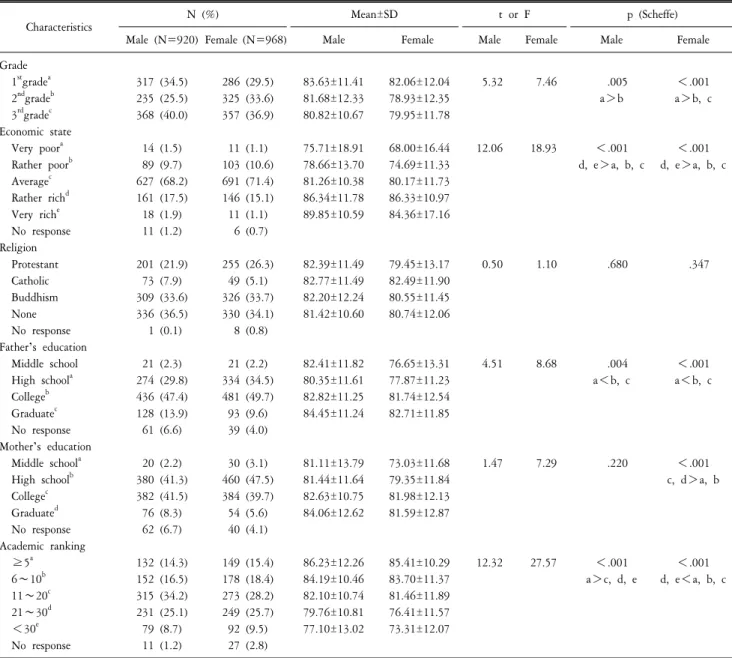
The general characteristics of the sample are presented in Table 1. Self-concept was significantly different according to grade levels in both male and female, and Scheffe test showed that 1
stgrade male and female students had higher self-concept than students in 2
ndor 3
rdgrades.
The majority of the subjects for both genders reported their
economic status as average, and self-concept was significantly
different according to economic status. Scheffe test for both
genders revealed that above average and very rich students had
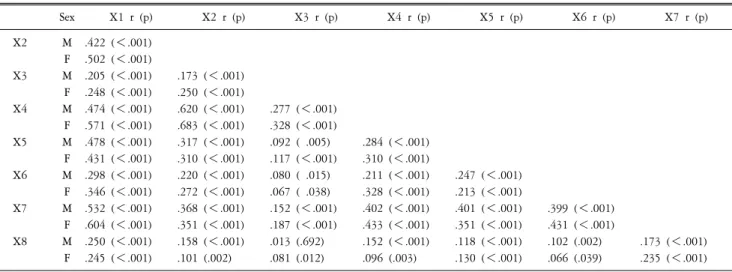
Table 3. Correlation between related factors and self-concept.
Sex X1 r (p) X2 r (p) X3 r (p) X4 r (p) X5 r (p) X6 r (p) X7 r (p)
X2
X3
X4
X5
X6
X7
X8 M
F M F M F M F M F M F M F
.422 (<.001) .502 (<.001) .205 (<.001) .248 (<.001) .474 (<.001) .571 (<.001) .478 (<.001) .431 (<.001) .298 (<.001) .346 (<.001) .532 (<.001) .604 (<.001) .250 (<.001) .245 (<.001)
.173 (<.001) .250 (<.001) .620 (<.001) .683 (<.001) .317 (<.001) .310 (<.001) .220 (<.001) .272 (<.001) .368 (<.001) .351 (<.001) .158 (<.001) .101 (.002)
.277 (<.001) .328 (<.001) .092 ( .005) .117 (<.001) .080 ( .015) .067 ( .038) .152 (<.001) .187 (<.001) .013 (.692) .081 (.012)
.284 (<.001) .310 (<.001) .211 (<.001) .328 (<.001) .402 (<.001) .433 (<.001) .152 (<.001) .096 (.003)
.247 (<.001) .213 (<.001) .401 (<.001) .351 (<.001) .118 (<.001) .130 (<.001)
.399 (<.001) .431 (<.001) .102 (.002) .066 (.039)
.173 (<.001) .235 (<.001) X1: self-concept, X2: parental acceptance, X3: autonomy, X4: family satisfaction, X5: peer support, X6: teacher support, X7: school adjustment, X8:
school achievement, M: male, F: female.
Table 2. Degree of related factors of self-concept.
Variables Mean±SD Min Max Range
Self-concept Male Female Parental acceptance Male
Female Autonomy Male Female Family satisfaction Male
Female Peer support Male Female Teacher support Male Female School adjustment Male
Female
School achievement Male
Female
82.01±11.43 80.40±12.13
18.00±3.03 18.08±3.17
18.99±3.35 19.99±3.33
29.96±6.04 29.57±5.93
24.03±3.85 25.54±3.73
20.31±4.05 20.62±4.03
27.30±3.43 27.04±3.45
11.57±4.34 11.20±3.66
36 38
6 6
6 6
10 10
8 8
8 9
13 13
6 6
116 115
24 24
24 24
40 40
32 32
31 31
39 38
24 24
30∼120
6∼24
6∼24
10∼40
8∼32
8∼32
10∼40
6∼24 higher self-concept than average and relatively poor students.
Almost 80% of male and 85% of female students reported that their parents have had high school or college education. However,
only father’s education showed significant difference in self-concept in both genders. Students who had fathers with at least college education had higher self-concept than other students. Mother’s education was significantly different in female self-concept only.
Academic ranking also showed significant difference in self-concept for both genders. More than half of both male and female students reported that they ranked 11th∼30th in class.
Scheffe test showed that male students within the top 5 rank had higher self-concept; while female students within the top 20 had higher self-concept than those with lower class ranking.
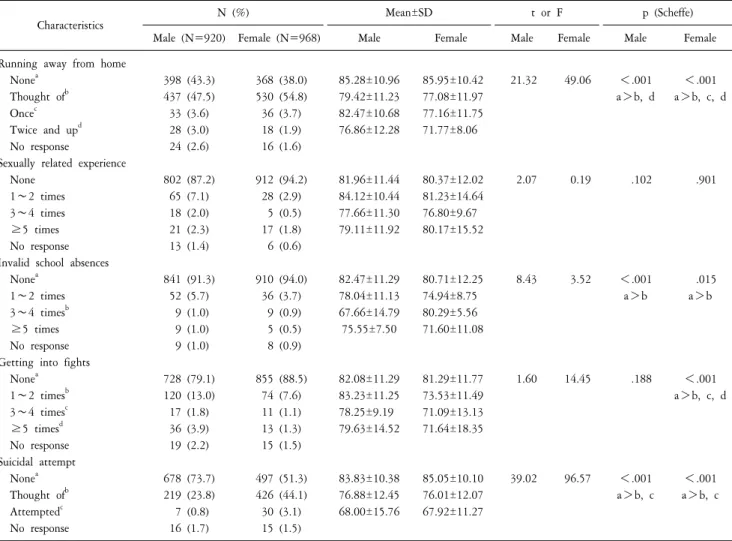
Majority of male and female students reported not to have experienced any of the followings: running away, sexual relationship, invalid school absences, getting into fights, and suicidal attempt. Among these factors, running away, invalid school absences, and suicidal attempt showed significant difference in self-concept; while getting into fights was statistically significant in female self-concept only. Scheffe test found that for those who haven’t experienced these behaviors revealed higher self-concept than those who have thought about it or have actually done it. Religion and sexual related experience were not statistically different in middle school students’ self-concept in both genders.
2. Degree of self-concept and related factors
Female students showed higher parental acceptance, autonomy,
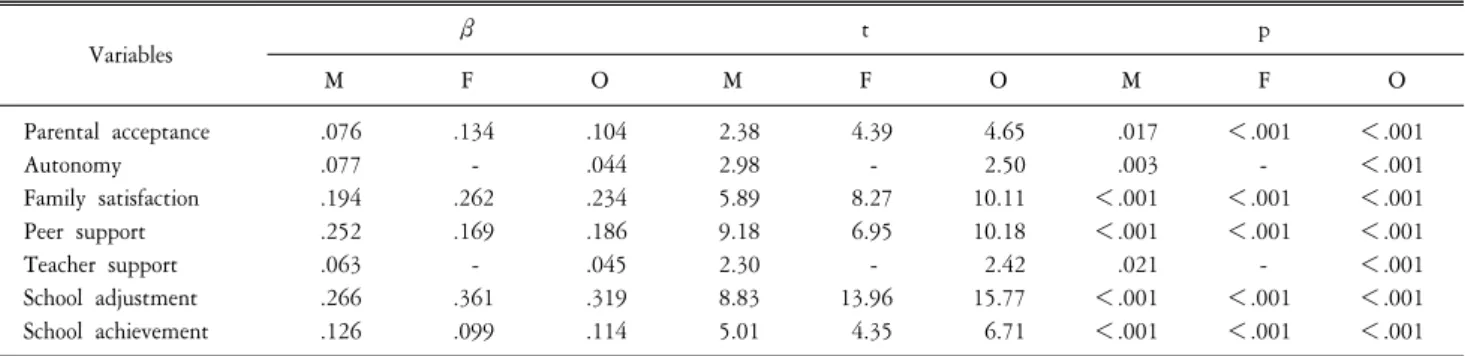
Table 4. Effects of related factors on self-concept (N=1,888).