* Corresponding author
Phone.: +82-51-620-6188 Fax: +82-51-620-5863 E-mail: [email protected]
This is an open-access journal distributed under the terms of the Creative Commons Attribution Non-Commercial License
(http://creativecommons.org/licenses/bync/3.0)
http://dx.doi.org/10.15433/ksmb.2014.6.2.123 ISSN 2383-5400 (Online)
Growth of flounder larvae, Paralichthys olivaceus using enriched rotifer fed with artificial microparticle diets
Kyung-Jin Cho1, Mi-Ryung Kim2, Heum-Gi Park3, Young Soo Lim4, Chae Hun Ra5, Sung-Koo Kim5*
1Genebiotech Co., Ltd., Chungcheongnam-do, Gongju 314-831, Republic of Korea
2Department of Food Biotechnology, Silla University, Busan 617-736, Republic of Korea
3Department of Marine Bioscience, Gangneung-Wonju National University, Gangneung 210-702, Republic of Korea
4National Fisheries Research and Development Institute, Busan 619-705, Republic of Korea
5Department of Biotechnology, Pukyong National University, Busan 608-737, Republic of Korea (Received 12 January 2015, Revised 23 January 2015, Accepted 23 January 2015)
Abstract Three types of artificial microparticle diets were developed for rotifer (Brachionus plicatilis) enrichment. The efficacies of enrichment with the artificial diets were evaluated and compared to those with commercial enrichment diets on the growth and survival of flounder larvae.
Total lipid content was highest in the rotifer enriched with oil capsule (40.5% in dry weight).
The n-3 highly unsaturated fatty acid (n-3 HUFA) content was also highest in the rotifer fed with oil capsule (7.08% in dry weight). The flounder larvae fed on the rotifer enriched with oil capsule showed the highest growth compared to those fed on any other enriched rotifer (P<0.05).
The survival ratio of flounder larvae fed on the rotifers enriched with oil capsule and emulsion oil were higher than those fed on any other enriched rotifer (P<0.05). From the feeding study, the growth and survival of flounder larvae were enhanced by feeding rotifer enriched with oil capsule compared to rotifer enriched with any other diets. The rotifer fed on oil capsule containing high contents of n-3 HUFA. Therefore, a significant relationship between the growth and survival of flounder larvae and the n-3 HUFA content of rotifer could be obtained.
Keywords : Artificial microparticle diets, Oil capsule; Rotifer, Enrichment, Flounder larvae
Introduction
The rotifer is widely used as the primary food organism offered to a large variety of fish species during their early developmental stages [3]. Marine rotifers were initially used as live feed for marine finfish over thirty years ago [1]. Methods of mass culture of rotifers have been developed, and several
innovations have contributed to this success.
Recently, the importance of rotifer as feed for marine fish larvae has been increased in both quality and quantity. Most marine fish require n-3 highly unsaturated fatty acid (n-3 HUFA) such as eicosapentaenoic acid (EPA; 20:5n-3) and docosahexaenoic acid (DHA; 22:6n-3) as essential fatty acid (EFA) for the normal growth and the
development of fish larvae [5,13]. Many studies have shown that the content of n-3 HUFA in live foods is the principle factor determining their dietary value for the larvae of marine fish [9,15,16]. For increase in dietary value of rotifer cultured with baker’s yeast, Saccharomyces cerevisiae, a secondary feeding with marine Chlorella or other unicellular algae having high concentrations of n-3 HUFA, have been performed as an enrichment method to increase n-3 HUFA content. However, mass culture of these algae requires a lot of space and labor. The difficulty of maintaining steady production of sufficient algae is one of the limiting factors in the mass production of live foods. Therefore, if such algae could be replaced with a convenient substitute for improving the dietary value of rotifers cultured with baker’s yeast, it would simplify the live food production for marine fish larvae.
In recent years, high-density mass culture of marine rotifers using concentrated freshwater Chlorella were reported by Yoshimura et al. [17].
However, this method has a problem that the n-3 HUFA contents of rotifer fed on fresh water Chlorella is very low for the normal growth and survival of marine fish larvae. Therefore, when freshwater Chlorella is employed as a rotifer food, it is a prerequisite to fortify n-3 HUFA through the secondary culture process before feeding to marine fish larvae [16].
This study was carried out to develop artificial microparticle diets for rotifer enrichment, also the fatty acid composition of enriched rotifer in high density secondary culture conditions was evaluated.
The growth and survival of flounder larvae fed on rotifer enriched with artificial microparticle diets were determined.
Materials and Methods
Preparation of microparticle diets
The microparticle diets were prepared by the
methods described in the previous report [2]. These particles had the size range of 3-10µm.
Solidified blood particle
Twenty ml of 40% bovine blood meal (Harimex B.V. Co., Netherlands) was added to 200ml of squid oil (Ewha oil and fat Ind., Ltd., Korea) with 2% soy lecithin and emulsified by a homogenizer.
The emulsion was heated in a hot water bath for 20 min at 80℃. After heating, the capsules were allowed to settled out from the suspension for 24 hours. The settle particles were then washed twice by cyclohexane. Cyclohexane was removed using a vacuum evaporator.
Oil capsule
Gelatin (175 bloom, Sigma Chem. Co., St. Louis, USA) of 8.9g was added to 95.5g of deionized water. The gelatin solution was heated to 50-55℃
by a water bath. The pH was adjusted to 6.5 using 25% NaOH solution. Squid oil of 107.9g was added to the gelatin solution under vigorous agitation using a blender. A premixture of 212.3g were then diluted with 143.3g deionized water and the resulting mixture was heated to 50 to 55℃. A solution of 1.2g of CMC (carboxymethyl cellulose: low viscosity, Sigma Chem. Co., St. Louis, USA) in 75.5g deionized water was then added. The pH of the resulting mixture was adjusted to 10 using 25%
NaOH solution, Then 15% acetic acid solution was added slowly by stirring to adjust the pH to 4.2.
The stirring speed was increased and glutaraldehyde solution (25% w/w), 2.25g was added. The mixture was chilled to 10℃ and left stirring for one hour.
Sodium carbonate solution (10%, w/w), 4.53g was added. After holding for 5min, the pH was adjusted to 10 with 25% NaOH solution.
Nylon protein walled capsule
Nylon protein walled capsule was prepared with 25% bovine blood meal dissolved in 0.5M ethylenediamine. One hundred ml of bovine blood
meal solutions were added to 100ml of chloroform with 2% soy lecithin and homogenized for 1 minute at room temperature. The emulsion was agitated with a magnetic stirrer and 20ml of cyclohexane with 2% soy lecithin was added to the emulsion. Four hundred µl of BTC (benzenetricarbonyl trichloride) was added to the mixture and agitated for 20 minute [9]. The capsule suspension was washed three times with cyclohexane. Cyclohexane was removed using a vacuum evaporator.
Larvae
Eggs of flounder Paralichthys olivaceus obtained from Cheju Susan Co. (Cheju, Korea), were randomly divided into three groups. Each experimental group consisted of five 50 L ellipse tanks with egg density of 3,107±81 eggs per tank.
Water temperature and salinity were controlled to 20.5±1℃ and 34±1 ppt. From the 3rd to the 12th day after hatching, larvae were fed with enriched rotifers at a density of 10-15 individuals /ml. The exchange rate of water was 30% per day. The photoperiod was set to a 15: 9 of light / dark cycle. On the 12th day of the experiment, twenty larvae were randomly sampled from each tank and then body length, body height and body weight of the larvae were measured by a profile projector (V-12A; Nikon, Japan) and an electronic balance (ER-120A; AND, Japan).
Rotifer enrichment and feeding
Rotifers (Brachionus plicatilis) were grown on concentrated freshwater Chlorella (HANA Ind., Co.
Ltd., Korea) in 500L transparent circular tanks.
Water temperature and salinity were 26℃ and 34±1ppt with vigorous aeration, respectively. Three types of artificial microparticle diets (Blood particle, Oil capsule, Nylon protein walled capsule), a commercial emulsion oil diet (Ewha oil and fat Ind., Ltd, Korea) and freshwater Chlorella as a control diet (without enrichment) were used for the
enrichment of rotifer. The diets were supplied by 0.02g in dry weight per 10,000 rotifers during the enrichment period. The rotifers were harvested daily by sieving through a 40µm meshed screen. After washing with seawater, the rotifers were enriched for 6 hours with various diets in five 5 L plastic containers at 28±1℃. Initial rotifer density was 2,000 individuals/ml. During the experiment, samples of rotifers with and without the enrichment were collected for the analyses of fatty acid compositions. The enriched rotifers were fed to larvae at the concentration of 10-15 rotifers/ml of tank water from the third day of posthatching.
Fatty acid analysis
The determination of fatty acids from enriched rotifer was carried out by an extraction method using a chloroform and methanol (2:1,v/v) mixture. Fatty acid methyl esters were prepared by transesterification with boronitrifluoride in methanol as described by Metcalfe and Schmitzi [8]. The fatty acid methyl esters were analyzed on a gas chromatography (GC-17A; Shimadzu, Japan) equipped with a capillary column (HP-INNOwax, 30m30.32mm30.5µm; HP, USA). The carrier gas was helium (30ml/min), and the oven temperature was increased by 1℃/min from 170℃ to 225℃. The temperature of the injector and detector (flame ionization detector) were 250℃ and 270℃, respectively.
Fatty acid contents (%, dry weight) were calculated according to the method described by Yoshimatsu et al. [17].
Fatty acid contents (%, dry weight) = Total lipid (%, dry weight) x Fatty acid (Area %) x 0.892
Statistical analysis
Statistical analysis of the growth and survival of flounder larvae were carried out with the one-way ANOVA and Duncan’s multiple range test (P<0.05) (DMRT) using SPSS version 7.5 (SPSS, Cary, NC, USA). All measurements were made in triplicate.
Results
Changes of rotifer density and DO during the secondary culture
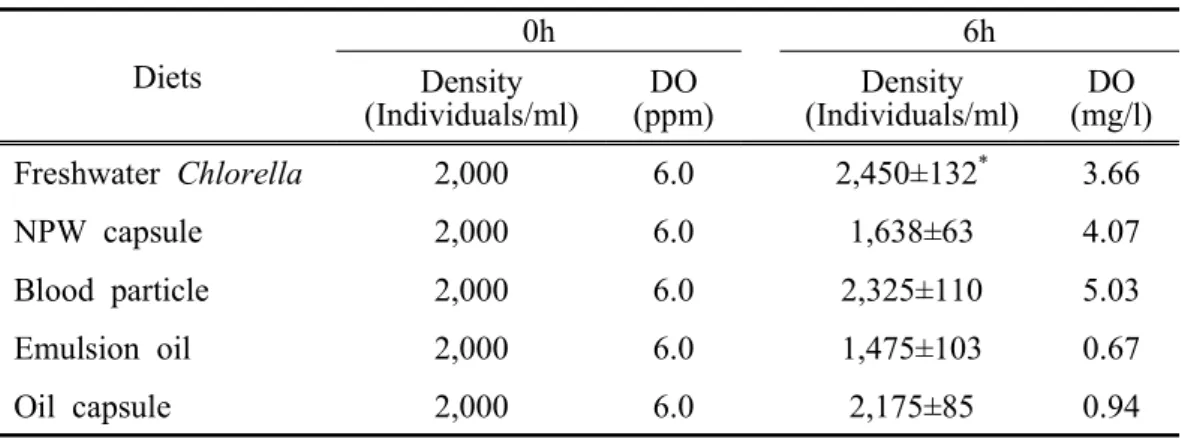
Nutritional compositions of artificial and natural diets for rotifer culture are shown in Table 1. The enrichment of rotifers grown with freshwater Chlorella was carried out for 6 hours. The initial rotifer density and DO were 2,000 individuals/ml and 6mg/l, respectively. Changes of rotifer density and DO during the enrichment are shown in Table
2. Rotifers enriched with blood particle (BP), oil capsule (OC) and freshwater Chlorella(FC) showed the densities of 2,325±110, 2,175±85 and 2,450±132 individuals/ml, respectively. However, rotifer densities fed with nylon protein walled capsule (NPW) and emulsion oil (EO) decreased to 1,638±63 and 1,474±103 individuals/ml, respectively. As the oil contents of diets were increased, DO values lowered due to the surface film formation. DO values in oil capsule and emulsion oil decreased from 6mg/l to 0.94 and 0.67mg/l, respectively.
Table 1. Nutritional composition of artificial and natural diets (%).
Diets Moisture Protein* Lipid*
Freshwater Chlorella 75.8 61.3 21.1
NPW capsule 13.7 85.3 12.9
Blood particle 16.4 79.8 18.8
Emulsion oil 30.0 10.5 66.5
Oil capsule 63.0 14.8 81.6
z
Protein and lipid contents were calculated by dry matter basis.
Table 2. Changes of rotifer density and DO in the secondary culture for 6 hours.
Diets
0h 6h
Density (Individuals/ml)
DO (ppm)
Density (Individuals/ml)
DO (mg/l)
Freshwater Chlorella 2,000 6.0 2,450±132* 3.66
NPW capsule 2,000 6.0 1,638±63 4.07
Blood particle 2,000 6.0 2,325±110 5.03
Emulsion oil 2,000 6.0 1,475±103 0.67
Oil capsule 2,000 6.0 2,175±85 0.94
*
Data are mean±Standard Error with n = 4.
Fatty acid composition of rotifer
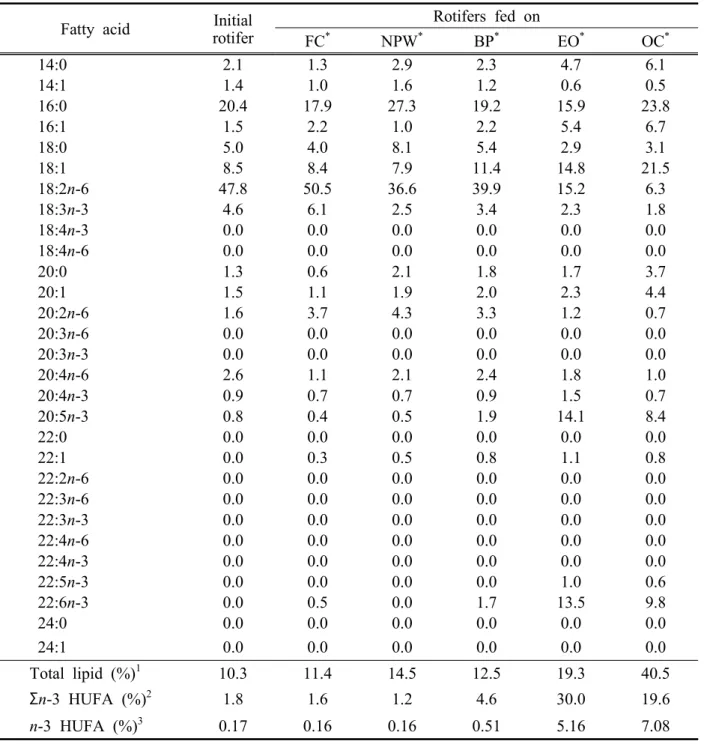
The total fatty acid profile and n-3 HUFA contents of enriched rotifer are shown in Table 3.
The total lipid content of the initial rotifer was 10.3%. Enrichments of rotifer with various diets increased the total lipid content from 11.4 to
40.5%. As expected, rotifers enriched with oil capsule and emulsion oil showed high lipid contents, 40.5% and 19.3%, respectively. However, small increases in lipid contents were observed for the rotifer fed on freshwater Chlorella, NPW capsules, and blood particles.
The oil capsule and emulsion oil enrichment also increased the n-3 HUFA contents of the rotifer after the secondary culture, which were around 40 times higher than that of initial rotifer.
Three times increase in n-3 HUFA could be
observed in the rotifer fed with blood particle.
However, the n-3 HUFA contents of rotifers were not changed, in the case of NPW capsule and freshwater Chlorella enrichment, compared to that of the initial rotifer.
Table 3. Fatty acid compositions of rotifers fed on different enrichments during the secondary culture (area %)
Fatty acid Initial rotifer
Rotifers fed on
FC* NPW* BP* EO* OC*
14:0 2.1 1.3 2.9 2.3 4.7 6.1
14:1 1.4 1.0 1.6 1.2 0.6 0.5
16:0 20.4 17.9 27.3 19.2 15.9 23.8
16:1 1.5 2.2 1.0 2.2 5.4 6.7
18:0 5.0 4.0 8.1 5.4 2.9 3.1
18:1 8.5 8.4 7.9 11.4 14.8 21.5
18:2n-6 47.8 50.5 36.6 39.9 15.2 6.3
18:3n-3 4.6 6.1 2.5 3.4 2.3 1.8
18:4n-3 0.0 0.0 0.0 0.0 0.0 0.0
18:4n-6 0.0 0.0 0.0 0.0 0.0 0.0
20:0 1.3 0.6 2.1 1.8 1.7 3.7
20:1 1.5 1.1 1.9 2.0 2.3 4.4
20:2n-6 1.6 3.7 4.3 3.3 1.2 0.7
20:3n-6 0.0 0.0 0.0 0.0 0.0 0.0
20:3n-3 0.0 0.0 0.0 0.0 0.0 0.0
20:4n-6 2.6 1.1 2.1 2.4 1.8 1.0
20:4n-3 0.9 0.7 0.7 0.9 1.5 0.7
20:5n-3 0.8 0.4 0.5 1.9 14.1 8.4
22:0 0.0 0.0 0.0 0.0 0.0 0.0
22:1 0.0 0.3 0.5 0.8 1.1 0.8
22:2n-6 0.0 0.0 0.0 0.0 0.0 0.0
22:3n-6 0.0 0.0 0.0 0.0 0.0 0.0
22:3n-3 0.0 0.0 0.0 0.0 0.0 0.0
22:4n-6 0.0 0.0 0.0 0.0 0.0 0.0
22:4n-3 0.0 0.0 0.0 0.0 0.0 0.0
22:5n-3 0.0 0.0 0.0 0.0 1.0 0.6
22:6n-3 0.0 0.5 0.0 1.7 13.5 9.8
24:0 0.0 0.0 0.0 0.0 0.0 0.0
24:1 0.0 0.0 0.0 0.0 0.0 0.0
Total lipid (%)1 10.3 11.4 14.5 12.5 19.3 40.5
Σn-3 HUFA (%)2 1.8 1.6 1.2 4.6 30.0 19.6
n-3 HUFA (%)3 0.17 0.16 0.16 0.51 5.16 7.08
*FC: Freshwater Chlorella; NPW: nylon protein walled capsule; BP: blood particle; EO: emulsion oil; OC: oil capsule
1dry base
2area %
3calculated by Fatty acid (%, dry weight) = Total lipid (%, dry weight)⨯Fatty acid (area %)⨯0.892
Table 4. Growth of flounder larvae fed rotifer enriched with different enrichment diets.
Diets Body length (mm) Body height (mm) Body weight (mg) Freshwater Chlorella 5.02±0.04a 1.19±0.01a 0.50±0.06b
NPW capsule 4.81±0.10a 1.10±0.05a 0.30±0.06a
Blood particle 5.42±0.07b 1.37±0.04b 0.73±0.03c
Emulsion oil 5.50±0.09bc 1.37±0.02b 0.77±0.09c
Oil capsule 5.77±0.11c 1.54±0.06c 1.00±0.06d
Initial length of larvae was 2.49±0.12 (mm), and the result were determined after 9 days of rotifer feeding Values in the same column within the different superscript letter are significantly different (P<0.05).
Mean±Standard Error, n=60.
Figure 1. The effect of total n-3 HUFA content of rotifer enriched with the various diets on the body weight and survival of flounder larvae.
(Body weight (1): n=60; Survival (r): n=3; Different letters are significantly difference (P< 0.05). Mean±S.E.M.)
(Initial: initial rotifer, FC: freshwater rotifer, NPW: nylon protein walled capsule, BP: blood particle, EO: emulsion oil, OC: oil capsule)
Growth and survival of flounder larvae
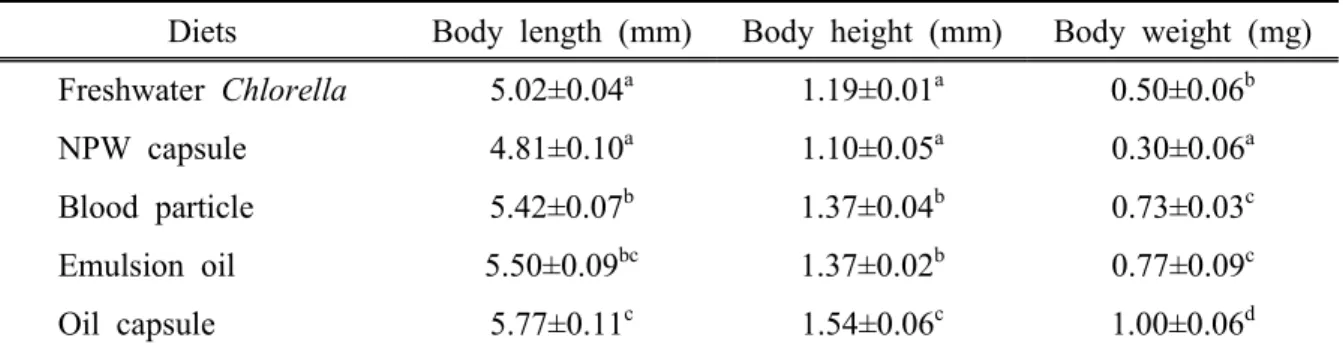
Table 4 shows the growth of flounder larvae after 9 days of rotifer feeding. Flounder larvae grown with rotifer enriched with oil capsule showed significant increases in body length, body height and body weight compared to the flounder larvae grown with other diets enriched rotifers (P<0.05). The enrichments with freshwater Chlorella and nylon protein walled capsule did not show a significant difference (P>0.05) in the growth of larvae. Oil containing groups showed the highest
growth pattern of flounder larvae. Fig. 1 showed the relationship between the growth and survival of flounder larvae and the n-3 HUFA contents of rotifers enriched with different diets. The larvae fed on rotifer enriched with oil capsule showed the highest body weight gain. And the rotifer enriched with oil capsule had the highest n-3 HUFA content. The larvae fed with rotifers that were enriched with both emulsion oil and blood particle showed a similar growth pattern in terms of weight gain. However, the total n-3 HUFA content of
rotifer enriched with blood particle was significantly lower than that enriched with emulsion oil. Slow growth was observed for the larvae fed on the rotifers enriched with NPW capsule and freshwater Chlorella. Also, the low n-3 HUFA contents of the rotifers enriched with nylon protein walled capsule and freshwater Chlorella were observed. The relationship between growth of larvae and n-3 HUFA contents of rotifer could be obtained that the higher n-3 HUFA contents the rotifer has, the higher growth the larvae obtains.
The larvae fed on the rotifers showed 25% of survival ratio. Also, the rotifers enriched with emulsion oil and oil capsule had high contents of n-3 HUFA. The larvae fed on the rotifers enriched with blood particle, nylon protein walled capsule and freshwater Chlorella showed low survival ratios. And the rotifers fed in these cultures showed low contents of n-3 HUFA. This showed a direct relationship between survival of larvae and n-3 HUFA of the rotifers fed in the culture. This result indicated, that oil capsule showed a potential for the artificial enrichment diet for the rotifer as a substitute for marine Chlorella.
Discussion
The contents of n-3 HUFA in rotifer was reported as an important factor for nutritional value of marine fish larvae. According to Lubzens et al.
[7], the most significant dietary factor to influence the growth and survival of fish larvae was n-3 HUFA. This is due to the fact that marine fish contain large amount of 22:6 n-3 and 20:5 n-3 in the phospholipids of their cellular membranes.
Marine fish cannot synthesize 22:6 n-3 from shorter chain precursors such as 18:3 n-3. Therefore, 22:6 n-3 and 20:5 n-3 are essential dietary constituents for marine fish [15].
The lipid content and the fatty acid composition of the rotifers were positively correlated to the diets [12]. Therefore, capsules or particles
containing high lipid or protein level were usually used to improve the dietary value of rotifer [14].
In this study, blood particle and nylon protein walled capsule were used to improve protein level of diet, and the oil capsule and emulsion oil were used to improve the lipid level.
Marine fish larvae requires about 3-4% (dry basis) or more of n-3 HUFA as essential fatty acids for their healthy growth [17]. Izquierdo et al.
[4] also reported that the best result was about 3.5-3.8% of n-3 HUFA during the Artemia feeding experiments in the Japanese flounder larvae. In Fig.
1, the relationship between n-3 HUFA contents and the growth and survival of flounder larvae was shown. The amounts of n-3 HUFA in the rotifer enriched with various artificial microparticle diets were closely related with the growth and survival of flounder larvae. However, blood particle groups had only 0.51% n-3 HUFA, but showed no significant difference in the growth of rotifer fed with emulsion oil, having high contents of n-3 HUFA (5.16 %) (P>0.05). This indicated that a small amount (0.5%) of n-3 HUFA was required for the growth of larvae. Juvenile marine fish generally require about 0.5-1.0% of n-3 HUFA (dry basis) [15]. Koven et al. [6] also reported that n-3 HUFA content of rotifer for best growth of gilthead seabream was 0.5%. These reports were in accordance with our result. However, survival of the larvae was closely related with n-3 HUFA content of rotifer. In this study, the best result in growth and survival was obtained from the group fed on oil capsule enriched rotifer.
Park et al. [11] reported that concentrated freshwater Chlorella could be used as feed for high density culture of rotifer. However, they also reported that a secondary nutrient enrichment after feeding concentrated freshwater Chlorella was required to increase n-3 HUFA content for efficacy of feed. In this study, suitable feed for a secondary nutrient enrichment after feeding concentrated freshwater Chlorella was determined as oil capsule.
The oil capsule contained a considerable amount of n-3 HUFA that was essential for growth and survival of larvae, and rotifer density fed with oil capsule was well maintained as shown in Table 2.
As a result, oil capsule could be used as good enrichment feed for rotifer to increase the nutritional value. Also the oil capsule enriched rotifers could produce the best result in larvae growth and survival of flounder larvae.
References
1. Cahu, C., Zambonino Infante, J. 2001. Substitution of live food by formulated diets in marine fish larvae.
Aquaculture. 200, 161-180.
2. Hwang, J. A., Kim, S. K. 1998. Artificial microparticle diets for culturing rotifer, Brachionus plicatilis. J. Fish. Sci. Tech. 1, 30-34.
3. Hagiwara, A., Suga, K., Akazawa, A., Kotani, T., Sakakura, Y. 2007. Development of rotifer strains with useful traits for rearing fish larvae. Aquaculture. 268, 44-52.
4. Izquierdo, M. S., Arakawa, T., Takeuchi, T., Haroun, R., Watanabe, T. 1992. Effect of n-3 HUFA level in Artemia on growth of larval Japanese flounder (Paralichthys olivaceus). Aquaculture. 105, 73-82.
5. Koven, W. M., Tandler, A., Kissil, G. W., Sklan, D., Friezlander, O., Harel, M. 1990. The effect of dietary (n-3) polyunsaturated fatty acids on growth, survival and swim bladder development in Sparus aurata larvae. Aquaculture. 91, 131-141.
6. Koven, W. M., Tandler, A., Kissil, G. W., Sklan, D.
1992. The importance of n-3 highly unsaturated fatty acids for growth in larval Sparus aurata and their effect on survival, lipid composition and size distribution. Aquaculture. 104, 91-104.
7. Lubzens, E., Tandler, A., Minkoff, G. 1989. Rotifers as food in aquaculture. Hydrobiologia 186/187, 387-400.
8. Metcalfe, L. D., Schmitz, A. A. 1961. The rapid preparation of fatty acid esters for gas chromatographic analysis. Anal. Chem. 33, 363-364.
9. Ostrowski, A. C., Divakaran, S. 1990. Survival and bioconversion of n-3 fatty acids during early development of dolphin (Coryphaena hippurus) larvae fed oil-enriched rotifers. Aquaculture. 89, 273-285.
10. Onal, U., Langdon, C. 2000. Characterization of two microparticle types for delivery of food to altricial fish larvae. Aquac. Nutr. 6, 159–170.
11. Park, H. G., Lee, K. W., Lee, S. M., Kim, S. K., Kim, H. S. 1999. Change of fatty acids composition of rotifer according to enrichments and methods in the high density culture. J. Korean Fish. Soc. 32, 748-752.
12. Retain, K. I., Rainuzzo, J. R., Øie, G., Olsen, Y.
1997. A review of the nutritional effects of algae in marine fish larvae. Aquaculture. 155, 207-221.
13. Rainuzzo, J. R., Retain, K. I., Olsen, Y. 1997. The significance of lipids at early stages of marine fish: a review. Aquaculture. 155, 103-155.
14. Salhi, M., Izquierdo, M. S., Hernández-Cruz, C. M., González, M., Fernández-Palacios, H. 1994. Effect of lipid and n-3 HUFA levels in microdiets on growth, survival and fatty acid composition of larval gilthead seabream (Sparus aurata). Aquaculture. 124, 275-282.
15. Sargent, J., McEvoy, L., Estevez, A., Bell, G., Bell, M., Henderson, J., Tocher, D. 1999. Lipid nutirtion of marine fish during early development: current status and future directions. Aquaculture. 179, 217-229.
16. Watanabe, T., Kiron, U. 1994. Review: Prospects in larval fish dietetics. Aquaculture. 124, 223-251.
17. Yoshimatsu, T., Imoto, H., Hayashi, M., Yoshimura, K. 1997. Preliminary results in improving essential fatty acids enrichment of rotifer cultured in high density. Hydrobiologia. 358, 153-157.