• 검색 결과가 없습니다.

Feasibility of Transradial Coronary Intervention Using a Sheathless Guiding Catheter in Patients With Small Radial Artery

N/A
N/A
Protected

Academic year: 2022

Share "Feasibility of Transradial Coronary Intervention Using a Sheathless Guiding Catheter in Patients With Small Radial Artery"

Copied!
6
0
0

로드 중.... (전체 텍스트 보기)

전체 글

(1)

143

Open Access

Feasibility of Transradial Coronary Intervention Using a Sheathless Guiding Catheter in Patients With Small Radial Artery

Young Jin Youn, MD, Junghan Yoon, MD, Sang Woo Han, MD, Jun-Won Lee, MD, Joong Kyung Sung, MD,

Sung-Gyun Ahn, MD, Jang-Young Kim, MD, Byung-Su Yoo, MD, Seung-Hwan Lee, MD, and Kyung-Hoon Choe, MD Division of Cardiology, Wonju College of Medicine, Yonsei University, Wonju, Korea

ABSTRACT

Background and Objectives: Transradial coronary angiography and intervention are increasing in frequency due to lower major vascular access site complications and the potential for early mobilization. However, the small size of the radial artery (RA) is a major limitation of this technique. A sheathless guiding catheter (GC) has recently been introduced that has a 1-2 French smaller diameter compared with the corresponding introducer sheath. This catheter also has a hydrophilic coating along its entire length. We evaluated the feasibility of using a sheathless GC in patients who have small radial arteries. Subjects and Methods: The procedural results were evaluated in patients with small radial arteries (diameter <2.3 mm) who under- went transradial coronary intervention using a sheathless GC. Results: A total of 25 (male: 9) patients with 29 lesions were enrolled. The mean RA diameter was 1.81±0.26 mm. 44% of the patients had stable angina and 50.0% had acute coronary syn- drome. The procedural success rate was 93.1%. Two patients (6.9%) had chronic total occlusive lesions that could not be crossed with a guide-wire despite good guiding support. An intravascular ultrasound could be used for all of the treated lesions.

Multi-vessel intervention was performed in 29.2% of the patients. Two bifurcated lesions were treated with a kissing balloon technique, and one with a modified T-stenting technique. No catheter related complications were reported. Conclusion:

The use of a sheathless GC is feasible in patients with small radial arteries without catheter related complications. (Korean Circ J 2011;41:143-148)

KEY WORDS: Coronary intervention; Radial artery; Vascular access.

Received: June 10, 2010 Revision Received: July 22, 2010 Accepted: August 9, 2010

Correspondence: Junghan Yoon, MD, Division of Cardiology, Wonju Col- lege of Medicine, Yonsei University, 162 Ilsan-dong, Wonju 220-701, Korea Tel: 82-33-741-0906, Fax: 82-33-741-1219

E-mail: [email protected]

• The authors have no financial conflicts of interest.

cc
This is an Open Access article distributed under the terms of the Cre- ative Commons Attribution Non-Commercial License (http://creativecom- mons.org/licenses/by-nc/3.0) which permits unrestricted non-commer- cial use, distribution, and reproduction in any medium, provided the origi- nal work is properly cited.

Introduction

The use of transradial coronary angiography and interven- tion (TRI) is increasing because of its low rates of major vas- cular access-related complications and the potential for early mobilization.

1)2)

A large-bore guiding catheter (GC) with a lar- ge-bore introducer sheath is needed in patients with complex lesions, but they cannot be used in patients with a small ra-

dial artery (RA) because they can cause forearm discomfort and RA spasm and occlusion,

3)

which are significant limita- tions to the transradial approach. To conquer this limitation, GC that does not require an introducer sheath has been de- veloped.

The sheathless GC system (Sheathless Eaucath, Asahi In- tecc

®

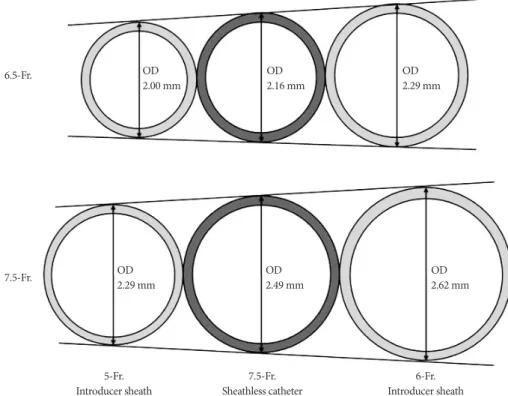
, Japan) consists of a hydrophilic GC and a central dila- tor. This system can be used to insert the GC into the RA wi- thout the use of an introducer sheath. The outer diameter of the 6.5 French (Fr.) sheathless GC (2.16 mm) is smaller than a 5 Fr. introducer sheath (2.29 mm). The outer diameter of the 7.5 Fr. sheathless GC (2.49 mm) is also less than that of a 6 Fr. introducer sheath (2.62 mm) (Fig. 1). With this feature, the sheathless GC system enables performance of TRI even in patients with small RAs. Furthermore, the hydrophilic co- ating that is present along the entire length of the GC may be helpful in reducing radial pain and RA spasm.

Here, we evaluated the feasibility of coronary intervention

using the sheathless GC in patients with small RAs.

(2)

Subjects and Methods

Study population

A total of 36 patients with 60 lesions were enrolled in this study. The patients underwent TRI using a 6.5 or 7.5 Fr. shea- thless GC at Wonju Christian Hospital from January 2009 to December 2009. All patients underwent diagnostic coronary angiography using a 5 Fr. conventional catheter through a 5 Fr. introducer sheath. Patients who required primary percu- taneous coronary intervention (PCI) were excluded because preparation of a sheathless GC that is composed of two pie- ces (a catheter and a central dilator) requires more time than a conventional one-piece GC. All procedures were performed in the left RA unless the patient had a history of previous an- giography through the right RA. All patients signed inform- ed consent forms for participation in this study.

Antiplatelet and anticoagulation therapy

A loading dose of 600 mg clopidogrel and 300 mg aspirin was given to all patients at least three hours before the proce- dure. We administered 5,000 units of heparin through the RA after insertion of the 5 Fr. introducer sheath. An additional dose of 5,000 units heparin was given through the same route before PCI. Glycoprotein IIb/IIIa inhibitor was used at the operator discretion.

Radial artery puncture and radial artery diameter measurement

The RA was punctured using a 20-G venous needle at a

point 5-10 mm proximal to the styloid process after subcuta- neous infiltration with 0.6 mL of 2% lidocaine. A 5 Fr. intro- ducer sheath (Terumo Company, Japan) was inserted into the RA. Normal saline (10 mL) with 200 μg of nitroglycerine was injected into the RA through the introducer sheath to pre- vent RA spasm. Angiography of the RA was performed after injection of normal saline (10 mL) with 200 μg of nitroglyc- erine. A 30- to 40-mm long segment of RA from the tip of the introducer sheath was selected for the determination of the mean diameter. The mean of the maximal and minimal dia- meter of the selected segment of RA was used to determine the size of the RA using a computer-assisted quantification method (GE

®

, US). Because the outer diameter of the 5 Fr.

introducer sheath was approximately 2.3 mm in diameter, a small RA was defined as a diameter ≤2.3 mm.

Sheathless guiding catheter engagement

After the diagnostic angiography, the sheath was exchang- ed for the sheathless catheter over a standard 150 cm J-tipp- ed 0.035-inch (Terumo

®

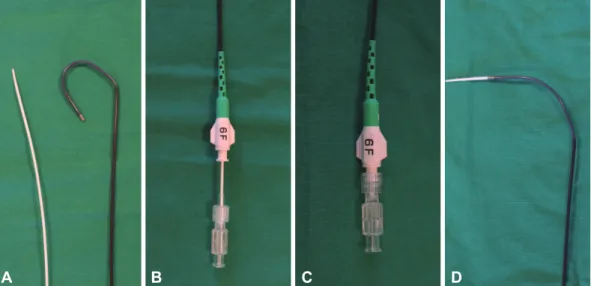
, Japan) wire. The shape and size of the sheathless GC was selected at the operator discretion. The sheathless GC was composed of two parts: a hydrophilic ca- theter and a central dilator. The central dilator was inserted into the catheter and locked in place (Fig. 2). The sheathless GC with the central dilator was advanced along the 0.035- inch wire to the proximal ascending thoracic aorta. The cen- tral dilator and 0.035-inch wire were then removed. The os- tium of the selected coronary artery was engaged by the GC and PCI was performed.

Fig. 1. Comparison of outer diameter (OD) between introducer sheath and sheathless guiding catheter (GC) (illustrated by author referred to SheathLess Eaucath

®

information brochure).

OD 2.29 mm

7.5-Fr.

Sheathless catheter 6-Fr.

Introducer sheath 5-Fr.

Introducer sheath

OD

2.49 mm OD

2.62 mm

7.5-Fr.

(3)

Definition of success

We defined procedural success as the successful implanta- tion of stent(s) with final thrombolysis in myocardial infarc- tion flow grade 3 and residual stenosis <30%, despite the se- lection of the GC.

Measurement of complications

Dissections of coronary artery and aorta were evaluated by coronary angiography during the procedure. Forearm pain dur- ing the procedure was documented when the patient compl- ained of forearm pain. Presence of hematoma or bleeding at ac- cess site was evaluated during the admission period. RA occlus- ion was defined as absence of a RA pulse by clinical assessment.

Statistical analysis

Categorical variables were expressed as proportions while continuous variables were expressed as mean±standard de- viation.

Results

A total of 25 patients (29 lesions) with a small RA who under- went PCI using a sheathless GC were included in this study.

The mean age was 66.1±10.2 years, and nine (36.0%) pa- tients were men. Approximately half of the patients had a his- tory of hypertension (52.0%) and diabetes mellitus (52.0%).

Eleven (44.0%) patients had stable angina, 12 (48.0%) had acute coronary syndrome, and two (8.0%) had ischemic heart failure. The mean RA size was 1.82±0.27 mm. Baseline char- acteristics are presented in Table 1.

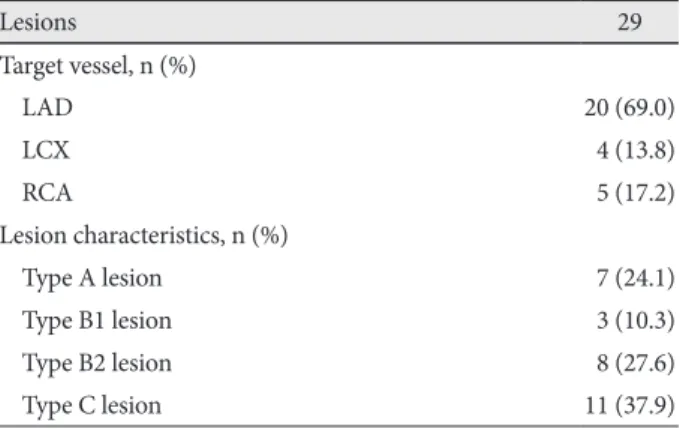
Twenty (69.0%) lesions were located in the left anterior des- cending (LAD) coronary artery. According to the modified American College of Cardiology/American Heart Associa- tion criteria, most of the lesions were type B2 (27.6%) or C (37.9%). Angiographic characteristics are presented in Table 2.

Eight (32.0%) patients underwent multi-vessel PCI. A 6.5 Fr. Power Backup (PB) 3 cm sheathless GC was used in appro- ximately half of the cases (51.7%). Most of the lesions were implanted with a zotarolimus-eluting stent(s) (48.2%) or ever- olimus-eluting stent(s) (37.9%). One lesion consisting of reste- C

A B D

Fig. 2.The sheathless GC system (sheathless Eaucath, Asahi Intecc

®

, Japan). A: 6.5 Fr. hydrophilic GC illustrated with central dilator. B and C: Central dilator was inserted into GC and locked. D: GC with central dilator can be advanced along the 0.035” wire. GC: guiding catheter.

Table 1. Baseline characteristics

Patients with small radial artery, n 25

Mean age (years) 66.1±10.2

Male gender, n (%) 09 (36.0)

Past history, n (%)

Hypertension 13 (52.0)

DM 13 (52.0)

MI 02 (8.0)

Previous PCI 05 (20.0)

Smoking 08 (32.0)

Dyslipidemia 10 (40.0)

Medication, n (%)

Aspirin 25 (100)

Clopidogrel 25 (100)

Statin 08 (32.0)

CCB 07 (28.0)

BB 08 (32.0)

ACEi or ARB 11 (44.0)

Clinical diagnosis, n (%)

Stable angina 11 (44.0)

Unstable angina 09 (36.0)

NSTEMI 03 (12.0)

Ischemic heart failure 02 (8.0)

Radial artery size (mm) 1.82±0.27

DM: diabetes mellitus, MI: myocardial infarction, CCB: calcium channel blocker, BB: beta-blocker, ACEi: angiotensin converting enzyme inhibitor, ARB: angiotensin II receptor blocker, NSTEMI:

non-ST-segment elevation myocardial infarction

(4)

nosis of a previously implanted drug-eluting stent was treated using balloon angioplasty with a cutting balloon. The mean number of stents implanted at one lesion was 1.43±0.79. The mean total length of the stents was 36.8±19.9 mm and the

mean diameter was 2.96±0.43 mm. Two of three bifurcated lesions were treated with a kissing balloon technique and one lesion was treated with two stents by using a modified T-st- enting technique. All PCIs were performed under intravas- cular ultrasound guidance. Two of the successfully treated lesions required conversion to a conventional GC after inser- tion of the 6 Fr. introducer sheath. One lesion tried with a 6.5 Fr. PB 3.0 sheathless GC in the LAD was treated by con- version to 6 Fr. Extra Backup 3.5 GC. The other lesion tried with 6.5 Fr. Amplatz Left (AL) 0.75 sheathless GC in the rig- ht coronary artery (RCA) was treated by conversion to 6 Fr.

Judkins Right 3.5 GC. These two sheathless GCs did not en- gage the coronary arteries and provided poor guiding sup- port; however, the main reason for conversion to a conven- tional GC was a limitation in GC shape selection. There were no problems using the 6 Fr introducer sheath in these two patients. Twenty seven of 29 (93.1%) lesions were therefore successfully treated. The two failed lesions were chronic total occlusions (CTO) in the LAD that could not be crossed with a guidewire supported by a microcatheter. The procedural results are presented in Table 3.

There were no catheter-related complications. Only one patient, who developed RA spasm during coronary angiog- raphy using a conventional 5 Fr catheter, complained of fo- rearm pain during PCI. Although there was no immediate access site complication including hematoma and bleeding, two patients lost pulse in the RA used as the access site with- out hand ischemia during a median 357 (140-432) days of fol- low-up. The procedural complications are presented in Table 4.

Discussion

Our study shows the feasibility of TRI using a sheathless GC in 25 consecutive patients (29 lesions) with small RAs (diame- ter ≤2.3 mm).

The procedural success rate of TRI is comparable to that of transfemoral coronary intervention with the benefit of lower rates of bleeding and fewer vascular complications.

1)2)

How- ever, a larger GC and introducer sheath cannot be used in some patients because of the small diameter of their RA. Saito et

Type B1 lesion 03 (10.3)

Type B2 lesion 08 (27.6)

Type C lesion 11 (37.9)

LAD: left anterior descending, LCX: left circumflex, RCA: right coronary artery

Table 3. Procedural results

Patients 25

PCI, n (%)

Multi-vessel PCI 08 (32.0)

Single-vessel PCI 17 (68.0)

Lesions 29

Guiding catheter, n (%)

6.5-Fr. AL 0.75 04 (13.8)

7.5-Fr. AL 0.75 02 (6.9)

6.5-Fr. PB 3.0 15 (51.7)

7.5-Fr. PB 3.0 02 (6.9)

6.5-Fr. PB 3.5 05 (17.2)

7.5-Fr. PB 3.5 01 (3.4)

Type of stent, n (%)

Zotarolimus-eluting stent 14 (48.2)

Everolimus-eluting stent 11 (37.9)

Sirolimus-eluting stent 01 (3.4)

Use of cutting balloon 01 (3.4)

Use of stent(s)

No. of stent per lesion 1.43±0.79

Stent length per lesion, mm 36.8±19.9

Stent diameter per lesion, mm 2.96±0.43

Bifurcation PCI, n (%) 03 (10.3)

With kissing balloon 02 (6.9)

With two stents 01 (3.4)

Use of IVUS (%) 27 (93.1)

Crossover to conventional GC, n (%) 02 (6.9)

Procedural success, n (%) 27 (93.1)

AL: amplatz left, PB: power backup, No.: number, PCI: percutane- ous coronary intervention, IVUS: intravascular ultrasound, GC:

guiding catheter

Bleeding 0 (0)

Radial artery occlusion 2 (8.0)

(5)

al.

3)

demonstrated that the RAs were smaller than the outer diameter of a 6 Fr. introducer sheath in 14.3% of males and 27.4% of females. They also reported that when the ratio of the RA inner diameter to the cannulated sheath outer diam- eter was less than 1.0, the incidence of flow reduction was in- creased. They therefore suggested that smaller catheters sh- ould be considered to prevent RA occlusions or narrowing.

With the sheathless GC system, one can use the larger-bore GC in patients with a small RA without using an introducer sheath and thereby minimizing radial discomfort.

4)

Yoo et al.

5)

have shown that the mean RA diameter measured by ul- trasound was 2.66±0.44 mm (male: 2.69±0.40 mm, female:

2.43±0.38 mm) in Korean patients. Although direct compari- son is difficult because we did not use ultrasound to measure RA diameter, the mean diameter of the RA in our study was 1.82±0.27 mm, which is smaller than the mean RA diameter in Korean patients and smaller than the outer diameter of the sheathless GC. Despite this finding, only one patient compl- ained of forearm pain, namely discomfort during PCI. This patient developed severe RA spasm before using the sheath- less GC and the operator has difficulty in performing diag- nostic coronary angiography with the conventional 5 Fr. ca- theter. However, the operator did not experience any difficul- ty in manipulating the catheter during PCI.

Despite the above-mentioned results, a disadvantage in using a sheathless GC was noted. Because sheathless GCs slide easily within vessels due to the hydrophilic coating, disenga- gement of the catheter could happen in cases requiring good guiding support. In our study, the sheathless GC frequently slipped away from the ostium in two cases of RCA interven- tion, despite the small size of the RA. Mamas et al.

6)

fixed the sheathless GC to the forearm at the point of entry to the RA using a Tegaderm adhesive dressing to avoid slippage during the procedure. Even if this solution could be helpful in pre- venting the slippage of GC, it could also be very dangerous if the patient were to move unconsciously as it may result in an aortic or coronary dissection.

Two studies have reported successful use of a sheathless GC in complex interventions with large bore catheters including rotablation, crush stent bifurcation lesions, 7 Fr. proximal pro- tection, thrombectomy devices, and simultaneous kissing st- enting.

7)8)

In our study, we successfully performed three com- plex procedures including two in which the kissing balloon technique was used and one in which the modified T-stent- ing technique was used. These results suggest that other com- plex procedures may also be performed using sheathless GCs.

Most recently, Mamas et al.

6)

reported a 100% procedural success using the sheathless GC in 100 patients. They includ- ed patients requiring primary PCI. The primary difference in our study is that we enrolled only patients with small radial arteries, because the use of a sheathless GC is more beneficial for these patients.

Although we failed to treat two cases of CTO lesions which required catheter conversion from sheathless to conventional, these results were not due to the GC itself but to limitations in GC selection with different shapes. Only AL, PB, Hotkey stick, and Judkins Left GCs were available at our institute, and the shapes of catheters were slightly different from those of conventional catheters.

During a median 357 days of follow-up, two patients (8%) developed RA occlusion, and this is consistent with a previ- ous report of an asymptomatic RA occlusion rate of 5-10%.

9)

Because the outer diameter of the sheathless GC is smaller than that of the conventional GC, we expected a lower incid- ence of RA occlusion, and our results may be related to the fact that we included only patients with small RAs and some of the patients had a RA with a diameter smaller than the ou- ter diameter of sheathless GCs. Even though the sheathless GC could be beneficial in forearm pain, the risk of RA occlus- ion should be considered in treating patients with small RAs.

We did not use the sheathless GC during the primary PCI in our study. Although the use of the sheathless GC is feasible in cases of primary PCI, this system requires more time to as- semble because it is composed of two parts, and the introdu- cer sheath must be removed before inserting it. We usually use a 6 Fr. introducer sheath from the beginning in cases of primary PCI via a transradial approach.

Our study has some limitations. First, although we measur- ed the diameter of the RA by angiography after using a vaso- dilator, this intervention could not completely prevent vaso- spasm. This fact could result in a smaller RA diameter than the diameter measured by non-invasive methods such as ul- trasound. Second, we documented the presence of forearm pain only when the patient complained of forearm pain and did not use a pain scale such as the visual analogue scale or the 4-category verbal rating scale. Finally, this was not a ran- domized trial to compare the sheathless GC with the con- ventional GC.

Conclusion

The use of a sheathless GC was feasible in almost clinical settings for patients with small RAs regardless of complexity or severity of the lesion. However, disengagement of the GC and limitations in the setting of primary PCI should be taken into account.

REFERENCES

1) Jolly SS, Amlani S, Hamon M, Yusuf S, Mehta SR. Radial versus fe- moral access for coronary angiography or intervention and the impact on major bleeding and ischemic events: a systematic review and meta- analysis of randomized trials. Am Heart J 2009;157:132-40.

2) Agostoni P, Biondi-Zoccai GG, de Benedictis ML, et al. Radial versus

femoral approach for percutaneous coronary diagnostic and interven-

tional procedures: systematic overview and interventional proce-

dures. J Am Coll Cardiol 2004;44:349-56.

(6)

수치

Fig. 1. Comparison of outer diameter (OD) between introducer sheath and sheathless guiding catheter (GC) (illustrated by author referred to  SheathLess Eaucath ®  information brochure).
Fig. 2.The sheathless GC system (sheathless Eaucath, Asahi Intecc ® , Japan). A: 6.5 Fr
Table 3. Procedural results

참조

관련 문서

Post-surgical use of radioiodine (131I) in patients with papillary and follicular thyroid cancer and the issue of remnant ablation: a consensus

Prevention of coronary and stroke events with atorvastatin in hypertensive patients who have average or lower-than-average cholesterol concentrations, in

• Despite medical intervention with supportive care (78% of the patients use corticosteroids), patients continued to show disabling symptoms, progressive complications,

An Android program generally forms a Java program with APIs in Android platform. Using the APIs, one can build user interfaces to make a phone call, play a game, and so on. An

(c) the same mask pattern can result in a substantial degree of undercutting using substantial degree of undercutting using an etchant with a fast convex undercut rate such

The stain field associated with a dislocation can in certain cases provide a favorable interaction with the strain field of the martensite nucleus, such that one of the

The locations of aneurysms were middle cerebral artery in 15 patients, cerebral artery in 15 patients, cerebral artery in 15 patients, cerebral artery in

Results: In this research, in the group with fibromyalgia patients group, systemic lupus erythematosus patients group and without systemic autoimmune