Korean Circulation Journal
Introduction
Intravenous immunoglobulin (IVIG) plus aspirin therapy is an ef- fective treatment for acute Kawasaki disease (KD).
1) However, 10%
to 20% of children with KD do not respond to IVIG treatment.
2) In-
http://dx.doi.org/10.4070/kcj.2014.44.6.415
Print ISSN 1738-5520 • On-line ISSN 1738-5555
Prediction of Resistance to Standard Intravenous Immunoglobulin Therapy in Kawasaki Disease
Sang Min Lee, MD, Jeong Bong Lee, MD, Young Bin Go, MD, Ho Young Song, MD, Byung Jin Lee, RN, and Ji Hee Kwak, MD
Department of Pediatrics, Myongji Hospital, Goyang, Korea
Background and Objectives: Ten to twenty percent of children with Kawasaki disease (KD) do not respond to initial intravenous immu- noglobulin (IVIG) treatment. If untreated, approximately 15% to 25% of KD patients have complications. The aim of this study was to find useful predictors of responsiveness to initial IVIG treatment in KD.
Subjects and Methods: We retrospectively reviewed medical records of 91 children diagnosed with KD at Myong Ji Hospital from March 2012 to April 2014. Before and after (24 hours to 36 hours) IVIG treatment, the following laboratory data were obtained: hemoglobin (Hb) level, white blood cell count, proportion of neutrophil, lymphocyte and eosinophil, platelet count, erythrocyte sedimentation rate (ERS), C- reactive protein (CRP), creatine kinase (CK), creatine kinase MB (CK-MB), and N- terminal pro-brain natriuretic peptide (NT-proBNP). Sub- jects were then divided into two groups: IVIG-responsive or IVIG-resistant.
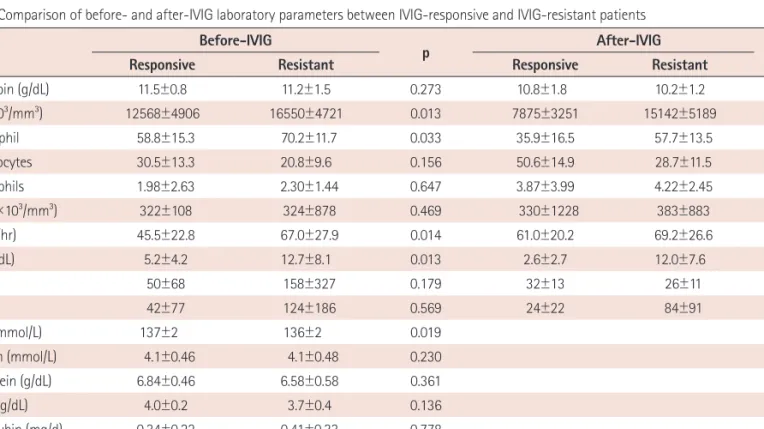
Results: Of 91 patients, 11 (12%) required retreatment. By univariate analysis, before-IVIG laboratory parameters of white blood cell count,
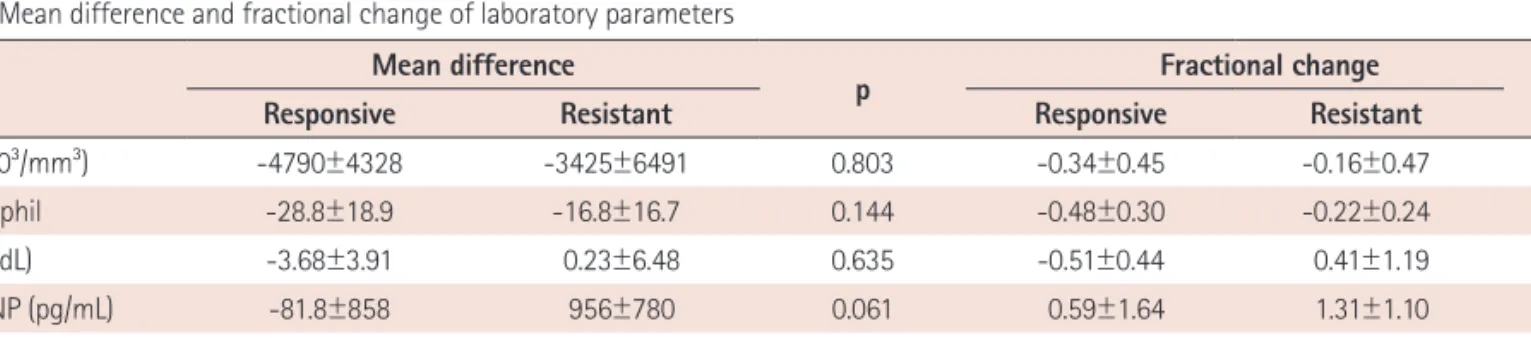
% neutrophil, ERS, CRP, sodium, CK, CK-MB, and NT -proBNP were significantly different between IVIG-responsive and IVIG-resistant patient groups. In the after-IVIG laboratory parameters, Hb level, white blood cell count, % neutrophil, % lymphocyte, CRP, CK, CK-MB, and NT-pro- BNP were significantly different between the two groups. While the mean-differences were not statistically significant, fractional change (FC)-CRP and FC-% neutrophil showed significant difference. By multivariate analysis, FC-CRP was confirmed to be an independent predictor for initial IVIG resistance.
Conclusion: Fractional change-C-reactive protein might be a useful and important value for predicting initial IVIG resistance in KD patients.
(Korean Circ J 2014;44(6):415-422)
KEY WORDS: Kawasaki disease; Immunoglobulins, intravenous; Risk factors.
Received: July 1, 2014
Revision Received: September 1, 2014 Accepted: September 12, 2014
Correspondence: Ji Hee Kwak, MD, Department of Pediatrics, Myongji Hospital, 55 Hwasu-ro 14beon-gil, Deogyang-gu, Goyang 412-270, Korea Tel: 82-31-810-7020, Fax: 82-31-810-5109
• The authors have no financial conflicts of interest.
This is an Open Access article distributed under the terms of the Creative Commons Attribution Non-Commercial License (http://creativecommons.
org/licenses/by-nc/3.0) which permits unrestricted non-commercial use, distribution, and reproduction in any medium, provided the original work is properly cited.
complete KD is recognized with increasing frequency. The preva- lence of incomplete KD has been reported to be 15% to 36.2%.
3-7)
Approximately 15% to 25% of untreated KD children have compli- cations such as coronary aneurysm and coronary artery ectasia that may develop into ischemic heart disease, leading to possible sudden death.
1) Early diagnosis and treatment with IVIG can reduce the risk of coronary artery abnormalities to under 5%.
8-10) Hence, the impor- tance of early aggressive management of IVIG-resistant KD must be emphasized, together with early identification of likely IVIG-resistant KD who may require additional therapy such as a second dose of IVIG, steroids, or infliximab.
1)
Many studies have addressed the early identification of IVIG-re-
sistant KD.
11-15) However, there is no consensus on factor that could be
used to predict KD patients with IVIG resistance. Therefore, the objec-
tive of this study was to find predictors of resistance to initial IVIG in
KD patients by comparing clinical pattern, echocardiography data, and
laboratory data before and after initial IVIG treatment. Previous studies