ABSTRACT
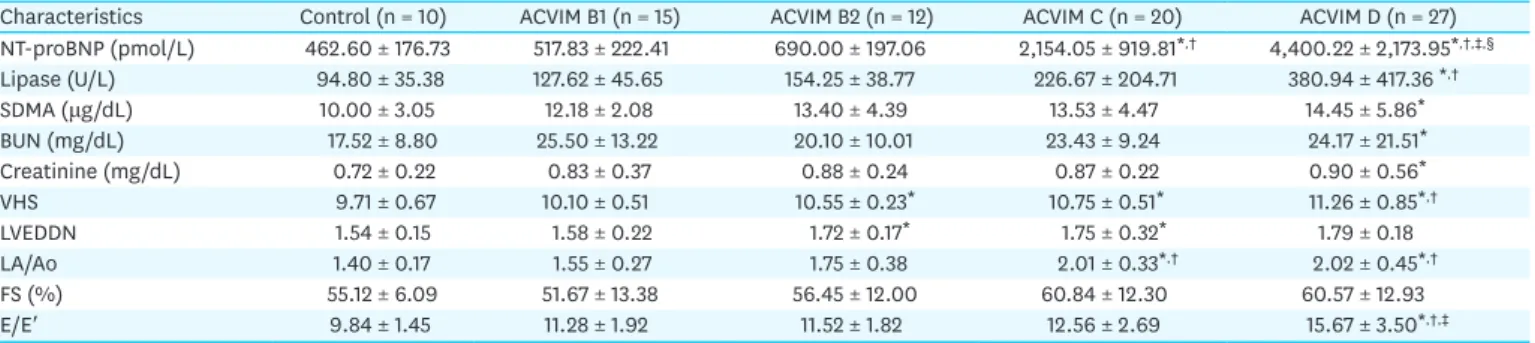
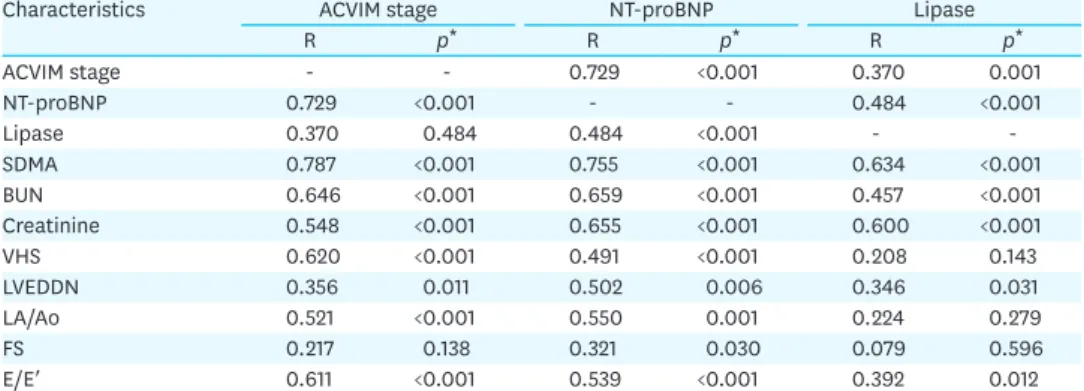
Chronic mitral valve disease (CMVD) is the most common cardiovascular disease in dogs, causing decreased cardiac output that results in poor tissue perfusion and tissue damage to kidneys, pancreas, and other organs. The purpose of this study was to evaluate the relationships between heart disease severity and N-terminal pro B-type natriuretic peptide (NT-proBNP) and lipase in dogs with CMVD, as well as to evaluate longitudinal changes in these values. A total of 84 dogs participated in this 2015 to 2017 study. Serum values of NT-proBNP and lipase were analyzed; radiography was used to measure the vertebral heart score and assess various echocardiographic values. NT-proBNP showed a strong positive correlation with increasing stage of heart disease; lipase showed a mild positive correlation with heart disease stage. When the three values (NT-proBNP, lipase and month) were continuously measured at 6-month intervals, all showed a correlation with the increasing length of the disease.
Keywords: NT-proBNP; lipase; mitral valve disease; dog
INTRODUCTION
Chronic mitral valve disease (CMVD) progresses chronically over the years through progressive valve degeneration and worsening of symptoms. Risk factors for rapid progression include the quantity of mitral regurgitation, age, and changes in valvular severity [1,2].
The N-terminal proB-type natriuretic peptide (NT-proBNP) has received considerable interest as a dog heart biomarker in recent years. NT-proBNP while regarded as a biomarker of heart disease, also exhibits a high degree of diversity among individuals, according to recent studies [3-6]. Regardless, longitudinal evaluation of NT-proBNP is reported to be effective in dogs with CMVD [7].
Reduced cardiac output can lead to poor tissue perfusion and secondary tissue congestion, which can damage multiple organs. In humans, many patients undergoing cardiac surgery exhibit a variety of pancreatic lesions, ranging from lethal necrotizing pancreatitis to subclinical hyperamylasemia. These lesions are associated with a variety of factors, among
Original Article
Received: Dec 19, 2018 Revised: May 17, 2019 Accepted: Jun 24, 2019
*Corresponding author:
Kun-Ho Song
College of Veterinary Medicine, Chungnam National University, 99 Daehak-ro, Yuseong- gu, Daejeon 34134, Korea.
E-mail: [email protected]
© 2019 The Korean Society of Veterinary Science
This is an Open Access article distributed under the terms of the Creative Commons Attribution Non-Commercial License (https://
creativecommons.org/licenses/by-nc/4.0) which permits unrestricted non-commercial use, distribution, and reproduction in any medium, provided the original work is properly cited.
ORCID iDs Jun-Seok Park
https://orcid.org/0000-0003-1333-167X Jae-Hong Park
https://orcid.org/0000-0002-2025-0141 Kyoung-Won Seo
https://orcid.org/0000-0002-1561-3278 Kun-Ho Song
https://orcid.org/0000-0001-8478-2035 Conflict of Interest
The authors declare no conflicts of interests.
Author Contributions
Conceptualization: Park JS, Song KH;
Investigation: Park JS, Park JH; Methodology:
Park JH; Resources: Park JS; Supervision: Song KH; Validation: Seo KW; Writing - original draft:
Park JS, Song KH; Writing - review & editing:
Park JS; Seo KW, Song KH.
Jun-Seok Park
1, Jae-Hong Park
2, Kyoung-Won Seo
1, Kun-Ho Song
1,*1
College of Veterinary Medicine, Chungnam National University, Daejeon 34134, Korea
2