Korean Circulation Journal
Introduction
The patch clamp experiment is a technique in electrophysiology that allows the study of single or multiple ion channels in cells;
it was developed in the late 1970s and early 1980s by Neher and Sakmann.
1)Several configurations of this technique have been introduced, including cell-attached, excised inside-out, and whole-
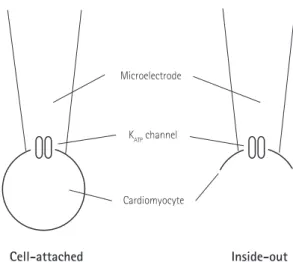
cell patch configuration (Fig.1). In the ‘cell-attached’ mode, a tight seal is formed between the micropipette and the cell membrane, and the pipette captures the ion channel current flow. Although this configuration does not disturb the intracellular contents, it is difficult to accurately measure the membrane potential and to perfuse into the intracellular space. In the ‘excised inside-out’
mode, the micropipette is pulled away from the main body of the cell, leaving the formerly intracellular membrane surface exposed to the bath. Even though the cell body is broken in the excised patch, this technique is more likely to regulate the intracellular environment. Cell-attached and excised patch techniques are used to study the behavior of single ion channels in the section of membrane attached to the electrode. However, ‘whole-cell’ patches allow researchers to study the electrical behavior of the entire cell, instead of single channel currents.
2)Potassium channels (K
+channels) play a crucial role in regulating the action potential of cardiomyocytes. Among K
+channels in the cardiovascular system, the adenosine triphosphate (ATP)-sensitive potassium channels (K
ATPchannels), the first to be discovered in cardiomyocytes,
3)have a structure analogous to the inwardly
Print ISSN 1738-5520 • On-line ISSN 1738-5555
Influence of Thromboxane A 2 on the Regulation of Adenosine
Triphosphate-Sensitive Potassium Channels in Mouse Ventricular Myocytes
In Seok Jeong, MD 1 , Hwa Jin Cho, MD 2 , Jeong Gwan Cho, MD 3 , Sang Hyung Kim, MD 1 , Kook Joo Na, MD 1 , and Jong-Keun Kim, MD 4
1
Department of Thoracic and Cardiovascular Surgery,
2Department of Pediatrics,
3Department of Internal Medicine,
4Department of Pharmacology, Chonnam National University Medical School, Gwangju, Korea
Background and Objectives: Adenosine triphosphate (ATP)-sensitive potassium (K
ATP) channels play an important role in myocardial protection. We examined the effects of thromboxane A
2on the regulation of K
ATPchannel activity in single ventricular myocytes.
Materials and Methods: Single ventricular myocytes were isolated from the hearts of adult Institute of Cancer Research (ICR) mice by enzymatic digestion. Single channel activity was recorded by excised inside-out and cell-attached patch clamp configurations at -60 mV holding potential during the perfusion of an ATP-free K-5 solution.
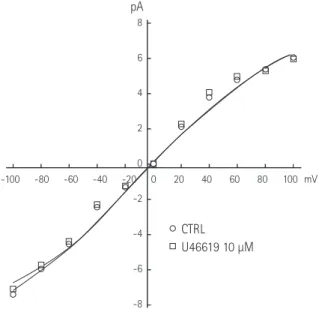
Results: In the excised inside-out patches, the thromboxane A
2analog, U46619, decreased the K
ATPchannel activity in a dose-dependent manner; however, the thromboxane A
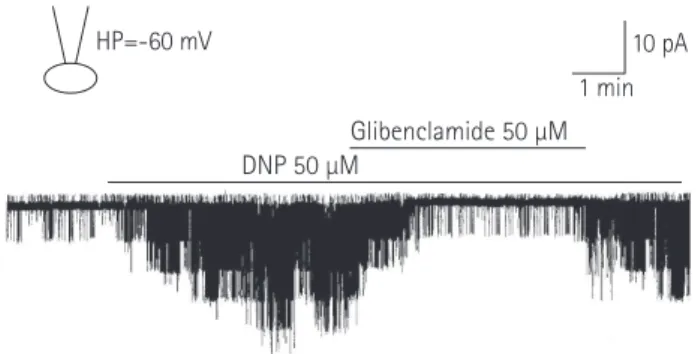
2receptor antagonist, SQ29548, did not significantly attenuate the inhibitory effect of U46619. In the cell-attached patches, U46619 inhibited dinitrophenol (DNP)-induced K
ATPchannel activity in a dose-dependent manner, and SQ29548 attenuated the inhibitory effects of U46619 on DNP-induced K
ATPchannel activity.
Conclusion: Thromboxane A
2may inhibit K
ATPchannel activity, and may have a harmful effect on ischemic myocardium. (Korean Circ J 2016;46(4):562-568)
KEY WORDS: KATP channels; Thromboxane A
2; Myocytes; Cardiac.
Received: March 20, 2015 Revision Received: June 17, 2015 Accepted: November 5, 2015
Correspondence: Jong-Keun Kim, MD, Department of Pharmacology, Chonnam National University Medical School, 160 Baekseo-ro, Dong-gu, Gwangju 61469, Korea
Tel: 82-62-220-6546, Fax: 82-62-227-1636 E-mail: [email protected]
• The authors have no financial conflicts of interest.
This is an Open Access article distributed under the terms of the Creative Commons Attribution Non-Commercial License (http://creativecommons.
org/licenses/by-nc/3.0) which permits unrestricted non-commercial use,
distribution, and reproduction in any medium, provided the original work
is properly cited.
rectifying potassium channel superfamily, and their activity is regulated by the concentration of intracellular ATP metabolites.
4)The activity of K
ATPchannels is regulated by the ratio of ATP/
Adenosine Driphosphate or ATP concentration, which is an indicator of intracellular metabolism. Intracellular K
+loss and extracellular K
+accumulation occur within a few minutes of the onset of myocardial ischemia. This is due to the K
+efflux that occurs as K
ATPchannels open when intracellular ATP decreases during myocardial ischemia.
5)6)K
ATPchannel activity simultaneously has a protective effect during ischemia, through vasodilation and the reduction of myocardial contractility, and a negative arrhythmogenic effect caused by the depolarization of the membrane potential.
7)8)Due to this, K
ATPchannels are considered to be one of the more interesting ion channels, and research on the substances that regulate the activity of this channel has been increasing.
Thromboxane A
2, a member of the eicosanoid family, is a typical vasoconstrictor. Because its effect is generally the opposite of prostacyclin, the balance of these two substances has major implications for the regulation of cardiovascular tension. In particular, a marked increase in thromboxane A
2synthesis during myocardial ischemia-reperfusion has been observed, and it appears to be related to the regulation of cardiac function during myocardial ischemia. If thromboxane A
2is involved in the regulation of K
ATPchannel activity, then, working in opposition to prostacyclin, it decreases the channel activity, increases cardiovascular tension, and likely has an overall negative impact on myocardial ischemia.
We used excised the inside-out and cell-attached patch clamp electrophysiological techniques to investigate the effects of thromboxane A
2on the regulation of K
ATPchannels.
Materials and Methods
All experiments were performed according to the Guide for the Care and Use of Laboratory Animals published by the US National Institutes of Health (NIH Publication No. 85-23, revised 1996). The Ethics Committee of Chonnam National University Medical School approved all experimental protocols.
Isolation of single ventricular myocytes
Single ventricular myocytes were obtained from ICR mice (25-35 g).
After induction of unconsciousness through cervical dislocation, the thoracic cavity was opened and the heart was extracted.
Using a dissecting microscope at 20× magnification, adipose and connective tissues were removed from the extracted heart in a 4°C, 100% oxygen saturated Tyrode solution (composition:
137 mM NaCl, 5.4 mM KCl, 1 mM MgCl
2, 1 mM CaCl
2, 0.33 mM NaH
2PO
4, 10 mM HEPES, 10 mM dextrose, titrated to pH 7.4 with NaOH). After inserting a catheter into the aorta, the aorta was ligated and suspended in a Langendorff device where the coronary arteries were perfused for 5 minutes in a 37°C Tyrode solution at 1.5 mL/min.
Next, the extracted heart was perfused with a Ca
2+-free Tyrode solution until the pulse stopped. With the heart completely relaxed, a Ca
2+-free Tyrode solution containing 0.6 mg/mL collagenase (CLS2, Worthington Biochemical Co. Lakewood, NJ, USA) and 0.15 mg/mL protease (type XIV, Sigma-Aldrich Co. St. Louis, MO, USA) was perfused for around 25 minutes; the heart was then perfused for 5 minutes with a high K
+, low Cl
-solution (composition: 20 mM taurine, 70 mM glutamic acid, 25 mM KCl, 10 mM KH
2PO
4, 3 mM MgCl
2, 0.5 mM EGTA, 10 mM HEPES, 10 mM dextrose, titrated to pH 7.35 with KOH) to remove the remaining enzymes from the heart.
We detached the ventricles from the digested heart, and placed them in a high K
+, low Cl
-solution. After cutting them into small fragments, they were separated into single ventricular myocytes using light mechanical stimulation with a pipette. After storing the isolated cells in a high K
+, low Cl
-solution, we examined the inverted microscope (American Optical Co. Buffalo, NY, USA) images, and selected the cells exhibiting no motion and having a distinct rod- shaped outline; these cells were used for all further experiments.
Fabrication of microelectrodes
The microelectrodes used in the patch clamp technique were given a resistance of 5–7 MΩ, using 1.5 mm bore diameter borosilicate glass tubing (PG150T-7.5, Clark Electromedical Instruments Co., Edenbridge, Kent, UK) and a micropipette puller (P-97, Flaming/
Brown Micropipette Puller, Sutter Instrument Co., Novato, CA, USA).
Using a stereozoom microscope (SMZ-2B, Nikon Co., Tokyo, Japan),
Cell-attached Inside-out
Microelectrode
K
ATPchannel
Cardiomyocyte
Fig. 1. Cell-attached (left) and excised inside-out (right) patch clamp
configurations.
they were then coated with Sylgard (Dow Corning Co., Midland, MI, USA) up to the area around the microelectrode’s terminal, and dried with a laboratory-made coiled heater. Once the terminal endpoints of these microelectrodes had heat reapplied to them and were polished (under an optical microscope [MF-83, Microforge, Narishige Scientific Instrument. Tokyo, Japan]), microelectrodes with a resistance of 3–5 MΩ were used in the experiment.
Single-channel current measurement and data analysis Single-channel current was recorded using the excised inside- out and cell-attached membrane patch techniques (Fig. 1).
9)The electrical signal (at a 2 kHz cut-off frequency) measured with a patch clamp amplifier (Axopatch 200A, Axon Instruments Inc., Union City, CA, USA) was recorded onto a VCR tape with a digital data recorder (VR-10B, Instrutech Co., Longmont, CO, USA).
To analyze single-channel currents, the VCR tape was played, saved to a computer by connecting it to an A/D converter (Digidata 1200 interface, Axon Instruments Inc., Union City, CA, USA), and analyzed using the pClamp program (Version 9, Axon Instruments Inc., Union City, CA, USA). The half-maximum single-unit amplitude threshold method was used to measure the opening and closing times of a single channel.
Solutions and drugs used in the experiment
To measure single-channel currents, an ATP-free K-5 solution was used as an internal, pipette, and bath solution (composition: 140 mM KCl, 2 mM MgCl
2, 5 mM EGTA and 10 mM HEPES, titrated to pH 7.2 with HCl). The thromboxane A
2analog, U46619 (9, 11- dideoxy- 9α, 11α- methanoepoxy- prosta- 5Z, 13E- dien- 1- oic acid), and thromboxane A
2receptor antagonist, SQ29548 ([1S-α,α(Z),α,α]]- phenylamino) carbonyl]hydrazino]methyl]-oxabicyclo[2.2.1]hept-yl]- heptenoic acid), used in the experiment were purchased from Cayman
Chemical Co. (Ann Arbor, MI, USA). The ATP, Glibenclamide (K
ATPchannel blocker), 2,4-Dinitrophenol (DNP, metabolite restrainer), and other reagents related to the creation of experimental solutions were purchased from Sigma-Aldrich Co. (St. Louis, MO, USA). Following manufacturers’ guidelines, each drug was highly diluted before use in the final experimental solutions.
Statistical analysis
Using a paired Student’s t-test, we interpreted p<0.05 as a significant difference between the data of the two experimental groups.
Results
Excised inside-out patch experiment
An excised inside-out patch was prepared under a perfusion of ATP-free K-5 solution. When a holding potential of -60 mV was applied, inverted current channel activity appeared. When 1 mM ATP was added to the intracellular perfusate, the channel activity gradually decreased, and within about a minute no activity could be detected.
When the intracellular perfusate was replaced with an ATP-free K-5 solution, channel activity reappeared. Within about 3 minutes,
ATP 1 mM HP=-60 mV
1 min 10 pA Glibenclamide 50 μM
Fig. 2. Typical ATP-sensitive K
+(K
ATP) channel activity in an excised inside- out patch (HP=-60 mV). Channel activity appeared immediately after making an excised inside-out patch, and ATP (1 mM) almost completely inhibited the channel activity. Channel activity reappeared when the ATP was washed out with the bath solution, and the K
ATPchannel inhibitor, glibenclamide (50 μM) inhibited the channel activity. ATP: adenosine triphosphate.
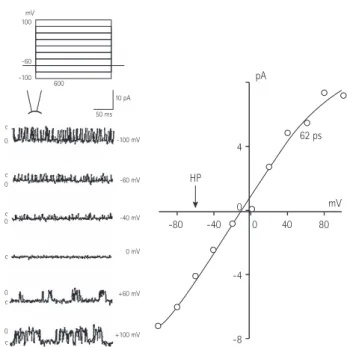
pA
100
-60 -100 600
c 0
c 0
0 c
c 0
mV
HP
mV 62 ps
-80 -40 0 40 80
4
0
-4
-8
50 ms 10 pA
-100 mV
-60 mV
-40 mV
+60 mV
+100 mV 0 mV
c
0 c