• 검색 결과가 없습니다.

흰쥐

N/A
N/A
Protected

Academic year: 2022

Share "흰쥐"

Copied!
9
0
0

로드 중.... (전체 텍스트 보기)

전체 글

(1)

Original Articles Korean Circulation J 2000;;;;30((((9))))::::1156-1164

흰쥐 하대정맥에서 퓨린수용체활성화에 의한 혈관반응

분당제생병원 응급의학과,

1

연세대학교 원주의과대학 생리학교실

2

이부수

1

·정해숙

2

·박규상

2

·공인덕

2

·정성우

2

·이중우

2

Vascular Reactivity by Purinoceptor Activation in Rat Inferior Vena Cava

Boo Soo Lee, MD

1

, Hae Sook Chung, MS

2

, Kyu Sang Park, MD

2

,

In Deok Kong, MD

2

, Seong Woo Jeong, PhD

2

and Joong Woo Lee, PhD

2

1

Department of Emergency Medicine, Pundang Jesaeng Genernal Hospital, Sungnam,

2

Department of Physiology, Yonsei University, Wonju College of Medicine, Wonju, Korea

ABSTRACT

Background: : :Extracellular ATP, released from platelets and nerve endings, plays significant roles in the regula- : tion of circulation. The effects of ATP depend on the location of the vessels and the species of experimental animals.

Until now, studies were limited to arteries, so we compared the effects of ATP in rat vena cava with those in the aorta and attempted to identify the characteristics of their receptors. Methods: : :Vascular rings were isolated from : the rat inferior vena cava and descending thoracic aorta. Endothelial cells were preserved or removed by gentle rubbing. The isometric contractions were recorded on polygraph using a force transducer. Results: : :In the vena : cava ring precontracted by 100 nM norepinephrine (NE), ATP elicited relaxations in a dose-dependent manner.

These effects were abolished by removal of the endothelium or pretreatment with a nitric oxide synthase inhibitor.

Relaxations to ATP in the vena cava (EC

50

:9.9 μM) were less potent than those in the aorta (1.7 μM). The relative order of potencies was ADP>ATP>AMP>adenosine, but the maximal relaxation to ADP was smaller than to ATP. ATP-induced vasorelaxation was blocked by suramin, a nonselective antagonist for P

2

purinoceptor and reactive blue-2, a P

2Y

blocker. At basal tension, ATP contracted the vena cava dose-dependently and these effects were potentiated by endothelium-removal. Contractions in the vena cava were also less potent than in the aorta, and the order of potencies was α, β-MeATP>UTP>ATP>ADP>AMP=adenosine. ATP-induced vasoconstriction was blocked by suramin and α, β-MeATP, a desensitizing antagonist of P

2X

purinoceptor, and potentiated by pretreatment with UTP. Conclusion: : : :These results suggest that ADP and ATP acts on P

2Y1

- and P

2Y2

-purinoceptor in the endothelium, respectively and induces vasorelaxation of the vena cava, which is mediated by nitric oxide. Since ATP and UTP induced vasoconstriction in endothelium-denuded condition, it may be mediated by the activation of the P

2X

and P

2Y4

,

6

purinoceptor on smooth muscles, respectively.

( ((

(Korean Circulation J 2000;30( (( (9) )) ):1156-1164) )) )

KEY WORDS:Adenosine 5’-triphosphate (ATP)·α, β-methylene adenosine 5’-triphosphate (α, β-MeATP)

· Inferior vena cava·Purinoceptor·Vasorelaxation·Vasoconstriction.

서 론

세포외액의 adenine 뉴클레오티드 및 adenosine은

혈소판,

1)2)

신경말단,

3)4)

심근세포

5)

및 혈관내피세포

6)

등으로부터 혈중으로 유리되어 생체내 혈류순환에 중 요한 역할을 담당하고 있다고 알려져 왔다.

7)

이러한 작

논문접수일:2000년 1월 10일

심사완료일:2000년 9월 25일

교신저자:이중우, 220-701 강원도 일산동 162번지 연세대학교 원주의과대학 생리학교실 전화:(0371) 741-0291・전송:(0371) 745-6461 E-mail:[email protected]

(2)

용들은 퓨린수용체를 통해 이루어지며, 이는 크게 ad- enosine의 작용이 우세한 P

1

과 ATP의 작용이 우세 한 P

2

로 나뉘어졌다.

8)

이후 여러 뉴클레오티드들의 효 력 비교 및 선택적 길항제의 봉쇄효과 등을 기준으로 P

1

은 A

1

, A

2

, A

3

로, P

2

는 P

2X1-7

와 P

2Y1-11

로 세분되 었다.

9)10)

일반적으로 ATP를 비롯한 adenine 뉴클레오티드는 혈관 평활근에 존재하는 P

2X

수용체에 작용하여 혈관 수축을, 내피세포에 존재하는 P

2Y

수용체에 작용하여 혈관이완을 일으킨다고 알려져 왔다.

11-13)

이로 인해 ATP는 혈관의 기초장력 및 효현제의 농도에 따라 상 이한 반응을 나타내기도 한다.

14)

하지만 혈관계에 존재 하는 퓨린수용체의 분포 및 특성들은 실험동물의 종 및 혈관부위에 따라 많은 차이가 있다고 보고되고 있으며, 이와 관계된 다양한 작용기전에 대해 아직 명확히 알려 지지 않았다. 예를 들어 P

2Y

에 의한 혈관이완반응의 경 우 대부분 내피세포 의존적으로 나타난다고 알려져 있 으나, 토끼의 장간동맥 및 간동맥 등에서는 내피세포와 무관하게 평활근에 직접 작용하여 나타난다고 보고된 바 있다.

8)15)16)

그리고 내피세포에 작용하였을 때 유리 되는 혈관이완인자에 관해서도 주로 nitric oxide(NO) 인 것으로 알려져 있으나, 일부 조직에서는 prostacy- clin 등이 보다 중요한 역할을 담당한다고 하였다.

17)18)

지금까지의 이러한 연구들은 주로 동맥혈관계를 중심 으로 비교되어 왔으며, 정맥에서의 퓨린수용체 분포 및 작용기전에 관해서는 아직 잘 알려져 있지 않다. 따라 서 본 실험에서는 흰쥐의 하대정맥에서 ATP를 비롯한 adenine 뉴클레오티드 및 adenosine에 의한 혈관반응 을 관찰하여 이를 대동맥에서와 비교하고, 이러한 작용 을 매개하는 퓨린수용체의 분포, 활성화 기전 및 작용 에 관해 규명하고자 하였다.

대상 및 방법

실험 동물

실험동물로는 300 gm 내외의 수컷 흰쥐(Sprague- Dawley rat)를 사용하였다.

실험용액 및 약물

실험용액으로는 Krebs-Ringer bicarbonate(KRB) 용액을 사용하였는데, 이의 조성은 NaCl 117, KCl 4.7,

CaCl

2

1.91, KH

2

PO

4

1.19, MgSO

4

1.44, NaHCO

3

24.8 및 glucose 5.5 mM이며, 95% O

2

-5% CO

2

의 혼합 개스를 주입하여 pH 7.4로 평형을 이루게 하였다. Ad- enosine(AD), adenosine 5’-monophosphate(AMP), adenosine 5’-diphosphate(ADP), adenosine 5’- triphosphate(ATP), α, β-methylene adenosine 5’- triphosphate(α, β-MeATP), uridine 5’-tripho- sphate(UTP), theophylline, reactive blue-2(RB- 2), N-nitro-L-arginine methylester(L-NAME), acetylcholine(ACh) 및 norepinephrine(NE)은 Si- gma 제품(Sigma Chemical Co., St. Louis, MO, USA) 을 사용하였으며, suramin은 RBI 제품(Research Bi- ochemicals International, MA, USA)을 사용하였다.

Adenosine 및 theophylline은 DMSO에 녹였고, 그 외의 모든 시약은 이차 증류수에 녹여 사용하였다. 사 용된 뉴클레오티드들은 1 N NaOH로 pH가 7.0이 되 게 적정한 뒤 사용하기 직전까지 영하 20℃의 냉동고 에 보관하여 활성도를 유지하게 하였다.

대정맥 또는 대동맥 적출 및 장력측정

복강내로 sodium thiopental(50 mg/kg)을 주입하여 마취시킨 다음 대퇴정맥으로 heparin(500 IU/kg)을 투여하였으며, 이어 총장골 정맥 상부에서 간 하부까지 의 하대정맥을 조심스럽게 적출하였다. 또 일부 실험에 서는 흉곽을 열고 하행성 흉부대동맥을 적출하였다. 적 출된 혈관은 해부 현미경 하에서 주위의 지방 및 결체 조직을 제거하였고 혈관 내피세포가 손상되지 않도록 주의하여 길이 5 mm 정도의 환을 만들었다. 내피세포 를 제거할 경우 KRB 용액으로 적셔진 여과지위에 혈 관환을 올려놓고, 혈관강내에 가는 forcep을 넣어 부드 럽게 문질러 내피세포를 제거하였다. 분리된 혈관환의 한쪽 끝은 KRB용액이 들어있는 organ bath 바닥에 L 자형 가는 stainless steel 고리로 고정시키고 다른 한 쪽은 force transducer(Grass FT03C)에 연결하여 등척성 조건하에서 변화하는 혈관의 장력을 polygraph (Grass Model 7E)에 기록하였다. KRB 용액은 37℃

로 유지하고 혼합개스(95% O

2

-5% CO

2

)를 지속적으

로 공급하였다. 정맥혈관환에는 약 0.5 gm, 동맥 혈관

환에는 1 gm의 기초장력을 각각 부하하였고, 60분 정

도 기다려 평형이 되도록 하였다. 그 기간 동안 KRB

용액을 3~4회 바꾸어 주며, Furchgott등의 방법으로

(3)

내피세포의 존재유무를 확인하였다.

19)

즉 100 nM NE 으로 혈관을 수축시켜 평형에 이르게 한 후 가해준 1 M ACh에 의하여 80%이상 이완하면 내피세포가 존재 하는 것(E

)으로, 수축된 혈관이 1 μM ACh에 의하 여 이완반응을 전혀 보이지 않으면 내피세포가 제거된 것(E

-

)으로 간주하였다.

퓨린수용체 활성화에 의한 장력변화 측정

내피세포가 존재하거나 제거된 혈관에서 100 nM의 NE을 전처치하여 수축을 유도시킨 후, ATP, ADP, AMP, AD 등의 여러 뉴클레오티드를 100 nM에서부 터 1 mM이 되도록 점진적으로 가하여 이들에 의한 혈 관장력의 변화를 기록하였다. 이때 이완된 정도는 NE 에 의해 전수축된 장력에 대한 백분율로 나타내었으며, 최대 이완효과의 50%를 이완시키는데 필요로 하는 효 현제의 농도(EC

50

)를 구하여 이를 서로간에 비교하였 다. 또한 기초장력 상태에서도 ATP 등의 수축효과를 관찰하여, 이를 고농도 KCl(40 mM)의 최고 수축 효 과에 대한 백분율로 나타내어 비교하였다. 한편 이러한 작용에 내피세포가 관여하는지 또는 NO가 매개하는지 의 여부를 확인하기 위하여, 혈관 내피세포를 제거하거 나 NO생성 억제제인 L-NAME(1 mM)를 투여한 후 다시 위의 작용을 관찰하여 이를 비교하였다.

퓨린수용체 차단제에 의한 영향

ATP의 이완작용에 대한 차단효과를 관찰하기 위하 여, 먼저 내피세포가 존재하는 혈관을 NE으로 전수축 시킨 뒤 100 μM의 ATP를 투여하여 그 이완의 정도 를 대조군으로 하였다. 이어서 P

1

수용체 차단제인 theophylline(50 μM), P

2

수용체 비선택적 차단제인 suramin(1 mM), P

2X

수용체의 효현제이나 수용체 탈 감작에 의한 차단제 효과도 갖는 α, β-MeATP(100 μM),

20)21)

P

2Y

수용체 차단제인 RB-2(10 μM) 등을 20분전에 미리 처치한 다음 다시 ATP의 반응을 비교

・관찰하여, 이들의 작용을 매개하는 수용체의 특성을 확인하였다. 또 위와 동일한 방법으로 P

2Y2

/P

2Y4

수용체 효현제인 UTP(50 μM)를 전처치 한 후 ATP의 이완 효과를 대조군과 비교하여 수용체 공유에 따른 탈감작 (desensitization)

22)

현상이 나타나는지 확인하였다.

한편 ATP의 수축작용에 대한 차단효과를 관찰하기 위하여 내피세포가 제거된 혈관에 2 mM의 ATP를 투

여하여 수축한 정도를 대조군으로 하고, 위의 여러 차 단제 및 효현제를 전처치 한 후 ATP를 재투여하여 그 수축크기를 대조군과 비교하였다. 모든 차단효과는 차 단된 정도를 대조군의 효과에 대한 백분율로 나타내어 비교하였다.

자료 분석

결과는 평균±표준오차로 표시하며, 차단제의 효과 검 정은 Student의 paired t-test에 의하여 p값이 0.05 미 만일 때를 통계적으로 유의한 차이의 한계로 삼았다.

결 과

정맥 및 동맥에서 ATP에 의한 혈관이완반응

100 nM의 NE를 투여하여 수축된 혈관이 평형상태 에 이르렀을 때 ATP를 점진적으로 가하였으며, 이에 의한 장력변화를 Fig. 1A와 B에 도시하였다. 정맥에서 는 동맥에 비해 100 nM의 NE에 의한 전수축의 크기 가 작았으며, ATP에 의한 이완반응 역시 동맥보다 작 았다. 특히 정맥에서 혈관이완효과의 EC

50

(9.9 μM) 가 동맥(1.7 μM)에 비해 높았으며, 이완의 크기 역시 동맥에서는 30 μM에서 이미 전수축의 100% 가깝게 이완하였으나, 정맥의 경우 300 μM에서도 80% 정도 에 불과하였다(Fig. 1C).

내피세포 제거 및 NO 생성 차단에 의한 영향

내피세포가 보존된 상태에 비해 기계적으로 내피세 포를 제거한 경우 ATP에 의한 혈관이완효과가 현저히 감소하였으나, 30 μM 이상의 고농도에서는 다소 이완 반응이 남아 있었다. 하지만 L-NAME를 투여하여 NO생성을 차단한 경우 이완반응이 완전히 소실되었거 나 오히려 수축시키는 결과를 나타냈다(Fig. 2).

Adenine 뉴클레오티드 및 adenosine에 의한 혈관이완 반응

NE으로 전수축시킨 정맥에서 ATP, ADP, AMP 및

adenosine을 30 nM에서부터 1 mM까지 점진적으로

가하여 이에 의한 혈관이완효과를 비교하였다. 이중

ADP(EC

50

;0.52 μM)는 다른 뉴클레오티드들에 비

해 매우 낮은 농도에서 혈관이완효과를 나타내었으나,

최대 이완 크기는 ATP에 비해 작았다. AMP(153 M)

(4)

및 adenosine(309 μM)은 혈관이완효과를 나타내 는데 있어서 ATP(9.9 μM)에 비해 보다 높은 농도를 필요로 하였다(Fig. 3). 그러나 UTP의 경우는 처음에 일시적인 혈관이완 후에 바로 다시 수축되는 효과를 나 타내었다(실험결과에 나타내지 않았음).퓨린수용체 차

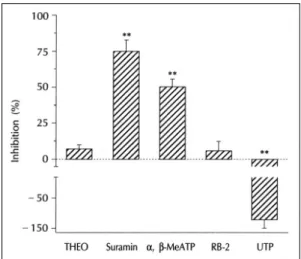
단제들이 ATP에 의한 혈관이완반응에 미치는 영향 ATP에 의한 혈관이완작용에 관여하는 수용체의 특성 을 규명하기 위하여, 여러 퓨린수용체 차단제 및 효현 제들의 전처치에 따른 영향을 확인하였다. 먼저 P

1

Fig. 1. Comparison of ATP-induced vasorelaxation in NE-precontracted rat inferior vena cava and aorta.

Following precontraction with NE (100 nM), vasorela- xation was induced by cumulative application of ATP (0.1 μM-100 μM) in inferior vena cava (a) and aorta (b) with intact endothelium. (c) Concentration-resp- onse curves represent relaxation (%) from NE-induced contraction. Data are presented as mean±SEM from six experiments.

Fig. 2. Effects of ATP on NE-precontracted rat inferior vena cava with or without endothelium in presence of L-NAME. Following precontraction with NE (100 nM), vasorelaxation was induced by cumulative application of ATP (0.1 μM-100 μM). Concentration-response cu- rves represent relaxation (%) from NE-induced contra- ction. Data are presented as mean±SEM from eight experiments.

Fig. 3. Effects of adenine nucleotides and adenosine

on NE-precontracted rat inferior vena cava with intact

endothelium. Following precontraction with NE (100

nM), vasorelaxation was induced by cumulative ap-

plication of either adenine nucleotides or adenosine

(0.03 μM-1000 μM. Concentration-response curves re-

present relaxation (%) in NE-induced contraction. Data

are presented as mean±SEM from six experiments.

(5)

용체 차단제인 theophylline(50 μM)은 ATP에 의한 혈관이완효과에 크게 영향을 미치지 못한 반면(2.8±

1.9%), P

2

수용체 비선택적 차단제인 suramin(1 mM)은 이를 현저히 억제시켰다(80.0±2.0%). 그리고 P

2Y2

/P

2Y4

수용체 효현제인 UTP(50 μM) 및 P

2Y

수용 체 차단제인 RB-2(10 μM)는 각각 69.6±8.0%

및 18.0±3.0%를 억제시켰다. 하지만 P

2X

수용체의 효 현제이나 수용체 탈감작에 의한 차단제 효과도 갖는 α, β-MeATP(100 μM)에 의해서는 크게 영향을 받지 않았다(-2.9±9.2%)(Fig. 4).

정맥 및 동맥에서 ATP에 의한 혈관수축반응

평형을 이룬 기초장력 상태의 혈관에 ATP를 10 μ M에서 3 mM까지 점진적으로 가하여, 이에 의한 혈관 장력의 변화를 Fig. 5의 A와 B에 나타내었다. 정맥에 서의 반응은 동맥에 비해 보다 높은 농도에서 작용을 나타내기 시작하였으며, 최대 수축정도도 동맥에 비해 작았다(Fig. 5). ATP에 의한 혈관수축효과는 내피세포 제거에 의해 항진되었으며, 특히 내피세포가 존재하는 상태에서 NO생성을 차단하였을 때가 내피세포를 제거 한 경우보다 수축효과가 크게 나타났다(Fig. 6).

여러 뉴클레오티드 및 adenosine에 의한 정맥 수축반응 기초장력 상태의 정맥에 α, β-MeATP, UTP, ATP, ADP, AMP 및 adenosine을 10 μM에서부터 3 mM 까지 점진적으로 가하여 이에 의한 혈관 수축효과를 비 교하였다. 그 중 α, β-MeATP이 가장 큰 수축효과를 보였으며 다음으로 UTP, ATP, ADP 순이었고, AMP 및 adenosine은 거의 영향을 미치지 못했다(Fig. 7).

퓨린수용체 차단제들이 ATP에 의한 정맥수축반응에 미치는 영향 ATP의 혈관 수축작용에 대한 여러 퓨린

Fig. 4. Effects of purinergic agonists and antagonists on ATP-induced relaxations in NE-precontracted rat inferior vena cava with intact endothelium. Following pretreatment with theophylline (THEO, 50 μM), sura- min (1 mM), RB-2 (10 μM), α, β-MeATP (100 μM) or UTP (50 μM) for 20 min, ATP (100 μM)-induced rela- xation (%) was acquired in NE (100 nM)-precontracted preparation. The value below zero indicates more co- ntraction than control. Data are presented as mean

±SEM from six experiments and denotes p<0.01.

Fig. 5. Comparison of ATP-induced vasocontraction in

rat inferior vena cava and aorta as basal tension. Va-

socontraction was induced by cumulative application

of ATP (10 μM-3 mM) in inferior vena cava (a) and

aorta (b) with intact endothelium. (c) Cumulative co-

ncentration-response curves represent changes in va-

scular tension. Data are presented as mean±SEM from

five experiments.

(6)

수용체 차단제 및 효현제들의 영향을 확인하였는데, the- ophylline (50 μM)은 큰 영향을 미치지 못한 반면(5.4±

2.9%), suramin(1 mM;74.1±7.4%) 및 α, β-Me-

ATP (100 μM;48.7±3.1%)는 이를 현저히 억제시켰 다. 한편 RB-2(10 μM)는 ATP의 작용에 의의 있는 영 향을 미치지 못하였으며(9.3±7.5%), UTP의 경우 오히려 이를 현저히 증가시켰다(-127.7±25.5%) (Fig. 8).

고 안

교감신경 자극시 ATP는 norepinephrine(NE)과 함 께 유리되어 혈관장력을 조절한다는 사실은 이미 여러 차례 보고된 바 있다.

23-25)

또 혈소판 등에 존재하는 vesicle에는 ATP가 600 mM이상의 고농도로 존재하고 있으므로, 이들이 자극에 의해 세포외로 유리될 경우 인 접부위는 생리적 작용을 나타내기에 충분한 농도에 이를 것이라 하였다.

13)26)

그러나 ATP가 혈관계에 미치는 작 용은 조직마다의 다양성, 복잡한 수용체 분류 등으로 인 해 쉽게 이해되어지지 못하고 있다. 특히 ATP는 혈관의 수축 및 이완효과를 모두 가지고 있으므로, 경우에 따라 상반된 작용을 나타내기도 한다.

14)27)28)

본 실험에서도 ATP는 부하된 장력상태에 따라 혈관 이완효과와 수축효과를 모두 나타내었다. 혈관이완효과 는 내피세포 제거시 크게 감소된 점으로 보아 작용부위 Fig. 6. Comparison of ATP-induced contraction in rat

inferior vena cava with or without endothelium in pre- sence of L-NAME. ATP (300 μM-2 mM) was added cumulatively in inferior vena cava. Contraction (%) was normalized to the maximal tension developed by high KCl (40 mM). Data are presented as mean±SEM from five experiments.

Fig. 7. Effects of adenine nucleotides and adenosine on basal tension of rat inferior vena cava. Contraction was induced by a cumulatative application of differ- ent purinergic receptor agonists (α, β-MeATP, UTP, adenine nucleotides and adenosine (10 μM-3 mM)) from endotheliumdenuded preparation. Contraction (%) was normalized to the maximal tension developed by high KCl (40 mM). Data are presented as mean±

SEM from six experiments.

Fig. 8. Effects of purinergic agonists and antagonists on ATP-induced contraction in rat inferior vena cava.

Following pretreatment with theophylline (THEO, 50 μ M), suramin (1 mM), RB-2 (10 μM), α, β-MeATP (100 μM) and UTP (50 μM) for 20 min., then ATP (100 μM) was applied to endotheliumdenuded preparation.

Result represents as percentage changes of ATP-ind-

uced contraction. The value below zero indicates a

further contraction than those in the absence of puri-

nergic agonists. Data are presented as mean±SEM

from six experiments and ** denotes p<0.01.

(7)

가 주로 내피세포에 존재할 것이라 말할 수 있다. 내피세 포 의존적 이완효과는 endothelium derived relaxing factor(EDRF)를 매개로 한다고 알려져 있다.

19)

따라서 ATP가 내피세포에 위치한 수용체에 결합하면 내피세포 에서 EDRF를 유리하게 되고, 이 EDRF가 평활근세포에 작용하여 이완효과를 나타내게 된다는 것이다. EDRF의 실체에 관해서는 많은 연구가 있어 왔으며, 주로 nitric oxide(NO)일 것이라 알려져 있으나,

29)30)

NO보다 cyclooxygenase 대사산물인 prostacyclin이 더 중요한 역할을 담당한다는 보고도 적지 않았다.

18)31)

본 실험에 서 prostacyclin의 역할을 확인하지는 못했으나, NO생 성 억제제인 L-NAME를 전처치함에 의해 이완반응이 완전히 소실된 점으로 미루어 볼 때 이러한 작용이 대부 분 NO에 의해 매개되어질 것이라 생각된다.

Adenine 뉴클레오티드 중 ADP는 ATP에 비해 매우 낮은 농도에서부터 작용을 나타내기 시작하였다. 이는 수 용체에 대한 ADP의 친화력이 높음을 의미하며, 동맥에 서 관찰된 기존의 보고와는 상반되는 결과이다.

9)

하지만 ADP의 최대이완효과는 전수축 크기의 60%정도에 불과 하여 ATP뿐 아니라 AMP나 adeno-sine보다도 작았다.

AMP 및 adenosine은 ATP에 비해 보다 높은 농도에 서 작용을 나타내기 시작하였으며, 이들에 의한 이완효 과는 내피세포를 제거한 경우에도 큰 차이를 나타내지 않았다(실험결과에 나타내지 않았음). Adenosine은 주 로 P

1

수용체에 작용하여 내피세포와 무관하게 평활근 을 직접 이완시킨다고 알려져 있으므로,

15)

위의 결과도 이에 잘 부합함을 알 수 있다.

본 실험에서는 여러 수용체 차단제들의 영향을 통해 그 작용을 매개로 하는 수용체를 규명하고자 하였다. 우 선 P

1

수용체 차단제인 theophylline에 의해서는 변화가 없는데 반해 P

2

수용체 비선택적 차단제인 suramin에 의해서 크게 억제되었으므로, ATP의 효과가 P

2

수용체 에 작용함을 확인할 수 있었다. P

2

수용체 중 P

2X

수용 체 효현제이며 수용체 탈감작에 의한 차단효과를 갖는 α, β-methylene adenosine 5’-triphosphate(α, β-MeATP)

20)21)32)

는 큰 영향이 없었으나, P

2Y

수용 체 차단제인 reactive blue-2

33)

에 의해서는 18.0%,

UTP

22)34)

에 의해서는 69.6%가 억제되었다. 이는 ATP

에 의한 혈관이완효과는 P

2Y

수용체에 작용을 통해 나타 남을 의미한다. 또한 P

2Y

수용체는 내피세포내 IP

3

생 성을 증가시켜 세포질내 Ca

2+

농도를 높인다고 보고된

바 있으며,

35)36)

이로 인해 유리된 NO가 평활근에 작 용하여 이완효과를 나타낸다고 추정할 수 있다. 최근 들어 여러 아형의 P

2Y

수용체들이 분자생물학적인 결 과를 토대로 분류되고 있으며 이에 따른 효현제 감수성 (agonist sensitivity)이 알려지고 있다.

33)

본 실험에서 ATP나 ADP는 강력한 혈관이완효과를 나타내었으나 UTP의 경우는 처음에 일시적인 이완작용을 보인 후 바 로 다시 수축하는 이중적인 효과를 나타냈다(실험결과에 나타내지 않았음). 또한 원래는 P

2Y2

/P

2Y4

수용체 효현제 이지만 P

2Y2

/P

2Y4

수용체 탈감작에 의하여 차단역할을 하는 UTP

22)

를 전처치한 경우 ATP에 의한 이완반응이 현저히 억제되는 것으로 보아 ATP에 의한 이완이 P

2Y2

수용체에 의하여 매개되었을 가능성이 크다. 이러한 결 과에 따르면 ADP에 의한 이완은 P

2Y1

수용체의 존재를, 그리고 ATP에 의한 이완이 UTP전처치에 의하여 억제 된 점은 P

2Y2

수용체의 존재를 각각 나타내므로, 정맥내 피세포에서는 P

2Y1

수용체와 P

2Y2

수용체가 혈관 이완을 매개할 것으로 생각된다. 한편 결과에 따르면 내피세포 를 제거한 뒤에도 높은 농도의 ATP에 의해서 일부 이완 효과가 남아 있었다. 이와 같은 이완효과의 기전은 adenosine과 같은 P

1

수용체를 통한 내피세포 비의존적 이완이라기 보다는, 완전히 제거되지 않고 일부라도 남 아 있던 내피세포에 의해 정맥혈관이완이 일어났을 것이 라 생각된다. 특히 NO synthase inhibitor 전처치한 경 우 이완효과가 없는 것으로 보아 여기에는 내피세포 의 존성 이완이 관여함을 나타낸다.

전수축시키지 않은 기초장력상태의 정맥에서 ATP는 가한 농도에 비례하여 수축효과를 나타내었으나, 그 크 기가 동맥에 비해 작았다. 이는 혈관벽을 구성하는 평 활근의 함량이 동맥에 비해 작기 때문일 것이다.

37)

특 히 ATP에 의한 수축효과는 내피세포 제거시 혹은 NO 생성 억제제를 투여한 경우 오히려 항진되었다. 내피세 포에서 유리된 NO의 이완효과가 사라짐으로 인해 일 부 상쇄되어 있던 수축효과가 강화되었기 때문이라 추 측되어진다. 일단 수축작용이 내피세포 제거에 의해 감 소하지 않은 점으로 보아 작용부위가 최소한 내피세포 는 아니라고 말할 수 있겠다. 정맥의 수축반응에서 여 러 뉴클레오티드 및 adenosine의 수축효과를 비교해 본 결과 α, β-MeATP>UTP>ATP>ADP>AMP=

adenosine 순으로 나타났으며, 이는 기존의 특정 P

2

수용체 효력비교 결과와 일치한다.

38)

ATP의 수축반응

(8)

을 매개하는 수용체를 확인하기 위하여, 여러 수용체 차 단제의 영향을 관찰한 결과, 이완효과에서와 동일하게 theophylline은 큰 영향을 미치지 못하였고 주로 내피세 포에 존재하는P

2Y1

혹은 P

2Y1

유사수용체를 봉쇄하는 RB-2

33)

역시 억제효과를 나타내지 못하였다. 이에 반 해 비특이적 P

2

수용체 차단제인 suramin에 의해서는 현저히 억제되었으며 P

2X

효현제이나 수용체 탈감작에 의한 차단제 효과도 갖는 α, β-MeATP

20)21)

에 의해 서도 수축효과가 억제되었다. 그러나 ATP에 의한 수축 효과는 α, β-MeATP에 의해 완전히 억제되지는 않았 으며 UTP를 전처치한 경우 ATP의 수축효과가 오히려 크게 항진되었다. 이와 같이 정맥평활근에서 P

2

효현제 와 차단제의 효과를 비교해 본 결과 ATP에 의한 수축효 과는 주로 P

2X

수용체를 매개하여 나타나며, UTP에 의 한 작용은 그 수축반응이 ATP보다 더 크게 나타나는 것 으로 보아 P

2Y2

수용체보다는 uridine 뉴클레오티드에 특 이성을 갖는 수용체인 P

2Y4

나 P

2Y6

수용체를 통하여 나 타나는 것으로 추측된다. 또한 UTP에 의한 ATP수축반 응의 증가가 각각의 수용체 수준에서 나타나는지 혹은 수용체 활성화 후 세포내 신호전달과정에서의 변화인지 알 수 없었으며 그 구체적 과정에 대해서는 앞으로 연구 해 볼 가치가 있는 것으로 생각된다.

ATP는 출혈에 의한 또는 패혈성 shock의 실험모델 에서 생존률을 증가시키고, 생체의 기관부전의 회복을 촉진시키는 것으로 보고되었다.

39)

또 심실상성 부정맥 에서는 adenosine과 함께 치료제로 사용되고 있다.

40)

특히 ATP는 체내에 존재하는 내인성 물질이므로 작용 후 분해되어 생체내 독성을 남기지 않는 장점을 가지고 있다. 따라서 혈관계에서 ATP의 작용을 폭 넓게 확인 하여 그 기전을 규명할 경우 임상적 활용의 폭을 넓히 는데 기여할 수 있을 것으로 사료된다.

요 약

연구목적:

세포외액의 adenosine 5’-triphosphate(ATP)는 혈 소판, 신경말단 등으로부터 유리되어 생체내 혈류순환에 중요한 역할을 담당하고 있다고 알려져 왔다. 이러한 ATP의 작용은 혈관부위 및 실험동물의 종에 따라 차이가 있으나, 지금까지의 연구는 주로 동맥혈관을 중심을 이루 어졌다. 따라서 본 실험에서는 흰쥐 대정맥에서 ATP의

혈관이완 및 수축반응을 관찰한 뒤 동맥에서의 반응과 비교 하며, 이를 매개로 하는 수용체의 특성을 규명하고자 하였다.

방 법:

흰쥐 하대정맥 및 흉부대동맥을 적출한 뒤 내피세포 가 손상되지 않도록 주의하여 혈관환을 만들었으며, 일 부는 내피세포를 제거하였다. 등척성 조건하에서 변화하 는 혈관환의 장력을 force transducer로 측정하여 po- lygraph에 기록하였다.

결 과:

100 nM의 norepinephrine(NE)으로 전수축시킨 정 맥에서 ATP는 농도의존적인 이완반응을 나타내었으며, 이러한 효과는 내피세포 제거시 혹은 nitric oxide(NO) 생성 차단시 현저히 감소되었다. 정맥(EC

50

;9.9 μM) 에서의 혈관이완효과는 동맥(1.7 μM)에서 보다 작았다.

이완작용은 ADP>ATP>AMP>adenosine 순으로 나타 났으나, ADP는 최대이완정도가 ATP에 비해 작았다.

ATP의 혈관이완효과는 P

2

수용체 비선택적 차단제인 suramin와 reactive blue-2에 의해 의의 있게 억제되 었다. 기초장력상태의 정맥에서 ATP는 가한 농도에 비 례하는 수축현상을 보였으며, 이러한 효과는 내피세포 제거시 혹은 NO 생성 차단시 보다 증가되었다. 수축작 용은 동맥에 비해 정맥에서의 효과가 작았으며, α, β- MeATP>UTP>ATP>ADP>AMP>adenosine 순으로 나 타났다. ATP의 수축효과는 suramin 및 P

2X

수용체 탈 감작에 의한 차단효과를 갖는 α, β-MeATP에 의해 억제되었으나, UTP에 의해서는 오히려 항진되었다.

결 론:

위의 실험결과로 볼 때, 하대정맥에서 ADP와 ATP 는 내피세포에 존재하는 P

2Y1

과 P

2Y2

수용체에 각각 작 용하여 NO를 유리케 함으로써 혈관을 이완시키고, 내 피세포가 제거된 혈관평활근에서 ATP와 UTP는 P

2X

와 P

2Y4,6

수용체에 각각 작용하여 수축작용을 나타낼

것으로 사료된다.

중심 단어 :Adenosine 5’-triphosphate (ATP)・α, β-methylene adenosine 5’-triphosphate (α, β- MeATP)・하대정맥・퓨린수용체・혈관이완반응・혈 관수축반응.

REFERENCES

1)

Goetz U, Da Prada M, Pletscher A. Adenine-, guanine-

and uridine 5’-Phosphonucleotides in blood platelets and

(9)

storage organelles of various species. J Pharmacol Exp Ther 1971;178:210-5.

2)

Detwiler TC, Feinman RD. Kinetics of the thrombin-ind-

uced release of adenosine triphosphate by platelets com- parison with release of calcium. Biochemistry 1973;12:

2462-8.

3)

Su C. Purinergic neurotransmission and neuromodulation.

Pharmacol Rev 1983;23:397-411.

4)

Corr L, Burnstock G. Vasodilator response of coronary

smooth muscle to the sympathetic cotransmitters noradr- enaline and adenosine 5’-triphosphate. Br J Pharmacol 1991;104:337-42.

5)

Forrester T, Williams CA. Release of adenosine triphos-

phate from isolated heart cells in response to hypoxia. J Physiol (Lond) 1977;268:371-90.

6)

Pearson JD, Gordon JL. Vascular endothelial and smooth

muscle cells in culture selectively release adenine nucleo- tides. Nature 1979;281:384-6.

7)

Olsson RA, Pearson JD. Cardiovascular purinoceptors.

Physiol Rev 1990;70:761-845.

8)

Burnstock G, Warland JJI. P2

-purinoceptors of two sub- types in the rabbit mesenteric artery: reactive blue-2 sel- ectively inhibits responses mediated via the P

2Y

- but not the P

2X

-purinoceptor. Br J Pharmacol 1987;90:383-91.

9)

Kunapuli SP, Daniel JL. P2

receptor subtypes in the car- diovascular system. Biochem J 1998;336:513-23.

10)

Burnstock G, Overview. Purinergic mechanisms. Ann New

York Acad Sci 1990;603:1-17.

11)

De Mey JG, Vanhoutte PM. Role of the intima in cholin-

ergic and purinergic relaxation of isolated canine femoral arteries. J Physiol (Lond) 1981;316:347-55.

12)

Martin W, Cusack NJ, Carletton JS, Gordon JL. Specifi-

city of P2 purinoceptor that mediates endothelium-depen- dent relaxation of the pig aorta. Eur J Pharmacol 1985;

108:295-9.

13)

Boeynaems JM, Pearson JD. P2-purinoceptors on vascular

endothelial cells: physiological significance and transducti- on mechanisms. Trends Pharmacol Sci 1990;11: 34-7.

14)

Lee JW, Kong ID, Park KS, Jeong SW. Effects of adeno-

sine tetraphosphate (ATPP) on vascular tone in the isolated rat aorta. Yonsei Med J 1995a;36:487-96.

15)

Corr L, Burnstock G. Analysis of P2 -purinoceptor subt-

ypes on the smooth muscle and endothelium of rabbit co- ronary artery. J Cardiovasc Pharmacol 1994;23:709-15.

16)

Brizzolara AL, Burnstock G. Endothelium-dependent and

endothelium-independent vasodilation of the hepatic art- ery of the rabbit. Br J Pharmacol 1991;103:1206-12.

17)

Needham L, Cusack NJ, Pearson JD, Gordon JL. Char-

acteristics of the P

2

purinoceptor that mediates prostacy- clin production by pig aortic endothelial cells. Eur J Ph- armacol 1987;134:199-209.

18)

Carter TD, Hallam TJ, Cusack NJ, Pearson JD. Regulation

of P

2Y

purinoceptor mediated prostacyclin release from human endothelial cells by cytoplasmic calcium concent- ration. Br J Pharmacol 1988;95:1181-90.

19)

Furchgott RF, Zawadzki JV. The obligatory role of endo-

thelial cells in the relaxation of arterial smooth muscle by acetylcholine. Nature 1980;288:373-6.

20)

Lee JW, Kong ID, Park KS, Jeong SW. Effects of adeno-

sine tetraphosphate (ATPP) on vascular tone in the isol- ated rat aorta. Yonsei Med J 1995;36:487-96.

21)

Bultmann R, Klebroff W, Starke K. A contraction-mediating

receptor for UTP, presumably P2Y2, in rat vas deferens. Na- unyn Schmiedebergs Arch Pharmacol 1999;360:196-201.

22)

Sugamoto Y, Hirai K, Tokoro T. P2Y2 receptor elevates

intracellular calcium concentration in rabbit eye suprac- horoid. J Med Dent Sci 1999;46:83-92.

23)

Westfall DP, Sedaa K, Bjur RA. Release of endogenous

ATP from rat caudal artery. Blood Vessels 1987;24:125-7.

24)

Burnstock G. Sympathetic purinergic transmission in

sm-all blood vessels. Trends Pharmacol Sci 1988;9:116-7.

25)

Von Kugelgen I, Starke K. Noradrenaline-ATP cotrans-

mission in the sympathetic nervous system. Trends Pha- rmacol Sci 1991;12:319-24.

26)

Gordon JL. Extracellular ATP: effects, sources and fate.

Biochem J 1986;233:309-19.

27)

Kong ID, Jeong SW, Lee JW. Effects of adenosine tetra-

phosphate on the rat cardiovascular system. The New Medical J 1991;34:53-61.

28)

Ralevic V, Burnstock G. Roles of P2

-purinoceptors in the cardiovascular system. Circulation 1991;84:1-14.

29)

Moncada S, Palmer RMJ, Higgs EA. Nitric oxide: Phys-

iology, pathophysiology, and pharmacology. Pharmacol Rev 1991;43:109-42.

30)

Vials AJ, Burnstock G. Effects of pyrimidines on the guinea-

pig coronary vasculature. Br J Pharmacol 1993;110: 1091-7.

31)

Wilkinson GF, McKechnie K, Dainty IA, Boarder MR.

P2Y purinoceptor and nucleotide receptor-induced relax- ation of precontracted bovine aortic collateral artery rings:

Differential sensitivity to suramin and indomethacin. J Pharmacol Exp Ther 1994a;268:881-7.

32)

Kasakov L, Burnstock G. The use of the slowly degrada-

ble analog, α, β-methylene ATP, to produce desensitiza- tion of the P2 -purinoceptor: effect on non-adrenergic, non- cholinergic response of the guineapig urinary bladder.

Eur J Pharmacol 1983;86:291-4.

33)

Ralevic V, Burnstock G. Receptors for purines and pyri-

midines. Pharmacol rev 1998;50:413-92.

34)

Wilkinson GF, Purkiss JR, Boarder MR. Differential heterol-

ogous and homologous desensitization of two receptors for ATP(P

2Y

purinoceptors and nucleotide receptors) coexisting on endothelial cells. Mol Pharmacol 1994b;45:731-6.

35)

Keppens S, Vandekerckhove A, De Wulf H. Extracellular

ATP and UTP exert similar effects on rat isolated hepato- cytes. J Pharmacol 1992;105:475-9.

36)

Wilkinson GF, Purkiss JR, Boarder MR. The regulation of

aortic endothelial cells by purines and pyrimidines involves coexisting P2Y -purinoceptors and nucleotide receptors lin- ked to phospholipase C. Br J Pharmacol 1993;108:689-3.

37)

Berne RM, Levy MN. Physiology, the cirtuitry. 3rd ed. St.

Louis, Missouri, Mosby;1993, p.361-3.

38)

Houston DA, Burnstock G, Vanhoutte PM. Different P2

-purinergic receptor subtypes of endothelium and smooth muscle in canine blood vessels. J Pharmacol Exp Ther 1987;241:501-6.

39)

Chaudry IH. Cellular mechanism in shock and ischemia

and their correction. Am J Physiol 1983;245:R117-34.

40)

Belhassen B, Glick A, Laniado S. Comparative clinical

and electrophysiologic effects of adenosine triphosphate

and verapamil on paroxysmal reciprocating junctional

tachycardia. Circulation 1988;77:795-805.

수치

Fig. 1. Comparison of ATP-induced vasorelaxation in NE-precontracted rat inferior vena cava and aorta.
Fig. 4. Effects of purinergic agonists and antagonists on ATP-induced relaxations in NE-precontracted rat inferior vena cava with intact endothelium
Fig. 8. Effects of purinergic agonists and antagonists  on ATP-induced contraction in rat inferior vena cava

참조

관련 문서

The index is calculated with the latest 5-year auction data of 400 selected Classic, Modern, and Contemporary Chinese painting artists from major auction houses..

1 John Owen, Justification by Faith Alone, in The Works of John Owen, ed. John Bolt, trans. Scott Clark, &#34;Do This and Live: Christ's Active Obedience as the

By plotting a series of the free energy-composition curves at different temperatures we established the manner in which the phase compositions changes with temperature. In

CMP characteristics such as the removal rate and WIWNU% were improved by the increase of CMP pressure; however, the electrical properties

ƒ Monosaccharide may be present in the form of Monosaccharide may be present in the form of a linear or ring structure. ƒ In solution it is in the form of

Number employed Month and

– Thermal effects: arises from temperature change – Misfits: results from imperfections in construction – Misfits: results from imperfections in construction – Prestrains:

– Thermal effects: arises from temperature change – Misfits: results from imperfections in construction – Misfits: results from imperfections in construction – Prestrains: